Best Knife Sharpening Steels: 8 Rods for Sharp Kitchen Knives
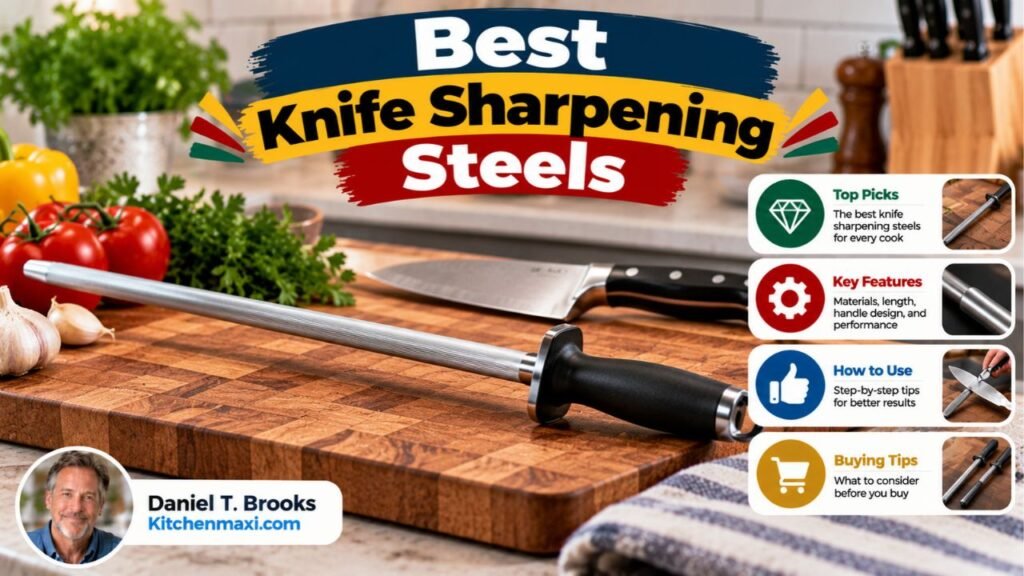
A good sharpening steel should match the hardness and style of the knife you already own. Traditional steel rods are excellent for maintaining many Western kitchen knives, ceramic rods suit harder blades and provide mild abrasion, while diamond-coated rods remove more metal and can refresh an edge that needs more than simple realignment.
The first thing to clear up is terminology. A traditional honing steel does not rebuild a genuinely dull cutting edge. It mainly straightens microscopic edge deformation. Ceramic and diamond rods are abrasive, so they can remove some metal while maintaining the edge.
Rod material therefore matters more than brand prestige. A fine steel can be a great partner for a German chef’s knife, while a fine ceramic rod may make more sense for a harder Japanese blade. Diamond is better reserved for an edge that needs a faster touch-up rather than frequent routine honing.
Length matters too. A 10-inch rod is a practical size for the common 8-inch chef’s knife. A 12-inch rod gives extra stroke room for longer slicing knives, butcher knives, and 10-inch chef’s knives.
For the best knife sharpening steels, my strongest all-around traditional steel pick is the Victorinox Classic 10-inch rod, while the Idahone 12-inch Fine Ceramic Rod is the more flexible choice if your knife collection mixes harder Japanese and Western blades. A diamond rod such as the ZWILLING 12-inch model serves a different purpose because it actually abrades the edge.
Knife manufacturers also disagree on how hard a blade a traditional steel should maintain. Victorinox currently rates its 25 cm medium-fine honing steel for knives up to 65 HRC, while ZWILLING’s current instructions place its chrome-plated steels up to 60 HRC and recommend ceramic or diamond for harder blades. That makes the exact rod manufacturer’s guidance more useful than a universal hardness rule.
The eight picks below cover traditional honing, hard Japanese-style edges, diamond touch-ups, butcher use, long blades, and users who want angle guidance.
Best Knife Sharpening Steels at a Glance
| Sharpening Steel or Rod | Best For | Rod Type | Length |
| Victorinox Classic Honing Steel | Best overall traditional steel | Medium-fine steel | 10 in. / 25 cm |
| Idahone Fine Ceramic Rod | Best overall ceramic | Fine ceramic | 12 in. |
| WÜSTHOF 10″ Honing Steel | Best for German knives | Steel | 10 in. |
| ZWILLING Diamond Sharpening Steel | Best diamond rod | Diamond-coated steel | 12 in. |
| Shun Classic Combination Honing Steel | Best for Shun knives | Smooth + micro-ribbed steel | 9 in. |
| MAC Black Ceramic Honing Rod | Best premium Japanese-knife rod | Ceramic | 10.5 in. |
| F. Dick Dickoron Sapphire Cut | Best for butcher and heavy prep use | Sapphire-cut steel | 12 in. |
| Messermeister 1200 Grit Ceramic Rod | Best long fine ceramic | 1200-grit ceramic | 12 in. |
The table shows why there is no single rod that is ideal for every knife. Steel, ceramic, and diamond surfaces perform different edge-maintenance jobs.
Sharpening Steel vs Honing Steel: What Do You Actually Need?
The phrase “sharpening steel” is commonly used for several rod types, but they do not all treat an edge the same way.
Traditional Steel Rods Realign the Edge
A standard steel rod is mainly a honing tool.
As a knife is used, a thin cutting edge can bend slightly away from its original alignment. Drawing the blade over a suitable steel helps straighten that edge.
Victorinox describes sharpening and honing as separate processes: honing realigns an edge, while sharpening creates a new edge.
Traditional steel works especially well for many Western kitchen knives that respond readily to edge realignment.
Ceramic Rods Hone and Lightly Abrade
Ceramic is harder and abrasive.
A fine ceramic rod can:
- Straighten light edge deformation
- Remove a small amount of metal
- Refresh cutting bite
- Polish an already sharp edge
Idahone’s 12-inch fine ceramic rod is listed at about 1200 ANSI grit, while Messermeister publishes a 1200-grit ceramic abrasive for its 12-inch rod.
Ceramic is a strong option for harder knife steels, but the rod itself is more fragile than steel.
Diamond Rods Remove More Metal
A diamond sharpening steel is more abrasive than a conventional steel rod.
ZWILLING says its diamond steel uses fine diamond material on the rod and is intended to sharpen rather than simply realign. The company also warns that the diamond layer gradually wears and recommends lighter pressure to slow that wear.
Use diamond for:
- An edge that has lost more bite
- Fast maintenance between full sharpening sessions
- Knives that need mild material removal
It is not my first choice for routine honing before every cooking session.
Key Takeaway: Traditional steel mainly realigns, ceramic realigns while lightly abrading, and diamond removes more material. Choose the rod based on the edge problem you need to correct.
8 Best Knife Sharpening Steels Reviewed
1. Victorinox Classic 10-Inch Honing Steel — Best Overall Steel
The Victorinox Classic 7.8303 is my top traditional-steel choice because its specifications are unusually clear.
Victorinox gives it a 25 cm rod, a chrome-plated low-wear surface, and a medium-fine cut. The brand states that it is suitable for straightening knife edges up to 65 HRC. The complete tool weighs 276 grams and uses a synthetic handle.
That 10-inch working length is a good match for:
- 6- to 8-inch chef’s knives
- Santoku knives
- Utility knives
- Boning knives
- Many common Western kitchen knives
The handle includes a guard area that keeps the hand separated from the rod.
I also like that Victorinox clearly treats this as a honing tool rather than suggesting it can repair every dull blade. If a knife has lost its bevel or has chips, move to a stone or true sharpening system.
The main drawback is that a steel rod will not provide the same abrasive touch-up as ceramic or diamond.
Best for: Home cooks who want a dependable traditional steel for regular knife maintenance.
2. Idahone 12-Inch Fine Ceramic Rod — Best Ceramic Pick
The Idahone Fine Ceramic Rod is a strong choice if you want one rod for harder blades or a mixed knife collection.
The current R-12B specification uses high-alumina ceramic with an approximate 1200 ANSI grit, a 12-inch rod, a 1/2-inch diameter, and a hard rock maple handle. It is made in the United States.
The ceramic surface removes a small amount of steel, so it does more than a plain honing steel.
Its 12-inch length is useful for:
- Gyutos
- 8- to 10-inch chef’s knives
- Long slicing knives
- Carbon-steel knives
- Hard stainless blades
The New York Times’ Wirecutter Show also included the 12-inch Idahone Fine Ceramic Sharpening Rod among its recommended knife-maintenance tools in 2026.
The main weakness is physical fragility. Drop a ceramic rod onto tile or stone and it can chip or break.
Best for: Cooks with Japanese knives, mixed knife collections, or anyone wanting mild abrasion from a maintenance rod.
3. WÜSTHOF 10-Inch Honing Steel — Best for German Knives
WÜSTHOF’s 10-inch honing steel is a straightforward match for Western kitchen knives, especially WÜSTHOF’s own German blades.
The current product is made in Germany and uses a 10-inch steel rod. WÜSTHOF recommends regular use to maintain a sharp edge and specifically tells owners to move to a diamond or ceramic steel when a knife has become especially blunt.
That distinction is useful.
This rod is suited to keeping an already functional edge aligned. It is not the tool I would choose to rescue a chef’s knife that has not been sharpened for years.
The 10-inch length gives enough room for most home-kitchen knives without making the rod difficult to store.
WÜSTHOF also recommends wiping it with a damp cloth and drying it immediately rather than soaking or machine washing it.
Best for: WÜSTHOF owners and cooks using conventional German or Western chef’s knives.
4. ZWILLING 12-Inch Diamond Sharpening Steel — Best Diamond Rod
The ZWILLING 12-inch Diamond Sharpening Steel belongs in this list because it addresses an edge that needs more than realignment.
The current model measures about 12 inches and is made in Germany. Its core is stainless steel with a diamond sharpening surface.
ZWILLING explains that diamond sharpening steels are coated with fine diamond material and actively sharpen flat-ground knives. It also recommends using light pressure because the abrasive coating wears over time.
That makes this a good fit for someone who wants:
- Faster edge restoration
- Light sharpening without pulling out a stone
- A long rod for bigger kitchen knives
- More bite than a traditional steel
Use it less aggressively than a conventional honing steel. Every pass removes some material.
A knife with a damaged bevel, large chip, or badly rounded edge still needs proper sharpening.
Best for: Cooks who want a rod that provides real abrasive sharpening rather than edge alignment alone.
5. Shun Classic 9-Inch Combination Honing Steel — Best for Shun Knives
The Shun Classic Combination Honing Steel is purpose-built around Shun’s knife geometry.
Its 9-inch stainless steel rod provides two surfaces:
- Smooth for lighter routine honing
- Micro-ribbed for a stronger maintenance pass
The standout feature is the built-in 16-degree angle guide on the handle. Shun uses that guide to help owners maintain the angle intended for its knives.
This makes the rod easier to recommend to someone who worries about freehand angle control.
The 9-inch length is slightly shorter than many other rods here, so users with 10- or 12-inch slicing knives may prefer a longer option.
For an 8-inch Shun chef’s knife or santoku, the length makes sense.
Shun says its harder knife steel generally needs honing less often than many softer European knives.
Best for: Shun knife owners who want the matching 16-degree guide and two honing surfaces.
6. MAC 10.5-Inch Black Ceramic Honing Rod — Best Premium Ceramic Rod
MAC’s black ceramic rod is one of the more interesting choices for hard Japanese-made Western-style knives.
The SRB-104 provides about 10.5 inches of working ceramic surface. Two sides are grooved for a stronger honing action, while two smooth sides are around 2000 grit for finer polishing. It also uses a steel core with cushioning material and a rubberized tip for stability when the rod is held vertically against a cutting board.
That gives you more control than a one-surface ceramic rod.
Use the grooved face when the edge needs more bite, then move to the smooth face for a lighter finish.
The 10.5-inch length also strikes a good balance between storage and stroke room.
The downside is the same as any ceramic system: the surface can load with fine metal residue and needs cleaning, and ceramic should still be protected from hard impacts.
Best for: Hard Japanese-style chef’s knives and users who want both stronger and finer ceramic surfaces.
7. F. Dick Dickoron Sapphire Cut 12-Inch Steel — Best for Butchers
F. Dick has a long presence in professional meat-cutting environments, and the 12-inch round Dickoron Sapphire Cut is designed around frequent knife maintenance.
The current catalog identifies model 7598130 as a 12-inch round Sapphire Cut Dickoron steel. A 14-inch version and oval Sapphire Cut models are also available.
F. Dick literature describes the Sapphire Cut surface as a fine-feeling sharpening surface intended to extend the working edge without leaving it excessively rough.
The 12-inch rod gives plenty of room for:
- Butcher knives
- Breaking knives
- Long chef’s knives
- Slicers
- Commercial prep knives
A professional user making repeated cuts throughout the day will get more from this style of steel than someone who uses one 8-inch chef’s knife a few nights per week.
Best for: Butchers, meat cutters, and cooks who maintain long Western-style blades frequently.
8. Messermeister 12-Inch 1200 Grit Ceramic Rod — Best Fine Long Ceramic
The Messermeister CR-12F combines a long rod with a clearly published abrasive grade.
Its specifications include:
- 12-inch ceramic rod
- 1200-grit surface
- Break-resistant solid core
- Rubberized TPE handle
- Hanging ring
Messermeister describes it as a fine ceramic rod for honing and polishing edge maintenance.
The 12-inch length gives a comfortable full stroke with longer chef’s knives and slicing knives.
I would choose it over a traditional steel if the knife collection contains several hard blades that respond better to ceramic. It is also a useful single rod in a kitchen with both European and Japanese-style knives, provided pressure stays light.
Stock has varied among U.S. retailers, so availability can be less predictable than Victorinox or WÜSTHOF. Messermeister’s own current product page still lists the CR-12F.
Best for: Users who want a long, fine ceramic rod with a published 1200-grit surface.
Key Takeaway: Victorinox is my traditional-steel pick, Idahone is the ceramic pick for broad knife compatibility, ZWILLING is the choice when mild material removal is the goal, and the other rods fit more specific knife styles and work patterns.
How to Choose a Knife Sharpening Steel
Match the Rod Material to the Knife
For many Western stainless knives, start with a fine traditional steel.
For harder Japanese-style knives, check the knife maker’s instructions. Ceramic is often a safer general maintenance choice when the blade needs a harder, mildly abrasive surface.
Shun is a useful exception to simplistic rules: it sells its own steel combination rod specifically for its harder knives and includes the correct 16-degree guide.
For an edge that needs actual material removal, choose diamond or move to a sharpening stone.
Choose a Rod at Least as Long as the Main Knife
A rod should give you enough working length to move the blade from heel to tip in one controlled stroke.
For most kitchens:
- 8–9 inches: compact knives and common 8-inch blades
- 10 inches: strong general-purpose size
- 12 inches: long chef’s knives, slicers, and butcher knives
A longer rod is easier to use with long blades but takes more storage space.
Fine Surfaces Are Better for Frequent Maintenance
A coarse rod removes or disturbs more material.
For regular maintenance, a fine steel or fine ceramic surface gives more control.
Choose aggressive diamond or coarse surfaces only when the edge condition calls for them.
Look for a Strong Hand Guard and Secure Grip
The rod and knife move close to your hand.
A clear guard between the rod and handle is worth having.
Rubberized handles provide grip with damp hands, while shaped synthetic or wood handles may feel more natural to some cooks.
Consider Round vs Oval Rods
Round rods create a smaller contact area between the knife and steel.
Oval rods create a wider contact surface.
Professional steels are available in both designs. Neither shape automatically produces a sharper knife; angle, rod surface, knife hardness, and pressure matter more.
Key Takeaway: Match material first, then choose enough rod length for your longest everyday knife, a fine surface for routine care, and a handle that keeps your hand securely behind the guard.
How to Use a Knife Sharpening Steel Safely
Find the Knife’s Edge Angle
Use the angle recommended by the knife maker.
ZWILLING currently recommends approximately 15 degrees for many of its knives and about 9–12 degrees for its Santoku, MIYABI, and Kramer lines. Shun builds a 16-degree guide into its Classic rod.
Do not assume every knife uses 20 degrees.
Use the Vertical Method for More Control
A beginner-friendly method is to place the rod tip on a stable cutting board.
Hold the handle upright.
Set the knife heel against the upper part of the rod at the correct angle, then move the blade down and toward yourself so the contact travels from heel to tip.
Repeat on the opposite side.
This setup removes much of the fast midair motion seen in restaurant demonstrations.
Keep the Pressure Light
Heavy pressure is not needed.
It is especially undesirable with ceramic and diamond rods.
Use controlled strokes and let the rod surface do the work.
ZWILLING specifically recommends lighter pressure as the honing sequence progresses and warns that heavy pressure shortens the life of diamond coatings.
Use Only a Few Strokes
Start with roughly three to six alternating strokes per side.
Test the knife.
If a traditional steel produces no improvement after repeated attempts, the knife may need real sharpening rather than more honing.
Key Takeaway: Match the knife’s intended angle, stabilize the rod vertically if needed, use light pressure, and stop after a few controlled passes instead of grinding repeatedly.
When a Sharpening Steel Is Not Enough
A rod is primarily a maintenance tool.
Move to a sharpening stone or another true sharpener if the knife has:
- A visibly chipped edge
- A rounded bevel
- No improvement after honing
- Trouble cutting paper or tomato skin after maintenance
- Gone a long time without sharpening
WÜSTHOF tells users to move from its normal honing steel to diamond or ceramic when a blade becomes especially blunt. ZWILLING says a heavily worn edge that cannot be restored with a steel needs to be reground.
Think of honing as maintenance between sharpening sessions, not a replacement for sharpening forever.
How to Clean and Maintain Knife Sharpening Steels
Cleaning Traditional Steel Rods
Wipe steel rods with a damp cloth and dry them promptly.
WÜSTHOF gives exactly this care method for its honing steels.
Avoid putting a rod away while damp.
Victorinox lists its Classic steel as not dishwasher-safe.
Cleaning Ceramic Sharpening Rods
Ceramic develops dark streaks as tiny particles of knife steel collect on the abrasive surface.
Clean it periodically so the surface continues to contact the blade properly.
Use the cleaning method specified by the rod maker and keep ceramic away from falls onto tile, granite, or concrete.
Caring for Diamond Steels
Diamond coatings wear during use.
Keep pressure light, clean the rod according to its instructions, and do not treat it like an ordinary grooved steel.
ZWILLING specifically notes that diamond material wears over time and recommends reduced pressure.
Key Takeaway: Keep steel rods dry, remove loaded metal residue from ceramic, and use light pressure on diamond coatings to reduce premature wear.
Conclusion
The best knife sharpening steels are not all traditional steel. The right choice may be a fine steel, ceramic rod, combination hone, or diamond-coated sharpener based on the knife hardness and the condition of its edge.
For ordinary Western kitchen knives, I would start with the Victorinox Classic 10-inch Honing Steel. For a mixed collection or harder Japanese-style blades, the Idahone 12-inch Fine Ceramic Rod is a strong alternative. Choose the ZWILLING Diamond Steel when actual mild sharpening is more useful than simple edge alignment.
Whichever rod you buy, keep the angle consistent and pressure light. A maintenance rod keeps a good edge working longer, but a knife that is truly dull, damaged, or chipped eventually needs a proper sharpening stone or another sharpening system.
FAQs About Knife Sharpening Steels
What is the best knife sharpening steel for home use?
For traditional honing, the Victorinox Classic 10-inch steel is a strong general-purpose pick. It has a medium-fine chrome-plated surface and Victorinox rates it for knife edges up to 65 HRC. For a knife collection containing harder Japanese blades, a fine ceramic rod such as the Idahone 12-inch model may suit more knives.
Does a sharpening steel actually sharpen a knife?
A traditional steel mainly hones by realigning the cutting edge. Ceramic is mildly abrasive, while diamond-coated rods remove more metal and perform genuine light sharpening. A badly dull knife still needs a stone, guided sharpener, or professional sharpening.
Is ceramic better than steel for honing knives?
Ceramic is a strong choice for harder blades because it provides mild abrasion as well as edge maintenance. Traditional steel is durable and works very well for many Western knives. Check the knife and rod manufacturer’s hardness guidance rather than assuming one material works best for every blade.
What length sharpening steel should I buy?
A 10-inch rod is a good general size for an 8-inch chef’s knife. Choose 12 inches if you frequently use 10-inch chef’s knives, carving knives, butcher knives, or long slicers. The extra length gives more room to move the full blade across the rod in one controlled stroke.
How often should I use a honing steel?
Use it when a previously sharp knife starts losing clean cutting bite but is not genuinely dull. Softer Western edges may benefit from more frequent honing. Harder blades may need less frequent maintenance. Shun, for example, suggests roughly weekly honing for many of its knives based on use.
Can I use a sharpening steel on Japanese knives?
Sometimes, but follow the knife manufacturer’s recommendation. Shun sells a steel combination hone specifically for its knives, while ceramic rods are commonly used for many other hard Japanese-style blades. Aggressive coarse steels and heavy pressure are poor choices for thin, hard edges.
Is a diamond sharpening steel better than ceramic?
It is more aggressive, not automatically better. Diamond removes metal faster and suits an edge that needs a stronger touch-up. Fine ceramic removes less material and is better suited to frequent edge maintenance. If the knife only needs realignment, a traditional steel may remove no meaningful metal at all.
Can a honing steel fix a completely dull knife?
No. If the edge is rounded, chipped, heavily worn, or does not respond after a few proper honing strokes, use a sharpening stone or another true sharpening system. Honing maintains an existing edge; it cannot rebuild a bevel that is already worn away.