


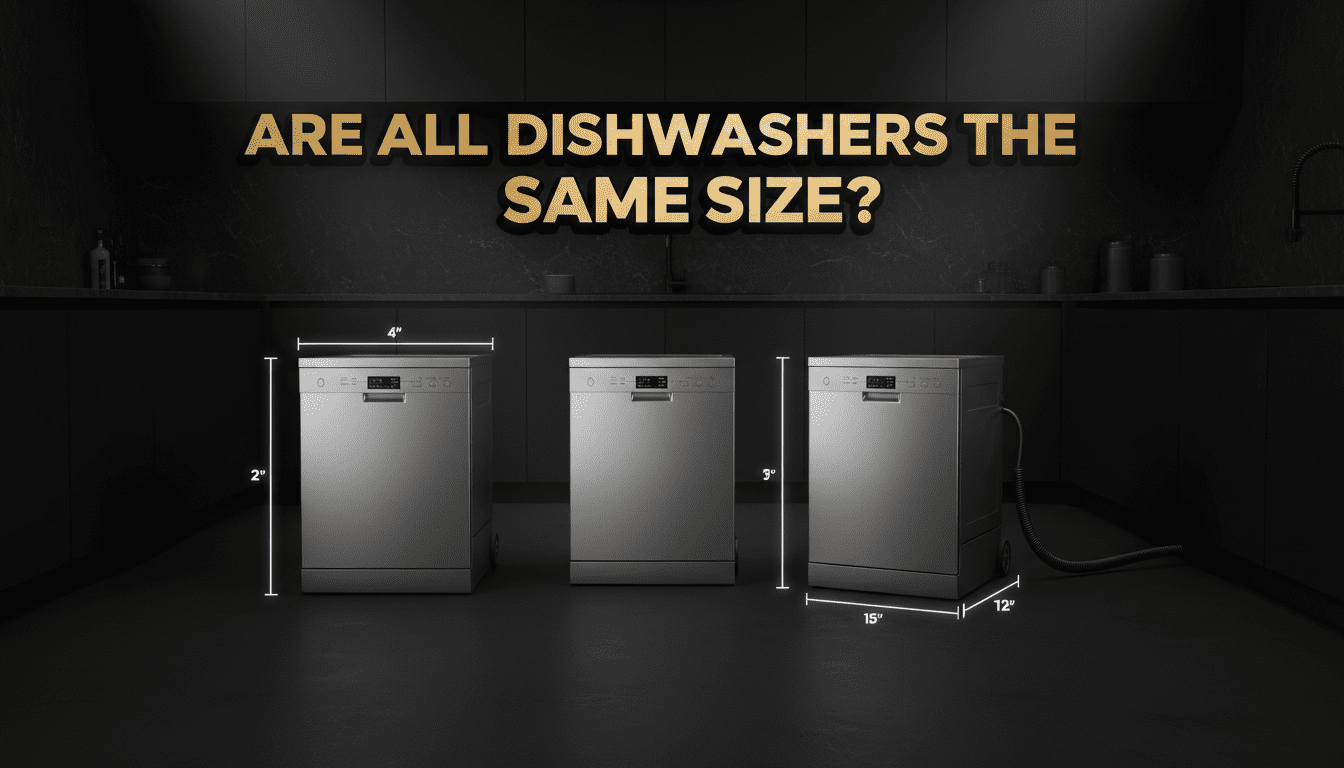

Do you think All Dishwashers Are the same size? I still remember how scared I was when my first dishwasher came. Like many people, I felt that a dishwasher was just a dishwasher. I didn’t measure the cutout. I didn’t look at how deep it was. I bought the one on sale because it looked nice. The delivery team tried to slide it in, but it stuck out three inches past the counter because of a pipe at the back that I hadn’t thought of.
It was a rookie mistake, but it taught me a valuable lesson: not every machine fits every kitchen, even though there are “standards.”
If you are in your kitchen right now with a tape measure in one hand and a confusing spec sheet in the other, you might be wondering, “Are all dishwashers the same size?” The short answer is no. Most built-in models follow a general standard, but small differences in depth, height, and where the control panel is located can mean the difference between an easy installation and a renovation nightmare.
I’ll show you everything I wish I had known back then, from the standard sizes to the strange small models, so you can buy with confidence and get back to cooking (and let the machine do the cleaning)..
Are All Dishwashers the Same Size: Standard Dishwasher Dimensions
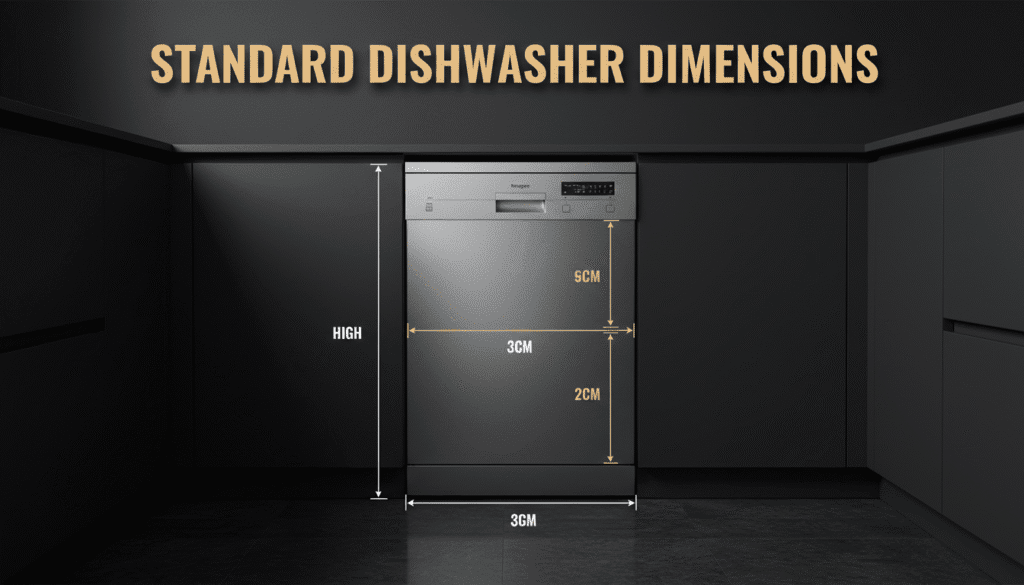
Most of what you see when you go into an appliance store or look through listings online is “standard” built-in dishwashers. Most families have these as their main appliances.
The Magic Numbers: 24 x 24 x 35
For a standard built-in dishwasher, the rough dimensions you are looking for are generally:
- Width: 24 inches (61 cm)
- Depth: 24 inches (61 cm)
- Height: 35 inches (89 cm)
But this is the part that trips people up. A “24-inch dishwasher” is not always exactly 24 inches wide. It is usually a little less than 24 inches wide, around 23 7/8 inches, so that it can fit easily into a cabinet opening that is exactly 24 inches wide.
Why Is This the Standard?
These dimensions became standard because they fit with standard cabinet sizes. Most kitchen cabinets are 24 inches deep, and most countertops are 36 inches high. The dishwasher fits perfectly under that counter, with just enough space for leveling legs to make it fit snugly.
These units can hold 12 to 16 place settings, so they’re great for families or anyone who cooks a lot and has a lot of dishes to wash.
Variations in Dishwasher Sizes
Not every kitchen has a 24-inch gap that needs to be filled. You have other choices if you’re furnishing a small studio apartment, a butler’s pantry, or an older home with strange layouts.
Slimline (18-Inch) Dishwashers
The 18-inch (45 cm) dishwasher is a lifesaver if you don’t have a lot of room. I used to live in a galley kitchen where a full-sized unit would have gotten in the way of the oven door. We switched to an 18-inch model, and it changed everything.
- Width: ~17 5/8 to 18 inches
- Depth and Height: Usually the same as standard models (24″ deep, 35″ high).
Don’t be fooled by how small they are; they can usually hold 8 to 10 place settings. You might have to run it more often, but it’s better than washing by hand.
Countertop Dishwashers
Countertop models sit right next to your sink, which is great for renters or people who don’t have any cabinet space. Instead of being connected to permanent plumbing, they connect to your kitchen sink.
- Dimensions: Roughly the size of a large microwave (approx. 22″ wide x 20″ deep x 17″ high).
- Capacity: 4 to 6 place settings. Great for singles or couples, but you won’t be fitting your large pasta pot in there.
Portable Dishwashers on Wheels
These are basically machines with wheels and a butcher-block top that are built right in. When you need them, you roll them over to the sink. When you don’t, you put them away.
- Dimensions: Similar to standard sizes (18 or 24 inches wide), but often taller due to the wheels and countertop.
Factors Influencing Your Choice
It’s not just about what fits in the hole when you choose the right size; it’s also about how you live.
Kitchen Layout and Walkways
It’s not just the cabinet box that needs to be measured. You should think about the “swing space.” I’ve been in kitchens where the dishwasher door hits the handle on the refrigerator across the room or blocks the only way out of the kitchen. Make sure there is at least 27 inches of space in front of the unit so you can stand there and load it easily.
Household Size
An 18-inch dishwasher will probably drive you crazy if you have four people in your family who cook dinner every night. You will run it twice a day. On the other hand, if you live alone and mostly eat takeout, a huge 24-inch unit might sit half-empty for days, starting to smell before you have enough to make a run.
Plumbing and Electrical Access
You might have enough room for a 24-inch unit, but the plumbing might be hard to get to. Standard units usually have a channel at the bottom for pipes to run through. But if your plumbing comes out of the floor in a strange place (which is common in older homes), a standard depth unit might stick out.
How to Measure Your Space Correctly
This is the most important part of this post. Stop using your phone and get a metal tape measure. Fabric tape measures can stretch.
Step 1: Measure the Width
Take the width of the opening at the top (close to the counter), the middle, and the bottom (close to the floor). Over time, cabinets can bend.
- Tip: Use the smallest measurement every time. A standard 24″ dishwasher won’t fit if your top is 24″ and your bottom is 23.5″.
Step 2: Measure the Height
Measure from the floor to the lowest point of the countertop.
- Watch out for: The floor. If you put tiles in your kitchen around the cabinets but not under the dishwasher, the floor is at a different height. You need to measure the distance from the floor to the dishwasher. If you’ve put in new floating floors, you might have lost an inch of headroom.
Step 3: Measure the Depth
Measure from the back wall to the front of the cabinets.
- Crucial Check: Check the back wall for things that might get in the way. Your effective depth can be lessened by pipes, electrical boxes that stick out, or baseboards. If a drain pipe takes up two inches of a standard 24-inch opening, it’s useless.
Installation Considerations
Once you have bought the machine, getting it in is the next hurdle.
Plumbing and Electrical
Most dishwashers need their own electrical circuit and a connection to hot water. If you’re replacing an old unit, the connections are probably already there. You will need both a plumber and an electrician if you are putting in a new one where a cabinet used to be.
DIY vs. Pro Install
I like to do things myself, but unless you are very handy, I usually suggest hiring a pro to install your dishwasher. A slow leak can cause a lot of water damage. You could damage your floors if the hose isn’t tight enough or the drain loop isn’t high enough. Many stores will install things for a small fee, and it’s usually worth it for the peace of mind.
The Kickplate
This is just for looks, but it’s still important. The kickplate, which is the panel at the bottom, needs to line up with your cabinet plinths in some way. Most of them can be changed, but if you have custom kickboards that are really tall, make sure to check the specs to make sure the dishwasher won’t leave a strange gap.
Benefits and Drawbacks of Different Sizes
Here is a quick breakdown to help you decide: Are all dishwashers the Same Size? Which route t,o take?
Standard (24-Inch)
- Pros: Huge capacity, cleans pots and pans easily, usually more energy-efficient per place setting, widest variety of features and finishes.
- Cons: Requires significant space, uses more water per cycle (though less per dish).
Slimline (18-Inch)
- Pros: Fits tight spaces, uses less water per load, great for small families.
- Cons: Can be pricier than standard models (niche product), holds large pots poorly, often has fewer “fancy” features like third racks.
Countertop
- Pros: No installation required, portable, and cheap.
- Cons: Takes up valuable counter space, noisy (it sits right out in the open), small capacity, requires hooking/unhooking to the tap every time.
Energy Efficiency and Water Usage
People think that washing dishes by hand is better than using a dishwasher. It’s rarely the case. A modern dishwasher that has the ENERGY STAR rating is very efficient and can wash a whole load with only 3 to 4 gallons of water.
Interestingly, size affects efficiency. It is usually better to run a full 24-inch dishwasher than two loads in an 18-inch machine. But if you can’t fill the big one, you’re wasting energy heating water for space.
Look for models that have “Half Load” or “Eco” sensors. These machines change how much water they use based on how dirty the dishes are. This cuts down on waste when you only run a partial load..
Aesthetic a. Design Considerations
Finally, we have to talk about looks. The dishwasher takes up a big visual chunk of your lower cabinetry.
- The classic: stainless steel. It goes well with most other appliances and is easy to clean.
- If you want the dishwasher to blend in, get a panel-ready model. Your cabinet maker makes a door front that matches your kitchen drawers. It then screws onto the front of the machine.
- Handle Style: Look at the handle! A bar handle that sticks out on the dishwasher might stop a drawer that is right next to it from opening. Pocket handles, also called recessed handles, fix this problem.
Pros & Cons:
| Feature | Standard (24″) | Slimline (18″) | Countertop |
|---|---|---|---|
| Capacity | Excellent (12-16 place settings) | Good (8-10 place settings) | Limited (4-6 place settings) |
| Space Required | High (Cabinet cutout) | Medium (Narrow cabinet) | Countertop surface |
| Installation | Hard-wired/plumbed | Hard-wired/plumbed | Faucet adapter |
| Price | Wide range ($400 – $2000+) | Often premium priced | Affordable ($250 – $400) |
| Best For | Families, avid cooks | Apartments, small kitchens | Renters, singles |
Our Rating Methodology
When we review dishwashers at KitchenMaxi, we don’t just look at the spec sheet. We load them with dried-on oatmeal bowls, peanut butter spoons, and greasy plastic containers.
Overall Rating for “Standard Sizing”: 4.5/5
At KitchenMaxi, we don’t just look at the spec sheet when we review dishwashers. We fill them with bowls of oatmeal that have dried on them, spoons of peanut butter, and greasy plastic containers..
Conclusion
Are all dishwashers the same size? No way. But if you have a tape measure and know a little about how you cook, it’s not as scary to find the right one as it seems.
Measure three times (width, height, and depth) so you only h, have to buy once. Getting the right fit means no leaks, no doors that stick out, and best of all, no more washing by hand, whether you squeeze in a slimline model or a family-sized workhorse.
FAQ:
u003cstrongu003eHow do I know if a dishwasher will fit?u003c/strongu003e
Take u003ca href=u0022https://kitchenmaxi.com/dishwasher-measurements-guide-how-to-measure/u0022 target=u0022_blanku0022 rel=u0022noreferrer noopeneru0022u003emeasurementsu003c/au003e of the width, height, and depth of your cabinet opening. A normal opening should be 24 inches wide, 24 inches deep, and 34 to 35 inches high. Always measure the narrowest part of the opening (top, middle, and bottom) to make sure the unit won’t get stuck.
u003cstrongu003eWhat is the most common size of a dishwasher?u003c/strongu003e
The 24-inch model that comes with the phone is the most popular. The dimensions are about 24 inches wide, 24 inches deep, and 35 inches high. For most homes, this size is the best balance between cost and capacity.
u003cstrongu003eWhat brand dishwasher should to stay away from?u003c/strongu003e
Be careful with generic u0022white labelu0022 brands you find on discount sites, though, because it can be hard to find parts and service for them. Stick with well-known brands like Bosch, Whirlpool, KitchenAid, or Miele, where you can get help if you need it.
u003cstrongu003eIs a 24-inch dishwasher actually 24 inches wide?u003c/strongu003e
No, and that’s on purpose! A u002224-inchu0022 dishwasher is usually 23 7/8 inches wide. This small space makes sure that it fits easily into a rough opening that is exactly 24 inches wide without scraping the sides of your cabinets.
Are All Dishwashers the Same Size?
To tell the truth no youtruth now about different sizes which you can ccomfortablyfcomfortableehen