


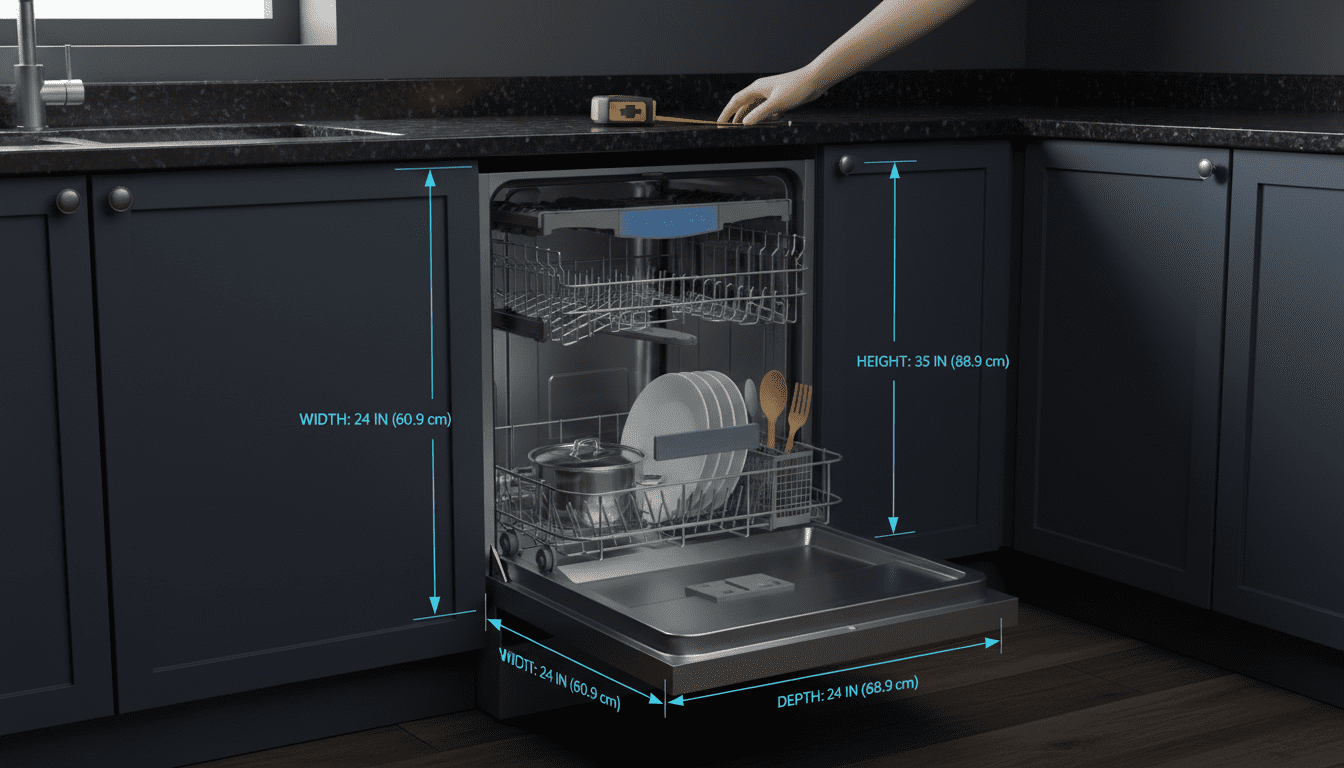

I still remember how scared I was when I first renovated my kitchen. I had chosen a sleek, fully integrated dishwasher that promised to change my life (or at least the way I do the dishes). I measured the gap’s width and found it to be exactly 60 cm. Then I clicked “buy.”
The installer shook his head when he saw it. I didn’t think about the pipes sticking out of the back wall or the new floor tiles we had just put down, which made the height clearance 15mm less than it should have been. I had to pay a lot of money to restock and wash dishes by hand for a week because of that mistake. I learned the hard way, so you don’t have to: accurate measurements are about more than just how wide something is.
Table of Contents
Introduction
When you buy a new appliance, it feels like a big upgrade until you realize it doesn’t fit in your kitchen. Getting the right size is the most important step in the process, whether you’re replacing an old unit or making a new layout. It saves you money, time, and the trouble of having to send back a heavy appliance.
This guide will explain everything you need to know about measuring your dishwasher. We’ll talk about the standard sizes you can find in the UK, how to measure your space so you don’t make the same mistakes I did, and what to do if your kitchen layout is a little strange. Let’s make sure your kitchen upgrade goes smoothly.
Understanding Standard Dishwasher Measurements
It’s helpful to know what you’re looking for before you get out the tape measure. In the UK, there are two main types of dishwashers: full-size and slimline. Knowing these standards helps you quickly get rid of appliances that won’t fit in your space.
Full-Size Dishwashers (The 60cm Standard)
The full-size model is the most common size for homes. They are made to fit into a gap that is 60 cm wide.
- Width: Typically 59.8cm (often rounded up to 60cm in conversation).
- Height: Freestanding models are usually 84cm–85cm tall. Integrated models (hidden behind a cabinet door) usually sit between 81.5cm and 82cm to fit under the worktop.
- Depth: Usually around 55cm–60cm, though this varies if you include handles.
Slimline Dishwashers (The 45cm Saver)
If you are tight on space, slimline models are the go-to.
- Width: 44.8cm (rounded to 45cm).
- Height: Similar to full-size, roughly 85cm for freestanding and 81.5cm for built-in.
- Depth: Standard depth of roughly 55cm–60cm.
Compact and Tabletop
If your apartment is very small, you might want to look at dishwashers in small sizes. These sit on top of the counter and look like a big microwave. They are usually about 55 cm wide and 45 cm tall, but they can hold a lot less.
How to Measure Your Dishwasher Space Correctly
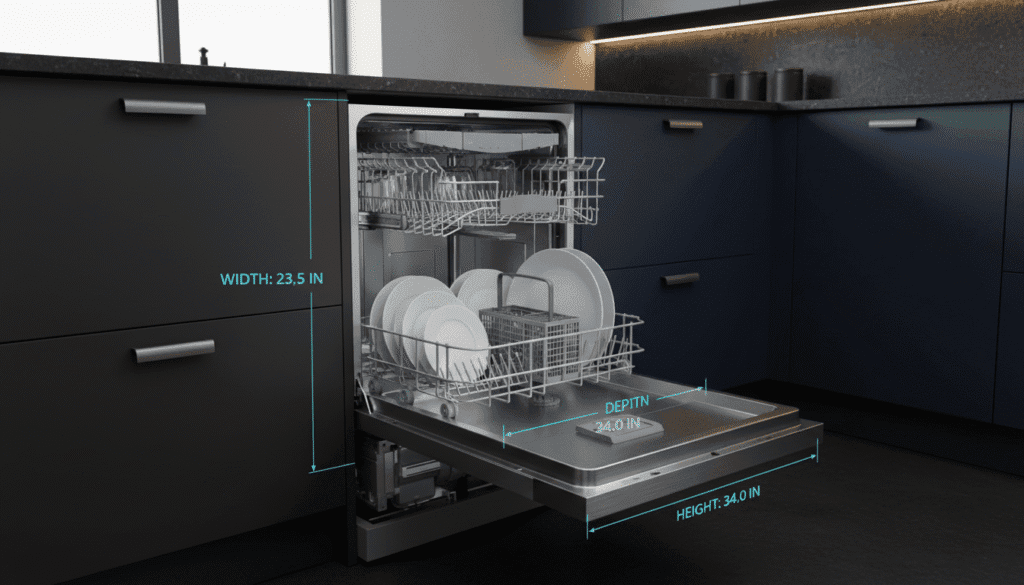
It’s not enough to just measure the old dishwasher and hope the new one fits. You need to measure the space (the cavity) where the new one will go.
1. Measure the Width
Don’t just measure across the front. Cabinets can warp or sit unevenly.
- Measure the width at the top, just below the worktop
- Measure the middle width
- Measure the width at the bottom, close to the floor
- The rule is to use the smallest of these three numbers. If your gap is 60cm at the top bu
- Only 59.5cm at the bottom because of a skirting board or an uneven cabinet, a standard 60cm machine won’t fit.
2. Measure the Height
This is where many people get caught out, especially with flooring.
- From the floor to the bottom of the worktop, measure.
- Look at both sides of the hole.
- If you have tiled up to the edge of the cabinets but not under them, your dishwasher has to “jump” over a lip. Make sure to measure from the highest point of the floor (the tile) to the counter.
3. Measure the Depth
Depth is tricky because you need to account for what is happening behind the machine.
- Measure from the back wall to the front edge of your cabinets.
- The Pipe Factor: Look for electrical outlets or water pipes on the wall behind the room. A regular machine is about 55 to 60 cm deep. The machine will stick out past your worktop if your plumbing is big and sticks out 5 cm from the wall. Plumbing should be in the next cupboard, not right behind the unit.
The “Set In Under Counter” Challenge
When you put in a dishwasher set under the counter, you’re working with a small box. An under-counter installation doesn’t leave any room for error, unlike a freestanding unit that sits at the end of a run.
Most new dishwashers have feet that can be adjusted. You can lower the machine to slide it into the hole, and then raise it back up until it fits snugly against the bottom of the worktop. When you look at the dishwasher’s measurements, make sure to look at the manufacturer’s “min” and “max” height. If your worktop is very low (less than 81.5 cm), standard integrated models might not fit. If your worktop is very high, you might need a special “giant” or “XL” model.
Integrated vs. Freestanding: Size Differences
The type of dishwasher you choose changes how you read the measurements.
Integrated (Built-In)
These are designed to be invisible. They come without a finished front because you attach your own matching kitchen door.
- Depth is very important: The machine itself may be 55 cm deep, but you need to make sure there is enough room for the cabinet door to be 18 mm to 22 mm thick.
- Plinth cuts: When you open the dishwasher, the bottom of your matching door may hit the plinth (kickboard). If your doors are long or your plinths are low, look for models with a “sliding hinge” system. This moves the door panel up as it opens to keep it from hitting something.
Freestanding
These have a finished front and top.
- Top Removal: You can take off the “lid” or top panel on a lot of freestanding models. This can lower the height by about 3 cm, which means you can fit a freestanding unit under a standard worktop. Before you do anything else, always check the manual to see if the dishwasher’s measurements change when the lid is off.
Clearance and Door Swing
You have measured the hole, but have you measured the room?
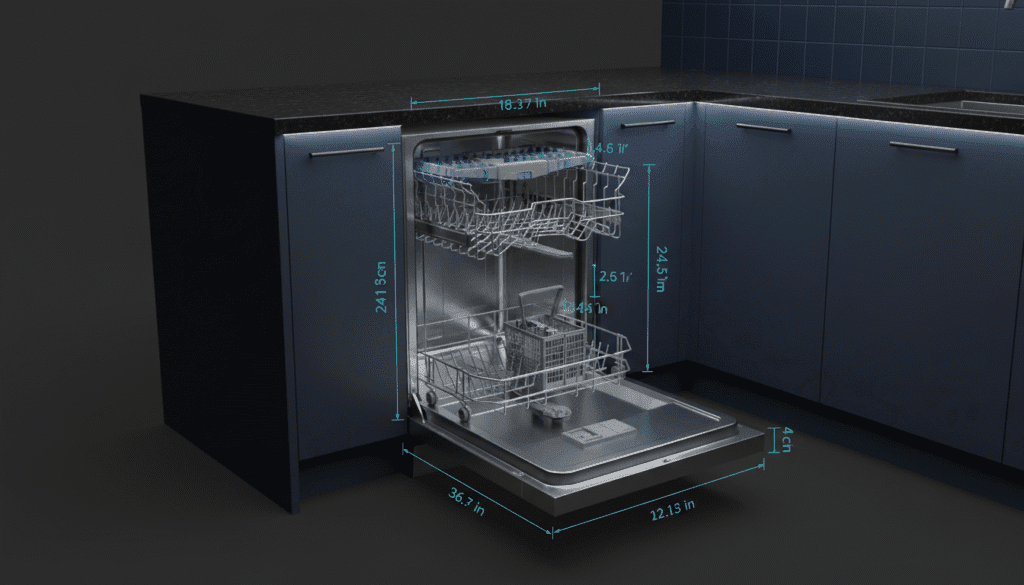
- Front Clearance: The door of a standard dishwasher drops all the way down. You need about 60 to 70 cm of clear space in front of the machine for this to work.
- The Oven Clash: Make sure that the door of your dishwasher doesn’t hit an oven or drawer handles when it opens if it is at a 90-degree angle to them.
- Walkways: Make sure you can still walk past the door when it’s closed. This is a common problem if you have a kitchen island.
Pros & Cons of Standard 60cm Models
Here is a quick breakdown of why the standard size is usually the best bet for families, based on real usage experience.
| Pros | Cons |
|---|---|
| Capacity | Holds 12–14 place settings easily, perfect for families or keen cooks. |
| Availability | Every major brand makes them, giving you huge choice in features and price. |
| Pot Washing | Enough internal height and width to wash large pasta pots and roasting trays. |
| Repair Parts | Standard parts are widely available and often cheaper than niche sizes. |
KitchenMaxi Rating: 4.8/5
We give the standard 60cm size format a high rating. There is a reason why it is the universal standard. It can be hard to get the right measurements for a dishwasher, but sticking to the standard 60cm width gives you the best balance of washing power and energy efficiency. It only loses points because it’s hard to install when plumbing gets in the way of a flush finish, which is a common problem in many UK homes.
FAQ
u003cstrongu003eWhat is the standard size of a dishwasher?u003c/strongu003e
A standard full-size dishwasher in the UK is about 60 cm wide, 85 cm tall, and 60 cm deep. Built-in or integrated models, on the other hand, are a little shorter (about 81.5 cm), so they can fit under worktops. Slimline models are 45 cm wide.
u003cstrongu003eWill a dishwasher fit in a 60cm gap?u003c/strongu003e
Yes, most of the time. Standard dishwashers are actually made to be a little less than 60cm wide (usually 59.8cm) so they can fit into a 60cm space. You must make sure that the gap is 60 cm all the way down, not just at the top, because skirting boards or bowed cabinets can make the space at the bottom smaller.
u003cstrongu003eWhat size is a dishwasher in CM?u003c/strongu003e
Dishwashers are almost always measured in centimetres in the UK.u003cbru003eu003cstrongu003eFull sizeu003c/strongu003e: 60cm W x 85cm H x 60cm D.u003cbru003eu003cstrongu003eSlimlineu003c/strongu003e: 45cm W x 85cm H x 60cm D.u003cbru003eu003cstrongu003eIntegratedu003c/strongu003e: 60cm W x 81.5cm H x 55cm D.
u003cstrongu003eHow to measure a dishwasher to fit?u003c/strongu003e
To get the right size for your dishwasher, measure from the floor to the bottom of the worktop. Next, measure the cavity’s width at the top, middle, and bottom. Use the smallest number. Finally, measure the depth from the back wall to the front of the cabinets. If the plug or pipes are right behind the unit, remember to leave about 5 cm of space for hoses and air flow.
Conclusion:
Getting the right Dishwasher Measurements is the difference between a smooth installation on Saturday morning and a stressful weekend of fixing things yourself. It’s not just the width; it’s also the height of your floors, the depth of your plumbing, and the space needed for the door to swing open.
Take the time to measure the width in three places and carefully check the depth. If you’re not sure, a standard 60cm integrated or freestanding model is usually safe as long as your plumbing is neat. Always remember that it’s better to measure twice and buy once than to end up with a heavy appliance that sticks out too far. Enjoy cooking (and cleaning)!