
How to Sharpen a Ceramic Knife Safely Without Chipping the Edge
Sharpen a ceramic blade with a diamond abrasive made for ceramic knives, using light pressure and slow, controlled strokes. Support the blade well, follow its existing bevel angle, and remove only enough material to restore the edge. Avoid steel honing rods and ordinary knife sharpeners that are not specifically rated for ceramic blades.
Ceramic kitchen knives are very hard but more brittle than typical steel knives. That combination lets them hold an edge for a long time, yet it also means careless twisting, heavy sharpening pressure, or grinding at the wrong angle can create microchips instead of improving the edge.
The goal is not to grind the blade aggressively. Diamond abrasive removes ceramic material with far less pressure than a tool that struggles to cut the hard zirconia blade. Slow passes also give you more control over how much material comes off.
A mildly dull ceramic edge is a reasonable home sharpening job. A knife with a large chip, cracked blade, broken tip, or deep edge damage is better sent to a professional service that works specifically with ceramic knives.
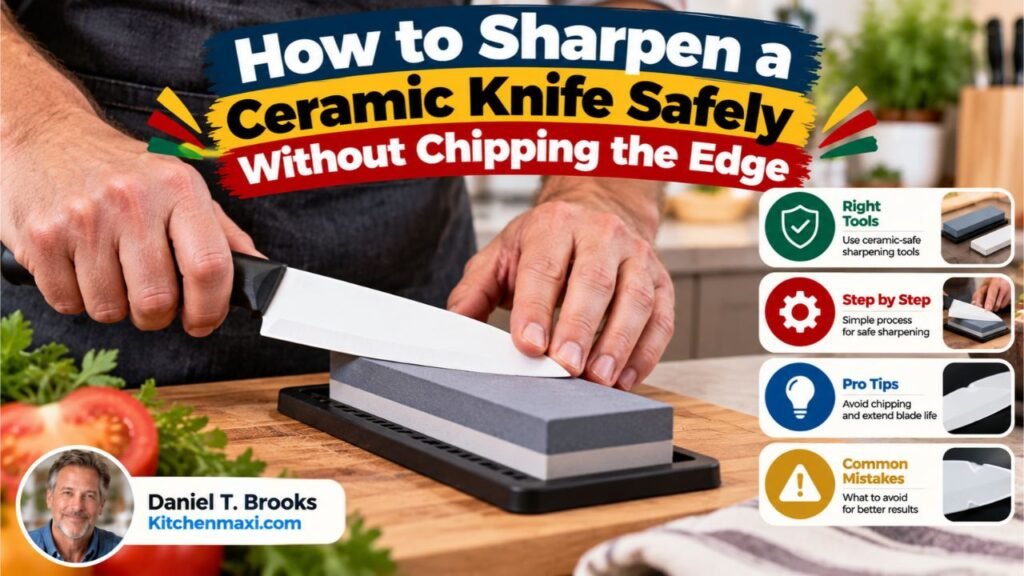
For how to sharpen a ceramic knife, a purpose-built diamond-wheel sharpener is the simplest option for most home cooks. A flat diamond sharpening plate also works, but it demands better control of the bevel angle and more care to support the brittle blade.
Do not confuse a ceramic knife with a ceramic sharpening rod. Ceramic rods are commonly made for sharpening or refining steel knives. Rubbing a zirconia knife against a ceramic rod is not the normal method for restoring a ceramic blade.
The process below covers diamond sharpeners, diamond stones, edge angles, small chips, pressure, testing, common mistakes, tool selection, and the point where home sharpening should stop.
Why Ceramic Knives Need a Different Sharpening Method
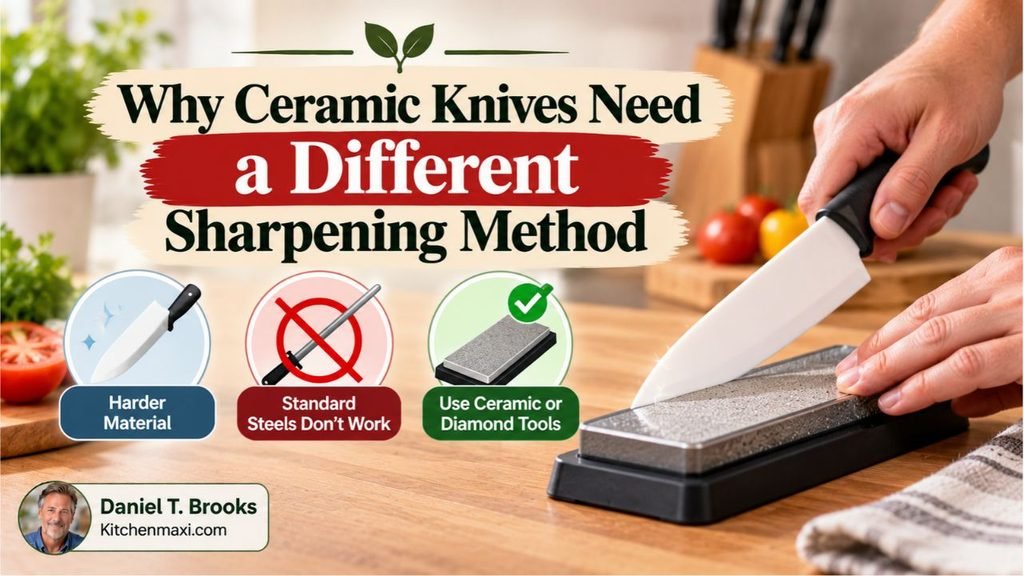
Ceramic and steel blades behave differently during sharpening.
Ceramic Knife Blades Are Made From Very Hard Zirconia
Most quality ceramic kitchen knives use zirconium oxide, commonly called zirconia.
After forming and firing, this material becomes extremely hard and wear-resistant. That hardness is why a ceramic knife can stay sharp through a long period of normal fruit, vegetable, and boneless-food prep.
The same property makes the blade harder to sharpen with ordinary kitchen sharpening tools.
An abrasive needs to remove a controlled amount of material from the bevel. Diamond abrasive is well suited to this job because it can cut the hard ceramic surface without demanding excessive pressure.
Ceramic Blades Are Brittle
Hardness and toughness are different properties.
A ceramic blade resists wear very well, but it does not flex like many steel knife blades.
Problems can occur if you:
- Twist the blade during sharpening
- Push hard sideways
- Drop the knife
- Force the tip into the sharpening surface
- Bend the blade while supporting only the handle
- Grind away too much material
The result can be a small chip, a larger fracture, or a broken tip.
Ceramic Knives Do Not Sharpen Like Steel Knives
Steel edges can often be honed when slightly misaligned.
Ceramic does not normally develop the same type of rolled edge because the blade material does not bend in the same way.
Instead, wear tends to appear as:
- Loss of sharpness
- Tiny edge chips
- Small flat spots
- Larger visible chips after impact
Sharpening removes a small amount of ceramic to create a fresh cutting edge.
Key Takeaway: Ceramic knives use hard zirconia that resists wear but can chip under side pressure. Diamond abrasive and gentle material removal suit this blade far better than normal steel-knife honing methods.
What You Need to Sharpen a Ceramic Knife
You do not need a large knife-sharpening setup, but the abrasive needs to be suitable for ceramic.
Useful options include:
- Diamond-wheel ceramic knife sharpener
- Manual diamond roll sharpener rated for ceramic knives
- Electric diamond sharpener rated for ceramic knives
- Flat diamond sharpening plate
- Non-slip mat or damp towel
- Clean water if recommended for the diamond plate
- Soft cloth
- Good lighting
- Sheet of plain paper for edge testing
For most beginners, I recommend a guided diamond sharpener made specifically for ceramic kitchen knives.
The guide controls the blade position and reduces the amount of freehand angle work.
A diamond plate gives you more control over the finished bevel but also creates more opportunities to tilt, twist, or overgrind the blade.
How to Sharpen a Ceramic Knife Step by Step
Before starting, inspect the blade under bright light.
If the knife has a crack running into the blade body, a major missing section, or a badly broken tip, do not continue with home sharpening.
For a dull edge or very small chips, use the following method.
- Clean and dry the ceramic knife.
Remove food, grease, and residue from the blade. A clean bevel is easier to inspect while sharpening. - Inspect the entire cutting edge.
Look from the heel to the tip. Identify dull sections, small chips, and any areas that reflect light strongly. A sharp edge is extremely narrow and reflects very little light directly. - Set the sharpener on a stable surface.
The sharpening tool should not slide while the blade is moving. Use a nonslip base or damp towel if needed. - Confirm that the sharpener is rated for ceramic knives.
Do not assume any diamond-branded kitchen sharpener works with ceramic. Follow the sharpener manufacturer’s material and blade-type restrictions. - Position the heel of the blade first.
Start at the rear portion of the cutting edge rather than dropping the middle of the blade into the abrasive. - Use light pressure.
Diamond does the cutting. Heavy force raises the chance of edge chipping and removes more ceramic than needed. - Move slowly from heel toward tip.
Use a smooth, controlled motion. Do not twist the knife as the tip reaches the sharpening area. - Sharpen both sides evenly.
For a normal double-bevel ceramic knife, alternate sides according to the sharpener instructions. Guided sharpeners may set this automatically. - Check the edge after a few passes.
Do not perform dozens of strokes before checking. Ceramic material removed during sharpening cannot be put back. - Repeat only if the knife remains dull.
Add a few passes at a time until the edge cuts cleanly. - Rinse the blade.
Sharpening can leave fine ceramic dust on the knife. Wash or rinse the blade thoroughly according to its care instructions. - Dry the knife and test the edge safely.
Use paper or suitable food rather than running a finger along the sharpened edge.
Safety Tip: Never test a ceramic knife by dragging your thumb or fingertip across the edge. Even a small sharpening improvement can make the blade sharp enough to cut skin immediately.
How to Sharpen a Ceramic Knife With a Diamond Stone
A diamond sharpening plate is a good manual option if you can maintain a steady bevel.
Find the Existing Ceramic Knife Bevel
Do not automatically assign a universal sharpening angle to every ceramic knife.
Blade geometry varies by brand and model.
Instead, use the existing bevel as your reference.
Place the blade almost flat against the diamond plate, then raise the spine gradually until the bevel sits against the abrasive.
You are trying to follow the factory edge rather than create a completely new geometry.
Reprofiling a ceramic knife removes much more material and raises the chance of chips.
Support More Than the Ceramic Knife Handle
Holding only the handle leaves a long brittle blade unsupported.
Place fingers from your other hand gently on the flat side of the blade, well away from the cutting edge.
Spread the pressure rather than concentrating it in one small spot.
Do not press down hard.
Sweep the Blade Across the Diamond Surface
Begin with the heel.
Move the blade across the diamond plate so the abrasive reaches:
- Heel
- Middle
- Curved front section
- Tip
Use a slow sweeping movement.
The tip deserves extra care because it is easier to chip than the wider heel section.
Do not push the tip straight into the diamond surface.
Sharpen the Opposite Side
Turn the knife over carefully and repeat the same process.
Try to keep:
- Angle similar
- Pressure similar
- Number of passes similar
A double-bevel knife should remain centered rather than becoming heavily ground on one side.
Refine Rather Than Grind Aggressively
A fine diamond surface is a good choice for routine edge restoration.
A coarser abrasive removes material faster but also leaves less margin for mistakes.
I would reserve aggressive grinding for damaged blades and let a ceramic-knife sharpening service handle major chips.
Key Takeaway: When using a diamond plate, follow the existing bevel, support the blade along its length, apply very light pressure, and use smooth heel-to-tip strokes on both sides.
How to Use a Diamond-Wheel Sharpener on a Ceramic Knife
A dedicated diamond-wheel sharpener is simpler because its guide controls much of the sharpening geometry.
Manual Diamond Roll Sharpener
Set the sharpener on a flat, nonslip surface.
Insert the ceramic blade into the specified slot and keep it positioned as directed by the manufacturer.
Pull the blade slowly through the sharpener.
Do not:
- Push down heavily
- Twist the blade
- Move sideways
- Rock the handle
- Force the tip against the guide
Start with only a few strokes and inspect the edge.
For example, Kyocera’s manual diamond roll system uses an industrial diamond wheel and directs the user to increase the number of strokes gradually while checking sharpness.
Electric Diamond Ceramic Knife Sharpener
An electric model turns the diamond wheel for you.
Use only a machine specifically stating that it accepts ceramic knives.
Place the knife into the guide, switch the unit on as instructed, and draw the blade through at the specified speed.
Do not hold the blade stationary against the powered wheel.
That can remove material from one small section and create an uneven edge.
Some ceramic-specific electric sharpeners can also remove very small chips. Kyocera states that its home diamond-wheel system can address chips around 0.5 mm deep on suitable Kyocera blades.
Larger damage deserves professional assessment.
Key Takeaway: A ceramic-rated diamond-wheel sharpener is the simpler home method because the guide controls the blade position. Use slow passes and only enough repetitions to restore cutting ability.
Can You Sharpen a Chipped Ceramic Knife?
Small chips and major blade damage should be treated differently.
Tiny Ceramic Edge Chips
A series of very small edge chips can sometimes be removed as part of normal diamond sharpening.
The new bevel has to be ground far enough to reach clean ceramic below the damaged edge.
This removes more material than ordinary sharpening.
Do it gradually.
Ceramic Chips Around 0.5 mm
Some manufacturer-approved diamond-wheel sharpeners are rated to correct chips around 0.5 mm on compatible knives.
That number should not be applied automatically to every knife and sharpener.
Check both:
- Knife manufacturer’s repair guidance
- Sharpener manufacturer’s ceramic-blade limits
If either company recommends professional service, use that option.
Large Chips
A large notch means much more of the blade would have to be removed across the entire edge to create a smooth profile again.
Home sharpening can turn a damaged blade into a thinner, uneven knife if too much ceramic is ground away.
Professional ceramic-knife services use diamond equipment to reshape the edge more evenly.
Broken Ceramic Knife Tip
A tiny tip chip may sometimes be reshaped professionally.
A large broken tip changes the blade profile much more.
Do not grind aggressively at home just to restore a point. Removing too much material can weaken the front section or create another fracture.
Key Takeaway: Very small chips may be corrected with a ceramic-rated diamond sharpener. Large chips, deep notches, cracks, and serious tip damage belong with a professional sharpening service.
What Not to Use to Sharpen a Ceramic Knife
Ceramic knives are easy to damage with the wrong sharpening approach.
Do Not Use a Steel Honing Rod
A steel honing rod is meant primarily for steel knife maintenance.
It is not the proper abrasive for zirconia ceramic.
Running the ceramic edge forcefully along a honing steel also puts the brittle blade at risk of impact and side loading.
Do Not Use a Ceramic Honing Rod on a Ceramic Knife
The similar name causes confusion.
A ceramic honing rod is usually a sharpening or honing tool for steel knives.
It is not automatically meant to sharpen a ceramic knife.
Kyocera specifically directs ceramic-knife owners toward diamond-wheel sharpeners rather than its ceramic rods.
Do Not Use an Ordinary Pull-Through Sharpener
Many inexpensive pull-through sharpeners use carbide cutters or abrasives designed for steel.
If the package does not specifically list ceramic knives, do not put a ceramic blade through it.
A hard carbide insert can also place concentrated pressure on the brittle edge.
Do Not Use a Powered Grinder
A bench grinder or general-purpose powered grinding wheel removes material too aggressively for normal home ceramic-knife care.
Problems include:
- Uneven edge geometry
- Chipping
- Tip damage
- Excess material removal
- Poor angle control
Use equipment made for ceramic knife sharpening instead.
Do Not Twist the Blade Against Any Abrasive
Even the correct diamond sharpener can damage a ceramic knife if the blade is twisted sideways.
Keep movement smooth and aligned with the guide or bevel.
Key Takeaway: Skip honing steels, ceramic rods, ordinary carbide pull-through tools, and general powered grinders. Use sharpening equipment specifically rated for ceramic knives.
How to Tell if a Ceramic Knife Needs Sharpening
Ceramic knives often stay sharp much longer than ordinary inexpensive steel knives, so sharpening should be based on cutting behavior rather than a fixed schedule.
Signs include:
- Tomato skin resists the edge
- Onion skin needs extra pressure
- Paper tears rather than slices
- Soft produce gets crushed before the edge enters
- Blade slips across food
- Small reflective flat spots appear along the edge
Check for chips before assuming dullness is the only problem.
A knife can still feel sharp across most of its edge while one chipped section catches food during a slicing stroke.
How to Test a Ceramic Knife After Sharpening
Use a test that does not put your fingers in contact with the edge.
Paper Test
Hold a sheet of ordinary paper away from your body.
Start the knife near the paper edge and make a gentle slicing motion.
A restored edge should enter and cut the paper without requiring heavy downward force.
Do not expect a home-sharpened ceramic knife to feel identical to a new factory edge.
Tomato Test
A ripe tomato is another useful kitchen test.
A sharp blade should enter the skin with light forward slicing pressure instead of crushing the tomato first.
Wash the knife before any food test after sharpening.
Inspect the Ceramic Edge Under Light
Hold the blade so overhead light reaches the edge.
Large flat or damaged areas may reflect light.
A very fine edge is harder to see directly.
Do not run a finger lengthwise along the edge to feel for sharpness.
How Often Should You Sharpen a Ceramic Knife?
There is no useful universal schedule.
Sharpen when cutting performance drops.
Frequency changes with:
- How often the knife is used
- Foods being cut
- Cutting-board material
- Knife storage
- Blade thickness
- Knife quality
- Impact damage
A ceramic knife used mainly for fruit and boneless vegetables on a wood or plastic board may stay sharp for a long period.
Sharpening too frequently only removes ceramic unnecessarily.
Unlike daily honing routines used with some steel knives, ceramic knives do not normally need constant edge work.
How to Keep a Ceramic Knife Sharp Longer
Care has a major effect on edge life.
Use a Wood or Plastic Cutting Board
Use a cutting surface with some give.
Good options include suitable:
- Wood cutting boards
- Plastic cutting boards
Avoid routine cutting on:
- Glass
- Marble
- Granite
- Ceramic plates
- Tile
- Stone countertops
Hard surfaces can damage the ceramic edge.
Avoid Hard and Frozen Foods
Ceramic knives work best for straightforward slicing tasks.
Use another knife for:
- Frozen food
- Bones
- Hard cheese blocks
- Hard fruit pits
- Thick squash stems
- Tough rind
- Foods requiring twisting or prying
A steel chef’s knife or cleaver is better for heavy tasks.
Do Not Twist the Blade While Cutting
Use straight slicing motions.
Do not put the ceramic knife into a hard ingredient and twist sideways to break it apart.
Side pressure is a common way to chip brittle ceramic.
Store the Blade Separately
Do not throw a ceramic knife loosely into a utensil drawer where the edge can strike metal tools.
Use:
- Knife block
- Blade guard
- Suitable knife case
- Protected storage slot
Keep the blade from contacting other hard objects.
Key Takeaway: Cut on wood or plastic, avoid frozen and very hard foods, never pry sideways with the blade, and store the ceramic edge where it cannot strike other utensils.
When to Get a Ceramic Knife Professionally Sharpened
Professional service is the safer route when:
- The blade has a large chip
- Several deep chips run along the edge
- The tip is badly broken
- You cannot identify the factory bevel
- A home diamond sharpener does not restore the edge
- The knife manufacturer recommends factory or authorized service
- The blade is expensive enough that trial-and-error sharpening is not worth the risk
Kyocera currently offers authorized sharpening options for its ceramic knives and recommends diamond-based equipment for home maintenance.
A professional service can remove ceramic across the entire edge in a controlled way so a damaged section does not become an isolated low spot.
Serrated ceramic knives also need special attention. Standard home diamond-wheel sharpeners are generally intended for straight double-bevel blades, not serrations.
Common Ceramic Knife Sharpening Mistakes
A few mistakes account for much of the damage that happens during home sharpening.
- Using heavy pressure: Diamond abrasive works without forcing the edge into it.
- Sharpening at a random angle: Follow the existing bevel whenever possible.
- Supporting only the handle: Support the blade gently along its length when using a flat diamond plate.
- Twisting near the tip: Keep the blade aligned throughout every stroke.
- Using a steel honing rod: It is not the correct tool for zirconia.
- Using an unapproved pull-through sharpener: Ceramic knives need compatible diamond sharpening equipment.
- Trying to grind out a large chip at home: Major damage requires too much material removal.
- Sharpening a serrated ceramic knife like a straight blade: The sharpening system can alter the serration profile.
- Performing too many strokes at once: Check progress often.
- Testing sharpness with a fingertip: Use paper or food instead.
Conclusion
For how to sharpen a ceramic knife, use a diamond sharpening system made for ceramic blades, keep pressure light, and follow the existing bevel rather than aggressively creating a new edge.
A guided diamond-wheel sharpener is the simplest home option. A flat diamond plate gives more manual control but requires steady angle control and proper support along the brittle zirconia blade. Add only a few passes at a time and test before removing more material.
Very small edge chips may be corrected with a compatible home sharpener, while deep chips, cracks, badly broken tips, and serrated ceramic blades are better handled professionally. Do not try to solve major damage with force or a coarse general-purpose grinder.
Once the edge is restored, keep the knife on wood or plastic cutting surfaces and reserve it for foods that do not require prying, twisting, or cutting through hard bones, pits, frozen items, or dense rinds.
FAQs About Sharpening a Ceramic Knife
Can You Sharpen a Ceramic Knife at Home?
Yes.
A mildly dull straight-edge ceramic knife can be sharpened at home with a diamond sharpener specifically rated for ceramic knives. Use light pressure and check the edge after only a few passes. Large chips or cracks should be assessed by a professional sharpening service.
What Is the Best Tool for Sharpening Ceramic Knives?
A guided diamond-wheel sharpener made for ceramic knives is the simplest option for most home users.
A diamond sharpening plate can also restore the edge if you can follow the existing bevel accurately and support the blade without putting side pressure on it.
Can You Use a Regular Knife Sharpener on a Ceramic Knife?
Only if the manufacturer explicitly says that sharpener is suitable for ceramic knives.
Many ordinary pull-through sharpeners are designed only for steel and may use carbide cutters or other sharpening elements that are not suitable for a brittle zirconia edge.
Can You Sharpen a Ceramic Knife With a Whetstone?
A normal kitchen whetstone should not be the default choice.
Ceramic knives are extremely hard, and manufacturers such as Kyocera recommend diamond sharpening surfaces for their ceramic blades. A diamond plate gives more dependable material removal with less need for pressure.
Can You Use a Ceramic Rod to Sharpen a Ceramic Knife?
No, not as a general rule.
Ceramic sharpening rods are mainly used on steel knives. A ceramic knife should be sharpened with an approved diamond abrasive rather than assuming a ceramic rod is suitable because both tools contain ceramic material.
Can a Chipped Ceramic Knife Be Sharpened?
Small chips can sometimes be removed by grinding the edge back with a ceramic-rated diamond sharpener.
Some home systems are rated for chips around 0.5 mm on compatible blades. Larger chips require much more material removal and are better handled by a professional service.
Do Ceramic Knives Need Honing?
They do not normally need the same honing routine used for many steel knives.
Ceramic does not readily bend into a rolled edge. When cutting performance declines, the blade usually needs actual sharpening with diamond abrasive rather than realignment with a honing steel.
Why Is My Ceramic Knife Chipping After Sharpening?
Possible causes include too much pressure, twisting the blade, grinding at the wrong angle, an unsuitable sharpener, or existing cracks near the edge.
Stop sharpening if new chips appear. Continuing to grind an already damaged blade can make the edge worse.