



I will always remember the night I had my first real dinner party. The oven was cooking a chicken, the microwave was warming up sauce, and the fridge’s compressor started up with a familiar hum. All of a sudden, there was silence. The kitchen was completely dark. I had tripped the breaker.
It wasn’t just embarrassing; it made me realize how my kitchen was wired. We often think of fridges as empty boxes that just sit there, but they use a lot of power, especially when they first start up. Learning about amperage not only helped me avoid future dinner party disasters, but it also helped me understand my energy bills and keep my food safe. This guide is for you if you’re remodeling or just want to know why your lights flicker when the fridge turns on.
Table of Contents
What Goes into Powering Your Fridge?
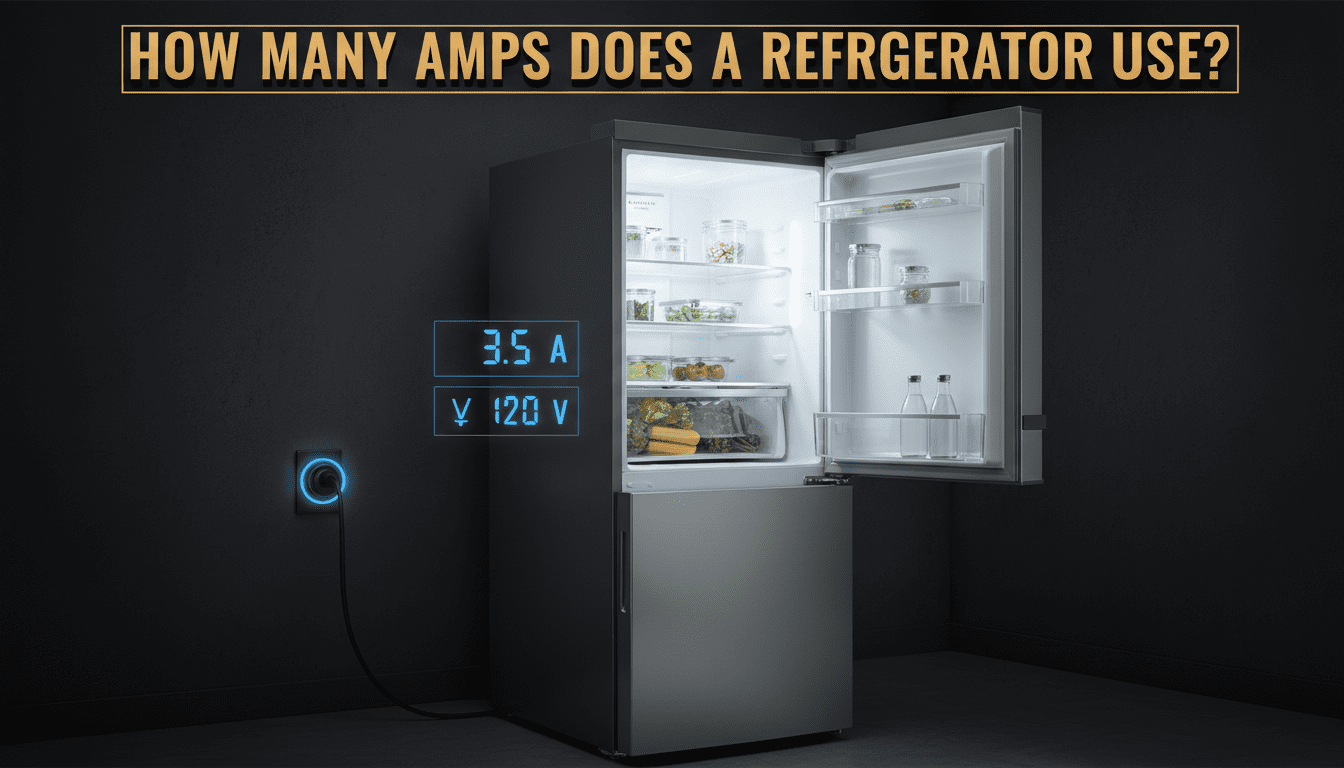
Refrigerators are the most important part of the kitchen because they keep our food fresh all day and night. But most of us don’t look at the technical specs until something goes wrong. Asking How Many Amps Does a Refrigerator Use? is the first step to setting up a safe kitchen, whether you’re putting in a new unit, buying a backup generator, or checking your circuit capacity.
A regular home refrigerator uses between 3 and 6 amps while it’s running, but it needs a lot more power to start the motor. But this can change a lot based on how old, big, and efficient your model is. In this article, we’ll explain How Many Amps a Refrigerator uses, how to find your specific number, and why having a separate circuit might save you trouble later.
Understanding the Power Draw: Starting vs. Running
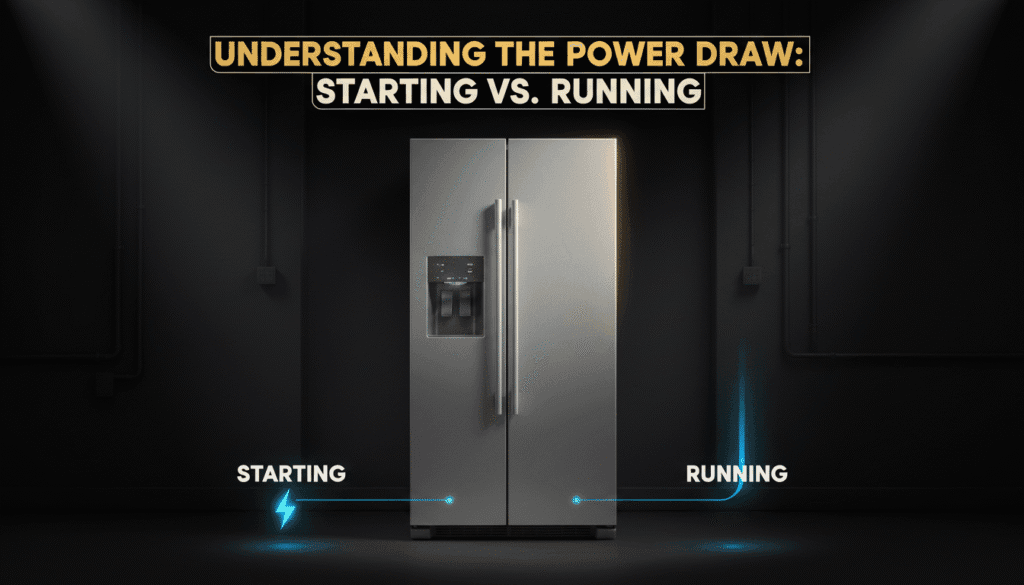
To really know How Many Amps a Refrigerator uses, you need to know the difference between the marathon and the sprint. Your fridge doesn’t use the same amount of power all the time; it cycles.
Running Amps (The Marathon)
This is the power that keeps your refrigerator cool. A modern, energy-efficient fridge usually uses between 3 and 5 amps (at 120 volts) once the compressor is working. Some older models might pull a little more, up to 6 or 8 amps. This is the number that most general energy guides use.
Starting Amps (The Sprint)
This is where things get hard. If the thermostat in your fridge senses that the temperature inside has gone up, it tells the compressor to turn on. A big burst of energy, called “Locked Rotor Amps” (LRA) or surge current, is needed to start that motor.
This surge can be three to four times the amount of current that is running. A fridge that uses 4 amps may need 12 to 15 amps for a short time to get going. This split-second spike is often what causes breakers to trip, especially if you have other appliances running on the same circuit.
How to Find Your Fridge’s Amp Rating
You don’t have to be an electrician to understand this. If you’re curious about how many amps your refrigerator uses in your kitchen, here’s how to find out:
- Find the sticker from the maker: You can usually find this on the back of the unit, on the kickplate at the bottom, or inside the fridge door.
- Read the specs: Check for “Amps” or “A.” You’re done if it’s on the list!
- Do the math (if only watts are shown): Sometimes, labels only show Watts (W) and Volts (V). This simple formula will help you figure out the amps:
- Watts ÷ Volts = Amps
- Example: If your fridge uses 720 Watts and runs on 120 Volts, then 720 ÷ 120 = 6 Amps.
Why Dedicated Circuits Matter
You might be wondering, “Why do electricians recommend a dedicated circuit if a fridge only uses 3–5 amps?”
The National Electrical Code (NEC) in the US doesn’t say that every fridge has to have its own circuit, but most professionals agree that this is the best way to do things. A dedicated circuit means that the fridge is the only thing that can use that breaker. This is important for your home for the following reasons:
- Preventing Overloads: If your fridge, toaster, and coffee maker all share a circuit and all three turn on at the same time, you will go over the circuit’s limit (usually 15 or 20 amps). The breaker pops.
- Protecting Your Food: If a shared breaker trips while you’re at work or on vacation, everything in the fridge will go bad. A dedicated circuit keeps the fridge separate from the rest of the kitchen, so it will keep running even if you overload another circuit.
Keeping Costs Down: Efficiency Tips
It’s also good for your wallet to know how many amps a refrigerator uses. A fridge from the 1990s could use a lot more power than a newer Energy Star-rated one.
- Dusty condenser coils make the fridge work harder to get rid of heat, which increases the amp draw. Once a year, vacuum them.
- Look at the seals: The compressor runs more often when cold air gets out. Use a piece of paper to check your door seals. If you can easily pull it out when the door is closed, it’s time to get a new gasket.
- Ventilation: Make sure there is space for air to flow around the sides and back of your fridge. When there isn’t enough airflow, the motor has to pull more amps to stay cool.
Pros & Cons of Dedicated Fridge Circuits
If you’re doing some work on your home, you might be thinking about whether or not to pay for a dedicated line. Here is a list of the pros and cons.
| Feature | Pros | Cons |
|---|---|---|
| Reliability | Eliminates “nuisance tripping” from other appliances (toasters, blenders). | Requires space in your breaker panel (you might need a sub-panel). |
| Food Safety | Ensures the fridge stays on even if another kitchen circuit fails. | Higher upfront installation cost (wire + labour). |
| Appliance Life | A dedicated outlet cannot be used for other convenience items easily. | Can be difficult to retrofit in finished kitchens without opening walls. |
| Troubleshooting | Easier to diagnose fridge issues when it’s isolated. | Dedicated outlet cannot be used for other convenience items easily. |
KitchenMaxi Rating: 5/5
We rate the importance of understanding your refrigerator’s amperage a solid 5 out of 5.
Why? Because not knowing here isn’t fun; it’s costly. Your refrigerator is probably the only appliance in your home that runs all day, every day of the year. Knowing how much power it needs helps you make better buying decisions and keeps your home’s electrical system from getting too full. It separates a kitchen that is safe and works well from one that leaves you in the dark with spoiled milk.
Conclusion
How many amps does a fridge use? The short answer is that it usually runs on 3 to 6 amps, but when it starts, it jumps to 15 amps for a short time. But the most important thing is to know how your kitchen uses that power.
You can keep your groceries and your home’s electrical health safe by checking the rating of your specific model and making sure you have the right circuit setup. Don’t wait until the power goes out to find this out. Check your breaker panel and the rating sticker on your fridge for five minutes today. It’s a small, useful thing to do that will make you feel much better.
Frequently Asked Questions:
Can you run a refrigerator on a 15-amp circuit?
Yes, you can usually do that. Most modern home refrigerators use between 3 and 6 amps of power, which is well within the limits of a 15-amp circuit. But because of the startup surge (which can be much higher), it’s very important that the circuit is dedicated, which means that no other appliances are plugged into it. If other things are using power on the same 15-amp line, the fridge’s startup spike will probably trip the breaker.
How many amps does a full-size refrigerator use?
A full-size refrigerator typically consumes between 3 and 6 amps of power when in operation (running amps). But newer Energy Star models are very efficient and may only use 1 to 2 amps. On the other hand, very big commercial-style units or models that are a lot older could use 8 to 10 amps or more. To be sure, always look at the sticker from the maker inside the door.
How many refrigerators can be on a 20-amp circuit?
If we only look at running amps, you might think you could fit two or three. Don’t do this. One refrigerator per circuit is the best way to do things. If two fridges started their compressors at the same time on a 20-amp circuit, the combined surge could be more than 20 amps, which would trip the breaker. Follow the “one fridge, one circuit” rule to make sure your food is safe and reliable.
How many amps does a 240V fridge use?
In the US, the standard voltage for fridges is 120V. But if you live in a place with 240V standards (like the UK or Europe) or have a big built-in commercial unit, the amperage will be lower. Amps = Watts / Volts, so if you double the voltage, the amperage will be about half of what it was before. A 240V fridge may require only 1.5 to 3 amps to perform the same work as a 120V fridge, which needs 3 to 6 amps.