



If you want to change the tile floor or backsplash in your bathroom, you will need to use cement board. It is the heavy-duty, water-resistant cousin of drywall that gives tile work a strong base that will last for a long time. That first sheet can look scary, though, if you’ve never worked with it before. It is heavy and breaks easily, and if you cut it wrong, it makes a cloud of dangerous dust.
Knowing how to cut cement board correctly is more than just making a straight line; it’s also about keeping your lungs safe and your project moving quickly. The method you choose is important whether you’re working with thin ¼-inch sheets for floors or thick ½-inch boards for shower walls.
We’ll show you the four best ways to cut cement backer board in this guide. We’ll talk about everything from the “score and snap” method, which doesn’t leave any dust, to using power tools to make precise cuts. We will also go into great detail about the important safety steps you need to take to stay safe from silica dust. At the end of this post, you’ll know exactly which tool to use for each cut you need to make.
Table of Contents
Understanding Cement Board
Before we start chopping and slicing, it’s important to know what we’re cutting. Cement board, which is also known by brand names like HardieBacker or Durock, is a composite material made of cement and reinforcing fibers, which are usually fiberglass.
Cement board is made to be strong, unlike drywall, which has a gypsum core that breaks easily. Because it doesn’t rot, warp, or grow mold when it gets wet, it is the standard in the industry for wet areas. But that durability is what makes cutting cement board harder than cutting drywall or wood.
Types of Cement Board
Generally, you will find two main thicknesses:
- ¼-inch board: Used mostly for floors and counters. It gives the tile a solid surface to stick to without making the floor too high.
- ½-inch board: For walls, ceilings, and showers. It is the same thickness as regular drywall, so there are no gaps between the tiled areas and the painted walls.
It is easy to snap ¼-inch board by hand, but ½-inch board is much stiffer. You can score and snap ½-inch board, but power tools usually make the edges cleaner and require less work.
The Silica Safety Warning
If you must use power tools, connect them to a shop vacuum equipped with a HEPA filter.
Safety Rules for Cutting:
- Work Outdoors: Whenever possible, make your cuts outside to let the breeze carry the dust away from you.
- Wear a Respirator: A regular dust mask won’t do. At the very least, wear an NIOSH-approved N95 mask. A P100 respirator is even better for heavy cutting.
- Eye Protection: Cement chips and dust are abrasive. Always wear safety glasses.
- Dust Extraction: If you have to use power tools, make sure they are connected to a shop vacuum with a HEPA filter.
Tools for Cutting Cement Board
You don’t need to buy every tool on this list. The best tool depends on how many cuts you need to make and where you are working.
- Utility Knife: Best for straight cuts on ¼-inch board.
- Carbide Scoring Tool: A specialized knife with a carbide tip that digs deeper grooves than a standard blade.
- T-Square or Straight Edge: Essential for guiding your knife.
- Circular Saw: Best for ripping long straight lines on thick boards. Requires a fiber cement blade.
- Oscillating Multi-Tool: Perfect for cutting out holes for vents, toilets, or outlets. Requires a carbide-grit or diamond blade.
- Fiber Cement Shears: A pro-level tool that cuts without making dust. Great for large jobs.
- Jigsaw: Useful for curves, provided you use an abrasive carbide-grit blade.
Method 1: Scoring and Snapping
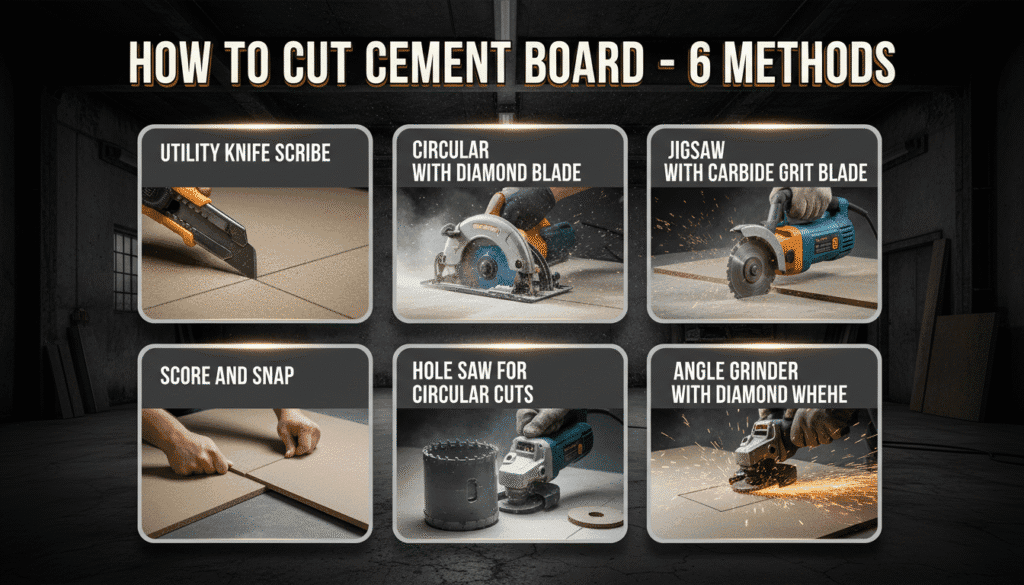
Best for: Straight cuts, indoor work, keeping dust to a minimum.
This is probably the method you’ll use the most if you’re a DIYer working on a small bathroom renovation. It is almost the same as cutting drywall, but it takes a little more work. This method creates very little dust in the air, which makes it the safest choice for indoor cuts.
Step-by-Step Guide
1. Measure and Mark
Use a pencil or marker to mark the cut line on the rough side of the cement board after you measure the space.
2. Set Your Straight Edge
Put your T-square or a long metal straight edge along your mark. Hold the straight edge firmly in place or clamp it down so it doesn’t move while you cut.
3. Score the Board
Use your utility knife or carbide scoring tool to pull it along the straight edge. You don’t want to cut all the way through; you just want to cut through the top layer of fiberglass mesh and make a deep groove in the cement core.
- Tip: Don’t be afraid of the pressure. You will probably need to make 3 to 5 passes to get a score line that is deep enough. If you’re using a regular utility knife, have extra blades on hand because cement board dulls steel right away.
4. Snap the Board
Put the board on a hard edge, like a table or a stack of lumber, and line up the score line with the edge. With one hand, hold the board firmly on the table. With the other hand, press down hard on the piece that is hanging over the edge. It should break cleanly along the line.
- Alternative: You can also place a 2×4 under the board directly beneath the score line and press down on both sides to snap it.
5. Cut the Backing
The fiberglass mesh on the back of the board will now hold it up. To cut the two pieces apart, use your utility knife to cut through this mesh.
6. Smooth the Edge
The edge that broke will be rough. You can use a rasp or a “surform” tool (a plane that looks like a cheese grater) to smooth out bumps.
When to use this method: This is the go-to method for ¼-inch boards. You can use it on ½-inch boards, but expect the snap to be more difficult and the edge to be ragged.
Method 2: Circular Saw
Best for: Large projects, thick ½-inch boards, long rip cuts.
Scoring and snapping can get old quickly when you have to tile a whole house. A circular saw cuts through cement board in a matter of seconds. But this method makes a huge cloud of dust. You must do this outside or with a special dust collection system.
Step-by-Step Guide
1. Choose the Right Blade
Don’t use a regular wood-cutting blade. In less than a foot of cutting, the cement will grind the teeth down to nubs. You need a blade with a polycrystalline diamond (PCD) tip or a special fiber cement blade. To keep dust to a minimum, these usually have only 4 to 6 teeth.
2. Set Up Outdoors
Put sawahorses outside. Check the direction of the wind and move so that it blows the dust away from your face. Wear your safety glasses and N95 mask.
3. Mark Your Line
Mark your cut line on the board.
4. Make the Cut
Set the saw blade so that it only goes about ¼ inch deeper than the board. This makes things less hot and less friction. Cut slowly and steadily. Don’t push the saw; let it do its job.
Tips for Reducing Dust:
- Wet Cutting: Some saws are designed for wet cutting, which eliminates dust.
- The Second Person Trick: If you don’t have a vacuum attachment, have a helper hold a shop vac nozzle near the front of the saw guard as you cut to catch the stream of dust.
Method 3: Oscillating Tool
Best for: Detailed cuts, notches, circles, corners.
You might need to cut a hole for a shower valve, a toilet flange, or a heat vent. A circular saw is too big, and you can’t snap it for cuts inside. This is where the oscillating multi-tool really shines.
Step-by-Step Guide
1. Choose the Blade
You need a diamond-grit blade or a carbide-grit blade. Standard wood and metal blades will burn out very quickly.
2. Mark the Cutout
Draw the square, circle, or notch that you want to get rid of.
3. Cut with a plunge
Turn on the tool and slowly push the vibrating blade into the board along your line.
4. Follow the Line
Steadily move the tool along your mark. The oscillating action breaks down the cement into dust.
5. Clean Up
To get rid of the cutout piece, push it through. This method makes fine dust, so keep a vacuum cleaner nearby.
When to use this method: This is indispensable for intricate shapes where how to cut cement backer board involves more than just straight lines.
Method 4: Fiber Cement Shears
Best for: Professional installers, indoor work, dust-free cutting.
If you are a pro or planning a massive renovation, investing in electric fiber cement shears might be worth it. These look like a drill with a specialized scissor head.
Step-by-Step Guide
1. How the Cut Works
As they cut through the board, shears take off a thin strip of material that is about ¼ inch wide.
2. The Cut
Push the shears through the board while they are on. They cut a little slower than a saw, but faster than scoring.
3. The Outcome
What I like best? There is almost no dust. Instead of turning into powder that floats in the air, the waste material curls up into a solid coil.
Advantages:
- Safe to use indoors.
- Quiet.
- Clean cuts.
Disadvantages:
- The tool is expensive ($100-$300).
- It requires a specific technique to keep the line straight.
Dealing with Dust
We talked about safety before, but it’s worth saying again. When you cut cement board, the most dangerous thing is the silica dust.
The Danger:Particles of crystalline silica are small enough to get deep into the lungs. You can’t see them with your eyes. The air is not safe just because you can’t see a “cloud.”
Best Practices for Dust Control:
- Never dry sweep: Don’t sweep after you’re done cutting. When you sweep, the dust that has settled back into the air. You can either wet-mop the area or use a HEPA vacuum..
- Wash your clothes: IIf you have been cutting wood outside with a saw, your clothes are probably covered in silica dust. Wash them by themselves, not with the rest of the laundry.
- Change filters: If you’re using a shop vac, make sure the filter is clean and in the right place. If your filter is clogged, it will suck less and may blow dust out the exhaust.
Conclusion
For any serious DIYer, learning how to cut cement board is a rite of passage. It is a material that deserves respect because it is strong and dangerous.
The score-and-snap method with a carbide scoring tool is the best and most cost-effective way for most homeowners to deal with one bathroom. It cleans the air and doesn’t take much time to set up. But if you’re framing a big shower or putting down a whole subfloor, don’t be afraid to rent or buy a circular saw with the right blade. Your arms will thank you.
Always wear your mask and remember to measure twice and cut once. That hard board is just another step toward your beautiful new tile installation if you use the right technique.
FAQ:
What is the best tool to cut cement board with?
It all depends on the job. A carbide scoring knife is the best choice for cheap, straight cuts. A circular saw with a fiber cement blade is best for big jobs that need a lot of cuts. An oscillating multi-tool is best for making detailed cutouts, like for pipes.
How do you cleanly cut cement board?
Use a straight edge guide to get the cleanest edge. If you’re scoring, do it deeply and quickly. If you’re using a saw, use a guide rail or clamp a straight board to the cement board to help the saw shoe stay straight. After the cut, you can use a surform tool or rasp to smooth out any rough edges.
Can you cut cement board with a regular blade?
No. A regular circular saw blade for cutting wood will dull almost right away and could even burn out the motor of your saw because of friction. Always use a blade that is made for fiber cement or a polycrystalline diamond (PCD) blade.
How to cut 12mm cement board?
It is hard to snap 12mm (about 1/2 inch) board cleanly. The best way to do it is to use a diamond blade on a circular saw or angle grinder outside. If you have to snap it, make sure to score it very deeply on both sides of the board first.