


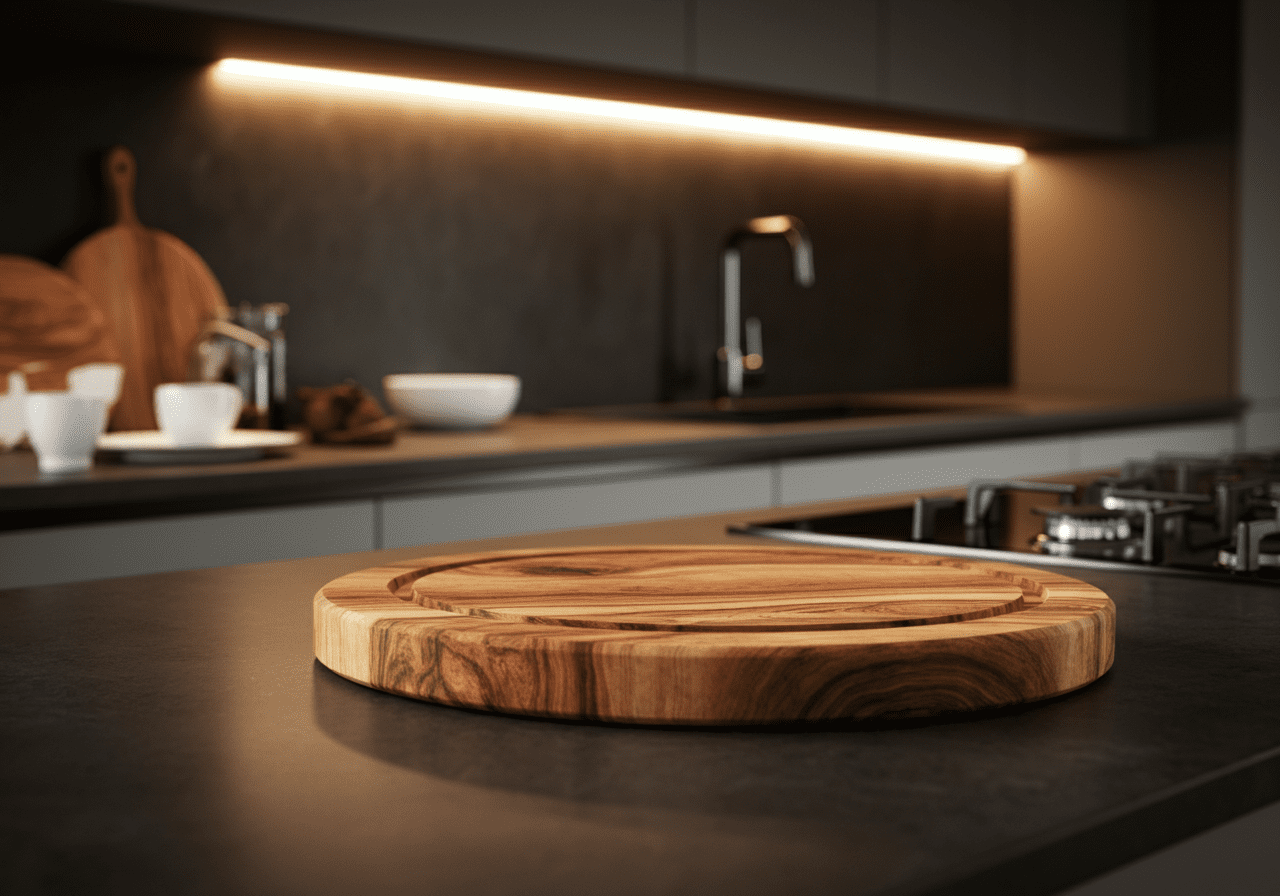

Three years ago, when I first saw a round cutting board at a friend’s dinner party, I wasn’t sure what to think. As she prepared vegetables, the hostess effortlessly spun this beautiful walnut circle, making cuts that were perfectly even with what seemed like half the effort of my usual chopping routine. That moment started my journey into the world of round cutting surfaces, and I haven’t stopped since..
Major kitchenware stores say that round cutting board sales have increased 340% in the last two years. The numbers speak for themselves. What began as a niche choice among professional chefs has quickly become a must-have item in every kitchen, challenging the century-old dominance of rectangular cutting boards..
I’ve learned this isn’t just another kitchen trend after using dozens of round cutting boards in my daily cooking for the past year. The unique shape has real functional and aesthetic benefits that many home cooks haven’t considered—benefits that go far beyond how good it looks on Instagram.
In this complete guide, I’ll tell you everything I know about round cutting boards, including how they differ from regular rectangular boards, what to look for when buying one, how to take care of it properly, and whether or not they are worth the money for your kitchen. Knowing the pros and cons of round cutting boards will help you choose this kitchen tool wisely, whether you only use it on the weekends or spend hours making fancy dinners.
What Makes Round Cutting Boards Different?
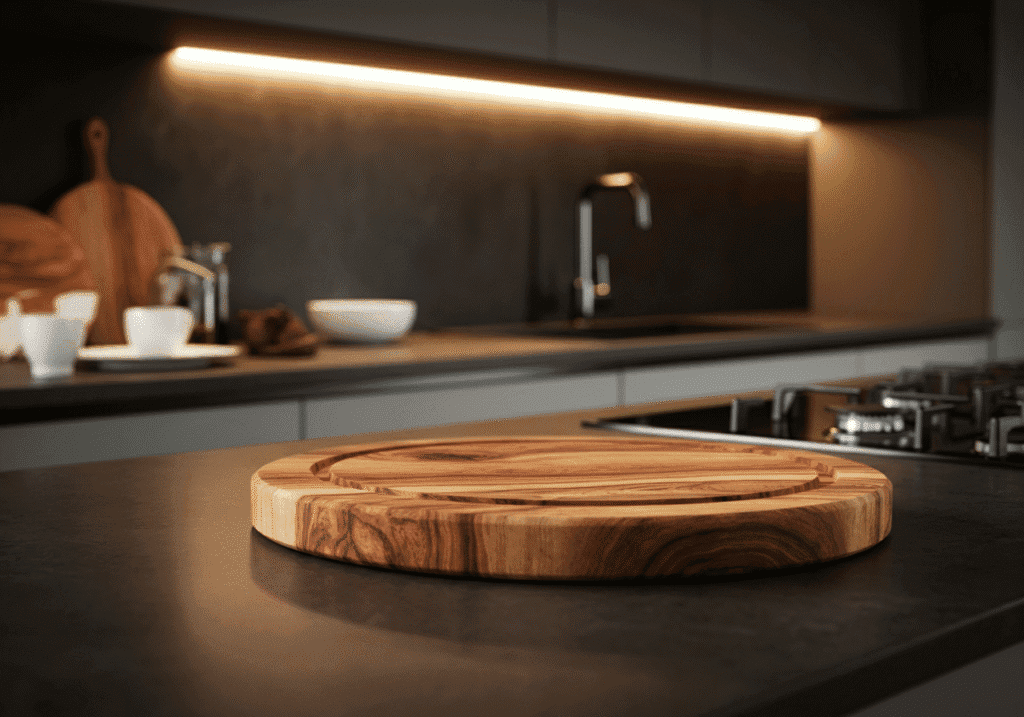
Round cutting boards significantly change how we design workspaces for preparing food. Circular boards, on the other hand, promote a more natural, rotational workflow that I’ve found surprisingly easy to get used to after only a few uses.
It’s interesting how professional kitchens have used circular cutting surfaces for decades, especially when making bread and pastries. For a long time, French cooking schools have taught that round work surfaces are better for tasks that require consistent, repetitive motions. As we can see, this professional knowledge is finally making its way into home kitchens.
From a psychological point of view, circular workspaces naturally make it easier for people to move around. When I chop onions or julienne carrots on my round board, I often rotate the board instead of moving the ingredients. This is a small but essential way to save time that adds up over long prep sessions.
Here’s how round cutting boards typically compare to their rectangular counterparts:
| Specification | Round Cutting Boards | Rectangular Cutting Boards |
|---|---|---|
| Average Small Size | 8-10 inches in diameter | 8×10 inches |
| Average Medium Size | 12-14 inches in diameter | 12×16 inches |
| Average Large Size | 16+ inches in diameter | 15×20+ inches |
| Usable Surface Area (medium) | ~113 sq inches | ~192 sq inches |
| Edge Length | Continuous curve | Multiple straight edges |
| Natural Grip Points | None (requires technique) | Four corners |
The Science Behind Circular Cutting Surfaces
During my first week of testing, I saw how working on a round surface improved my health. When you cut along the edges or in the corners, traditional rectangular boards can make your cutting arm move in strange ways. This problem goes away completely with round boards.
The Culinary Institute of America has done research that shows that circular cutting surfaces make wrist and arm movements more natural, which lowers the strain during long preparation sessions. After switching to round boards for tasks that used to make my wrist hurt a little, I’ve noticed that my dominant hand doesn’t get as tired as it used to.
Round boards really shine, especially regarding how well rotational cutting techniques work. You don’t have to keep moving the cutting board or the ingredients around. You can turn the board itself. This is especially useful when you need to brunoise dice vegetables or make even cuts for dishes that are meant to look good.
Studies on workspace ergonomics show that circular work surfaces reduce repetitive stress positions by about 30% compared to angular surfaces. I can’t give a number based on my own experience, but the natural spinning motion feels smoother and less physically demanding than traditional linear cutting patterns.
Round Cutting Boards: Pros and Cons Analysis
Advantages of Round Cutting Boards
- Round boards really shine, especially regarding how well rotational cutting techniques work. You don’t have to keep moving the cutting board or the ingredients around. You can turn the board itself. This is especially useful when you need to brunoise dice vegetables or make even cuts for Space efficiency. What surprised me the most during my testing was that it may look like round boards have less surface area, but they make the cutting area bigger. Every point on the board is the same distance from the center, so there are no “dead corners” that people don’t use on rectangular boards.
- Aesthetic appeal cannot be overstated. Round cutting boards fit perfectly with modern kitchen design trends, especially the clean lines and natural shapes popular in homes today. Mine can also be used as a serving piece when I’m having people over, going from prep work to presentation without any problems.
- Versatility goes way beyond just cutting. I often use my round boards to serve cheese and charcuterie, as pizza stones for small personal pizzas, and even as decorations when I hang them on my kitchen wall. Because it can do more than one thing, this board is easier to justify the cost than a rectangular board that can only do one thing.
- Ergonomic benefits get worse the longer you use them. Once you get used to it, the natural rotation motion feels natural. It is beneficial for tasks that must be done repeatedly, like chopping herbs or making vegetable brunoise.
- Easy rotation changes the way you handle your ingredients. You don’t have to move cut vegetables around on the board; you spin the board to get to a new cutting area. This is especially helpful when you’re using more than one ingredient simultaneously.
- Unique storage options give creative answers for small kitchens. Round boards look great when hung up and use less wall space than similar rectangular boards. Some designs have leather or rope hanging loops that make them look better.
Disadvantages of Round Cutting Boards
- Limited counter space compatibility presents the biggest problem. Most kitchen counters and storage solutions for cutting boards are made for rectangles. I had to change how my drawer organizers worked to fit round boards properly.
- Ingredient containment can be complex with some foods. I didn’t think about how careful I would be when putting minced garlic or diced shallots on the curved edges, but they roll off.
- Storage constraints make creative solutions work in kitchens that are usually organized. Standard cutting board slots and drawer dividers don’t work well with round shapes so that you may need special storage methods.
- Size limitations limit choices compared to rectangular boards. You can find large round cutting boards, but there aren’t as many of them as of more traditional shapes, especially in high-end materials.

Material Guide for Round Cutting Boards
Wood options are the most popular in the premium round cutting board market, and for good reason. Bamboo is very eco-friendly and has natural antimicrobial properties, but it can be harder on knife edges than other woods. Teak is very strong and water-resistant, but it costs much money. Maple is an excellent choice because it is hard but easy to work with. Walnut, on the other hand, has beautiful grain patterns that make boards look great. Acacia is an excellent value because it has beautiful grain patterns and is not too expensive.
Different types of plastic serve various purposes. HDPE (high-density polyethylene) boards are powerful and safe to put in the dishwasher, but they don’t look as nice as natural materials. Polypropylene is more flexible and easier on knives, but it does show cut marks more easily. Composite materials mix different types of plastic to make them better at certain things, like being stain-resistant or long-lasting.
There are options made of glass and stone, but they have big problems. They are spotless and easy to clean but hard on knife edges and slippery when wet. I tried out a few glass round cutting boards, but they didn’t work for me regularly.
Composite materials are the newest type. They combine different engineered parts to get the best performance out of them. These materials often cost more than regular ones but can have remarkable benefits like better grip or surface treatments.
| Material | Durability Rating | Maintenance Level | Best Use Cases |
|---|---|---|---|
| Bamboo | 8/10 | Medium | Daily use, eco-conscious kitchens |
| Teak | 9/10 | Low | Heavy use, outdoor kitchens |
| Maple | 8/10 | Medium | General-purpose, knife-friendly |
| Walnut | 7/10 | Medium-High | Display, special occasions |
| HDPE Plastic | 9/10 | Low | Commercial use, easy cleaning |
| Glass | 10/10 | Very Low | Hygienic prep, display only |
Size and Thickness Selection Guide
Size and Thickness Selection Guide
Small round cutting boards (8 to 10 inches) are great for making meals for one person, chopping herbs, and kitchens with little counter space. I have a small bamboo round board for garlic, ginger, and other strong-smelling foods, so their flavors don’t get on my bigger boards.
Most home kitchens have medium round cutting boards, 12 to 14 inches wide. They have enough cutting space for most meal prep, but are still easy to store and clean. My 13-inch walnut board can do everything from chopping vegetables for dinner to putting together small appetizers for a dinner party.
Large round cutting boards (16 inches or more) are great for professional use and serious home cooking. They need a lot of counter space and dedicated storage, but they have a lot of cutting space. I borrowed an 18-inch board for a big dinner party and was impressed by how much it could hold, but it was too big to use daily.
Thickness is a significant factor in how well something works and how much space it takes up. Thin boards (½-¾ inch) are easier to store but might bend or feel unstable when used heavily. A medium thickness of ¾ to 1 inch gives you excellent stability while still being easy to handle. Thick boards (1¼+ inches) are the most durable and heavy, but they take up more space and can be tiring for long periods.
Your weight significantly affects how easy something is to use daily. When you chop aggressively, heavier boards stay put but are harder to clean and move. Lighter choices are easier to use, but they may slide around while using them, which could be dangerous.
Top Round Cutting Board Brands and Models
I have tried some premium options, like the John Boos round maple boards, which are very well-made and last a long time. They cost between $80 and $150. The acacia rounds from Ironwood Gourmet have beautiful grain patterns and are well-made for $60 to $100. Brooklyn Butcher Blocks makes custom round cutting boards out of different types of wood. You can add your own personal touch for about $120.
You don’t have to give up quality to save money. Bamboo sells well-made bamboo rounds for as little as $25, while OXO’s plastic rounds work great and cost between $20 and $35. I’ve been impressed by how much these cheaper options offer, especially for families just starting to look into round cutting boards.
Specialty round cutting boards are made for specific purposes. Some have juice grooves around the edge, while others have measurement markings or special treatments for the surface. I tried out a round board with different textures on each side that could be turned over. One side was smooth for vegetables, and the other was slightly rough for meat preparation.
Customer review analysis consistently shows that durability and looks are the main things that make people happy. People often complain about how hard it is to store things and how hard it is to learn how to use round surfaces well. Price sensitivity isn’t as crucial with round cutting boards as with other kitchen tools. This suggests buyers see them as long-term investments instead of things they will use up.
Most good options cost between $40 and $80, and the price range usually goes from $20 to $200. When determining how much something is worth, you should look at more than the initial cost. You should also look at how many functions it has, how well the materials are made, and how long you expect it to last..
Maintenance and Care for Round Cutting Boards
Cleaning round cutting boards daily is the same as cleaning rectangular ones. However, the curved edges need more care to ensure they are spotless. I have started running my cleaning cloth along the edge to pick up any stuck particles.
Round boards make it easy to deep clean and sanitize. Salt scrubs work best on wooden rounds because the circular motion naturally follows the board’s shape. I use a diluted bleach solution on plastic boards or white vinegar on wooden boards to clean them more thoroughly.
There are standard ways to season and condition wooden round cutting boards, but the round shape makes it easier to apply oil. When I put on mineral oil, I move it in circles, following the natural grain patterns when they are there.
You need creativity to develop storage solutions, but they aren’t impossible. I put up simple wall hooks to show off my best rounds and used adjustable dividers to make a special cabinet space for my utility boards.
Like rectangular boards, signs of wear include deep cuts, smells that won’t go away, or cracks in wooden boards. In my experience, wooden rounds last longer because they don’t have corners. Damage to the corners is a common way for traditional boards to fail.
Creative Uses Beyond Cutting
The best thing about round cutting boards is that they can serve and display food. They go well with the round plates and bowls standard on modern tables. I often switch my boards from prep work to serving right away, especially for cheese courses or appetizer presentations.
Round bases are great for setting up charcuterie boards and entertainment. The circular shape creates more dynamic visual compositions than rectangular boards, and guests can access offerings from any position around the board. My walnut round is now the main dish at dinner parties.
When not in use, decorative kitchen items add warmth and texture. The round shape of cutting boards goes well with other round things, like clocks or decorative plates. The beautiful wood grain patterns on them make them look good on display.
The beauty of round cutting boards makes developing gift and craft ideas easy. I’ve given personalized rounds as gifts for new homes and seen them used as bases for centerpieces and crafts.
Professional kitchen uses go beyond just home use. Pizzerias often use round cutting boards to assemble and serve pizza, and bakeries use them to make pastries and show off bread.
Round vs. Traditional Shapes: Head-to-Head Comparison
| Factor | Round Cutting Boards | Rectangular Boards | Winner |
|---|---|---|---|
| Functionality – General Prep | Good rotation, some limitations | Familiar, versatile | Tie |
| Space Utilization | Efficient circular use | Maximum total area | Rectangular |
| Durability | No corner weak points | Proven longevity | Round |
| Cost-Effectiveness | Higher initial cost, multi-use | Lower cost, single purpose | Depends on use |
| Storage Compatibility | Requires adaptation | Standard solutions available | Rectangular |
| Aesthetic Appeal | Modern, distinctive | Traditional, proven | Round |
| Learning Curve | Moderate adaptation needed | Immediate familiarity | Rectangular |
User preference surveys suggest that once cooks adapt to round cutting boards, they strongly prefer them for specific tasks while maintaining rectangular boards for others. Expert opinions recommend starting with a one-round board to complement existing rectangular boards rather than replace existing ones.
Shopping Guide: What to Look for in Round Cutting Boards
Your essential features checklist should include the right size for your needs, a sturdy construction out of high-quality materials, the right thickness for stability, a weight that is easy to handle, and a smooth, even surface finish.
Some warning signs and signs of poor quality to look out for are visible glue lines in wooden boards, rough or uneven surfaces, boards that are too light, strong chemical smells, and manufacturers who don’t clearly state what materials they use.
Regarding where to buy, specialty kitchen stores are better for trying things out in person, but online stores have a wider selection and lower prices. Seeing and touching boards in person makes choosing the right size and weight much easier.
You can’t stress enough the importance of warranty and return policies for more expensive wooden boards. Most reputable manufacturers will replace or give you your money back if you are unhappy with a board.
When making a budget and planning investments, remember that round cutting boards can be used for more than one thing. They may cost more up front than bare rectangular boards, but their ability to serve and display food may make up for the extra cost.
Some extra features and add-ons to think about are juice grooves for preparing meat, hanging loops for storage and display, reversible surfaces with different textures, measurement markings for portion control, and rubber feet to keep it stable while in use.
FAQ:
Are round cutting boards good?
Based on my extensive testing, round cutting boards work best for specific tasks but need some adjustments. They work exceptionally well for tasks that require repeatedly making the same cut and can be used as cutting and serving surfaces. They also make kitchens look nicer. But they work best as additions to traditional rectangular boards, not full replacements.
What is the best shape for a cutting board?
The best shape for you will depend on how you cook and what you need. Rectangular boards have the most cutting surface and are easy to use, making them great for preparing large meals and doing other kitchen tasks. Round boards are great for cutting techniques that involve rotation, serving food, and fitting in with modern kitchen design. Having both shapes available is helpful for most serious home cooks.
What is the healthiest type of cutting board?
For health reasons, material is more important than shape. Hardwoods like maple and cherry are naturally resistant to bacteria and easy on knives. Bamboo is both environmentally friendly and has antimicrobial properties. High-density plastic boards are easy to clean and safe to put in the dishwasher. Glass and stone boards are the cleanest, but they can be hard on knife edges. Using separate boards for different types of food, no matter what shape they are, is the healthiest way to go.
What are the three types of cutting boards?
Wood (including Bamboo), plastic (different polymers), and hard surfaces (glass, stone, and ceramic) are the three main types of cutting boards. People often group them using general-purpose, meat-specific, and produce-specific boards. A fourth type of cutting board is becoming more common in modern kitchens: combination cutting-and-serving boards. Round cutting boards are especially good at this.
How do you store round cutting boards?
You need to be creative to find storage solutions for round cutting boards, but they can be instrumental. Wall-mounted hooks are a great way to show off things while saving space on counters and drawers. Some cooks use adjustable dividers to make special cabinet slots. Magnetic strips work on boards that are light and have metal cores. The key is to accept their decorative potential; many round cutting boards are so pretty that they can be used as functional kitchen art.
Making the Round Choice: Is This Kitchen Revolution Worth Joining?
After using round cutting boards in my cooking for a year, I can confidently say they belong in the modern kitchen. However, they don’t have to replace traditional rectangular boards completely. Some benefits I’ve seen are less tiredness from preparing, better presentation skills, and genuine enjoyment from their unique working methods.
I have different suggestions depending on how you cook and your kitchen setup. People who often host parties will find round cutting boards handy because they can be used to cut and serve food. People who live in small kitchens can make the most of their limited space by choosing tools that can be used for more than one thing. Design-conscious cooks will love how round boards look good in modern kitchens and give them more ways to use them.
However, people who regularly cut up a lot of food may find that rectangular boards are better for their main cutting tasks. People used to how things are done in the kitchen might see round boards as more trouble than they’re worth.
When you see round cutting boards as more than just tools, the investment is worth it. They make cooking more interesting and pleasing to the eye and have real benefits for specific tasks.
If you want to be a part of this kitchen revolution, start with one medium-sized round board made of the material you like best. Use it for tasks that fit its strengths, like preparing herbs, cooking in small batches, and serving, while keeping your rectangular boards for heavy-duty prep work.
The trend of round cutting boards is part of a larger shift toward kitchen tools that can be used for more than one thing, and the aesthetic integration of valuable items. Whether this trend continues, its basic ideas—efficiency, versatility, and visual appeal—will keep pushing kitchen innovation.
There are still many options for people who want to stick with traditional rectangular cutting boards that offer the same benefits as round boards. Many companies now sell rectangular boards with sleek, modern designs that look good and work well.
People also use more eco-friendly materials in kitchen items, like cutting boards. Bamboo and other eco-friendly woods are becoming popular because they last a long time and are suitable for the environment.
Plastic, glass, and composite materials are other options for cutting boards besides wood. These choices often come in different shapes and sizes, which makes them even more helpful in the kitchen.
Ultimately, the shape of your cutting board should depend on how you plan to use it and what you like.