



I clearly remember the first time I noticed that something important was missing from my kitchen drawer. I was trying to get the last bit of expensive vanilla bean paste out of a small jar. My big silicone spatula was too wide to fit the neck, and a teaspoon couldn’t get into the corners. I was angry, wasting money, and making a mess. A friend of mine who works in a pharmaceutical lab saw me having trouble and laughed. “You’re using the wrong tools,” she said, giving me a thin, stainless steel rod with a small flat paddle on the end.
That small tool made a big difference. It slid into the jar, cleaned the sides, and put the paste exactly where I wanted it. It turns out that the accuracy needed for spatula chemistry isn’t just for scientists in white coats; it’s also what home cooks need to make their meals better. I’ve replaced half of my clumsy kitchen tools with these sleek, useful lab tools since then. This might be the upgrade you didn’t know you needed if you’re tired of wasting food and want to be able to do more in the kitchen.
Introduction to the Chemistry Spatula
When you hear the word “spatula,” you might think of a wide, rubbery tool for scraping cake batter or a metal “fish slice” for flipping burgers. But there are a lot of other tools that most home cooks don’t know about. A chemistry spatula is a common tool in the world of science. These are thin, strong tools that are made for handling small amounts of powder, mixing pastes, and scraping valuable materials out of test tubes and beakers.
But why should someone who cooks at home care about lab equipment? The answer is accuracy and speed. The goal of spatula chemistry is to move things around without wasting them or getting them dirty. In the kitchen, this means measuring spices exactly, getting every last drop of sauce out of a bottle, and handling delicate garnishes without breaking them. By using metal spatula chemistry ideas in your home, you can go from messy cooking to chef-like precision. This guide will show you why this simple lab tool should always be in your utensil jar.
Product Overview: What is a Laboratory Spatula?
A lab spatula, also known as a micro-spatula or lab spatula, is a small tool made of stainless steel. These are mostly made of high-quality metal, which makes them resistant to chemical corrosion. This means they won’t rust when they come into contact with food acids like lemon juice and vinegar.
Most of the time, they have a long, thin handle. One end may have a flat, square blade, and the other may have a small spoon or a rounded scoop. They can be anywhere from 15 cm to 30 cm long. They are made to fit into small containers like test tubes or spice jars, and they will last a long time. They aren’t sold in most grocery stores, but you can easily find them online or in specialty stores, and they are surprisingly cheap.
Key Features
There are a few key differences between chemistry spatulas and regular cutlery that you should know about when you’re looking for one to add to your kitchen tools:
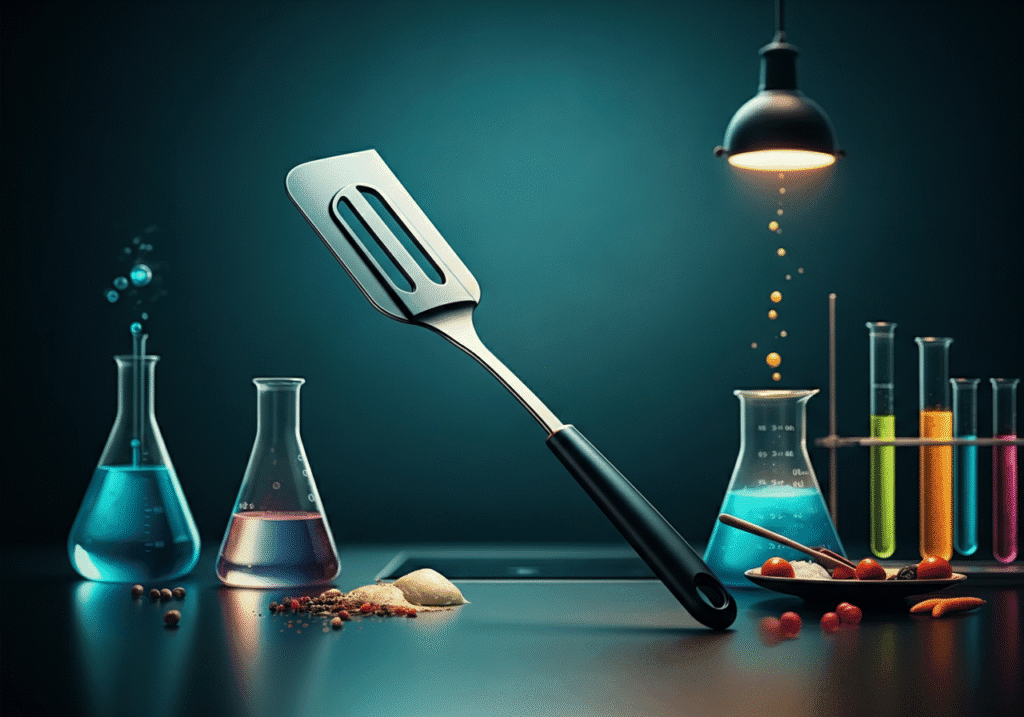
- Most lab spatulas have a double-ended design, which means they can be used for more than one thing. One end usually has a flat paddle for scraping or spreading, and the other end has a spoon or scoop for picking up powders like spices or baking soda.
- High-Quality Material: Most of the time, they are made of 304 or 316 stainless steel. This means that they won’t rust, get hot, or react with acidic foods.
- Slim Profile: Their thinness is what makes them stand out. They fit into the narrow necks of flasks and bottles, so they’re great for consumer jars like capers, tomato puree, or fancy mustards.
- Weighted Balance: A good metal spatula feels balanced in your hand, unlike cheap plastic tools. This gives you more control when decorating a cake or seasoning a soup.
Design & Build Quality
Chemistry spatulas are usually better made than regular kitchen tools because they are made for use in labs and factories. A tool in a lab can’t break, rust, or flake into a chemical mix.
Material Integrity
The stainless steel used in metal spatula chemistry doesn’t react with anything. This is very important for cooking. You don’t want your tool to make your food taste metallic, and you don’t want it to react with acidic foods like tomatoes or citrus. Not only do these tools look professional when they are polished to a mirror finish, but they also have less surface area for bacteria to hide on.
Durability
There are no moving parts, no glued joints, and no plastic handles that could melt if you accidentally leave it near a hot stove. It is basically one piece of forged metal. You could drop it, step on it, or run it through the hottest cycle of your dishwasher, and it would still look like new. You only have to buy it once, and you can keep it forever, so it’s a good choice for the environment.
Performance in the Kitchen
So, how does a tool made for mixing chemicals work when it comes to peanut butter or paprika? The answer is: very well.
The “Bottom of the Jar” Hero
We’ve all been annoyed when we had to leave perfectly good food in a jar because we couldn’t reach the bottom corner with a knife or spoon. You can use the flexible but strong flat end of a chemistry spatula to press against the curved glass of a jar and get every last bit of product out. This saves a lot of food waste and money over the course of a year.
The Perfect “Pinch”
A lot of recipes say to add a “pinch” of salt or a “dash” of cayenne. Using your fingers can be messy and wrong (especially if you just chopped up some chilies!). The small spoon end of a lab spatula is often the right size for these measurements. It lets you sprinkle seasoning with more control than a regular teaspoon can.
Plating and Decorating
You know that big tools can be clumsy if you’ve ever tried to put a delicate mint leaf on a dessert or a bit of icing on a cookie. The pointed tip on these spatulas is almost like an extension of your finger, which lets you do detailed work that makes your food look like it came from a professional bakery.
Ease of Use
The learning curve is one of the biggest things that stops people from trying new kitchen tools. Adding spatula chemistry tools to your routine is easy and doesn’t require any training.
- Dexterity: They feel natural in the hand because they are as thin as a pencil. This gives you a lot of freedom of movement.
- Cleaning: Stainless steel wipes clean right away, unlike wooden spoons that soak up oils or silicone tools that can hold on to strong smells like garlic. They can go in the dishwasher and dry quickly.
- Storage: They don’t take up much space at all. You can keep five or six of them in a jar on your counter without making your workspace messy, unlike big ladles or turners.
Pros and Cons
Here’s a quick list of the pros and cons of using metal spatula chemistry in your home cooking to give you a balanced view.
| Pros | Cons |
|---|---|
| Precision: Amazing control for small tasks and measurements. | Not for Non-Stick: Metal edges can scratch Teflon pans that are very thin. |
| Waste Reduction: Great for cleaning jars. | Size: Not big enough to mix up big bowls of batter or flip food. |
| Durability: Will not melt, rust, or snap. | Heat Transfer: Being metal, the handle can get hot if left in a boiling pot. |
| Hygiene: Doesn’t hold smells and is easy to clean. | Sharpness: Some ends can be sharp, so be careful with kids. |
| Price: Generally very affordable compared to “chef” branded tools. | Availability: Rarely found in standard supermarkets. |
Comparison with Competitors
You should know where the chemistry spatula fits in with the other tools you probably already have. The word “spatula” is a broad term, as general definitions show.
The Silicone Scraper (The Rubber Spatula)
This is the tool you likely use for cake batter. It has a wide, flexible head.
- Verdict: The silicone scraper is better for folding egg whites or getting the contents out of a big mixing bowl. But it doesn’t work at all when it comes to getting into small jars or handling small amounts of spices. The silicone scraper makes broad strokes, while the chemistry spatula is more precise.
The Fish Slice (The Turner)
We often call the metal tool used to flip eggs a “fish slice” in the UK, but Americans might call it a spatula.
- Verdict: These are two very different tools. You can’t use a lab spatula to flip a burger, and you can’t use a fish slice to measure 0.5 grams of saffron. They do very different things.
The Palette Knife
This is the closest relative. A palette knife is used for icing cakes.
- Verdict: A chemistry spatula is like a palette knife with two ends. The lab spatula is the best upgrade for you if you like using a palette knife but wish it could fit inside a spice jar.
Pricing & Value for Money
Prices for kitchen gadgets can get out of hand. You can buy a garlic press with a celebrity chef’s name on it for £50. This is where spatula chemistry tools really shine. They are cheap because they are made in large quantities for schools and businesses.
You can usually get a set of three or four stainless steel lab spatulas for less than £10. The value for money is great, especially since these tools are almost impossible to break. You aren’t paying for a brand name or fancy packaging; you’re paying for the usefulness of high-quality steel. This is one of the best things you can do if you want to save money while cooking at home.
User Reviews & Ratings
You won’t find these in regular kitchen stores, but you can find a lot of reviews from people who have found the secret on online marketplaces.
- The Baker: “I bought these for my son’s chemistry set, but I took them for my kitchen.” They are the only thing that can perfectly level off a measuring spoon.
- The Hot Sauce Lover: “I used to throw away bottles that still had sauce stuck to the bottom. I’ve saved enough on condiments to pay for this tool.
- The Artist: “I use these to set the table for dinner parties.” It makes me think I’m on a cooking show. I can put garnishes exactly where I want them.
Most people agree that once you start using them, you’ll find a lot of uses you didn’t expect. Most of the complaints are small, and they mostly have to do with people getting the wrong size (too short) for their jars.
Who Should Buy This Product?
Is a chemistry spatula right for you? We believe it is a must-have for:
- The Frugal Cook: If you hate throwing away food and want to make sure you get the most out of your grocery jars, this tool is a must-have.
- The Baker: To level off cups of flour and measure exact amounts of baking soda or spices.
- The Organizer: This tool is the best way to move powders without spilling if you put them in jars that match.
- The Parent: This is great for mixing medicines or breaking up small amounts of food for toddlers.
- The Coffee Nerd: Great for measuring exact grounds or stirring the bloom in a pour-over coffee.
Warranty & Support
These are often sold as generic scientific supplies, so they don’t usually come with a warranty like a toaster would. But because of how metal spatula chemistry works, you probably won’t need one. Stainless steel is very strong.
When you buy something, make sure it says “304 Stainless Steel” or “Surgical Grade Steel.” If the item you buy from a trusted online store (like Amazon or a science supply shop) is damaged when it gets to you, their normal return policies usually cover you.
Where to Buy
You won’t find these next to the potato peelers in the supermarket. Your best bets are:
- Online Marketplaces: Search for “Lab Spatula Set” or “Micro Spatula”.
- Science Supply Stores: Many sell directly to the public.
- Specialty Baking Shops: Sometimes sold as “modelling tools” for fondant icing.
Tips for Best Use
To get the most out of your new tools, here are a few tips from my own experience:
- Don’t scratch the pan; it’s made of hard metal. If you use it to scrape scrambled eggs off your non-stick frying pan, the coating will come off. Only use it on glass, ceramic, and metal containers.
- The Taste Test: The metal cools down quickly, so it’s a great way to dip into a simmering sauce, blow on it, and taste it. It’s a lot cleaner than dipping a tasting spoon twice.
- Taking off labels: The flat, sharp edge of a chemistry spatula is the best tool for getting rid of sticky price tags on new jars and containers.
- Don’t throw them away: They are small and thin, so they can easily fall into the plughole or into a trash can. Be careful when you wash them!
Conclusion:
It’s funny how we often try to solve simple problems in complicated and expensive ways. We buy big gadgets that say they can do everything, but they just sit in a drawer and collect dust. In contrast, the chemistry spatula is the opposite of that. It is simple, works well, and is not boastful.
You can be more accurate, waste less, and make cooking easier by using a lab concept called spatula chemistry in the kitchen. This small piece of stainless steel will probably be the tool you use the most, whether you’re leveling off a cup of flour for a birthday cake or trying to get the last bit of pesto for your pasta. It’s cheap, strong, and dependable—just the kind of tool we like at KitchenMaxi. So, take a tip from the scientists; your cooking will be better for it.
Frequently Asked Questions (FAQ)
What is a spatula used for in chemistry?
In chemistry, a spatula is usually used to move small amounts of solid chemicals, scrape things out of containers, or mix things in the lab.
What is a chemistry lab spoon called?
People often call a chemistry lab spoon a lab spatula or a microspatula. These tools are made for accuracy and are necessary for safely handling small chemical samples or fine powders.
What is the function of a spoon and a spatula in a laboratory?
In a lab, you can use both the spoon and the spatula to move, mix, or handle chemicals. The spoon is better for scooping and moving larger amounts, while the spatula is better for small, precise tasks.
What’s the difference between a spatula and a turner?
A spatula is a precise tool for moving chemicals in a lab, while a turner (which is often used in kitchens) is made to flip or turn food as it cooks. Their designs and purposes are very different depending on how they will be used.