Stainless Steel Electric Stove Range: Sizes, Types, and Features
A stainless steel electric range combines an electrically heated cooktop and oven in one appliance, with stainless steel used mainly on the exterior panels, controls, and oven door. Most full-size U.S. models are about 30 inches wide and use either exposed coils, a smooth radiant cooktop, or induction cooking.
The biggest mistake is choosing by appearance alone. Two stainless models that look almost identical can use very different cooktop technology, oven capacity, control placement, electrical circuits, cleaning systems, and cabinet dimensions.
A well-matched range gives you enough burner space for everyday cookware, an oven sized for the meals you normally prepare, and controls that fit the way your kitchen is arranged. The stainless finish also pairs easily with refrigerators, dishwashers, microwaves, and range hoods.
Most current full-size electric ranges are 30 inches wide. Whirlpool identifies 30 inches as the standard full-size width and also sells compact 24-inch models for smaller kitchens.
For a stainless steel electric stove range, the first decisions should be range width, freestanding or slide-in construction, and cooktop type. After those are settled, convection, Air Fry modes, oven capacity, cleaning systems, and smart controls become easier to compare.
“Stainless steel” usually describes the visible appliance finish rather than the cooking surface itself. A smooth-top electric model often has black ceramic glass surrounded by stainless trim or paired with a stainless door and control panel. GE’s current electric range specifications show this combination clearly.
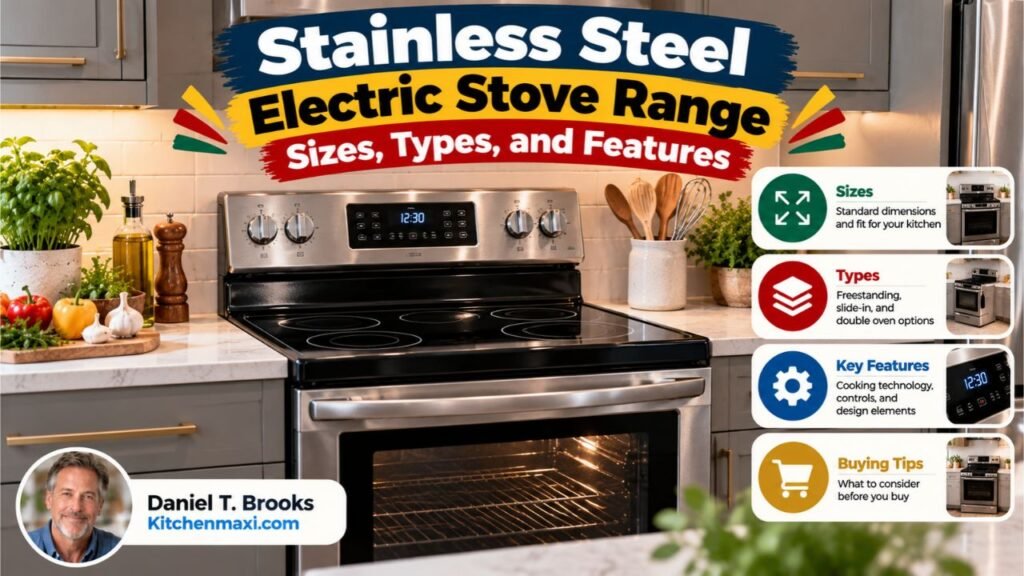
The sections below cover electric heating types, 24- and 30-inch sizes, slide-in versus freestanding construction, oven capacity, electrical requirements, cookware, stainless cleaning, major features, and the situations each range style suits best.
What Is a Stainless Steel Electric Stove Range?
A range is one appliance containing both a cooktop and an oven.
The terms stove and range are often used interchangeably in everyday conversation, though appliance manufacturers commonly use “range” for the combined unit.
A stainless electric range generally has:
- An electrically powered cooktop
- One or two electric ovens
- Stainless steel exterior trim or panels
- A storage, warming, or baking drawer on some models
- Front or rear-mounted controls
- A freestanding or slide-in body
The cooktop itself may not be stainless steel.
Stainless Steel Refers Mainly to the Finish
On many smooth-top ranges, the cooking area is ceramic glass.
For example, GE lists current stainless steel models with a black ceramic-glass radiant cooktop, stainless handle, and stainless exterior detailing.
Some entry-level ranges use exposed electric coils rather than glass.
The stainless finish therefore tells you more about appliance appearance than heating technology.
Electric Range and Induction Range Are Closely Related
Induction also runs on electricity, but it heats differently.
A traditional radiant electric element heats a coil below the glass, which then transfers heat into cookware. Induction creates an electromagnetic field that produces heat directly in compatible cookware. Whirlpool identifies coil, radiant, and induction as three electric stovetop types.
That distinction matters because cookware compatibility, temperature response, surface heat, and purchase cost change with the cooktop technology.
Key Takeaway: A stainless electric range combines cooktop and oven functions, while “stainless steel” normally describes its exterior finish rather than the heating surface.
Common Stainless Steel Electric Range Sizes
Width is the first dimension to check because existing cabinetry determines which range can physically fit.
30-Inch Electric Range
A 30-inch range is the main full-size U.S. format.
Whirlpool describes 30 inches as the standard width for full-size ranges. Its current electric range lineup includes numerous 30-inch radiant and induction models.
Actual width can be slightly below 30 inches. A GE stainless model, for example, measures 29⅞ inches wide, while another current GE platform is listed at a full 30 inches.
Do not assume a nominal 30-inch label gives you every installation dimension.
Check:
- Overall width
- Body depth
- Depth with handle
- Height to cooktop
- Rear-control height
- Door-open depth
- Required side clearances
24-Inch Electric Range
A 24-inch electric range is designed for apartments, small homes, accessory dwelling units, and compact kitchens.
Whirlpool describes 24-inch ranges as space-saving models for smaller kitchens.
Current retail listings also include 24-inch stainless models from several manufacturers, confirming that this remains an active compact category.
The smaller width usually means:
- Fewer large cookware positions
- Smaller oven capacity
- Less space between pots
- A better fit in narrow cabinet runs
Overall Depth Is Usually Greater Than Cabinet Depth
A nominal 30-inch range can extend roughly 26 to 29 inches from front to back before the oven handle is fully considered.
A current GE freestanding stainless model measures 29⅞ inches wide and 28 inches deep. A current Frigidaire slide-in model lists a 26-inch body depth and more than 47 inches with the oven door fully open.
This is why a range near an island needs door-opening clearance checked before purchase.
Key Takeaway: Most full-size stainless electric ranges are nominally 30 inches wide, while 24-inch models serve compact kitchens. Use the complete installation sheet rather than width alone.
Electric Cooktop Types on Stainless Steel Ranges
Electric ranges can look similar from across the room while cooking very differently.
Coil Electric Ranges
Coil models use exposed metal heating elements.
Electric current heats each coil, which then transfers heat into the base of the pan.
Advantages include:
- Simple construction
- Lower purchase prices on many models
- Replaceable coil elements
- No large glass cooktop surface to crack
Drawbacks include:
- More areas where spills can collect
- Drip pans that need cleaning
- A less flush appearance
- Less uninterrupted work surface
Whirlpool describes coil elements as exposed heating coils positioned above drip trays.
Radiant Smooth-Top Electric Ranges
Radiant models place electric elements beneath a ceramic-glass cooktop.
This is one of the most common designs in current stainless electric ranges.
GE explains that most of its current electric ranges and cooktops use radiant elements beneath smooth ceramic glass rather than exposed coils.
Advantages include:
- Flat appearance
- Easier wipe-down
- Multiple element sizes on many models
- Warming zones on some ranges
- A large continuous cooking surface
The glass stays hot after an element is switched off, so hot-surface indicator lights matter.
Flat-bottom cookware also produces better contact with the heated zone.
Induction Electric Ranges
Induction ranges use electricity too, but the cooktop produces an electromagnetic field that interacts with magnetic cookware.
The pan itself becomes the primary heat source.
Whirlpool notes that induction transfers heat directly into compatible cookware rather than first heating a radiant element and then transferring that heat through the glass.
Induction is attractive for:
- Fast heat changes
- Quick boiling
- Easier spill cleanup
- Less heating of the surrounding glass
- Precise low-temperature adjustment
Cookware must contain magnetic material.
Frigidaire recommends the simple magnet test: if a magnet sticks strongly to the pan base, the cookware is generally compatible with induction.
Key Takeaway: Coil ranges favor simplicity, radiant smooth tops give a flat glass surface, and induction offers faster response but requires compatible magnetic cookware.
Freestanding vs Slide-In Stainless Steel Electric Ranges
These two configurations dominate the residential market.
Freestanding Electric Range
A freestanding range can sit between cabinets or at the end of a cabinet run.
Traditional versions usually have a raised rear control panel.
Whirlpool describes freestanding ranges as models that can stand alone or fit between cabinetry.
They often make sense for:
- Straight replacements
- Rental properties
- Budget-focused kitchens
- Open-ended cabinet runs
- Kitchens that already use a rear-control range
A current GE stainless freestanding model measures about 47 inches high, 29⅞ inches wide, and 28 inches deep.
The 47-inch height includes the raised rear controls rather than the cooktop itself sitting 47 inches from the floor.
Slide-In Electric Range
A slide-in model is intended to fit between cabinets with controls toward the front.
Its lower-profile design keeps the backsplash visible.
Whirlpool describes slide-in ranges as front-control appliances that create a more built-in appearance.
A current GE 30-inch stainless slide-in measures roughly 37.1 inches high, 30 inches wide, and 28.6 inches deep.
Slide-in models suit kitchens where:
- Front controls are preferred
- A tiled backsplash should remain visible
- A cleaner cabinet line is desired
- The range is surrounded by countertops
Front-Control Does Not Always Mean Traditional Slide-In
Current manufacturers also sell freestanding ranges with front controls.
Read the installation classification rather than assuming control placement determines the body style.
Key Takeaway: Freestanding models are flexible replacements and often use rear controls, while slide-in ranges use a lower-profile front-control design for a more integrated cabinet appearance.
Oven Capacity and Cooking Features to Compare
Width tells you only part of the story.
Two 30-inch ranges can have different oven capacities and cooking systems.
Oven Capacity
Whirlpool divides current range capacities into general groups from about 3.0–4.0 cubic feet, 4.0–6.0 cubic feet, and models exceeding 6.0 cubic feet.
Current 30-inch models illustrate that range:
- GE models around 5.0–5.3 cu. ft.
- Frigidaire models around 6.2 cu. ft.
- Other full-size products exceeding 6 cu. ft.
A larger cavity is useful for:
- Large roasting pans
- Multiple racks
- Holiday meals
- Large sheet pans
- Batch baking
Interior dimensions still matter if you use an oversized roasting pan. Cubic-foot capacity alone does not prove that a particular pan fits.
Standard Bake
Traditional electric ovens rely mainly on heating elements above and below the cavity.
For everyday casseroles, baked goods, frozen food, and roasting, standard bake may be all you need.
Convection
Convection adds a fan to move hot air through the oven.
Current ranges may offer:
- Fan convection
- True convection
- Multiple convection modes
Whirlpool’s present electric lineup includes both fan-convection and true-convection configurations.
If you regularly roast vegetables, bake several trays, or want more cooking-mode choice, convection is worth comparing closely.
Air Fry Modes
Air Fry is now common on midrange electric ranges.
It generally uses high heat and forced air circulation inside the oven.
Do not choose a range only because “Air Fry” appears on the control panel. Compare the actual convection system, rack setup, preheat instructions, and oven size too.
Hidden Bake Element
Some ovens place the bottom heating element beneath the oven floor.
This leaves a flatter cavity floor for wiping spills.
Frigidaire highlights a hidden bake element on current induction-range models for this reason.
Single vs Double Oven
A double-oven electric range divides the available space into two separate cavities.
This is useful if you often cook two dishes at different temperatures.
The tradeoff is that each cavity is smaller than one large single oven.
Electrical Requirements for an Electric Stove Range
A full-size electric range is not a standard 120-volt countertop appliance.
Most Full-Size Models Need 208/240-Volt Service
GE states that its electric ranges require 240/208 volts.
Samsung’s current delivery requirements call for a dedicated, grounded 220/240-volt branch circuit protected by a 40-amp breaker for its electric range installation.
That 40-amp figure is common, but it is not universal.
Some models or induction configurations may specify another circuit rating. The rating plate and installation manual for the exact range control the final electrical requirement.
Three-Prong vs Four-Prong Connections
Existing homes may have different range receptacles.
Samsung’s installation information notes that electric-range locations may use three- or four-prong connections.
Do not assume your existing cord should simply be moved to the new appliance.
Installation requirements, local electrical rules, cord condition, and receptacle type need to match the appliance instructions.
Anti-Tip Bracket Installation Matters
A freestanding or slide-in range can tip forward if excessive weight is placed on an open oven door.
Samsung’s delivery requirements include anti-tip bracket installation as part of proper range setup.
The exact bracket design differs by manufacturer.
Key Takeaway: Full-size electric ranges commonly need 208/240-volt service and a dedicated circuit. Confirm breaker size, cord type, receptacle, and anti-tip requirements for the exact model before delivery.
Cookware for Stainless Steel Electric Ranges
The exterior finish does not determine cookware compatibility.
The cooktop type does.
Cookware for Coil and Radiant Electric Ranges
Most conventional cookware materials can work on coil or radiant heat.
For a smooth radiant surface, GE recommends flat-bottom pans and says stainless steel or aluminum cookware performs well. It also advises matching the pan size closely to the heating element.
A warped pan can rock on glass and create weaker contact with the heated surface.
Cookware for Induction Ranges
Induction requires magnetic cookware.
Often compatible:
- Cast iron
- Enameled cast iron
- Magnetic stainless steel
Often incompatible unless built with a magnetic base:
- Pure aluminum
- Copper
- Some stainless steel alloys
Frigidaire notes that not every stainless steel pan is magnetic, so “stainless steel” on a cookware box does not guarantee induction compatibility.
Protect Glass Cooktops From Scratches
Lift heavy cast iron rather than sliding it across ceramic glass.
Frigidaire specifically warns that rough cast-iron bases can scratch an induction glass surface.
The same caution is sensible for radiant ceramic glass.
Pros and Cons of a Stainless Steel Electric Range
| Pros | Cons |
| Matches many modern appliances | Stainless exterior shows fingerprints on some finishes |
| Available in budget through premium models | Smooth glass needs careful cleaning |
| No gas line needed | Full-size models usually need 208/240V service |
| Coil, radiant, and induction choices | Radiant glass stays hot after use |
| Many 30-inch replacement options | Induction may require new cookware |
| Convection and Air Fry widely available | Metal exterior can scratch |
| Front-control and rear-control styles | Power outage means cooktop and oven cannot operate |
| 24-inch compact models available | Installation dimensions vary by model |
Where Stainless Electric Ranges Make Sense
They fit well in kitchens that already have a range circuit and no gas line.
The stainless exterior also coordinates easily with other common appliance finishes.
Current retail inventories show a large selection of 30-inch stainless freestanding, slide-in, radiant, and induction ranges, so buyers are not limited to one price class or cooktop design.
Where Another Range Type May Fit Better
A gas range may appeal to someone who strongly prefers visible flame control and already has an approved gas connection.
A separate wall oven and cooktop can suit a custom kitchen layout.
A 24-inch electric range may make more sense where a 30-inch opening cannot be created.
How to Clean a Stainless Steel Electric Range
Two surfaces usually need different cleaning methods: the stainless exterior and the cooktop.
Clean the Stainless Steel Exterior With the Grain
Wait until the range is cool.
Whirlpool recommends starting with soap, water, and a soft cloth or sponge for general range cleaning. For stainless steel, it warns against steel wool, gritty cloths, abrasive cleaners, and other materials that can damage the finish.
On brushed stainless, wipe in the direction of the grain.
Use a soft microfiber cloth for drying to reduce streaks.
Clean a Ceramic-Glass Cooktop Separately
Do not assume a stainless cleaner belongs on the black glass cooktop.
Use the cooktop-cleaning method stated in the owner’s manual.
Remove sugary spills according to the manufacturer’s instructions because melted sugar can damage some glass surfaces as it cools.
Fingerprint-Resistant Stainless Is Still Stainless-Look Finish
Some ranges use finishes marketed as fingerprint resistant or smudge resistant.
A current Frigidaire stainless range, for example, uses a Smudge-Proof stainless finish.
Treat coated finishes according to their specific manual rather than using harsh stainless polish automatically.
Key Takeaway: Clean stainless exterior panels with soft, nonabrasive materials and treat the cooktop as a separate surface. Glass, coated stainless, and bare stainless may require different products.
Features Worth Checking Before Buying a Stainless Electric Range
The longest feature list is not automatically the best range.
Focus on functions that affect your normal cooking.
Element Size and Power
Look at the actual cooktop layout.
Useful configurations may include:
- Large 12-inch elements
- Dual-size elements
- Small simmer zones
- Warming zones
- Bridge or sync elements
A current Whirlpool radiant range, for example, offers a 12-inch 3000-watt element, while current GE radiant and induction models use different wattages and element sizes.
Match those zones to your common pots and pans.
Control Position
Rear controls keep hands farther from front knobs but require reaching across the cooktop.
Front controls remove that reach and suit slide-in styling.
Families with young children may also want to compare control-lock designs.
Oven Cleaning System
Common choices include:
- Manual cleaning
- Steam cleaning
- High-temperature self-clean
- Combination cleaning systems
Whirlpool’s lineup currently includes manual, self-clean, steam-clean, and AquaLift configurations depending on model.
Storage Drawer or Warming Drawer
A lower drawer may store sheet pans and racks.
On other ranges it may warm food or serve another cooking purpose.
Do not assume every bottom drawer is storage.
Smart Controls
Wi-Fi features can add:
- Remote oven monitoring
- Notifications
- App-based settings
- Firmware features on supported models
These features should come after fit, cooktop type, oven performance, and electrical compatibility in the buying decision.
How to Choose the Right Stainless Steel Electric Stove Range
Start with the physical opening.
Measure:
- Width at several points
- Height from finished floor to countertop
- Depth to the wall
- Space to an island
- Door-opening clearance
- Delivery path
Most full-size shoppers will land on a 30-inch model because that is the standard width.
Next, select the cooktop.
Choose coil if simple construction and low purchase price are priorities.
Choose radiant smooth top if you want familiar electric cooking with a flat glass surface.
Choose induction if quick response and direct pan heating matter enough to justify cookware compatibility checks.
Then decide between freestanding and slide-in construction.
After that, compare oven capacity, convection, cleaning mode, element layout, drawer function, and controls.
I would place smart features near the bottom of the list. A range that fits the kitchen, works with the electrical circuit, accommodates your cookware, and has the right oven space will matter more every day than an extra app function.
Conclusion
A stainless steel electric stove range combines an electric cooktop and oven with a stainless-look exterior, and the category includes far more variation than the finish suggests. Most full-size U.S. models are 30 inches wide, while 24-inch ranges serve compact spaces.
The most meaningful choice is the cooktop: exposed coil, radiant ceramic glass, or induction. From there, compare freestanding versus slide-in construction, oven capacity, convection, heating-element layout, cleaning method, cookware compatibility, and actual installation dimensions.
Before buying, verify the range’s full width and depth, electrical rating, receptacle, required breaker, door clearance, and anti-tip installation. A model that matches the kitchen physically and electrically is a much stronger choice than one selected mainly for stainless appearance or a long feature list.
FAQs About Stainless Steel Electric Ranges
What is the standard size of a stainless steel electric range?
Most full-size electric ranges in the U.S. are 30 inches wide. Whirlpool identifies 30 inches as the standard full-size range width, while 24-inch models are available for compact kitchens. Exact height and depth vary, so use the model’s installation dimensions rather than assuming all 30-inch ranges are identical.
Is a stainless steel electric range the same as an induction range?
Not necessarily. Stainless steel describes the exterior finish. A stainless electric range may use exposed coils, radiant elements beneath glass, or induction. Induction is one form of electric cooking that uses electromagnetic energy to heat compatible cookware directly.
Does an electric range need a 240-volt outlet?
Most full-size electric ranges require 208/240-volt electrical service rather than a standard 120-volt household receptacle. GE states that its electric ranges require 240/208 volts, and Samsung lists a dedicated 220/240-volt circuit in its current installation requirements. Check the exact model before electrical work begins.
Is a slide-in electric range better than a freestanding range?
Neither style is automatically better. A slide-in range uses front controls and creates a lower-profile, built-in appearance between cabinets. A freestanding range can stand independently and often makes replacement simpler in kitchens already set up for a rear-control appliance.
Can I use cast iron on a smooth-top electric range?
Yes, but lift cast iron instead of sliding it across ceramic glass. Rough cookware bottoms can scratch smooth cooktops. Keep the pan base clean and flat, and match the cookware size reasonably closely to the heating zone.
How do I know if my cookware works on an induction range?
Hold a magnet against the flat bottom of the pan. Strong attraction usually indicates induction compatibility. Cast iron works, and many stainless steel pans work, but not every stainless alloy is magnetic.
Is fingerprint-resistant stainless steel easier to clean?
It can reduce the appearance of fingerprints and smudges. Frigidaire, for example, markets current Smudge-Proof stainless finishes for easier exterior care. Cleaning instructions still vary by finish, so use the method listed for the exact appliance rather than aggressive polish or abrasive pads.
Should I choose radiant electric or induction?
Radiant is the simpler choice if you want a familiar smooth electric cooktop and broad cookware compatibility. Induction gives faster response and heats magnetic cookware directly, but cookware compatibility must be checked. Your existing electrical setup, budget, cookware, and preferred cooking response should drive the decision.