
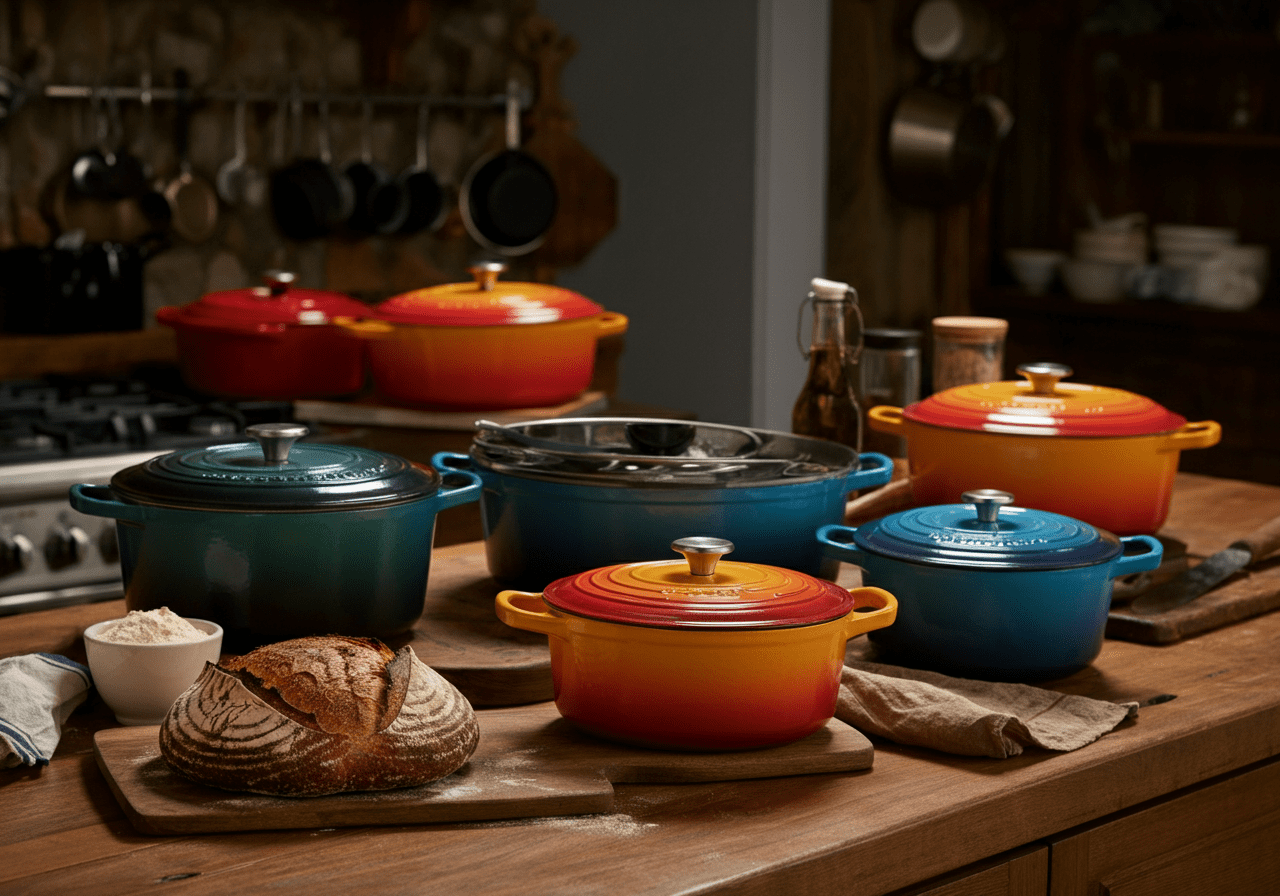

Let’s talk about heartbreak, the kind that only a sourdough baker really understands. You know how it feels when you’ve been hovering over your oven, hoping to see your dough spread out like a defeated pancake or cramped into a lopsided lump? I’ve been there, pacing my kitchen like a parent-to-be, silently asking my Dutch oven to work its magic. Trust me, nothing makes you less excited about baking than a Dutch oven that is too small or too big.
Choosing the right Dutch oven can feel like a big deal. It’s the perfect partner for making bread that you didn’t know you needed. You might think that picking a pot would be easy, but with all the different sizes, shapes, and prices that are through the roof, it’s easy to get lost! If I had a baguette for every time I doubted my Dutch oven, I could open a bakery.
The good news is that the right Dutch oven can help you become a sourdough hero. A Dutch oven is more than just a pot. It’s your way to make crust that makes your neighbors want to complain about the noise, a spring that deserves an Olympic medal, and a loaf that makes you smile every time you cut it.
I’ll show you the strange world of Dutch oven sizing with real advice, a few laughs, and a good dose of empathy (because let’s face it, bread bakers need it). This is where great bread starts!
Why Use a Dutch Oven for Sourdough?
Let’s get technical: steam is what makes your Dutch oven work. Imagine this: your dough hits the very hot bottom of the Dutch oven, and the moisture that was trapped in the dough turns into steam, making a warm bread sauna. Steam is a big deal, even without a fart joke.
Why is that important? For one thing, it makes your bread rise in the oven (in a good way). The crust stays soft, the yeast has a last party, and the sourdough rises to the top, which bread nerds call “oven spring.” Your crust hardens too quickly without steam, and your loaf ends up short and angry.
And then, halfway through baking, you take off the lid like it’s a big reveal on a baking show. The steam escapes, and the crust gets crispy, turning a golden-brown color that would look great on Instagram (please tag me; I’ll cheer you on). That’s what makes the Dutch oven so great!
It really is like turning your home oven into a professional bakery. Those heavy walls made of cast iron? They are both a shield and a secret weapon that makes your bread game a lot better by giving it even heat.
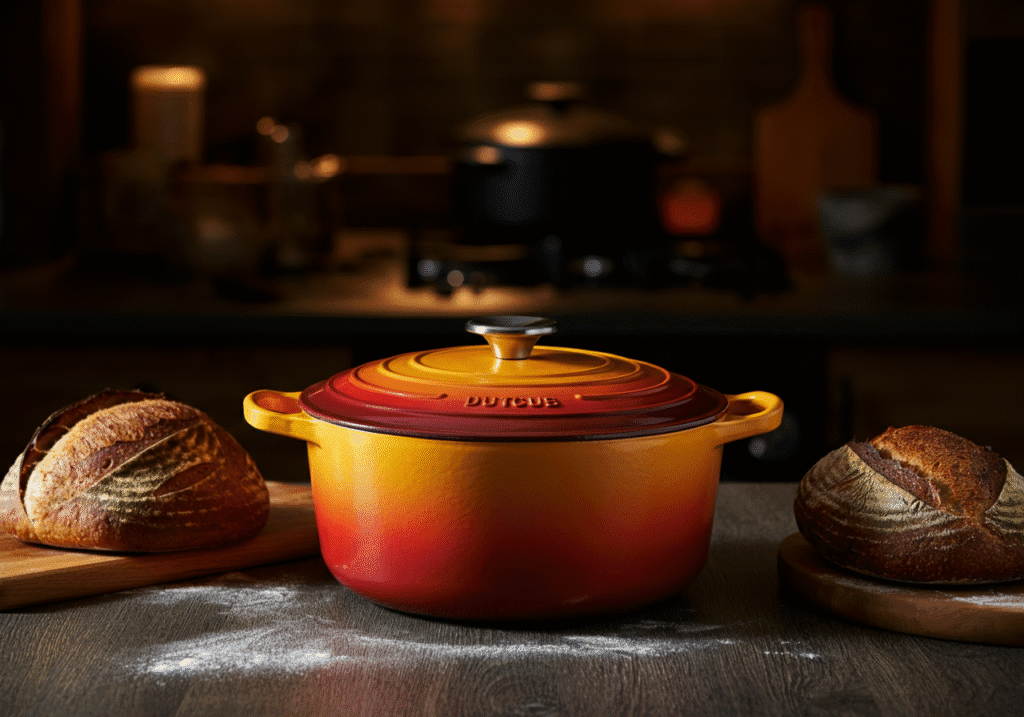
Finding Your Perfect Dutch Oven Size
Okay, this is where we get down to business. There isn’t a single answer to the Dutch oven problem, but there are some simple rules that I wish someone had put on my kitchen wall when I first started baking.
For Standard Loaves (500g Flour)
I bake with 500 grams of flour almost every weekend (okay, every weekend because I can’t stop eating carbs). A Dutch oven with a capacity of 5 to 6 quarts (about 4.7 to 5.7 liters) is perfect for this size. It’s just right—not too tight or too big.
Once, I tried to fit a big, hopeful dough baby into a small pot. The outcome? A loaf that is trying very hard to climb the sides and looks more like a bread volcano than dinner. Believe me, 5.5 quarts is the magic number for a standard loaf, just like my trusty Le Creuset. Your future self will thank you.
For Smaller Loaves (250g–350g Flour)
You might be baking for one person, or you might not be able to be trusted with a big loaf (no judgment—I once “tasted” my way through one on a cozy weekend). A Dutch oven that holds 3 to 4 quarts (2.8 to 3.8 liters) will be the perfect size for your dough. If you make it bigger, you’ll get a bread disk that works better for frisbee than brunch.
For Larger Loaves (750g–1000g Flour)
Having brunch? Or giving food to a family that loves carbs? A big Dutch oven, like 7 to 9 quarts (6.6 to 8.5 liters), is what you need right now. First, make sure it fits in your oven! I had to bake with the oven door open a little bit once because I was too confident and made it too big. That was a cold mistake (and my cat was happy).
Dutch Oven Size Recap – Quick Reference
| Flour Weight | Recommended Dutch Oven Size (Quarts) | Recommended Dutch Oven Size (Litres) |
|---|---|---|
| 250–350g | 3–4 qt | 2.8–3.8 L |
| 500g | 5–6 qt | 4.7–5.7 L |
| 750–1000g | 7–9 qt | 6.6–8.5 L |
Stick this chart on your fridge for an instant Dutch oven pep talk!
Does Shape Matter? Round vs. Oval
Don’t let anyone tell you that shape doesn’t matter. It does.
Round Dutch Ovens for Boules
The round Dutch oven is your best friend if you love classic, round boules (and who doesn’t?). It’s also probably the most useful thing you’ll ever bring home that isn’t a dog. I use mine for everything, from bread to chili, and sometimes both in one weekend.
Oval Dutch Ovens for Batards
Are you more of a Batard fan? Or maybe you want to cook a chicken on Sunday, which is very lucky. Oval Dutch ovens are great for longer loaves, but be careful: they can be hard to use on round burners. I learned that the hard way when my brother kept leaning like the Leaning Tower of Pisa in the kitchen.
Other Factors to Consider
Material
You’ll see two main types: enamelled and non-enamelled cast-iron Dutch ovens.
- Enamelled Dutch Oven: Your mom will love how easy it is to clean and how pretty it looks. A little expensive, but nice. I got mine for my birthday, and to be honest, it feels like a trophy in the kitchen.
- Non-Enamelled Dutch Oven: It’s cheaper, tough as nails, and if you season it right, it gets better with age, like cheese and, hopefully, us. A little extra care, but it’s worth it.
Lid Handle
Don’t forget about the handle! If you turn up the heat, some Dutch ovens’ handles will melt or break. Check to see if that little knob is plastic before you heat up your Dutch oven to 500°F. If it is, get a metal one instead. They’re cheap and can save your life. I learned that lesson the hard way when my kitchen smelled like plastic…
Your Partner in Baking
To sum it up, a 5- to 6-quart round Dutch oven is the holy grail for most people. Let’s be honest, it will never leave your stove. This Dutch oven traps steam, nails that crust, and consistently turns out swoon-worthy sourdough. Your Dutch oven is your trusty sidekick, not the star of the show, so don’t let perfectionism ruin the fun. Enjoy the messy, magical ride, laugh at the mistakes, and cheer on the wins, even if they’re not quite right. Have fun baking!
And don’t forget: every spot, chip, or little disaster just proves that you’re a real bread nerd.
Frequently Asked Questions
What Size Dutch Oven for Sourdough?
A Dutch oven that is 4 to 6 quarts is the best size for baking sourdough bread. This size works well for most sourdough recipes because it gives the dough enough room to rise without getting too crowded. A 5-quart Dutch oven is often thought to be the best choice because it can handle both small and large loaves. To get that signature crispy crust, make sure your Dutch oven has high sides and a lid that fits tightly to keep the steam in..
What size Dutch oven for sourdough bread?
A Dutch oven that is 4 to 6 quarts is usually the best size for baking sourdough bread. This size gives the dough enough space to rise while baking and keeps the heat and steam evenly distributed. A 5-quart Dutch oven is a popular choice for making sourdough because it can be used for a lot of different recipes. If you often bake smaller loaves, a 4-quart option might be enough. But if you bake bigger loaves or batches, you might need closer to 6 quarts.
Related Posts:
Why an 8-Piece Cookware Set is a Kitchen Essential
Cook Steak in a Cast Iron Skillet and Oven: A Perfect Guide
The Ultimate Guide to Perfect Filet Mignon in a Cast Iron Skillet