
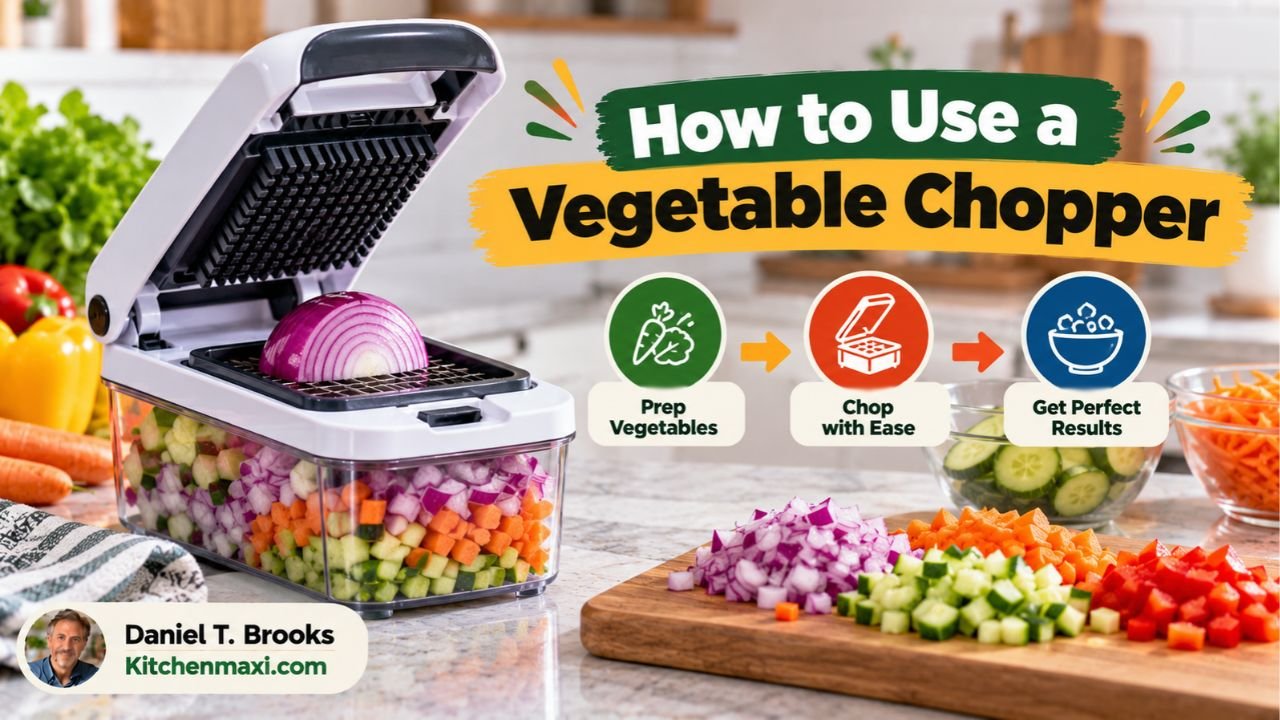
How to Use a Vegetable Chopper: Steps, Types, and Brand Tips
Set the chopper on a dry, stable counter, install the correct blade, prepare vegetables so they fit the cutting area, then use the tool’s press, pull, crank, or pulse mechanism until the pieces reach the size you want. The exact motion changes with the chopper design, but correct food prep and blade setup matter more than brute force.
Vegetable choppers can turn onions, peppers, cucumbers, zucchini, celery, potatoes, and many other ingredients into recipe-ready pieces with less repetitive knife work. Poor setup causes most problems: oversized food can jam a dicing grid, an overloaded bowl can stop a rotating blade from circulating food, and a loose attachment can produce uneven cuts.
The best results come from matching the food to the chopper. A push-down dicer is meant to create cubes by forcing food through fixed blades. A pull-cord chopper, crank model, push-plunger model, or electric mini chopper uses rotating blades and produces a coarse chop, fine chop, mince, or purée rather than true cubes.
Using the tool correctly also gives you more control over cut size, texture, and batch consistency. Firm vegetables can stay in distinct pieces, while onions and herbs can be chopped finely without running the blade long enough to turn them wet or pasty.
The safest approach to how to use a vegetable chopper starts with identifying the mechanism before adding food. A hinged grid chopper needs a firm downward press, while a bowl-style chopper works better with controlled pulls, turns, presses, or short electric pulses.
Fresh produce should be rinsed under running water before cutting. Firm produce such as potatoes can be scrubbed with a clean produce brush. Do not wash fruits or vegetables with dish soap or household detergent. Drying excess surface water can also give cleaner results with onions, peppers, herbs, and other foods that release moisture quickly.
The sections below cover setup, blade selection, food preparation, cutting technique, onions and other common vegetables, hard and soft ingredients, different chopper designs, popular brands, cleaning, storage, safety, and fixes for common chopping problems.
What Is a Vegetable Chopper and How Does It Work?

A vegetable chopper is a hand-powered or electric kitchen tool that cuts produce into smaller pieces using fixed or rotating blades.
The name covers several tools that work in very different ways.
Grid-Style Vegetable Choppers
A grid chopper has a frame containing rows of sharp intersecting blades.
You place food on top of the blade grid, then close or press a hinged lid. A matching pusher forces the food through the grid and into a collection container underneath.
The grid determines the finished width of the pieces.
A small grid creates fine dice. A larger grid creates bigger cubes.
These models are good for:
- Onions
- Bell peppers
- Cucumbers
- Zucchini
- Celery
- Firm tomatoes
- Potatoes, when the model permits them
- Other produce that can be cut to fit the grid
The food still needs some knife preparation. A vegetable that is wider than the cutting area should be halved, quartered, or trimmed before pressing.
Bowl-Style Vegetable Choppers
A bowl chopper contains a central blade assembly that rotates through food.
The blade may be powered by:
- Pull cord
- Hand crank
- Push-down plunger
- Spring mechanism
- Electric motor
These choppers do not normally create square dice.
Instead, they chop food repeatedly as the blade spins. More blade cycles produce smaller pieces.
A few rotations may leave a coarse texture. More rotations can produce a fine mince, and prolonged processing can move soft foods toward a purée.
Key Takeaway: A fixed dicing grid makes defined cubes, while a rotating-blade chopper makes chopped or minced pieces. Identify the mechanism first because the correct operating technique is different for each design.
Vegetable Chopper Parts to Identify Before You Start

Take a minute to identify the working parts before loading vegetables.
Blade or Cutting Insert
The cutting insert determines what the tool does.
A multi-function chopper may include:
- Fine dicing grid
- Large dicing grid
- Straight slicer
- Julienne blade
- Wavy slicer
- Fine grater
- Coarse grater
- Spiralizer insert
Do not assume every insert is installed the same way.
Look for arrows, lock marks, tabs, or wording such as “this side up.”
The insert should sit flat and lock into its intended position. If it rocks, lifts, or sits at an angle, remove it and reinstall it before adding food.
Pusher or Pressing Lid
A grid chopper usually has a pusher plate on the underside of the hinged lid.
Its raised teeth line up with spaces in the blade grid and force food completely through the cutters.
Food residue often becomes packed between these teeth. A clogged pusher can stop the lid from closing fully during the next batch.
Collection Container
The container catches the finished food.
Make sure the container is seated correctly before pressing.
Do not continue chopping once diced vegetables are piled directly under the grid. A full container can block new food from falling through and make the lid much harder to close.
Rotating Blade Assembly
Bowl-style choppers usually have a removable blade column placed on a central shaft.
The assembly should sit fully down on the shaft before food is added.
Handle it by the hub or other safe gripping area rather than touching the cutting edges.
Safety Holder
Choppers with mandoline-style slicing inserts may include a food holder or hand guard.
Use it.
A slicer exposes a long sharp edge, and the risk rises as the vegetable becomes shorter.
Key Takeaway: Locate the blade, pusher, container, locking points, rotating shaft, and any safety holder before adding food. Correct assembly prevents jams, poor cuts, and unnecessary contact with sharp edges.
How to Prepare Vegetables Before Using a Chopper

Preparation is one of the biggest differences between clean cuts and a jammed tool.
Wash Produce Before Cutting
Rinse fresh vegetables under running tap water.
Scrub firm produce such as potatoes or carrots with a clean produce brush if needed.
Remove damaged areas before chopping.
Produce labeled ready-to-eat or pre-washed normally does not need another wash.
Peel Only When the Recipe Calls for It
Peeling depends on the vegetable and dish.
You may want to peel:
- Onions
- Garlic
- Mature carrots
- Potatoes for mashed or smooth dishes
- Thick-skinned produce
Cucumber, zucchini, young carrots, and many potatoes can often be chopped with edible skin left in place.
Remove Stems, Cores, Seeds, and Pits
A vegetable chopper is meant to cut edible food, not hard pits or dense nonfood parts.
Remove:
- Pepper stems and cores
- Peach or avocado pits
- Apple cores when needed
- Tough squash stems
- Hard seed clusters when appropriate
Never send a fruit pit, bone, shell, or stone through a chopper blade.
Cut Large Vegetables Into Smaller Sections
Do not treat pre-cutting as unnecessary work.
It protects the chopper and gives the blades a manageable starting shape.
A whole large onion may be too wide for a fine dicing grid. Quarter it.
A thick carrot may need to be cut into shorter pieces or split lengthwise.
A potato may need to be halved or quartered.
For a rotating-blade bowl, starting with similarly sized chunks gives the blade a better chance of chopping everything at roughly the same rate.
Create a Flat Side When Possible
Round vegetables can roll across a grid.
Cutting one flat surface gives the ingredient a stable base.
Place the flat side against the cutting grid when the chopper instructions support that orientation.
This works especially well with:
- Onion halves
- Potato pieces
- Zucchini sections
- Cucumber sections
- Bell pepper panels
Key Takeaway: Wash and trim produce, remove hard nonfood parts, cut oversized vegetables to fit the tool, and create a flat contact surface when possible. Proper preparation reduces jams and uneven pieces.
How to Use a Vegetable Chopper Step by Step
The following method focuses on the common hinged manual vegetable chopper with a dicing grid and catch container.
1. Place the Chopper on a Stable Counter
Choose a flat, dry work surface.
Check that the base or container is not rocking.
If the unit has nonslip feet, make sure they are clean and contacting the counter.
Do not operate a press-style chopper on a wet surface where it can slide as downward force is applied.
2. Choose the Correct Blade
Decide what cut you need before loading the vegetable.
Use a fine dicer for small pieces such as:
- Finely diced onion
- Chilies
- Garlic, if permitted
- Small pepper pieces
- Salsa ingredients
Use a large dicer for foods such as:
- Larger onion cubes
- Cucumber
- Zucchini
- Pepper
- Potato
- Fruit salad pieces
A slicing, julienne, or grating attachment uses a different motion from a dicing grid. Do not push food onto a mandoline-style blade with bare fingertips.
3. Lock the Blade Into Place
Insert the blade exactly as the chopper is designed to accept it.
Make sure:
- The correct side faces upward.
- All tabs are seated.
- Any blade lock is engaged.
- The insert does not move when lightly touched at a safe plastic edge.
Never press food through a loose grid.
4. Prepare the Vegetable to Fit the Blade Area
The vegetable should sit entirely inside the cutting area.
If part of an onion or potato extends beyond the metal grid, cut it smaller.
With a fine dicing insert, food often needs more pre-cutting than it does with a large grid.
Hard produce should also be thinner or smaller than soft produce because it creates more resistance.
5. Center the Vegetable on the Grid
Place the food near the center rather than balancing it partly over the plastic frame.
Put a stable flat side against the blade when practical.
Check that your fingertips are completely away from the cutting area before moving the lid.
6. Bring the Lid Into Position
Lower the lid until the pusher contacts the food.
Keep your hands on the designated handle or pressing surface.
Do not hold the vegetable in place while the lid comes down.
If the food will not remain stable by itself, cut it into a safer shape.
7. Press the Lid Down Firmly
For many hinged grid choppers, use one firm, straight downward motion.
Pressing slowly in several weak stages can let some foods shift, crush, or become stuck halfway through the grid.
Do not strike the tool violently.
If ordinary firm pressure does not move the vegetable through the blades, stop. The food may be too large, too hard, or incorrectly positioned.
8. Open the Lid and Check the Grid
Lift the lid after the vegetable has passed through.
Look for pieces stuck:
- In the grid
- In the pusher teeth
- Around the blade frame
Use the supplied cleaning comb, brush, scraper, or the method listed by the manufacturer.
Never push food out from the sharp side with your fingers.
9. Empty the Container Before It Becomes Packed
Watch the level under the grid.
If chopped pieces reach the underside of the cutting frame, stop and empty the container.
A packed container creates resistance from below and can make later presses feel much harder.
10. Change Blades Only With the Chopper Empty
If you need a different size, remove the food and open the unit fully.
Grip the insert only at the intended plastic tabs or safe edges.
Store the removed blade somewhere that will not expose the cutting side.
11. Rinse the Blade Soon After Use
Onion layers, pepper skin, potato starch, and vegetable fibers are easier to remove while fresh.
Rinse the grid and pusher after chopping rather than leaving food to dry inside small openings.
Use the manufacturer-supplied cleaning tool when one is included.
Key Takeaway: Secure the chopper, lock in the correct blade, pre-cut vegetables to fit, place food fully inside the grid, press straight down, empty the container before it backs up, and clean residue without putting fingers into the blades.
How to Get Even Cuts With a Vegetable Chopper

Using the same chopper does not automatically produce the same result every time. Food size, firmness, orientation, and blade choice all matter.
Keep Starting Pieces Similar
If one carrot piece is thick and another is thin, the amount of force needed will differ.
Try to give the chopper pieces with similar:
- Width
- Height
- Firmness
- Shape
For bowl choppers, equal starting chunks also reduce the chance of getting tiny bits mixed with large untouched pieces.
Match the Grid to the Recipe
Small dice are useful for:
- Salsa
- Relish
- Sauces
- Omelets
- Stuffing
- Fine soup bases
Larger dice fit:
- Roasted vegetables
- Stews
- Chunky salads
- Potato dishes
- Kebabs
- Fruit bowls
The smallest blade is not automatically the best blade.
A fine grid puts more cutting edges against the food, so hard vegetables require more force.
Keep the Press Straight
Angled pressure can make food shift sideways.
Stand in front of the chopper and press down over the center of the lid.
If one side closes before the other, reset your grip.
Work in Batches
Do not pile several thick vegetables onto a grid unless the instructions specifically permit that load.
One correctly positioned piece often cuts faster than a crowded grid that needs repeated attempts.
Key Takeaway: Similar starting pieces, the correct grid, centered pressure, and smaller batches produce cleaner, more repeatable cuts.
How to Use a Vegetable Chopper for Common Vegetables

Different produce behaves differently against a fixed grid or rotating blade.
How to Chop Onions With a Vegetable Chopper
Peel the onion and remove the papery skin.
Cut a large onion into halves or quarters so each piece fits fully over the dicing blade. Place the flat cut surface against the grid and press firmly.
For a rotating chopper, cut the onion into several similar chunks, place them around the blade, and use short cycles. Stop early for coarse onion; continue gradually for finer pieces.
Avoid continuous electric processing if you want distinct pieces. Onion can release water quickly and move from chopped to wet pulp.
How to Chop Potatoes With a Vegetable Chopper
Check that your model permits raw potato before starting.
Potatoes are much harder than ripe tomatoes or cucumber.
Cut a large potato into smaller slabs or chunks that fit the entire grid. A coarse dicing blade usually requires less force than a fine grid.
If the lid stops firmly before the potato passes through, do not put your full body weight onto the plastic housing. Remove the potato and cut it thinner.
Some choppers specifically exclude very hard produce such as raw sweet potato or beet.
How to Chop Carrots With a Vegetable Chopper
Trim the carrot ends and peel if desired.
For a grid chopper, cut thick carrots into short sections and split them lengthwise if necessary. A large grid is generally easier on dense carrots than a fine dicer.
For a rotating bowl model, cut carrots into smaller pieces than soft vegetables.
If a pull cord becomes difficult to move, stop and reposition or reduce the carrot pieces rather than jerking the cord.
How to Chop Bell Peppers With a Vegetable Chopper
Remove the stem, seeds, and thick inner membranes.
Cut the pepper into flat panels sized for the grid.
Lay a panel flat across the dicing insert and press.
Peppers usually work well because the flesh is firm but not extremely dense. Very thin skin can occasionally remain attached between pieces, so inspect the grid between batches.
How to Chop Tomatoes With a Vegetable Chopper
Choose a firm tomato if you want defined pieces.
Very ripe tomatoes may collapse rather than cut cleanly through a grid.
Remove the stem area and cut large tomatoes into sections that fit.
Use a larger grid for salsa-style chunks.
For bowl choppers, use only a few short blade cycles. Too much processing releases juice and seeds and quickly turns tomato into a sauce-like mixture.
How to Chop Cucumbers and Zucchini
Trim the ends.
Large vegetables can be halved lengthwise or cut into shorter sections.
Both cucumber and zucchini are softer than potato, so they normally need less pressure.
If the vegetable has a very soft, watery center, the center pieces may not look as square as the firmer outer flesh.
How to Chop Celery
Trim the root end and damaged leaves.
Cut long stalks into sections that fit the blade area.
For a dicing grid, place the pieces flat rather than trying to press a tall bundle upright.
Celery strings can sometimes remain connected after cutting. A sharp grid and short starting sections reduce that problem.
How to Chop Garlic and Chilies
Use a fine grid only if the manufacturer lists very small ingredients as suitable.
A small rotating-blade chopper is often better for garlic, chilies, herbs, and other ingredients that need a mince rather than cube-shaped pieces.
Use short cycles and inspect frequently.
Key Takeaway: Soft vegetables need less force and fewer blade cycles, while carrots and potatoes need smaller starting pieces. Very ripe tomatoes, hard sweet potatoes, and fibrous produce may require another cutting method.
Foods You Should Not Force Through a Vegetable Chopper
A vegetable chopper has limits.
Avoid forcing unsuitable foods simply because they fit into the container.
Common problem foods include:
- Frozen solid vegetables
- Bones
- Fruit pits
- Hard shells
- Ice, unless the model specifically supports it
- Very hard raw sweet potato on models that prohibit it
- Hard beet on models that prohibit it
- Large chunks that extend outside the grid
- Hot food when the bowl is not rated for high temperatures
Frozen foods and pits can chip or deform thin cutting edges.
Hot ingredients can damage some plastics or create steam under a closed lid.
Stringy ingredients such as lemongrass may wrap around a rotating shaft rather than chop cleanly. Slice highly fibrous foods across the fibers first or use another tool.
How to Use Different Types of Vegetable Choppers
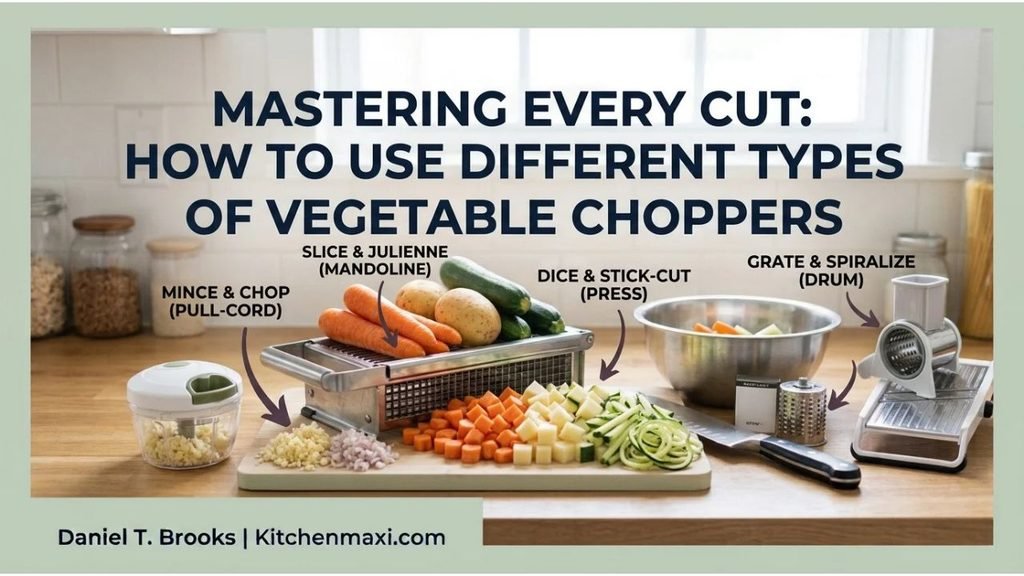
Each style needs a different motion. These are short operational overviews rather than model-specific instructions.
How to Use a Push-Down Grid Vegetable Chopper
Install the dicing grid, cut the vegetable smaller than the blade area, place a flat side against the grid, and close the lid with one straight, firm press. The cubes fall into the container below. Use a coarse grid for harder produce and a fine grid for small onion or pepper pieces. Stop if the lid meets strong resistance. Never clear the underside of the grid with your fingertips.
How to Use a Pull-Cord Vegetable Chopper
Place the central blade in the bowl, add pre-cut vegetables around it, lock the lid, then pull the cord with smooth controlled strokes. Start gently with hard ingredients. Inspect the food after a few pulls and continue only if a finer texture is needed. More pulls mean smaller pieces. Do not overfill the bowl or yank a cord that feels jammed.
How to Use a Hand-Crank Vegetable Chopper
Fit the rotating blade onto the center post, add manageable food pieces, lock the lid, and turn the crank steadily. Stop periodically to inspect the texture. If pieces stay above the blade, redistribute them after the blade stops. Hard vegetables should be cut smaller before loading. Keep one hand on the container or handle so the chopper remains stable while the crank turns.
How to Use a Push-Plunger Chopper
Place prepared vegetables inside the cup or on the approved cutting surface, attach the chopping unit, and press the top plunger repeatedly. Each press rotates or moves the blade and reduces the food size. Fewer presses leave coarse pieces; more presses create a finer chop. Do not put fingers beneath the chopping mechanism, and wait until the blade stops before opening the container.
How to Use an Electric Vegetable Chopper
Install the blade in the work bowl, add similarly sized vegetable chunks, lock the bowl and lid, plug in the unit, and use short pulses. One-second pulses give better control than a long continuous run for vegetables. Stop and scrape down food only after unplugging or switching the unit fully off. Electric choppers are suited to chopping and mincing rather than producing grid-cut cubes.
How to Use a Mandoline-Style Chopper Attachment
Install the slicer, julienne, or grater insert and secure the base over its container. Attach the vegetable to the supplied food holder. Move the holder across the blade with controlled, even strokes. Keep using the guard as the vegetable becomes shorter. Do not hold a small remaining piece with bare fingers near the exposed slicing edge.
Key Takeaway: Grid choppers need a straight press, pull-cord models need smooth pulls, crank choppers need steady turns, plunger models need repeated presses, and electric choppers work best with short pulses.
How to Use Different Vegetable Chopper Brands
Brand designs vary by model, so the product manual should take priority. The following sections give a short overview of common operating patterns.
How to Use a Fullstar Vegetable Chopper
For common Fullstar grid-style models, place the container on a stable surface, install the selected blade in the correct orientation, and prepare food so it stays completely inside the cutting area. Put the flat or larger side of the vegetable on the grid and press the pusher down firmly. Fine grids need smaller starting pieces. Empty the container before food reaches the grid, and use the supplied cleaning tools rather than fingers to clear packed residue.
How to Use a Mueller Vegetable Chopper
A Mueller Pro-Series style chopper uses interchangeable dicing, slicing, julienne, and grating inserts. For dicing, lock the selected grid into the base, place a pre-cut ingredient entirely inside the blade frame, then close the cover in one swift, firm motion. For slicing or grating, attach the matching insert and use the safety holder. Small and large dicer sizes create different cube sizes, so match the blade to the recipe.
How to Use a Geedel Vegetable Chopper
Many Geedel grid models use a container, lid, pusher, and interchangeable dicing or grating blades. Pre-cut large vegetables, lock the chosen insert into place, center the food over the cutting area, and press the lid down with controlled force. Geedel also sells hand-crank choppers; on those models, install the central rotating blade, add small food pieces, close the lid, and turn the handle until the texture is right.
How to Use a Cuisinart Chopper
A Cuisinart Mini-Prep style appliance uses an electric rotating blade rather than a dicing grid. Cut vegetables into roughly 1/2- to 1-inch pieces, fill the bowl no more than the model permits, lock the lid, and use the Chop control in short pulses. On Mini-Prep models with an auto-reversing blade, the sharp edge is intended for chopping softer foods such as onions and herbs. Stop and scrape the bowl when needed.
How to Use a KitchenAid Food Chopper
For a KitchenAid electric food chopper, install the multipurpose blade, add prepared ingredients, lock the lid, select the chop setting on models that provide chop and purée choices, then use the pulse/on control. Rapid presses and releases create a coarser chop. Holding the control longer makes the texture finer. Keep ingredients below the bowl’s stated capacity and wait for the blade to stop before removing the lid.
How to Use an OXO Vegetable Chopper
The OXO Vegetable Chopper with Easy-Pour Opening uses a fixed stainless cutting pattern and a pressing lid. Trim the vegetable so it fits the recessed cutting area, place it securely, then close the lid in a firm motion so the food passes into the container. OXO also sells rotating-blade push and crank choppers; those models need repeated knob presses or handle turns rather than a single grid press.
How to Use a Ninja Express Chop
A Ninja Express Chop is a small electric rotating-blade chopper. Seat the blade in the bowl, add pre-cut vegetables, fit the splash guard or lid as required, attach the motor head correctly, then use short controlled pulses. Stop before vegetables turn too fine. Unplug and wait for the blade to stop before opening or disassembling the unit. Treat the loose blade assembly carefully during washing.
How to Use a Brieftons Pull-Cord Chopper
For a Brieftons QuickPull style chopper, seat the blade on the bowl pin, cut soft foods into manageable chunks and hard foods smaller, then distribute the ingredients around the blade. Lock the pull-cord lid and begin with gentle pulls. Inspect the texture every few pulls. Do not force the cord when resistance is high; open the bowl and reposition the food after the blade stops.
Key Takeaway: Fullstar, Mueller, and many Geedel models commonly use press-through grids, while Cuisinart, KitchenAid, Ninja, OXO, Brieftons, and some Geedel models also use rotating blades. Match your technique to the exact mechanism rather than the brand name alone.
How Many Times Should You Press, Pull, or Pulse a Vegetable Chopper?
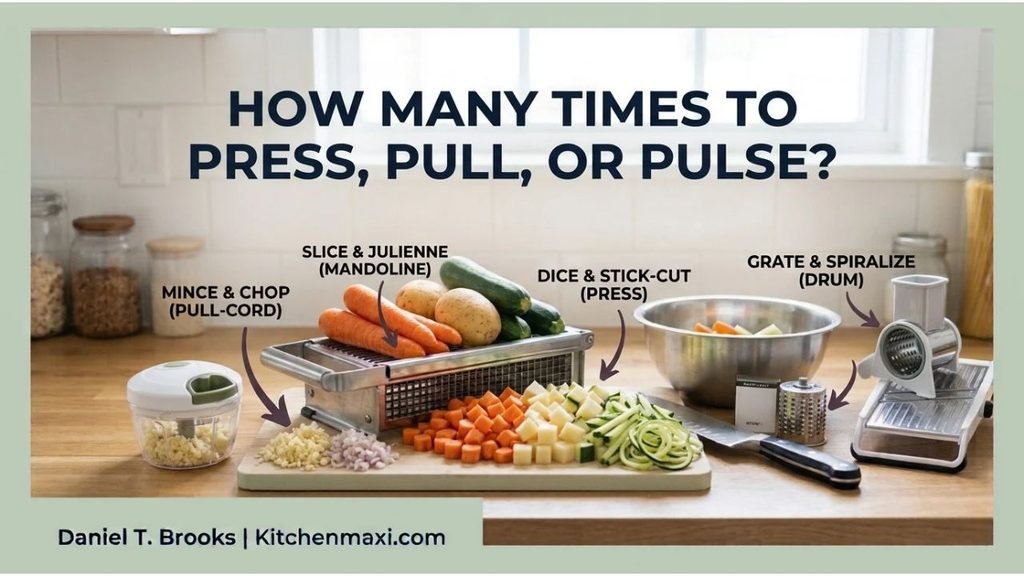
There is no universal number because blade shape, food quantity, motor speed, and vegetable firmness vary.
For a grid-style dicer, one complete press should normally finish one properly sized piece.
If repeated hard presses are needed, check:
- Food size
- Food hardness
- Grid size
- Blade sharpness
- Grid blockage
- Container fill level
For rotating choppers, work gradually.
A practical pattern is:
- Run two or three short cycles.
- Stop.
- Check the texture.
- Redistribute large pieces if necessary.
- Continue one or two cycles at a time.
This prevents soft vegetables from moving past finely chopped into paste.
For onions used in salsa, you may want visible small pieces.
For sauce, dressing, garlic paste, or purée, more cycles may be appropriate.
How Full Should a Vegetable Chopper Be?
Avoid filling a bowl to the top.
A rotating blade needs space for pieces to move through its cutting path.
If the bowl is packed tightly, food near the blade may become extremely fine while pieces at the top remain nearly whole.
Manufacturer capacities differ. Some bowl choppers work best with small batches well below the maximum container volume.
For a press-through grid, the catch container can hold more finished food, but it still needs empty space immediately below the blade.
Stop once diced vegetables begin approaching the underside of the grid.
Working in two batches is usually faster than clearing a jam caused by overfilling.
How to Use Vegetable Chopper Blades and Attachments
Multi-function models can do much more than simple chopping.
Fine Dicing Blade
A fine dicer produces small cubes.
Use it for ingredients such as:
- Onion
- Shallot
- Pepper
- Chili
- Zucchini
- Mushroom
Hard food creates more resistance on a fine grid because more blades contact it at once.
Pre-cut dense vegetables smaller.
Large Dicing Blade
A large dicer needs less pressure and leaves larger cubes.
It suits:
- Potato
- Cucumber
- Zucchini
- Onion
- Bell pepper
- Fruit
This blade is often a better starting choice for a new chopper user.
Straight Slicer
A slicing insert creates flat pieces rather than cubes.
Secure the insert, use the safety holder, and slide the vegetable across the blade in the specified direction.
Keep fingertips behind the guard.
Julienne Blade
A julienne blade creates thin strips.
It works well for:
- Carrot
- Zucchini
- Cucumber
- Potato
Use long, controlled strokes and do not abandon the food holder when the ingredient becomes small.
Grating Blade
A grating insert can shred vegetables or certain cheeses.
Choose coarse or fine grate based on the dish.
Use the supplied holder on exposed grating surfaces.
Spiralizer Attachment
Trim the vegetable ends and center the produce in the spiralizing holder.
Long, relatively straight vegetables such as zucchini and carrots are usually easiest to spiralize.
Use the supplied grip rather than pushing the final short piece toward the blade with your hand.
Key Takeaway: Fine and large grids control cube size, while slicers, julienne blades, graters, and spiralizers need their own cutting motion and safety holder.
Why Your Vegetable Chopper Is Hard to Press
A chopper should require some force with firm produce, but excessive resistance points to a problem.
The Vegetable Is Too Large
This is the first thing to check.
If food extends beyond the blade area, the plastic frame may be taking part of the load.
Cut the vegetable smaller.
The Vegetable Is Too Hard for the Blade
Raw beet, dense sweet potato, and very thick carrot sections can exceed what some manual choppers are built to cut.
Check the manual’s food restrictions.
Do not assume that sharper-looking blades mean the frame can tolerate unlimited pressure.
The Fine Grid Is Too Small for the Food
A fine grid has many more cutting edges contacting the ingredient at once.
Switch to a larger dicing grid or pre-cut the food thinner.
Food Is Stuck in the Grid
Pepper skin, onion membrane, celery fibers, or potato pieces can remain between the blades.
Unplug an electric unit or fully stop manual operation, then clear the insert with the supplied tool.
The Collection Container Is Full
Finished pieces can push upward against the grid.
Empty the container and try again.
The Blade Is Installed Incorrectly
An insert that is upside down, loose, or partially locked may not cut correctly.
Remove it safely and reinstall it.
Key Takeaway: Excessive resistance usually comes from oversized food, a grid that is too fine, a clogged blade, a full container, or incorrect assembly. Fix the cause rather than adding more force.
Why a Vegetable Chopper Makes Mushy or Uneven Food
Texture problems are common with rotating-blade choppers and soft produce.
The Vegetable Is Too Ripe
Very ripe tomatoes, peaches, and similar foods collapse easily.
A knife may give a cleaner dice than a grid chopper in this situation.
You Chopped for Too Long
Rotating blades keep cutting every time they pass through the food.
Stop sooner.
For electric models, switch from continuous operation to short pulse cycles.
For pull-cord and crank models, inspect the contents after a few strokes.
The Bowl Is Overfilled
An overloaded bowl prevents food from circulating.
Some pieces remain large while pieces near the blade become tiny.
Reduce the batch size.
Starting Pieces Are Unequal
A whole garlic clove, large onion quarter, and tiny pepper piece will not finish at the same time.
Start with pieces closer in size if you want a similar final texture.
Watery Vegetables Were Processed Too Aggressively
Tomato, cucumber, onion, and zucchini release moisture when repeatedly cut.
For a coarse salsa or salad, stop while distinct pieces remain.
Key Takeaway: Mushy food usually comes from overprocessing or very soft produce, while uneven food often comes from overloading or starting with pieces of very different sizes.
Vegetable Chopper Safety Tips
The blades deserve the same respect as a sharp kitchen knife.
Keep Fingers Away From Blade Openings
Never test sharpness with your fingertip.
Do not push stuck food through a dicing grid by hand.
Use:
- Cleaning brush
- Grid comb
- Plastic scraper
- Food pusher
- Other supplied tool
Use the Safety Holder on Slicing Attachments
The danger rises as the vegetable becomes shorter.
Discard or hand-cut the last small piece if it cannot be held safely in the guard.
Disconnect Electric Choppers Before Handling the Blade
Switch the unit off and unplug it before:
- Removing stuck food
- Scraping down the bowl
- Changing blades
- Cleaning
- Reassembling
Do not rely only on the control button.
Keep the Counter Dry
Press-style choppers create downward force.
A wet counter can let the base slide during the press.
Keep Loose Blades Out of the Sink
Do not drop a sharp dicing insert or rotating blade into cloudy soapy water where it becomes hard to see.
Wash it separately and keep the cutting edge visible.
Store Blades Securely
Use a blade box, storage rack, protective insert, or the storage system supplied with the chopper.
Do not leave loose grids in a drawer where someone can reach into the cutting edge.
Key Takeaway: Use guards and cleaning tools, unplug electric models before touching blades, keep the work surface stable, and never leave sharp inserts hidden in sink water or loose in a drawer.
How to Clean a Vegetable Chopper After Use
Cleaning immediately after chopping takes less work than removing dried onion, herbs, or starch later.
Disassemble the Chopper Safely
Empty the food first.
Remove blades by their safe tabs, hubs, or handles.
Do not grab the metal grid itself.
Rinse Fresh Food Residue
Rinse grids from the direction that pushes vegetable pieces away from the openings.
Use the supplied brush or comb for pusher teeth.
A running-water rinse is especially useful after:
- Onion
- Pepper
- Potato
- Herbs
- Garlic
Wash the Bowl and Container
Use warm water and dish soap.
Plastic containers can retain onion or garlic odor if dirty food sits inside for a long time.
Wash soon after use and dry completely.
Follow Dishwasher Instructions for Your Model
Do not assume every part is dishwasher-safe.
Some products permit top-rack washing for removable plastic and blades, while lids containing cord mechanisms, gears, motors, or electrical parts may require hand cleaning.
Check the exact manual.
Never Immerse an Electric Motor Base
Wipe an electric base with a damp cloth as instructed by the manufacturer.
Do not put the motor head, power cord, plug, or electric base into water.
Dry Before Storage
Water trapped around a metal blade, gear, or enclosed plastic joint can cause odor, staining, or corrosion.
Let every washable part dry before reassembly.
Key Takeaway: Take the tool apart carefully, rinse residue before it dries, use a brush around sharp grids, follow model-specific dishwasher rules, and keep motorized or geared lids out of water when required.
How to Maintain a Vegetable Chopper
A few habits keep the tool working smoothly.
Do not chop foods the manual excludes.
Avoid forcing a dull or clogged blade through dense vegetables.
Check the plastic frame periodically for:
- Cracks
- Warping
- Broken locking tabs
- Loose hinges
Inspect pull cords for fraying and stop using a unit with a damaged mechanism.
Check electric chopper cords, plugs, bowl locks, and lid interlocks for damage.
Do not attempt to sharpen a fixed grid unless the manufacturer provides a specific method. Many thin grid blades are not designed for home sharpening.
Replace damaged blades rather than bending them back into position.
Store the tool clean and dry with sharp parts covered.
Common Vegetable Chopper Mistakes to Avoid
Several habits create most chopping problems.
- Using whole vegetables: Pre-cut large food so it fits completely inside the blade area.
- Choosing the smallest blade for everything: Fine grids need more force with hard foods.
- Pressing a grid chopper slowly in several weak attempts: Use the motion recommended for your model.
- Overfilling a bowl chopper: Leave room for food to move.
- Running an electric chopper continuously: Pulse when you want distinct vegetable pieces.
- Forcing a jammed pull cord: Stop and reposition the food.
- Holding food near a mandoline blade: Use the safety holder.
- Ignoring container capacity: Empty chopped food before it blocks the cutting grid.
- Cleaning sharp grids with fingers: Use the supplied brush or comb.
- Putting every component in the dishwasher: Check care instructions first.
- Using frozen or rock-hard foods without approval: Hard foods can damage thin blades or plastic frames.
- Storing blades loose: Cover sharp edges before storage.
Conclusion
For how to use a vegetable chopper, start by identifying the chopper type, installing the correct blade, washing and trimming the produce, and cutting large vegetables into sections that fit the working area. A little preparation reduces jams and gives the cutting mechanism a better chance of producing consistent pieces.
A press-through chopper should hold the food entirely within its dicing grid, with a stable flat side against the blade when possible. Bowl-style pull, crank, plunger, and electric models need manageable chunks and controlled blade cycles so vegetables do not become mushy.
Dense foods such as carrots and potatoes need smaller starting pieces than cucumber, zucchini, or peppers. Very hard produce may be excluded by the manufacturer. Very soft tomatoes may be better cut with a knife if neat pieces are the goal.
The sharp parts need careful handling during both chopping and cleaning. Keep hands away from grid openings, use food holders and cleaning tools, disconnect electric models before blade handling, and store every insert with its cutting edge protected.
FAQs About Using a Vegetable Chopper
Do You Have to Cut Vegetables Before Putting Them in a Chopper?
Usually, yes.
Large vegetables should be cut into pieces that fit comfortably inside the dicing area or bowl. Pre-cutting also reduces strain on manual mechanisms and gives rotating blades more similar starting pieces. A whole onion may fit some large grids, while fine grids often require quarters or smaller sections.
How Do You Use a Vegetable Chopper for Onions?
Peel the onion and cut it into pieces that fit the chopper. For a grid dicer, place a flat side on the blade and press the lid firmly. For a rotating chopper, cut the onion into similar chunks and use a few short pulls, turns, presses, or pulses. Stop once the onion reaches the size needed for the recipe.
Can You Put Raw Potatoes in a Vegetable Chopper?
Some vegetable choppers can cut raw potatoes, while others place restrictions on hard vegetables.
Use a larger dicing grid, cut the potato into smaller sections, and stop if the lid requires extreme force. Check the model instructions before attempting dense potatoes, raw sweet potatoes, or other very hard produce.
Can You Use a Vegetable Chopper for Carrots?
Yes, many choppers can handle carrots if they are pre-cut.
Thick carrots may need to be split lengthwise or cut into shorter sections before going through a grid. With a pull-cord or electric chopper, start with small carrot chunks and use short blade cycles rather than loading large hard pieces.
Why Won’t My Vegetable Chopper Cut an Onion?
The onion may be too large for the grid, the cutting insert may be clogged, the fine blade may require smaller pieces, or the pusher may contain trapped food.
Quarter a large onion, clear the grid with the supplied tool, check blade installation, and make sure the collection container is not full.
Can a Vegetable Chopper Make Small Dice?
A grid-style chopper with a fine dicing insert can make small, fairly uniform cubes.
A rotating-blade chopper cannot create true square dice because the blade strikes food from changing angles. It can produce a fine chop or mince, which may be suitable when exact cube shape does not matter.
How Do You Keep Vegetables From Turning to Mush in a Chopper?
Use firm produce, process small batches, and stop early.
For electric models, use short pulses rather than a long run. For pull-cord or crank choppers, inspect the food every few cycles. Very ripe tomatoes and other soft produce may lose their shape even with careful processing.
Can You Chop Tomatoes in a Vegetable Chopper?
Yes, firm tomatoes can work well in many choppers.
Use a larger grid for defined chunks and avoid heavy repeated processing. Very ripe tomatoes can collapse under a grid or become watery in a rotating-blade bowl, so a knife may be a better choice for soft fruit.
Can You Use a Vegetable Chopper for Garlic?
Yes, especially with a small rotating-blade model.
Cut larger cloves if necessary and use a few short cycles for a mince. A fine grid may also work if the manufacturer lists garlic as a suitable ingredient. Keep tiny pieces away from exposed slicing blades unless a food holder can grip them safely.
Why Does Food Get Stuck in My Vegetable Chopper?
Food can become stuck because the piece is too large, the grid is too fine, vegetable skin or fibers are caught between blades, the container is full, or the blade is installed incorrectly.
Stop applying force, remove the food safely, clear the grid with the supplied tool, and restart with smaller pieces.
Is a Vegetable Chopper Better Than a Food Processor for Dicing?
A grid-style vegetable chopper is usually better for simple cube-shaped cuts because the fixed grid sets the piece size.
A standard food processor with a spinning blade produces a chop or mince rather than true dice. Some full-size processors have dedicated dicing kits that use a slicing disc and grid, which can produce more uniform cubes.
Can I Put a Vegetable Chopper in the Dishwasher?
It depends on the model and component.
Many removable bowls, containers, and blade inserts are dishwasher-safe, while pull-cord lids, geared tops, electric bases, and motor heads may need hand cleaning. Check the manufacturer’s care directions for the exact chopper before placing any part in the dishwasher.






2 Comments