
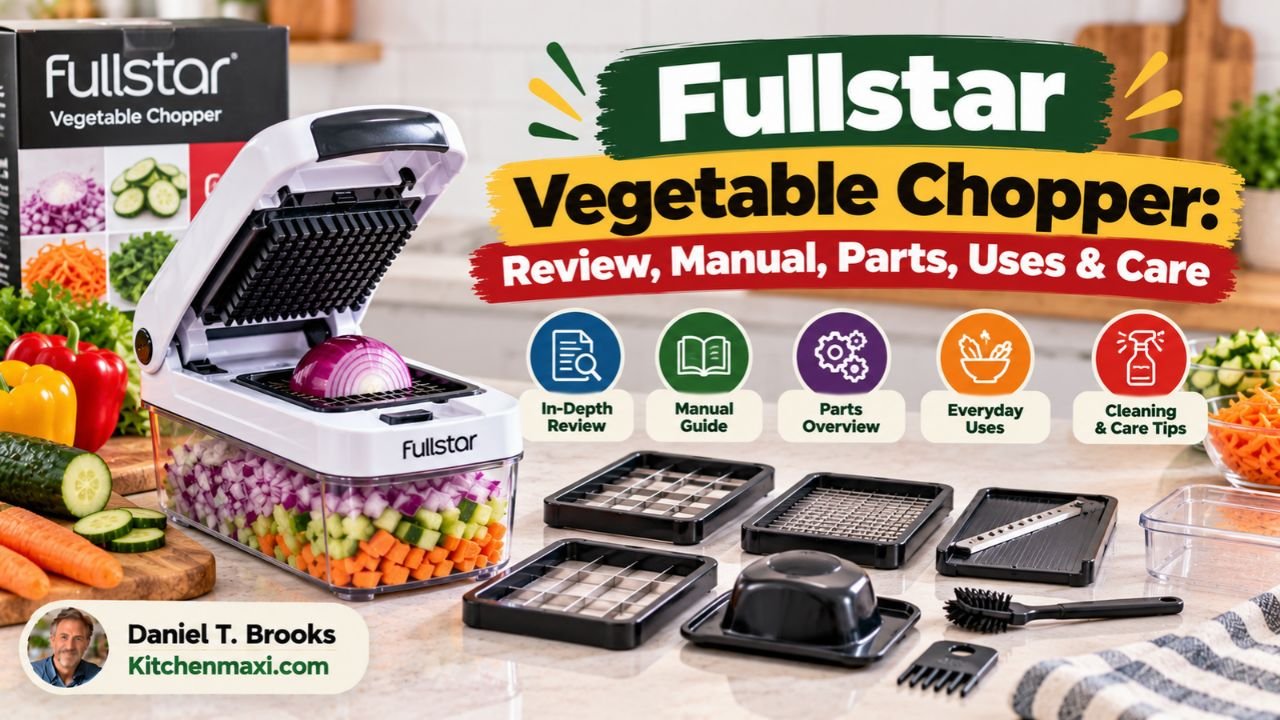
Fullstar Vegetable Chopper: Review, Manual, Parts, Uses & Care
Fullstar’s manual choppers are best suited to repetitive vegetable prep such as dicing onions, peppers, potatoes, cucumbers, and similar produce into consistent pieces. Interchangeable blade inserts, a collection container, and press-down operation can save prep time, though dense vegetables may require pre-cutting and firm downward pressure.
Fullstar now sells several chopper families rather than a single model. Current options include Original, Compact/Pro Core, larger XL versions, and smaller Essential designs, with different combinations of dicing, slicing, julienne, grating, and spiralizing attachments.
That variety matters because a 2-in-1 model is quite different from a 10-in-1 or 14-in-1 kit. Buying the version with the attachments you will actually use can reduce storage clutter and simplify cleanup.
For anyone researching the fullstar vegetable chopper, the main strengths are fast repetitive dicing, interchangeable stainless steel inserts, a catch container, and the ability to replace certain blades instead of replacing the entire chopper. Current Original models use 420J stainless steel inserts, and Fullstar sells a separate replacement dicing-blade kit for selected models.
The tradeoffs are mostly physical effort and cleanup. Dense carrots, potatoes, and similar foods may need smaller starting pieces, while onion skins and vegetable fibers can become trapped around fine cutting grids. Buyer feedback also shows that some people find the cleaning process more tedious than expected.
A good Fullstar setup therefore depends on the foods you prep most often, the blade types you need, how much manual pressure you are comfortable applying, and how willing you are to rinse the cutting grid immediately after use.
What Is a Fullstar Vegetable Chopper?
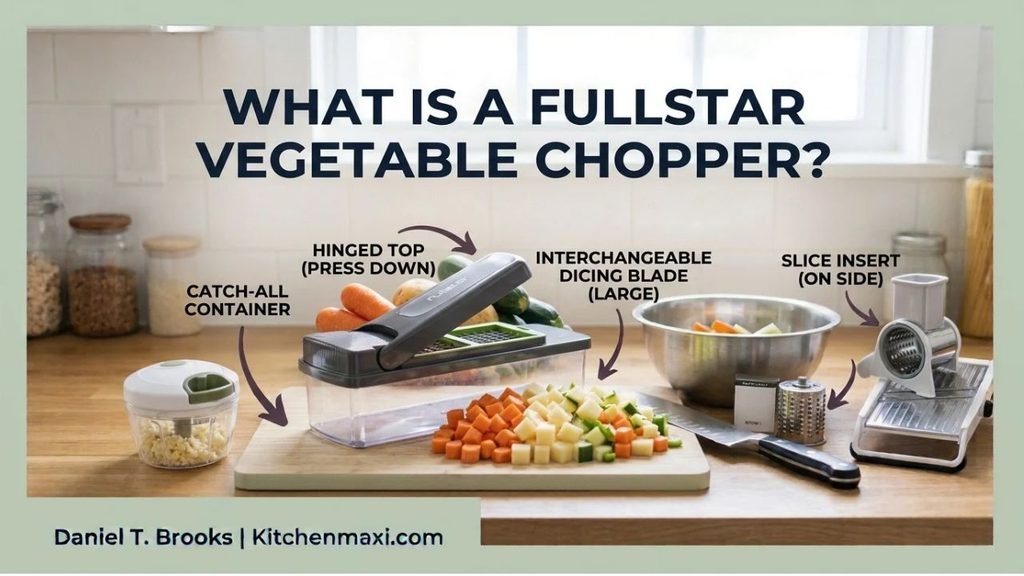
A Fullstar Vegetable Chopper is a manual food-prep tool that pushes ingredients through interchangeable stainless steel cutting inserts and into a collection container.
Unlike an electric food processor, it has no motor.
You provide the cutting force by lowering the hinged top or pressing the chopper mechanism down onto the food.
Fullstar Chopper Body and Container
The main body supports the cutting insert.
A container sits underneath and catches chopped food as it passes through the blade.
This arrangement is useful for:
- Onions
- Bell peppers
- Potatoes
- Cucumbers
- Zucchini
- Apples
- Garlic
- Other firm produce
The container reduces the amount of chopped food scattered across the cutting board or counter.
Fullstar Stainless Steel Blade Inserts
Current Fullstar Original and Pro Core product pages list 420J stainless steel blade inserts. Different models include different combinations of dicing, slicing, grating, julienne, and spiralizing parts.
The insert is removable, so changing the blade changes the type or size of cut.
Fullstar Manual Press-Down Operation
For dicing, food sits over the grid and the upper section is pressed down.
The food is forced through the cutting openings and drops into the container.
This works differently from an electric chopper, which rotates a blade through the food.
Key Takeaway: Fullstar choppers use manual pressure and interchangeable cutting inserts to dice or prepare produce directly into a collection container.
Fullstar Vegetable Chopper Review: Is It Actually Good?

For repetitive meal prep, the Fullstar design makes the most sense when consistent pieces matter more than knife-level control.
It can be especially practical for people who regularly prepare several onions, peppers, cucumbers, or potatoes for:
- Salsa
- Soup
- Stew
- Salad
- Stir-fry
- Meal-prep containers
What the Fullstar Vegetable Chopper Does Well
The strongest feature is repeatability.
Once an ingredient is cut small enough to fit over the grid, each push creates pieces based on the blade opening.
That can be much faster than manually trying to produce dozens of similar cubes with a knife.
The collection bin is another practical feature because chopped food falls directly underneath the blade instead of spreading across the counter.
Current Fullstar Original models also have replaceable inserts, a safety lock, grip handle, and anti-slip design.
Fullstar Vegetable Chopper Limitations
Hard vegetables can require substantial pressure.
Carrots, large potatoes, sweet potatoes, and similar dense foods are easier to process when cut into smaller or thinner pieces first.
Buyer comments also repeatedly mention that vegetable pieces can become trapped in the blades or pusher grid, creating extra cleaning work. Some reviews report that larger pieces need to be cut down before chopping.
Another limitation is precision.
A chef’s knife gives you much more freedom over:
- Dice size
- Shape
- Delicate ingredients
- Irregular cuts
The Fullstar is better for repetitive cuts than fine knife work.
Fullstar Vegetable Chopper Review Verdict
I would consider it a good fit for someone who frequently chops the same types of vegetables in moderate or large batches.
It makes less sense for someone who:
- Chops only one small vegetable at a time
- Has strong knife skills and prefers a cutting board
- Dislikes cleaning multi-part tools
- Has difficulty applying downward pressure
- Mostly prepares very soft or delicate produce
Key Takeaway: The Fullstar earns its place for repeated dicing and meal prep, but hard vegetables, cleaning the fine grid, and the manual force required are its main compromises.
Fullstar Vegetable Chopper Models and Sizes

Fullstar currently separates its choppers into several families, and blade counts vary within each family.
Fullstar Original Chopper
The Original line is the product most closely associated with the Fullstar name.
Current configurations include several blade-count options, with Original models built around a heavier chassis.
The official Original product page lists:
- Replaceable 420J stainless inserts
- Safety lock
- Grip handle
- Catch container
- Dishwasher-safe construction for the currently featured configurations
- Multiple 2-in-1, 4-in-1, and 8-in-1 choices
There are also larger Original Chopper & Slicer configurations with more attachments.
Fullstar Compact Chopper & Slicer
The Compact/Pro Core line is built around a lighter body and adds combinations of:
- Dicer
- Julienne
- Grater
- Slicer
Current versions include 6-in-1, 9-in-1, and 10-in-1 configurations.
This type makes more sense if you want more than square dicing but do not need the largest Fullstar setup.
Fullstar XL Chopper and Slicer
The XL family is aimed more toward larger-volume preparation.
Fullstar’s support hub lists multiple 4-in-1, 6-in-1, 8-in-1, and 11-in-1 XL configurations.
A larger catch system can be more practical if you frequently prepare food in batches.
Fullstar Essential Chopper
Fullstar also sells smaller Essential models for lighter jobs.
These are better matched to:
- Smaller kitchens
- Single-person meal prep
- Basic dicing
- Lower attachment counts
Choosing the smallest model that performs your normal tasks can be better than storing a large set of inserts that rarely get used.
Key Takeaway: Fullstar offers Original, Compact/Pro Core, XL, and Essential choppers, so blade count and body size should be matched to the amount and type of food you normally prepare.
Fullstar Vegetable Chopper Manual: How to Use It

The basic fullstar vegetable chopper manual process is straightforward, though exact attachment installation can differ by model.
Always verify that the insert is locked in place before pressing food through it.
Read More: How to Use A Vegetable Chopper Like a Pro
Step 1: Place the Fullstar Chopper on a Stable Counter
Use a:
- Flat
- Dry
- Solid
work surface.
The anti-slip base works best when both the counter and the bottom of the container are clean.
Step 2: Select the Fullstar Blade
Choose the insert based on the cut you want.
For example:
- Fine dicer for smaller cubes
- Larger dicer for bigger pieces
- Slicer for flat slices
- Julienne attachment for strips
- Grater for shredded ingredients
Keep your fingers away from the cutting edges while installing an insert.
Step 3: Lock the Fullstar Blade Into Position
Seat the insert completely in its frame.
Do not use the chopper if the blade:
- Rocks
- Sits unevenly
- Is only partly engaged
A loose insert can shift when pressure is applied.
Step 4: Pre-Cut Large Vegetables
Do not expect a full large potato or onion to fit through a small dicing grid.
Cut large ingredients into sections that:
- Fit over the blade area
- Sit reasonably flat
- Do not extend far beyond the cutting grid
Smaller pieces also reduce the force needed to close the lid.
Step 5: Place the Food Flat on the Blade
Flat placement matters.
A rounded potato or onion can move sideways when pressure begins.
Cutting one face flat first creates a more stable starting surface.
Step 6: Close the Fullstar Chopper Firmly
Lower the top using steady pressure.
A controlled firm press works better than repeatedly pushing weakly against a hard ingredient.
Do not place your fingers under the hinged top or near the blade.
Step 7: Empty the Fullstar Container
Stop when the container becomes crowded.
Too much chopped food underneath the insert can interfere with normal operation.
Step 8: Remove and Clean the Fullstar Blade
Hold the insert by its plastic frame.
Never press your fingers through the grid to remove stuck pieces.
Use the supplied cleaning tool, brush, or another manufacturer-approved cleaning method.
Key Takeaway: Correct Fullstar use starts with a securely installed blade, appropriately sized food pieces, a stable flat surface, and firm controlled pressure away from the cutting grid.
Fullstar Vegetable Chopper Blade Guide
Fullstar uses several insert types across its chopper range.
Not every model includes every blade.
Fullstar Dicer Blades
Dicing inserts cut food into cubes or rectangular pieces.
Fullstar distinguishes between fine and larger dicing inserts in its current blade system.
Fine dicing works well for ingredients such as:
- Onion
- Garlic
- Smaller vegetable pieces
Larger dicing is more practical for:
- Potatoes
- Apples
- Cucumbers
- Zucchini
Fullstar Slicer Blades
Slicer inserts create flat cuts.
They work well for foods such as:
- Potatoes
- Cucumber
- Zucchini
A finger guard should be used on mandoline-style slicing attachments whenever the model includes one.
Fullstar Julienne and Grater Blades
Julienne inserts create narrow strips.
Grating inserts are suited to foods such as:
- Cheese
- Carrots
- Vegetables
More elaborate Fullstar kits include multiple grating or julienne styles.
Fullstar Spiralizer Attachments
Selected models include spiralizer parts for producing vegetable ribbons or noodles.
Zucchini is an obvious match because its shape and texture work well for spiral cuts.
Key Takeaway: Fullstar blade sets range from simple dicing grids to slicing, julienne, grating, and spiralizing attachments, so model choice should follow the cuts you actually make.
Fullstar Vegetable Chopper Replacement Part Options
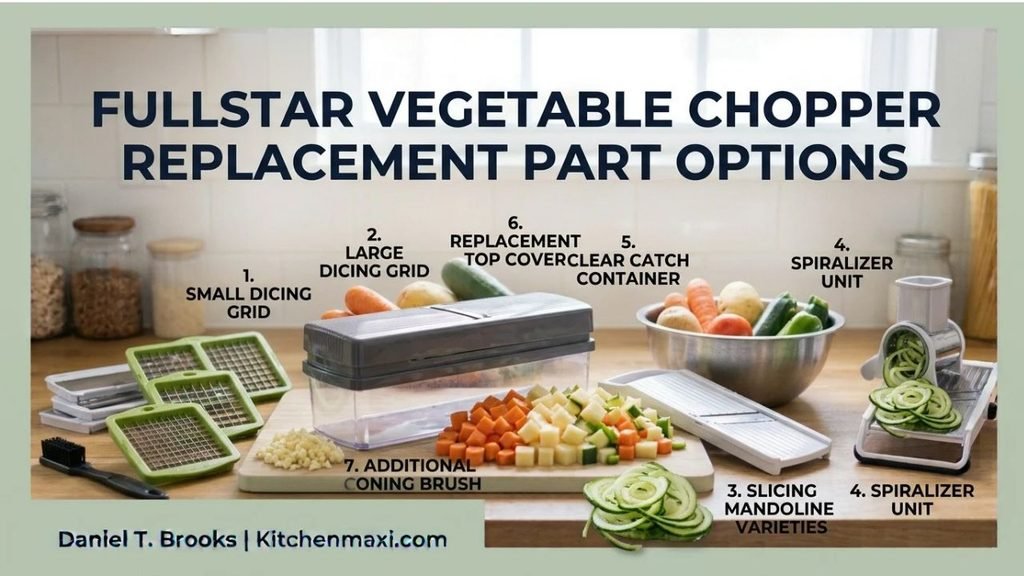
The most important current fullstar vegetable chopper replacement part is the replacement dicing-blade kit.
Fullstar currently sells a two-piece replacement kit with a small and large dicing insert. The listed insert dimensions are 3.9 by 4.4 inches, and Fullstar warns that the kit fits selected models rather than every chopper in its range.
Fullstar Replacement Blades
The replacement kit includes:
- Small dicer
- Large dicer
The small dicer is intended for finer cuts such as onions and tomatoes.
The larger dicer is better suited to bigger pieces such as potatoes and apples.
Check Fullstar Replacement Blade Compatibility First
Do not order a blade based only on the Fullstar brand name.
Fullstar sells several chassis sizes.
Before buying a replacement:
- Identify the model number.
- Check the insert dimensions.
- Compare the current blade frame.
- Confirm compatibility on Fullstar’s support page.
Fullstar’s support hub lets owners choose a model or enter the model number printed under the base or on the packaging.
When to Replace a Fullstar Chopper Blade
A replacement becomes sensible when a blade:
- Tears rather than cuts
- Needs much more pressure than before
- Has a damaged cutting edge
- Has a cracked frame
- No longer seats securely
Do not keep forcing hard vegetables through a damaged insert.
Fullstar Lid, Container, and Other Replacement Parts
Availability for individual lids, containers, cleaning grids, and accessory inserts can change.
For these parts, the model-specific Fullstar support system is safer than assuming every component fits every chassis.
Key Takeaway: Fullstar sells replacement dicing blades for selected models, but model number and insert dimensions should be checked before ordering because the range uses more than one frame size.
Fullstar Vegetable Chopper Cleaning and Dishwasher Care
Cleaning immediately after use is much easier than removing dried onion skin or potato starch later.
Rinse the Fullstar Blade Immediately
Hold the insert by its plastic frame.
Rinse from the back side so water pushes food away from the cutting edges.
This works especially well for:
- Onion skin
- Pepper membrane
- Potato
- Carrot fibers
Clean the Fullstar Pusher Grid
The raised pusher area can trap small food pieces.
Use the supplied cleaning brush or scraper rather than your fingers.
Fine dicing grids usually take longer to clean because there are more small openings.
Check the Fullstar Dishwasher Instructions for Your Model
Current Fullstar pages describe many choppers as dishwasher-safe and often recommend top-rack cleaning. Some variant specifications on Fullstar’s site also show hand-wash-only instructions, so the care directions for the exact model should control.
Do not assume every Fullstar chopper version has identical cleaning instructions.
Dry Fullstar Blades Before Storage
Stainless steel resists corrosion, but storing a wet cutting insert is unnecessary.
Dry around:
- Blade edges
- Plastic frame
- Corners
- Locking tabs
before placing the attachment back into storage.
Key Takeaway: Rinse Fullstar blades before food dries, clear the pusher grid with the supplied tool, follow model-specific dishwasher directions, and dry the inserts before storage.
What Foods Work Best in a Fullstar Vegetable Chopper?
The Fullstar design performs best on ingredients firm enough to cut cleanly but not so hard that enormous pressure is required.
Onions and Bell Peppers
These are among the best uses for a press-style dicer.
Cut a large onion into halves or quarters first so each section fits the grid.
Remove thick pepper stems and seeds before chopping.
Cucumbers and Zucchini
Both are easy to dice or slice.
Very soft zucchini may compress slightly if too much force is used.
Potatoes
Potatoes can work well, especially for:
- Soup
- Hash
- Roasting
Large potatoes should be cut into smaller sections before going onto the grid.
Carrots
Carrots are much denser.
Thin sections are easier to push through than thick pieces.
If the chopper requires excessive force, make the carrot pieces smaller rather than slamming the lid.
Tomatoes
Firm tomatoes are easier to dice than very ripe ones.
Soft tomatoes can crush and release juice instead of passing cleanly through a small grid.
Cheese
Some Fullstar grating and slicing attachments are intended for cheese.
A dicing grid is not the right attachment for every type of cheese, especially very hard blocks.
Key Takeaway: Onions, peppers, cucumbers, zucchini, potatoes, and similar produce are natural Fullstar chopper foods, while dense roots and very soft produce need more preparation.
Fullstar Vegetable Chopper Safety Tips
Fullstar blades are sharp enough to cut skin very quickly.
Treat every insert like a kitchen knife.
Do not:
- Push fingers into the blade grid
- Clear stuck food while the insert is under pressure
- Leave loose blades in a drawer
- Let children handle inserts
- Catch a falling blade with your hand
Use the plastic frame when moving a blade.
For slicing and julienne attachments, use the supplied guard if the model includes one.
If an ingredient refuses to pass through the dicer, stop and make it smaller.
Applying uncontrolled body weight or striking the lid can damage the chopper and increase the chance of slipping.
Is the Fullstar Vegetable Chopper Worth Buying?
For repeated vegetable dicing, yes, it can be.
The strongest case for buying one is batch preparation.
If you routinely make:
- Salsa
- Soup
- Salad
- Stir-fry
- Meal-prep bowls
- Diced vegetables for freezing
the time saved across several ingredients can outweigh the cleanup.
It is less convincing for someone who chops only a small amount of food at a time.
A knife may be faster once you include:
- Assembly
- Pre-cutting
- Blade changes
- Washing
- Drying
- Storage
I would also avoid buying the largest attachment set solely because it includes more pieces. Choose the blade combination that matches your normal recipes.
Conclusion
The fullstar vegetable chopper is a practical manual prep tool for people who want repeatable dicing, slicing, grating, or julienne cuts without using an electric appliance. Its main strengths are interchangeable sharp inserts, a collection container, and multiple model sizes.
For the review side, its value is strongest with onions, peppers, cucumbers, potatoes, zucchini, and batch meal prep. Dense vegetables can require smaller starting pieces and more pressure, while the fine blade and pusher grid need prompt cleaning.
The Fullstar vegetable chopper manual process is simple: choose and secure the correct insert, pre-cut large foods, keep the chopper stable, press with controlled force, and handle every blade by its plastic frame.
Replacement blades are a major advantage because a dull dicing insert does not automatically require a new chopper. Check your exact Fullstar model and insert dimensions before ordering any replacement part, since different Fullstar families use different chassis and attachment combinations.
FAQs About Fullstar Vegetable Choppers
Is the Fullstar vegetable chopper worth it?
It makes the most sense for frequent batch prep. If you regularly dice several onions, peppers, potatoes, cucumbers, or similar vegetables, it can reduce repetitive knife work. For very small prep jobs, a knife may require less total cleanup.
Is there a Fullstar vegetable chopper manual?
Yes. Fullstar maintains a support and instructional system for its chopper models. The model number can be found under the base or on the original packaging, then matched with the appropriate Fullstar product instructions.
Can you buy Fullstar vegetable chopper replacement blades?
Yes. Fullstar currently sells a two-piece replacement dicing kit for selected chopper models. Because the range uses different chassis sizes, check blade dimensions and model compatibility before ordering.
What comes with a Fullstar vegetable chopper?
Contents depend on the configuration. Most sets contain the chopper body, lid, catch container, and interchangeable stainless steel inserts. Larger models may add slicing, julienne, grating, spiralizing, or other attachments.
Can a Fullstar vegetable chopper cut potatoes?
Yes, but large potatoes should be cut into smaller sections first. A flat starting surface also keeps the potato from moving when the press is lowered.
Why is my Fullstar vegetable chopper hard to press?
The food may be too thick, too large, or too dense for the selected dicing grid. Cut the ingredient into smaller or thinner pieces and check that the blade is clean, sharp, and fully seated.
Are Fullstar vegetable choppers dishwasher safe?
Many current Fullstar choppers are listed as dishwasher safe, often with top-rack cleaning recommended. Some model or variant instructions differ, so follow the care instructions for the exact chopper you own.
How do you clean food stuck in a Fullstar chopper blade?
Remove the blade by its plastic frame and rinse it from the back side. Use the supplied brush or cleaning scraper for food trapped in the dicing grid or pusher. Do not push your fingers between the sharp blade openings.





One Comment