



I still remember the day I got my first air conditioner. The technician, a big guy with a lot of knowledge, tapped the side of the condenser unit and said, “This runs on Puron.” It is the future. That “Puron” was really R-410A refrigerant, and it was the best way to keep our homes cool and comfortable for more than ten years.
Today, the conversation has changed a lot. The tone was different when I talked to an HVAC expert about a slow leak in my system. He said, “We can fix it,” but you should know that this gas is going away. Many homeowners are scared when they hear that their expensive appliance on the wall uses a “banned” substance.
In my opinion, the most important thing is to stay calm. 410A refrigerant isn’t going to go away overnight, and your system isn’t going to stop working all of a sudden. But if you’re thinking about replacing your system or making a big repair, I honestly suggest looking into the newer types of refrigerants, like R-32. If you stick with R-410A refrigerant for a new installation in 2025, you might save a few pounds up front, but it could cost you more in the long run as supplies run out.
Table of Contents
Introduction
There is a very good chance that your air conditioner or heat pump runs on R-410A refrigerant if you bought it in the last 15 years. This hydrofluorocarbon (HFC) gas, which is often called Puron, Suva, or Genetron, is the most important part of millions of cooling systems around the world. It was the hero that took the place of R-22 (Freon), which destroys the ozone layer, and gave us a better way to stay cool.
But the business is changing once more. HFCs are being banned in the UK, EU, and US because they have a high Global Warming Potential (GWP), even though they don’t hurt the ozone layer. This means that R-410a works like a thick blanket in the air, holding in heat much better than carbon dioxide does.
As we enter a new era of climate-friendly cooling, it’s important to know what happens to your current air conditioner. This guide will explain what 410A refrigerant is, why it is being phased out, and most importantly, how this will affect your home comfort and your wallet.
Importance, Uses, and Benefits
We need to look at why R-410A refrigerant became so popular in the first place before we can understand why the industry is changing.
The Modern Cooling Standard
410A refrigerant has been the best choice for air conditioning in homes and small businesses for a long time. Before it came, most systems used R-22. R-410A came to the rescue when R-22 was banned because it contained chlorine, which is bad for the ozone layer.
Efficiency at High Pressure
R-410A is a mix of two other refrigerants, R-32 and R-125, in a 50/50 ratio. This mix makes it better at taking in and letting out heat than older models. It works at a lot higher pressures than older refrigerants. Because of the high pressure, manufacturers had to make stronger, more durable compressors and tubing. This made the systems last longer without meaning to.
Heating and cooling can be used in many ways
Not only does R-410a cool things down, but it is also important for how heat pumps work. R-410A has played a huge role in the UK, where heat pumps are becoming a big part of the push for Net Zero homes. It can take in heat from the outside air and move it inside to keep your living room warm, even when it’s cold outside.
Summary of Benefits
Zero Ozone Depletion: It doesn’t hurt the ozone layer.
Better Heat Transfer: It works better than R-22.
Widely Available: All technicians have it, and parts are easy to find right now.
The Environmental Problem: Why the Phase-Down?
If 410A refrigerant works so well, why are governments getting rid of it? The answer is in how we figure out how bad something is for the environment.
Understanding GWP (Global Warming Potential)
Every refrigerant is given a GWP score. Carbon dioxide ($CO_2$) has a baseline score of 1.
- R-410A has a GWP of 2,088.
This means that if one kilogram of R-410A leaks into the air, it will warm the Earth as much as 2,088 kilograms of $CO_2$ over the course of 100 years. That is a massive footprint for a relatively small amount of gas.
The Regulatory Landscape
Because there are so many of them, laws like the F-Gas Regulation in the UK and EU and the AIM Act in the US are forcing a “phase-down.” It’s important to know the difference between a ban and a phase-down.
- A Ban: Usually stops you from using or servicing equipment (eventually).
- A Phase-Down: Reduces the amount of new gas that can be produced and imported.
What does this mean for 2025?
Big rules will start to apply in 2025. It will be against the law to make new split-system air conditioners that use high-GWP fluids like R-410A in a lot of places. The supply of new gas will slowly be cut off, which means that 410A refrigerant will probably become more expensive as it becomes harder to find.
Real-Life Applications: Is Your System Affected?
You might be looking at the white box on your wall and thinking, “What do I need to do right now?”
How to Look at Your System
Go outside to the big box with the fan, which is your condenser unit. On the side, there should be a sticker or data plate. Find the field that says “Refrigerant” or “Ref.” Your system uses this fluid if it says R410A, R-410A, or has a pink color code.
The “Leaking” Situation
I just talked to my neighbor Sarah, who said her air conditioner wasn’t working. The technician discovered a leak. Sarah was scared she would have to buy a whole new system because she thought R-410A was against the law.
The truth is that the technician had the right to fix the leak and add 410A refrigerant to the system. You can still work on systems that are already in place. The limit is not the legality of the service, but the cost and availability.
The “New Installation” Situation
My cousin is fixing up a house and needs a new heat pump. He was given a price for a less expensive model that uses R-410A and a more expensive one that uses R-32.
The Truth: I told him to get the R-32 unit. The R-410A unit is cheaper now, but if he needs to fix it in seven years, the price of the gas could be very high. It’s worth the extra money up front to make your home future-proof.
Examples: Repair vs. Replace Scenarios
Deciding whether to keep your 410A refrigerant system running or to swap it out is a numbers game. Here are two examples to help you decide.
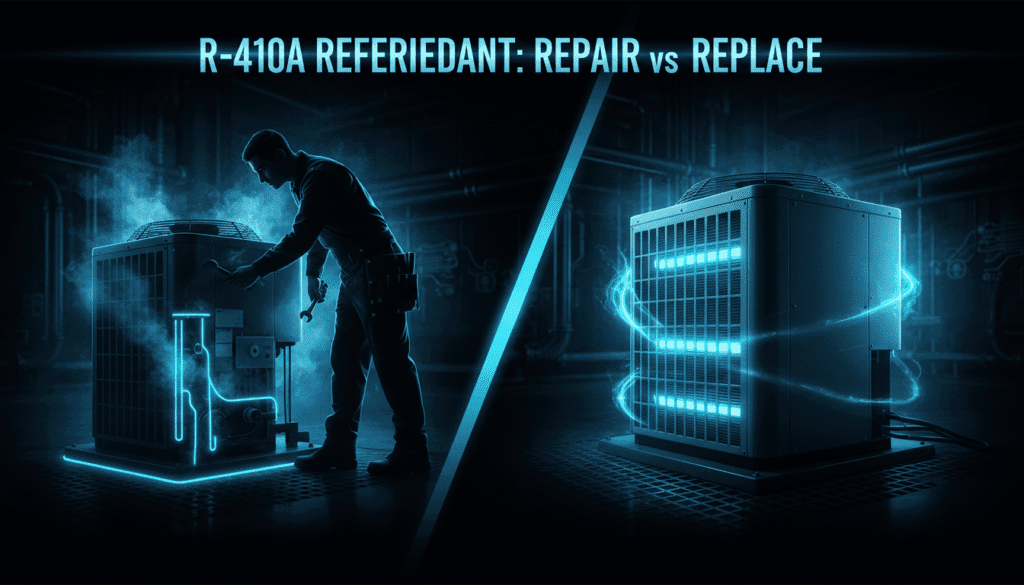
Example A: The 12-Year-Old Unit
System: 12-year-old central AC using R-410A.
Problem: Compressor failure.
Cost to Fix: £1,200 (Parts + Labour + Refrigerant).
Verdict: Replace. A 12-year-old system is near the end of its life. Investing heavy money into a compressor for an obsolete refrigerant system is throwing good money after bad. You are better off upgrading to a lower-GWP system.
Example B: The 4-Year-Old Unit
System: 4-year-old mini-split using R410A.
Problem: Leaking valve.
Cost to Fix: £300.
Verdict: Repair. The system is practically new. Fixing the leak is simple, and recycled or reclaimed 410A refrigerant will be available for servicing for years to come. It doesn’t make financial sense to rip out a new unit just because of the phase-down.
Advantages and Disadvantages of R-410A refrigerant
To give you a balanced view, let’s break down the pros and cons of this refrigerant as it stands today.
Advantages
- One of the best things about R-410A is that it is safe (A1 Safety Rating): It won’t catch fire. It has an ASHRAE A1 rating, which means that at 60°C and normal pressure, it doesn’t spread flames. It is very safe to use in homes.
- Proven Reliability: We have decades of information about these compressors. We know that they work and how long they last.
- No Ozone Depletion: It meets all the requirements of the Montreal Protocol for ozone safety.
Disadvantages
- High Global Warming Potential: The GWP of 2,088 is its biggest weakness, as we said.
- Costs are going up: The price of 410A refrigerant per kilogram is going through the roof as production limits get tighter.
- Obsolescence: New equipment is moving away from it, which means that parts and knowledge will eventually move toward newer standards.
The Alternatives: What Comes Next?
If R-410A refrigerant is stepping down, who is taking the throne?
R-32
This is the most common replacement right now. R-32 is 50% of R-410A, which is a blend. Using pure R-32, manufacturers can get the same level of efficiency with a GWP of 675, which is about one-third of 410A. It is A2L, which means it is not very flammable, but it is safe for most home uses.
R-454B
This is another strong candidate, especially for the US market, where some big companies like Carrier and Rheem prefer it. It has an even lower GWP of 466. It is also “mildly flammable,” like R-32, which means that technicians need to use new tools and follow new safety rules.
Conclusion:
The switch from R-410A refrigerant is a big change in home comfort technology, but it shouldn’t worry you. Keep enjoying the cool air as long as your system is working well. You don’t have to tear out your unit; technicians will be able to fix it with reclaimed gas for years to come.
If your system is getting old or needs a major repair, though, this is a good reason to upgrade. Switching to a system that uses R-32 or R-454B is good for the environment and good for your wallet because it protects your home from rising refrigerant costs in the future.
410A refrigerant is on its way out, but smarter, greener cooling is just getting started.
FAQ:
Are 410A and R-410A the same?
Yes, they are the same. R-410A is the technical name (R stands for Refrigerant), but it is often shortened to just 410A, or referred to by brand names like Puron.
What is 410A refrigerant used for?
Yes, they are the same. The technical name for R-410A is “Refrigerant,” but people often just call it “410A” or use brand names like “Puron.”
Why is R-410A refrigerant banned?
It is not technically “banned” for current users, but it is being “phased down.” This is because it has a high Global Warming Potential (GWP). It holds more than 2,000 times more heat in the air than carbon dioxide. To fight climate change, governments are limiting the production of new units that use R-410A, but you can still service old ones.
Is R-410A safe to breathe?
No, you should never try to breathe in refrigerant on purpose. R-410A is less toxic than some chemicals, but it is heavier than air. In a small space, a big leak can push out oxygen, which can cause suffocation. If you think there might be a leak, open a window right away and call a pro.
References
- EPA. (2024). Frequent Questions on the Phasedown of Hydrofluorocarbons. Environmental Protection Agency. https://www.epa.gov/climate-hfcs-reduction/frequent-questions-phasedown-hydrofluorocarbons
- European Commission. (2024). Climate-friendly alternatives to F-gases in Air Conditioning. Climate Action. https://climate.ec.europa.eu/eu-action/fluorinated-greenhouse-gases/climate-friendly-alternatives-f-gases/air-conditioning_en
- Rheem. (2023). What to Know About the 2025 HVAC Refrigerant Change. Rheem Manufacturing. https://www.rheem.com/air-conditioning/articles/what-to-know-about-the-2025-hvac-refrigerant-change/
- National Refrigerants. (2021). R-410A Safety Data Sheet. https://refrigerants.com/wp-content/uploads/2019/12/SDS-R410A.pdf