Epicurean Cutting Board Review: Durability, Knives, and Cleanup
Epicurean cutting boards are a strong choice if you want a thin, lightweight board that can go in the dishwasher and needs almost no maintenance. The main tradeoffs are a harder cutting surface, more chopping noise than wood, visible knife marks over time, and less grip on basic models without silicone feet.
Epicurean boards sit between traditional wood and plastic. They use a dense paper-composite material, giving them a wood-like appearance while avoiding the oiling, thick profile, and hand-wash-only routine associated with many hardwood boards.
That combination makes them appealing for everyday vegetables, fruit, cooked meats, sandwiches, and quick kitchen prep. The thin profile also makes a large Epicurean board much easier to lift into a sink or dishwasher than a thick butcher block.
The harder composite surface creates the biggest point of disagreement. Epicurean describes its boards as knife-safe, but independent cutting-board tests have found more edge wear than on softer wood, rubber, and some plastic boards. One recent controlled comparison also found Epicurean among the louder surfaces during chopping.
This Epicurean cutting board review uses the original Kitchen Series as the main reference because it represents the basic Epicurean design. I also compare the All-in-One Series where features such as non-slip feet and a juice groove change the experience.
For someone who values dishwasher cleaning, low weight, thin storage, and freedom from board oil, Epicurean solves several everyday annoyances at once. Someone with premium Japanese knives or a strong preference for a soft, quiet cutting surface may be happier with end-grain wood or rubber.
The sections below cover construction, sizes, knife wear, staining, odor resistance, dishwasher performance, slipping, durability, meat preparation, differences between Epicurean series, and who gets the most value from one.
Epicurean Cutting Board Review: Quick Verdict
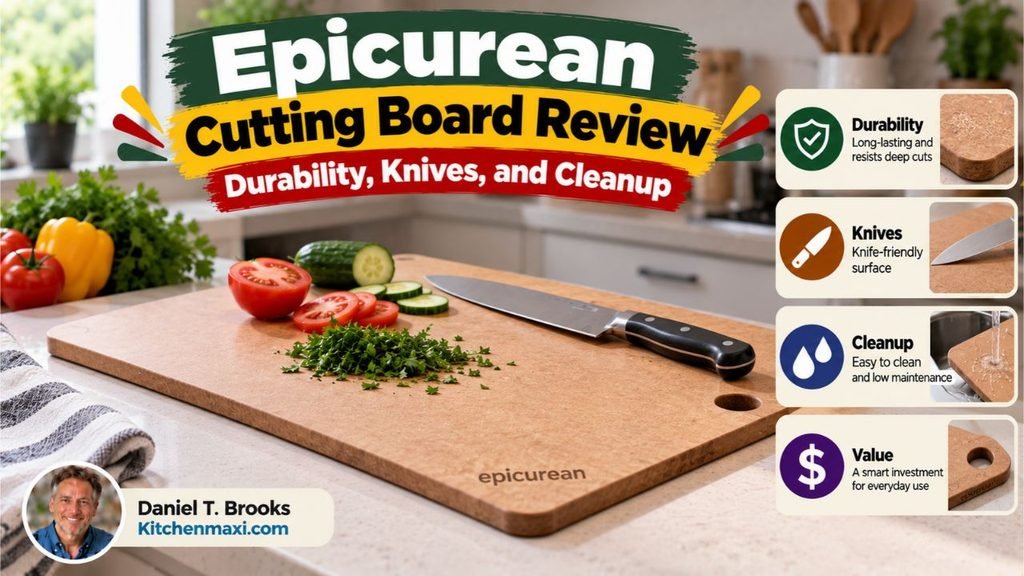
Epicurean cutting board is easiest to recommend as a low-maintenance everyday cutting board.
The original Kitchen Series is only 1/4 inch thick, comes in four current sizes from 8 x 6 inches up to 17.5 x 13 inches, is dual-sided, dishwasher-safe, NSF certified, and sold with a lifetime warranty. Epicurean currently lists a 4.9/5 rating from more than 500 reviews on its own product page.
The board’s biggest strengths are:
- Low weight
- Thin profile
- Dishwasher cleaning
- No oiling
- Several sizes
- Dual-sided use
- Good stain and odor resistance
- Easy cabinet storage
Its main weaknesses are:
- Harder feel under a knife
- More chopping noise than wood
- Knife scratches become visible
- Basic Kitchen Series boards can slide
- Less cushioning for fine knife edges
- Higher price than basic plastic boards
Independent reviews reflect that split. Good Housekeeping gave the All-in-One model a 2026 Kitchen Award for its light weight, dishwasher performance, stability, and resistance to stains and odors. Bon Appétit declined to recommend the Kitchen Series because testers found the surface hard and loud.
I would rate Epicurean highest for convenience rather than knife-edge preservation.
What Is an Epicurean Cutting Board Made Of?
Epicurean uses a dense paper-composite material rather than a solid piece of wood.
Good Housekeeping describes the material as layers of kraft paper fused with resin into a thin, rigid board. Epicurean itself labels its current All-in-One line as paper composite.
Paper Composite Feels Different From Wood
The finished surface is:
- Smooth
- Dense
- Thin
- Firm
- Nonporous compared with traditional wood
- Resistant to absorbing normal kitchen moisture
It does not have the soft fiber response of maple or walnut.
When a knife reaches the surface, you hear and feel more contact.
That firm feel is one reason the board stays thin without behaving like a flexible plastic mat.
The Board Does Not Need Mineral Oil
Traditional wood boards commonly need food-grade mineral oil to limit drying and cracking.
Epicurean lists its Kitchen Series as maintenance-free, so there is no regular oiling schedule.
For people who like wood’s appearance but do not want wood-board maintenance, that is a major attraction.
Key Takeaway: Epicurean uses a dense paper composite that stays thin and rigid without requiring the oiling routine of a traditional hardwood board.
Epicurean Kitchen Series Sizes and Design
The Kitchen Series is the simplest Epicurean board and the best baseline for understanding the brand.
Current Kitchen Series Sizes
Epicurean currently offers four sizes:
| Size | Thickness | Best Use |
| 8 x 6 in. | 1/4 in. | Lemon, herbs, small fruit |
| 11.5 x 9 in. | 1/4 in. | Small daily prep |
| 14.5 x 11.25 in. | 1/4 in. | General kitchen prep |
| 17.5 x 13 in. | 1/4 in. | Larger vegetables, meat, meal prep |
All four sizes are currently listed as dual-sided and dishwasher-safe.
For a primary kitchen board, I would skip the smallest two sizes unless counter space is extremely limited.
The 14.5 x 11.25-inch size works for most routine vegetables. The 17.5 x 13-inch version gives more room for a pile of chopped produce without ingredients falling onto the counter.
Thin Profile Makes Storage Easy
At only 1/4 inch thick, the Kitchen Series takes up little cabinet space.
Several boards can stand vertically beside baking sheets or slide into a narrow divider.
That thin construction is a clear advantage over a 1.5- to 2-inch butcher block.
The Hang Hole Is Useful but Basic
The Kitchen Series includes a hole near one corner for hanging.
It is also useful as a finger hold when pulling a board from a vertical cabinet slot.
There are no built-in feet on this basic model, which leads to one of its most common practical drawbacks: sliding.
Key Takeaway: The Kitchen Series is thin and offered in useful sizes, but larger versions make more sense as primary prep boards and the basic design lacks built-in non-slip feet.
Does an Epicurean Cutting Board Dull Knives?
This is the most important drawback to understand before buying.
Epicurean calls the board knife-safe, but that does not mean it is the gentlest board available for knife edges.
The Composite Surface Is Harder Than Many Wood Boards
The board has very little give.
An end-grain wood board lets a fine knife edge move slightly between fibers. A softer rubber board also cushions blade contact.
Epicurean feels much firmer.
That does not mean a chef’s knife becomes dull after one dinner. The concern is edge retention over repeated use.
Independent Testing Found Measurable Edge Loss
Prudent Reviews measured knife sharpness before and after cutting-board tests and reported an 85-point loss on the BESS sharpness scale with its Epicurean Gourmet board. The board ranked sixth out of nine materials in that test.
Another independent cutting-board comparison described composite models such as Epicurean as the hardest surfaces in its group and found them tougher on knife edges than end-grain wood and softer alternatives.
These tests do not mean every knife will wear at exactly the same rate. Knife steel, edge angle, cutting pressure, and technique all matter.
The useful conclusion is that Epicurean should not be chosen specifically because you want maximum knife-edge life.
Fine Japanese Knives Deserve More Consideration
A thicker Western chef’s knife used for ordinary vegetables is less concerning than a very thin, highly sharpened Japanese blade.
If you own expensive knives and sharpen them at fine edge angles, I would use:
- End-grain maple
- End-grain walnut
- Suitable soft rubber
for most knife work and keep Epicurean as a dishwasher-safe secondary board.
Key Takeaway: Epicurean is usable with normal kitchen knives, but independent tests show its firm composite surface can wear edges faster than softer wood or rubber boards.
How Does an Epicurean Board Feel During Chopping?
The cutting feel is firm and somewhat loud.
Chopping Produces a Noticeable Clack
A knife hitting Epicurean produces a harder sound than it does on thick wood.
Prudent Reviews measured the Epicurean Gourmet board at about 74.4 dB during chopping and 62.2 dB during rocking cuts in its comparison, placing it among the louder boards tested.
Bon Appétit’s testers also singled out noise as one of the reasons they did not favor the Kitchen Series.
If you cook early in the morning or dislike hard chopping sounds, this matters.
The Surface Is Stable but Not Soft
The board does not flex under normal knife pressure.
That stability is nice for:
- Slicing fruit
- Chopping vegetables
- Portioning cooked meat
- Sandwich preparation
For long mincing sessions, the firmer contact can feel less pleasant than a thick wood or rubber surface.
Knife Marks Are Normal
The board will develop visible cuts and scratches.
A current Kitchen Series customer review on Epicurean’s own site specifically notes that knife marks should be expected, while Good Housekeeping also found the All-in-One surface scratched fairly easily.
Those marks are cosmetic in normal use unless the surface becomes deeply damaged.
Key Takeaway: Expect a firm, audible cutting feel and visible knife marks; Epicurean prioritizes thinness and easy care rather than the soft feel of thick wood.
Does the Epicurean Cutting Board Slip on the Counter?
The answer depends on the series.
Kitchen Series Can Slide
The standard Kitchen Series has no silicone feet.
Current owner feedback on Epicurean’s site includes reports of placing silicone squares underneath the board because it can move on some counters. Tom’s Guide also noted slipping as a weakness in its Kitchen Series test.
If yours moves, place a:
- Damp paper towel
- Thin damp kitchen towel
- Non-slip silicone mat
under the board before cutting.
Do not continue chopping on a board that slides.
All-in-One Series Solves the Grip Problem
The All-in-One model has four non-slip silicone feet that work with either side of the reversible board.
Good Housekeeping found the feet stable during testing and reported that they remained secure after months of use and dishwasher cycles.
If countertop grip matters, I would spend more for the All-in-One rather than buying the bare Kitchen Series.
Key Takeaway: Kitchen Series boards may need a damp towel or mat underneath, while the All-in-One line includes built-in silicone feet for better stability.
How Well Does Epicurean Resist Stains and Odors?
This is one of the stronger parts of the design.
Stain Resistance Is Good
Good Housekeeping tested the All-in-One with foods including beets and found that it cleaned well without holding troublesome stains.
Prudent Reviews tested an Epicurean Gourmet board with beet, chipotle, and garlic residue and reported no visible staining after cleaning.
The darker Slate color can also hide cosmetic marks better than Natural, though knife scratches can still become visible.
Odor Retention Is Low
Onions and garlic can leave strong smells in porous or heavily scratched boards.
Independent testing found little or no lingering odor on Epicurean after washing.
That makes it useful for:
- Garlic
- Onion
- Fish
- Cooked meats
- Strong herbs
especially if you want a board that can be placed directly into the dishwasher afterward.
Key Takeaway: Epicurean performs well with strongly colored and aromatic foods, with independent tests reporting low staining and little lingering odor after cleaning.
Is the Epicurean Cutting Board Dishwasher Safe?
Yes. Dishwasher cleaning is one of the clearest reasons to buy it.
Epicurean officially lists both the Kitchen Series and All-in-One Series as dishwasher-safe.
Dishwasher Cleaning Saves Time
A thick hardwood board usually needs:
- Hand washing
- Prompt towel drying
- Air drying
- Periodic oiling
An Epicurean board can go into a dishwasher after normal food prep.
That is convenient after cutting:
- Raw meat
- Poultry
- Fish
- Garlic
- Onion
- Greasy cooked food
Good Housekeeping repeatedly ran its All-in-One test boards through a dishwasher and reported no warping during its testing period.
Thin Boards Fit Dishwashers Easily
The 1/4-inch profile uses little rack space.
Even the larger board is easier to fit than a thick butcher block, assuming your dishwasher rack is tall and wide enough.
Hand Washing Is Still Fast
Dishwasher compatibility does not mean you must machine-wash it every time.
Warm soapy water and a sponge work for quick daily cleaning.
The thin board also dries quickly compared with thick wood.
Key Takeaway: Dishwasher compatibility is one of Epicurean’s strongest advantages, combining easy sanitation with a thin board that takes little rack space and dries quickly.
Can You Use an Epicurean Cutting Board for Raw Meat?
Yes, an Epicurean board can be used for raw meat if it is cleaned correctly afterward.
The Kitchen Series is currently NSF certified, which supports its suitability as a food-contact cutting surface.
For raw meat or poultry, I prefer either:
- A dedicated board
- A reversible board with one clearly designated side
- A dishwasher-cleanable board like Epicurean
The original Kitchen Series has no juice groove, so liquid from a large roast or very juicy raw meat can run toward the countertop.
The All-in-One is better for those jobs because one side includes a juice groove while silicone feet keep either side usable.
If carving cooked meat or handling juicy proteins is a regular task, the All-in-One or Gourmet line makes more sense than the basic Kitchen Series.
Epicurean Kitchen Series vs. All-in-One Cutting Board
These are the two lines most home cooks are likely to compare.
| Feature | Kitchen Series | All-in-One |
| Thickness | 1/4 in. | 1/4 in. |
| Dual-sided | Yes | Yes |
| Dishwasher-safe | Yes | Yes |
| NSF certified | Yes | Yes |
| Silicone feet | No | Yes |
| Juice groove | No | Yes, one side |
| Hang hole | Yes | No main emphasis |
| Current size options | 4 | 5 |
| Starting price | Lower | Higher |
| Best use | General prep | Meat, produce, stable daily prep |
The All-in-One currently comes in sizes from 10 x 7 inches to 19.5 x 14.5 inches, making it available in a larger maximum size than the Kitchen Series.
I think the All-in-One is the stronger primary cutting board.
The silicone corners fix the basic model’s slipping issue, while the juice groove makes the board more useful for tomatoes, fruit, roasts, and meat.
The Kitchen Series remains appealing if low cost, a hang hole, and the simplest possible design matter most.
Key Takeaway: Kitchen Series is the cheaper minimalist option; All-in-One adds non-slip feet, a juice groove, and an extra-large size that make it better suited to primary-board duty.
Epicurean Cutting Board Durability
The composite construction is resistant to several problems that affect ordinary wood boards.
It Does Not Need Oiling
There is no mineral-oil maintenance schedule.
That means no worrying about a dry, pale surface or routinely conditioning the board.
Warping Resistance Is Strong but Not Absolute
Good Housekeeping found no warping during repeated dishwasher testing of the All-in-One. Epicurean also explicitly markets its boards for dishwasher use.
Long-term user reports on Epicurean’s own site include owners describing many years of use. Those reports are anecdotal rather than controlled durability tests, but they support the board’s reputation for a long service life.
Surface Wear Appears Before Structural Failure
The board is likely to look used before it stops being useful.
Common aging signs include:
- Light scratches
- Cut lines
- Surface fading
- Darkening or lightening
- Worn appearance
Good Housekeeping found scratches and cosmetic fading but said those changes did not interfere with function.
If you want a cutting board that develops a handsome wood patina, Epicurean may not satisfy that expectation. Its wear looks more functional than decorative.
Key Takeaway: Epicurean’s structure holds up well with little maintenance, though visible knife marks and fading are normal signs of use.
Epicurean Cutting Board Pros and Cons
Pros
- Lightweight
- Thin and easy to carry
- Dishwasher-safe
- No mineral-oil maintenance
- Fast drying
- Dual-sided
- Several size choices
- NSF-certified Kitchen and All-in-One lines
- Strong resistance to stains and odors
- Easy vertical storage
- Made in the USA on the Kitchen Series
- Lifetime warranty on current Kitchen Series
- All-in-One has silicone feet and juice groove
Cons
- Harder on knife edges than soft wood or rubber
- Chopping can be loud
- Knife marks show readily
- Basic Kitchen Series can slide
- Costs more than basic plastic
- Standard Kitchen Series has no juice groove
- Firm surface may feel harsh during long prep sessions
- Thin design lacks the substantial feel of a butcher block
Who Should Buy an Epicurean Cutting Board?
Epicurean is a particularly good match if you want easy cleanup without switching to a thick plastic board.
Buy One if You Want Dishwasher Convenience
This is the clearest use case.
If hand-washing a large wooden board after every meal becomes annoying, Epicurean removes that problem.
It works well for households that want a board that can move from countertop to dishwasher repeatedly.
Buy One if Heavy Wood Boards Are Hard to Move
Large wood boards can weigh several pounds and become even less convenient once wet.
Epicurean gives you a large cutting surface without much bulk.
That is useful for anyone who has difficulty lifting heavy kitchen equipment or simply wants faster cleanup.
Buy One if Cabinet Space Is Tight
At 1/4 inch thick, several Epicurean boards occupy very little vertical storage space.
A set of different sizes can sit in the same cabinet slot that might hold one thick butcher block.
Skip It if Knife Edge Retention Comes First
For expensive, thin Japanese knives, I would favor a quality end-grain wood or suitable rubber surface.
Independent tests consistently show softer boards doing a better job of protecting a fine cutting edge.
Skip It if You Want a Quiet Cutting Surface
The hard composite creates a clear chopping sound.
A thick wood or rubber board is more pleasant if noise bothers you.
Key Takeaway: Epicurean is best for cooks prioritizing low weight, dishwasher cleaning, and compact storage; choose softer wood or rubber when knife feel and edge retention matter more.
Is an Epicurean Cutting Board Worth the Money?
For the right buyer, yes.
Epicurean charges more than a basic polyethylene board, but the product solves several problems that inexpensive plastic and traditional wood handle less neatly.
You get:
- Dishwasher cleaning
- Thin storage
- Low weight
- No oiling
- Strong stain resistance
- Low odor retention
- Long-term structural durability
Food & Wine has identified Epicurean as a strong dishwasher-safe, wood-like option, while Good Housekeeping gave the All-in-One a recent Kitchen Award.
The harder knife contact prevents it from being an automatic recommendation for every kitchen.
For me, the value makes the most sense as a daily convenience board, especially the All-in-One version. For someone building a knife-focused workstation, I would put the same money toward a good maple, walnut, or rubber board.
Conclusion
This Epicurean cutting board review points to a very practical board for cooks who care more about easy cleanup, low weight, and compact storage than a soft traditional cutting feel. Its paper-composite construction is thin, rigid, dishwasher-safe, and free from routine oiling.
The Kitchen Series is the simplest option and comes in four useful sizes, but it can slide on smooth counters and has no juice groove. The All-in-One costs more but adds silicone feet, a juice channel, and a fifth, larger size.
The main compromise is knife contact. Epicurean describes the surface as knife-safe, yet independent tests show more edge wear than softer wood or rubber. Chopping is also louder, and visible cut marks are normal with regular use.
I would buy the All-in-One for an everyday dishwasher-safe board or the Kitchen Series for a lighter, cheaper secondary board. For premium knife care, end-grain wood or rubber remains the better surface.
FAQs About Epicurean Cutting Boards
Are Epicurean Cutting Boards Good?
Yes, especially for cooks who prioritize dishwasher cleaning, low weight, and easy storage.
Their weak point is the hard cutting feel. Independent tests suggest the composite can wear knife edges faster than softer wood or rubber, so it may not be the best primary surface for very fine knives.
Are Epicurean Cutting Boards Made of Wood?
Not solid wood.
Epicurean boards use a paper-composite material. Good Housekeeping describes the construction as layers of paper combined with resin, producing a thin and rigid board that behaves differently from solid hardwood.
Do Epicurean Cutting Boards Dull Knives?
They can dull knives faster than softer cutting-board materials.
Independent tests have found greater edge loss on Epicurean composite than on several wood and rubber boards. Normal chef’s knives can still be used on them, but a softer board is preferable when maximum edge retention is the priority.
Can Epicurean Cutting Boards Go in the Dishwasher?
Yes.
Epicurean officially lists the Kitchen Series and All-in-One Series as dishwasher-safe. Good Housekeeping also ran All-in-One boards through repeated dishwasher cycles during testing without reporting warping.
Do Epicurean Cutting Boards Need to Be Oiled?
No. The current Kitchen Series is listed as maintenance-free.
Unlike many solid wood boards, Epicurean composite does not require periodic applications of food-grade mineral oil.
Do Epicurean Cutting Boards Stain or Hold Odors?
They perform well in this area.
Independent tests using foods such as beets, garlic, onion, and strongly colored ingredients reported little staining and low odor retention after washing.
Which Epicurean Cutting Board Is Best?
For most kitchens, I would choose the All-in-One Series because its silicone feet reduce slipping and one side includes a juice groove.
The Kitchen Series is better if you want the simplest, thinnest lower-cost design and do not mind placing a damp towel or mat underneath it.
How Long Do Epicurean Cutting Boards Last?
There is no fixed replacement interval.
The paper composite is built for repeated use and dishwasher cleaning, and long-term owners report years of service. Replace the board if it becomes structurally damaged, develops a surface that can no longer be cleaned properly, or shows separation rather than ordinary knife marks and cosmetic wear.