Decorative Cutting Boards: Styles, Safety, Uses, and Display
A decorative cutting board can be used as kitchen decor, a serving surface, or a working prep board, but those uses are not automatically interchangeable. A plain hardwood board finished for food contact can often handle normal cutting, while painted, lacquered, resin-coated, ornamented, or craft-only boards may need to stay off the food-prep counter.
The appeal comes from combining a familiar kitchen shape with color, grain, engraving, handles, inlays, or custom artwork. Some boards are made to work hard and still look attractive enough to leave beside the backsplash. Others are signs shaped like cutting boards and are never meant for knives or food.
That difference matters before you slice bread, arrange cheese, or chop vegetables on a decorative surface. Knife contact can cut through paint, resin, decorative film, or an unknown finish, while food contact can expose surfaces that were made only for display.
Decorative cutting boards are best chosen by intended use first and appearance second. If the board will touch food, look for a food-contact-safe material and finish. If it will be used for chopping, the cutting face should also tolerate knife marks without exposing decorative layers.
Wood remains one of the most versatile choices because maple, walnut, cherry, and other close-grained hardwoods can look decorative without needing paint across the cutting surface. Glass, marble, resin-accented wood, bamboo, and personalized boards can also work for selected uses, but each has different limits.
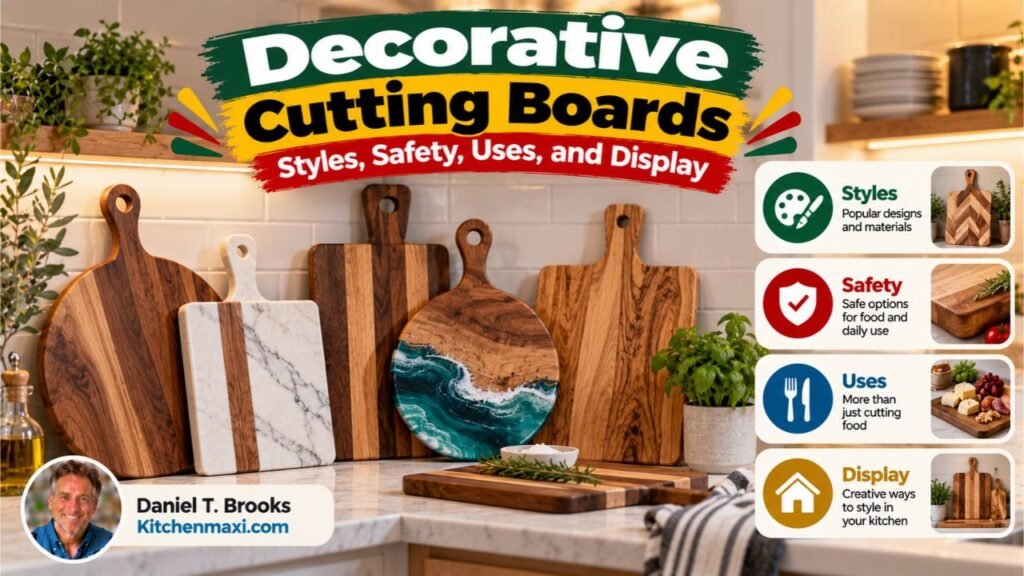
A practical kitchen may have one true cutting board for daily prep and another decorative board for serving or display. That keeps knife work, sanitation, and kitchen styling from competing with each other.
The sections below cover food-safe versus decor-only boards, materials, styles, personalization, serving uses, countertop display, knife considerations, cleaning, maintenance, buying factors, and signs that a decorative board should never be used for food.
What Are Decorative Cutting Boards?
Decorative cutting boards are boards made with visual design as a major part of their purpose.
They may still function as cutting or serving surfaces, or they may be made only as decor.
Functional Decorative Cutting Boards
A functional decorative board uses a material and finish suited to food contact and normal kitchen use.
Common examples include:
- Walnut boards with dramatic grain
- Maple boards with engraved borders
- Cherry paddle boards
- End-grain mosaic boards
- Edge-grain boards with contrasting wood strips
- Food-safe personalized boards
- Hardwood boards with decorative handles
The decoration may come from natural wood grain, board shape, safe engraving, or contrasting hardwood rather than a coating covering the cutting surface.
These boards can work as prep tools and display pieces when the maker states that the food-contact surface is intended for cutting.
Decorative-Only Cutting Boards
Some products look like cutting boards but are actually kitchen signs.
They may include:
- Painted lettering
- Vinyl graphics
- Bows
- Artificial greenery
- Craft stain
- Decorative sealers
- Glitter
- Unsealed plywood
- MDF
- Decorative hardware
A board sold as “decorative use only” should stay decorative.
Do not assume that a product is suitable for food because it is made from wood or shaped like kitchenware.
Serving Boards Are a Middle Category
Some decorative boards are suitable for serving food but not repeated knife work.
Examples include certain:
- Resin boards
- Marble boards
- Glass boards
- Engraved presentation boards
- Charcuterie boards
A surface can be appropriate for cheese, fruit, bread, or crackers while still being a poor chopping surface.
Key Takeaway: Decorative boards fall into three main groups: true cutting boards, serving boards, and decor-only pieces. Check the intended use before food or knives touch the surface.
Are Decorative Cutting Boards Safe to Use for Food?
Some are. Some are not.
The word “decorative” does not tell you if a board is a food-contact surface.
Check the Cutting Board Material
For a working wood board, close-grained hardwood is a sensible starting point.
Common options include:
- Hard maple
- Walnut
- Cherry
- Beech
The FDA Food Code permits hard maple or equivalently hard, close-grained wood for cutting boards in regulated food settings.
Plywood, MDF, particleboard, and many unfinished craft blanks are better treated as decorative materials unless the manufacturer specifically identifies them for food contact.
Check the Cutting Board Finish
A food-use board should have a finish its maker identifies as suitable for food contact.
Common finishes for working wooden boards include:
- Food-grade mineral oil
- Mineral oil and beeswax board cream
- Other finishes specifically made for food-contact wooden surfaces
Do not assume furniture stain, craft paint, polyurethane, lacquer, or an unknown decorative sealer belongs on a food-prep surface.
Check Where the Decoration Is Located
A personalized board may have an engraved name in one corner while leaving most of the board plain.
That differs greatly from paint, resin, or printed graphics covering the whole face.
Decoration limited to a handle, border, or reverse side leaves a larger plain area for food prep if the manufacturer identifies that side as a cutting surface.
Read the Product Label
Look for wording such as:
- Food safe
- Suitable for food contact
- Serving use
- Cutting use
- Decorative use only
- Not intended for food
- Hand wash only
If a painted or coated product gives no clear food-use instructions, use it as decor rather than a cutting board.
Key Takeaway: A decorative board is suitable for food only when its material, finish, construction, and product instructions support food contact.
Best Materials for Decorative Cutting Boards
Material changes appearance, knife feel, maintenance, and the jobs a board can handle.
Decorative Wood Cutting Boards
Wood offers one of the strongest combinations of appearance and real cutting ability.
Maple gives a pale, traditional look. Walnut creates dark contrast. Cherry develops warm reddish-brown tones with age.
Wood boards can come in:
- Rectangles
- Paddles
- Arches
- Rounds
- Handled designs
- End-grain patterns
- Mixed-hardwood designs
A plain hardwood cutting face is much friendlier to knife edges than glass, marble, or stone.
Wood needs hand washing, full drying, and occasional conditioning.
Decorative Bamboo Cutting Boards
Bamboo often has a light color with strong linear grain.
It can be:
- Laser engraved
- Made with handles
- Built with juice grooves
- Used for serving
- Used for general prep
Bamboo tends to feel harder under a knife than many traditional cutting-board woods.
Avoid long soaking and follow the maker’s cleaning directions.
Decorative Marble and Stone Boards
Marble and stone look polished and work well for:
- Cheese
- Pastries
- Chocolate
- Cold appetizers
- Counter display
Their major weakness is knife-edge wear.
A hard mineral surface does not give under the cutting edge like wood. Use stone boards more for presentation than regular chopping.
Decorative Glass Cutting Boards
Glass boards can feature photographs, patterns, printed artwork, or themed kitchen graphics.
They are nonporous, but they are extremely hard on knife edges.
A decorative glass board makes more sense for:
- Serving
- Counter protection
- Display
- Non-knife kitchen tasks
Use wood, rubber, or a suitable plastic board for normal chopping.
Decorative Resin Cutting Boards
Resin can create colored waves, metallic effects, embedded flowers, and wood-resin designs.
Even a resin rated for food contact can become heavily scratched if used as a regular chopping surface.
Resin-accented pieces are better suited to:
- Charcuterie
- Cheese
- Bread
- Serving
- Display
If a wood-and-resin board provides a large plain wood section specifically intended for cutting, keep knife work on that area.
Key Takeaway: Hardwood gives the strongest balance of decoration and knife use. Marble, glass, and many resin designs work better for serving and display.
Popular Decorative Cutting Board Styles
Decorative boards come in many shapes without needing complicated ornamentation.
Paddle and Handle Cutting Boards
A paddle board has an extended handle, often with a hanging hole.
It works well for:
- Counter display
- Bread
- Cheese
- Small appetizers
- Serving
Several paddle boards of different heights can be layered against a backsplash.
Round Decorative Cutting Boards
Round boards break up the straight lines created by counters and cabinets.
They work well for:
- Pizza
- Cheese
- Fruit
- Bread
- Serving displays
A round board can also be layered in front of a taller rectangular board.
Engraved Cutting Boards
Laser engraving can add:
- Family names
- Initials
- Wedding dates
- Recipes
- Kitchen sayings
- Border patterns
- Floral designs
For a working board, engraving near an edge or on the reverse face leaves more uninterrupted cutting space.
Deep engraving across the main prep surface can collect crumbs or food particles.
End-Grain Decorative Boards
End-grain construction can create checkerboard, brick, geometric, and mosaic patterns entirely from wood.
The appearance comes from grain orientation rather than paint.
That makes end-grain hardwood a strong option for someone who wants both a decorative design and a serious chopping surface.
Rustic and Live-Edge Boards
Natural-looking edges create a farmhouse or rustic style.
For food use, the board still needs a smooth, cleanable surface and suitable finish.
Loose bark and very rough edges are harder to clean, so some rustic designs are better reserved for display or dry-food serving.
Key Takeaway: Paddle, round, engraved, end-grain, and rustic boards offer very different looks. Decoration created through wood grain and shape is easier to combine with real cutting use.
Personalized Decorative Cutting Boards
Personalized cutting boards are common gifts for weddings, anniversaries, housewarmings, and family kitchens.
Common Cutting Board Personalization
Boards may feature:
- Last name
- Couple’s names
- Initials
- Wedding date
- Handwritten family recipe
- Home coordinates
- Short kitchen message
- Business logo
The personalization method matters if the board will also be used for food.
Engraved vs Painted Cutting Boards
Laser engraving removes a small amount of wood.
Paint or vinyl adds another material to the surface.
A lightly engraved hardwood board with a food-use finish may still function as a cutting board.
A painted board may need to remain decorative if its coating is not intended for food contact or repeated knife wear.
Use One Side for Decoration
A useful two-sided setup is:
- Decorative side for display or serving
- Plain reverse side for chopping
This protects detailed artwork while still giving the board a working role.
Key Takeaway: Personalized boards are most practical when decoration stays near an edge or on one side, leaving a plain cutting face for actual food prep.
How to Use Decorative Cutting Boards in the Kitchen
A decorative board can earn its counter space rather than functioning only as an ornament.
Use Food-Safe Decorative Boards for Prep
An attractive walnut, maple, cherry, or beech board can handle:
- Vegetable chopping
- Fruit slicing
- Bread
- Herbs
- Cooked meat
- General food prep
If the board remains on the counter, there is no need to retrieve it from a cabinet for every meal.
Use Decorative Boards for Serving
Serving usually causes less surface wear than chopping.
Food-contact-safe boards work well for:
- Cheese
- Crackers
- Bread
- Fruit
- Cookies
- Sandwiches
- Appetizers
A handle or paddle shape can make carrying easier.
Use Decor-Only Boards as Kitchen Accents
Craft boards can be displayed:
- Against a backsplash
- On a stand
- On open shelves
- On a wall
- In a kitchen corner arrangement
Keep painted or ornamented pieces away from regular sink splash and cooking grease.
Key Takeaway: A functional hardwood board can prep and serve, a presentation board can serve, and a craft board should remain decorative.
How to Display Decorative Cutting Boards on a Kitchen Counter
A small vertical arrangement creates a decorative effect without using much counter space.
Layer Two or Three Cutting Boards
Put the tallest board at the back.
Add a shorter board or round board in front.
Using different heights, shapes, and handles creates contrast without requiring many pieces.
Keeping similar wood tones together often makes the arrangement look cleaner.
Use a Cutting Board Stand
A vertical cutting board rack keeps boards separated and upright.
This is useful for working wooden boards because air can move around them after cleaning.
Choose a rack that is stable enough for heavy hardwood boards.
Keep Cutting Boards Outside the Main Prep Zone
Good locations include:
- Backsplash corners
- End of a cabinet run
- Open counter near a pantry
- An unused section away from the sink and stove
Do not let the display take away the workspace needed for cooking.
Avoid Constant Sink Water and Stove Grease
Repeated sink splash is poor for wood, painted details, ribbons, and craft finishes.
Cooking grease can also coat display boards beside a range.
Leave some distance from these areas when possible.
Key Takeaway: Display a few boards vertically, vary the shapes, and keep them outside the busiest prep, sink, and cooking areas.
Decorative Cutting Boards for Charcuterie and Serving
Some boards called decorative cutting boards are better described as presentation boards.
That can be a good use of the material.
Wood Serving Boards
Hardwood works well for:
- Cheese
- Bread
- Fruit
- Crackers
- Cured meats
- Small appetizers
An engraved or dark walnut board can make pale foods stand out visually.
Marble and Glass Serving Boards
Marble and glass provide a polished presentation and are easy to wipe clean when their care instructions permit it.
Avoid chopping on these surfaces if protecting knife edges matters.
Resin Serving Boards
A resin-accented board can create a strong visual centerpiece.
Use it according to its food-contact instructions and avoid repeated chopping across the resin unless the product is specifically made for that use.
Key Takeaway: Serving is often the best job for decorative marble, glass, and resin boards because presentation matters while heavy knife contact is limited.
How to Clean Decorative Cutting Boards
Cleaning depends on both the material and the decoration.
Cleaning Decorative Wooden Cutting Boards
For a functional hardwood board:
- Wash with warm water and dish soap after use.
- Scrub with a soft sponge or brush.
- Rinse thoroughly.
- Towel dry.
- Let the board air-dry completely.
USDA food-safety guidance recommends washing cutting boards after use and replacing boards that become excessively worn or develop hard-to-clean grooves.
Avoid prolonged soaking because wood can swell, warp, or crack.
Cleaning Painted Decorative Boards
A painted craft board should not automatically be washed like a cutting board.
Water may damage:
- Paint
- MDF
- Plywood edges
- Decorative paper
- Fabric
- Adhesive
- Bows
Follow the maker’s cleaning directions.
If it is marked decorative-only, there is no reason to sanitize it as a food-prep surface.
Cleaning Decorative Serving Boards
Clean food-contact serving boards after each use according to their material.
A wood board needs full drying.
Glass, marble, and other nonporous boards may tolerate different cleaning methods, but attached decorations or backing materials can change the care requirements.
Key Takeaway: Clean functional boards as food tools and decor-only pieces as decorative objects. Do not soak or scrub artwork unless the maker permits it.
How to Maintain Decorative Wooden Cutting Boards
A working wooden board needs conditioning as its surface dries.
Use Food-Grade Mineral Oil
Apply food-grade mineral oil to a clean, dry board when the wood starts looking pale, rough, or dry.
Coat:
- Front
- Back
- Edges
- End grain
Let the oil absorb, then wipe away excess.
Avoid using ordinary cooking oils such as olive or vegetable oil as the main conditioner because they can oxidize and develop unpleasant odors.
Add Cutting Board Wax if Desired
A board cream made from mineral oil and beeswax can leave the wood smoother and slow moisture movement.
It does not make the board waterproof.
Store Decorative Boards Dry
Let wood dry fully before stacking boards tightly.
Standing boards upright gives more airflow.
Move boards displayed permanently against a backsplash from time to time so crumbs and moisture do not collect behind them.
Key Takeaway: Condition working wooden boards with food-grade mineral oil, treat every face and edge, and store them completely dry.
When a Decorative Cutting Board Should Not Be Used for Cutting
Keep a decorative board away from knives if it has:
- Paint across the cutting face
- Vinyl graphics
- Unknown resin
- Unknown sealer
- Decorative lacquer
- Fabric
- Flowers or bows
- Glitter
- Craft adhesive
- MDF construction
- Craft plywood
- Printed artwork not intended for cutting
- A label stating decorative use only
Glass, marble, and stone also make poor everyday chopping surfaces if you want to protect knife edges.
An attractive board does not need to function as a cutting tool to be useful.
How to Choose Decorative Cutting Boards
Start with the job the board must perform.
Decorative Board for Real Cutting
Look for:
- Close-grained hardwood
- Plain cutting area
- Food-contact-safe finish
- Stable construction
- Enough prep space
- Comfortable thickness
- Easy cleaning
Natural grain can provide decoration without adding a coating.
Decorative Board for Serving
Look for:
- Food-contact rating
- Attractive shape
- Suitable surface area
- Easy-to-clean material
- No loose ornament near food
Wood, marble, glass, and selected resin-accented boards can work here.
Decorative Board for Display
For decor-only use, you can focus on:
- Paint
- Typography
- Seasonal designs
- Bows
- Flowers
- Farmhouse styling
- Custom messages
Just keep such materials away from cutting and food unless the product instructions state otherwise.
Decorative Cutting Board as a Gift
Think about how the recipient is likely to use it.
A personalized hardwood board with a food-use finish can work for chopping, serving, and display.
A painted craft board may be the better gift when the custom artwork itself is the main purpose.
Key Takeaway: Choose by function first: hardwood for cutting, food-contact-rated surfaces for serving, and craft materials for display.
Conclusion
Decorative cutting boards can be working kitchen tools, serving pieces, or pure decor. The right choice starts with identifying which of those jobs the board was actually made to perform.
For daily chopping, a close-grained hardwood with a plain cutting face gives a strong combination of appearance and knife friendliness. Walnut, maple, cherry, engraving, and patterned end grain can create decorative character without placing paint or resin beneath the knife.
For serving, marble, glass, resin-accented wood, and highly styled boards can work well when their food-contact instructions permit it. Painted signs, bows, printed designs, plywood craft blanks, and other ornamented pieces are better kept for countertop or wall display when they are not rated for food use.
Check the material, finish, and product instructions before using the board. Then clean and maintain it according to its actual purpose rather than treating every decorative board as the same type of kitchen tool.
FAQs About Decorative Cutting Boards
Can Decorative Cutting Boards Actually Be Used for Cutting?
Some can.
A solid hardwood board with a food-contact-safe finish and plain cutting surface can function as a real cutting board. Painted, vinyl-covered, craft-sealed, resin-coated, or decor-only boards may not tolerate repeated knife contact.
Are Painted Decorative Cutting Boards Food Safe?
Do not assume they are.
The paint and finish must be suitable for their intended food contact, and knife cuts can damage even a finished painted area. A board labeled decorative-only should stay away from direct food prep.
Can You Serve Food on a Decorative Cutting Board?
Yes, if the product is intended for food contact.
Many wood, marble, glass, and resin-accented boards are made for serving or charcuterie. Check the product instructions when paint, printed graphics, resin, or another decorative finish is present.
What Wood Is Best for Decorative Cutting Boards?
Hard maple, walnut, cherry, and beech are strong options for boards intended to be functional.
Walnut provides dark contrast, maple has a light classic appearance, and cherry develops warmer color as it ages.
Are Resin Decorative Cutting Boards Good for Chopping?
They are usually better for serving than daily chopping.
Repeated knife contact can score a resin surface. If a wood-and-resin board has a plain wood area specifically intended for cutting, keep knife work on that section.
Can Decorative Cutting Boards Be Hung on the Wall?
Yes.
Boards with handles or hanging holes are simple to display. Heavy hardwood pieces need suitable wall hardware. Keep painted or ornamented boards away from burners, open flames, heavy grease, and regular water splash.
How Do You Display Decorative Cutting Boards on a Counter?
Stand two or three boards upright against a backsplash or place them in a stable rack.
Use different heights and shapes, keep the main work area open, and make sure functional wood boards are completely dry before grouping them tightly.
How Do You Clean a Decorative Wooden Cutting Board?
For a functional hardwood board, wash it with warm soapy water, rinse it, towel dry, and let it finish air-drying.
Avoid prolonged soaking. Apply food-grade mineral oil when the wood begins to look dry. Painted and craft-only boards should be cleaned according to their individual care instructions.