

10 Best Cheese Cutting Boards for Parties and Entertaining
A good cheese board gives guests room to slice, spread, and serve without knocking food onto the table. Choose a wooden cutting surface for regular knife work, a bamboo set for organized serving, or a covered board for travel. SMIRLY is my first pick for a starter set; Sonder LA Winsome suits hosts who also want a working cutting board.
Shopping for the best cheese cutting boards for entertaining gets confusing because a serving platter, a drawer-equipped gift set, and a board with a wire slicer do different jobs. A crowded center or awkward cutting surface can turn an appealing display into a frustrating snack station.
Matching the board to your gathering gives cheese more room, keeps wet accompaniments away from crackers, and reduces the extra dishes you need. It also prevents paying for accessories that stay in a cupboard.
For a useful planning benchmark, Dairy Farmers of Wisconsin recommends 2 ounces of cheese per person for an appetizer board. That means eight guests need about 1 pound of cheese before adding fruit, bread, or meat—a more useful starting point than an unsupported claim that a board “serves eight.”
What stood out during my research was how often advertised dimensions include space occupied by bowls, grooves, or storage. I would check the open cheese area before choosing a set by its total width or accessory count.

The ten reviews below explain each board’s strongest use and main compromise. Material comparisons, serving quantities, cutting advice, setup steps, food handling, and cleaning instructions then turn that purchase into a practical entertaining setup.
Best Cheese Cutting Boards for Entertaining at a Glance
My recommendations draw on manufacturer specifications, established customer-rating histories, and visible purchase activity where available. These are research-based reviews; I have not tested the boards firsthand. The awards reflect different hosting jobs, rather than an unverifiable ranking of lifetime sales.
| Board | My recommended use | Main compromise |
| SMIRLY Original Bamboo Set | First complete cheese-board set | Compact center needs careful arrangement |
| ROYAL CRAFT WOOD Side-Tray Set | Spreads with several accompaniments | Expanded layout needs more table room |
| Bambüsi MAT-CB2 | Simple square board with stored knives | Perimeter groove reduces open space |
| House Ur Home Four-Drawer Set | Hosts starting without serving accessories | Many separate pieces to clean |
| ChefSofi Acacia Set | Round display with several dips or sides | Fitted bowls occupy much of the perimeter |
| Sonder LA Winsome Acacia | Food preparation and serving | Substantial weight before adding food |
| Farberware Build-A-Board | Taking an arranged spread to a gathering | Compartments and lid restrict the layout |
| Picnic at Ascot Vienna | Folding storage and tiered presentation | Moving sections need careful cleaning |
| Prodyne 805B | Small wooden cheese-slicing station | Too small for a full party spread |
| Fox Run 3841COM | Marble serving station with a wire cutter | Limited display area and a replaceable wire |
Check the exact configuration before ordering. Similar product names can refer to different board sizes, drawer arrangements, and accessory bundles. A photograph showing three trays does not guarantee that every selectable version includes all three.
10 Best Cheese Cutting Boards for Entertaining
1. SMIRLY Original Bamboo Charcuterie Set: Best Starter Set
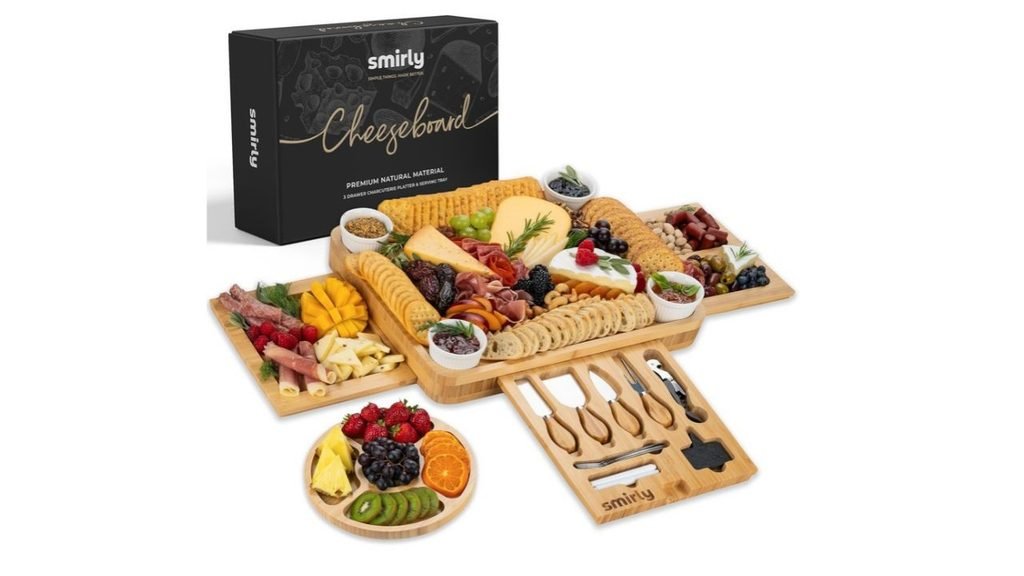
The original SMIRLY set is my first recommendation for someone building a cheese-serving setup from scratch. The 13-by-13-inch bamboo board comes with a separate fruit tray, two ceramic sauce bowls, four cheese knives, and two slate labels. Its drawer keeps the cutting tools with the board between gatherings.
The separate tray is the feature I would use most. Moving grapes or sliced fruit off the main board leaves a clearer path to the cheese. It also gives you a second serving point, so every guest does not have to reach into the same crowded square.
This layout suits an appetizer spread with a few cheeses and restrained accompaniments. Put one bowl on the main board and another beside it if both would crowd the center. Included accessories are options, not a requirement to fill every available slot.
The limitation is the square footprint. It cannot hold an unlimited assortment just because the package contains several tools. You also need clearance in front of the drawer, and the fruit tray requires its own storage space.
The manufacturer specifies damp-cloth cleaning for the board, hand-washing for the tools, and no dishwasher use. Treat this as a serving set that needs prompt care after sticky cheese, honey, or jam.
My verdict: A balanced first set for someone who wants a board, basic cheese tools, and a second tray in one purchase. Choose a larger layout if you dislike refilling during a party.
2. ROYAL CRAFT WOOD Bamboo Cheese Board and Knife Set with Charcuterie Board & Serving Tray with Appetizer Plates & Side Trays
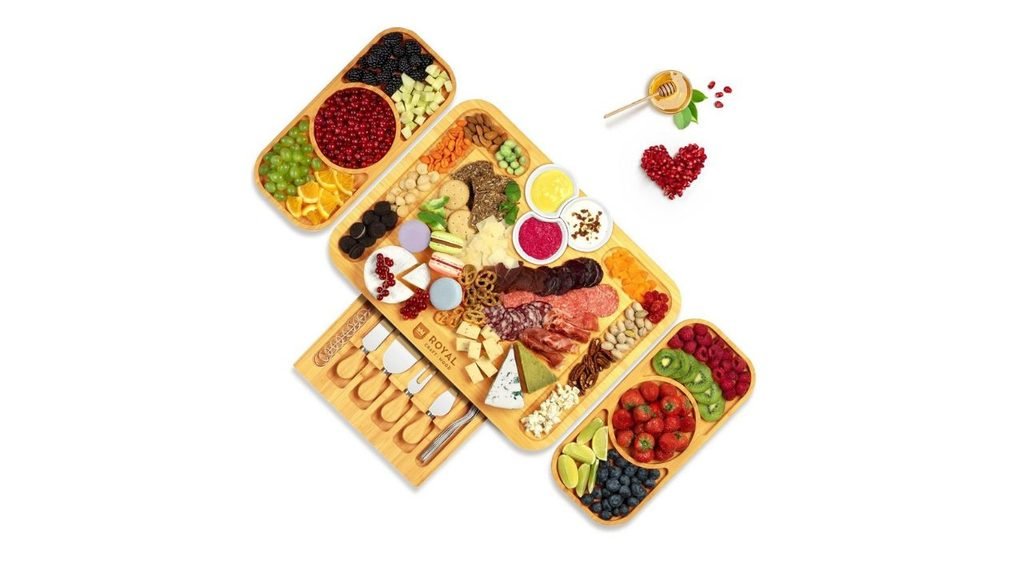
This ROYAL CRAFT WOOD set starts with a 17.5-by-13-inch bamboo main board and adds two side serving trays. Three ceramic sauce bowls, hidden cutlery storage, and a knife-and-fork set support a spread with more components than cheese and crackers alone.
Its appeal is the ability to distribute food across separate areas. Keep cheeses on the center board, bread on one side tray, and fruit on the other. That arrangement leaves fewer foods competing for the same cutting space and gives guests clearer places to reach.
The bowls suit olives, mustard, or preserves. I would avoid filling all of them with similar sweet spreads; one sweet option, one savory option, and one briny accompaniment create more distinct pairings without adding another dish.
The complete arrangement occupies more space than the main board’s stated dimensions. Measure the serving area with room for trays, opened storage, plates, and hands. On a narrow coffee table, the extra components could become obstacles.
Choose this set for the extra serving space and bowls, then confirm the tools included in your selected package. Accessory descriptions can vary across versions with similar names.
My verdict: A strong option for hosts who regularly serve cheese with bread, fruit, meats, and condiments. Its extra serving pieces earn their place on a generous dining table or buffet, but a simpler board is less cumbersome for a small snack.
3. Bambüsi Charcuterie Board Cheese Board Set with Accessories – Bamboo Wooden Serving Tray, Platter – House Warming Gifts New Home, Wedding, Bridal Shower, Anniversary, Housewarming, Birthday Gifts for Women
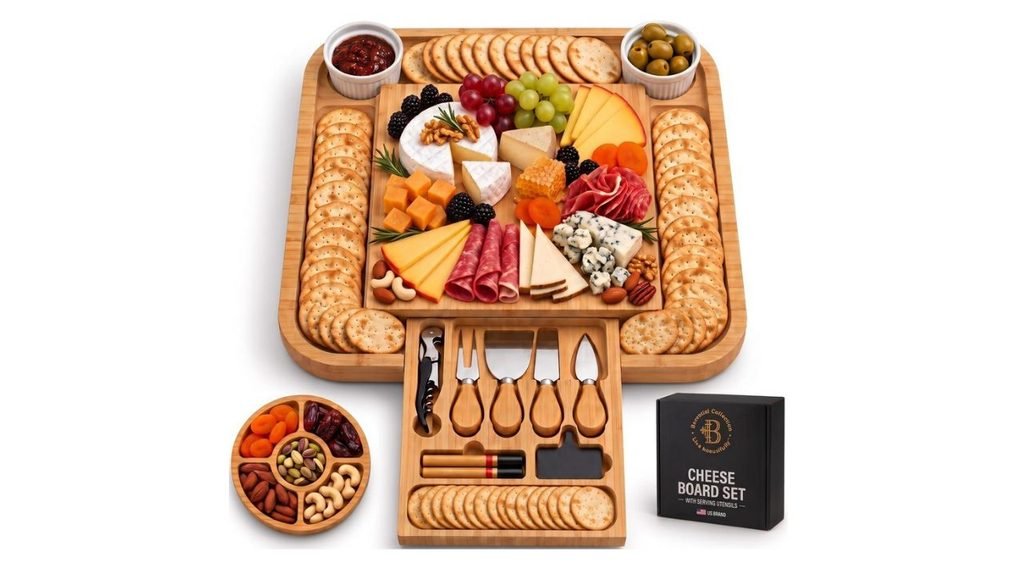
The Bambüsi MAT-CB2 centers on a straightforward layout: a square bamboo board, a perimeter snack groove, and four stainless steel cheese knives stored in a slide-out drawer. The manufacturer gives the board itself as 13.5 by 13.5 inches.
This is a sensible choice if you prefer a square board with drawer storage to an expandable arrangement with side trays. Separate serving accessories can stay off the table for a smaller display, while the groove gathers crackers around the central cheese area.
For a casual cheese tasting, I would arrange a few portions in the center and keep bread refills nearby. The square format encourages a contained display. It works better with a deliberate selection than with many full-size wedges crowded together.
The groove is both a convenience and a compromise. It organizes food, but it reduces the uninterrupted surface available for slicing. Crumbs and soft cheese also need attention during cleaning; wiping only the flat center leaves part of the board unfinished.
Bambüsi directs owners to hand-wash with mild soap and warm water, dry promptly, avoid soaking and dishwashers, and use food-grade mineral oil as needed. Some retail bundles add labels or other extras; confirm those separately.
My verdict: A good fit for someone who wants the board and knives stored together without building an elaborate serving station. Its main attraction is orderly storage and a familiar square layout, rather than maximum display area.
4. Bamboo Charcuterie Board Set with Leather Handles | Large Cheese Board with Knives & Bowls | Elegant Housewarming, Wedding & Birthday Gift for Couples
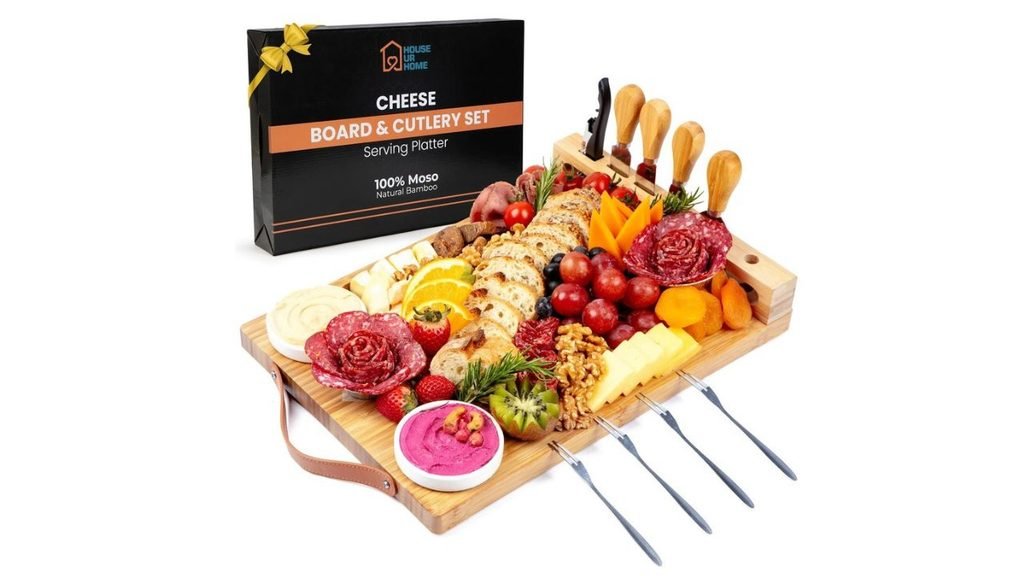
House Ur Home’s bamboo set suits a host who still needs many of the small serving pieces. Its package includes four magnetic pull-out drawers, four cheese knives, two ceramic bowls, two serving plates, labels, markers, serving forks, a wine opener, and a separate round tray.
The useful part of this assortment is the number of serving tasks it covers. Bowls contain moist foods, plates provide extra landing spots, and the separate tray can carry fruit or a second group of cheeses. You can spread those pieces across the table instead of squeezing everything onto the bamboo center.
That makes the set appealing as a housewarming gift or a first entertaining purchase. It is less persuasive for someone who already owns small bowls, reliable knives, and serving plates. Duplicate utensils add storage demands without improving the meal.
Four drawers also mean four areas to check for crumbs and moisture. Open the storage before arranging surrounding dishes, and place the tools guests need beside the cheeses. Constantly pulling drawers during service could disturb a tightly packed table.
The manufacturer calls for gentle hand-washing and thorough drying. Plan cabinet space for the whole package, including the separate tray and ceramic pieces.
My verdict: Choose this set for its included serving equipment. I would pass on it if the main goal were a broad, uncomplicated cutting surface, since the accessory system is the reason to buy it.
5. ChefSofi Acacia Cheese Board Set: Best Round Layout
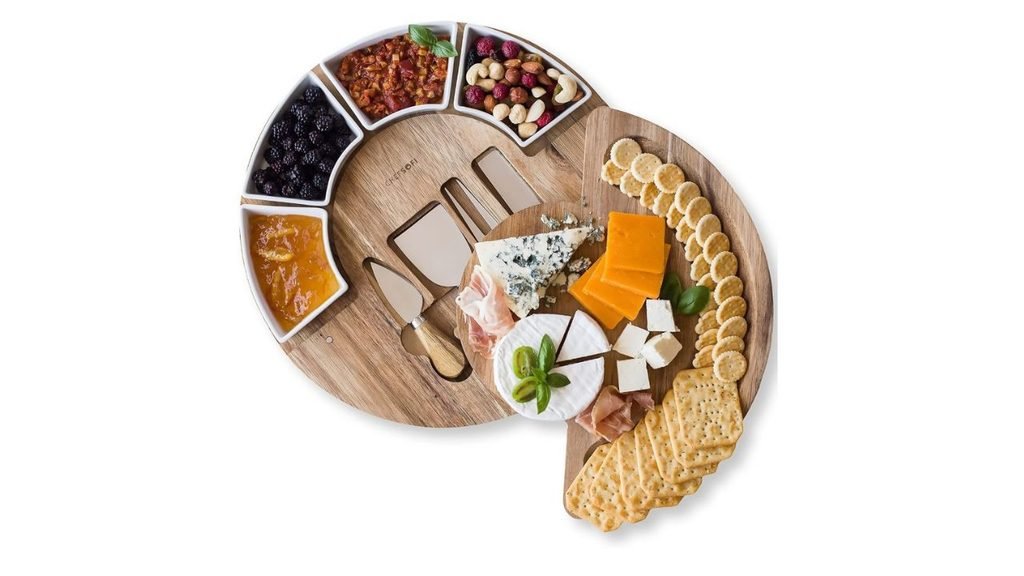
ChefSofi offers a round alternative to the many square bamboo sets. Its acacia board measures 13 inches across and 1.6 inches thick, with four ceramic bowls and four stainless steel cheese knives with wooden handles. Hidden utensil storage keeps the knives with the set.
The four bowls give this board a clear purpose: serving cheese alongside several small accompaniments. Olives, preserves, dried fruit, and a savory spread can stay in separate containers instead of spreading across the cutting surface.
A round board can sit comfortably at the center of a small table, with guests approaching from different directions. I would use a few modest cheese portions and keep extra crackers on a separate plate. That protects the middle from becoming a cramped collection of bowls and wedges.
The advertised diameter describes the whole board. It does not mean you get a clear 13-inch circle for cutting. The bowls occupy part of that footprint, so compare the center area with the cheese sizes you usually buy.
Acacia’s grain gives the set a different appearance from pale bamboo, but the pattern will vary between boards. The wooden board needs careful surface cleaning, and the wood-handled tools deserve separate attention after use.
My verdict: A practical round set for hosts who enjoy several condiments and a coordinated display. Choose a plain rectangular board if your usual spread centers on large wedges or if you prefer unrestricted cutting space.
6. Sonder Los Angeles Winsome Acacia Wood Cutting Board
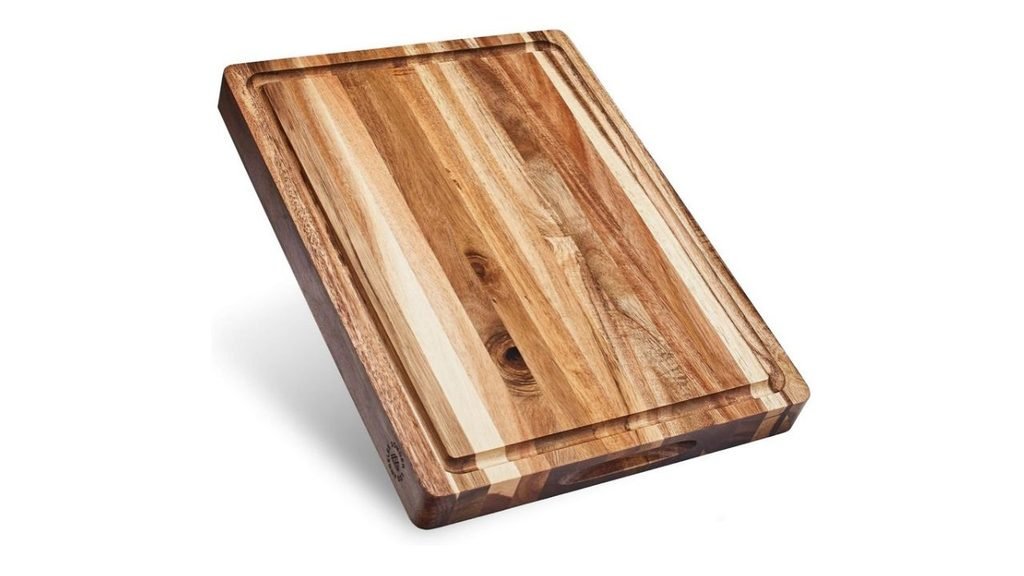
The Winsome acacia board is the clearest match for someone who wants a working cutting board that also belongs on the dinner table. It measures 16 by 12 by 1.5 inches, weighs 6 pounds, and uses edge-grain acacia. One side has a juice groove; the reverse has a recessed cracker well.
That reversible design gives it a useful role beyond occasional parties. You can prepare fruit or portion cheese on a broad surface, clean it, then arrange the serving side. The cracker well gathers small accompaniments without requiring a pull-out tray or fitted ceramic bowls.
I prefer this style for someone who already owns good cheese knives. The purchase focuses on the board itself, so you are not paying for a second collection of small utensils that duplicate tools in the kitchen.
Its weight is the main compromise. Six pounds is substantial before adding cheese, fruit, and a bowl of olives. Recessed finger grips provide a lifting point, but they do not remove that weight. Consider the distance between your counter and serving table.
Sonder specifies hand-washing with mild soap and regular conditioning. Keep it out of the dishwasher and avoid soaking or steam. This review concerns the acacia Winsome; the maple version is a different product.
My verdict: My preferred choice for regular preparation and occasional entertaining on the same board. It is less suitable if lightweight carrying or included serving tools matter most.
7. Farberware Bamboo Cutting Board: Best for Taking Food to a Party
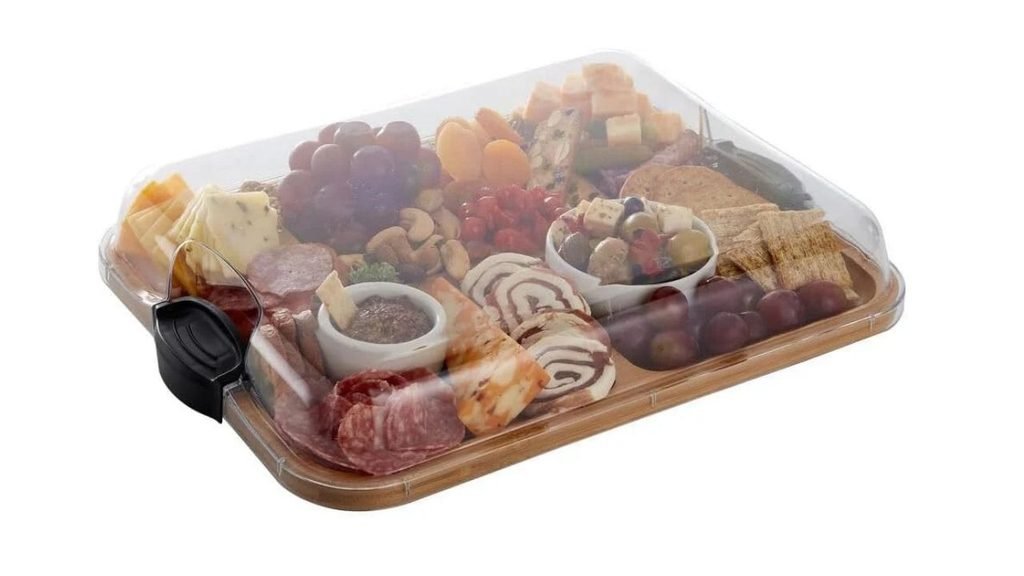
The 11-by-14-inch, six-compartment Build-A-Board addresses a problem that uncovered cheese platters leave unsolved: getting an arranged spread to another location. Its bamboo board has a flat preparation side, a divided serving side, and a clear locking lid.
The compartments give each part of the spread a defined space. Cheese pieces, crackers, grapes, and other snacks can stay in separate sections, which suits a potluck, picnic, or visit to a friend’s home. The cover is also useful when you want to protect an arrangement while handling other party preparations.
I would choose this model for transport before choosing it for a dramatic centerpiece. The divided layout favors smaller portions and practical organization. A tall wedge, upright cracker arrangement, or large bowl may not fit beneath the lid.
The cover is not a substitute for cold storage. Pack perishable ingredients in a suitable cooler during travel and keep the board level. A locking lid should not be treated as proof that liquids cannot leak if the board tips.
Farberware lists hand-washing for this board. Check that the selected version is the six-compartment model, since other Build-A-Board layouts look similar in product listings.
My verdict: The strongest choice here for bringing a prepared snack board to a gathering. Its cover and compartments solve a real carrying problem, while the layout is less flexible than a broad, open serving board.
8. Picnic at Ascot Patented Bamboo Cheese/Charcuterie Board with Cheese Knife Set – Stores as a Compact Wedge – Opens to 18″ Diameter – Designed & Quality Checked in USA
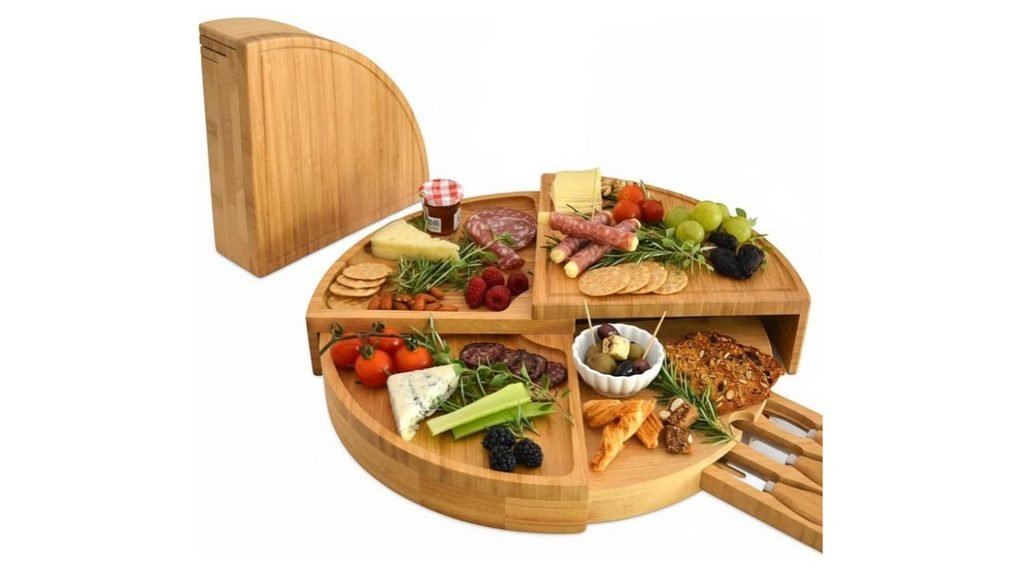
The Picnic at Ascot Vienna changes from a compact wedge into a circular, tiered bamboo serving board. A concealed drawer holds three stainless steel cheese tools. Its folding structure is the reason to choose it over a conventional flat board.
The tiers can separate small groups of food without adding individual serving stands. Place cheese on one section and accompaniments on others, leaving the tools where guests can reach them. The presentation offers more height than a plain slab while still folding down after the gathering.
Closed storage is the strongest argument for this design. A host with limited cupboard width may find a folded wedge easier to accommodate than a large, permanently open circle. Measure the open serving arrangement too; compact storage does not guarantee a compact table setup.
The moving sections bring some tradeoffs. Joints and overlaps need checking for crumbs, and the divided surface is better suited to serving than extensive preparation. I would portion firm cheeses on a separate stable cutting board before placing them on the tiers.
Open the board fully before loading it, and keep the food arrangement away from areas that move. It has no locking food cover, so it is not the natural choice for carrying an assembled spread to another home.
My verdict: A distinctive option for hosts who want a tiered display that folds for storage. Choose a simple slab if broad cutting space and minimal cleaning detail are higher priorities.
9. Prodyne Prodyne Beechwood Cheese Slicer: Best Small Wooden Board With a Wire Slicer
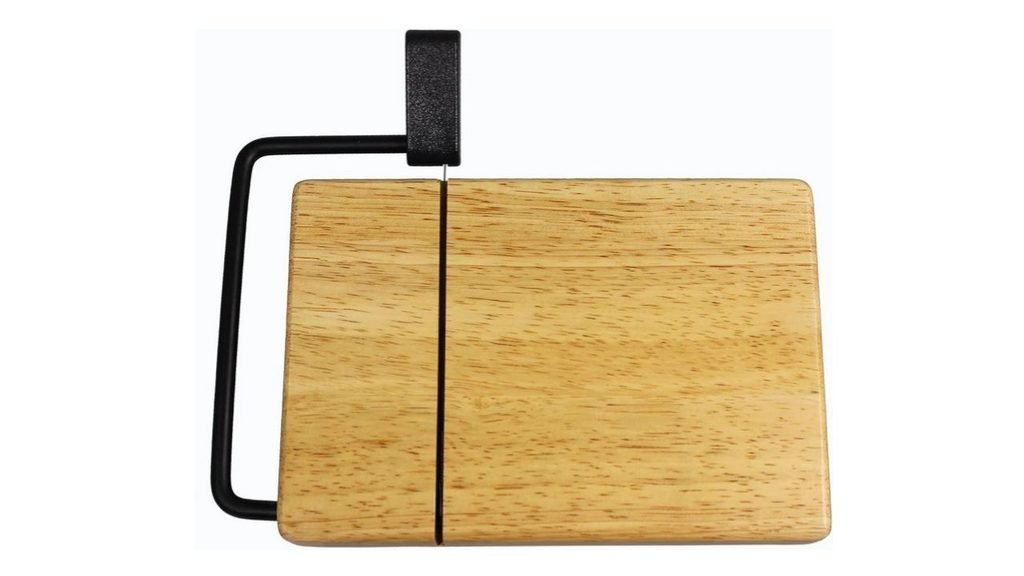
The Prodyne 805B is a compact cheese-slicing station. Its beechwood base measures 9½ by 6 by ⅞ inches, and a black arm carries the cutting wire. The assembled tool occupies more room than the wooden base alone.
Its role is different from the larger serving sets. Place a suitable block on the board, use the wire to portion it, and transfer slices to the main platter. You can also position it beside a spread so guests can cut fresh pieces without taking over the central display.
The compact format makes sense for a small cheese course or for someone who frequently serves one block cheese. It offers little room for the fruit, bread, and condiments that turn a cheese plate into a larger entertaining spread.
A wire is also a wear item. Prodyne has different replacement lengths and assembly types, so match the replacement to the model and cutting slot. Do not assume that every wire sold for a cheese board fits this one.
Keep the block within the cutter’s working space and stop if it requires force beyond normal operation. A compact wire slicer should not replace a suitable knife for tough rinds or every very hard cheese.
My verdict: A useful companion to a larger platter, especially for serving sliced block cheese. Buy it as a cutting tool with a small serving surface, rather than expecting it to hold an entire party arrangement.
10. Fox Run Marble Cheese Slicer: Best Marble Board With a Wire Cutter
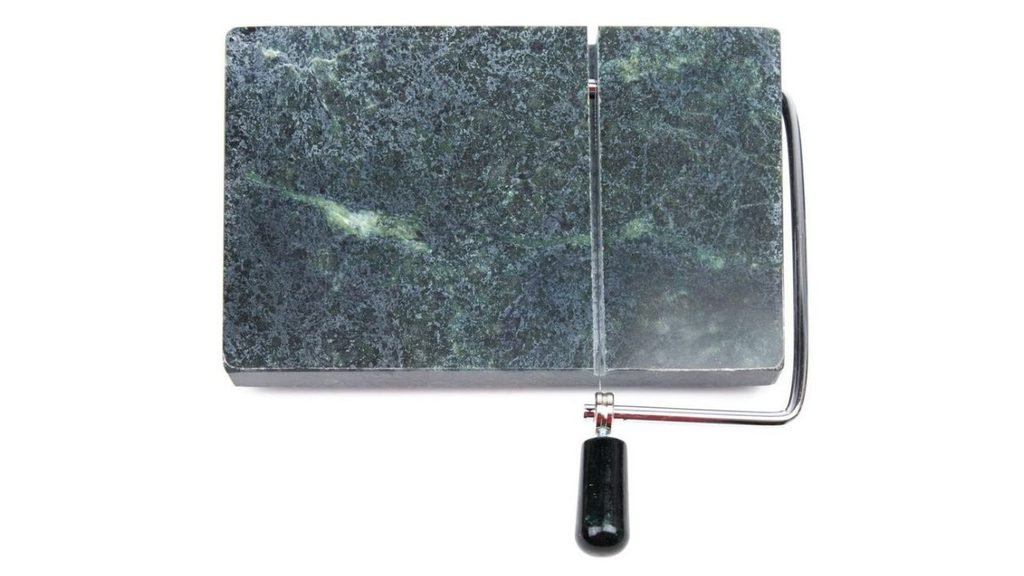
Fox Run’s white marble cheese slicer combines a compact stone base with a lever-operated stainless steel wire. The board measures 8.25 by 5 inches, making it a small slicing and serving station. Feet beneath the base separate it from the table surface.
Choose it if you like marble’s appearance and want a built-in cutter for a suitable cheese block. The wire does the cutting, so you do not need to bring a sharp kitchen knife down against the stone.
I would place this beside a larger wooden board, with crackers and accompaniments elsewhere. That gives the marble slicer a clear job and avoids filling its limited surface with foods that obstruct the wire’s path.
The stone pattern will vary, and the cutting wire may eventually need replacement. Check the package contents for the spare supplied with your chosen set. Fox Run also lists replacement wire packs for its marble slicers.
Marble can feel cool, but that does not establish a safe food-holding temperature. Keep the same serving-time plan you would use for another board. Hand-wash the slicer and inspect the wire and feet before setting it out.
My verdict: A compact choice for hosts who want marble presentation with a purpose-built slicing mechanism. It complements a main board; its small footprint limits how much of the overall spread it can display.
Key Takeaway: Choose a complete set for serving equipment, a plain wood board for preparation, or a wire board for a separate slicing station.
Cheese Cutting Boards and Serving Boards Do Different Jobs
A cutting board provides a surface intended for knife contact. A serving board holds food for presentation and sharing. One product can do both, but its appearance and name do not prove that every part is suitable for cutting.
A solid wooden center may work for portioning cheese, while a thin pull-out tray is better reserved for crackers. A marble insert can hold prepared slices, but bringing a kitchen knife down against stone can dull the edge. Knife maker Shun advises against marble, granite, glass, and ceramic cutting surfaces.
The distinction changes how you shop. If you usually cut cheese in the kitchen and carry finished portions to guests, serving space matters most. If guests will slice from wedges, prioritize a stable cutting area and enough room to hold the cheese safely.
A board with an integrated wire is a separate category. Its cutter portions cheese along a fixed path, so check the block size and working clearance. The stone base of a wire slicer does not make stone a suitable surface for ordinary knife work.
Choosing cheese cutting board Between Wood, Bamboo, Marble, and Other Materials
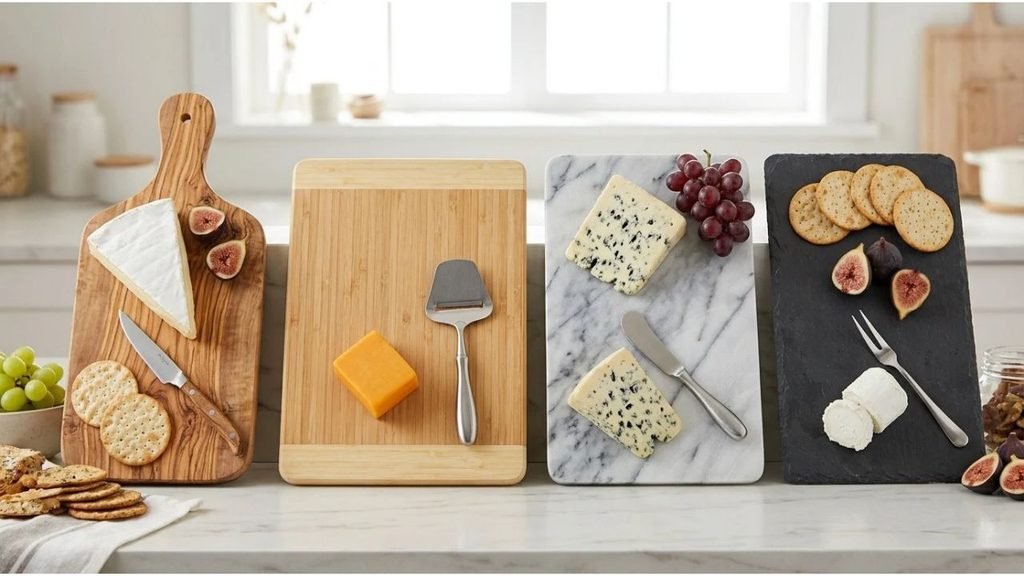
Match the material to the amount of cutting, carrying, and cleaning you expect to do. The most attractive finish in a photograph may be inconvenient for the way you actually serve cheese.
| Material | Useful qualities for entertaining | What to check |
| Wood, including acacia and beech | Suitable cutting-board designs can handle preparation and serving | Weight, finish, washing directions, conditioning |
| Bamboo | Common in sets with drawers, grooves, and included tools | Hard cutting surface, glued joints, approved care |
| Marble or slate | Suits prepared cheese and table presentation | Weight, edge condition, knife restrictions |
| Food-contact plastic or composite | Practical preparation surface; some permit dishwasher cleaning | Exact temperature and dishwasher instructions |
| Decorative mixed materials | Can provide separate serving areas and visual contrast | Which areas permit food contact and cutting |
Wood makes sense when cutting is part of the job. A board sold for food preparation offers more flexibility than a decorative tray. Choose a shape with enough uninterrupted space to hold a wedge and guide the knife. A thick board can feel substantial, but its extra weight becomes noticeable when carrying a loaded spread.
Bamboo suits many organized serving sets, but it is not automatically gentle on knives. WÜSTHOF warns that bamboo can dull blades faster than softer wood or suitable synthetic surfaces. If preserving a fine knife edge is your priority, portion cheese on a knife-approved preparation board and use the bamboo set for serving.
Stone works best as a presentation surface or part of a purpose-built slicer. Check for chips, sharp edges, and damaged feet before use. Do not count on a cool-feeling slab to maintain refrigerated food temperatures throughout a gathering.
With resin details, painted designs, or decorative coatings, check the maker’s food-contact and cutting instructions. Approval for serving food does not automatically establish suitability for repeated knife cuts. A plain approved area may be the only part intended for preparation.
How to Choose a Board That Fits Your Table
Measure the Usable Surface and Open Footprint
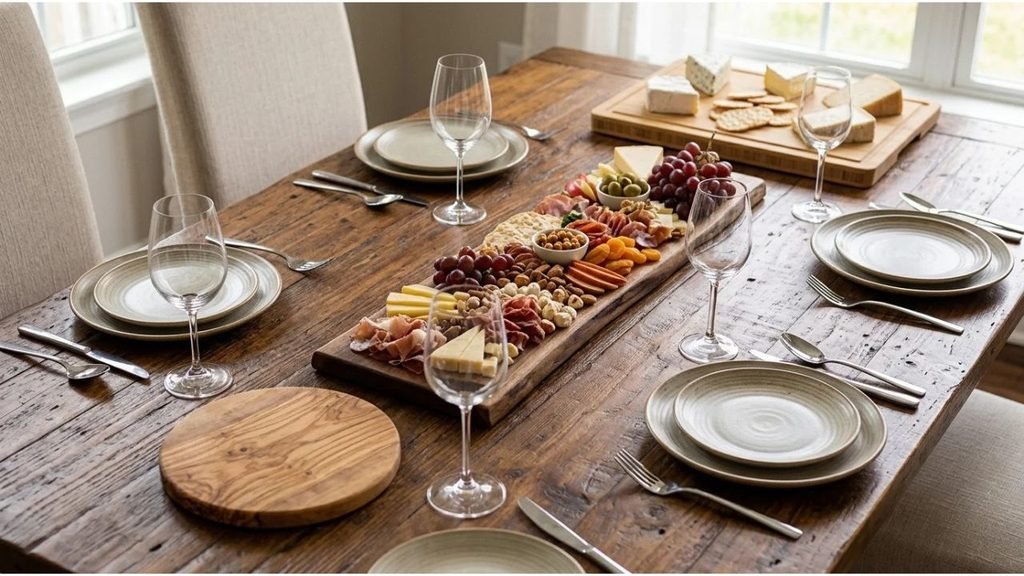
Start with the space left after bowls, handles, cracker channels, and other fixed features. That is where the cheese and cutting tools must fit. A wide board with a deep border can offer less open space than a narrower plain slab.
Before buying a cutting board, make a paper outline of the listed dimensions. Place your usual small bowls and a plate representing the cheese area inside it. This simple layout check reveals crowding before you commit to a heavy set.
For expandable boards, allow room for every tray and drawer you intend to open. Leave space around the arrangement for guests’ plates, glasses, and hands. Check the refrigerator, sink, cooler, and storage shelf too; table fit is only part of ownership.
Consider Loaded Weight and Guest Access
A board’s empty weight does not include ceramic bowls, cheese, grapes, or a cover. Think about how you will lift the finished arrangement and where your fingers can grip it. Recessed handles may be useful, but a loaded board still needs a controlled, level carry.
For a larger gathering, two reachable stations may work better than one huge centerpiece. Put familiar cheeses at both ends of a buffet and keep bread accessible nearby. This is a serving-layout choice, not a claim that smaller boards hold more food.
On a coffee table, check that guests can reach the knives without stretching over a bowl or tall cheese wedge. A low, open layout often suits seated guests better than several stacked levels.
Spend on Features You Will Actually Use
Compare the complete purchase with what you already own. A set containing bowls, knives, and labels can make sense for a new host. An established kitchen may need only a better board.
Pay extra for usable surface, comfortable lifting, a fitting cover, or replaceable cutting parts if those solve your actual problem. Decorative packaging and a large accessory count do not tell you how sharp the knives are or how well the drawers fit.
Check replacement options and return terms before discarding the packaging. Inspect a new board for wobbling, splits, rough areas, loose hardware, and missing pieces. Open and close its storage while it is empty.
Key Takeaway: Check the board’s working space, loaded handling, and storage fit before paying for extra accessories.
How Much Cheese and Serving Space to Plan
Calculate Cheese by Guest Count
Use 2 ounces of cheese per person as an appetizer starting point. Dairy Farmers of Wisconsin’s larger-meal benchmark is 5 ounces per person. The following totals are calculated from those planning amounts and cover cheese only.
| Guests | Appetizer cheese at 2 ounces each | Meal-size cheese portion at 5 ounces each |
| 4 | 8 ounces | 20 ounces, or 1¼ pounds |
| 8 | 16 ounces, or 1 pound | 40 ounces, or 2½ pounds |
| 12 | 24 ounces, or 1½ pounds | 60 ounces, or 3¾ pounds |
Adjust your shopping list for the rest of the menu and your guests’ appetites. A short cheese course before dinner is different from a long gathering built around grazing. Bread, fruit, dips, and any meat need their own allowance.
For eight appetizer guests, dividing 1 pound among four cheeses gives about 4 ounces of each. You do not have to buy equal amounts: buy more of the familiar favorite and a smaller portion of a stronger cheese if that suits the group.
Plan Refills Instead of Filling Every Inch
Total food purchased does not have to equal food displayed at the start. A board can serve a gathering through several fresh presentations. Keep the reserve food covered and refrigerated as appropriate, then replace a used platter with a fresh one.
For example, start a small board with portions of three cheeses, one bowl, and a modest amount of fruit. Put bread on a separate plate. That leaves a usable serving area without requiring a much larger board.
I would plan the first arrangement around clear access to the cheeses. A narrow strip beside a wedge is more useful than another handful of crackers if guests need that space to cut and serve.
Key Takeaway: Buy cheese by guest count, then size the display around access and planned refills.
Selecting Cheese, Matching Knives, and Making Useful Cuts
Build Variety Without Crowding the Board
Start with three to five cheeses if the board is a main feature of the gathering. Wisconsin Cheese suggests that range as a starting point. A soft cheese, a firm familiar cheese, and a bolder choice can create contrast without requiring a separate space for every cheese at the store.
A possible combination is Brie, cheddar, and blue cheese. Substitute a mild Gouda for the blue if the guests prefer gentler flavors. The purpose is a mix people will eat, not a checklist that forces unwanted leftovers.
Keep accompaniments selective. Pair a crisp item, a fresh item, and a small sweet or savory spread with the cheeses already chosen. Several jams and several dried fruits can consume the board while adding little variety to the meal.
Match the Tool to the Cheese
The knife’s shape should suit the cheese’s texture. A broad spreader works for a creamy cheese, while a firmer block needs a tool that can make a controlled slice.
| Cheese texture | Useful tool | Practical reason |
| Soft and spreadable | Cheese spreader | Transfers a small portion to bread or a cracker |
| Soft and sticky | Thin or perforated cheese knife | Reduces the blade area that can collect cheese |
| Firm, sliceable block | Suitable cheese knife or wire slicer | Portions the block without turning it into chunks |
| Semi-firm cheese for thin pieces | Cheese plane | Produces thin shavings |
| Hard, crumbly cheese | Short pointed cheese knife | Breaks off small pieces |
Wisconsin Cheese explains the different roles of spreaders, perforated knives, planes, and pointed Parmesan-style knives. Keep a separate serving tool with each cheese so guests do not carry a strong cheese’s flavor across the board.
Cut Portions and Identify the Rind
Prepare a few starter pieces so guests can see how to serve the cheese. Thin triangles suit many firm wedges; small chunks suit crumbly aged cheese. Leave enough of the original piece to identify it without making guests wrestle with a large block.
Remove wax and cloth coverings before serving. Brie’s bloomy rind is edible, while a hard natural rind may be too tough to enjoy even if edible. Wisconsin Cheese distinguishes these edible rinds from protective coverings.
Cut on a stable, approved surface. If a wedge rocks or the board moves, stop and reposition it before continuing.
Key Takeaway: Select contrasting cheeses, provide suitable tools, and make the first portions easy to recognize and serve.
How to Arrange a Cheese Board for Entertaining
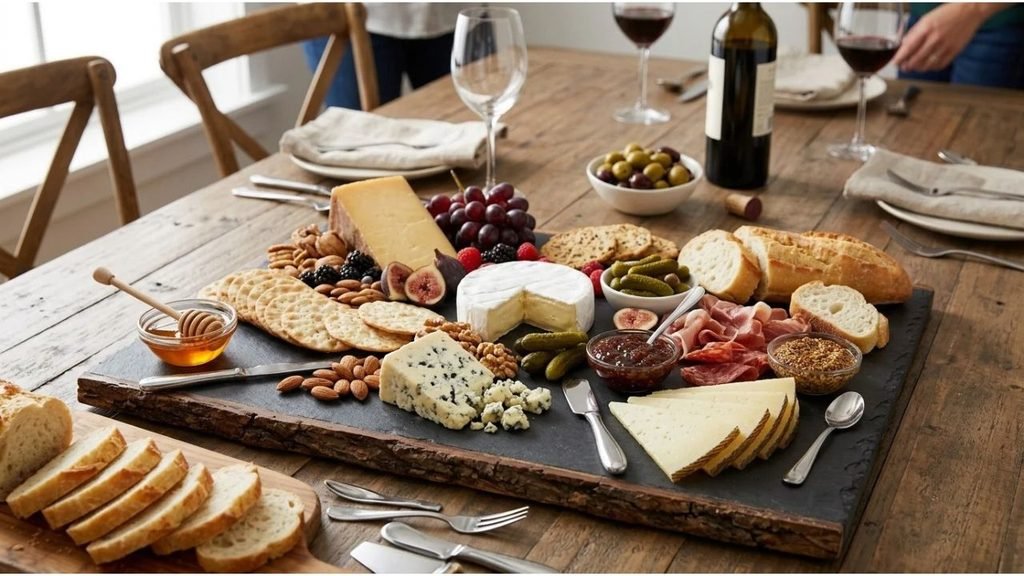
Set up the empty board before bringing refrigerated ingredients out. The following order is a practical arrangement method, not a fixed recipe.
- Choose the serving position. Put the board where guests can approach the food and reach the tools. Check that the base sits securely and that any drawer has clearance. If using a folding model, open it completely before adding anything.
- Place empty bowls first. Bowls occupy fixed space, so use them to establish the layout. Leave the cheese area open and avoid putting a bowl directly where a guest must hold a wedge. You can move a bowl off the board if it crowds the food.
- Add the cheeses with space between them. Position large pieces before small accompaniments. Turn a cut face toward the guest and leave room for the knife to travel. A wedge pressed against a bowl may look tidy but be awkward to portion.
- Add prepared fruit and savory accompaniments. Rinse fresh produce under running water and dry it with a clean towel before arranging it. The FDA advises washing produce without soap or detergent. Put olives and other wet foods in bowls instead of letting liquid spread onto the wood or crackers.
- Place bread and crackers where they stay dry. Use a perimeter groove for a small starting supply or set out a separate basket. Keep them away from cut fruit, brine, and soft spreads. Holding extra crackers back also leaves room for guests to work around the cheese.
- Add utensils and clear labels. Place each knife beside its cheese with the handle reachable. Give bowls their own spoons or small serving tools. Labels should identify unfamiliar cheeses and relevant ingredients; keep signs clear of the cutting path.
- Check the arrangement from a guest’s position. Make sure someone can pick up a slice, cut a portion, and reach the bread without brushing another food. Move crowding pieces to a side plate. Keep the refill food ready in the refrigerator and note when the perishable display leaves cold storage.
Tip: Photograph the empty layout with bowls and tools in place. If that arrangement works well for your table, the photo becomes a useful reference for the next gathering without forcing you to serve the same foods.
For a seated cheese course, small portions on a central board may be enough. For a buffet, distribute popular items across more than one reachable location. The arrangement should support how guests move and eat, not simply fill the entire surface.
Serving Time, Cold Storage, and Transport
Follow the Clock for Perishable Foods
The FDA advises discarding perishables left at room temperature for more than 2 hours, unless held at a safe temperature. When the surrounding temperature is above 90°F, that limit becomes 1 hour. Cold foods should be kept at 40°F or below.
For serving quality, Wisconsin Cheese suggests taking cheese out about 30 minutes before serving. Include that time in the room-temperature limit, along with preparation and display. Moving food from the counter to the dining table does not restart the clock.
Follow storage directions for each cheese and meat; a mixed board may contain foods with different handling requirements. Bring out only the portions that will be served soon.
Serve modest portions and replace used platters with fresh refrigerated ones instead of piling new food over older leftovers. For a long party, smaller displays are easier to track. A cover or a chilled stone surface does not prove that food has stayed cold enough.
Keep Travel Food Cold and Dry
For transport, use an insulated cooler with ice or frozen gel packs for perishable ingredients. USDA advises maintaining cold food at 40°F or below during travel. A covered serving board may protect the arrangement, but it is still only one part of the packing setup.
If the assembled board will not fit in the cooler, pack chilled ingredients separately and arrange them at the destination. Keep crackers in a dry container. Protect a wooden board from melted ice rather than resting it in water.
When preparing ahead at home, refrigerate the perishable components in suitable covered containers. Put the clean board, empty bowls, labels, and tools aside. This removes much of the setup work without keeping cheese at room temperature during other preparations.
Keep Allergic Guests’ Food Separate
Ask guests about food allergies before planning a shared board, and retain ingredient labels. A corner without nuts or crackers is not automatically free from their transferred ingredients.
FARE advises thoroughly cleaned surfaces and separate equipment to prevent allergen cross-contact. Prepare a suitable separate plate before handling the shared spread, and give it dedicated utensils. Simply removing an unwanted ingredient or wiping a used knife is not enough.
Key Takeaway: Track time out of refrigeration, transport perishables cold, and prepare separate food for guests who need it.
Cleaning and Caring for Cheese Boards
Clean the Surface, Grooves, and Accessories
Remove food and utensils promptly after serving. Follow the board’s directions: some sets specify surface wiping, while others permit brief hand-washing with mild soap and water. Use the approved method to remove cheese residue, then dry the board thoroughly.
Keep raw-meat preparation on a separate board from cheese, fruit, and other ready-to-eat foods. USDA recommends separate boards for raw animal foods and fresh produce, with cleaning after each use.
Check cracker grooves, bowl recesses, drawer edges, and folding joints. Wash removable pieces separately and let them dry before returning them to storage. Do not leave a wet knife inside a closed wooden drawer.
For ordinary bamboo boards, Totally Bamboo recommends hand-washing, towel-drying, and standing the board upright so air can circulate. It warns that soaking and dishwasher exposure can cause warping or cracking; dishwasher-approved products are separate exceptions.
A ceramic bowl’s cleaning directions do not determine the board’s care. Check each component separately, including wood-handled knives and plastic lids.
Condition Wood Only as Directed
If the maker recommends conditioning, use its approved food-grade board oil or wax on a clean, fully dry surface. Spread a thin layer, allow the stated absorption time, and remove excess before serving food.
John Boos recommends food-grade conditioning products for its wood boards and notes that frequency changes with use and household conditions. Treat that as a reminder to follow your own board’s directions, not a fixed schedule for every material.
Oil does not clean food residue or sanitize a board. Coated surfaces may have different requirements, so do not oil decorative inserts or sealed finishes without the maker’s approval.
Inspect Damage and Maintain Wire Cutters
Replace a board with deep, difficult-to-clean grooves, serious splitting, or other damage that prevents proper cleaning. USDA recommends replacing excessively worn cutting boards. A loose foot or cracked serving edge also deserves attention before the next gathering.
For a wire slicer, clear food from the cutting slot and inspect the wire before use. Replace a stretched or broken wire with the specified part and follow the assembly instructions. Keep fingers away from the wire’s path, even when it looks less intimidating than a knife.
Key Takeaway: Clean hidden areas, dry every piece, follow the finish’s care instructions, and replace damaged cutting parts.
Conclusion
The best cheese cutting boards for entertaining give your usual cheeses enough room and fit the way you host. SMIRLY is a sensible starter set, Sonder LA Winsome suits preparation and serving, and Farberware’s covered design is useful for taking food to another gathering.
Choose by usable space, carrying weight, cleaning requirements, and the tools you will actually use. Keep stone surfaces for serving or their intended wire-cutting mechanism, and leave room around cheese portions so guests can serve themselves comfortably.
I would buy the simplest board that handles my regular gatherings, then add a separate tray when the guest list grows. Thoughtful portions, reachable utensils, timely refills, and prompt cleaning matter more than covering an oversized board with food.
FAQs About Cheese Cutting Boards for Entertaining
Can I make a cheese board without meat?
Yes. Cheese, bread, fruit, vegetables, and suitable spreads can form a complete serving arrangement without meat. Replace the space that meat would occupy with another accompaniment or leave it open for cutting. If guests follow a vegetarian diet, check the cheese’s ingredients and production details instead of assuming every cheese meets their preferences.
Are personalized cheese boards suitable for cutting?
Some are, but check the maker’s directions for the engraved or decorated area. A plain reverse side may be the intended cutting surface. Deep engraving can collect cheese residue, and a decorative coating may be approved only for serving. Choose personalization that leaves a practical area for the way you intend to use the board.
Should I line a wooden cheese board with parchment?
Food-grade parchment can provide a removable serving layer if the board’s instructions permit it. It is useful for a prepared arrangement, but it can shift or tear under cutting tools. Portion cheese on an approved cutting surface first. Remove the paper afterward and clean any residue or moisture that reached the board underneath.
Does a cheese board need a juice groove?
No. A juice groove can collect small amounts of moisture, but it also reduces the flat display area and adds a channel to clean. For a cheese-focused spread, small bowls often provide better control over brine or preserves. Choose a groove if the board will also handle juicy fruit or other preparation tasks.
Can I replace a broken cheese-cutting wire?
Often, yes. Prodyne and Fox Run provide replacement-wire information for their slicers. Match the model, wire length, and attachment system before ordering; similar-looking wires are not automatically interchangeable. Follow the installation instructions and confirm that the wire moves into its cutting slot correctly before putting cheese on the board.