Work Sharp Knife Sharpener Review: Best Models, Pros & Cons
Work Sharp makes several strong sharpening systems, but the Precision Adjust is the model I would recommend to most knife owners because its clamp, adjustable 15°–30° angle system, diamond abrasives, and ceramic finishing surface make repeatable sharpening much easier than freehand stones. Faster powered models are better for people who sharpen many knives or tools.
Work Sharp does not sell one universal sharpener under a single design. Its current range includes fixed-angle manual systems, powered belt sharpeners, dedicated kitchen sharpeners, compact field tools, and professional bench systems.
That variety is useful, but it can also make choosing one confusing. A $50 field sharpener and a several-hundred-dollar professional sharpening station solve very different problems even though both carry the Work Sharp name.
For this Work Sharp knife sharpener review, the main question is which sharpening method matches your knives. The Precision Adjust works well for controlled edge angles, the Ken Onion Edition Mk.2 prioritizes speed and flexibility, the Knife & Tool Sharpener Mk.2 is a lower-cost powered option, and the Kitchen Electric model is aimed at cooks who want a simpler process.
Work Sharp also supports sharpening angles from roughly 15° to 30° on several adjustable systems. That range covers many kitchen, pocket, hunting, and outdoor knives without locking every blade into one factory-selected bevel.
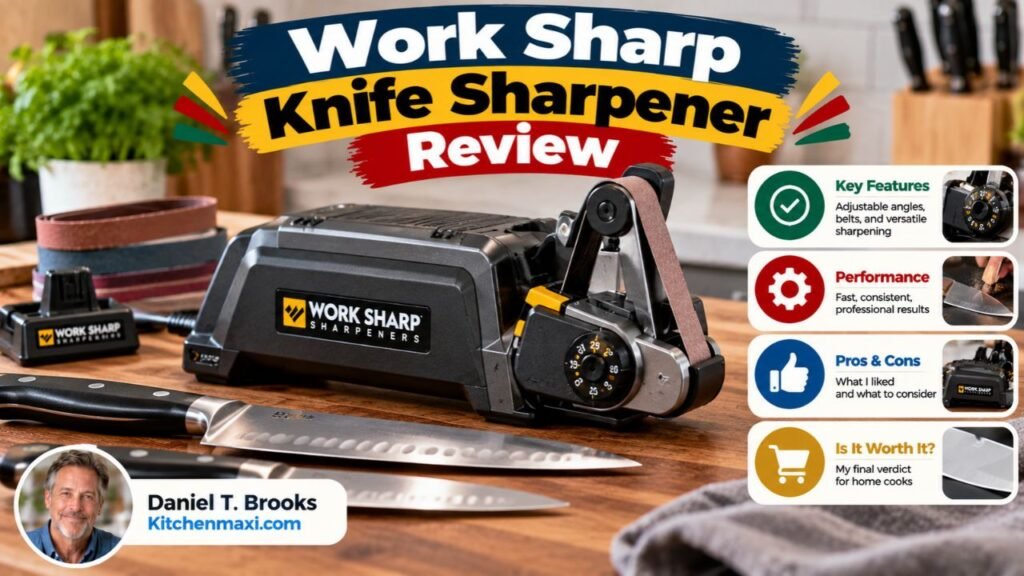
My overall view is positive. Work Sharp’s strongest feature is that its sharpeners reduce much of the angle-control difficulty associated with freehand sharpening while still offering more control than a basic carbide pull-through sharpener.
Work Sharp Knife Sharpener Review: Quick Verdict
For most knife owners, I would start with the Work Sharp Precision Adjust Knife Sharpener.
It gives you:
- 15°–30° adjustable sharpening
- Knife clamp
- 320-grit diamond
- 600-grit diamond
- Fine ceramic
- Bench base
- Guided sharpening rod
That combination is enough to repair moderately dull edges, refine the bevel, and finish the edge without requiring you to hold a sharpening angle freehand.
The current Work Sharp range also gives buyers clear upgrade paths.
If sharpening speed matters more than manual precision, the Knife & Tool Sharpener Mk.2 or Ken Onion Edition Mk.2 is a stronger choice.
If you want more abrasive stages, a metal frame, and digital angle measurement, the Professional Precision Adjust line moves far beyond the basic system.
Best Work Sharp Models by Use
| Work Sharp Model | Best For | Angle System | Sharpening Type |
| Precision Adjust | Best for most users | 15°–30° | Manual fixed-angle |
| Precision Adjust Elite | More abrasive choices | 15°–30° | Manual fixed-angle |
| Professional Precision Adjust | Serious knife owners | 15°–30° | Manual precision system |
| Knife & Tool Sharpener Mk.2 | Fast general sharpening | 20° or 25° | Powered belt |
| Ken Onion Edition Mk.2 | Advanced powered sharpening | 15°–30° | Variable-speed belt |
| Kitchen Electric Sharpener | Kitchen knives | Guided fixed system | Electric |
| Guided Field Sharpener | Outdoor and travel use | 20° and 25° | Manual portable |
Key Takeaway: The Precision Adjust is the easiest Work Sharp model to recommend broadly, while the Ken Onion and professional systems make more sense for users who want greater speed or finer control.
Work Sharp Precision Adjust Knife Sharpener Review
The Precision Adjust is the model that best represents what many people want from Work Sharp: controlled sharpening without a large price or powered abrasive belt.
The system holds the knife in a V-block clamp while the abrasive moves along a guide rod.
You set the sharpening angle between 15° and 30°.
That means the sharpener controls one of the hardest parts of sharpening: maintaining a repeatable bevel angle from heel to tip.
Work Sharp Precision Adjust Abrasives
The standard model uses a rotating Tri-Brasive handle with:
- 320-grit diamond
- 600-grit diamond
- Fine ceramic
The 320-grit diamond surface handles initial sharpening and minor edge repair.
The 600-grit diamond refines the scratches left by the coarser plate.
The ceramic surface finishes the edge and removes much of the remaining burr.
Three stages are enough for routine home sharpening.
Someone chasing mirror-polished bevels will want the Elite version or additional abrasives.
Work Sharp Precision Adjust Angle Range
The 15°–30° range works with many common knife types.
Typical starting points include:
- 15°–17° per side for many thin kitchen edges
- Around 20° per side for many general-purpose pocket knives
- 20°–25° for tougher outdoor edges
Do not automatically change every knife to the same angle.
If the existing bevel performs well, matching it usually removes less steel.
Work Sharp Precision Adjust Clamp
The clamp rotates so you can sharpen both sides without removing and reclamping the knife.
That makes it easier to keep both bevels consistent.
The standard system is light compared with Work Sharp’s professional metal version, so very large or heavy knives can introduce some movement.
For normal kitchen, EDC, and hunting knives, the setup is much easier to manage.
Where the Precision Adjust Falls Short
Its limitations include:
- Smaller abrasive surfaces than the professional model
- More flex than an all-metal sharpening frame
- Large chef’s knives can require careful positioning
- Very small blades can be awkward in the standard clamp
- Three abrasives limit ultra-fine polishing
Those are reasonable compromises at its place in the lineup.
Key Takeaway: The Precision Adjust offers the strongest mix of price, repeatable angles, diamond sharpening, and ease of use for people who want sharper knives without mastering freehand stones.
Work Sharp Precision Adjust Elite Review
The Elite version keeps the same basic sharpening concept but expands the abrasive progression.
This is aimed at users who like the standard Precision Adjust but want more control over edge refinement.
More abrasive stages let you move gradually from:
- Edge repair
- Bevel shaping
- Basic sharpening
- Refinement
- Fine finishing
- Stropping
A broader abrasive progression leaves finer scratch patterns and gives you more control over how polished the finished bevel becomes.
Who Needs the Elite Version?
I would consider the Elite if you:
- Sharpen regularly
- Own several pocket knives
- Enjoy experimenting with edge finishes
- Want a finer polish than the basic three-stage system produces
- Do not want to jump to the larger Professional model
For ordinary household knife maintenance, the standard Precision Adjust is still enough.
Work Sharp Professional Precision Adjust Review
The Professional Precision Adjust is a much more substantial bench sharpener.
It uses a metal frame and clamp rather than relying heavily on lightweight molded components.
The standard Professional model includes:
- 220-grit diamond
- 320-grit diamond
- 400-grit diamond
- 600-grit diamond
- 800-grit diamond
- Fine ceramic
- Leather strop
- Serration rod
- Digital angle indicator
- Clamp stabilizer
- Small-knife table
Its sharpening angle adjusts continuously from 15° to 30°.
Digital Angle Indicator
The digital indicator is one of the features that separates the Professional system from the cheaper Precision Adjust.
Work Sharp states that it lets the angle be set in very small increments.
This is useful if you want to reproduce the same edge angle later instead of estimating its position on a printed scale.
Larger Sharpening Abrasives
The Professional system uses 1 × 6-inch sharpening surfaces.
The longer abrasive gives you a smoother sharpening stroke and more abrasive area to work with.
That matters more if you sharpen frequently.
Better Support for Large Knives
The heavier base and clamp stabilizer reduce movement.
This makes the system better suited to:
- Chef’s knives
- Large hunting knives
- Longer outdoor blades
than the lighter basic model.
Professional Precision Adjust Drawbacks
The biggest issue is price.
A home cook who sharpens six kitchen knives a few times each year will probably never use enough of its extra capability to justify the jump.
It also occupies more workbench and storage space.
Key Takeaway: The Professional Precision Adjust earns its higher price through a metal build, larger abrasives, digital angle measurement, extra stability, and a fuller abrasive progression.
Work Sharp Knife & Tool Sharpener Mk.2 Review
The Knife & Tool Sharpener Mk.2 takes a completely different approach.
Instead of sliding stones manually along the edge, an electric motor drives flexible abrasive belts.
This makes sharpening much faster.
The Mk.2 includes:
- 20° sharpening guide
- 25° sharpening guide
- Dual-speed motor
- P80 coarse belts
- P220 medium belts
- 6000 fine belts
- 65° scissor guide
It can sharpen more than knives.
It is intended for:
- Kitchen knives
- Pocket knives
- Hunting knives
- Serrations
- Scissors
- Axes
- General tools
Why Belt Sharpening Is Fast
A powered abrasive moves continuously across the edge.
That removes steel much faster than a small manual stone.
If you have several neglected knives or workshop tools, the time savings can be substantial.
Why You Need More Restraint
The same speed creates more risk.
Leaving a blade against a coarse powered belt too long removes unnecessary metal.
It can also change the edge shape faster than expected.
Use light pressure and short passes.
Start with a finer abrasive unless the blade is genuinely damaged.
Convex Edge Character
Flexible belts conform slightly around the edge.
That can create a mildly convex bevel rather than the perfectly flat bevel produced by a rigid sharpening stone.
Many outdoor and working knives perform well with this type of edge.
Someone who specifically wants a flat V-bevel may prefer the Precision Adjust.
Key Takeaway: The Knife & Tool Sharpener Mk.2 is better for speed and mixed knife/tool sharpening, while the Precision Adjust gives you slower, more deliberate angle control.
Work Sharp Ken Onion Edition Knife Sharpener Mk.2 Review
The Ken Onion Edition Mk.2 is the model I would choose for serious powered sharpening.
It expands substantially on the basic Knife & Tool Sharpener Mk.2.
The current system offers:
- Adjustable 15°–30° guide
- Seven motor-speed settings
- 3/4 × 12-inch abrasive belts
- P120 extra-coarse belt
- X65 coarse belt
- X22 medium belt
- X4 fine belt
- 6000 extra-fine belt
- Leather-lined guides
- Tool sharpening cassette
- 65° scissor guide
The adjustable guide is a major upgrade over the fixed 20° and 25° choices on the basic powered Mk.2.
Ken Onion Variable Speed Control
Speed control lets you slow the belt down for finer work.
Higher speed can be useful for:
- Repairing damaged edges
- Sharpening tools
- Removing more material
Lower speed gives more control for:
- Fine kitchen knives
- Edge finishing
- Small blades
- Delicate passes near the tip
Wider Belts
The 3/4-inch belts provide a larger abrasive surface than the basic Work Sharp belt system.
They are also available in several grits.
The Ken Onion Learning Curve
This model gives you more control, but it also gives you more ways to remove too much material.
A beginner should practice on an inexpensive knife before sharpening a prized chef’s knife.
Pay close attention near the tip.
Pulling the blade too far through the guide before stopping can round the tip over time.
Who Should Buy the Ken Onion Edition?
It makes sense for someone who sharpens:
- Kitchen knives
- EDC knives
- Hunting knives
- Scissors
- Axes
- Workshop tools
and wants powered speed without being locked into two edge angles.
Key Takeaway: The Ken Onion Edition Mk.2 is Work Sharp’s stronger choice for powered sharpening because its 15°–30° adjustment, seven speeds, and broader belt selection give far more control than the basic Mk.2.
Work Sharp Kitchen Electric Knife Sharpener Review
The Kitchen Electric Knife Sharpener is much simpler than the Precision Adjust or Ken Onion models.
That simplicity is the point.
It is designed for people who want to sharpen kitchen knives without setting angles, clamping blades, changing diamond plates, or managing loose sharpening stones.
The system uses:
- P120 ceramic sharpening discs
- Fine ceramic honing wheel
- Guided slots
- Automatic timing
- Scissor guide
Work Sharp states that the abrasive discs are reversible and replaceable.
The built-in timing system stops automatically after the sharpening period.
Kitchen Electric Strengths
This model works well for:
- Chef’s knives
- Utility knives
- Paring knives
- Common kitchen cutlery
- Serrated knife maintenance
- Scissors
Its biggest advantage is convenience.
Pull the knife through the guide and let the system control much of the process.
Kitchen Electric Limitations
It offers less angle flexibility than the Precision Adjust.
It is also not the model I would buy for someone who enjoys tuning pocket knives to several bevel angles.
This is a kitchen appliance first.
Key Takeaway: Work Sharp’s Kitchen Electric model is the simplest option for cooks who care more about quick sharp kitchen knives than custom bevel angles or hand-controlled sharpening.
Work Sharp Guided Field Sharpener Review
The Guided Field Sharpener is small enough to keep in a:
- Backpack
- Hunting kit
- Tackle box
- Vehicle
- Tool bag
It weighs only a few ounces but combines several sharpening surfaces.
The standard system includes:
- 220-grit diamond
- 600-grit diamond
- Fine ceramic rod
- Serration ceramic
- Leather strop
- 20° and 25° guides
That is a lot of sharpening capability in a compact package.
Why the Guided Field Sharpener Works Well Outdoors
No electricity is needed.
No separate clamp is needed.
There are no loose water stones to carry.
You can repair a dull edge with diamond, refine it with ceramic, then strop it using the same tool.
The Main Compromise
The angle guides only help establish the starting angle.
You still move the knife freehand across the sharpening surface.
That takes more hand control than the Precision Adjust.
The Field Sharpener is therefore portable rather than fully guided.
Key Takeaway: The Guided Field Sharpener is one of the better Work Sharp choices for hunting, camping, fishing, and travel because it packs coarse sharpening, fine sharpening, ceramic honing, and stropping into one compact tool.
Work Sharp Manual vs Electric Knife Sharpeners
Choosing between manual and powered Work Sharp systems changes the sharpening experience more than choosing between individual models.
Choose Manual Work Sharp Sharpening for More Control
Manual systems are better when you want to:
- Remove steel slowly
- Match specific bevel angles
- Watch burr development closely
- Work on expensive knives cautiously
- Refine the edge through several stages
Precision Adjust models fit this style.
Choose Electric Work Sharp Sharpening for Speed
Powered sharpeners make more sense when you:
- Sharpen many knives
- Maintain workshop tools
- Repair damaged edges
- Dislike long manual sharpening sessions
The Knife & Tool Mk.2 and Ken Onion Mk.2 fit this category.
Choose a Kitchen Electric Model for Simplicity
A dedicated electric kitchen sharpener sacrifices adjustment for a simpler routine.
It is suited to users who want functional kitchen edges without turning knife sharpening into a hobby.
Key Takeaway: Manual Work Sharp systems prioritize controlled steel removal, belt systems prioritize speed, and kitchen electric models prioritize simple operation.
Does Work Sharp Remove Too Much Metal?
Any sharpener can remove too much steel if used incorrectly.
Powered belt models deserve the most attention because the abrasive moves quickly.
Do not begin every sharpening session with the coarsest belt.
A lightly dull knife may need only a fine abrasive or honing stage.
Coarse abrasives are more appropriate for:
- Edge chips
- Heavy dullness
- Reprofiling
- Damaged tools
With the Precision Adjust, metal removal is easier to monitor because each stroke is manual.
That is one reason I prefer it for beginners working on higher-priced knives.
Can Work Sharp Sharpen Japanese Kitchen Knives?
Several Work Sharp systems can sharpen many Japanese-style double-bevel kitchen knives.
The adjustable 15°–30° Precision Adjust and Ken Onion systems are better suited than fixed 20° or 25° tools when the knife has a thinner edge.
Check the knife maker’s edge recommendation before changing the bevel.
Use lighter pressure and finer abrasives with thin blades.
For expensive single-bevel Japanese knives, traditional stone sharpening or a specialist may be the better choice because their edge geometry differs from standard double-bevel knives.
Can Work Sharp Sharpen Serrated Knives?
Selected Work Sharp models support serrated edges.
The ceramic rod on models such as the Guided Field Sharpener and Professional Precision Adjust can reach individual serrations.
Do not grind both sides of a serrated knife as though it were a normal plain edge.
Most serrated kitchen knives have scallops ground primarily from one side.
Work on the bevel side and use very light cleanup on the opposite side if required.
Can Work Sharp Sharpen Scissors?
The powered Knife & Tool Sharpener models include a scissor guide.
The basic Mk.2 and Ken Onion Edition currently use a 65° scissor guide.
The dedicated Kitchen Electric model also includes a scissor sharpening feature.
Follow the tool’s guide rather than treating scissors like a knife.
Scissor blades rely on both edge geometry and blade contact, so aggressive grinding can do more harm than good.
Work Sharp Knife Sharpener Pros and Cons
Work Sharp Pros
- Several sharpening styles available
- Guided angle control on many models
- Diamond abrasives on manual systems
- Replaceable abrasives
- Kitchen, pocket, hunting, and tool options
- Powered sharpening available
- Portable field system available
- 3-year warranty on current sharpening machines
- Upgrade paths for enthusiasts
Work Sharp Cons
- Product lineup can be confusing
- Powered belts can remove steel quickly
- Basic Precision Adjust has some frame flex
- Professional systems are expensive
- Belt systems can round knife tips if technique is poor
- Some models are better for knives than others
- Multiple abrasive replacements add ownership cost
Key Takeaway: Work Sharp offers unusually broad sharpening choices, but buyers need to choose the sharpening method first rather than assuming every Work Sharp model works the same way.
Work Sharp vs Whetstone Sharpening
Whetstones give you maximum direct control over the blade and abrasive.
They also demand more skill.
Work Sharp Advantages
A guided Work Sharp system gives you:
- Repeatable angle control
- Less freehand practice
- Faster setup
- Easier consistency between sessions
Whetstone Advantages
Freehand stones give you:
- Full control over blade position
- No clamp restrictions
- Easy work on unusual blade geometry
- Many stone and polishing choices
A skilled whetstone user does not need a Work Sharp system.
A beginner who struggles to hold 15° or 20° consistently may get a much better edge from a guided system.
Which Work Sharp Knife Sharpener Is Best?
My recommendations are straightforward.
Best Work Sharp for Most People: Precision Adjust
Choose it if you want repeatable sharpening without spending several hundred dollars.
Best Work Sharp for Kitchen Simplicity: Kitchen Electric
Choose it if your main goal is maintaining household kitchen knives quickly.
Best Work Sharp for Fast Powered Sharpening: Ken Onion Edition Mk.2
Choose it if you sharpen many types of blades and want speed, variable angles, and adjustable motor control.
Best Work Sharp for Tools and Utility Knives: Knife & Tool Sharpener Mk.2
Choose it if knives share sharpening duty with scissors, axes, and shop tools.
Best Work Sharp for Outdoor Use: Guided Field Sharpener
Choose it for camping, hunting, fishing, or keeping a sharpener in a vehicle.
Best Work Sharp for Knife Enthusiasts: Professional Precision Adjust
Choose it if you care about measured angles, larger abrasives, rigid construction, and edge finishing.
Is a Work Sharp Knife Sharpener Worth It?
For many knife owners, yes.
The strongest reason to buy one is repeatability.
A freehand stone can produce an excellent edge, but only if you can maintain the bevel angle throughout the stroke.
Work Sharp’s guided systems remove much of that difficulty.
The powered models solve a different problem: time.
They can sharpen several knives or tools much faster than manual stones, though they require more restraint because steel disappears quickly under a moving abrasive belt.
For a person with a normal collection of kitchen and pocket knives, the basic Precision Adjust offers the strongest balance.
For someone sharpening a large knife collection or mixed workshop tools, the Ken Onion Mk.2 becomes easier to justify.
Conclusion
This Work Sharp knife sharpener review finds a lineup that works best when the model is matched to the user’s sharpening style rather than bought solely by price.
The Precision Adjust is my first recommendation for most home users. Its 15°–30° angle adjustment, clamp, diamond plates, and ceramic finish provide a controlled route to a sharp edge without the practice demanded by freehand stones.
The powered Knife & Tool Mk.2 is faster, while the Ken Onion Edition Mk.2 adds much greater angle and speed control. Kitchen users who want minimal setup may prefer the dedicated Electric Kitchen Sharpener, and outdoor users have a compact option in the Guided Field Sharpener.
If you are new to sharpening and care about repeatable edge geometry, start with the Precision Adjust. Move toward powered or professional Work Sharp systems once speed, specialty tools, or finer edge finishing becomes a real need.
FAQs About Work Sharp Knife Sharpeners
Is Work Sharp a good knife sharpener?
Yes. Work Sharp makes several well-designed sharpening systems with guided angles, replaceable abrasives, and options for manual or powered sharpening. The Precision Adjust is a strong starting point for normal kitchen, pocket, and outdoor knives.
Which Work Sharp sharpener is best for beginners?
The Precision Adjust is my first choice for beginners because the knife is clamped in place and the sharpening angle adjusts from 15° to 30°. That removes much of the difficulty of holding an angle by hand.
Is the Work Sharp Ken Onion Edition worth the extra money?
It can be if you want powered sharpening with adjustable 15°–30° guides, seven motor speeds, and a broad abrasive-belt range. For occasional household knife sharpening, the cheaper Precision Adjust may be enough.
Can Work Sharp sharpen kitchen knives?
Yes. Several Work Sharp models sharpen kitchen knives, including the Precision Adjust, Kitchen Electric, Knife & Tool Mk.2, Ken Onion Edition, and Professional Precision Adjust.
Does Work Sharp damage knives?
Not when used correctly. Powered models can remove steel quickly, so excessive pressure, coarse belts, or too many passes can alter the edge faster than intended. Manual fixed-angle systems provide slower steel removal and more control.
What angle should I use on a Work Sharp knife sharpener?
Match the knife’s existing bevel when practical. Many kitchen knives fall near 15°–20° per side, while tougher outdoor knives may use angles around 20°–25°. Check the knife manufacturer’s specifications before reprofiling the edge.
How long do Work Sharp abrasives last?
Abrasive life varies with model, steel hardness, pressure, and how much metal is removed. Work Sharp lists replaceable abrasives across its current systems, so worn belts, discs, diamond plates, and related components can be replaced rather than replacing the full sharpener.
Is Work Sharp better than a whetstone?
It is easier for users who struggle to hold a steady freehand angle. A skilled whetstone user has more direct control over unusual blade geometry and polishing progression, while a guided Work Sharp system makes repeatable sharpening easier for many home users.