AccuSharp Knife Sharpener Review: Results, Pros, Cons & Verdict
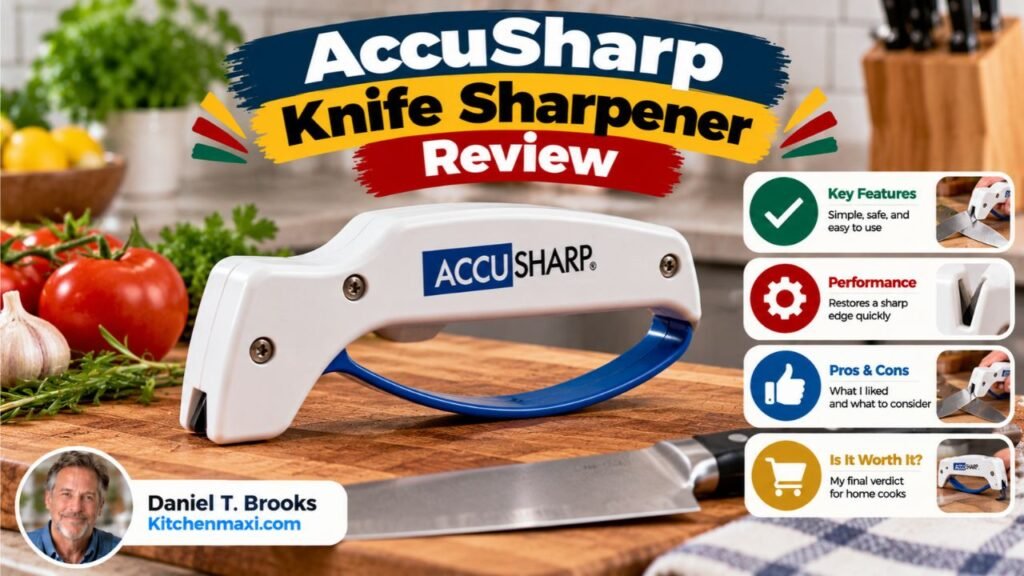
The AccuSharp 001C is a fast, inexpensive manual sharpener that makes the most sense for everyday Western kitchen knives, hunting knives, fillet knives, utility blades, and tools. Its fixed 21-degree tungsten-carbide cutters restore a dull working edge with very little skill, but the aggressive single-stage design is not my first choice for premium Japanese or thin, specialized knives.
Its appeal is simplicity. You place the knife edge-up on a stable surface and draw the sharpener from the heel toward the tip using light pressure. There are no stones to flatten, angle settings to calculate, or electric parts to maintain.
AccuSharp equips the 001C with diamond-honed tungsten carbide sharpening blades, a full-length finger guard, an ambidextrous handle, replaceable cutting inserts, dishwasher-safe construction, and a lifetime warranty. The classic model is made in the United States.
This AccuSharp knife sharpener review focuses mainly on the original 001C Knife & Tool Sharpener rather than treating every AccuSharp model as identical. The company now offers 15-degree sharpeners, pull-through models, precision stone systems, multi-function outdoor sharpeners, and other designs for different edge angles and blade types.
The biggest limitation is the same feature that makes the 001C so easy to use: its sharpening angle is fixed. AccuSharp sets the original model at 21 degrees, so it is a natural fit for many general-purpose Western and outdoor blades but can change the edge geometry of a knife originally sharpened at a much lower angle.
Owner feedback is strong. Walmart currently lists the classic model at about 4.7 out of 5 stars from more than 1,300 ratings, with ease of use, sharpening speed, and price appearing frequently in buyer feedback. The same retailer currently lists a single unit around the $11 range, though retail pricing can change.
The sections below cover sharpening performance, carbide-blade design, edge quality, safety, compatibility, durability, owner feedback, drawbacks, correct technique, and which knives should be kept away from the 001C.
AccuSharp 001C Knife Sharpener Specifications
| Feature | AccuSharp 001C |
| Type | Manual handheld knife and tool sharpener |
| Sharpening material | Diamond-honed tungsten carbide |
| Factory angle | 21° |
| Sharpening stages | 1 |
| Cutters | Reversible and replaceable |
| Straight-edge knives | Yes |
| Serrated knives | Manufacturer lists as compatible |
| Cleavers | Yes |
| Axes and machetes | Yes |
| Finger guard | Full length |
| Hand use | Right- or left-handed |
| Cleaning | Dishwasher-safe |
| Country of origin | USA |
| Warranty | Lifetime |
| Weight | About 2.5 oz in current Walmart listing |
AccuSharp says the 001C is intended to restore an edge in about 10 seconds and lists kitchen knives, serrated blades, hunting knives, axes, cleavers, and machetes among its uses.
The phrase diamond-honed tungsten carbide deserves clarification. The actual sharpening inserts are tungsten carbide; AccuSharp uses diamond honing in the manufacturing process to finish those carbide cutting surfaces. This is not a fine diamond-abrasive system like a diamond sharpening plate.
How the AccuSharp Knife Sharpener Works
The Carbide Cutters Remove Steel
The 001C uses two carbide cutters arranged to form the sharpening angle.
As the sharpener travels along the edge, the carbide scrapes a small amount of blade steel away and forms a new bevel.
This is true sharpening, not merely honing.
A honing rod mainly straightens or refines an existing edge, while a carbide sharpener removes metal to create a fresh cutting edge. Serious Eats makes the same distinction between honing and sharpening and notes that pull-through systems remove material rather than merely realigning the edge.
The 21-Degree Angle Is Fixed
AccuSharp specifies a preset 21-degree angle on the classic Knife & Tool Sharpener.
That takes angle control out of the user’s hands.
For a beginner, this is a major advantage. It also means the sharpener cannot preserve every factory bevel.
A knife originally ground around 15 degrees per side, for example, does not match the classic 001C geometry. AccuSharp now sells a separate Gourmet 15° line for thinner kitchen edges.
You Move the Sharpener, Not the Knife
The 001C technique differs from many countertop pull-through sharpeners.
AccuSharp tells users to place the knife edge-up on a stable surface, let the tip extend slightly beyond the surface, hold the sharpener at about 90 degrees to the blade, and draw it from heel to tip using light pressure.
This design lets the large finger guard stay between your hand and the cutting edge.
Key Takeaway: The 001C uses fixed-angle carbide cutters to remove steel quickly, which makes sharpening simple but gives you far less control over bevel geometry than a stone or adjustable system.
AccuSharp Knife Sharpener Performance on Dull Knives
Everyday Kitchen Knives Sharpen Quickly
The 001C’s strongest job is restoring a dull general-purpose knife to a usable cutting edge.
Food & Wine highlights the same strength: fast operation, a simple handheld design, tungsten-carbide cutters, and little setup compared with sharpening stones.
Walmart’s large owner sample also leans strongly positive. Current feedback repeatedly mentions one or a few light passes being enough for routine sharpening and calls out the low skill requirement.
This is the type of sharpener that makes sense for:
- Everyday chef’s knives
- Utility knives
- Paring knives
- Fillet knives
- Hunting knives
- Pocket knives
- Workshop blades
- Machetes
- Cleavers
- Axes
A moderately dull knife may need only a few strokes.
A severely rounded edge can take more passes, and a deeply chipped blade may need a stone, belt system, grinding service, or professional repair before a simple carbide tool can restore it properly.
The Edge Is Sharp but Not Highly Polished
A carbide pull-through sharpener is designed to produce a working cutting edge quickly.
It does not include a fine ceramic stage for polishing the bevel afterward.
That means the resulting edge tends to feel more aggressive or toothy than a blade finished on fine whetstones.
For tomatoes, meat, rope, cardboard, and everyday prep, a toothy edge can cut very well.
For a cook who wants a refined, highly polished bevel for delicate slicing, the 001C is not built for that goal.
Repeated Passes Remove More Steel
The fast cutting action needs restraint.
Serious Eats notes that pull-through sharpeners trade some control for convenience and that sharpening systems which remove more steel should not be used more often than necessary.
With the AccuSharp, the best approach is to start with light pressure and a small number of passes.
Check the edge before sharpening again.
More strokes are not automatically better.
Key Takeaway: The AccuSharp produces a fast, practical working edge, but its carbide action removes steel aggressively enough that light pressure and limited passes are smarter than repeated sharpening.
Is the AccuSharp 001C Good for Expensive Kitchen Knives?
This is where I would be selective.
A $20 workhorse chef’s knife and a thin, hard Japanese gyuto should not automatically receive the same sharpening treatment.
The classic AccuSharp is fixed at 21 degrees. Many Japanese-style knives use a thinner edge, often around 15 degrees, though actual factory geometry varies by model.
Using the 001C on such a knife can reshape the bevel toward the sharpener’s preset geometry.
That does not mean the knife instantly becomes unusable. It means you lose control over the edge profile the knife maker intended.
For expensive Japanese knives, single-bevel knives, hand-ground carbon steel blades, or thin premium chef’s knives, I would use:
- A suitable whetstone
- A guided system with the correct angle
- AccuSharp’s 15-degree system if it matches the knife
- A reputable professional sharpening service
Serious Eats favors whetstones when edge-angle control and blade preservation matter, since stones let the user match the knife’s geometry rather than forcing every knife into a fixed slot.
AccuSharp 001C vs AccuSharp Gourmet 15° Sharpener
The original 001C is not AccuSharp’s only kitchen option anymore.
| Feature | AccuSharp 001C | AccuSharp Gourmet 15° |
| Angle | 21° | 15° |
| Main use | General Western and utility blades | Thinner gourmet/Asian-style edges |
| Abrasive | Tungsten carbide | Tungsten carbide |
| Replaceable cutters | Yes | Yes |
| Finger guard | Yes | Yes |
| Best match | Everyday workhorse knives | Knives designed around a thinner bevel |
AccuSharp specifically introduced its 15-degree range because many newer kitchen knives use thinner edge geometry than traditional 18- to 21-degree Western-style knives.
If your knife maker specifies a 15-degree edge, the Gourmet version is a more logical AccuSharp choice than the original 001C.
Can the AccuSharp Sharpen Serrated Knives?
AccuSharp officially lists serrated knives among the 001C’s compatible blade types.
The design can contact the exposed edge portions of many serrated blades, which makes it more flexible than some flat stones.
Still, serrations vary greatly.
A bread knife with large scallops is normally sharpened most precisely by working inside each scallop with a tapered ceramic or diamond rod sized for that serration.
The 001C is better viewed as a quick maintenance tool for compatible serrated edges than as a precision serration-restoration system.
For an expensive bread knife or specialty serrated blade, a tapered rod gives more control.
AccuSharp Knife Sharpener Safety and Ease of Use
The Finger Guard Is a Strong Design Feature
The large handle and full-length finger guard are among the 001C’s best design choices.
Because the knife remains stationary while the sharpener moves along it, the guard separates your fingers from the upward-facing edge.
AccuSharp specifically designed the handle for either hand and emphasizes the guard as a safety feature.
This design can be easier for someone who dislikes holding a knife and pulling it repeatedly through a small countertop slot.
Light Pressure Is Enough
AccuSharp’s own instructions call for light pressure and only a few strokes.
Heavy pressure removes more steel and makes the tool feel harsher.
If a blade needs a large amount of force to sharpen, stop and inspect the knife and sharpener.
The Knife Must Be Stable
Place the knife on a firm counter or table with the edge facing upward.
Let the tip extend just past the edge of the work surface so the sharpener can travel all the way through the tip.
Do not hold the knife loosely in midair while drawing the sharpener toward your other hand.
Key Takeaway: The full finger guard makes the 001C easier to control than many tiny pull-through sharpeners, but the safest setup still requires a stable knife, light pressure, and strokes that move away from your body.
How to Use the AccuSharp Knife Sharpener Correctly
- Clean the knife first. Remove grease or food residue from the blade.
- Place the knife edge-up. Rest it on a stable flat surface with the tip projecting slightly over the edge.
- Hold the knife handle securely. Keep fingers away from the exposed cutting edge.
- Place the AccuSharp near the heel. Hold the sharpening tool approximately perpendicular to the knife.
- Use light downward pressure. The carbide should make contact without being forced.
- Draw the sharpener toward the tip. Use one smooth, continuous stroke.
- Repeat only as needed. Start with a few strokes and test the edge.
- Clean the knife afterward. Sharpening can leave tiny metal particles on the blade.
- Wash the sharpener when needed. AccuSharp lists the 001C as dishwasher-safe and rust-resistant.
Do not saw the sharpener back and forth rapidly along the edge.
A controlled heel-to-tip stroke gives more predictable contact.
How Long Do AccuSharp Sharpening Blades Last?
The exact service life depends on what you sharpen and how often you use the tool.
The important design feature is that the carbide cutters are reversible and replaceable.
When one working edge becomes worn, the inserts can be reversed.
AccuSharp also sells replacement cutter sets rather than forcing you to replace the entire handle.
That gives the inexpensive sharpener a longer usable life than a sealed disposable design.
Owner reports support long service life as one of the product’s strengths. Current Walmart reviews include customers describing many years of use, though individual user reports should not be treated as a fixed lifespan for every unit.
What AccuSharp Owners Like Most
Current Walmart feedback gives the classic sharpener a 4.7-star rating from more than 1,300 reviews.
The most common positive themes are:
- Very easy operation
- Fast sharpening
- Low purchase price
- Compact drawer storage
- Long service life
- Little hand strength required
- Good results on ordinary household knives
Northern Tool also lists a 4.8/5 rating from 19 reviews for the 001C, though the sample is much smaller.
The owner feedback matches the basic design: this is a convenience-first sharpener rather than a precision knife hobbyist’s system.
AccuSharp Knife Sharpener Drawbacks
The Fixed 21-Degree Angle Limits Compatibility
This is the main technical drawback.
You cannot adjust the angle to match a 15-degree Japanese knife, a custom edge, or a specialty bevel.
The tool decides the geometry.
Carbide Is Aggressive
The cutters restore dull edges quickly because they remove steel rapidly.
That is good for an abused utility knife.
It is less appealing for a premium blade you want to preserve for decades.
There Is No Fine Finishing Stage
The 001C has one sharpening stage.
There is no built-in ceramic rod or fine stone to polish the edge after the carbide pass.
If you want a more refined edge, a separate fine ceramic hone or stone makes more sense.
It Cannot Repair Every Type of Damage
Deep chips, bent tips, thick damaged bevels, and badly uneven edges may need more controlled repair.
The Washington Post’s earlier comparative test found the AccuSharp capable of producing a good edge but unable to eliminate a serious nick in the test blade.
Fine Knives Deserve More Control
The classic model is best treated as a workhorse sharpener.
Its speed and low price are strong advantages on ordinary kitchen and outdoor knives, but those same traits are less attractive for a hand-finished knife with specialized geometry.
Key Takeaway: The 001C’s main weaknesses are its non-adjustable 21-degree geometry, aggressive metal removal, single-stage finish, and limited ability to repair major edge damage.
AccuSharp Knife Sharpener Pros and Cons
| Pros | Cons |
| Very easy to use | Fixed 21° sharpening angle |
| Sharpens quickly | Removes steel more aggressively than fine stones |
| Low purchase price | No fine polishing stage |
| Full finger guard | Poor match for some thin Japanese knives |
| Works for many knives and tools | Limited control over final bevel |
| Right- or left-handed use | Not ideal for single-bevel knives |
| Reversible carbide cutters | Major chips need another repair method |
| Replaceable sharpening blades | Serration sharpening is less precise than a tapered rod |
| Dishwasher-safe | Toothier finish than fine whetstone sharpening |
| Lifetime warranty | Easy operation may encourage over-sharpening |
| Made in USA |
The balance is straightforward: the AccuSharp prioritizes speed, cost, and simplicity over edge customization.
AccuSharp 001C vs Whetstone
A whetstone offers far more control.
You choose:
- Sharpening angle
- Pressure
- Grit
- Edge finish
- Amount of steel removed
- How each side of the knife is treated
The drawback is skill and time.
Serious Eats favors whetstones for cooks who want precise control and a more refined finish but recognizes that manual pull-through systems are much faster and easier for casual users.
Choose the AccuSharp if you want a sharp work knife in a few strokes.
Choose a whetstone if preserving geometry and creating a fine edge matter more than speed.
AccuSharp 001C vs Honing Steel
These tools do different jobs.
A honing steel maintains an edge that is already in decent condition.
The AccuSharp 001C removes steel to restore an edge that has become dull.
If a knife only feels slightly less crisp than usual, honing may be enough.
If the blade no longer cuts paper, tomato skin, or onion cleanly after honing, sharpening is the next step.
Using a honing steel between sharpening sessions reduces how often the carbide sharpener needs to remove metal.
Who Should Buy the AccuSharp 001C?
The 001C makes sense for someone who:
- Wants a cheap knife sharpener
- Does not want to master whetstones
- Uses standard Western kitchen knives
- Maintains hunting or fishing knives
- Sharpens utility blades
- Owns machetes, axes, or cleavers
- Wants a compact tool for a drawer or tackle box
- Needs quick edge restoration
- Prefers a large finger guard
At its current roughly $11 Walmart price, there is not much financial risk for a user who understands what the tool is meant to do.
Who Should Skip the AccuSharp 001C?
I would skip the classic model for:
- Premium Japanese chef’s knives
- Single-bevel sushi knives
- Very thin hard-steel blades
- Custom knife edges
- Collectible knives
- Users who want a mirror-polished bevel
- People who sharpen frequently and want minimum steel removal
AccuSharp’s own 15-degree range is a better place to start for many thin kitchen knives.
For a valuable knife with a specialized bevel, a whetstone or skilled sharpening service gives more control.
Is the AccuSharp Knife Sharpener Worth It?
For ordinary knives and working tools, yes.
The 001C costs little, takes almost no setup, needs very little technique, has replaceable carbide inserts, and is backed by AccuSharp’s lifetime warranty.
It also has unusually deep owner feedback for such a simple product. More than 1,300 current Walmart ratings average about 4.7 stars, with ease of use and sharpening performance among the most frequently mentioned themes.
Its value falls sharply when the knife itself becomes expensive or specialized. Saving a few minutes on sharpening is not worth changing the geometry of a premium blade that was built around a thinner edge.
My preference is to treat the 001C as a working-knife sharpener: excellent for knives and tools that need to get sharp and get back to work, but not the first tool I would choose for a carefully ground Japanese chef’s knife.
Conclusion
This AccuSharp knife sharpener review finds the original 001C very good at the job it was built for: restoring a functional edge quickly on ordinary kitchen knives, hunting knives, fillet knives, cleavers, and outdoor tools.
Its fixed 21-degree carbide system is fast and simple, the finger guard is well designed, and the reversible replaceable cutters extend the life of an already inexpensive tool. The tradeoff is less edge control, more aggressive steel removal, and no fine polishing stage.
Buy it for workhorse blades that need quick maintenance. Use a 15-degree sharpener, guided system, whetstone, or professional service for thin premium knives whose original bevel geometry you want to preserve.
FAQs About the AccuSharp Knife Sharpener
Does the AccuSharp knife sharpener really work?
Yes. The 001C uses tungsten-carbide cutters to remove metal and create a fresh edge, and its fixed angle reduces the technique required. Current Walmart feedback is strongly positive, with more than 1,300 ratings averaging about 4.7 stars. It works best when the knife’s intended edge geometry is reasonably close to the sharpener’s 21-degree angle.
What angle does the AccuSharp 001C sharpen at?
The original AccuSharp Knife & Tool Sharpener uses a preset 21-degree sharpening angle. That makes it suited to many general-purpose Western kitchen and outdoor knives. AccuSharp also sells a separate Gourmet 15° range for knives that use thinner edge geometry.
Does the AccuSharp remove too much metal?
It removes steel faster than gentle honing and many fine-stone methods because the sharpening surfaces are carbide cutters. That speed is part of its appeal, but excessive strokes can shorten blade life. Use light pressure, start with only a few passes, and stop once the knife cuts cleanly.
Can you use an AccuSharp on Japanese knives?
The classic 001C is not my preferred choice for Japanese knives sharpened around 15 degrees or for single-bevel blades because its preset angle is 21 degrees. AccuSharp now makes 15-degree products for thinner kitchen edges. A whetstone also gives more control over the original bevel.
Can AccuSharp sharpen serrated knives?
AccuSharp says the 001C can sharpen serrated knives. It can restore the exposed edge on many serrated designs, but it does not individually follow each scallop the way a tapered ceramic or diamond rod can. For an expensive serrated knife, a rod matched to the serration shape gives greater control.
How many times should you run an AccuSharp over a knife?
Start with a few light heel-to-tip strokes, then test the knife. AccuSharp says only light pressure and a few strokes are normally needed. A knife that remains dull may need more work, but repeated unnecessary passes remove extra steel.
Are AccuSharp replacement blades available?
Yes. The tungsten-carbide sharpening cutters are both reversible and replaceable. Once the first working surfaces become worn, the inserts can be turned around, and AccuSharp sells replacement cutters when the set eventually needs replacement.
Is the AccuSharp 001C dishwasher-safe?
Yes. AccuSharp lists the original Knife & Tool Sharpener as dishwasher-safe and rust-resistant. The company also backs the model with a lifetime warranty. Clean the knife separately after sharpening so any loose metal residue is removed before food preparation.