
Round Cutting Board Guide: Materials, Sizes, Uses, and Care
A circular chopping surface can handle vegetables, fruit, bread, pizza, and serving, provided it offers enough usable room and stays steady. For frequent knife work, prioritize the cutting material, flatness, and easy cleaning. Its shape offers attractive presentation but gives up corner space compared with a square of the same width.
Choosing a round cutting board from appearance alone can lead to an awkward purchase. A board may look generous in a photograph yet leave too little room for a chef’s knife, or prove too heavy to wash comfortably.
A suitable board can earn its place at both the counter and the table. The benefit is having a surface that fits your regular food preparation and looks appropriate for serving.
The U.S. Department of Agriculture recommends using one board for fresh produce and bread and a separate board for raw meat, poultry, and seafood. That practical arrangement matters when a chopping surface also becomes a platter for food eaten without further cooking.
I would measure the counter, sink, and storage space before choosing a wood species or decorative finish. A beautiful board is harder to enjoy when washing and putting it away become a chore.
The details below explain material choices, circular working space, size, construction, safe use, serving, and maintenance so you can choose a board suited to the way you cook.
Why Round Boards Appeal in Modern Kitchens
A circular board introduces a curved outline among straight cabinet edges, rectangular appliances, and tiled backsplashes. That visual contrast explains much of its appeal when it remains on display.
It also fits foods with a similar outline. A round loaf, pizza, or arrangement of cheese wedges can sit naturally around the center. For serving, you can arrange several small portions around a bowl without creating an obvious front or back.
These are practical and visual reasons to consider the shape. Claims that round boards are “taking over” should be treated as styling language unless supported by reliable sales data.
A round board can serve as an everyday work surface, too. Its usefulness comes from adequate size, steady contact with the counter, and a material suited to your knife.
The distinction to check is cutting use versus serving use. A decorative platter may be approved for food contact while its coating or surface is unsuitable for repeated knife cuts.
Round vs. Rectangular Cutting Boards
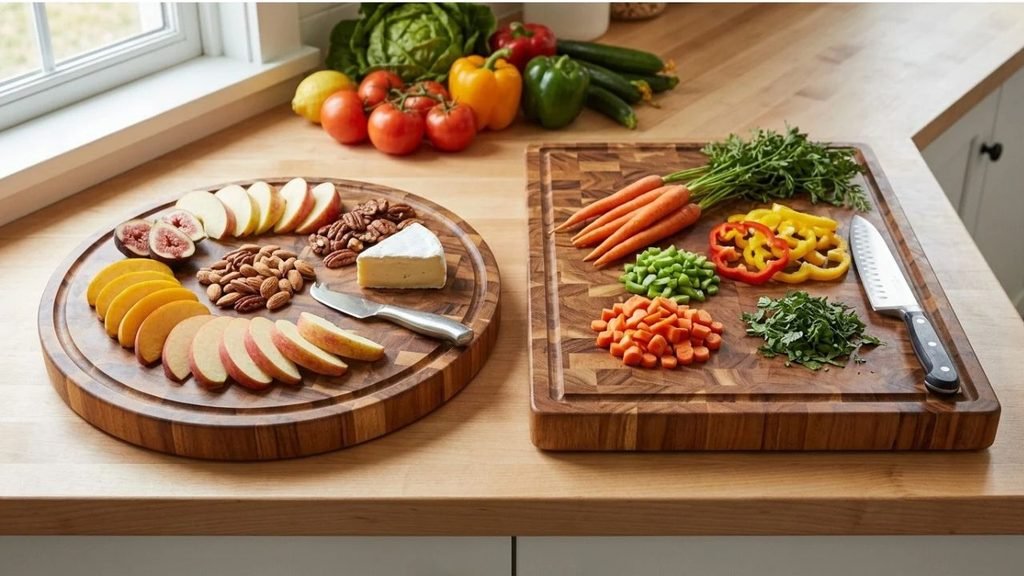
A round board has its greatest width through the center. The available working width decreases as you move toward either curved edge. That affects where you can place a long ingredient and collect chopped pieces.
A rectangle offers more room near its corners, which can be useful when preparing several ingredients. A circle may feel comfortable when the food stays near the center and finished pieces move into a nearby bowl.
| Consideration | Round board | Rectangular board |
| Long ingredients | Best placed across the widest central area | More choice along its longer dimension |
| Separate ingredient piles | Less room near the curved edges | Corners provide extra flat area |
| Round foods | Follows the outline of pizza and round loaves | Leaves additional space around them |
| Serving arrangement | Suits a centered or circular layout | Suits rows and longer arrangements |
| Storage | Needs support to prevent rolling when upright | Can rest on a straight edge |
The space comparison needs actual dimensions. A 14-inch circle provides about 154 square inches, while a 14 × 14-inch square provides 196 square inches.
Those figures come from geometry. With the same maximum width and depth, the circle offers about 21.5% less surface area. A circle can leave the counter corners clear, but those spaces are no longer available for cutting.
I would choose the shape after picturing an ordinary meal on it. Chopping one cucumber and moving it into a bowl is a different job from preparing several vegetables and keeping them separated.
Choosing a Round Cutting Board Material
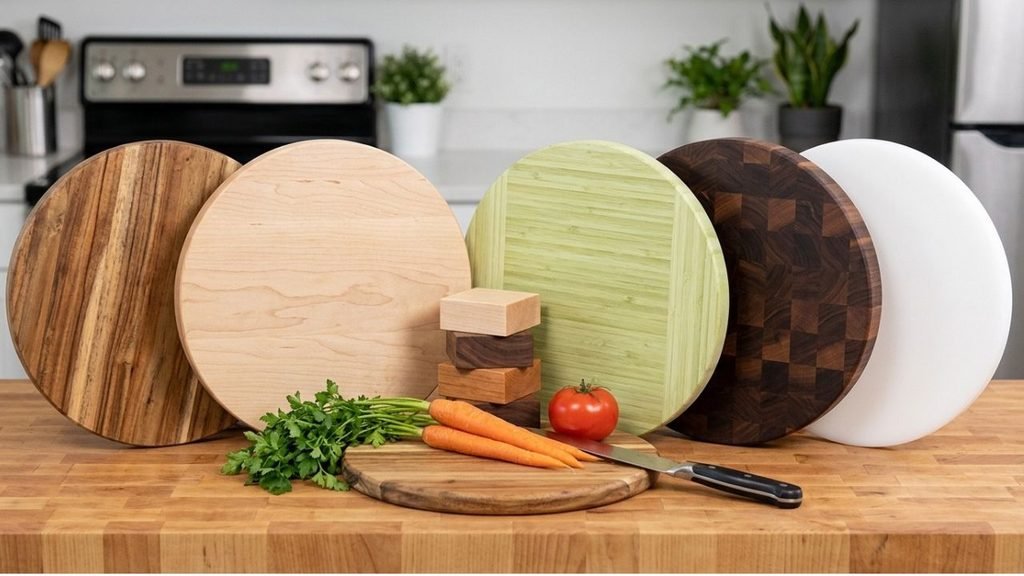
Maple, Walnut, and Cherry
Maple, walnut, and cherry are established choices for wooden cutting boards. They are available in different constructions, so the species name alone does not describe the entire product.
For a board that will stay on display, color and grain pattern can be part of the decision. For frequent preparation, examine smoothness, joints, flatness, weight, and the maker’s care instructions first.
I would favor a well-made board in a suitable size over a more decorative one with rough patches or questionable joints. A premium wood name does not excuse poor construction.
Wood also requires a care routine. Choose it if hand washing, thorough drying, and occasional conditioning fit your kitchen habits.
Acacia, Teak, and Bamboo
Acacia and teak offer distinctive grain patterns, while bamboo is another common board material. Compare individual products rather than treating these names as guarantees of durability or easy maintenance.
Bamboo boards are manufactured from joined material. Look for clear information about their construction, finish, intended use, and washing requirements.
Knife feel deserves attention. Wüsthof cautions that bamboo can dull blades faster than softer wood or suitable synthetic surfaces. That does not establish an identical result for every board, but it is a reason to look beyond appearance.
Avoid assuming that a bamboo or teak label automatically proves better environmental sourcing. Look for evidence attached to the particular product.
Plastic and Rubber
A plastic board may suit someone who prioritizes lighter handling and machine washing. Confirm that the exact board is dishwasher safe, including any restrictions on temperature, rack placement, or attached grips.
Rubber is a separate material category, and its washing instructions also vary. Do not transfer the care directions from a plastic board to a rubber one.
Choose a firm, stable surface that you can clean thoroughly. Very thin boards deserve a check for flexing and warping, while worn grooves deserve closer inspection on any material. University of Minnesota Extension stresses those condition and cleaning checks.
Paper Composite
Paper composite can offer a thinner alternative to a bulky wooden board. For example, Epicurean describes its material as paper layers combined with thermosetting resin and identifies its cutting boards as dishwasher safe.
That is a product-specific specification. Other boards marketed as wood fiber, composite, or plant fiber may use different formulations.
Check the listed material and care instructions. A wood-colored surface should not automatically receive the same oiling routine as solid wood, and a fiber label does not establish that a board contains no resin.
Glass, Stone, and Decorative Coatings
For repeated chopping, I would avoid round glass, marble, ceramic, or metal surfaces. Knife makers warn that very hard materials can damage or quickly dull a narrow cutting edge. A surface that wipes clean can still be a poor match for knife work.
Decorative resin requires a separate check. TotalBoat, for example, permits its cured TableTop epoxy for serving surfaces but specifically advises against cutting directly on it. Knives can damage the coating.
Use decorative sections only as the maker intends. Confirm cutting suitability before using a patterned, coated, or engraved serving board for daily prep.
Key Takeaway: Choose the material for cutting feel and cleaning requirements, then choose the appearance you prefer.
End Grain, Edge Grain, and Rustic Wood Rounds
End grain means the ends of the wood fibers face upward. The surface often has a block pattern because short pieces are joined together.
Edge grain presents the long edges of wood strips. The fibers run along the surface, and the board often shows lengthwise bands. John Boos describes both constructions and notes the added work involved in producing end-grain boards.
End-grain construction can provide a forgiving cutting surface, but it should not be treated as a promise that every scratch or structural defect will repair itself. Cracks, loose joints, and deep grooves still need attention.
For buying purposes, I would prioritize smooth joints and a flat board before paying extra for a particular grain pattern. Construction quality and maintenance remain part of the decision.
A rustic crosscut log slice deserves extra scrutiny. Confirm that it was prepared and finished for food preparation, rather than assuming a decorative wood round is ready for chopping. Check for cracking, loose bark, rough areas, and an unclear finish.
Choosing Diameter, Thickness, and Weight
Start With the Cutting Diameter
The following size bands are practical starting points, not industry standards or guaranteed meal capacities.
| Diameter | Approximate metric size | Tasks I would consider |
| 8–10 inches | 20–25 cm | Garnishes, small snacks, individual serving |
| 12–14 inches | 30–36 cm | Modest daily prep, bread, a small serving arrangement |
| 16–18 inches | 41–46 cm | Larger food items, more working room, broader serving layouts |
Diameter changes surface area faster than it may appear. A 12-inch circle has about 113 square inches of surface; a 16-inch circle has about 201 square inches.
Leave room for your knife and hands around the food. A pizza that reaches the edge of the board leaves little margin for cutting and handling.
Measure the usable flat surface. Handles, hanging holes, and deep perimeter grooves do not add cutting room.
Check Thickness and Working Height
Thickness influences weight and raises the cutting surface above the counter. A substantial chopping block may stay planted well, yet feel awkward if it brings your hands too high.
There is no need to buy the thickest board available for slicing fruit or serving cheese. Match the construction to the task, and check the maker’s intended use before treating a board as a heavy chopping block.
Think Through Washing and Carrying
Large round boards can be heavy. As one concrete example, Teakhaus lists its 18-inch circular Board 303 at 2 inches thick and 12 pounds. Those figures belong to that model, not every board of that diameter.
Consider lifting it while damp, turning it in the sink, and carrying it with food. Recessed grips can be useful if your fingers cannot get securely beneath the edge.
Key Takeaway: Choose enough working area without creating a board that is uncomfortable to lift, wash, or use at counter height.
Features That Deserve a Place on Your Checklist
A juice groove can catch some liquid from carving or juicy produce. It also reduces the uninterrupted cutting area and adds a channel to clean. For dry bread or routine vegetable chopping, a flat face may be more convenient.
Feet or grips should hold the board steady on your counter. Inspect their placement and attachment. Some designs support use on both faces; others make the board one-sided.
Reversible surfaces give you another working face. They are useful for spreading wear or keeping one face presentable, but flipping a board does not replace washing between foods.
Handles and recessed grips affect storage and carrying. A projecting handle adds overall length without increasing the circular working area. Recessed grips may suit a heavier board that you lift with both hands. John Boos identifies grips, grooves, and reversible faces as task-based buying choices.
Engraving and decorative edges should leave a suitable cutting zone. I prefer a smooth preparation face and decorative detail away from the area used for repeated knife work.
How to Use a Round Board Safely
Place the board on a clean, level counter and check for rocking or sliding before bringing out the knife.
If needed, use a suitable nonslip mat or a clean, lightly damp towel beneath it. Wüsthof recommends a damp towel to steady a cutting board. Remove it after use so moisture does not remain trapped beneath wood.
Keep the food near the central working area. Move prepared pieces into bowls when they begin crowding the knife’s path.
A round outline does not make the board a turntable. Stop cutting before repositioning it. A board that spins unexpectedly needs better support.
For rounded produce, create a flat resting surface when appropriate, then continue cutting with the food supported. The board’s curved edge does not prevent an onion or carrot from rolling.
Use a separate board for raw animal foods and ready-to-eat ingredients when possible. If one board must serve both jobs, clean and sanitize it between them using a method suitable for its material.
Using a Round Board for Pizza, Bread, and Entertaining
A circular serving arrangement works well when guests approach from several sides. Place a small bowl near the center, then arrange portions around it while leaving space for serving utensils.
For cheese and charcuterie, set out manageable portions and replenish with fresh platters. Avoid making the board so crowded that guests drag one food through another.
For pizza or a round loaf, check the full food diameter against the flat surface. A cutting board is also not automatically a trivet: use separate heat protection for a hot pan unless the maker approves that use.
A serving board does not keep perishable food cold. The FDA advises keeping cold foods at 40°F or below and discarding perishables left at room temperature for more than two hours, or one hour above 90°F, unless held safely hot or cold.
Plan space for clean utensils and replenishment alongside the board. An attractive arrangement should still be easy to serve from without crowding or repeated handling.
Cleaning and Caring for a Round Cutting Board
Wash, Rinse, and Dry After Use
Start with the instructions for your material and finish. For a typical hand-wash wooden board, the basic routine is:
- Remove food scraps.
- Wash the working surface, edges, and soiled underside with dish soap and water.
- Rinse away soap and debris.
- Towel-dry promptly.
- Allow remaining moisture to dry with air reaching the surfaces.
John Boos and Teakhaus provide hand-cleaning guidance for their wooden boards. Avoid soaking, standing water, and putting those boards in the dishwasher.
Support a round board securely while drying it upright. A rack or divider should prevent rolling; a loose lean against the backsplash may be unstable.
For plastic, rubber, or composite boards, follow the actual washing instructions. Dishwasher permission for one product does not apply to every board made from a similar-looking material.
Separate Cleaning From Sanitizing
Washing removes food residue. Sanitizing is a separate step that reduces germs on a previously cleaned surface.
Use a product labeled for food-contact surfaces and compatible with the board. Follow its dilution, contact-time, and rinsing directions, along with the board maker’s restrictions. Some wood-care instructions prohibit bleach, so a universal chemical recipe is a poor fit for every product.
Do not count lemon, salt, deodorizing, or oiling as a substitute for a suitable cleaning and sanitizing routine. A board that smells fresh may still need proper washing.
Condition Wood With an Appropriate Product
For wood that requires conditioning, use the maker’s recommended board oil or food-grade mineral oil. Apply it to a clean, fully dry board and follow the stated directions for absorption and removing excess.
Teakhaus advises against ordinary vegetable and olive oils because they can become rancid. The board’s condition and the manufacturer’s schedule should guide maintenance; there is no single oiling interval for every wood and finish.
Do not automatically oil plastic or composite. Epicurean states that routine oiling is unnecessary for its boards, although an optional conditioner can alter their appearance.
Key Takeaway: Match washing, sanitizing, drying, and conditioning to the actual material and finish.
Scratches, Warping, Cracks, and Replacement
Light knife marks are different from deep damage. Judge the board by its cleanability, surface condition, and stability rather than expecting it to remain visually untouched.
Deep, hard-to-clean grooves are a reason to retire a board from food preparation. USDA guidance also calls for replacing excessively worn cutting boards.
Stop using a board that splinters, has loose joints, or rocks enough to interfere with cutting. A high purchase price is not a reason to keep working on a damaged surface.
Some solid-wood boards can be professionally resurfaced when the damage is shallow and the construction permits it. Ask the maker before sanding a coated board, removing material near decorative sections, or attempting to flatten a warped block.
Sanding does not solve every problem. An opening glue joint or deep split needs an assessment of the structure, not just a smoother top.
Cost, Value, and a Sensible Buying Decision
Compare boards using the details that affect daily ownership: cutting diameter, material, construction, weight, grips, finish, cleaning requirements, and support from the maker.
A higher price may reflect more material, extra construction work, or decorative detail. Decide which of those differences you will use.
My preference is a board with a clearly identified cutting surface, a weight I can handle, and written care instructions. For a gift, I would also think about the recipient’s sink and storage space before choosing a large block.
Before ordering, confirm these five points:
- The surface is intended for cutting, not just display.
- The usable diameter fits the foods you prepare.
- The board fits your counter, sink, drying location, and storage.
- Its cleaning and maintenance routine is realistic for you.
- The return and warranty terms cover the purchase clearly.
Conclusion
A round cutting board can be a useful daily tool, a serving piece, or both. Its best qualities come from the combination of suitable material, enough working room, stable support, and care that fits your routine.
Choose diameter with the knife and food in mind, check the finish before cutting, and plan for washing and drying. Keep raw-food preparation separate from ready-to-eat serving, regardless of the board’s shape.
I would start with the task the board needs to perform most often. A circle earns its place when it works comfortably in your kitchen and at your table; appearance can then be part of a purchase that already makes practical sense.
FAQs About Round Cutting Boards
Can a Round Board Be My Only Cutting Board?
It can handle your everyday cutting if it is large enough, stable, and made for the task. Still, a second board is useful for separating raw animal foods from produce and bread. If you use one board, clean and sanitize it between those jobs; turning it over does not make it clean.
Are Round Boards Better for Small Kitchens?
Only if their dimensions suit the available space. A circle needs the same maximum width and depth as a square of equal width while providing less cutting area. Measure your counter and sink, then compare the actual boards. A smaller round board can suit snacks, while larger meal preparation may need more room.
Can I Cut Pizza With a Wheel on a Wooden Round Board?
Yes, if the board is intended for cutting and its usable surface is larger than the pizza. Expect a pizza wheel to leave marks over time, and avoid rolling across decorative resin, raised details, or unsupported edges. Keep the board steady and use a separate trivet for the hot pizza pan.
Can I Hang a Round Wooden Board on the Wall?
A board with a suitable hanging hole or handle can be stored that way once fully dry. Use hardware rated for the board’s weight and position it away from stove heat and splashes. Check that the handle or hole is intended to support hanging rather than serving as decoration alone.
Is a Rotating Craft Mat the Same as a Round Cutting Board?
No. A rotating craft mat is intended for tasks such as cutting fabric or paper, often with a rotary cutter. That intended use does not establish suitability for food contact or kitchen knives. Choose a product expressly made for food preparation, and keep its cutting surface stable while using it.