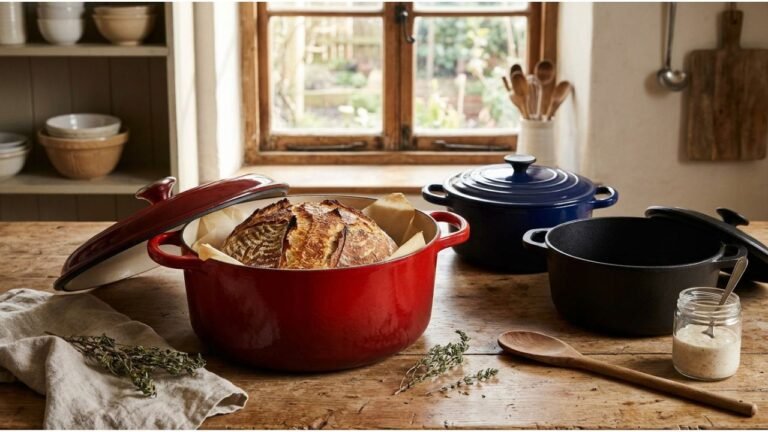
Can You Deep Fry in a Dutch Oven? Safe Oil Depth & Temperature
Yes, a heavy Dutch oven is well suited to deep frying because its tall sides contain oil and splatter, while its thick construction holds heat steadily as food is added. Cast iron and enameled cast iron models are commonly used for fried chicken, French fries, doughnuts, fish, and other foods cooked while submerged in hot oil.
The main safety concern is not the pot itself but the amount and temperature of the oil. Filling a Dutch oven too high leaves little room for the oil level to rise when food is added, increasing the chance of a dangerous overflow.
A heavy pot also recovers heat more steadily after cold food enters the oil. That makes it easier to keep fried foods crisp rather than greasy from cooking too long at a low temperature.
For can you deep fry in a dutch oven, the practical answer is yes if the cookware is approved for stovetop use, is deep enough for the food and oil, and remains well below full capacity. Lodge recommends keeping frying oil below half the height of the cookware because adding food raises the oil level.
Most Dutch-oven frying takes place around 325°F to 375°F. Le Creuset gives that range for deep frying in an enameled cast iron Dutch oven, while Lodge recipes commonly use temperatures such as 325°F and 350°F for fried chicken.
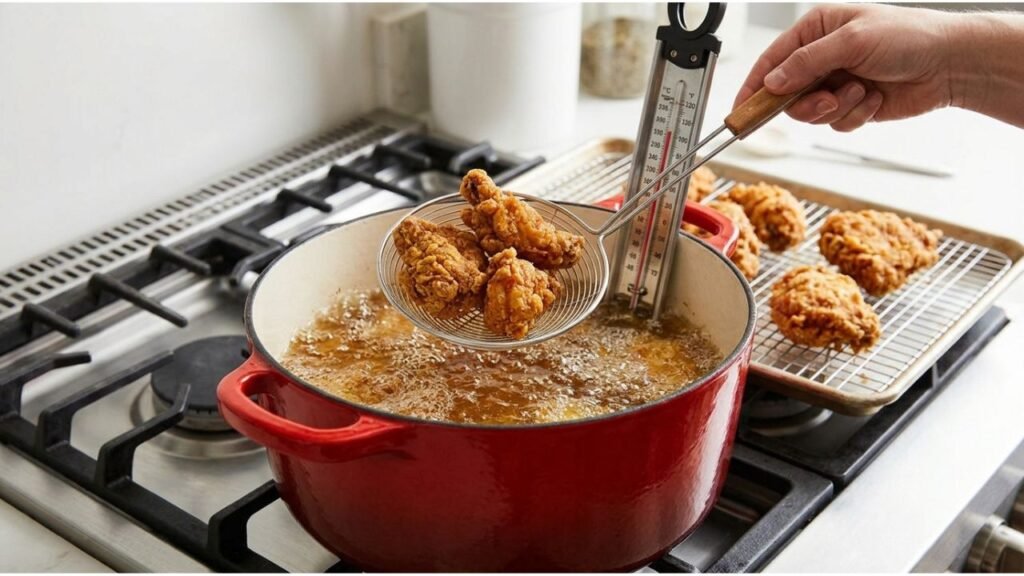
A thermometer, dry food, manageable batches, and a clear stovetop area matter more than filling the pot with as much oil as possible. The sections below cover cookware type, oil depth, frying temperature, oil selection, step-by-step technique, fire safety, and cleanup.
Can You Deep Fry Safely in a Dutch Oven?
A Dutch oven can be a very good deep-frying vessel because it combines tall walls with substantial weight.
Le Creuset specifically recommends its enameled cast iron Dutch ovens for deep frying and points to their heat distribution and heat retention as reasons they work well with hot oil. Lodge also lists deep-fried chicken among the intended uses for its cast iron Dutch ovens.
Cast Iron Dutch Oven
Seasoned cast iron holds a large amount of heat.
That is useful when adding food temporarily lowers oil temperature. The heavy pot releases stored heat back into the oil as the burner continues heating it.
Lodge uses cast iron Dutch ovens for deep-fried foods and recommends a vessel of at least 6 quarts for its French-fry method.
One point deserves attention if you plan to reuse frying oil many times. USDA notes that bare cast iron can cause frying oil to break down faster than some other metals. That does not mean a cast iron Dutch oven cannot fry food; it is a consideration for oil quality and repeated reuse.
Enameled Cast Iron Dutch Oven
An enameled Dutch oven also works well.
Le Creuset specifically calls its enameled cast iron Dutch ovens suitable for deep frying and recommends using a deep-fry or candy thermometer to hold the oil in the required temperature range.
The enamel creates a smooth cooking surface that does not expose the oil directly to bare iron.
Avoid striking the enamel with heavy metal tools, and follow the cookware maker’s stovetop heat instructions.
Other Heavy Dutch Ovens
A heavy stainless steel Dutch oven can also fry food if it is stovetop-safe and deep enough.
The same safety rules apply:
- Leave substantial empty space above the oil.
- Monitor oil temperature.
- Add dry food carefully.
- Never leave hot oil unattended.
- Keep water away from the pot.
Key Takeaway: Seasoned cast iron, enameled cast iron, and other heavy stovetop-safe Dutch ovens can all be used for deep frying; tall sides and steady heat make them well suited to the job.
How Much Oil Should You Put in a Dutch Oven for Deep Frying?
Do not fill a Dutch oven to the top with frying oil.
Lodge recommends keeping the oil less than halfway up the side of the pot because the oil level rises when food enters it.
For many smaller foods, about 2 inches of oil provides enough depth for full submersion. King Arthur Baking uses approximately 2 inches of oil in a large heavy pot such as a Dutch oven when frying doughnuts.
The exact amount changes with:
- Dutch oven diameter
- Pot depth
- Food size
- Amount of food being fried
- Fry basket size
A wider Dutch oven may need more oil than a narrower pot to reach the same depth.
Leave Room for Oil Displacement
A Dutch oven that appears only moderately full can rise quickly once several pieces of food enter it.
This is most noticeable with:
- Large chicken pieces
- Breaded fish
- Doughnuts
- Large fritters
- Fry baskets containing several items
If the oil is already near the upper half of the pot before adding food, remove some before heating.
Watch for Foaming Foods
Breaded and battered foods can create substantial bubbling.
That bubbling temporarily increases the volume at the surface and can carry oil toward the rim.
A deep pot with plenty of unused height provides a margin between the bubbling oil and the edge.
Do Not Test Oil Capacity With Hot Oil
If you are uncertain about how much displacement a large food will cause, determine the needed volume before heating.
Never place wet food into hot oil as a test. USDA warns that water contacting oil around frying temperature can flash into steam and throw hot oil outward.
Key Takeaway: Keep oil below half the Dutch oven’s height and use only enough depth to submerge the food safely, with plenty of unused space for displacement and bubbling.
What Temperature Should Oil Be in a Dutch Oven?
Most Dutch-oven deep frying happens between 325°F and 375°F.
Le Creuset recommends that general range for deep frying, and USDA lists similar temperatures for common fried foods.
Examples include:
| Food | Typical frying temperature |
| French fries, first fry | About 325°F |
| French fries, second fry | About 375°F |
| Fried chicken | About 325–375°F |
| Chicken fingers | About 350°F |
| Doughnuts | About 350–360°F |
| Fish fillets | Around 320°F in USDA guidance |
Lodge’s cast iron French-fry method starts at about 325°F, then finishes the fries around 375°F.
King Arthur Baking fries pączki in a Dutch oven between 350°F and 360°F.
Use a Deep-Fry Thermometer
A thermometer removes guesswork.
USDA notes that candy and deep-fry thermometers commonly measure from about 100°F to 400°F, covering the normal frying range.
Clip the thermometer where the probe sits in the oil without resting directly against the bottom of the Dutch oven.
A probe touching the hot metal can read differently from the oil surrounding the food.
Expect the Temperature to Drop
Cold food absorbs heat immediately.
If oil starts at 350°F, it may drop well below that temperature after a large batch enters the Dutch oven.
Do not compensate by overheating the oil far above the recipe temperature before adding food. Lodge advises keeping frying oil below 400°F.
Use smaller batches instead.
Why Low Oil Temperature Is a Problem
Oil that is much cooler than the recipe calls for can produce food that:
- Takes longer to brown
- Absorbs more oil
- Develops a soft coating
- Cooks unevenly
Le Creuset notes that excessively cool oil can lead to oily, soggy fried food.
Why Excessively Hot Oil Is a Problem
Oil that is too hot can brown or burn the coating before thicker food has cooked through.
It also moves the oil closer to smoking and possible ignition.
Use burner adjustments and the thermometer rather than judging solely from bubbling.
Key Takeaway: Keep most deep-frying oil between 325°F and 375°F, measure it with a thermometer, and fry smaller batches so the temperature does not collapse after food is added.
What Oil Should You Use for Dutch Oven Deep Frying?
Choose an oil that tolerates normal frying temperatures without smoking quickly.
USDA lists several high-smoke-point oils suitable for deep frying, including:
- Peanut oil
- Canola oil
- Corn oil
- Grapeseed oil
- Safflower oil
- Sunflower oil
- Vegetable oil
USDA lists approximate smoke points such as 450°F for peanut, safflower, and soybean oils and 435°F for canola oil.
Le Creuset recommends high-smoke-point oils such as canola, peanut, or grapeseed for Dutch-oven frying.
Lodge also lists peanut, vegetable, canola, avocado, and sunflower oils as choices for deep frying.
The recipe and flavor you want can guide the final choice.
How to Deep Fry in a Dutch Oven Step by Step
1. Put the Dutch Oven on a Stable Burner
Use a burner that supports the pot securely.
Center the Dutch oven so it cannot tip, and turn handles away from the front edge of the stove.
Clear nearby paper towels, packaging, oven mitts, and other items that could contact heat or flame.
2. Make Sure the Pot and Food Are Dry
The inside of the Dutch oven should be completely dry before oil is added.
Dry the food as well.
This matters with foods such as potatoes that have been rinsed or soaked. Lodge tells cooks to dry soaked French fries as thoroughly as possible before lowering them into frying oil.
Water can vaporize almost instantly when it contacts very hot oil, producing violent splattering. USDA specifically warns against allowing water into frying oil.
3. Add Oil Without Filling Past Halfway
Pour enough oil into the Dutch oven to submerge the food while staying below the halfway point.
For many small items, roughly 2 inches is enough.
Do not fill extra oil simply because the Dutch oven has unused capacity.
4. Attach a Frying Thermometer
Position a candy or deep-fry thermometer so its tip sits in the oil.
Do not let the sensing area rest against the Dutch oven bottom.
5. Heat the Oil Gradually
Use moderate burner heat and watch the temperature rise.
Aim for the temperature stated in the recipe, commonly between 325°F and 375°F.
Do not walk away while the oil heats.
NFPA advises staying in the kitchen whenever food is frying and turning off the burner if you leave.
6. Lower Food Into the Oil Slowly
Use:
- Long tongs
- A wire skimmer
- A spider strainer
- A properly sized fry basket
Do not drop food from several inches above the oil.
Lodge recommends adding food slowly and using a fry basket when suitable.
Lower food away from your body to direct any small splash toward the back of the pot.
7. Fry in Small Batches
Do not crowd the Dutch oven.
Le Creuset recommends small batches because adding too much food cools both the pot and oil, which can leave the exterior soggy.
Wait for the oil to return to the target temperature before adding the next batch.
8. Remove the Food and Check Doneness
Lift fried food carefully and allow oil to drain back into the Dutch oven.
A wire rack placed over a sheet pan works well for draining many foods. Le Creuset recommends a wire rack rather than leaving freshly fried food sitting in oil-soaked paper towels.
For meat, poultry, or seafood, use a food thermometer after removal from the oil.
USDA lists safe minimum internal temperatures of 165°F for poultry and 145°F for fish and shellfish.
9. Turn Off the Heat and Let the Oil Cool
Once frying is finished, turn off the burner.
Leave the Dutch oven where it is until the oil has cooled enough to handle safely.
USDA advises allowing frying oil to cool fully before cleaning or transferring it and notes that cooling can take around two hours or longer.
Key Takeaway: Keep the Dutch oven dry and stable, heat the oil under constant supervision, add dry food slowly in small batches, and let the oil cool fully before moving or filtering it.
Can You Deep Fry in an Enameled Dutch Oven?
Yes.
Le Creuset specifically recommends enameled cast iron Dutch ovens for deep frying and says their heat distribution and retention keep frying oil relatively steady as food is added.
A 5.5-quart Dutch oven is one size Le Creuset highlights for frying, though other sizes can work too.
Use wooden, silicone, or other cookware-safe tools if your manufacturer recommends them for enamel protection.
Do not scrape the enamel aggressively with sharp metal utensils while moving fried food.
Also avoid heating the Dutch oven empty at high heat. Add the frying oil before bringing the pot up to temperature and follow the care instructions for your exact cookware.
Is Cast Iron Good for Deep Frying?
Yes, cast iron’s heat capacity is one reason it has been used for frying for generations.
Lodge directly lists deep-fried chicken as a use for its cast iron Dutch ovens and sells fry baskets meant to turn Dutch ovens into deep fryers.
The heavy iron helps limit rapid temperature swings after food is added.
There is one tradeoff: USDA states that bare cast iron can cause frying oil to break down faster than some other cookware materials.
If you fry only occasionally and discard or limit reuse of the oil, that point may matter less than it would in a kitchen that filters and reuses oil repeatedly.
What Foods Can You Deep Fry in a Dutch Oven?
A Dutch oven can handle most foods normally cooked in a countertop deep fryer.
Common examples include:
- Fried chicken
- Chicken wings
- French fries
- Onion rings
- Doughnuts
- Hush puppies
- Tempura vegetables
- Fish
- Shrimp
- Fritters
- Mozzarella sticks
- Potato chips
Le Creuset specifically lists breaded and battered foods, chicken, and tempura vegetables as suitable Dutch-oven frying foods.
Lodge publishes Dutch-oven recipes for Korean fried chicken and French fries, using staged temperatures that take advantage of cast iron heat retention.
The food should fit comfortably below the oil surface without making the level approach the rim.
Dutch Oven Deep-Frying Safety
Keep a Lid Nearby, but Fry Uncovered
A matching metal lid should be within reach while frying.
It is for an emergency, not normal frying.
If a small grease fire starts, NFPA advises turning off the burner if it is safe to do so and sliding the lid over the pan to smother the flames. Leave the lid on until the pan is cool.
Normal deep frying should remain uncovered so steam can escape rather than condense inside a lid and drip toward hot oil.
Never Put Water on an Oil Fire
This is one of the most serious deep-frying rules.
USDA warns that water contacting very hot oil can rapidly turn into steam and cause hot oil to splatter. It also states that water should never be used to extinguish a grease fire.
NFPA gives the same warning.
If the fire is not small and immediately controllable, get everyone out and call emergency services from a safe location.
Never Leave Hot Oil Unattended
Hot oil can move from normal frying temperature toward smoking or ignition faster than expected.
USDA states that deep frying should never be left unattended.
NFPA also advises staying in the kitchen the entire time food is frying.
Keep Children and Pets Away
NFPA recommends a 3-foot child-free zone around the stove and other areas where hot food or drinks are prepared.
A Dutch oven containing several quarts of hot oil is heavy and dangerous to move, so keeping traffic away from the stovetop matters.
Have the Right Fire Protection Available
NFPA classifies fires involving cooking oils and fats in cooking appliances as Class K fires.
For a small pan fire, a fitted lid and shutting off the burner are the first actions given in NFPA home-cooking guidance.
Do not attempt to carry a burning Dutch oven outside.
Key Takeaway: Stay beside the Dutch oven, keep food and cookware dry, leave a lid within reach for a small grease fire, never use water on burning oil, and do not move a pot containing burning grease.
Common Dutch Oven Deep-Frying Mistakes
The most serious mistake is overfilling the pot.
A second common problem is adding too much food at once, which causes a steep temperature drop.
Other mistakes include:
- Heating oil without a thermometer
- Frying wet or partly frozen food
- Dropping food into the oil
- Heating past the oil’s smoke point
- Leaving the burner unattended
- Filling beyond half the pot
- Allowing the thermometer to touch the bottom
- Using short utensils that place your hand near splatter
- Trying to move a Dutch oven full of hot oil
- Using water on an oil fire
Frozen food with heavy surface ice can produce severe splattering. Remove loose ice and follow the product’s cooking directions.
A whole frozen turkey should never be deep fried. USDA specifically states that whole poultry must be fully thawed before deep-fat frying.
Can You Reuse Oil After Deep Frying in a Dutch Oven?
Yes, frying oil can often be reused if it still smells and looks normal.
USDA recommends straining cooled oil through cheesecloth or a sieve and storing it in a sealed, light-resistant container. It also recommends refrigeration for oil that will be reused.
Discard the oil if it:
- Smells rancid or unpleasant
- Foams excessively
- Becomes unusually cloudy
- Smokes well below its former frying temperature
- Contains large amounts of burnt debris
Bare cast iron may shorten oil life compared with some other pot materials, according to USDA guidance.
Never pour used cooking oil down the drain. USDA advises placing cooled oil in a suitable sealed container for disposal or using a local cooking-oil recycling program where available.
Conclusion
For can you deep fry in a dutch oven, yes—a deep, heavy Dutch oven is one of the most practical stovetop vessels for fried chicken, fries, doughnuts, fish, and similar foods. Cast iron and enameled cast iron both work well when their normal cookware instructions are followed.
Keep the oil below half the height of the pot, use a deep-fry thermometer, and aim for the temperature called for by the recipe, commonly between 325°F and 375°F. Dry food before frying and cook in small batches so the oil does not overflow or lose too much heat.
Stay beside the stove from the moment the oil begins heating until the burner is off. Keep a fitting lid nearby, never add water to hot oil or an oil fire, and let the Dutch oven cool fully before attempting to filter, store, or discard the oil.
FAQs About Deep Frying in a Dutch Oven
Is a Dutch oven better than a frying pan for deep frying?
A Dutch oven is usually the safer shape for full deep frying because its tall walls provide more space above the oil and reduce splatter outside the pot. A shallow frying pan is better suited to pan frying, where food cooks in a smaller amount of oil and is turned during cooking. Le Creuset recommends Dutch ovens for deep frying and shallow skillets for pan frying.
How full should a Dutch oven be for deep frying?
Keep frying oil below half the height of the Dutch oven. Lodge recommends filling cookware less than halfway because food raises the oil level as it enters the pot. For many recipes, about 2 inches of oil is enough to submerge smaller foods.
Can you deep fry in a Le Creuset Dutch oven?
Yes. Le Creuset specifically recommends its enameled cast iron Dutch ovens for deep frying. The company suggests high-smoke-point oil and a frying temperature commonly between 325°F and 375°F, monitored with a candy or deep-fry thermometer.
Can you deep fry in a Lodge cast iron Dutch oven?
Yes. Lodge lists deep frying among the uses for its cast iron Dutch ovens and sells fry baskets made for Dutch-oven frying. Lodge also publishes recipes for deep-fried chicken and French fries cooked in cast iron Dutch ovens.
Should you put the lid on a Dutch oven while deep frying?
No. Leave the Dutch oven uncovered during normal frying so steam can escape. Keep the lid nearby for fire safety. NFPA recommends sliding a lid over a small grease fire, turning off the burner, and leaving the lid in place until the pan cools. Never pour water onto burning oil.
What temperature should I deep fry chicken in a Dutch oven?
Fried-chicken recipes commonly use oil between about 325°F and 375°F. Lodge’s Korean fried chicken recipe starts at 325°F, then raises the oil to 350°F for the second fry. Poultry should reach at least 165°F internally before serving.
What size Dutch oven is best for deep frying?
A 5.5- to 6-quart Dutch oven is a useful size for many home frying jobs. Le Creuset highlights its 5.5-quart model for frying, while Lodge recommends at least a 6-quart vessel for its French-fry method. Smaller pots can work for small batches as long as the oil remains below halfway and the food fits without crowding.
Can I deep fry frozen food in a Dutch oven?
Some packaged frozen foods are made for frying, but loose surface ice and excess moisture can cause violent splattering. Follow the food maker’s directions and remove loose ice where instructed. Never deep fry a frozen whole turkey; USDA requires it to be fully thawed before deep-fat frying.