How Big of a Dutch Oven for Sourdough? Size, Shape, and Loaf Fit
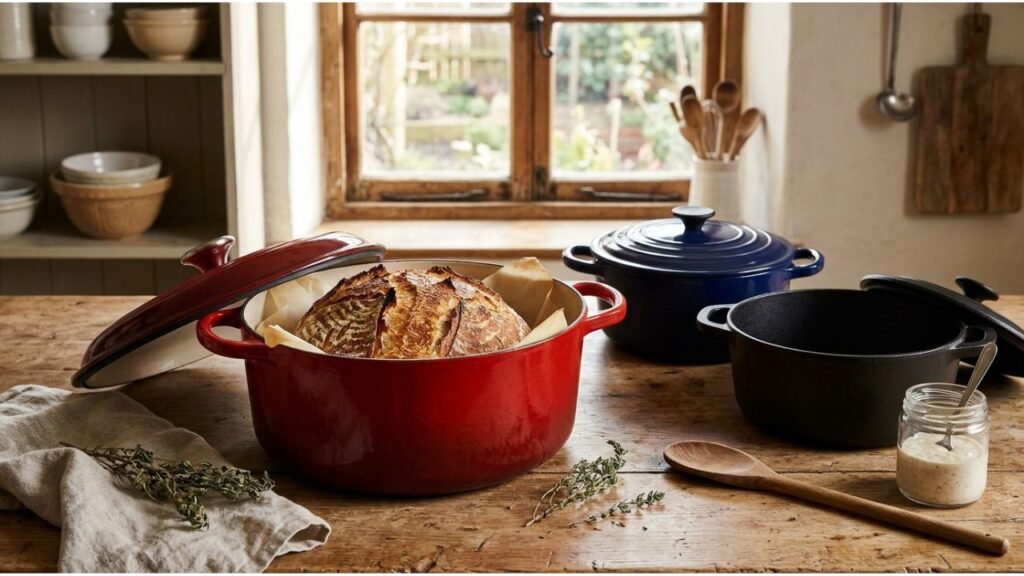
For most standard sourdough boules, a 5- to 6-quart round Dutch oven is a strong starting size. It gives a typical home loaf room to expand upward and outward while keeping the dough inside a relatively compact, covered space that traps steam during the first part of baking.
A pot that is too small can crowd the loaf against the sides or lid as it expands. A much larger pot can still bake good bread, but it adds weight, takes more oven space, and may provide far more room than a single standard loaf needs.
The size on the box is only part of the decision. A short, wide 5-quart pot and a tall, narrow 5-quart pot can fit the same dough very differently, so interior diameter and usable height matter along with quart capacity.
A lidded Dutch oven works well for sourdough because it traps moisture released by the dough. That steam keeps the outer surface flexible during early oven spring, giving the loaf more time to expand before the crust firms. Bread-baking guidance describes covered vessels as a way to trap the loaf’s own steam during the early part of the bake.
For how big of a dutch oven for sourdough, I would choose a 5- to 6-quart round model for a typical boule if buying one pot mainly for bread. A 3- to 4-quart vessel can work for smaller loaves, while 6- to 7-quart pots make more sense for large boules or longer loaves when the shape matches.
A 3.2-quart combo cooker has been used for roughly 500 to 900 grams of bread dough, while 4- or 5-quart Dutch ovens also fall within a common bread-baking range. That shows why shape and usable interior space can matter more than the capacity number alone.
The sections below match Dutch oven capacity to dough weight, explain 4-, 5-, 6-, and 7-quart choices, compare round and oval pots, and show how to tell if a Dutch oven you already own has enough room for your sourdough.
Dutch Oven Size for Sourdough at a Glance
The table below is a practical starting point rather than a fixed rule. Pot geometry varies by brand, and dough with the same weight can spread differently based on shaping and hydration.
| Dutch Oven Size | Practical Loaf Range | Best Match |
| 3–4 qt | Small to medium loaf | Compact boule, smaller batch, combo cooker |
| 4.5–5 qt | Medium loaf | Standard home boule |
| 5.5–6 qt | Medium to large loaf | Standard or larger boule |
| 6.5–7 qt | Large loaf | Large boule, some batards, multi-use cooking |
| 7+ qt | Very large loaf | Oversized dough or long loaf if the shape fits |
For many home sourdough recipes, the 5- to 6-quart range gives enough breathing room without turning the pot into a large, heavy vessel that is awkward to preheat and load.
A smaller pot is not automatically wrong. A 3.2-quart combo-cooker example accommodates dough up to about 900 grams because the vessel is shaped for bread and provides usable room under the inverted top.
Why Dutch Oven Size Matters for Sourdough
The pot needs to contain the loaf during its fastest expansion without pressing the dough into the sidewalls or lid.
The Dutch Oven Needs Room for Oven Spring
Oven spring is the rapid expansion that happens after the dough enters the hot oven.
During this stage, gases inside the dough expand and steam forms. The loaf may grow noticeably in both height and width before the crust becomes firm.
Bread-baking guidance explains that steam keeps the outside of the loaf moist and flexible long enough for fuller expansion. A covered Dutch oven creates that humid environment by trapping the moisture released by the dough.
If the raw loaf already fills the pot from wall to wall, it has very little room left for that expansion.
A Pot That Is Too Small Can Restrict the Loaf
A crowded loaf may touch the side of the Dutch oven or the underside of the lid.
Possible signs include:
- Flattened or compressed areas where the crust contacted the pot
- A loaf that expands into the sidewall rather than freely upward
- Parchment and dough wedged tightly against the pot
- Difficulty lowering the shaped dough without deforming it
The pot does not need a huge gap around the dough, but the shaped loaf should not begin the bake packed tightly against the sides.
Quart Capacity Does Not Tell the Whole Story
Capacity tells you how much volume the pot holds. It does not describe the shape of that volume.
For example, Le Creuset’s current 5.5-quart round Dutch oven lists an interior diameter of about 10.2 inches and an interior height of about 4.4 inches. Another 5.5-quart design can distribute the same volume differently.
For bread, check the interior base diameter, upper diameter, and usable height under the lid rather than shopping by quarts alone.
Key Takeaway: The best pot gives the shaped loaf space for oven spring, and interior dimensions often tell you more than quart capacity by itself.
What Size Dutch Oven for Different Sourdough Loaves?
Most bakers deciding between common Dutch oven sizes are comparing 4, 5, 6, and 7 quarts.
3- to 4-Quart Dutch Oven for Smaller Sourdough
A 3- to 4-quart pot works well for smaller boules and compact bread cookers.
This size is appealing if you:
- Bake smaller dough batches
- Prefer a compact boule
- Have limited oven space
- Use a combo cooker with a broad base and domed cover
Do not reject a 3.2-quart combo cooker just because the capacity sounds small. A documented 3.2-quart combo-cooker setup accommodates about 500 to 900 grams of dough.
A traditional deep 3-quart pot may be less roomy than a 3.2-quart combo cooker with a bread-friendly shape, so compare actual measurements.
5-Quart Dutch Oven for a Standard Boule
A 5-quart round Dutch oven is one of the easiest sizes to match with a standard home sourdough boule.
It provides a compact baking chamber while leaving room for a shaped loaf to expand.
Lodge’s 5-quart Double Dutch Oven is specifically positioned for sourdough bread baking. The design uses a shallow pan as one half and a deeper vessel as the other, which also reduces the need to lower dough into a tall hot pot.
If most of your loaves are moderate in size and round, 5 quarts is a very sensible single-purpose bread size.
5.5- to 6-Quart Dutch Oven for More Loaf Room
A 5.5- or 6-quart pot gives a standard boule more headroom and also accommodates a somewhat larger dough.
This is the size I would choose if the pot will serve both bread and normal kitchen cooking. It is large enough for many home sourdough loaves without moving into the bulk of a very large Dutch oven.
The 5.5-quart round model from Le Creuset is one real-world example with a 10.2-inch interior diameter. That size gives a useful reference when comparing the diameter of other round pots.
6.5- to 7-Quart Dutch Oven for Large Sourdough
A 6.5- to 7-quart pot is useful for a large boule or for bakers who already own a larger Dutch oven and do not want to buy another vessel.
A 7-quart Dutch oven is not automatically too big for a standard loaf. Published bread-baking guidance also states that larger Dutch ovens can work for bread even when smaller sizes are preferred.
The tradeoff is mainly bulk. A large cast-iron pot is heavier, occupies more oven space, and can be less convenient to load.
Key Takeaway: A 5-quart pot suits many standard boules, 5.5 to 6 quarts adds room for larger loaves, and 7 quarts is workable when you bake big bread or already own the pot.
Match Dutch Oven Size to Total Dough Weight
Use total dough weight, not flour weight alone, when comparing your loaf with the available interior space.
Total dough includes flour, water, starter, salt, and any inclusions that go into the loaf.
A recipe that starts with 500 grams of flour can produce a loaf weighing far more than 500 grams once water, starter, and salt are included. That is why two recipes described as “500-gram loaves” can be confusing if one number refers to flour and another refers to finished dough.
A practical sizing approach is:
| Total Dough Weight | Starting Dutch Oven Size |
| About 500–700 g | 3–4.5 qt |
| About 700–900 g | 4–5 qt |
| About 900–1,100 g | 5–6 qt |
| About 1,100–1,300 g | 6–7 qt |
| Above about 1,300 g | 7+ qt or a dedicated bread vessel |
Treat these ranges as room-planning estimates, not strict capacity limits. A broad 3.2-quart combo cooker may fit dough that feels cramped in a narrow 4-quart pot.
If you repeatedly bake the same recipe, weigh the mixed dough once and write that number next to the recipe. It becomes much easier to compare future Dutch ovens with the loaf you actually bake.
Round vs. Oval Dutch Oven Size for Sourdough
The loaf shape should match the pot shape as closely as practical.
Round Dutch Oven for a Boule
A boule is a round loaf.
A round 4.5- to 6-quart Dutch oven is a natural match because the loaf can expand evenly toward the sides.
Round pots are also common, so there are many cast-iron and enameled options in this size range.
Bread-baking guidance notes that Dutch ovens naturally favor round loaves that match the vessel’s shape. Longer or differently shaped loaves may need another covered baking setup.
Oval Dutch Oven for a Batard
A batard is an oval or oblong loaf.
Trying to place a long batard in a narrow round pot can force the ends inward or make the loaf touch the walls before baking starts.
An oval Dutch oven, bread cloche, or covered bread baker gives an oblong loaf more length without requiring excessive empty width.
For a large batard, do not choose capacity alone. Measure the usable interior length and width against the shaped loaf or banneton.
Key Takeaway: Use a round pot for a boule and an oval or longer bread vessel for a batard; matching the shape prevents wasted space and cramped ends.
How to Tell if Your Dutch Oven Is Big Enough for Sourdough
You do not need to buy a new Dutch oven simply because a recipe names a different quart size.
Check the pot you already own first.
- Measure the interior base. Record the usable width where the dough will sit, not the outside diameter.
- Measure the usable height. Include the space under the lid, accounting for any inward curve.
- Compare it with your proofing basket. A loaf coming from a round banneton needs enough room to expand beyond its proofed shape.
- Look for wall clearance. The unbaked loaf should not begin packed tightly against the pot.
- Check lid clearance. A high-domed loaf needs room above the score so it does not hit the lid during oven spring.
- Confirm the heat rating. The pot, lid, handles, and knob must be approved for your recipe’s baking temperature.
Bread-baking guidance recommends a Dutch oven or combo cooker that is oven-safe to at least 450°F and has a tight-fitting lid, while also warning that some vessels should not be preheated empty unless the manufacturer permits it.
If the pot clears those checks, bake a loaf before buying another size. Actual loaf fit is more useful than matching a recipe’s quart number exactly.
Is a 4-Quart Dutch Oven Big Enough for Sourdough?
Yes, a 4-quart Dutch oven can be big enough for sourdough.
It works best with a small or moderate boule and with pots that have a broad enough base for the shaped dough.
A 4-quart pot becomes questionable when the dough nearly fills the interior before baking or when a large loaf rises close to the lid.
If you regularly bake around 700 to 900 grams of total dough, check the actual interior diameter. Some 4-quart pots fit that range comfortably, while others are tall and narrow.
Is a 5-Quart Dutch Oven Big Enough for Sourdough?
Yes. A 5-quart round Dutch oven is a strong match for many home sourdough boules.
It sits near the middle of the useful range: compact enough for a standard loaf, yet roomy enough for strong oven spring.
A 5-quart Double Dutch Oven sold by Lodge is specifically positioned for sourdough bread baking.
If you want one clear answer and usually bake a single round loaf, 5 quarts is a solid place to start.
Is a 6-Quart Dutch Oven Too Big for Sourdough?
No. A 6-quart Dutch oven is not too big for most standard sourdough recipes.
It gives the loaf more room than a 4- or 5-quart pot and can also serve as a general-purpose cooking vessel.
The main point is shape. A round 6-quart pot with a sensible base diameter can work very well for a standard boule. A very wide, shallow 6-quart vessel will behave differently from a narrower, deeper model.
For someone buying one Dutch oven for both bread and family meals, 5.5 to 6 quarts is a practical middle size.
Is a 7-Quart Dutch Oven Too Big for Sourdough?
No. A 7-quart Dutch oven can bake a standard sourdough loaf.
A smaller pot may fit a normal boule more closely, but a larger covered pot still traps the loaf’s moisture and creates a steam-rich baking chamber. Published bread-baking guidance states that larger Dutch ovens work for bread even when smaller sizes are preferred.
A 7-quart model makes the most sense if you:
- Already own it
- Bake large boules
- Want room for larger recipes
- Use the pot for meals as well as bread
Do not replace a perfectly suitable 7-quart pot before testing it with your normal dough.
Dutch Oven Dimensions Matter More Than the Quart Number
Two pots with the same capacity can produce very different loaf fit.
Check Interior Diameter
For a round boule, base diameter is one of the most useful measurements.
A 5.5-quart Le Creuset round Dutch oven, for example, lists an interior diameter of about 10.2 inches.
Use manufacturer interior dimensions when available rather than estimating from the outside rim.
Check Height Under the Lid
A pot can have plenty of floor space and still be too short for a tall loaf.
Look at:
- Sidewall height
- Lid shape
- Interior knob projection, if any
- Space above the scored dough
A domed lid can provide more useful loaf clearance than a flat lid on a pot with the same stated capacity.
Check How the Dough Gets Into the Pot
Deep Dutch ovens require lowering the dough past tall hot walls.
A combo cooker or bread oven with a shallow base reduces that drop. Bread-baking guidance describes the Double Dutch style as a design that lets the loaf sit on the shallow section while the deeper body is placed over it.
This does not change the dough’s space requirement, but it can make a suitably sized vessel easier to use.
Key Takeaway: Compare base diameter, lid clearance, and loading depth before choosing between two Dutch ovens that list the same capacity.
What Size Dutch Oven Should You Buy for Your First Sourdough Loaf?
If you are buying a traditional round Dutch oven mainly for standard sourdough boules, 5 to 6 quarts is the simplest target.
Choose closer to 5 quarts if you favor moderate single loaves and want a more compact pot.
Choose 5.5 to 6 quarts if you want more room for larger boules or plan to use the Dutch oven for soups, braises, roasts, and other cooking.
A compact 3.2- to 4-quart combo cooker can also be an excellent bread vessel because its shape uses the available volume well. A 3.2-quart combo-cooker example handles dough up to about 900 grams.
I would not choose a pot from capacity alone. Check interior dimensions, loaf shape, heat rating, and the way the lid fits before buying.
Conclusion
For how big of a dutch oven for sourdough, a 5- to 6-quart round Dutch oven is the best starting range for most standard home boules. A 5-quart model keeps the baking chamber compact, while a 5.5- or 6-quart model adds room for a larger loaf and other cooking jobs.
Smaller vessels can work very well too. A broad 3.2- or 4-quart combo cooker may fit a moderate loaf because its shape provides useful width and lid clearance. At the other end, a 7-quart pot is not automatically too large and is worth trying if you already own one.
Match round boules with round pots and long batards with oval or longer covered vessels. Measure the usable base and lid clearance instead of relying only on the quart label.
If buying one Dutch oven mainly for sourdough, I would choose a round 5- to 6-quart model with enough interior width for the proofed loaf, a tight lid, and a heat rating that matches the bread recipe.
FAQs About Dutch Oven Size for Sourdough
What Is the Best Dutch Oven Size for a Standard Sourdough Loaf?
A 5- to 6-quart round Dutch oven is a practical choice for most standard home sourdough boules.
A 4- or 5-quart pot can also work well, and compact combo cookers may fit more dough than their quart rating suggests. Interior diameter and lid clearance should confirm the fit.
Can I Bake Sourdough in a 3-Quart Dutch Oven?
Yes, if the loaf is small enough and the pot has enough usable width and height.
A compact combo-cooker shape is often more bread-friendly than a narrow, deep pot with similar capacity. If the proofed dough already touches the sides, reduce the loaf size or use a larger vessel.
Is a 5-Quart Dutch Oven Good for Sourdough?
Yes. Five quarts is one of the most useful sizes for a single round sourdough loaf.
It gives many standard boules room to expand while keeping the vessel reasonably compact. Lodge sells a 5-quart Double Dutch Oven specifically positioned for sourdough bread baking.
Can I Use a 6-Quart Dutch Oven for Sourdough?
Yes. A 6-quart round Dutch oven works well for standard and somewhat larger boules.
It is a good option if you want extra loaf clearance or plan to use the same pot for regular cooking. Check the interior diameter because different 6-quart pots can have very different proportions.
Can I Use a 7-Quart Dutch Oven for a Standard Sourdough Loaf?
Yes. A standard loaf can bake successfully in a 7-quart Dutch oven.
You do not need to buy a smaller pot solely because your recipe names 5 quarts. Test the 7-quart vessel first and make sure the loaf has a tight-fitting cover, suitable heat rating, and enough room without being cramped.
Should a Sourdough Loaf Touch the Sides of the Dutch Oven?
The raw shaped loaf should have room around it before baking.
Brief contact after full expansion is less concerning than starting with dough already pressed against the walls. If the loaf repeatedly develops flattened contact areas or cannot expand cleanly, move to a wider vessel or reduce the dough size.
Is a Round or Oval Dutch Oven Better for Sourdough?
A round Dutch oven is better for a round boule, while an oval Dutch oven is better for a batard.
Matching pot shape to loaf shape gives the dough room where it actually needs it and avoids squeezing the ends of a long loaf into a round vessel.
Does Dutch Oven Size Affect Sourdough Oven Spring?
Yes, mainly through physical space and the covered baking environment.
A pot that is too small can physically restrict expansion. A suitably sized covered vessel traps steam released by the dough, keeping the crust flexible during the early bake so the loaf can expand before the surface firms.