Cheese Board vs Cutting Board: Uses, Materials, and Safety
A cheese board is primarily designed for presenting and serving cheese, crackers, fruits, and other appetizers, while a cutting board is made for slicing, chopping, and preparing food. A well-made cutting board can serve both purposes, but some decorative cheese boards are not suitable for regular knife use because of their materials, finishes, or construction.
The difference matters because using a knife on a decorative serving surface can leave scratches, damage protective coatings, or create grooves that are difficult to clean. Using an unwashed food preparation board for ready-to-eat cheese can also create a cross-contamination risk.
Choosing a suitable board gives you a stable surface for food preparation and an attractive way to serve appetizers. Understanding their design differences also prevents unnecessary purchases when one versatile board could handle both jobs.
The U.S. Department of Agriculture recommends refrigerating perishable foods within 2 hours, or within 1 hour when temperatures exceed 90°F. This matters when serving soft cheeses and other refrigerated appetizers because even an attractive marble or wooden board cannot replace proper temperature control.
What stood out to me during the research was how much the intended use matters. Two wooden boards may look nearly identical, yet their thickness, surface coating, and resistance to knife cuts can make them suitable for very different tasks.
The cheese board vs cutting board decision is not simply about appearance. Some cheese boards are sturdy hardwood surfaces suitable for slicing, while others are decorative platters intended mainly for presentation.
A closer comparison of materials, designs, sizes, food safety, cleaning requirements, and everyday uses will show when a dedicated cheese board makes sense and when a regular cutting board is the more practical purchase.
Cheese Board vs Cutting Board: Main Differences

The main difference between a cheese board and a cutting board is their intended function.
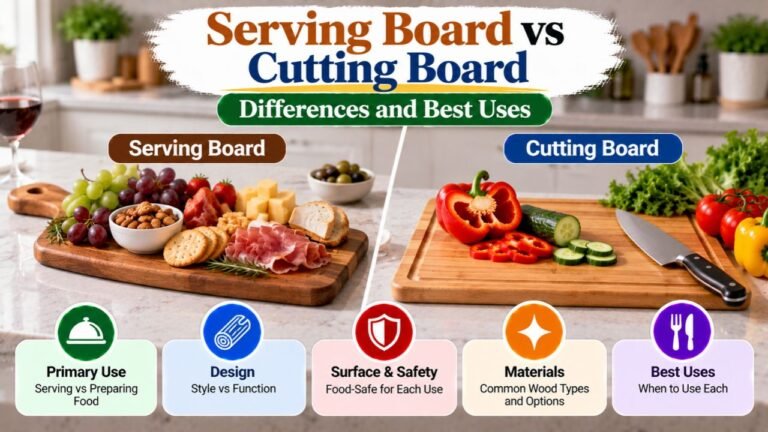
A cheese board focuses on food presentation and serving, while a cutting board focuses on food preparation and repeated knife contact.
Cheese boards often feature decorative shapes, serving compartments, handles, or attractive materials such as marble and slate. Cutting boards generally prioritize stability, usable cutting space, durability, and easy cleaning.
Here is a side-by-side comparison.
| Feature | Cheese Board | Cutting Board |
| Primary purpose | Serving cheese and appetizers | Cutting, slicing, and chopping |
| Common foods | Cheese, crackers, fruits, nuts, cured meats | Vegetables, fruits, meat, bread, cheese |
| Typical materials | Wood, bamboo, marble, slate, ceramic | Wood, bamboo, plastic, composite |
| Design priority | Appearance and presentation | Durability and cutting stability |
| Shape | Round, rectangular, paddle, irregular | Usually rectangular or square |
| Thickness | Often thinner, but varies | Often thicker for stability |
| Knife use | Light cutting if the surface permits | Designed for repeated knife use |
| Surface finish | May have decorative coatings | Intended to withstand knife contact |
| Special features | Handles, compartments, serving bowls | Juice grooves, non-slip feet, handles |
| Cleaning | Depends on material and finish | Depends on material and construction |
| Food safety | Must be clean and food-contact suitable | Must be clean and food-contact suitable |
| Best use | Entertaining and serving | Everyday meal preparation |
These differences describe common designs rather than strict product categories.
For example, a hardwood cheese board may be just as sturdy as a cutting board. Similarly, a wooden cutting board can look attractive enough for serving guests.
The product name alone does not determine its suitability for knife work.
What Is a Cheese Board and What Is a Cutting Board?
Understanding what each board is built to accomplish makes the comparison much simpler.
Although the names are sometimes used interchangeably, they describe different primary uses.
What Is a Cheese Board?
A cheese board is a serving surface used to arrange and present cheese, crackers, fruits, nuts, spreads, and other complementary foods.
The term can refer to the physical board or the arrangement of food displayed on it.
Cheese boards are popular for parties, holiday gatherings, wine tastings, and casual entertaining.
Common features include smooth serving surfaces, decorative edges, small compartments, handles, and matching cheese knives.
Some models include ceramic bowls for olives, honey, jam, or nuts.
A cheese board may hold several cheese varieties, such as:
- Brie or Camembert for a soft texture
- Cheddar or Gouda for a firmer texture
- Parmesan or aged Manchego for a hard texture
- Blue cheese for a stronger flavor
The main objective is to keep the food accessible and presentable.
A cheese board does not need to tolerate heavy chopping, although many models can handle occasional cheese slicing.
What Is a Cutting Board?
A cutting board is a durable surface used to cut, slice, chop, dice, and prepare ingredients while protecting the countertop underneath.
Cutting boards are designed for repeated contact with kitchen knives.
They are commonly made from hardwood, bamboo, plastic, rubber, or composite materials.
A typical cutting board has a flat working surface, stable construction, and enough space to move ingredients safely.
Some models include juice grooves for collecting liquid from tomatoes, fruits, or cooked meat.
Others feature non-slip feet to limit movement while cutting.
Unlike decorative serving boards, cutting boards must tolerate repeated washing, food residue, and knife marks.
How Does a Charcuterie Board Fit Into the Comparison?
A charcuterie board is primarily a serving arrangement traditionally centered on prepared or preserved meats.
Modern charcuterie boards commonly include cheese, fruit, crackers, nuts, olives, and spreads.
The physical board may be identical to a cheese board or serving platter.
The difference is mainly in the food presentation rather than the construction.
A rectangular walnut board could be used for cheese, charcuterie, or general appetizer service.
That same board might also work as a cutting board if its manufacturer specifies that the surface is suitable for knife use.
Key Takeaway: Cheese boards and charcuterie boards focus on serving food, while cutting boards focus on preparing it. One properly constructed surface may handle all three uses.
Can You Use a Cutting Board as a Cheese Board?
Yes. A clean cutting board can also serve as a cheese board, provided its materials and surface finish are suitable for food contact.
In fact, using a versatile hardwood cutting board for both preparation and presentation is often a sensible approach for kitchens with limited storage.
Using a Wooden Cutting Board for Serving Cheese
A smooth hardwood cutting board can provide an attractive foundation for cheese and appetizers.
Maple, walnut, cherry, and acacia are common choices.
Their natural grain patterns work well with cheese wedges, grapes, crackers, sliced bread, and small serving bowls.
Before arranging food, wash the board thoroughly and allow it to dry.
Use a board that has not been contaminated by raw meat or other ingredients during preparation.
A board reserved for vegetables, bread, and ready-to-eat foods is a convenient option.
You can arrange cheese directly on a clean wood surface if the board is suitable for food contact.
For sticky spreads or oily foods, small food-safe bowls reduce mess and simplify cleanup.
Can You Cut Cheese Directly on a Cutting Board?
Yes. Cutting boards are suitable for slicing hard, semi-hard, and soft cheeses.
A stable wooden or plastic cutting board works well for preparing cheddar, Swiss, Gouda, mozzarella, and other varieties.
Different cheeses may require different knives.
For example, a standard chef’s knife works for many firm cheeses, while a wire cheese slicer or thin-bladed cheese knife may produce cleaner cuts through softer varieties.
Avoid excessive force when cutting very hard cheeses.
For Parmesan and similar aged cheeses, a suitable cheese knife or chisel-style tool may offer better control than trying to force a thin kitchen knife through a dense block.
When Should You Avoid Using a Cutting Board for Serving?
A cutting board should not be used for serving when it has deep grooves, cracks, persistent food residue, or an unpleasant odor that remains after cleaning.
A board that has been used for raw poultry is not suitable for serving cheese until it has been thoroughly cleaned and sanitized as appropriate.
Also examine boards with loose wood strips or damaged glue joints.
These defects can collect food residue and make cleaning difficult.
For entertaining, I would choose a smooth hardwood board dedicated mainly to ready-to-eat foods rather than transferring a heavily scarred raw-meat board directly to the dining table.
Key Takeaway: A clean, food-contact-suitable cutting board can double as a cheese board. Surface condition and proper washing matter more than its original product label.
Can You Use a Cheese Board as a Cutting Board?
Some cheese boards can be used for cutting, but not every serving board is designed to withstand repeated knife contact.
The material, surface finish, thickness, and manufacturer’s instructions determine how the board should be used.
When a Cheese Board Is Suitable for Cutting
A wooden cheese board can often handle slicing when it has a durable hardwood surface and a finish intended for knife contact.
For example, a smooth maple serving board treated with food-grade mineral oil may be suitable for cutting cheese, fruit, and bread.
Light slicing is generally less demanding than repeated chopping.
Before cutting, check that the board sits securely on the countertop and does not rock.
If the manufacturer describes it as suitable for cutting and serving, it may perform both tasks.
When a Cheese Board Should Be Used Only for Serving
Some serving boards have decorative coatings, resin designs, painted surfaces, or delicate materials.
These products may be suitable for presenting food but not for direct knife contact.
Repeated cutting can scratch the finish, damage decorative sections, or expose material beneath a protective coating.
Food-safe for serving does not automatically mean knife-safe.
This distinction is especially relevant for resin-coated boards, painted serving platters, and decorative wood products.
Follow the manufacturer’s intended-use instructions rather than judging the surface solely by appearance.
Why Thin Decorative Boards May Be Poor for Chopping
A thin cheese board can be convenient to carry and display, but it may lack the stability needed for frequent chopping.
Some lightweight boards slide across smooth countertops.
Others have raised edges, uneven surfaces, or handles that interfere with knife movement.
A small paddle-shaped board might be comfortable for slicing a few pieces of Brie but inconvenient for dicing several onions.
For regular food preparation, a flat board with adequate thickness and usable cutting space is the better choice.
Key Takeaway: Use a cheese board for cutting only when its surface, finish, and construction support knife work. Decorative coatings and unstable designs are reasons to reserve a board for serving.
Cheese Board vs Cutting Board Materials: Which Are Best?
Material selection influences durability, knife wear, cleaning, maintenance, and appearance.
Some materials work well for both cutting and serving, while others are better suited to one purpose.
Hardwood Boards: Maple, Walnut, Cherry, and Acacia
Hardwood is a versatile option for both cheese boards and cutting boards.
Common cutting board woods include maple, walnut, cherry, and acacia.
Maple provides a light-colored surface with relatively fine grain. Walnut offers a darker appearance, while cherry develops a warm reddish-brown tone.
Acacia is popular for its contrasting grain patterns and decorative appearance.
The actual hardness of acacia varies by species.
A well-made hardwood cutting board may have an edge-grain or end-grain construction, while many serving boards use face-grain surfaces or single wood slabs.
All can be suitable for their intended tasks when correctly manufactured.
My preference for a board that must handle both slicing and serving is a smooth hardwood model with an appropriate food-contact finish.
Bamboo Boards for Cutting and Serving
Bamboo boards are common in both categories.
They are often lightweight, attractive, and available in rectangular or paddle-shaped designs.
Bamboo is technically a grass rather than wood, although it is manufactured into cutting boards with a wood-like appearance.
Many bamboo boards are relatively hard and resist ordinary surface wear.
This firmness can create a different cutting feel from softer hardwoods.
Bamboo boards may also contain adhesives joining individual strips, so construction quality matters.
For routine cleaning, follow the manufacturer’s instructions. Most bamboo boards are best hand-washed and dried promptly.
Marble and Slate Cheese Boards
Marble and slate are popular for cheese presentation because they have smooth, distinctive appearances.
Marble may feel cool to the touch and can be attractive for serving cheese during a gathering.
That does not mean it keeps perishable cheese at a safe temperature indefinitely.
Both marble and slate are hard surfaces that are generally unsuitable for routine chopping with kitchen knives.
Cutting directly on stone can accelerate knife-edge wear.
Slate may also chip along its edges, while marble can develop stains or surface damage from some acidic ingredients and cleaning products.
I recommend reserving these materials mainly for serving rather than regular food preparation.
Plastic, Composite, and Glass Boards
Food-grade plastic is common for cutting boards because many plastic models are inexpensive, lightweight, and dishwasher-safe.
It is practical for slicing cheese during preparation, although it may not offer the visual appearance preferred for formal serving.
Composite boards can also work for cutting and presentation, depending on their materials and construction.
Some are dishwasher-safe, while others require hand washing.
Glass and ceramic boards may be decorative and relatively easy to wipe clean, but they are not ideal cutting surfaces.
Their hard surfaces can dull knives quickly, and contact between a knife and a slippery glass surface may reduce control.
For a dual-purpose board, wood or a suitable composite generally offers a better balance than glass or stone.
Key Takeaway: Hardwood is a versatile material for cutting and serving. Marble and slate are better reserved for presentation, while plastic is convenient for everyday food preparation.
Size, Thickness, Shape, and Design Differences
Board dimensions and design affect how comfortably each product performs its intended job.
A serving board needs enough room for food arrangements, while a cutting board needs a clear working area and stable construction.
Cheese Board Sizes for Different Gatherings
Cheese boards come in various shapes and dimensions.
A compact board may hold two cheese varieties and a few accompaniments.
A larger board can provide room for multiple cheeses, fruit, crackers, small bowls, and serving utensils.
The following sizes are practical starting points rather than fixed serving standards.
| Board Size | Suggested Use |
| 8–12 inches | Small cheese arrangement for one or two people |
| 12–16 inches | Casual snacks or a small gathering |
| 16–20 inches | Several cheeses and accompaniments |
| 20–24 inches or larger | Larger appetizer presentations |
Guest count alone does not determine board size.
The amount of cheese, number of serving bowls, and space occupied by crackers or fruit also matter.
For example, a board holding three cheese wedges and a few grapes requires less room than one displaying five cheeses, meats, crackers, and dips.
Cutting Board Dimensions and Thickness
A cutting board needs enough working space for ingredients and safe knife movement.
A board around 12 × 18 inches is a practical everyday size for many home kitchens.
Smaller boards can work for fruit, cheese, or quick vegetable preparation.
Larger boards provide more space when preparing several ingredients at once.
Thickness contributes to stability, but there is no universal minimum thickness that makes every board suitable for chopping.
A stable composite board may be thinner than a large hardwood butcher block.
A heavy wooden board may provide a firm surface but can be inconvenient to lift and wash.
Choose dimensions that fit the countertop, sink, and storage area.
Handles, Juice Grooves, and Serving Compartments
Cheese boards may include handles, drawers for utensils, built-in bowls, or divided serving areas.
These features are useful for arranging and transporting appetizers.
Cutting boards may include juice grooves, non-slip feet, or handles.
Juice grooves are useful when carving cooked meats or cutting juicy produce, but they can reduce the flat area available for arranging crackers and cheese.
Non-slip feet improve cutting stability, although they may prevent both sides of the board from being used.
A reversible flat board offers more flexibility when the product is designed for that use.
For a dual-purpose board, I would prioritize a smooth, open surface over complicated compartments.
Key Takeaway: Cheese boards prioritize presentation space and carrying convenience, while cutting boards prioritize stable working space. A medium-sized rectangular hardwood board often provides a practical compromise.
Food Safety Differences Between Cheese Boards and Cutting Boards
Both boards contact food, so cleaning and proper handling matter regardless of their intended purpose.
The biggest concern is the transfer of microorganisms or allergenic ingredients from one food-contact surface to another.
Cross-Contamination During Food Preparation
The FDA recommends using separate cutting boards for raw meat, poultry, and seafood and for fresh produce.
This principle also applies to a board used for cheese and other ready-to-eat appetizers.
Raw chicken juices should never contact a cheese board containing crackers, fruit, or prepared cheese.
Wash cutting boards thoroughly between food preparation tasks.
For extra convenience, keep one board dedicated to raw animal products and another for foods that will be served without further cooking.
A hardwood cutting board reserved for vegetables and bread can then serve as a cheese board after proper cleaning.
Safe Serving Time for Cheese and Appetizers
Serving boards do not keep food safe simply because they are made from marble, wood, or another material.
Soft cheeses and other refrigerated foods need proper temperature control.
The USDA’s general two-hour rule applies to perishable foods left at room temperature.
When the surrounding temperature is above 90°F, the recommended maximum time is one hour.
Some hard cheeses are less perishable than soft cheeses, but mixed cheese boards often include foods that need refrigeration.
Cured meats, soft cheeses, prepared dips, and cut fruit may have different storage requirements.
For mixed appetizer boards, follow the handling requirements of the most perishable components.
A sensible serving approach is to place out modest amounts of refrigerated food and replenish them with fresh portions kept cold.
Do not assume a marble board provides refrigeration.
Food Allergies and Shared Serving Boards
Cheese boards commonly contain milk, wheat, tree nuts, and other ingredients associated with food allergies.
Allergen cross-contact may occur when a serving knife transfers residue from one food to another.
For example, a knife used to spread soft cheese may transfer milk proteins onto food intended for someone avoiding dairy.
Similarly, nuts scattered across a shared board can contaminate nearby foods.
Separate utensils and dedicated food-contact surfaces are sensible precautions when preparing food for someone with a diagnosed allergy.
Cleaning must remove allergen residue rather than simply making the board look clean.
Key Takeaway: The same food safety principles apply to both boards. Separate raw animal products from ready-to-eat foods, control the serving time of perishables, and prevent allergen cross-contact.
How to Clean and Maintain Cheese Boards and Cutting Boards
Cleaning requirements are determined mainly by the material and surface finish rather than the product’s name.
Wood, bamboo, stone, and plastic may need different care.
Cleaning Wooden Cheese Boards
Most wooden cheese boards should be washed by hand unless the manufacturer permits another cleaning method.
Use this basic process:
- Remove leftover cheese, crumbs, and other food particles.
- Wash the surface with warm water and mild dish soap.
- Gently scrub areas where soft cheese or spreads have collected.
- Rinse with clean water.
- Dry promptly with a clean towel or paper towels.
- Allow the board to finish air-drying before storage.
Avoid leaving wooden serving boards soaking in water.
Prolonged moisture exposure may cause swelling, warping, cracks, or damage to glued sections.
For boards with decorative resin or specialized finishes, follow the manufacturer’s care instructions.
Do not assume that every surface should be treated with mineral oil.
Cleaning Cutting Boards After Food Preparation
The USDA recommends washing cutting boards with hot, soapy water after each use.
For boards used with raw meat, poultry, or seafood, sanitizing after cleaning provides another precaution against contamination.
The USDA describes a household sanitizing solution made from 1 tablespoon of unscented liquid chlorine bleach per gallon of water.
Apply the solution after cleaning, allow it to remain on the surface for several minutes, then rinse thoroughly with clean water and dry.
Use suitable bleach and follow product label instructions. Never mix bleach with other cleaning chemicals.
Dishwasher-safe plastic cutting boards can often be washed in a dishwasher.
Wooden boards with glued layers generally require more careful handling because dishwasher conditions can damage the construction.
Oiling and Conditioning Wooden Boards
Wooden cutting boards and oil-finished cheese boards may benefit from periodic conditioning.
Food-grade mineral oil is commonly used to maintain wooden food-contact surfaces.
Apply it to a clean, completely dry board according to the manufacturer’s directions.
Allow the oil to absorb before wiping away excess residue.
Oiling helps reduce rapid moisture absorption, but it does not make wood waterproof.
A decorative cheese board with a sealed or lacquered finish may have different maintenance instructions.
Applying mineral oil over an intact film finish may accomplish little.
Check the product’s finishing method before conditioning.
When Should You Replace a Board?
Cutting boards gradually develop scratches and knife marks.
The USDA recommends replacing cutting boards that become excessively worn or develop hard-to-clean grooves.
Wooden cheese boards should also be inspected for cracks, splinters, loose joints, peeling coatings, or other surface damage.
A serving board with chipped decorative materials may no longer be suitable for direct food contact.
Minor cosmetic scratches are not automatically a reason for replacement.
The important distinction is between ordinary wear and damage that prevents safe cleaning or exposes unsuitable materials.
Key Takeaway: Clean both boards after use, follow material-specific care instructions, and inspect their surfaces regularly. Wooden boards need careful drying, while worn cutting surfaces may require replacement.
Which Should You Buy: A Cheese Board or a Cutting Board?
The more practical purchase comes from how the board will be used most often.
A dedicated serving board makes sense for someone who frequently entertains guests, while a cutting board is more useful for everyday kitchen preparation.
Choose a Cheese Board for Frequent Entertaining
A cheese board is a good option when food presentation is the main priority.
Decorative handles, small serving bowls, and attractive stone or wooden surfaces can make arranging appetizers more convenient.
A dedicated cheese board also stays separate from boards used for raw-food preparation.
It is useful for parties, holiday gatherings, cheese tastings, and occasional appetizer service.
If the board will rarely come into contact with knives, durability under heavy chopping becomes less important than appearance, easy cleaning, and carrying comfort.
Choose a Cutting Board for Daily Cooking
A cutting board is the better choice for regular chopping, slicing, and ingredient preparation.
Look for a stable working surface, suitable size, durable construction, and clear cleaning instructions.
A good cutting board handles vegetables, fruit, bread, and cheese without requiring separate equipment for each food.
A hardwood model can also be used for serving after thorough cleaning.
For daily cooking, I would prioritize cutting performance and durability over decorative compartments.
Choose a Dual-Purpose Board for a Small Kitchen
If you want one board for cutting and serving, a smooth hardwood cutting board is often the strongest option.
Maple, walnut, and cherry are familiar choices, while suitable acacia boards can also perform well.
Choose a flat design without excessive decoration, a finish intended for cutting, and enough room for both preparation and food presentation.
A reversible board may provide flexibility, but both sides still require proper cleaning.
I recommend choosing a board that performs the more demanding task first. A sturdy cutting board can usually serve cheese, while a delicate serving board may not withstand regular chopping.
Key Takeaway: Choose a dedicated cheese board for presentation, a cutting board for frequent food preparation, or a knife-safe hardwood board when one product needs to handle both roles.
Common Mistakes When Using Cheese Boards and Cutting Boards
Several mistakes can shorten board life or create avoidable food safety concerns.
Using decorative serving surfaces for heavy chopping: Marble, slate, glass, and some resin-coated boards are not intended for repeated knife contact. Cutting on these surfaces can damage the board or knife.
Assuming food-safe means cutting-safe: A finish suitable for serving food may still be damaged by a knife. Always check the product’s intended use.
Using an unwashed meat board for appetizers: Cheese, crackers, and fruit are often eaten without further cooking. Do not place them on surfaces contaminated by raw meat juices.
Choosing a board that is too small: Overcrowded cheese arrangements make food harder to reach, while cramped cutting boards leave little space for controlled knife movement.
Leaving perishable cheese out too long: A decorative serving surface does not replace refrigeration. Follow appropriate food storage and serving-time guidance.
Putting wooden boards in the dishwasher without checking instructions: Excessive heat and moisture can damage some glued wooden boards.
Ignoring surface wear: Deep cuts, cracks, peeling coatings, and loose joints can interfere with cleaning and make a board unsuitable for further food preparation.
Avoiding these mistakes helps preserve both the board’s appearance and its intended function.
Conclusion
The cheese board vs cutting board comparison comes down to purpose, construction, and knife compatibility. Cheese boards are primarily intended for attractive food presentation, while cutting boards are built to withstand regular slicing and chopping.
A hardwood cutting board can often perform both jobs, provided it is clean, undamaged, and made with materials suitable for food contact and knife use. Decorative cheese boards made from stone, glass, or specialized coated surfaces are generally better reserved for serving.
My recommendation is to buy a well-made hardwood cutting board if you need one versatile kitchen surface. Choose a separate cheese board when presentation features, serving compartments, or decorative materials matter more than cutting performance.
Before buying either option, check its surface finish, intended use, cleaning instructions, and overall construction. Those details reveal more about its practical use than the product name alone.
FAQs About Cheese Boards and Cutting Boards
Is a Cheese Board the Same as a Cutting Board?
No. A cheese board is mainly intended for serving cheese and accompanying foods, while a cutting board is designed for slicing, chopping, and preparing ingredients.
Some products can handle both tasks. For example, a smooth hardwood cutting board may also serve as a cheese board. The material, finish, construction, and manufacturer’s instructions determine its suitability.
Can You Use a Regular Cutting Board for Charcuterie?
Yes. A clean cutting board can be used to serve charcuterie, cheese, crackers, fruits, and other appetizers.
Wooden cutting boards are a popular choice because their natural grain provides an attractive background for food.
Make sure the board has been thoroughly cleaned and has no deep grooves, cracks, or residue from previous food preparation.
Can You Cut Cheese on a Marble Cheese Board?
You can use suitable cheese-serving utensils on marble, but marble is not recommended for regular cutting with sharp kitchen knives.
Its hard surface can accelerate knife-edge wear, and forceful cutting may damage the board or reduce control.
For frequent cheese slicing, use a wooden or suitable composite cutting board. Marble is better suited to presenting prepared cheese.
What Is the Best Wood for a Cheese Board?
Maple, walnut, cherry, and acacia are common choices for wooden cheese boards.
Maple offers a light-colored surface, walnut has a darker appearance, cherry provides warm reddish tones, and acacia often features contrasting grain patterns.
Choose smooth, properly finished wood suitable for direct food contact. If the board will also be used for chopping, confirm that its construction and finish are intended for knife work.
Should a Cheese Board Have a Juice Groove?
A cheese board does not usually need a juice groove.
Cheese, crackers, nuts, and similar appetizers typically produce less liquid than foods such as cooked meat or juicy fruit.
A flat surface often provides more usable arrangement space.
A juice groove may be useful for a dual-purpose board used to carve cooked meats or slice juicy produce, but it is not necessary for serving cheese.
Can I Use Both Sides of a Cutting Board for Serving?
Yes, if the cutting board is designed for reversible use and both surfaces are clean and suitable for food contact.
Flipping a board does not automatically make it sanitary. Food juices and residue can reach the edges or reverse side during preparation.
Wash and sanitize the board as appropriate before switching from raw animal products to ready-to-eat foods.
Do Cheese Boards Need to Be Food-Safe?
Yes. Any surface that directly contacts cheese or other food should be made from materials and finishes suitable for food contact.
Some decorative boards are intended only for display, and a serving-safe finish may still be unsuitable for cutting.
Check manufacturer instructions and avoid using products labeled for decorative use only as direct food-serving surfaces.
Is It Better to Buy a Cheese Board or a Cutting Board First?
A cutting board is generally the better first purchase because it supports everyday food preparation and may also be used for serving.
Choose a sturdy, easy-to-clean model with a surface suitable for repeated knife contact.
A separate cheese board becomes more useful when you frequently entertain guests or prefer decorative serving features that are unnecessary for regular cooking.