Beech vs Acacia Cutting Board: Which Is Better?
Beech is a strong choice for a smooth, fine-grained cutting surface, while acacia offers distinctive wood patterns and good durability for everyday food preparation. Both hardwoods make suitable cutting boards, but neither is automatically better. Beech offers more predictable wood properties, while acacia varies in hardness, density, and grain depending on the species used.
Choosing the wrong board can mean spending extra money on appearance without improving your chopping experience. Poor construction or improper drying can also lead to warped surfaces, open glue joints, and premature replacement.
A well-chosen wooden cutting board provides a stable surface for slicing vegetables, preparing meat, and protecting kitchen countertops. Comparing the actual wood properties also helps you avoid unnecessary knife wear and maintenance problems.
According to The Wood Database, American beech has a Janka hardness of 1,300 pounds-force, while European beech measures 1,450 pounds-force. Acacia mangium measures approximately 1,430 pounds-force, showing that the difference between these hardwoods is not always as large as product descriptions suggest.
The beech vs acacia cutting board comparison becomes more interesting when moisture resistance and grain structure enter the picture. Beech has a relatively uniform texture but responds strongly to moisture changes. Acacia can offer good dimensional stability, although its properties vary among species.
One detail that stood out during my research is how frequently acacia cutting boards are advertised as harder than beech without identifying the actual acacia species. I recommend checking construction quality and wood identification before relying on a general hardness claim.
The following comparison covers hardness, knife friendliness, water absorption, food safety, durability, appearance, cost, and maintenance, followed by practical recommendations for different cooking habits.
Beech vs Acacia Cutting Board: Quick Comparison
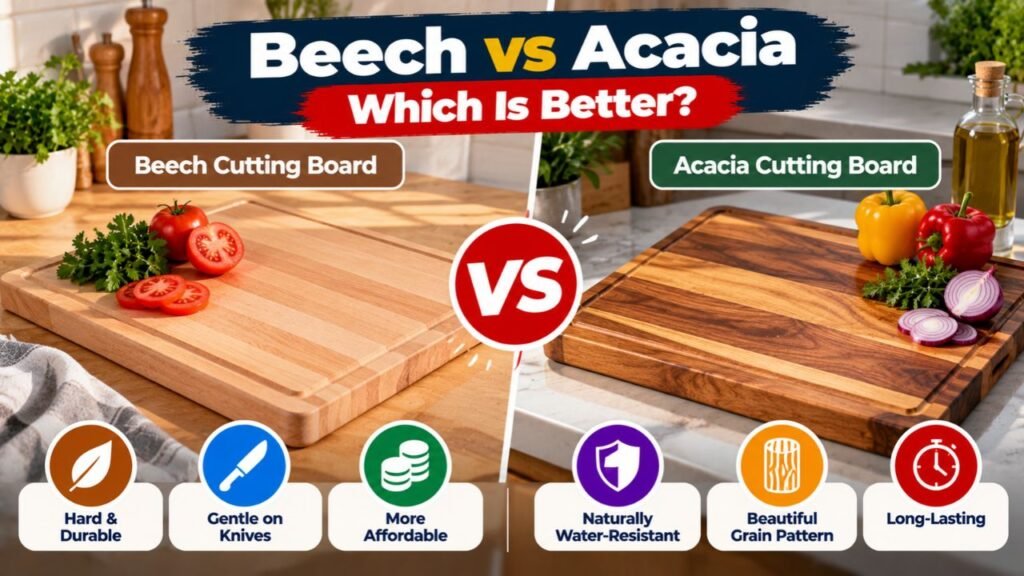
Both materials are natural hardwoods used in kitchen utensils, chopping blocks, and food preparation surfaces. Their differences become clearer when the main characteristics are compared side by side.
| Feature | Beech Cutting Board | Acacia Cutting Board |
| Wood type | Hardwood from the Fagus genus | Hardwood sold under several Acacia species |
| Typical color | Pale cream to light pinkish brown | Golden brown, reddish brown, and darker streaks |
| Grain appearance | Fine, straight, and generally uniform | Often more varied and visually pronounced |
| Janka hardness | Around 1,300–1,450 lbf for common beech species | Varies considerably by acacia species |
| Knife friendliness | Consistent, firm cutting surface | Depends on the exact hardness and grain |
| Scratch resistance | Good | Good, with variation among species |
| Water resistance | Needs careful drying; relatively high wood movement | Some species have lower shrinkage, but none are waterproof |
| Stain visibility | More noticeable on pale wood | Darker sections can conceal minor discoloration |
| Weight | Relatively dense | Varies by species and dimensions |
| Maintenance | Hand-washing and periodic oiling | Hand-washing and periodic oiling |
| Appearance | Simple, traditional, and understated | Decorative with contrasting natural colors |
| Price | Varies by manufacturer and construction | Varies by manufacturer and construction |
| Best suited for | Everyday chopping and a uniform work surface | Everyday prep, carving, and food presentation |
My recommendation: Choose beech if you prefer a consistent, pale cutting surface. Choose a well-made acacia board if its appearance appeals to you and the seller provides adequate information about the wood and construction.
Neither option should be selected purely because of a hardness number.
What Is a Beech Cutting Board?
A beech cutting board is made from hardwood belonging to the Fagus genus. Beech is commonly used for kitchen utensils, butcher blocks, furniture, and cutting surfaces because of its strength, uniform texture, and ability to accept a smooth finish.
American Beech and European Beech
Two species are especially relevant to cutting boards.
American beech (Fagus grandifolia) grows naturally in eastern North America. It has a pale appearance, relatively fine texture, and a Janka hardness of approximately 1,300 lbf.
European beech (Fagus sylvatica) comes from Europe and is widely used in traditional wooden kitchenware. Its Janka hardness is approximately 1,450 lbf.
Both species provide firm surfaces suitable for chopping vegetables, slicing bread, and preparing other ingredients.
European beech is somewhat harder according to these standard measurements. The difference does not guarantee that one finished board will produce less knife wear.
Beech Wood Grain and Cutting Surface
Beech has a fine, fairly uniform grain with relatively small, evenly distributed pores.
This creates a smooth cutting surface without the strongly contrasting grain lines found in many acacia boards.
Its natural color is generally pale cream, sometimes showing subtle pink or brown tones. Certain cuts reveal small decorative flecks caused by the wood’s rays.
The light surface makes small food particles and discoloration easier to notice during cleanup.
Beech is also a relatively dense hardwood. It resists ordinary chopping pressure but still develops knife marks through repeated use.
Key Takeaway: Beech provides a firm, fine-grained surface with fairly predictable hardness and a light appearance. Its main limitation is sensitivity to changes in moisture.
What Is an Acacia Cutting Board?
An acacia cutting board is made from wood sold under the acacia name, which covers several hardwood species with different physical characteristics.
Acacia boards are popular for their natural color contrast, distinctive grain, and use as both preparation surfaces and serving boards.
Different Acacia Species Have Different Properties
Not all acacia cutting boards use identical wood.
Examples of species belonging to the Acacia genus include:
- Acacia mangium: A hardwood with a Janka hardness of approximately 1,430 lbf.
- Acacia melanoxylon: Commonly called Australian blackwood, with a hardness of approximately 1,160 lbf.
- Acacia koa: Hawaiian koa, with a hardness of approximately 1,170 lbf.
These figures demonstrate why a single hardness rating cannot accurately describe every acacia cutting board.
They are examples of the variation within the genus, not a claim that all three are routinely used in mass-market cutting boards.
Some commercial products also use acacia as a broad trade name without identifying the botanical species.
A product labeled simply “acacia wood” may therefore provide less information about hardness than one labeled with a specific species.
Acacia Wood Grain and Appearance
Acacia often displays noticeable differences between lighter and darker sections of wood.
Depending on the species, the grain may appear straight, wavy, or interlocked. The colors can include warm golden brown, reddish brown, and deep chocolate tones.
This appearance makes acacia popular for charcuterie boards, cheese boards, and decorative kitchen displays.
A darker surface may conceal some minor stains better than pale beech. That does not mean the wood absorbs fewer stains or requires less cleaning.
The grain can also vary considerably between individual boards, even within the same product line.
Key Takeaway: Acacia offers strong visual appeal and useful cutting-board properties, but the species matters. Avoid assuming every acacia board has the same hardness, density, or moisture resistance.
Beech vs Acacia Cutting Board: Hardness and Durability
Hardness affects how a cutting board responds to dents, impacts, and repeated knife contact. It is an important comparison, but hardness alone does not determine cutting-board quality.
Comparing Janka Hardness Ratings
The Janka hardness test measures the force required to press a steel ball into wood to a specified depth.
A higher number indicates greater resistance to this type of indentation.
| Wood Species | Janka Hardness |
| American beech | 1,300 lbf |
| European beech | 1,450 lbf |
| Acacia mangium | 1,430 lbf |
| Australian blackwood (Acacia melanoxylon) | 1,160 lbf |
| Hawaiian koa (Acacia koa) | 1,170 lbf |
These standard wood-property values show considerable overlap.
European beech is slightly harder than Acacia mangium according to the listed measurements. It is also harder than Australian blackwood and Hawaiian koa.
Other acacia species may have greater hardness.
For that reason, statements claiming acacia is always harder than beech are inaccurate.
Which Wood Resists Scratches Better?
Both hardwoods resist ordinary kitchen wear reasonably well.
Beech develops fine knife marks as blades repeatedly contact its surface. Its pale color may make darker scratches or food discoloration more visible.
Acacia can also develop grooves. Harder species may resist indentation better, but the grain pattern can influence how noticeable the marks become.
Cutting technique matters as well.
Forceful chopping in one small area creates more concentrated surface wear than distributing cuts across the board.
A sharp knife used with controlled pressure is preferable to repeatedly striking the wood with unnecessary force.
Which Cutting Board Lasts Longer?
Neither wood has a guaranteed lifespan.
A properly constructed beech board can remain useful for many years. A well-made acacia board can do the same.
Actual durability depends on:
- Proper wood drying before manufacturing
- Sound glue joints
- Suitable board thickness
- Grain orientation
- Cleaning and drying habits
- Regular surface conditioning
Beech has relatively high shrinkage values compared with several acacia species, making moisture management an important consideration.
Acacia may offer an advantage in some species, but poorly dried or badly joined acacia can still warp and crack.
A quality beech board is preferable to a low-quality acacia board with loose joints or visible splits.
Key Takeaway: Hardness varies enough that neither wood wins universally. Acacia’s durability depends on the species, while beech offers consistent hardness but requires attention to moisture-related movement.
Which Cutting Board Is Better for Kitchen Knives?
Protecting knife edges is an important reason to choose wood instead of glass, stone, or metal cutting surfaces.
Both beech and acacia generally provide more suitable surfaces for everyday kitchen knives than those very hard alternatives.
Is Beech Wood Knife-Friendly?
Beech is a good cutting-board material for standard kitchen knives.
Its fine, uniform texture creates a consistent surface during slicing, chopping, and dicing.
Because the grain is relatively even, the blade is less likely to encounter abrupt changes in wood structure across a well-finished board.
Beech is still a firm hardwood, not a soft rubber cutting surface.
Repeated chopping will gradually affect knife sharpness, as it does on other cutting boards.
Does Acacia Dull Knives Faster?
Acacia does not automatically dull knives faster than beech.
A very hard acacia species may be less forgiving than a softer hardwood, but the exact relationship depends on wood density, grain structure, knife steel, cutting technique, and board construction.
For example, Australian blackwood has a lower Janka rating than European beech.
That does not prove it preserves knife sharpness longer, because Janka hardness measures indentation resistance rather than knife-edge retention.
I would be cautious about any product claiming a specific improvement in knife sharpness without comparative testing.
Does End Grain or Edge Grain Change Knife Friendliness?
The direction of the wood fibers can affect cutting feel as much as the species.
End-grain cutting boards expose the ends of wood fibers. A knife edge can move slightly between those fibers, often producing a more forgiving chopping surface.
Edge-grain boards expose the lengthwise sides of the fibers. They are common, practical, and generally less complicated to manufacture.
Both beech and acacia can be used in different grain constructions.
When comparing knife friendliness, a beech end-grain board and an acacia edge-grain board are not equivalent designs.
Key Takeaway: Both hardwoods are suitable for kitchen knives. Beech offers a consistent surface, while acacia knife friendliness varies by species. Grain construction deserves attention alongside hardness.
Water Resistance, Warping, and Stain Protection
Moisture is a major concern for wooden cutting boards because repeated washing causes wood fibers to absorb water and release it during drying.
Is Acacia More Water-Resistant Than Beech?
Some acacia species show lower shrinkage values than beech, suggesting an advantage in dimensional stability under changing moisture conditions.
European beech has a published volumetric shrinkage of approximately 17.9% from green to oven-dry conditions. Acacia mangium is listed at approximately 10.7%.
Those figures describe a standardized drying range, not the amount a kitchen cutting board will shrink during normal washing.
They demonstrate that the woods can behave differently as moisture changes.
Beech is well known for noticeable movement when humidity changes. Acacia properties vary, and the exact species must be considered before making comparisons.
Neither wood is waterproof.
Leaving either board submerged or sitting in a wet sink can cause swelling, warping, cracking, or glue-joint problems.
Which Wood Is More Likely to Warp?
Beech can be relatively sensitive to uneven moisture exposure.
If the top absorbs water while the underside remains dry, the board may temporarily cup or eventually develop a permanent distortion.
Acacia boards can also warp from uneven drying.
A thick, properly assembled acacia board may resist movement better than a thin beech board, but this is not a universal species advantage.
Construction, wood drying, and storage conditions are important.
For either material, wash both sides as needed and allow air to circulate around the board during drying.
Which Cutting Board Resists Food Stains Better?
Acacia’s darker sections often make small stains less noticeable.
Beech’s pale surface can show discoloration from foods such as beetroot, berries, and turmeric more clearly.
The actual amount of staining depends on the finish, exposure time, wood condition, and substance involved.
A dark board is not necessarily cleaner simply because stains are harder to see.
Wipe colored food residue promptly, wash with mild dish soap, and dry the surface.
Avoid aggressive scrubbing that removes large amounts of wood unnecessarily.
Key Takeaway: Some acacia species have an advantage in moisture-related stability, while beech requires careful drying. Both can warp or stain, and neither should be soaked in water.
Beech vs Acacia Cutting Board: Food Safety and Hygiene
Both beech and acacia can be used safely for food preparation when properly manufactured, cleaned, and maintained.
Wood species alone does not determine food safety.
Are Beech and Acacia Safe for Raw Meat?
The USDA Food Safety and Inspection Service allows wooden cutting boards to be used for preparing raw meat and poultry.
It recommends using separate cutting boards for raw meat, poultry, and seafood and for fresh produce or bread to reduce cross-contamination.
This recommendation applies to both beech and acacia.
After raw-meat preparation, the board should be washed thoroughly and sanitized when appropriate.
A board with deep, hard-to-clean grooves or separated wood joints should be replaced.
Does Either Wood Have Natural Antibacterial Properties?
Wood can interact with moisture and microorganisms differently from nonporous materials, but these effects should not be treated as a replacement for cleaning.
Claims that acacia naturally eliminates harmful bacteria or that beech prevents contamination without washing go beyond what a buyer should assume.
Surface condition, sanitation, and drying are far more practical factors.
Even a board advertised as antibacterial can become contaminated during food preparation.
What Cleaning Method Is Safest?
The USDA recommends cleaning cutting boards with hot, soapy water, rinsing with clear water, and drying thoroughly.
For sanitizing, its published guidance includes a solution of 1 tablespoon of unscented liquid chlorine bleach per gallon of water.
After washing, apply the solution, allow it to remain on the board for several minutes, rinse with clear water, and dry.
Follow the directions of any commercial food-contact sanitizer. Never mix bleach with other cleaning chemicals.
For typical glued wooden cutting boards, hand-washing is preferable to dishwasher cleaning because prolonged heat and moisture can damage joints.
Key Takeaway: Neither hardwood is automatically safer against bacteria. Proper cleaning, sanitizing when needed, separate preparation surfaces, and timely replacement are the main food-safety priorities.
Appearance, Weight, and Price Differences
The visual appearance of a cutting board matters when it remains on the countertop or serves food directly.
Yet color alone does not reveal its quality.
Beech vs Acacia Appearance
Beech provides a light, understated surface with relatively uniform grain.
It works well in kitchens with pale cabinets, natural wood finishes, and simple designs.
Acacia typically offers more dramatic contrasts between light and dark wood.
Its decorative appearance can make a serving board attractive without additional staining or coloring.
For serving cheese, sliced bread, and appetizers, I generally prefer the natural color variation of acacia.
For a dedicated preparation board, the uniform appearance of beech is appealing.
Which Wood Is Heavier?
Acacia is often described as heavier, but that is not consistently true.
The Wood Database lists American beech at approximately 720 kg/m³ in average dried density, compared with approximately 585 kg/m³ for Acacia mangium.
That means an equal-sized piece of American beech can weigh more than one made from Acacia mangium.
Actual cutting-board weight also depends on thickness, length, width, and construction.
A thick acacia chopping block will naturally weigh more than a thin beech board, even if its wood is less dense.
Compare product weights rather than assuming one species is always lighter.
Which Cutting Board Costs More?
There is no consistent price winner across U.S. retailers.
Acacia is widely used in mass-produced cutting boards, including affordable kitchen products.
Beech can also be economical, although imported European beech boards, specialized designs, and premium manufacturing may cost more.
An end-grain board generally requires more manufacturing work than a simple face-grain board.
Compare the actual size, thickness, grain construction, finish, and warranty before judging value.
A low purchase price is less attractive if the board arrives with rough surfaces, visible cracks, or weak glue joints.
Key Takeaway: Acacia usually offers more decorative grain, while beech provides a simpler appearance. Weight and price depend on the finished product rather than the wood name alone.
Which Cutting Board Is Better for Different Kitchen Tasks?
Both materials handle normal household food preparation, but certain features can make one design more convenient for specific cooking routines.
Everyday Vegetable Chopping
For slicing onions, chopping carrots, preparing herbs, and dicing vegetables, both woods are appropriate.
Beech’s uniform texture provides a consistent cutting surface, which is attractive for regular knife work.
Acacia also performs well when the board has suitable hardness and a smooth, flat surface.
I would prioritize a board large enough for the food and stable enough to remain in place during chopping.
For many home kitchens, an 18-by-12-inch board provides a practical amount of preparation space.
Meat Preparation and Carving
Both materials can handle cooked meat and raw-meat preparation with proper sanitation.
When carving roast beef, turkey, or other juicy foods, a juice groove may be more useful than the choice between beech and acacia.
A groove catches some liquid before it reaches the countertop.
A thick, stable board is also helpful when carving larger cuts of meat.
Use a dedicated board for raw meat if possible.
Bread, Cheese, and Serving
Acacia has an appearance advantage for many serving applications because its contrasting grain can complement cheese, fruit, crackers, and sliced bread.
Beech remains a practical serving surface for readers who prefer a lighter, simpler appearance.
For bread and cheese boards, a manageable size and easy handling often matter more than maximum hardness.
Check that the surface finish is intended for direct food contact.
Frequent Chopping With Sharp Knives
For someone who prepares large amounts of ingredients every day, I would compare grain orientation and board construction before choosing purely by species.
A properly made end-grain board may provide a more forgiving cutting surface than a long-grain board.
Beech and suitable acacia species can both work.
The better purchase is the model with dependable construction, sensible dimensions, and a surface appropriate for the knives being used.
Key Takeaway: Beech is an appealing everyday preparation board, while acacia combines food preparation with decorative serving. For heavy chopping, construction and stability matter more than appearance.
How to Choose a Quality Beech or Acacia Cutting Board
Two boards made from the same wood can perform differently because of manufacturing quality.
A few checks before purchasing can reveal more than promotional claims about durability.
Check the Exact Wood and Construction
Look for a product description that identifies the wood species, especially when shopping for acacia.
A listing that names Acacia mangium provides more useful material information than one saying only “premium acacia hardwood.”
For beech, identifying American or European beech is helpful.
Also determine if the board uses end-grain, edge-grain, or face-grain construction.
None of these designs automatically guarantees quality.
The wood should be properly dried, assembled, and finished for kitchen use.
Inspect the Surface and Glue Joints
A good wooden cutting board should have a smooth, flat work surface without loose fibers or rough patches.
Look for:
- Closed, even glue joints
- No visible open cracks
- No loose wooden sections
- No splinters or unstable knots on the cutting surface
- A finish identified as suitable for food contact
- A flat base that does not rock on the counter
Wood naturally contains color changes and grain variation. These are not automatically defects.
Open seams and cracks are different because they can trap food residue and moisture.
Consider Thickness, Storage, and Stability
Thicker boards are often more stable during chopping, but they are heavier to lift and wash.
A board that remains permanently on the counter can be thicker than one stored inside a drawer after every meal.
If a board slides during cutting, a clean nonslip mat placed underneath can improve stability.
Rubber feet may also prevent movement, although they can limit reversibility.
For carving meat, a juice groove may be useful. For vegetable preparation, an uninterrupted flat surface offers more working space.
Key Takeaway: Check the species, grain construction, surface finish, joints, dimensions, and stability. A well-built board is a better investment than one selected solely for its wood label.
How to Clean and Maintain Beech and Acacia Cutting Boards
Both woods need regular cleaning and occasional conditioning to stay suitable for food preparation.
Their maintenance routines are similar, although beech’s moisture sensitivity makes prompt drying especially important.
Daily Cleaning Steps
Follow this routine after ordinary food preparation:
- Remove food scraps. Use a scraper or soft utensil to clear the cutting surface.
- Wash with mild dish soap. Use hot, soapy water and a soft sponge or brush.
- Clean the edges and underside. Pay attention to grooves, handles, and any areas touched by food.
- Rinse with clear water. Remove soap and residue without prolonged soaking.
- Dry with a clean towel. Wipe away surface moisture promptly.
- Allow complete air drying. Position the board so both faces receive airflow.
Avoid leaving either board in standing water.
Do not place a damp board directly against a hot oven, heater, or other concentrated heat source to speed drying.
How Often Should You Oil the Wood?
Use food-grade mineral oil or a board-conditioning product recommended by the manufacturer.
Both beech and acacia can become dry after repeated washing.
Signs that conditioning may be needed include a dry-looking surface, dull patches, or an unusually rough feel.
For reference, John Boos recommends conditioning its wooden cutting boards at least monthly, adjusted for use and household conditions.
That recommendation is not a universal schedule for every beech or acacia product.
To condition a board:
- Clean the wood and allow it to dry completely.
- Apply a thin, even coat of food-grade mineral oil.
- Spread the oil across the cutting surface, sides, and underside.
- Allow it to absorb according to the product directions.
- Wipe off any remaining oil before preparing food.
A food-safe board cream containing beeswax can provide further surface protection if the board maker recommends it.
Avoid ordinary cooking oils such as olive oil, which can develop unpleasant odors as they deteriorate.
Preventing Cracks, Warping, and Rough Surfaces
Store both boards in a dry location with reasonable airflow.
Do not leave a wet board pressed flat against the counter for an extended period.
If a board begins rocking, inspect it for warping.
Minor scratches can sometimes be smoothed through careful sanding and refinishing, following the maker’s instructions.
Deep cracks, separated glue joints, and extensive knife grooves are more serious.
Do not attempt to conceal these defects with mineral oil.
If a surface can no longer be cleaned thoroughly, replace the board rather than continuing to prepare food on it.
Key Takeaway: Beech and acacia share similar care requirements. Hand-wash, dry thoroughly, condition when needed, and inspect damaged areas before continuing food preparation.
Common Mistakes When Comparing Beech and Acacia Cutting Boards
Several common assumptions can lead to an unsuitable purchase.
The first is believing that all acacia wood has the same hardness. Acacia species vary considerably, making a single advertised rating unreliable without identification.
Another mistake is assuming darker wood is naturally more hygienic. Acacia may conceal some stains, but hidden discoloration does not prove that a surface is clean.
Buyers sometimes assume beech is lightweight because of its pale appearance. Beech can be denser than certain acacia species, so dimensions and actual product weight must be checked.
A further mistake is overlooking grain construction. Comparing a thick end-grain acacia block with a thin face-grain beech board introduces differences that have little to do with species alone.
Finally, water resistance should never be mistaken for waterproof construction. Neither wood should be left soaking, and neither can be expected to resist cracking after repeated improper washing.
I recommend comparing two boards with similar dimensions, grain orientation, and construction quality before drawing conclusions about the wood itself.
Conclusion
The beech vs acacia cutting board comparison does not produce a universal winner. Beech offers a fine, uniform grain and reliable hardness for everyday kitchen preparation. Acacia offers attractive natural color variation and can provide excellent durability, although its properties depend on the species.
For regular vegetable chopping, slicing, and general food preparation, either wood can be a sound choice. Acacia may appeal more to cooks who also use their boards for serving, while beech is attractive for someone who prefers a consistent, understated cutting surface.
I would choose a well-constructed beech board over poorly made acacia, and a properly identified, well-finished acacia board over beech with visible manufacturing defects.
The best purchase is a stable, food-safe board with sound construction, enough work space, and maintenance requirements that fit your kitchen routine.
FAQs About Beech and Acacia Cutting Boards
Is beech or acacia wood better for cutting boards?
Both are suitable for cutting boards. Beech offers fairly consistent hardness, fine grain, and a smooth working surface. Acacia provides attractive grain patterns and useful durability, but hardness and moisture behavior vary among species. Choose based on actual construction quality, surface condition, dimensions, and cooking habits rather than assuming one wood is universally superior.
Is acacia wood harder than beech?
Not always. American beech has a Janka hardness of approximately 1,300 lbf, while European beech measures around 1,450 lbf. Acacia mangium measures approximately 1,430 lbf, and Australian blackwood measures around 1,160 lbf. Other acacia species can be harder. A manufacturer must identify the species before a meaningful hardness comparison can be made.
Is beech wood safe for food preparation?
Yes. Properly manufactured beech cutting boards with food-contact-safe finishes are suitable for preparing vegetables, fruit, bread, and meat. Clean the board after use, sanitize when appropriate, and keep raw meat separate from foods that will not be cooked. Replace boards with deep grooves, cracks, or damaged joints that prevent thorough cleaning.
Does acacia wood dull kitchen knives?
Acacia does not automatically damage kitchen knives. Knife wear depends on the exact acacia species, wood hardness, grain construction, knife steel, and cutting technique. Some acacia species are softer than European beech. A good acacia cutting board can be suitable for ordinary slicing and chopping, although very hard varieties may feel less forgiving than softer wooden surfaces.
Why does a beech cutting board warp?
Beech can warp when it absorbs or releases moisture unevenly. If one face becomes wetter than the other, the wood may expand at different rates and cause cupping or twisting. Thin boards can be more vulnerable to this movement. Hand-washing, prompt drying, adequate airflow, and avoiding prolonged soaking reduce the risk.
Are acacia cutting boards waterproof?
No. Acacia is natural wood and can absorb moisture. Some species have lower shrinkage values than beech, but this does not make an acacia board waterproof. Long soaking, standing water, and dishwasher exposure can still cause swelling, cracks, or glue-joint failure. Hand-wash and dry the board thoroughly after food preparation.
Which is better for a cheese board, beech or acacia?
Acacia is often preferred for cheese and charcuterie presentation because its contrasting colors and prominent grain create a decorative surface. Beech offers a lighter, simpler appearance that also works well for serving. Both are suitable when properly finished for food contact. For serving, shape, handling comfort, surface finish, and visual preference are usually more important than maximum wood hardness.
Can I use olive oil on beech or acacia cutting boards?
Food-grade mineral oil is generally a better choice than olive oil for conditioning wooden cutting boards. Olive oil can oxidize and develop unpleasant odors over time. Use a conditioning product intended for direct food-contact surfaces, follow its instructions, and remove excess oil before using the board. Both beech and acacia may need additional conditioning after frequent washing.
Which cutting board lasts longer, beech or acacia?
Neither wood has a guaranteed lifespan advantage. A well-made board from either material can provide years of household use. Proper wood drying, strong glue joints, adequate thickness, regular cleaning, and careful storage all affect durability. Some acacia species offer lower moisture-related shrinkage than beech, but a poorly manufactured acacia board can fail sooner than a properly maintained beech board.