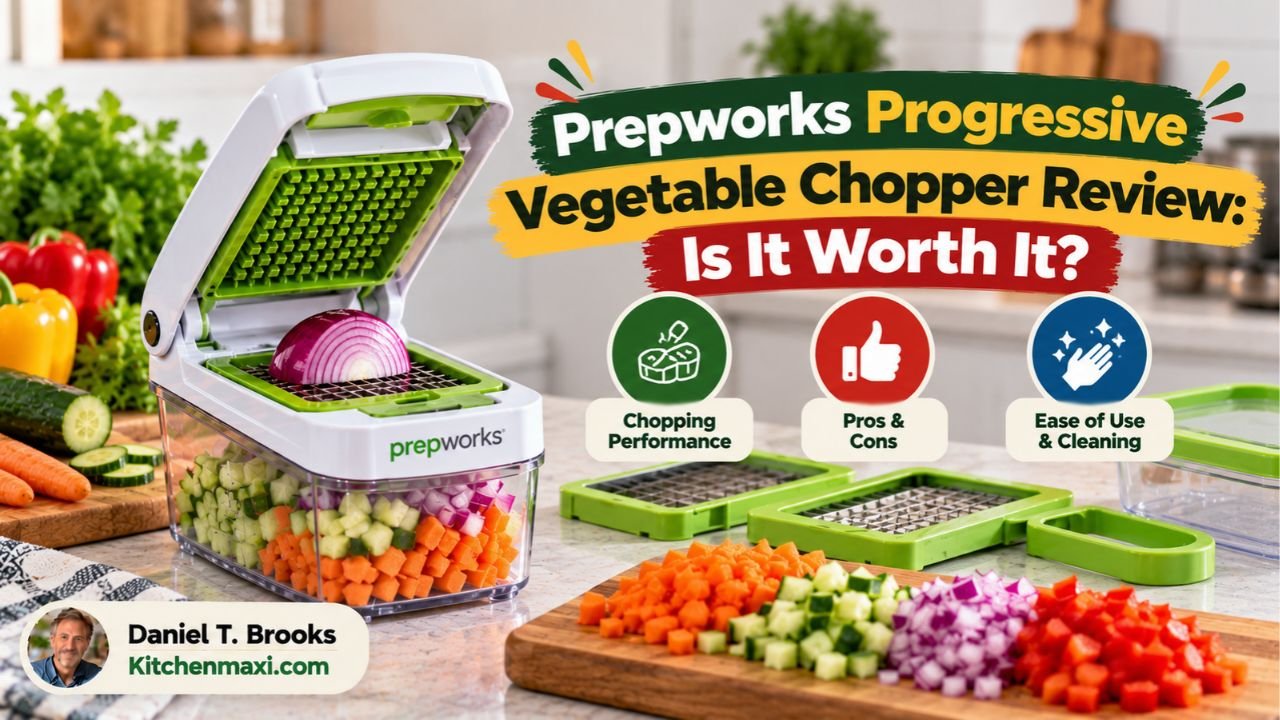
Prepworks Progressive Vegetable Chopper Review: Is It Worth It?
The Prepworks by Progressive Fruit and Vegetable Chopper is a strong manual option for cooks who want uniform diced or sliced produce without using an electric appliance. Its three interchangeable blades, 3-cup measuring container, non-skid base, cleaning tool, and built-in storage are useful, though hard vegetables demand more hand pressure than onions, peppers, mushrooms, or softer produce.
The main attraction is consistency. Instead of trying to create dozens of equally sized onion, potato, pepper, or cucumber pieces with a knife, you place prepared produce over the blade grid and push the lid down. The cut food drops directly into the container underneath.
Its limitation is also tied to that push-down design. Thick carrots, potatoes, sweet potatoes, and other dense foods put much more resistance against the blade grid. Pre-cutting hard produce into thinner pieces makes the chopper easier to operate and places less strain on its plastic frame.
The current three-blade version has a 3-cup (800 ml) measuring container, non-skid base, pusher lid, cleaning tool, storage box, and dishwasher-safe construction. Retail listings also describe a built-in side blade that cuts longer produce while the main grid is working.
This Prepworks progressive vegetable chopper review focuses on the three-blade Fruit and Vegetable Chopper associated with the GPC-4000 model family, rather than the smaller Prepworks Compact Veggie Chopper or the newer spiralizer combination model.
The product makes the most sense for salads, soups, salsa, casseroles, meal prep, and recipes where even vegetable pieces matter. The included measuring container also reduces the need to move chopped ingredients into a separate measuring cup.
The biggest things to consider are the amount of force needed for firm vegetables, blade safety, the extra parts that need cleaning, and the amount of pre-cutting required. Those details matter more than the fact that the chopper has no motor.
Prepworks Progressive Vegetable Chopper Quick Verdict
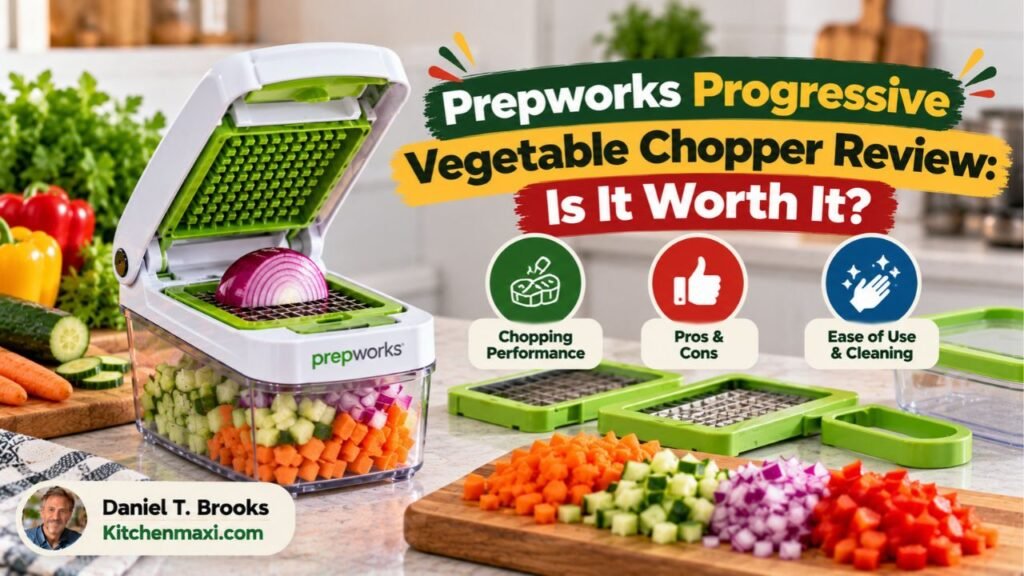
The Prepworks by Progressive Fruit and Vegetable Chopper is best viewed as a manual dicer and slicer, not as a replacement for a food processor.
Its strongest points are uniform cuts, three blade choices, a large cutting area, a stable base, and a container that catches the food as it falls through the grid.
Its weaker points appear with hard produce. A thick chunk of raw carrot or potato can require substantial force. Pushing oversized pieces through the grid can also put unnecessary stress on the lid and plastic frame.
| Category | Assessment |
| Onion and pepper dicing | Very good |
| Tomatoes and soft produce | Good with proper positioning |
| Potatoes and carrots | Good after pre-cutting |
| Uniformity | Very good |
| Batch capacity | Good for home meal prep |
| Cleanup | Fair to good |
| Storage | Very good |
| Hand strength required | Moderate to high for dense produce |
| Blade safety | Requires careful handling |
| Best use | Salads, salsa, soups, casseroles, meal prep |
I would choose it for cooks who frequently need diced vegetables and care about consistent piece size. I would skip it if the main goal is mincing tiny quantities, chopping without any pre-cutting, or processing large amounts of hard root vegetables.
What Comes With the Prepworks Progressive Vegetable Chopper?
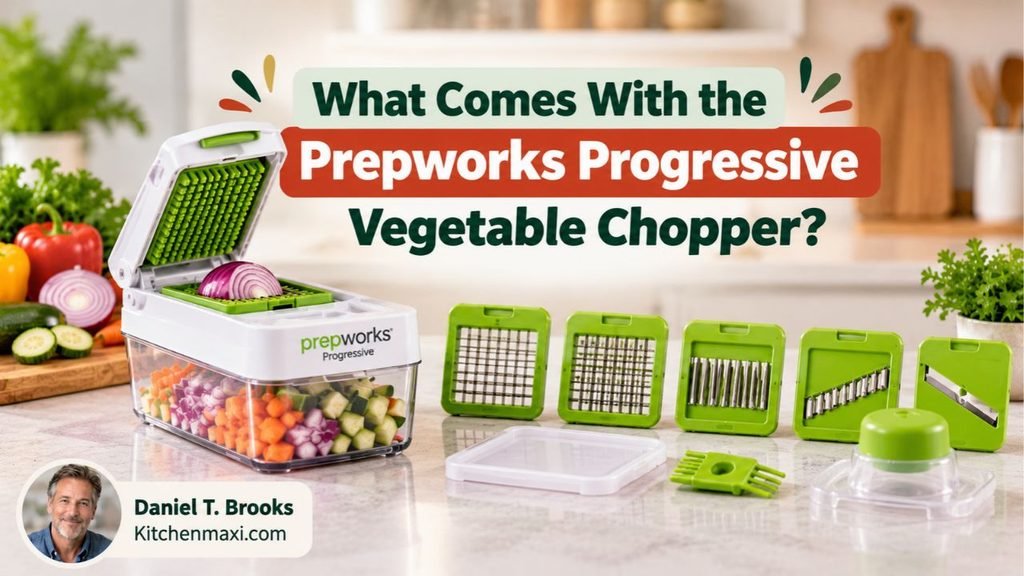
The three-blade setup gives the chopper more flexibility than a basic single-grid onion dicer.
Three Interchangeable Cutting Blades
Current product listings describe three blade options for dicing, slicing, chopping, and cutting fruits and vegetables. Another retailer describes the set more specifically as two stainless-steel dicing grates plus a stainless-steel slicing blade.
That arrangement is useful because one cut size does not suit every recipe.
A larger dice works well for:
- Potatoes
- Bell peppers
- Fruit
- Chunky salsa
- Soup vegetables
A smaller dice suits:
- Onion
- Pepper
- Relish
- Egg salad ingredients
- Fine vegetable mixtures
The slicing blade gives the tool a job that many grid-only choppers cannot perform.
3-Cup Measuring Container
The clear base holds up to 3 cups, or about 800 ml, and includes measurement markings.
This is more useful than it sounds.
If a soup recipe calls for two cups of diced onion and celery, you can monitor the amount while chopping instead of filling another bowl and measuring afterward.
The container also catches juice and small pieces that would otherwise end up across the cutting board.
Cleaning Tool, Storage Box, and Non-Skid Base
The chopper includes a dedicated cleaning tool for pushing trapped food from the pusher grid. The blade pieces can also be kept together in the supplied storage system.
The non-skid base is useful during the pressing motion. A manual grid chopper needs a stable surface because the downward force can be substantial with carrots, potatoes, and other firm foods.
Key Takeaway: The three blades, 3-cup measuring container, non-skid base, cleaning tool, and blade storage make this more versatile than a basic one-grid onion chopper.
How Well Does the Prepworks Vegetable Chopper Cut Food?
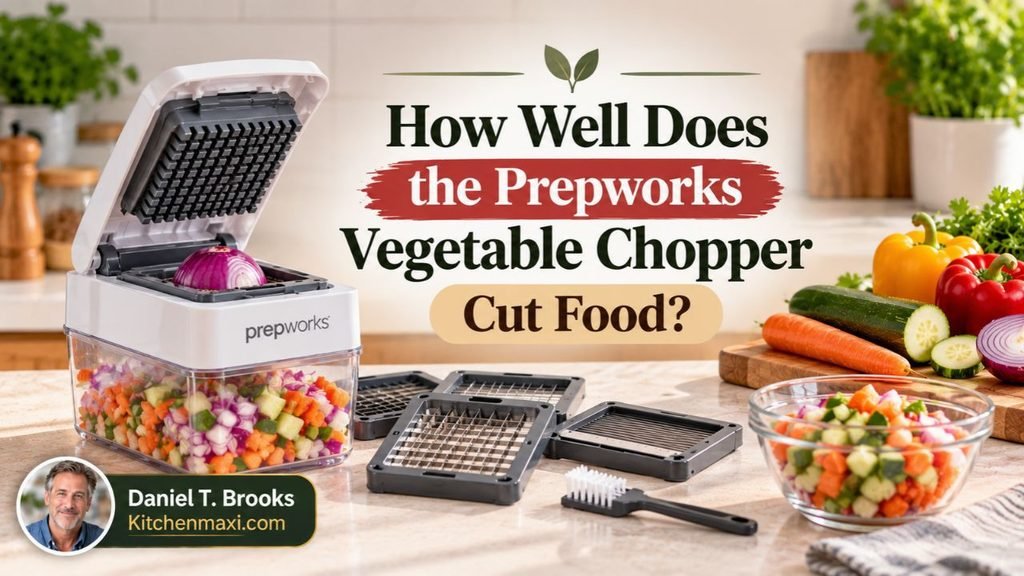
Results depend heavily on the ingredient.
Firm enough to pass cleanly through the grid but not so hard that it requires extreme force is the sweet spot.
Onions, Bell Peppers, and Celery
These are some of the best foods for the Prepworks chopper.
Onions can be cut into sections that fit the grate and then pushed through for consistent cubes. Bell peppers work well after removing the stem, seeds, and thick internal ribs.
Celery is also a good match. The built-in side-cutting design is intended to reduce some of the pre-cutting needed for longer vegetables such as celery and cucumber.
For salsa, soup, chili, and casseroles, being able to produce similar-sized pieces quickly is the product’s strongest advantage.
Tomatoes, Mushrooms, and Softer Produce
Soft produce requires a slightly different technique.
Pressing slowly can crush a ripe tomato or mushroom against the grid rather than sending it cleanly through. Buyer reports commonly describe better results when softer foods are properly sized and the lid is pushed down with a quick, controlled motion.
Tomatoes should be firm rather than overripe.
Positioning can matter too. Placing a cut tomato surface toward the blade can reduce the amount of skin that needs to break first.
Strawberries, zucchini, hard-boiled eggs, and similar foods are also suitable candidates when the blade chosen matches the desired cut.
Carrots and Potatoes
Carrots and potatoes reveal the limits of a manual grid chopper.
They can be chopped, but thick pieces create much more resistance. Buyer feedback repeatedly mentions the additional pressure required for dense vegetables, and some negative reports describe difficulty forcing onions or hard vegetables through certain units.
Pre-cutting is the solution.
Instead of placing a large chunk of potato over the grid, cut it into manageable slabs first. The chopper then creates the final dice.
That extra knife step may sound inconvenient, but it reduces strain on the plastic frame and makes the pressing motion much easier.
Fruit and Other Ingredients
Current product descriptions list fruits as one of the main intended food categories.
Apples, strawberries, melon, and firm peaches can work well once pits, cores, stems, and oversized sections are removed.
Retail product descriptions also mention nuts and chocolate among possible ingredients.
I would still use the tool mainly for fruits and vegetables. A conventional knife, nut chopper, or food processor gives more control when the goal is finely chopped nuts or irregular chocolate pieces.
Key Takeaway: Onions, peppers, celery, zucchini, firm tomatoes, and many fruits suit the chopper well; dense carrots and potatoes work better when sliced into smaller pieces first.
Does the Prepworks Chopper Produce Even Pieces?
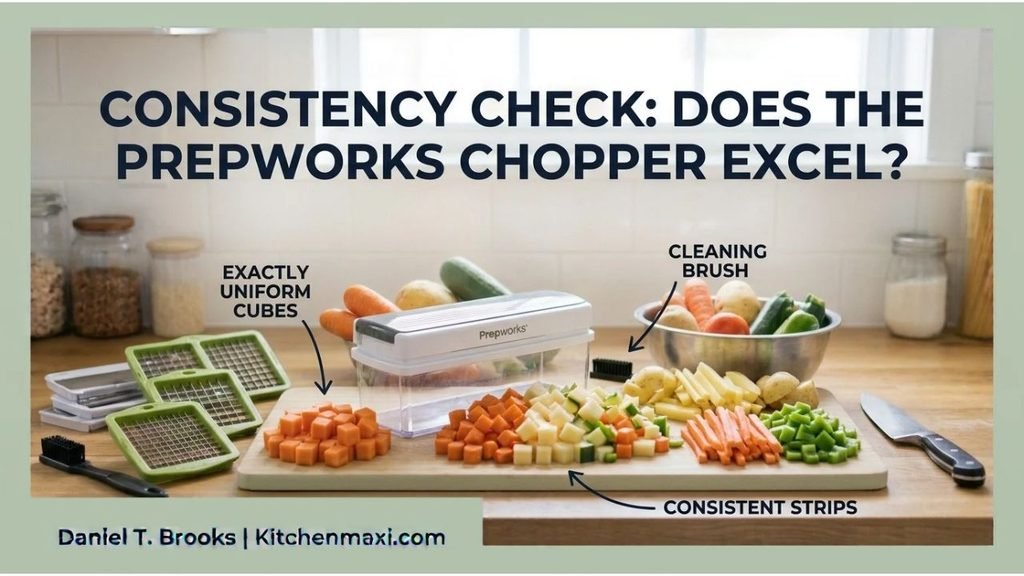
Uniformity is one of its best reasons to exist.
A knife gives you freedom to choose any size, but consistent hand dicing takes time and knife skill. A fixed grid creates the same basic dimensions every time food passes through it.
This is useful for dishes such as:
- Pico de gallo
- Salsa
- Potato hash
- Vegetable soup
- Egg salad
- Ceviche
- Relish
- Casseroles
- Mixed salads
Similar-sized pieces also tend to cook at a more similar rate.
Buyer comments on retailer and marketplace pages repeatedly praise the uniform cuts, including reports of using the chopper for salsa, soups, salads, potatoes, onions, peppers, and larger vegetable batches.
The important catch is that the grid controls only the dimensions it actually cuts. You may still need to pre-slice produce if you want cubes rather than long rectangular pieces.
How to Use the Prepworks Progressive Vegetable Chopper
The basic mechanism is simple, but food preparation and pressing technique change the result.
Choose the Blade for the Recipe
Pick the larger or smaller dice blade according to the finished piece size you want.
Use the slicing blade when slices make more sense than cubes.
Handle every insert by its plastic frame rather than touching the sharpened metal edges.
Pre-Cut Oversized Produce
Remove:
- Stems
- Cores
- Pits
- Seeds where needed
- Tough ends
Then cut the ingredient so it sits completely within the active blade area.
For dense produce, thinner pieces also reduce the pressure needed to close the lid.
Position the Food and Press the Lid Down
Set the chopper on a dry, flat counter so the non-skid base can grip.
Place the food over the blade.
Keep fingers away from the metal grid, then bring the lid down with a controlled, decisive motion.
A slow squeeze can mash softer produce. With hard produce, forcing a piece that clearly does not want to pass through is a sign to stop and cut it smaller.
Empty the Container Before It Becomes Packed
The 3-cup base holds a useful amount, but do not keep chopping after food becomes tightly packed against the underside of the blade.
Emptying the container gives incoming pieces somewhere to fall and keeps the mechanism easier to operate.
Key Takeaway: Match the blade to the recipe, size food to the cutting area, use a controlled downward motion, and cut dense produce smaller instead of forcing the lid.
How Easy Is the Prepworks Vegetable Chopper to Clean?
Cleanup is better than many multi-part manual choppers, but it is not as simple as rinsing a chef’s knife.
Food Can Collect in the Pusher Grid
Small pieces of onion, pepper, potato, and other produce can remain inside the upper pusher.
The supplied cleaning tool is intended to remove this trapped material.
Cleaning soon after chopping is much easier than allowing vegetable residue to dry inside the small spaces.
Some buyer-review summaries specifically mention food becoming trapped around the grid, even though many owners still describe the overall cleaning process favorably.
The Prepworks Chopper Is Dishwasher-Safe
Current retailer specifications list the product as dishwasher-safe.
Follow the care directions supplied with the version you purchase, since product revisions can change materials or dishwasher placement instructions.
Even if using a dishwasher, removing pieces from the pusher grid first prevents dried food from hiding in narrow spaces.
Blade Storage Keeps Loose Parts Together
Interchangeable blade products can become annoying when the pieces end up scattered across several kitchen drawers.
The included storage box addresses that problem.
Dry the blades before storing them and keep their sharp edges covered by the intended storage system.
Key Takeaway: Cleanup is manageable because a cleaning tool and dishwasher-safe parts are included, but washing soon after use prevents food from drying inside the pusher grid.
Prepworks Vegetable Chopper Durability and Safety
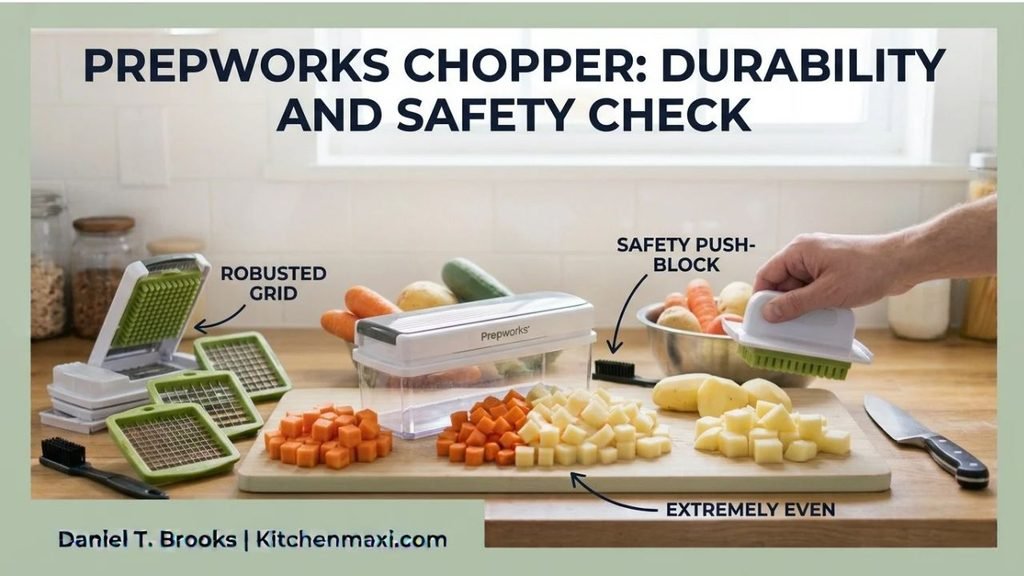
A manual chopper has no motor to fail, but its blade grid, hinges, lid, and plastic container still take substantial mechanical load.
The Stainless-Steel Blades Are Extremely Sharp
Sharp grid blades are necessary for clean cuts.
They also deserve the same caution as a kitchen knife.
Never:
- Test sharpness with a fingertip
- Clear food while pressing the lid
- Reach through the blade grid
- Leave uncovered blades loose in a drawer
Handle inserts by their plastic edges and use the cleaning tool rather than fingers to remove trapped food.
The Plastic Frame Should Not Be Used as a Press
Some user reports mention cracked plastic or concerns about stressing the clear container and frame. Other owners report years of use, so durability feedback is not uniform.
Technique makes a difference.
If the lid will not close with reasonable force, the answer is not to lean your entire body weight onto it. Remove the ingredient and cut it thinner.
That is especially true for:
- Raw sweet potato
- Thick carrot
- Large potato chunks
- Hard squash
- Other dense root vegetables
Stability Matters During Chopping
The non-skid base reduces movement while pressing, but it works best on a clean, dry counter.
Do not operate the chopper on a wet, unstable, or heavily sloped surface.
Keep the pressing hand on the intended lid area and the other hand away from the blade mechanism.
Key Takeaway: Respect the exposed blade grids, avoid excessive force on the plastic frame, and reduce hard vegetables to smaller pieces rather than trying to power through resistance.
Prepworks Progressive Vegetable Chopper Pros and Cons
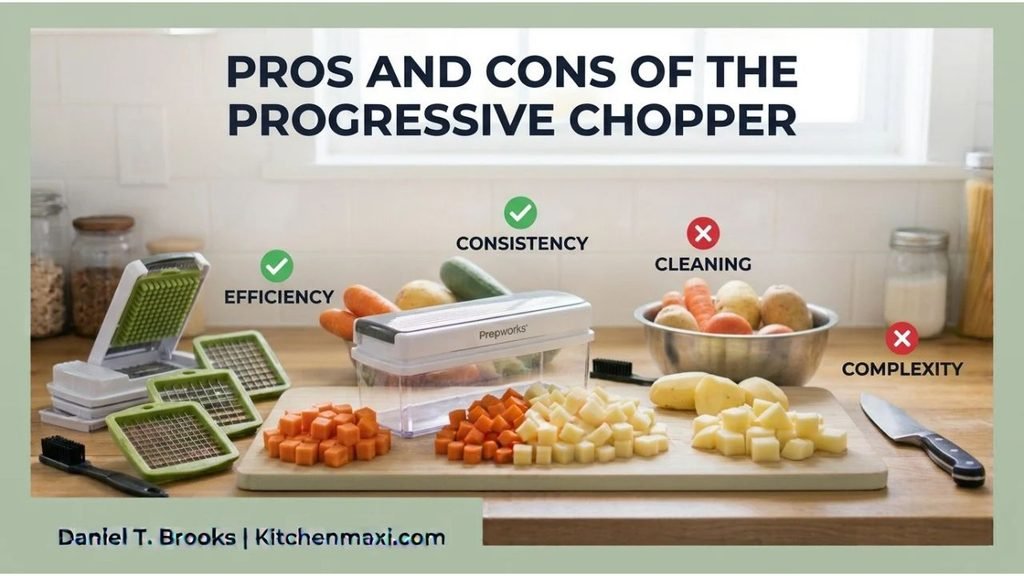
Pros
- Three interchangeable cutting blades
- Produces repeatable dice and slices
- 3-cup/800 ml measuring container
- Food drops directly into the catcher
- Non-skid base
- Built-in side-cutting feature for longer produce
- Cleaning tool included
- Blade storage included
- Dishwasher-safe
- No electricity, cord, or batteries
- Good for salsa, salads, soup, chili, and meal prep
Cons
- Dense vegetables require noticeable hand pressure
- Some foods still need pre-cutting
- Very soft produce can squash
- Food can collect in the upper grid
- More pieces to clean than a knife
- Plastic parts can be stressed by forcing oversized ingredients
- Sharp interchangeable blades require careful storage
- Not ideal for true mincing or puréeing
What Do Buyers Say About the Prepworks Chopper?
Buyer feedback is more mixed than a single retailer star rating suggests.
Positive Feedback Focuses on Cut Quality and Time Savings
Current retailer feedback praises its stable base, storage system, uniform pieces, and ability to shorten vegetable-prep time. Some long-term owner reports describe using the chopper repeatedly for salads, soup, salsa, zucchini, onion, fruit, and other everyday ingredients.
A marketplace review-pattern analysis of an older listing also found frequent praise for chopping speed, consistent cuts, and convenience.
Negative Feedback Focuses on Force and Plastic Parts
The recurring complaints are equally useful.
Some buyers report:
- Difficulty with onions or hard vegetables
- More force than expected
- Food trapped around the blade grid
- Plastic cracking
- Inconsistent blade performance between units
An Australian review page for the GPC-4000 has a very negative small sample, including complaints about dulling blades and difficulty chopping firm foods. Its six reviews are too few to represent every unit, but the complaints line up with the mechanical limits of a push-through grid design.
Star Ratings Need Context
A current major-retailer page shows a 4.3/5 rating, but only three ratings were present when the page was retrieved.
That is too small a sample to use as the main reason to buy.
The more useful pattern is consistent across feedback sources: people who prepare food to fit the grid tend to report better results, while trying to force large, hard vegetables through it creates the most frustration.
Key Takeaway: Positive feedback centers on uniform cuts and faster prep, while the main complaints involve dense vegetables, required pressing force, cleaning around the grid, and occasional plastic durability issues.
Who Should Buy the Prepworks Progressive Vegetable Chopper?
The design suits some kitchens much better than others.
Buy It if You Regularly Dice Vegetables
It makes the most sense if you routinely prepare:
- Onion
- Peppers
- Celery
- Potatoes
- Zucchini
- Tomatoes
- Fruit
- Salad ingredients
It is also appealing for people who want repeatable piece sizes without practicing precise knife dicing.
Meal prep is another good fit because several cups of vegetables can be processed directly into the catcher.
Skip It if You Want a Food Processor Replacement
This chopper does not:
- Purée soup
- Make nut butter
- Mix dough
- Grate cheese like a processor disc
- Chop continuously with a motor
- Mince tiny quantities as finely as a blade chopper
It also may not suit someone with limited hand, wrist, shoulder, or arm strength if hard vegetables are the main ingredients.
An electric chopper or food processor requires less downward force for those jobs.
Key Takeaway: Buy it for repeated manual dicing and slicing; choose an electric chopper or processor if hard produce, puréeing, mincing, or low-effort operation matters more.
Is the Prepworks Progressive Vegetable Chopper Worth the Price?
It can be worth buying when the price is reasonable and you frequently dice vegetables.
Current listings show a surprisingly broad price spread, so checking several reputable sellers before ordering makes sense. The core product is fairly simple: a manual frame, three blades, pusher, 3-cup container, cleaning tool, and storage box.
At a price in the mid-$30 range, I think the three-blade design and storage system make a stronger case than many basic single-grid choppers.
At prices approaching $60, comparison shopping becomes more important. That range includes newer multi-blade choppers with extra attachments, though extra accessories do not automatically mean a better cutting mechanism.
The real value question is how often you dice food. Someone who chops one onion each month may be better served by a knife. Someone preparing salads, salsa, soups, chili, casseroles, or meal-prep vegetables several times a week has more reason to dedicate cabinet space to it.
Conclusion
This Prepworks progressive vegetable chopper review points to a capable manual dicing tool with clear strengths and equally clear limits. Its three blades, 3-cup measuring container, stable base, cleaning tool, and organized storage make it more practical than a basic single-blade chopper.
Its best jobs are onions, peppers, celery, zucchini, potatoes that have been pre-cut, firm tomatoes, fruit, and other ingredients used in salads, salsa, soup, chili, and casseroles. Uniform cutting is the strongest reason to choose it.
Hard vegetables require more preparation and hand pressure, while very soft produce needs a quick, controlled motion to prevent crushing. The sharp blade inserts also need careful handling during washing and storage.
I would buy it for regular manual vegetable prep, especially if consistent dice size matters. For large volumes of dense root vegetables or tasks such as mincing and puréeing, an electric food processor is a better match.
FAQs About the Prepworks Progressive Vegetable Chopper
Is the Prepworks Progressive Vegetable Chopper Dishwasher-Safe?
Yes. Current product listings describe the three-blade Fruit and Vegetable Chopper as dishwasher-safe.
Remove trapped food from the pusher grid first, then follow the care directions supplied with your specific version. Dry the blade pieces before returning them to storage.
How Many Blades Does the Prepworks Vegetable Chopper Have?
The three-blade Fruit and Vegetable Chopper includes three interchangeable stainless-steel cutting options. Retail descriptions identify two dicing grates plus a slicing blade.
Prepworks also sells other choppers with different blade counts, so check the exact model before ordering replacement parts.
Can the Prepworks Chopper Cut Potatoes?
Yes, but potatoes should be sized to fit the cutting area.
Thick raw potatoes require substantial downward pressure. Cutting a potato into manageable slabs first makes it easier to push through the grid and reduces stress on the plastic frame.
Can It Chop Onions?
Yes. Onions are one of the foods that fit the design well.
Peel the onion, remove the ends, and cut it into sections that fit comfortably over the blade. Select the grid that matches the dice size needed for salsa, soup, chili, salad, or another recipe.
Does the Prepworks Vegetable Chopper Work on Tomatoes?
It can cut firm tomatoes, though very ripe tomatoes may crush if pressed slowly.
Cut larger tomatoes into manageable sections and try placing the cut surface toward the blade. A quick, controlled downward motion generally suits soft produce better than gradually squeezing the lid.
Does the Prepworks Chopper Require Pre-Cutting?
Sometimes.
The built-in side blade reduces some pre-cutting for long produce, but oversized or dense ingredients should still be cut into smaller pieces before going through the main grid.
Pre-cutting carrots, potatoes, and large onions also reduces the amount of pressure placed on the chopper.
Is the Prepworks Vegetable Chopper Good for Meal Prep?
Yes, especially when meal prep involves several cups of diced vegetables.
The 3-cup measuring catcher lets you chop and monitor quantity in the same container, while the interchangeable grids keep pieces consistent across onions, peppers, potatoes, zucchini, and similar ingredients.
Is the Prepworks Chopper Better Than Using a Knife?
It is better for producing repeated uniform dice quickly, while a knife provides more control and requires fewer parts to wash.
For one garlic clove or half an onion, a knife may be simpler. For several cups of evenly diced vegetables, the Prepworks chopper has a much stronger reason to be on the counter.