
How to Dice With Food Processor: Dicing Kit and Pulse Method
For true, even cubes, use a dedicated dicing attachment that slices food and pushes it through a grid. A standard S-blade can make small chopped pieces, but it cannot reliably create uniform cubes. Without a dicing kit, short pulses are the closest alternative, and the result will be more rustic than a true dice.
The attachment matters because chopping and dicing are different cuts. A spinning multipurpose blade repeatedly cuts ingredients from changing angles, while a dicing system forces sliced food through a fixed grid. KitchenAid specifically states that true dicing requires a food processor model with that capability.
Using the proper dicing setup gives onions, potatoes, carrots, zucchini, apples, and similar ingredients a more consistent size. Even pieces are useful for soups, hash, salsa, stews, salads, and recipes where pieces should cook at roughly the same rate.
Dice size comes from the dicing grid rather than the amount of pressure applied to the pusher. Some machines offer only one cube size, while others provide several. Breville, for example, offers dicing systems with 8 mm, 12 mm, and 16 mm grids on selected models.
Read More: is a food chopper the same as a food processor

For how to dice with food processor, first check that your machine actually has a dicing kit. If it does, install the grid and dicing blade, trim ingredients to fit the feed tube, and guide them through with the food pusher. If it does not, use the S-blade with very short pulses and stop before the pieces become minced.
Firm produce gives the cleanest dice. Very soft tomatoes, overripe fruit, cooked vegetables, and watery ingredients can crush against the grid or turn uneven under an S-blade. Ingredient texture should therefore influence both attachment choice and processing time.
The steps below cover true dicing with a dedicated attachment, the pulse method for processors without one, ingredient preparation, common dicing problems, cleaning, and the foods that work best.
Can a Food Processor Actually Dice Food?

Yes, but the type of cut depends on the attachment installed.
A Dicing Kit Makes True Cubes
A dedicated dicing attachment normally combines two cutting actions.
The first blade slices the food to a set thickness. The sliced ingredient is then pushed through a grid, producing pieces with similar length, width, and height.
KitchenAid’s dicing system uses a dicing grid, blade, lid, and drive components inside the work bowl. Food is fed through the designated feed tube after the kit is assembled.
Breville describes its dicing attachments as a two-stage process that first slices and then dices the ingredient. Selected models provide several grid sizes for different cube dimensions.
Read More: how to use dicer on cuisinart food processor
An S-Blade Chops Rather Than Truly Dices
A standard S-shaped multipurpose blade works differently.
Food falls toward a fast-spinning blade and is cut repeatedly. Some pieces reach the blade more often than others, so the finished bowl usually contains a mixture of sizes.
Short pulses can produce a coarse dice-like texture suitable for:
- Salsa
- Soup bases
- Mirepoix
- Sauces
- Stuffing
- Relishes
The pieces will not have the regular cube shape produced by a dicing grid.
KitchenAid recommends quick pulses when using the multipurpose blade for chopping so the cook can control processing time and stop before ingredients become too fine.
Key Takeaway: Use a dicing kit when uniform cubes matter. Use the S-blade when small, roughly chopped pieces are acceptable.
How to Dice With a Food Processor Using a Dicing Kit
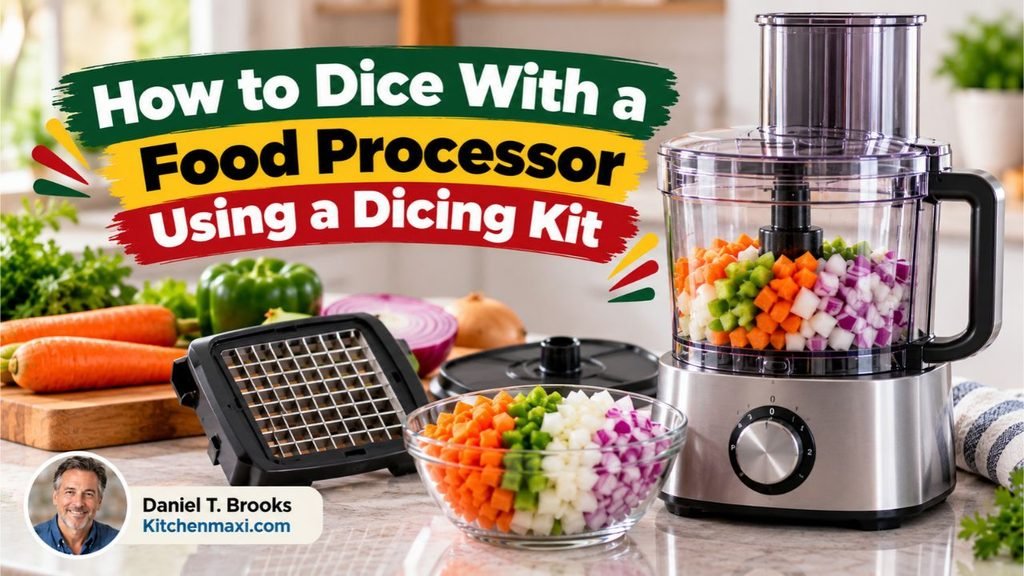
Exact assembly varies by model, so the owner’s manual should take priority. The basic process is similar across processors with dedicated dicing systems.
1. Check the Dicing Kit Compatibility
Do not assume a dicing attachment fits every processor from the same brand.
Check:
- Food processor model number
- Dicing-kit part number
- Required drive adapter
- Compatible bowl
- Required lid
- Feed-tube size
Some processors include a dicing kit from the factory, while other models accept one as an optional accessory.
KitchenAid, for example, lists the dicing kit on selected 13-cup models rather than on every processor in its range.
2. Prepare the Food for the Feed Tube
Wash the produce and remove parts that should not be processed.
Preparation may include:
- Peeling potatoes or carrots if the recipe calls for it
- Removing onion skin
- Removing pepper stems and seeds
- Coring apples
- Trimming celery ends
- Cutting oversized produce into sections
The goal is not to hand-cut the final cubes. You only need pieces that fit comfortably through the feed tube.
Avoid wedging an oversized potato or onion into the chute.
3. Install the Dicing Grid and Blade
Unplug the processor before assembly.
Install the parts in the order specified by the manufacturer. On one current KitchenAid design, the sequence includes the disc adapter, dicing grid, dicing blade, and dicing-kit lid before the processor lid is fitted.
The grid must sit in its intended orientation.
If a component does not seat normally, do not force the lid closed. Recheck the assembly.
4. Lock the Work Bowl and Lid
Food processors use interlocks that prevent operation when the bowl or lid is not seated correctly.
Make sure:
- Bowl is locked to the base
- Dicing components are fully seated
- Lid is locked
- Food pusher is positioned as required
KitchenAid notes that its processor will not operate if the bowl and lid are not correctly locked.
5. Put the Ingredient Into the Feed Tube
Choose the feed-tube section that best supports the ingredient.
A carrot or celery stalk may stay straighter in a smaller chute. A halved onion or potato may need a larger opening.
Keep the ingredient stable rather than letting it tumble sideways.
6. Start the Food Processor
Use the speed specified for your machine and dicing attachment.
Do not assume every model uses the same setting.
Some processors use a single operating speed for dicing, while others provide several speeds.
7. Guide the Food With the Pusher
Apply steady, controlled pressure with the supplied food pusher.
Do not use your fingers, utensils, or another object to force ingredients toward the blade. KitchenAid’s safety instructions specifically warn users to keep fingers out of the feed opening and always use the food pusher.
Heavy force is usually unnecessary. Let the blade and grid do the cutting.
8. Stop Before the Work Bowl Becomes Too Full
If you are processing a large batch, periodically check the bowl.
Diced food needs space to fall away from the grid.
Emptying the bowl during a large batch also gives you a chance to check for pieces stuck in the grid.
9. Clear the Grid With the Supplied Tool
Once processing is finished, turn the machine off and unplug it.
Wait until all moving parts stop.
Remove the lid and dicing blade according to the manual. Many dicing systems include a cleanout tool that pushes remaining pieces through the grid rather than requiring fingers near the sharp openings.
KitchenAid specifically instructs users to place its cleanout tool over the dicing grid after processing to push trapped food through.
Key Takeaway: True food-processor dicing requires the correct kit, proper assembly, ingredients sized for the feed tube, steady pusher pressure, and safe grid cleaning after use.
How to Dice Food Without a Dicing Attachment

A processor without a dicing grid can still reduce ingredients to small pieces, but the result is technically chopped rather than uniformly diced.
Cut Ingredients Into Similar Chunks First
Start by hand-cutting the food into pieces of roughly similar size.
For a large onion, for example:
- Peel it.
- Cut it into quarters or smaller wedges.
- Separate very large sections if needed.
- Place the pieces loosely in the work bowl.
Starting with similar chunks reduces the gap between the smallest and largest finished pieces.
Keep the Batch Small
Do not fill the bowl to the top.
When too much food surrounds the S-blade, pieces near the bottom may become tiny while pieces above them remain large.
A smaller batch gives the ingredients room to move and redistribute.
For onions, peppers, celery, or carrots, filling only part of the bowl generally gives more control than packing it tightly.
Use Short Pulses
Use the pulse control rather than leaving the machine running continuously.
Press briefly, stop, and inspect.
Repeat only as needed.
KitchenAid describes the pulse function as a way to control processing duration and frequency during chopping.
Continuous processing can move quickly from coarse pieces to minced food or purée, especially with onions and soft produce.
Redistribute Large Pieces if Needed
Stop the machine and unplug it before reaching into the bowl.
If several large pieces remain along the top or sides, move them safely toward the blade with an appropriate utensil after the blade has completely stopped.
Reassemble and pulse again.
Stop Before Every Piece Looks Identical
This is the most common mistake with the S-blade method.
If you keep pulsing until the largest pieces become small, the smallest pieces may already be minced.
Stop when most of the food is near the size you want.
A few larger pieces can be removed and cut by hand.
Key Takeaway: Without a dicing kit, pre-cut ingredients, work in small batches, and use brief pulses. Stop early because an S-blade creates a rough chop rather than identical cubes.
Best Foods to Dice in a Food Processor
Firm foods that hold their shape under pressure usually work better with a dicing attachment.
| Ingredient | Dicing Kit Result | Preparation Tip |
| Onion | Very good | Peel and cut to fit the chute |
| Potato | Very good | Peel if desired and trim to fit |
| Carrot | Good | Trim ends and use a narrow feed tube when possible |
| Celery | Good | Trim and feed in stable sections |
| Bell pepper | Good | Remove stem, seeds, and thick inner ribs |
| Zucchini | Good | Use firm zucchini rather than very soft pieces |
| Apple | Good | Core and cut to fit |
| Cucumber | Good | Firmer cucumbers hold shape better |
| Firm pear | Good | Core and use before it becomes very ripe |
| Tomato | Variable | Firm tomatoes work better than soft ripe ones |
Cuisinart recipes using a dicing assembly include potatoes, carrots, bell peppers, onions, eggplant, zucchini, and celery, showing the range of produce that can be processed with a suitable system.
Firm Vegetables Give Cleaner Cubes
Potatoes, carrots, celery, and firm zucchini resist crushing as they move through the grid.
Very dense vegetables may place more load on the machine. If the motor slows or the processor stalls, stop rather than forcing the ingredient harder.
Onions Are Well Suited to Batch Dicing
Onions can be tedious to dice by hand in large quantities.
A dicing kit can produce a large batch quickly with less variation than the S-blade.
Peel the onion and cut it only enough to fit the feed tube.
Soft Foods Need More Care
Very ripe tomatoes, soft pears, cooked potatoes, and similar foods can deform under pressure.
A clean grid may still cut them, but the result can contain crushed edges or extra juice.
For a neat raw salsa or garnish, a knife may be the better choice for very soft produce.
Key Takeaway: Firm onions, potatoes, carrots, celery, apples, peppers, and zucchini are strong candidates for food-processor dicing. Very soft or overripe foods are more likely to crush.
How Food Processor Dice Size Is Controlled
The dicing grid determines cube size.
Grid Openings Set the Final Dimensions
A smaller grid produces smaller cubes.
A larger grid produces larger cubes.
Breville’s Paradice 16, for example, includes 8 mm, 12 mm, and 16 mm dicing systems. Those sizes are about 5/16 inch, 1/2 inch, and 5/8 inch.
A processor supplied with one dicing grid will normally produce only that approximate cube size.
Pusher Pressure Does Not Change Cube Size
Pressing harder does not create a finer dice.
Extra force may instead:
- Crush soft ingredients
- Pack food into the grid
- Slow the motor
- Make a jam more likely
Use moderate, steady pressure.
S-Blade Piece Size Comes From Processing Time
With a standard chopping blade, there is no fixed grid.
Piece size depends mainly on:
- Starting chunk size
- Number of pulses
- Batch size
- Ingredient firmness
- Blade sharpness
- How evenly the pieces circulate
That is why an S-blade cannot match the consistency of a true dicing attachment.
Key Takeaway: A dicing grid physically sets cube size. With an S-blade, processing time controls average piece size, but the pieces will remain less uniform.
Why Food Processor Dicing Comes Out Uneven
Uneven pieces usually point to attachment choice, ingredient condition, or feeding technique.
The S-Blade Is Being Used for a True Dice
If you need square, consistent cubes, the multipurpose blade is the wrong attachment.
Use it for chopping, mincing, mixing, and puréeing rather than precision dicing.
The Ingredient Is Too Soft
Overripe tomatoes or soft cooked potatoes may smear instead of passing cleanly through the grid.
Try firmer produce if the recipe permits it.
Food Is Moving Sideways in the Feed Tube
Long carrots, celery stalks, or similar ingredients can tilt in an oversized feed tube.
Use a smaller chute or pack the ingredient so it stays stable.
Too Much Pressure Is Applied
Forcing food aggressively through the grid can compress softer ingredients.
Use enough pressure to maintain contact with the cutter, then let the machine do the work.
The Dicing Grid Is Clogged
Food trapped inside several grid openings reduces cutting area.
Turn the processor off, unplug it, remove the assembly safely, and clear it with the supplied tool.
The Wrong Grid or Blade Is Installed
Some processors have several discs and adapters that look similar.
If the food is being sliced rather than diced, recheck the attachment stack against the manual.
Key Takeaway: Uneven dicing commonly comes from using an S-blade, processing soft ingredients, feeding food at an angle, pushing too hard, or working with a clogged grid.
Common Mistakes When Dicing With a Food Processor
Several small mistakes can turn a fast prep job into a bowl of uneven pieces.
Expecting the S-Blade to Make Perfect Cubes
Short pulses create chopped food.
They do not reproduce the fixed geometry of a dicing grid.
If exact cube size matters for presentation or cooking time, use the dedicated attachment or dice by hand.
Overfilling the Chopping Bowl
This matters most with the pulse method.
A crowded bowl prevents ingredients from circulating evenly around the blade.
Process multiple small batches instead.
Running the S-Blade Continuously
Continuous operation is useful for puréeing and some mixing tasks.
For dice-like chopped vegetables, it is too easy to go past the desired size.
Use brief pulses and inspect often.
Using Very Soft Produce
Soft food can collapse under the dicing blade or grid.
Chilling some ingredients until firm may improve handling, but do not freeze produce unless the appliance instructions specifically permit processing it that way.
Forcing a Jammed Dicing Kit
If the processor slows, stops, or makes an abnormal sound, switch it off.
Unplug the machine before investigating.
Do not push harder in an attempt to force a potato, carrot, or other dense piece through a blocked grid.
Reaching Into the Feed Tube
Never push food with your fingers.
Use the supplied pusher every time. Food processor blades and dicing grids contain very sharp cutting edges.
Key Takeaway: The biggest dicing mistakes are using the wrong blade, overfilling the bowl, processing too long, forcing a jam, and putting hands near the cutting assembly.
How to Clean a Food Processor Dicing Kit
Dicing grids need more attention than a standard chopping blade because small cubes can remain trapped in the openings.
Unplug the Food Processor Before Disassembly
Turn the machine off and wait until all movement stops.
Unplug it before removing the lid, dicing blade, grid, or drive components.
KitchenAid instructs users to turn off and unplug the processor before disassembling the machine.
Use the Dicing Cleanout Tool
Many dicing kits include a tool shaped to match the grid.
Place it over the grid in the direction specified by the manual and press the trapped pieces through.
KitchenAid includes this step in its dicing-kit procedure.
Do not push food out of sharp grid openings with your fingertips.
Wash the Grid Before Food Dries Onto It
Starchy potato residue and vegetable fibers become harder to remove after drying.
Rinse and wash the parts soon after processing.
Use a brush where needed rather than scraping sharp openings by hand.
Check Dishwasher Instructions for Your Model
Food-processor parts differ in dishwasher compatibility.
Do not assume that every blade, grid, adapter, or lid can go through the dishwasher.
Follow the cleaning instructions supplied with the exact processor.
Key Takeaway: Unplug first, use the supplied grid-cleaning tool, keep fingers away from sharp openings, and wash trapped food away before it dries.
When Hand Dicing Is Better Than a Food Processor
The processor saves time on larger batches, but a knife still makes more sense for some jobs.
Hand dicing is often preferable when:
- You need only half an onion
- The ingredient is very soft
- Cube dimensions need to be exact
- The recipe needs a very small brunoise-style cut
- Cleaning the dicing kit would take longer than cutting the food
- The ingredient cannot fit or process safely in the machine
For a large pot of soup, several pounds of potatoes, or batch meal preparation, a dicing attachment can cut prep time substantially.
For one tomato going onto a taco, a knife is simpler.
Conclusion
How to dice with food processor comes down to the attachment. A dedicated dicing kit is the correct choice for uniform cubes because it slices ingredients and presses them through a fixed grid. A standard S-blade can create small chopped pieces with short pulses, but it will not produce a consistent geometric dice.
Prepare food so it fits the feed tube, choose firm ingredients, use the supplied pusher, and let the grid set the cube size. If your processor offers several grids, select the size that matches the recipe before assembly.
If your machine has no dicing accessory, use small batches and brief pulses, then accept a more rustic texture. For recipes where cube shape or size strongly affects appearance or cooking, hand dicing remains the better alternative.
FAQs About Dicing With a Food Processor
Can you dice onions in a food processor?
Yes. A processor with a dicing attachment can cut onions into fairly uniform cubes. Peel the onion, trim it as needed to fit the feed tube, and guide it through with the food pusher. With an S-blade, use short pulses for chopped onion and stop before the lower pieces turn too fine.
Can you dice potatoes in a food processor?
Yes, if your processor has a dicing kit rated for firm vegetables. Cut large potatoes only enough to fit the feed tube, then apply steady pressure with the pusher. A dicing grid gives much more consistent cubes than the standard chopping blade.
Can you dice carrots in a food processor?
Yes. Carrots work well with many dicing attachments because they are firm enough to retain their shape. Trim the ends and use a feed tube that holds the carrot steadily. Stop if a very thick carrot causes the machine to stall rather than forcing it through the grid.
Can you dice vegetables with a normal food processor blade?
You can make small chopped vegetable pieces with the normal S-blade, but they will not be true uniform dice. Cut vegetables into similar chunks first, process a small batch, and use brief pulses. Stop while a few pieces are still slightly larger rather than processing the rest into mince.
What food processor blade do I use for dicing?
Use the dedicated dicing blade and grid supplied or approved for your food processor. A slicing disc only creates slices, a shredding disc creates shreds, and an S-blade chops. Check your model number before buying a dicing accessory because these kits are often machine-specific.
Why does my food processor turn vegetables into mush?
The batch may be too large, the vegetable may be very soft, or the S-blade may be running too long. Use short pulses, work with smaller batches, and stop as soon as most pieces reach the desired size. For uniform cubes, switch to a dedicated dicing attachment.
How small can a food processor dice?
The minimum true dice depends on the grid available for your processor. Some systems provide several grid sizes. Breville, for example, offers 8 mm, 12 mm, and 16 mm dicing attachments on selected machines. A processor with only one grid is generally limited to that approximate cube size.
Is a food processor worth using just for dicing?
It makes the most sense for larger batches such as onions for meal prep, potatoes for hash, vegetables for soup, or fruit for salads. For one small ingredient, hand dicing may be faster once assembly and cleanup are counted.