Are Marble Cutting Boards Safe? Risks, Cleaning, and Best Uses
A marble board can be safe for food preparation when it is smooth, intact, clean, and used with normal food-hygiene practices. The bigger drawback is not usually bacteria—it is the hard stone surface, which dulls knife edges quickly. Marble also reacts with acidic foods, so it works better for pastry and serving than daily chopping.
USDA food-safety guidance lists marble among the nonporous cutting-board surfaces consumers may use, along with plastic, glass, and pyroceramic. USDA also says cutting boards should be washed with hot, soapy water after each use and kept free of hard-to-clean damage.
Food safety is only part of the decision. Stone gives almost no cushioning when a knife edge hits it. ZWILLING says glass or stone boards quickly dull kitchen knives, and Victorinox gives the same warning for hard surfaces made from natural or artificial stone.
Marble also contains calcium carbonate, so lemon juice, vinegar, wine, and other acids can dull or etch the polished finish. The Natural Stone Institute recommends mild, non-acidic cleaners for calcareous stone such as marble.
If you are asking are marble cutting boards safe, the practical answer is yes for food contact when the board is made for kitchen use and kept clean, but marble is a poor everyday surface for repeated chopping. A wood or plastic board is usually kinder to knives and easier to use for heavy prep.
Marble makes more sense for rolling dough, handling pastry, arranging cheese, serving fruit, or doing light prep that does not involve repeated knife impact. Its smooth, cool-feeling surface is useful in those jobs without sacrificing a knife edge on every cut.
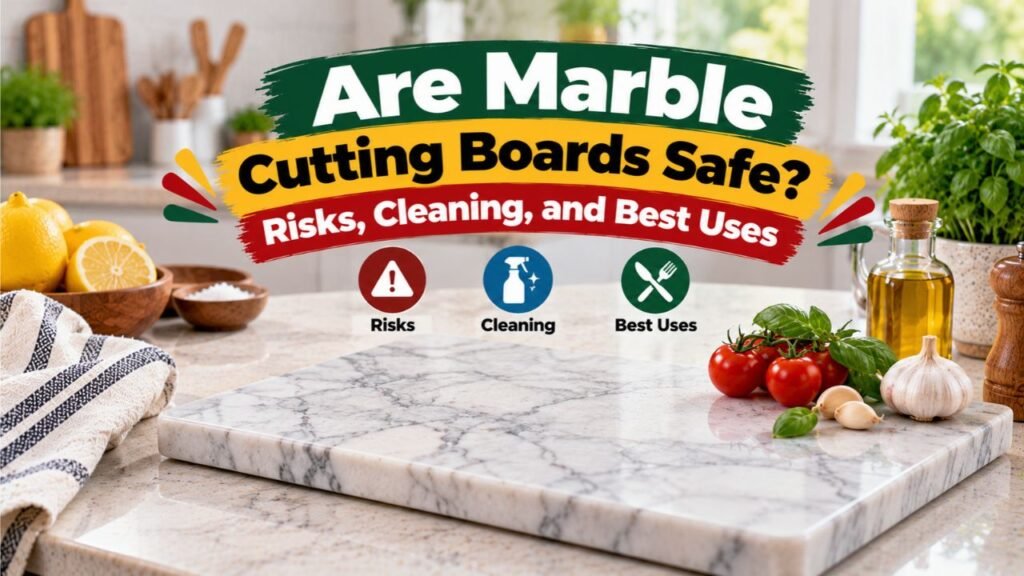
The sections below cover food safety, raw meat, knife damage, acidic foods, cleaning and sanitizing, the best jobs for marble, and when wood or plastic is the smarter cutting surface.
Are Marble Cutting Boards Safe for Food Preparation?
Yes. A smooth marble cutting board intended for kitchen use can be used as a food-contact surface.
USDA specifically includes marble in its list of nonporous cutting-board surfaces and says consumers may use wood or nonporous boards for raw meat and poultry. It also recommends separate boards for raw animal foods and ready-to-eat foods to reduce cross-contamination.
Marble Must Stay Smooth and Cleanable
Food-contact safety depends partly on surface condition.
A marble board with a smooth face is easy to wash because food residue can be removed from the surface. A board with deep cracks, chipped areas, rough pits, or damaged filler is harder to clean.
FDA food-contact guidance emphasizes surfaces that are smooth, durable, cleanable, relatively nonabsorbent, and free of open seams.
A decorative stone slab with unknown coatings is not automatically the same thing as a board sold for kitchen or serving use. If a board has a coating or sealer, use it for food contact only if the product maker identifies that finish for food-contact applications.
Marble Is Not Immune to Stains or Surface Damage
The word “nonporous” in consumer cutting-board guidance should not be taken to mean that marble can never absorb anything.
Natural stone can vary in absorption and finish. The Natural Stone Institute explains that stone impregnators act as repellents and make stone more stain resistant; they do not make stone stain-proof.
Oil, wine, sauces, and strongly colored foods should still be wiped up promptly.
Key Takeaway: Marble can be a safe food-contact surface when it is smooth, intact, made for kitchen use, and washed after use. Cracks, chips, damaged finishes, and unknown coatings deserve closer attention.
Why Marble Cutting Boards Are Hard on Knives
Knife damage is the strongest reason not to use marble as a primary chopping board.
Marble Has Almost No Give Under a Knife Edge
Wood and many plastic boards deform slightly when a sharp edge contacts them.
Marble does not offer that cushioning. The blade edge stops against a rigid stone surface.
ZWILLING states that cutting boards made from glass or stone are not suitable cutting bases because they quickly dull kitchen knives. Victorinox also advises avoiding natural or artificial stone because the blade becomes dull.
Repeated Chopping Can Roll or Damage the Edge
A kitchen knife ends in a very thin edge. Repeated impact against stone can make that edge lose sharpness much faster than it would on wood or plastic.
Fine, hard knife steels can also be more sensitive to chipping if the edge is thin and the user chops forcefully against a rigid board.
This is not a reason to fear brief contact with marble. It is a reason to avoid making marble the surface under hundreds of daily cuts.
A Dull Knife Creates Its Own Handling Problem
Once a knife loses sharpness, the user tends to apply more force.
More force can reduce control, especially on a smooth stone board where food or the board itself may slide if the setup is poor.
For normal chopping, I would keep a wood or plastic board beside the marble and move knife work to the softer surface.
Key Takeaway: Marble is safe for food contact but rough on knife edges. Use a softer cutting surface for chopping if you want knives to stay sharp longer.
Are Marble Cutting Boards Safe for Raw Meat?

USDA says consumers may use wood or a nonporous surface such as marble for cutting raw meat and poultry. The bigger issue is preventing raw juices from contaminating foods that will not be cooked.
Separate Raw Meat From Ready-to-Eat Foods
USDA recommends considering one cutting board for fresh produce and bread and a separate board for raw meat, poultry, and seafood.
That approach is simple and reduces the chance that raw juices move onto:
- Salad vegetables
- Fruit
- Bread
- Cheese
- Cooked foods
If marble is mainly a pastry or serving board, using a separate plastic or wood board for raw meat keeps the marble out of messy meat-prep jobs.
Wash Marble Immediately After Raw Meat
Do not leave raw poultry or meat juices drying on the board.
Remove food residue, then wash the surface with hot or warm soapy water and rinse it with clean water. USDA recommends washing cutting boards after each use.
Dry the marble before storage.
Use a Food-Contact Sanitizer When Needed
USDA gives a cutting-board sanitizing method based on 1 tablespoon of unscented liquid chlorine bleach per gallon of water, followed by a clean-water rinse and drying. It also says commercial sanitizers should be labeled for food-contact cutting boards or utensils.
Marble can be sensitive to some chemicals and acids, so check the stone-board maker’s care directions before applying any cleaner or sanitizer. Do not use vinegar as the default sanitizer on marble.
Key Takeaway: Marble can contact raw meat, but a separate raw-meat board is simpler for cross-contamination control. Wash promptly and use only food-contact sanitizers that are compatible with the stone.
Why Acidic Foods Can Damage a Marble Cutting Board
Marble is a calcareous stone, meaning calcium carbonate is a major part of its composition.
Acid can react with that surface.
Lemon, Vinegar, and Wine Can Etch Marble
The Natural Stone Institute warns that lemon, vinegar, and other acidic products can dull or etch calcareous stone.
Common kitchen examples include:
- Lemon and lime juice
- Vinegar
- Wine
- Some tomato sauces
- Pickling liquids
- Acidic cleaners
Etching is not the same as a food stain. It is physical or chemical damage to the polished finish, often seen as a dull patch or ring.
Sealer Does Not Make Marble Acid-Proof
A stone impregnator may slow liquid penetration and reduce staining, but the Natural Stone Institute says sealing does not make stone stain-proof.
It also does not change calcium carbonate into an acid-resistant surface.
Wipe acidic spills up quickly even on sealed marble.
Do Not Clean Marble With Vinegar
Vinegar is often suggested as a kitchen cleaner, but it is a bad match for marble.
The Natural Stone Institute specifically says vinegar should never be used on calcareous stones such as marble, limestone, or travertine.
Use a mild dish soap or a cleaner specifically labeled for natural marble.
Key Takeaway: Acid is a finish-damage issue on marble. Keep lemon juice, vinegar, wine, and acidic cleaners from sitting on the board, and do not expect sealer to prevent etching.
Best Uses for a Marble Cutting Board
Marble earns its counter space when the knife is not repeatedly striking it.
Use Marble for Pastry and Dough
A smooth stone slab is useful for:
- Pie dough
- Cookie dough
- Tart pastry
- Laminated dough
- Fondant
- Chocolate work
The solid surface gives dough a flat working area and can feel cooler than many other work surfaces.
For a pastry board, flour and a bench scraper often do more work than a chef’s knife, so knife-edge damage is not a major concern.
Use Marble for Cheese and Serving
Marble works well as a presentation board for:
- Cheese
- Crackers
- Fruit
- Desserts
- Charcuterie
- Cold appetizers
Use a separate softer board for any heavy slicing before arranging food on the marble.
Use Marble for Light Prep Without Heavy Chopping
Tasks that involve little knife contact are reasonable, such as:
- Shaping dough
- Portioning soft foods with a scraper
- Arranging prepared ingredients
- Serving sliced fruit
- Cooling certain baked items once the board maker permits that use
Avoid treating the board as a butcher block.
Key Takeaway: Marble is at its best as a pastry, dough, cheese, and serving surface. Reserve repeated chopping and dicing for wood or plastic.
How to Clean a Marble Cutting Board Safely
Cleaning should remove food without attacking the polished stone.
1. Remove Food Debris
Use a soft cloth, sponge, or plastic scraper.
Avoid aggressive metal scraping across a polished surface.
2. Wash With Mild Soap
Use mild dish soap and warm water.
The Natural Stone Institute recommends neutral or mild cleaners for natural stone and warns against acids on marble.
USDA also recommends hot, soapy water for cutting-board cleaning after each use.
3. Rinse Away Soap
Use clean water and remove all soap residue.
Do not leave the board sitting in a sink full of dirty water.
4. Dry the Marble
Wipe it dry with a clean towel.
Drying reduces water spots and makes the board ready for storage or serving.
5. Sanitize Only With a Compatible Food-Contact Product
If sanitizing is needed, choose a method that is approved for food-contact surfaces and compatible with marble.
Avoid acidic sanitizer recipes.
Do not mix bleach and ammonia. The Natural Stone Institute warns that the combination creates toxic gas.
Key Takeaway: Mild soap, water, a soft cleaning tool, and prompt drying suit routine marble-board care. Avoid vinegar, lemon-based cleaners, abrasive powders, and incompatible chemicals.
Marble Cutting Board vs Wood and Plastic
Marble is not automatically worse than every other material. It is simply suited to different jobs.
| Feature | Marble | Wood | Plastic |
| Food-contact use | Yes, if clean and intact | Yes | Yes |
| Knife friendliness | Poor | Very good | Good |
| Easy wipe-down | Good | Good with proper care | Very good |
| Dishwasher use | Usually avoid | Varies by construction | Often yes |
| Acid resistance | Poor | Varies | Good |
| Pastry work | Very good | Good | Fair |
| Heavy chopping | Poor choice | Very good | Good |
| Serving appearance | Very good | Very good | Basic |
| Weight | Heavy | Medium | Light |
USDA permits both wood and nonporous materials for cutting boards and stresses cleaning plus cross-contamination control rather than declaring one material universally safest.
Knife makers give a separate reason to favor wood or plastic for actual cutting: stone is too hard on the edge.
For one main board used for chopping every day, wood or quality plastic is the more practical choice. Marble works better as a specialty surface.
When a Marble Cutting Board Should Be Replaced
Marble does not develop deep knife grooves as quickly as soft plastic, but it can chip, crack, or lose a cleanable surface.
Stop using it for food prep if you find:
- A crack that traps food
- Loose chips or flakes
- A broken corner with sharp edges
- Deep pits that are hard to wash
- Failing filler or adhesive
- A peeling or unknown surface coating
A faint etch mark is mainly a finish issue if the surface is still smooth and cleanable. A structural crack is different because food and moisture can collect in it.
USDA advises replacing cutting boards once they become excessively worn or develop hard-to-clean grooves. The same cleaning principle applies to a damaged stone board: if you cannot reliably clean the food-contact surface, retire it from food prep.
Conclusion
Are marble cutting boards safe? Yes, a kitchen-grade marble board can be safe for food contact when it is smooth, intact, washed after use, and handled with normal cross-contamination precautions. USDA includes marble among nonporous cutting-board surfaces consumers may use.
The main reasons to limit marble are practical. Stone dulls knife edges quickly, acidic foods can etch the finish, and a heavy smooth board is not the best surface for repeated chopping. Wood or plastic usually makes more sense for daily slicing and dicing.
Use marble where it performs well: pastry, dough, cheese, serving, and light prep. Wash it with mild soap and water, avoid vinegar and lemon-based cleaners, and stop using the board for food if cracks or chips make the surface hard to clean.
FAQs About Marble Cutting Board Safety
Are marble cutting boards hygienic?
Yes, a smooth marble board can be kept hygienic with proper cleaning. USDA lists marble among nonporous cutting-board surfaces and recommends washing cutting boards with hot, soapy water after each use. Hygiene still depends on prompt cleaning, cross-contamination control, and replacing a board that develops damage that cannot be cleaned well.
Do marble cutting boards harbor bacteria?
A clean, smooth marble surface does not automatically harbor dangerous bacteria simply because it is stone. USDA treats marble as a nonporous cutting-board option. Food residue, raw juices, cracks, dirty utensils, and poor washing practices create the larger sanitation concerns.
Are marble cutting boards bad for knives?
Yes. Stone is too hard to be a good daily cutting surface for knife edges. ZWILLING says stone boards quickly dull kitchen knives, while Victorinox advises avoiding natural and artificial stone for the same reason. Use wood or plastic for repeated chopping.
Can you cut raw chicken on a marble cutting board?
USDA says raw meat and poultry can be prepared on wood or nonporous cutting boards such as marble. Wash the board promptly afterward and prevent its juices from reaching ready-to-eat foods. A separate raw-meat board is a simple way to reduce cross-contamination.
Can you use lemon or vinegar on a marble cutting board?
Do not use lemon juice or vinegar as routine marble cleaners. Marble is calcium-carbonate-based stone, and acids can etch or dull its polished surface. The Natural Stone Institute recommends mild, non-acidic cleaners for calcareous stones.
Does a marble cutting board need to be sealed?
Some marble benefits from a suitable impregnating sealer, while some stone may not require one. The Natural Stone Institute says these products increase stain resistance rather than making stone stain-proof. If you seal a board used with food, choose a product whose maker identifies it for that food-contact use.
Is marble better than wood for a cutting board?
Marble is easier to wipe down and works well for pastry and serving, but wood is far kinder to knife edges and better suited to daily chopping. USDA accepts both wood and suitable nonporous surfaces from a food-safety standpoint when they are properly cleaned.
What is a marble cutting board best used for?
Marble is best used for pastry, dough handling, cheese boards, serving fruit or desserts, and other jobs that involve little repeated knife impact. For chopping vegetables, slicing meat, or dicing ingredients every day, use a wood or plastic board to protect the knife edge.