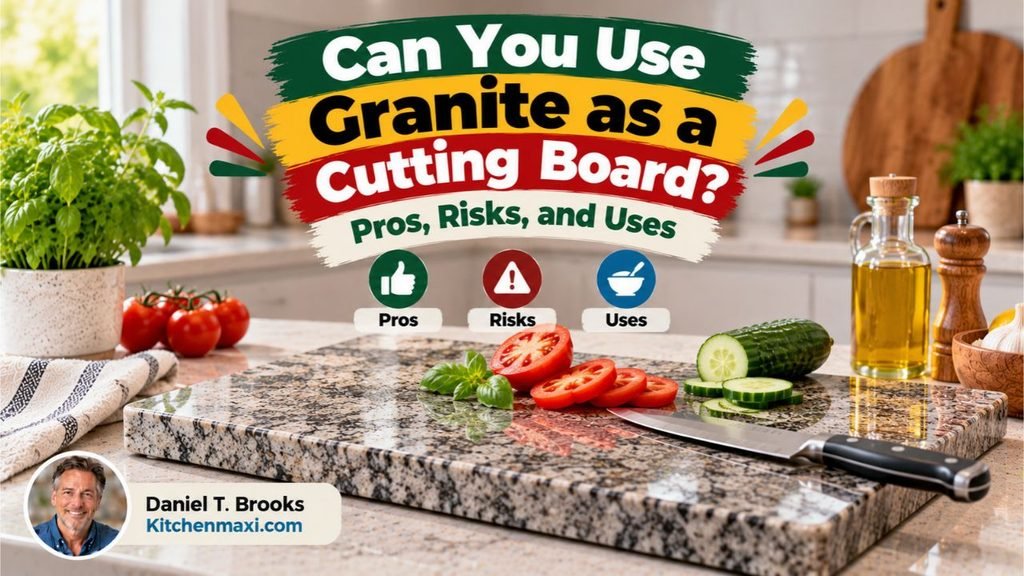
Can You Use Granite as a Cutting Board? Pros, Risks, and Uses
You can cut food on granite, but it is a poor everyday cutting surface. Granite is hard enough to dull kitchen knives quickly, offers almost no cushioning under the blade, and can be less comfortable for repetitive chopping. A wood, plastic, or suitable rubber cutting board is a much better surface for normal knife work.
Granite itself can tolerate contact with a kitchen knife quite well. The bigger problem is what happens to the knife edge. Instead of the cutting surface yielding slightly as wood or plastic does, the blade repeatedly strikes a hard stone surface.
Using a softer board reduces edge wear and gives the knife a more forgiving landing after each cut. That matters during chopping, dicing, mincing, and rocking motions where the edge contacts the board hundreds of times during one meal-prep session.
Food safety is a separate issue from knife care. USDA guidance permits wood and nonporous cutting surfaces and stresses washing boards after use, separating raw meat from ready-to-eat foods, and replacing cutting surfaces that become difficult to clean.
So, can you use granite as a cutting board? Physically, yes. For routine chopping with sharp chef’s knives, I would avoid it. Granite is better used as a pastry surface, serving slab, cheese board, or cool prep surface where repeated knife-to-stone contact is minimal.
Stone condition also matters. Natural granite can contain pores, pits, fissures, seams, and surface treatments. A polished kitchen countertop is not automatically equivalent to a purpose-made removable cutting board that can be washed from all sides.
The main issues are knife dulling, blade damage, food hygiene, countertop care, stability, and the better jobs for a granite slab when you want to use one in the kitchen.
Why Granite Is a Poor Cutting Surface for Kitchen Knives
Granite’s hardness is the main reason it works well as a countertop and poorly as an everyday chopping board.
Granite Gives the Knife Edge Almost No Cushion
Wood and many plastic cutting boards have a small amount of give under the blade.
Granite does not.
Each downward chopping motion ends with the thin knife edge contacting a rigid mineral surface. Repeated contact can roll, abrade, or chip the edge, based on the knife steel, edge geometry, and cutting force.
WÜSTHOF advises against glass, metal, and stone cutting boards because hard surfaces can quickly dull knife edges. ZWILLING gives similar guidance and recommends wood or plastic over stone for knife work.
Granite Contains Very Hard Minerals
Granite commonly contains quartz and feldspar. The Natural Stone Institute describes granite as one of the harder dimension stones and notes that the minerals in many granites are harder than common utensils.
Quartz rates 7 on the Mohs hardness scale, while orthoclase feldspar rates about 6. Common knife blades can fall within a similar broad hardness range when assessed through scratch testing, though Mohs hardness is not the same measurement used for knife-steel hardness.
The practical point is simple: granite is not a forgiving surface for a sharpened edge.
Hard Knife Steel Does Not Solve the Problem
A harder knife is not automatically safer to use on granite.
Hard steels can hold a fine edge for a long time on suitable cutting surfaces, but a thin hard edge can also be more sensitive to impact and micro-chipping.
A softer knife edge may roll instead.
Neither outcome is desirable when a wood or plastic board can avoid much of that repeated stone contact.
Key Takeaway: Granite protects itself better than it protects your knife. Its hard mineral surface can wear, roll, or chip a fine knife edge much faster than a wood or plastic cutting board.
Can Cutting on Granite Damage the Countertop?
Granite is highly resistant to normal knife scratches, but that does not mean direct chopping is risk-free.
The Granite May Resist Scratches Better Than the Knife
The Natural Stone Institute notes that granite’s mineral hardness gives it strong scratch resistance in normal countertop use.
That is why a knife may show damage before a polished granite countertop shows an obvious scratch.
Still, granite is a natural stone rather than an indestructible slab.
Edges and Corners Can Chip
Granite has a crystalline structure and can chip at exposed edges, around cutouts, or where the stone has a weak point.
Heavy chopping with a cleaver near:
- Countertop edges
- Sink cutouts
- Cooktop cutouts
- Seams
- Existing chips
adds impact where you do not want it.
A normal slicing motion is very different from striking the surface repeatedly with a heavy knife.
Knife Metal Can Leave Marks
A mark on granite is not always a scratch in the stone.
Sometimes a softer metal object leaves a trace on the harder surface.
That can create gray or dark marks that look like scratches until cleaned.
Sealers and Surface Treatments Need Consideration
Some granite countertops are treated with penetrating sealers or resins.
Direct cutting may expose these surfaces to:
- Food acids
- Oils
- Abrasion
- Repeated cleaning
The Natural Stone Institute recommends mild, non-acidic cleaning products for natural stone care and notes that some stones receive treatments to increase stain resistance.
Key Takeaway: Granite often withstands light knife contact without obvious scratching, but direct chopping can still create metal marks, edge damage, and unnecessary wear around vulnerable countertop areas.
Is Granite Safe for Food Preparation?
A clean granite surface can be used for many food-prep tasks, but using it as the main cutting board changes how the surface needs to be treated.
Cleanability Matters More Than the Stone Name
USDA guidance says consumers may use wood or nonporous cutting surfaces and recommends washing cutting boards with hot, soapy water after each use. It also recommends separate boards for raw meat, poultry, and seafood when possible to reduce cross-contamination.
A smooth, well-maintained granite surface is easier to clean than one with:
- Cracks
- Deep pits
- Failed seams
- Chipped areas
- Damaged surface treatments
Food debris and liquid are harder to remove from damaged areas.
Countertop Cleaner and Cutting-Board Sanitizer Are Not Always the Same
A cleaner that is suitable for a countertop is not automatically intended for direct food-contact equipment.
USDA distinguishes between sanitizers used on food-contact items and disinfectants used on countertops and other surfaces. Its guidance says commercial products used on cutting boards or utensils should be approved for food-contact use and used according to their labels.
That distinction matters if you turn a fixed granite countertop into a daily raw-meat cutting surface.
Raw Meat Raises the Cleaning Burden
Cutting raw chicken, beef, pork, or seafood directly on a fixed countertop means the entire preparation area needs careful cleaning before it is used for bread, fruit, vegetables, or ready-to-eat foods.
A removable cutting board is simpler to isolate and wash.
USDA recommends keeping raw meat, poultry, and seafood separate from ready-to-eat foods and using separate cutting boards when possible.
A Granite Slab Should Be Stable
A removable granite board is heavy, but a polished stone slab can still slide if the base or countertop underneath is slick.
A cutting surface should remain stable during chopping.
If a granite slab moves under pressure, add non-slip feet or a suitable mat beneath it—but the knife-edge problem remains.
Key Takeaway: Granite can be used for food prep if it is clean, intact, and maintained correctly, but a removable wood or plastic board is simpler for routine cutting and cross-contamination control.
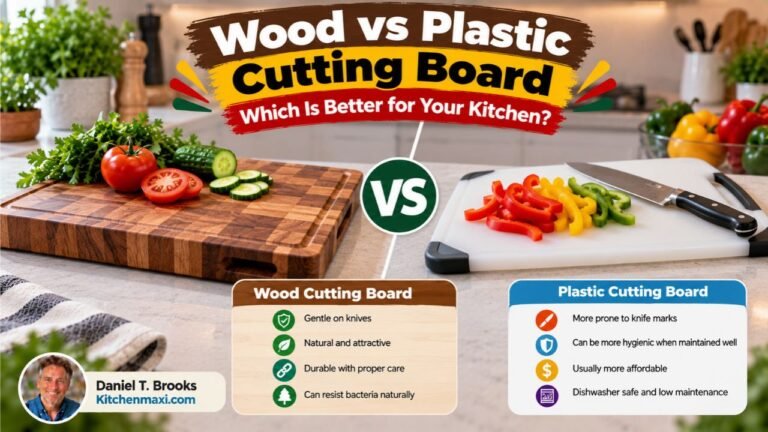
Granite Cutting Board vs. Wood, Plastic, and Bamboo
Granite is not the only hard cutting-board material, so it helps to compare it with common alternatives.
| Cutting Surface | Knife Friendliness | Easy to Wash | Good for Heavy Chopping | Typical Best Use |
| Granite | Poor | Good if smooth and maintained | Poor for knife edge | Pastry, serving, cool prep |
| Wood | Very good | Good with proper cleaning | Very good | Daily chopping |
| Plastic | Good | Very good | Good | Daily prep, raw-food separation |
| Bamboo | Fair to good | Good | Good | General kitchen prep |
| Glass | Poor | Very good | Poor for knife edge | Serving rather than chopping |
Wood Cutting Boards
Wood is one of the most knife-friendly common choices.
The blade can contact the surface without the harsh impact produced by stone or glass.
Common cutting-board woods include:
- Maple
- Walnut
- Cherry
- Beech
Wood does require care. It should be cleaned after use and kept from remaining wet for long periods.
Plastic Cutting Boards
Plastic is inexpensive, lightweight, and simple to dedicate to different food groups.
For example, you can keep one board for raw meat and another for produce.
USDA states that nonporous plastic surfaces are easy to clean and notes that boards with excessively worn or difficult-to-clean grooves should be replaced.
Bamboo Cutting Boards
Bamboo is harder than many traditional cutting-board woods.
USDA describes bamboo boards as hard and less porous than many hardwood boards.
That hardness can mean more knife-edge wear than a softer wood board, though it is still a much more practical cutting surface than granite.
Glass Cutting Boards
Glass shares granite’s main problem: it is too hard for repeated knife contact.
It cleans easily but is rough on sharp knife edges.
That is why major knife makers commonly steer users toward wood or synthetic boards rather than glass or stone.
Key Takeaway: Wood and plastic are better daily cutting surfaces because they are easier on knife edges, while granite and glass are better reserved for prep and serving jobs that do not involve repeated chopping.
What Is a Granite Board Good For Instead of Chopping?
A granite slab can still be useful in the kitchen.
Its weight, smooth surface, and ability to stay relatively cool make it suited to several jobs that involve little or no knife contact.
Rolling Pastry Dough
Granite can work well as a surface for:
- Pie dough
- Tart dough
- Cookies
- Biscuits
- Pizza dough
A smooth stone surface gives you a large, flat area for rolling.
Flour the surface as needed for the recipe.
Working With Chocolate or Candy
A cool stone slab can be useful for some chocolate and confectionery work.
The flat surface is also convenient for spreading or shaping ingredients.
Use a slab intended and maintained for food preparation.
Serving Cheese and Charcuterie
Granite can make an attractive serving surface for:
- Cheese
- Crackers
- Fruit
- Cured meats
- Small desserts
Place foods on the slab, but do the actual slicing on a knife-friendly cutting board before serving when possible.
If guests need to cut cheese at the table, place a small wood board beside the stone.
Preparing Foods That Do Not Require Cutting
A clean granite surface can be useful for:
- Kneading dough
- Shaping pastries
- Arranging ingredients
- Cooling certain foods
- Plating
These jobs take advantage of the stone without repeatedly striking it with a knife.
Key Takeaway: Granite is better as a pastry, serving, cheese, or general prep surface than as a chopping board because those uses preserve both the stone and your knife edges.
How to Protect Granite When Preparing Food
If your kitchen has granite countertops, a few habits reduce staining, contamination, and surface wear.
Put a Cutting Board Over the Granite
This is the simplest solution.
Use:
- Wood for everyday chopping
- Plastic for easy washing
- A separate board for raw proteins when practical
The granite remains underneath as the work surface while the board takes the knife contact.
Wipe Food Spills Promptly
Natural Stone Institute care guidance recommends mild cleaning products and warns against harsh or acidic cleaning chemicals on natural stone.
Foods and liquids that can leave stains should not sit on the surface longer than necessary.
Avoid Harsh Cutting Impacts Near Edges
Keep heavy cleaver work and pounding away from:
- Sink openings
- Counter edges
- Seams
- Thin stone sections
Use a thick wood chopping block for jobs that involve repeated impact.
Keep the Surface Dry Under a Removable Board
Moisture trapped under a board can create mess and allow the board to slide.
Dry both surfaces before starting food prep.
Key Takeaway: The easiest way to use a granite kitchen worktop without harming knives or stone is to place a stable wood or plastic board over it for all cutting tasks.
When a Granite Cutting Board Should Not Be Used for Food Prep
A granite slab may no longer be suitable even for non-cutting food preparation if its surface cannot be kept clean.
Avoid direct food contact when the slab has:
- Open cracks
- Loose repairs
- Deep chips
- Contaminated seams
- Unknown coatings
- Flaking surface treatments
- Areas that cannot be cleaned properly
A decorative granite remnant is not automatically manufactured for food preparation.
If you plan to repurpose leftover countertop stone as a pastry or serving board, check the fabrication history, repair materials, resin treatments, adhesives, and surface condition first.
A slab that contains unknown bonding compounds or coatings is better kept as decoration rather than used for direct food contact.
Conclusion
For can you use granite as a cutting board, the practical answer is that you can, but you should not use it as your normal chopping surface. Granite is hard, rigid, and resistant to many scratches, which means your knife edge takes much of the impact instead.
Wood and plastic give a sharp kitchen knife a more forgiving surface. They also make it easier to keep separate boards for produce and raw meat, wash the cutting area thoroughly, and replace the board once it becomes badly worn.
Granite still has plenty of kitchen uses. A clean, intact slab works well for pastry dough, serving cheese, arranging food, and other prep tasks that do not involve repeated blade contact.
My preference is simple: keep the granite for the jobs stone does well and put a wood or plastic cutting board on top whenever a knife is involved.
FAQs About Using Granite as a Cutting Board
Will Cutting on Granite Dull Knives?
Yes. Granite is a very hard surface, and repeated contact can dull a fine knife edge much faster than cutting on wood or plastic.
Knife makers such as WÜSTHOF and ZWILLING advise against stone cutting surfaces for this reason.
Will a Knife Scratch a Granite Countertop?
Many granite countertops resist normal knife scratches because granite contains hard minerals such as quartz and feldspar.
The knife may suffer edge wear before the stone shows visible damage. Granite can still chip or develop damage around weaker areas, so direct cutting is not recommended.
Is Granite Hygienic for Food Preparation?
A smooth, clean granite surface can be used for food preparation, but hygiene depends on surface condition, cleaning, and cross-contamination control.
USDA recommends washing food-contact cutting surfaces after use and separating raw meat, poultry, and seafood from foods that will be eaten without further cooking.
Can You Cut Raw Meat on Granite?
It is possible, but a separate removable cutting board is more practical.
Raw meat juices can spread across the fixed worktop and increase the area that needs careful cleaning. A dedicated plastic or wood board keeps the raw-food preparation area easier to isolate.
Is Granite Better Than Marble for a Cutting Board?
Neither is a good everyday cutting surface for sharp knives.
Both are much harder and less forgiving than wood or plastic. Granite is generally more scratch-resistant than marble, but the knife-edge problem remains.
Can I Use a Granite Slab as a Pastry Board?
Yes, an intact granite slab can be useful for rolling and shaping pastry when it is clean and suitable for food contact.
This use avoids the repeated knife strikes that make granite a poor chopping surface.
What Is the Best Cutting Board to Use on Granite Countertops?
Wood or plastic is a better choice for everyday knife work.
A stable board protects knife edges, keeps direct chopping off the granite, and gives you a removable surface that can be cleaned separately after food preparation.