JK Adams Cutting Board Review: Quality, Pros, Cons, and Value
JK Adams makes well-built wood cutting and carving boards for buyers who want North American hardwood, U.S. manufacturing, several size choices, and a board designed to last with regular care. The strongest options are its maple prep boards for everyday use, reversible carving boards for meat, and thicker end-grain boards for frequent knife work.
JK Adams is not a single-board brand. Its current line ranges from compact 12 × 8-inch maple prep boards to 20 × 16-inch professional end-grain blocks, plus carving boards in maple, cherry, and walnut. That makes the brand useful for different kitchens rather than forcing every buyer into one oversized butcher block.
The company has been making wood kitchen products in Dorset, Vermont since 1944 and remains family owned. Its current cutting boards use sustainably harvested North American hardwoods, and many carry a lifetime guarantee against qualifying manufacturing defects or shipping damage.
For this JK Adams cutting board review, the main question is not simply whether the brand makes good boards. It does. The more useful question is which JK Adams construction fits your work: a lightweight prep board, a reversible carving board with juice management, an Infinity Edge end-grain board, or a thick Professional end-grain block.
The flagship Maple Reversible Carving Board deserves special attention. The current 20 × 14-inch model is 1.25 inches thick, has a poultry well on one side, a flat cutting area with a juice groove on the other, and sells for $135 at the time of checking. America’s Test Kitchen has also named this design a longtime carving-board favorite.
My overall view is that JK Adams is strongest for buyers who appreciate natural wood, are willing to hand wash and oil it, and want a board that can stay in the kitchen for years. The weak point is maintenance: these are not dishwasher boards, and the thick end-grain models are heavier and more expensive than basic maple prep boards.
JK Adams Cutting Board Review: Quick Verdict
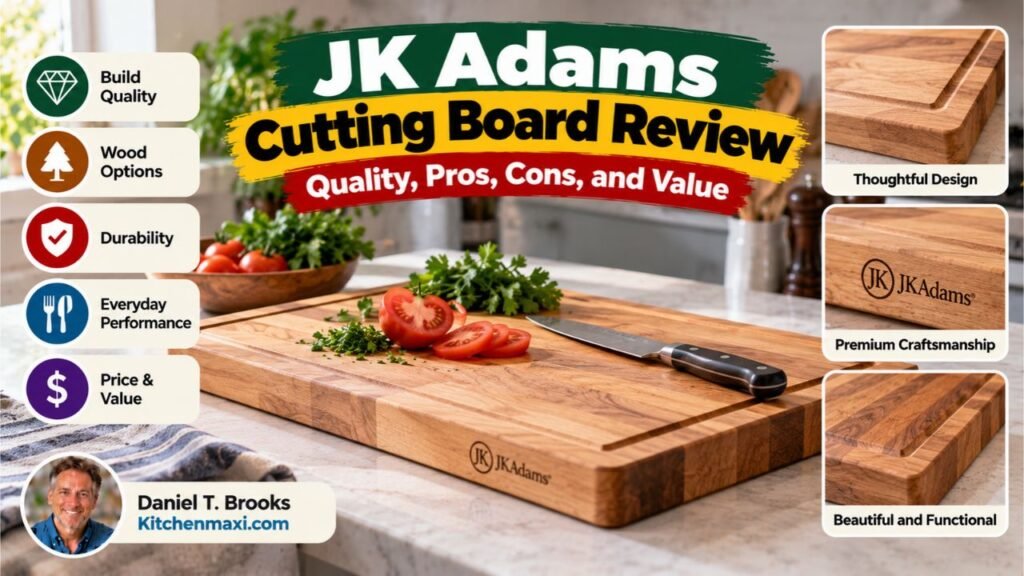
JK Adams earns a strong recommendation for wood-board buyers, but the right model matters.
The brand offers three clear levels.
A basic maple prep board is the easiest choice for routine vegetables, fruit, sandwiches, and light meat prep.
The Reversible Carving Board makes more sense if poultry, brisket, roasts, or other juicy foods are common in your kitchen.
The Professional and Infinity Edge end-grain models are better matched to frequent chopping and buyers who want a thick permanent workstation.
Prices also span a wide range. Current maple prep boards begin around $30, while large Professional End Grain Maple Boards reach $340.
That gives JK Adams an advantage over brands that sell only premium butcher blocks. You can enter the line with a simple prep board before spending several hundred dollars on a large end-grain model.
Which JK Adams Cutting Board Should You Buy?
The product range can look confusing at first because several boards share similar wood and finishes.
The intended use separates them more clearly.
JK Adams Maple Prep Cutting Boards
The Maple Prep line is the simplest place to start.
Current examples include approximately:
- 12 × 8 × 0.75 inches
- 14 × 10 × 0.75 inches
- 16 × 12 × 0.75 inches
- Larger reversible prep options
The 12 × 8-inch model is currently $30, while a 16 × 12-inch juice-groove model is around $50. Both are made from sustainably harvested North American hardwood, finished with mineral oil and beeswax, and backed by JK Adams’ lifetime guarantee.
These thinner boards are easy to lift and wash.
I would choose one for:
- Chopping vegetables
- Slicing fruit
- Sandwich prep
- Cheese
- Small portions of meat
- Daily knife work in a compact kitchen
They do not provide the mass or thickness of a butcher block, but that can be an advantage if you move the board to the sink after every meal.
JK Adams Maple Reversible Carving Board
The 20 × 14 × 1.25-inch Maple Reversible Carving Board is one of the most distinctive products in the range.
One side contains a recessed area that steadies poultry or a roast.
The other provides a flat cutting surface.
Both sides are designed around liquid control, and the board is large enough for turkey, chicken, brisket, melon, cabbage, and similar large foods.
America’s Test Kitchen praised this board for its balance of weight, handling, liquid capacity, and poultry well. JK Adams reports that the surrounding trenches can accommodate more than half a cup of liquid.
If carving meat is the priority, this is the JK Adams board I would choose.
JK Adams Infinity Edge End Grain Maple Board
The Infinity Edge model is a middle ground between a thin prep board and the massive Professional end-grain series.
The current 20 × 12-inch maple version measures 1.5 inches thick and sells for $185. Its rounded edges make the board easier to pick up, and the surface is finished with mineral oil and beeswax.
This shape makes sense for someone who wants:
- End-grain construction
- Daily chopping space
- Less weight than the largest butcher blocks
- A board that can still be lifted for washing
It has a simpler surface than the dedicated carving boards, so buyers who routinely cut juicy roasts may prefer a model with a substantial groove.
JK Adams Professional End Grain Maple Board
The Professional End Grain series is the heavier option.
The 16 × 16-inch maple model is:
- 16 × 16 inches
- 2 inches thick
- About 13 pounds
- Currently $235
The 20 × 16-inch version is also 2 inches thick, weighs around 16 pounds, and currently sells for $340.
These are boards that make sense as permanent countertop workstations.
You can move them, but they are not the kind of cutting surface most people will casually pull from a cabinet to slice one lemon.
Key Takeaway: Choose a Maple Prep Board for easy daily handling, the Reversible Carving Board for poultry and roasts, Infinity Edge for a manageable end-grain option, and Professional End Grain for a heavy permanent chopping station.
How Good Is the JK Adams Maple Reversible Carving Board?
This is the model that gives JK Adams much of its reputation.
Its design solves two specific carving problems: keeping large food stable and containing juices.
Poultry Well Performance
The recessed side cradles rounded foods.
That matters with:
- Turkey
- Whole chicken
- Large roast
- Pineapple
- Melon
- Cabbage
A flat board can allow rounded food to move while you cut.
The molded recess gives the food a more stable resting area.
America’s Test Kitchen specifically praised the poultry well for holding turkey and chicken without interfering with the carving knife.
Juice Groove Performance
The reverse side gives you a flatter workspace surrounded by a deep groove.
For:
- Brisket
- Roast beef
- Pork
- Steak
- Juicy fruit
that groove keeps more liquid on the board instead of allowing it to run directly onto the counter.
The related JK Adams Pour Spout Carving Board adds a corner pouring channel. Epicurious liked the ability to direct liquid out of the board but found that the grooves reduce some usable cutting area, which is a fair tradeoff to consider.
Everyday Chopping on the Carving Board
You can use the flat side for routine food prep.
The 20 × 14-inch footprint gives plenty of room for an 8-inch chef’s knife and several ingredients.
The issue is that buyers who rarely carve meat may be paying for a specialized recessed side they seldom use.
A simpler Maple Prep or end-grain board may fit daily chopping better.
Key Takeaway: The Reversible Carving Board stands out when meat and juicy foods are part of the job; for pure vegetable prep, JK Adams has simpler boards with more straightforward surfaces.
JK Adams End Grain Cutting Board Performance
End-grain construction is one of the main reasons to move into the more expensive JK Adams boards.
Instead of presenting long wood fibers across the cutting surface, the ends of the fibers face upward.
End Grain and Knife Contact
JK Adams describes its end-grain construction as more forgiving to knife edges because the fibers can separate slightly as the blade enters the surface.
Knife marks also tend to appear less prominently than on many conventional long-grain surfaces.
That makes end grain attractive for cooks who spend a lot of time:
- Chopping onions
- Mincing herbs
- Cutting vegetables
- Portioning meat
- Using a chef’s knife daily
End Grain Feels More Substantial
The Professional 16 × 16 board weighs about 13 pounds.
The 20 × 16 reaches about 16 pounds.
That mass keeps the board planted during chopping, though it also makes washing more physical.
End Grain Costs More
The construction requires more material and labor than a thin prep board.
Current maple end-grain prices range from roughly $140 for a 16 × 10-inch Infinity Edge model to $340 for the 20 × 16-inch Professional model.
That price jump only makes sense if you want the thicker construction and expect to use it frequently.
Key Takeaway: JK Adams end-grain boards are best for frequent knife work and buyers who want a thick countertop block, but they cost much more and require more effort to wash and move.
JK Adams Cutting Board Sizes and Current Prices
JK Adams offers far more size variety than many wood-board brands.
Here are several current maple examples:
| JK Adams Board | Size | Thickness | Current Price* |
| Maple Prep Board | 12 × 8 in. | 0.75 in. | $30 |
| Maple Prep Board | 14 × 10 in. | 0.75 in. | $36 |
| Reversible Prep Board | 20 × 16 in. | 0.75 in. | $70 |
| Maple Reversible Carving Board | 20 × 14 in. | 1.25 in. | $135 |
| Infinity Edge End Grain Maple | 16 × 10 in. | about 1.5 in. | $140 |
| Infinity Edge End Grain Maple | 20 × 12 in. | 1.5 in. | $185 |
| Professional End Grain Maple | 16 × 16 in. | 2 in. | $235 |
| Professional End Grain Maple | 20 × 16 in. | 2 in. | $340 |
*Prices were checked in October 2026 and can change.
Best JK Adams Size for Everyday Prep
Around 16 × 12 inches works well for a typical home kitchen.
It gives enough area for vegetable prep without creating a difficult washing job.
Best JK Adams Size for Carving
The 20 × 14-inch Reversible Carving Board gives a useful balance between food capacity and handling.
JK Adams also sells a 24 × 16-inch version for buyers who regularly carve larger food.
Best JK Adams Size for a Permanent Workstation
The 16 × 16 or 20 × 16-inch Professional End Grain boards make more sense when the board will remain on the counter most of the time.
Key Takeaway: JK Adams covers compact prep boards through heavy butcher blocks, so the best size depends as much on washing and storage as on available cutting area.
JK Adams Cutting Board Build Quality and Materials
The brand’s appeal is closely tied to its wood selection and manufacturing approach.
JK Adams states that its wood products are produced in Dorset, Vermont from sustainably harvested North American hardwoods. The company has operated since 1944 and remains family owned.
Maple is the dominant wood in the cutting-board range, though cherry and walnut are also available in several lines.
Maple
Maple is the easiest JK Adams wood to recommend for most kitchens.
It has:
- A light natural appearance
- A firm chopping surface
- Wide product availability
- Lower pricing than many walnut versions
The light color can show food staining more readily. Epicurious noted slight beet staining during testing of a JK Adams maple board.
Walnut
Walnut gives a much darker appearance.
It also costs more in the Professional end-grain line. The current 20 × 16-inch Professional End Grain Walnut model is listed at $425.
Cherry
Cherry sits visually between light maple and dark walnut and develops a warmer appearance.
JK Adams sells both carving and end-grain cherry models.
Wood color should be a secondary decision after construction, size, and intended use.
Does a JK Adams Cutting Board Warp?
Any solid wood board can move as moisture changes.
That is not unique to JK Adams.
The company specifically warns that wood expands and contracts with moisture and humidity, which is why it tells owners to avoid soaking and to condition all surfaces.
Long-term owner feedback is mixed in the way you would expect with natural wood. Some community owners report using JK Adams boards for a decade or more without trouble, while a few report early warping or dryness. Those reports are individual experiences rather than a measured failure rate.
Ways to Reduce Warping Risk
Wash both sides as needed rather than saturating only one face.
Dry the board promptly.
Do not:
- Leave it in the sink
- Soak it
- Run it through the dishwasher
- Store it while wet
Oil all surfaces, including:
- Top
- Bottom
- Sides
- Ends
Uneven moisture is one of the main conditions that encourages a wood board to cup or twist.
How to Clean a JK Adams Cutting Board
JK Adams gives clear care instructions for its wood products.
Wash the board by hand with warm, soapy water after use.
Dry it thoroughly with a towel.
Do not:
- Soak the board
- Submerge it for long periods
- Put it in the dishwasher
- Put it in a microwave
- Place very hot cookware directly on it
Those instructions apply across the prep, carving, Infinity Edge, and Professional end-grain boards.
Cleaning After Vegetables
Warm water, mild dish soap, and a soft sponge are usually enough.
Dry promptly.
Cleaning After Raw Meat
Wash the board promptly with warm soapy water.
Clean any juice grooves or poultry recess thoroughly.
Dry the entire board rather than leaving liquid trapped in a groove.
Do Not Put JK Adams Boards in the Dishwasher
Heat, detergent, and prolonged water exposure can damage wood.
A dishwasher can lead to:
- Cracking
- Warping
- Glue-joint stress
- Rough grain
- Dryness
Key Takeaway: JK Adams boards are hand-wash-only products, and prompt drying is just as important as washing if you want the wood to remain flat and stable.
How Often Should You Oil a JK Adams Cutting Board?
JK Adams ships many boards finished with mineral oil and beeswax.
The company currently recommends applying mineral oil or beeswax conditioner about once a week while the finish becomes established and again whenever the board feels dry.
That does not mean every board will need weekly oil forever.
Climate, washing frequency, and board thickness change how quickly wood dries.
Signs the Board Needs Oil
Look for:
- Pale dry areas
- Rougher texture
- Water absorbing immediately
- Raised grain
- Dull appearance
Apply food-grade mineral oil across all surfaces rather than only the cutting face.
What If the Grain Becomes Rough?
JK Adams recommends lightly buffing raised grain with approximately 200-grit sandpaper, then applying wood conditioner again.
That makes the boards more repairable than many synthetic cutting surfaces.
JK Adams Lifetime Warranty: What It Actually Covers
The lifetime guarantee is a real advantage, but it should be described accurately.
JK Adams states that damaged products or products with a manufacturer’s defect can qualify for replacement.
The warranty does not apply to items bought secondhand.
A claim normally requires product information and a photo, and JK Adams says processing may take two to four weeks. International replacement may not always be possible.
The warranty should not be interpreted as permission to ignore wood care.
Damage caused by soaking, dishwasher use, severe heat, or poor maintenance should not be assumed to qualify as a manufacturing defect.
JK Adams Cutting Board Pros and Cons
JK Adams Cutting Board Pros
The main advantages are:
- Made in Vermont
- North American hardwood
- Large choice of sizes
- Maple, cherry, and walnut options
- Prep, carving, and end-grain constructions
- Mineral-oil-and-beeswax finish on many models
- Lifetime guarantee for qualifying issues
- Reversible choices
- Strong carving-board design
- Thick professional end-grain options
- Personalization available on many products
JK Adams Cutting Board Cons
The main drawbacks are:
- Hand washing only
- Regular conditioning required
- Large end-grain boards are heavy
- Premium models become expensive
- Light maple can show stains
- Juice grooves reduce some flat working area
- Natural wood can move if moisture care is poor
- Some models lack features such as rubber feet or a juice groove
Key Takeaway: JK Adams offers strong craftsmanship, size choice, and repairable wood surfaces, but owners need to accept hand washing, conditioning, weight, and higher pricing on the end-grain models.
JK Adams Cutting Board vs Cheap Wood Cutting Boards
A low-cost board may perform basic chopping perfectly well.
The difference becomes more visible over years of ownership.
With JK Adams, you are paying for features such as:
- U.S. manufacturing
- Selected hardwood
- Established board designs
- Multiple thicknesses
- Specialized carving surfaces
- End-grain construction options
- Lifetime warranty support
That does not mean every cook needs the premium model.
A $30 JK Adams Maple Prep Board may be a better purchase for a small kitchen than a $340 Professional block that becomes too heavy to wash comfortably.
Price should follow the task.
Who Should Buy a JK Adams Cutting Board?
Buy One if You Want a Long-Term Wood Board
The brand makes sense if you want a cutting board that can be:
- Oiled
- Lightly sanded
- Maintained
- Kept for years
This is different from treating a thin plastic board as a low-cost replaceable item.
Buy the Carving Board if You Cook Large Meat
Turkey, roast chicken, brisket, and roasts are where the Reversible Carving Board earns its space.
Its poultry well and juice management are the reason to choose it over a flat board.
Buy End Grain if You Chop Frequently
The Infinity Edge and Professional lines make more sense for frequent knife work and buyers who want a substantial board left on the counter.
Skip JK Adams if You Want Dishwasher Cleaning
If dishwasher compatibility is non-negotiable, these wood boards are the wrong product type.
Skip the Thick Models if You Need Easy Portability
A 13- or 16-pound Professional board can become annoying if it has to be moved and washed after every small task.
Key Takeaway: JK Adams is a strong match for buyers who want maintained hardwood cookware; it is less suitable for someone who wants dishwasher cleaning or a lightweight zero-maintenance board.
Which JK Adams Cutting Board Is Best?
There is no single winner for every kitchen.
My picks by use would be:
| Use | JK Adams Board I Would Choose |
| Small kitchen | Maple Prep Board 12 × 8 or 14 × 10 |
| Everyday chopping | Maple Prep Board 16 × 12 |
| Large everyday prep | Reversible Prep Board 20 × 16 |
| Turkey and roast carving | Maple Reversible Carving Board 20 × 14 |
| Larger holiday carving | Maple Reversible Carving Board 24 × 16 |
| Daily end-grain chopping | Infinity Edge Maple 20 × 12 |
| Heavy butcher-block use | Professional End Grain Maple 16 × 16 |
| Maximum prep space | Professional End Grain Maple 20 × 16 |
The flagship 20 × 14 Reversible Carving Board is the most distinctive JK Adams model.
For pure daily chopping, I would lean toward the 16 × 12 Maple Prep Board for easy handling or the 20 × 12 Infinity Edge if end grain is the priority.
Is a JK Adams Cutting Board Worth the Money?
For the right buyer, yes.
The lower-priced maple prep boards are easy to justify because they bring the JK Adams construction and warranty into a relatively modest price range.
The carving board also makes sense because its poultry well and juice control solve a clear problem rather than merely adding decorative detail.
The end-grain boards require more thought.
At $185 to $340 for larger maple models, you should genuinely want:
- End-grain construction
- Thick hardwood
- A permanent work surface
- Long-term maintenance
If you mainly cut one onion or piece of fruit at a time, that money is difficult to justify.
If you cook most days and want a substantial wood surface, the higher price can make more sense.
Conclusion
This JK Adams cutting board review finds a strong wood-board line with clear differences between its everyday prep, carving, and end-grain models. The brand’s main strengths are its Vermont manufacturing, North American hardwoods, broad size selection, practical carving designs, and lifetime guarantee for qualifying defects.
The Maple Reversible Carving Board is the standout for turkey, chicken, brisket, and roasts. Its poultry well and deep liquid-management design make it more specialized than a normal flat board, and independent testing has treated it favorably.
For everyday chopping, the thinner Maple Prep Boards cost less and are much easier to carry to the sink. Buyers who want end grain can move to the Infinity Edge line, while the 2-inch Professional models suit cooks who want a heavy permanent workstation.
I would recommend JK Adams to someone who genuinely wants a wood cutting board and is prepared to maintain it. Hand washing, prompt drying, and periodic mineral oil are part of ownership. If that routine sounds reasonable, the brand offers enough sizes and constructions to find a board that fits almost any home kitchen.
FAQs About JK Adams Cutting Boards
Are JK Adams cutting boards good?
Yes. JK Adams uses North American hardwoods and manufactures its wood products in Dorset, Vermont. The range includes affordable maple prep boards, carving boards, and thick end-grain models, so quality and price can be matched to the intended use.
Where are JK Adams cutting boards made?
JK Adams states that its wood products are made in Dorset, Vermont. The company was founded in 1944 and remains family owned.
What wood does JK Adams use for cutting boards?
Maple is the most common option, with cherry and walnut also available in several carving and end-grain lines. JK Adams states that it uses sustainably harvested North American hardwood.
Are JK Adams cutting boards dishwasher safe?
No. JK Adams instructs owners to hand wash its wood boards with warm soapy water and dry them thoroughly. The company specifically says not to soak them or put them in a dishwasher.
How often should I oil a JK Adams cutting board?
JK Adams recommends conditioning the board about weekly while the finish becomes established and any time the wood feels dry. Apply oil to all faces, edges, and ends rather than conditioning only the top.
Is the JK Adams Reversible Carving Board worth it?
It is a strong choice if you regularly carve poultry or roasts. The 20 × 14-inch model provides a poultry recess on one side and a flatter grooved surface on the other, giving it more carving-specific function than a basic flat cutting board.
Is JK Adams end grain better for everyday chopping?
End grain is a strong option for frequent chopping because the upright wood fibers yield under the knife and tend to hide cut marks well. The tradeoff is higher price, extra thickness, and more weight.
Does JK Adams have a lifetime warranty?
Yes. Its current lifetime guarantee covers qualifying shipping damage and manufacturer defects. Secondhand purchases are excluded, and claims require review by JK Adams.