Is a Rubber Cutting Board Worth It? Pros, Cons & Buying Advice
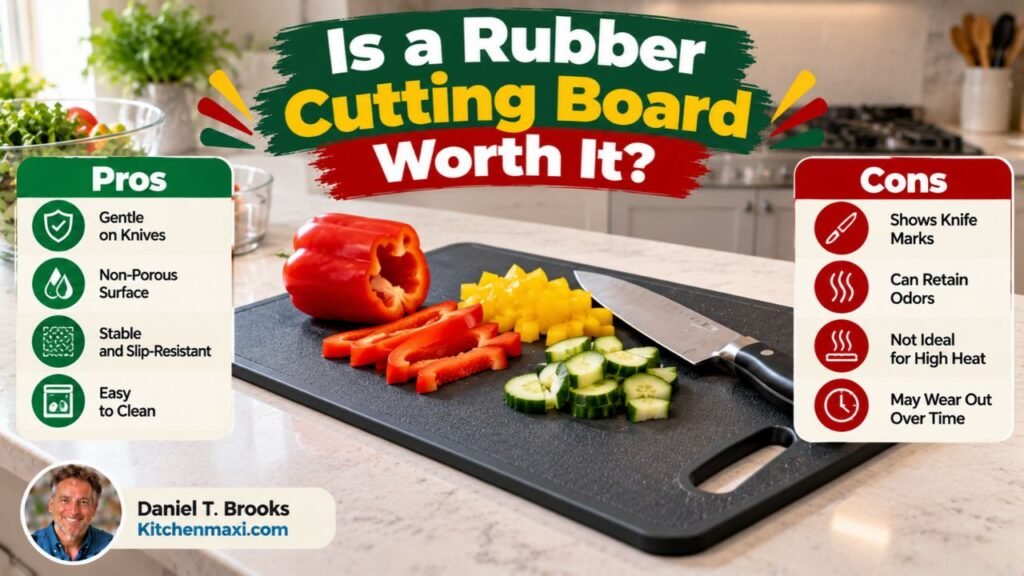
A good rubber cutting board is worth buying if you care about keeping sharp knives in good condition, want a board that stays planted on the counter, and prefer a non-absorbent surface that does not need oiling. It is less appealing if you want a lightweight, inexpensive board that can always go in the dishwasher.
Rubber has a slight give under a knife edge. That softer feel is a major reason rubber boards are common in professional and sushi-focused kitchens, where thin, sharp blades are used for repeated slicing. Bon Appétit and Epicurious both rate rubber highly for knife friendliness.
The main drawbacks are weight, cost, and cleaning convenience. Solid rubber boards can be thick and heavy, and many popular models must be washed by hand because high dishwasher temperatures can soften or warp the material. Asahi specifically says its synthetic-rubber board should not go in a dishwasher or dish dryer.
For is a rubber cutting board worth it, the answer depends mostly on your knives and kitchen habits. If you own sharp Japanese knives, slice fish, prepare vegetables every day, or dislike oiling wood boards, rubber makes a strong case. If you mostly use inexpensive knives and want the cheapest dishwasher-safe board, plastic may make more sense.
Rubber boards are also not all built the same. Asahi uses synthetic rubber, Hasegawa uses a softer elastomer surface over a wood core on several models, and some commercial rubber boards are built to tolerate machine washing. Care instructions should come from the maker of the exact board rather than from a generic rule about rubber.
The sections below explain how rubber feels under a knife, how it handles cleaning and stains, how it compares with wood and plastic, who gets the most from it, and which tradeoffs matter before paying more for one.
What Is a Rubber Cutting Board?
A rubber cutting board is a food-prep board made from a rubber-like material rather than hardwood, polyethylene, glass, stone, or bamboo.
Many well-known kitchen boards in this category use synthetic rubber or elastomer, not natural latex rubber. Parker Asahi states that its Cookin’ Cut boards are made from synthetic rubber. Hasegawa describes the soft surface on its Pro-Soft boards as elastomer over a rigid wood core.
The surface is softer than glass, stone, ceramic, and many hard plastic boards. That small amount of give is what makes rubber attractive to cooks who use fine knife edges.
A solid rubber board is also dense. That density adds weight and helps the board resist sliding, but it can make a large model harder to carry to the sink.
Why a Rubber Cutting Board Can Be Worth It
Rubber Is Gentle on Knife Edges
Knife care is the strongest reason to buy one.
Bon Appétit describes rubber as one of the better board materials for preserving knife edges because the surface flexes slightly as the blade contacts it. Epicurious makes the same point and highlights rubber for cooks who want to reduce how often their knives need sharpening.
Hasegawa also markets its soft cutting surfaces around the same property: the surface cushions knife strokes instead of presenting a hard barrier.
This matters most with thin Japanese chef’s knives, yanagiba, usuba, nakiri, and other blades with fine edges.
The Board Usually Stays Put
Heavy rubber has natural grip.
A thick rubber cutting board often sits securely without the damp towel trick commonly used under lightweight plastic boards. Bon Appétit found its tested rubber board stable on the counter, and JB Prince notes that the weight of its food-grade rubber board adds stability during slicing and chopping.
A board that does not creep across the counter also feels more controlled during fast vegetable prep.
Rubber Does Not Need Mineral Oil
Wood boards need periodic oiling to reduce drying and cracking.
Rubber boards do not.
Bon Appétit notes that rubber boards need normal washing rather than the mineral-oil care used on wood. That makes ownership simpler for someone who wants a premium cutting surface without a maintenance routine built around oil and wax.
Many Rubber Boards Can Be Resurfaced
Surface wear does not always mean the board is finished.
Parker Asahi says stubborn stains and worn surfaces can be polished, and it gives a resurfacing method using #100 water-resistant sandpaper under running water, followed by cleaning. JB Prince also sells rubber boards described as capable of being resurfaced once grooves form.
That feature can extend service life compared with a thin plastic board that has developed deep grooves and cannot be restored.
Key Takeaway: Rubber earns its higher price mainly through knife-friendly feel, counter stability, low oil-maintenance needs, and the ability of some models to be resurfaced.
Rubber Cutting Board Drawbacks to Consider
Rubber Boards Can Be Heavy
Weight is both a strength and a drawback.
Bon Appétit and Epicurious both flag rubber boards as heavy compared with common plastic options. Tom’s Guide also notes that solid rubber can be heavier than wood in similar sizes.
A heavy board is pleasant while chopping, but less pleasant when it has to be lifted into a small sink several times a day.
If mobility matters, a wood-core soft board such as Hasegawa’s Pro-Soft Lite reduces some of that mass; Hasegawa says its wood core cuts weight by roughly 30–50% compared with solid plastic-style boards.
Many Models Are Not Dishwasher-Safe
This is one of the biggest practical limits.
Parker Asahi says high dishwasher and dish-dryer temperatures can soften its synthetic rubber and cause warping. Bon Appétit also lists the tested Hi-Soft rubber board as hand-wash only.
There are exceptions. Hasegawa says most of its wood-core cutting boards are dishwasher-safe, and JB Prince lists some commercial rubber boards as suitable for commercial dishwashers.
The label on the exact board matters.
Rubber Can Stain
Light-colored rubber may show beet, turmeric, tomato, or other pigment stains.
Bon Appétit observed staining on a light rubber board during long-term use, even though the board still cleaned up well.
A stain does not automatically mean the surface is dirty. It does mean a pale rubber board may lose its new appearance sooner than a dark board.
Some Boards Have a Rubber Smell When New
Odor varies by product.
Parker Asahi says its boards can have an odor from the synthetic-rubber material and wood chips used in the board, and that the smell fades with use. The company recommends shade drying or approved bleaching if the smell is bothersome.
Bon Appétit noted that its preferred Hi-Soft board did not have the tire-like smell found on another rubber board it tested.
Good Rubber Boards Often Cost More Than Plastic
Premium rubber boards often sit closer to quality wood boards than bargain plastic in price.
Bon Appétit and Epicurious both describe rubber as more expensive than ordinary plastic.
The extra cost makes more sense if knife care and long service life matter to you.
Key Takeaway: The main costs of rubber are literal and practical: higher purchase price, more weight, possible staining or odor, and hand washing on many models.
Rubber Cutting Board vs Wood vs Plastic
| Feature | Rubber | Wood | Plastic |
| Knife friendliness | Excellent on soft models | Very good on suitable hardwood | Varies by hardness |
| Counter grip | Usually strong | Moderate; may need a mat | Varies |
| Weight | Often heavy | Medium to heavy | Usually light |
| Oiling needed | No | Usually yes | No |
| Dishwasher use | Model-specific | Usually poor for laminated boards | Often yes |
| Resurfacing | Possible on some models | Usually possible | Usually not practical |
| Staining | Possible | Possible | Possible |
| Appearance | Plain, professional | Warm and decorative | Utilitarian |
| Price | Medium to high | Medium to high | Low to medium |
USDA does not rank rubber against wood or plastic as the single safest choice. Its general advice is to keep cutting boards clean, use separate boards for raw animal foods when practical, and replace any board once deep grooves become hard to clean.
Rubber vs Wood for Knife Care
Both can be very good under a sharp knife.
Rubber has an advantage in maintenance because it does not need oiling and does not have wood grain that can dry or split.
Wood wins on appearance and can be much nicer as a board that stays visible on the counter.
If you enjoy maintaining wood and like its feel, switching to rubber is not mandatory. If you want low-maintenance knife friendliness, rubber is easier.
Rubber vs Plastic for Daily Prep
Plastic is usually cheaper, lighter, and easier to put in a dishwasher.
Rubber generally feels softer under a knife and stays in place better because of its mass and grip. Bon Appétit and Tom’s Guide both favor rubber for knife friendliness.
For someone who carries boards to the sink often, plastic can still be more convenient.
Rubber vs Glass, Stone, or Metal
Rubber is the better chopping surface for knife care.
Hard materials such as glass, ceramic, stone, and metal do not yield under the blade. Serious Eats recently recommended wood, plastic, or rubber instead of titanium after testing found the hard metal surface dulled knife edges quickly.
Keep glass, stone, and metal boards for serving or other non-chopping tasks.
Key Takeaway: Rubber combines the knife-friendly feel associated with good wood and the low-oil maintenance associated with plastic, but it gives up some portability and dishwasher convenience.
Is a Rubber Cutting Board Good for Japanese Knives?
Yes. This is one of the strongest reasons to consider rubber.
Thin Japanese edges benefit from a surface that gives slightly instead of stopping the blade against a very hard material.
Bon Appétit specifically recommends rubber for people who use Japanese knives, and Hasegawa positions its soft boards for delicate slicing such as sushi and sashimi.
Rubber can feel different from wood during rocking cuts. Bon Appétit notes that the springy surface favors slicing motions and may feel less natural to someone who uses a heavy Western knife with strong rocking action.
For gyuto, nakiri, sashimi knives, and fine push-cutting work, that softer feel is often a reason to buy the board rather than a drawback.
Are Rubber Cutting Boards Hygienic?
A rubber board can be kept sanitary with normal food-surface cleaning, but material alone does not keep a board clean.
USDA recommends washing cutting boards with hot, soapy water after use, rinsing, and drying. It also recommends separate boards for produce and raw meat, poultry, or seafood when practical.
Many rubber boards are non-absorbent. A school-nutrition equipment guide from the Institute of Child Nutrition lists rubber or silicone cutting surfaces as non-absorbent and notes that knife cuts may be sanded away on some types.
The rule that matters most is surface condition. If cuts become deep enough to trap food and cannot be cleaned or resurfaced, the board should be retired. USDA gives the same replacement advice for worn cutting boards in general.
For raw chicken, fish, and meat, cleaning immediately after prep is more important than relying on the material name.
How to Care for a Rubber Cutting Board
Wash It Soon After Use
Use warm water, neutral dish detergent, and a brush or sponge approved for the board.
Parker Asahi recommends neutral detergent, thorough rinsing, wiping away water, and drying after washing.
Prompt washing also reduces staining from strongly colored foods.
Check the Dishwasher Rule
Do not assume rubber means dishwasher-safe or hand-wash only.
Asahi says no dishwasher. Hasegawa says most of its boards are dishwasher-safe because the wood-core construction adds heat resistance. JB Prince lists some commercial rubber boards for machine washing.
Follow the exact model’s temperature limit.
Keep It Away From Excess Heat
A rubber board is not a trivet.
Asahi warns that high heat can soften and warp its synthetic rubber. Hasegawa also publishes heat limits for individual products, which vary by series.
Do not set a hot skillet, sheet pan, or Dutch oven on the board unless the maker specifically allows that use.
Resurface Only if the Maker Permits It
Some solid rubber boards can be sanded or scraped to remove knife marks and stains.
Asahi provides a resurfacing method for its boards, and JB Prince describes its commercial rubber boards as resurfaceable.
Do not sand a layered, wood-core, or specialty board unless the manufacturer says that method is safe for that product.
Key Takeaway: Wash rubber promptly, respect its heat and dishwasher limits, and only resurface boards whose makers specifically permit sanding or scraping.
When Should You Replace a Rubber Cutting Board?
Replace the board if it develops damage that can no longer be cleaned or safely repaired.
Warning signs include:
- Deep grooves that retain food
- Cracks or splits
- Warping that makes the board rock
- Pieces breaking away from the surface
- Layers separating on a laminated or core-style board
- Persistent contamination or odor that cleaning does not remove
USDA says worn cutting boards should be replaced once grooves become difficult to clean.
A resurfaceable solid rubber board may last much longer before reaching that point. Parker Asahi does not set a fixed life because use and care vary, though the company says long service periods are possible with proper maintenance.
Who Should Buy a Rubber Cutting Board?
A rubber board makes the most sense if you:
- Own sharp Japanese or premium kitchen knives
- Want to reduce edge wear
- Prefer a board that grips the counter
- Prep fish or vegetables frequently
- Want a non-absorbent cutting surface
- Do not want to oil a wood board
- Are comfortable hand washing a heavy board
- Want a surface that may be resurfaceable
It is especially attractive as a main prep board for slicing and push-cutting.
A smaller rubber board can also work well as a second board reserved for fish, meat, or knife-sensitive prep.
Who May Be Better Off With Wood or Plastic?
Rubber is less attractive if you want:
- The lowest purchase price
- A very light board
- Guaranteed dishwasher cleaning
- A decorative board for serving
- A large board that is easy to lift one-handed
- The warmer feel and appearance of hardwood
Plastic remains practical for low cost and dishwasher use.
Wood remains a strong choice for a beautiful, knife-friendly board that can be sanded and refinished, provided you are willing to wash it by hand and maintain the finish.
Is a Rubber Cutting Board Worth the Higher Price?
For someone who owns good knives, the higher price is easier to justify.
The board interacts with the knife on every cut. A soft surface reduces the harsh contact that comes from glass, stone, metal, or very hard composite materials. Rubber also avoids recurring oil treatment and may offer years of service if it can be resurfaced.
For an occasional cook with inexpensive knives, that advantage may not be worth paying several times the cost of a basic plastic board.
My preference would be rubber for a serious knife-focused prep station and plastic for a lightweight secondary board that needs frequent dishwasher cleaning. A well-made wood board remains a strong middle path for someone who wants appearance and knife friendliness together.
Conclusion
For is a rubber cutting board worth it, yes for cooks who place a high priority on knife-edge care, counter stability, and low-maintenance daily use. Rubber offers a soft, grippy cutting surface without the oiling routine that comes with wood.
The tradeoffs are clear: many rubber boards are heavier and cost more than plastic, light colors may stain, and several popular solid-rubber models must be hand-washed. Care rules also vary, so the exact product matters more than a blanket claim about all rubber boards.
If you use sharp Japanese knives or do a lot of slicing, rubber is one of the strongest cutting-board materials to consider. If price, low weight, and dishwasher cleaning matter more, plastic may fit the kitchen better. Wood remains a strong option for cooks who want a natural look and do not mind routine maintenance.
FAQs About Rubber Cutting Boards
Are rubber cutting boards good for knives?
Yes. Soft rubber gives slightly under the blade, which reduces harsh contact with the edge. Bon Appétit and Epicurious both rate rubber highly for preserving sharp knives, and Hasegawa builds its soft boards around that same cushioning property.
Are rubber cutting boards safe for raw meat?
They can be used for raw meat if the board is made for food contact and is cleaned correctly afterward. USDA recommends hot, soapy water after food prep and suggests separate cutting boards for raw meat, poultry, or seafood and ready-to-eat foods when practical.
Can rubber cutting boards go in the dishwasher?
Some can and some cannot. Asahi says its synthetic-rubber boards should not go in a dishwasher because heat can soften and warp them. Hasegawa says most of its wood-core boards are dishwasher-safe, while some commercial rubber boards are also sold for machine washing. Check the exact model.
Do rubber cutting boards smell?
Some new rubber boards have a noticeable material odor, while others have little or none. Asahi says its synthetic-rubber odor fades with use and suggests shade drying or approved bleaching if the smell is strong. Bon Appétit reported no tire-like odor from its preferred Hi-Soft board.
Can you sand a rubber cutting board?
Some solid rubber boards can be resurfaced. Asahi gives instructions for sanding its board with #100 water-resistant sandpaper under running water, and JB Prince describes its professional rubber boards as resurfaceable. Do not sand a layered or core-style board unless its maker approves it.
Is rubber better than wood for a cutting board?
Neither material wins for every kitchen. Rubber needs no oil, grips the counter well, and is very gentle on knife edges. Wood offers a more decorative surface and can also be very knife-friendly, but it needs more moisture care. Rubber is the simpler choice for low-maintenance knife care; wood suits cooks who prefer a natural surface.
Is rubber better than plastic for cutting boards?
Rubber is usually softer under a knife, heavier, and less likely to slide. Plastic is usually lighter, cheaper, and more likely to be dishwasher-safe. For premium knife care, rubber has the edge; for easy transport and low cost, plastic is often more practical.
How long does a rubber cutting board last?
There is no universal replacement interval. Service life depends on board construction, knife use, cleaning, heat exposure, and resurfacing. Replace it once deep grooves, warping, cracking, or other damage makes the surface hard to clean. Asahi says usable life varies widely with care and conditions.