Black Walnut Cutting Board: Pros, Cons, Care, and Buying Guide
A board made from American black walnut is an excellent choice for everyday chopping, slicing, serving, and kitchen display. The wood is hard enough for regular food prep yet softer than hard maple, which gives knives a relatively forgiving cutting surface. Its dark chocolate-brown color also hides many food stains and light knife marks better than pale woods.
The main tradeoff is surface wear. Walnut is softer than hard maple, so deep chopping, heavy cleaver work, or careless impacts can leave dents and cuts sooner. That softer surface is also part of the reason many cooks like the way a knife feels on walnut.
Black walnut is a North American hardwood known botanically as Juglans nigra. Its heartwood ranges from medium brown to deep chocolate, often with darker streaks or subtle purple tones. The wood is commonly rated at about 1,010 lbf on the Janka hardness scale.
A well-made board can handle vegetables, fruit, bread, cooked meat, cheese, and general knife work. Proper washing, complete drying, and occasional treatment with food-grade mineral oil are more important to its lifespan than trying to keep the surface looking new.
A black walnut cutting board also works well as a serving piece because light-colored bread, cheese, fruit, and charcuterie stand out against the dark wood. That makes walnut popular for boards that stay on the counter instead of being hidden in a cabinet.
Construction matters almost as much as species. End-grain walnut, edge-grain walnut, and face-grain boards all use the same wood but respond differently to knives, moisture, surface marks, and years of use.
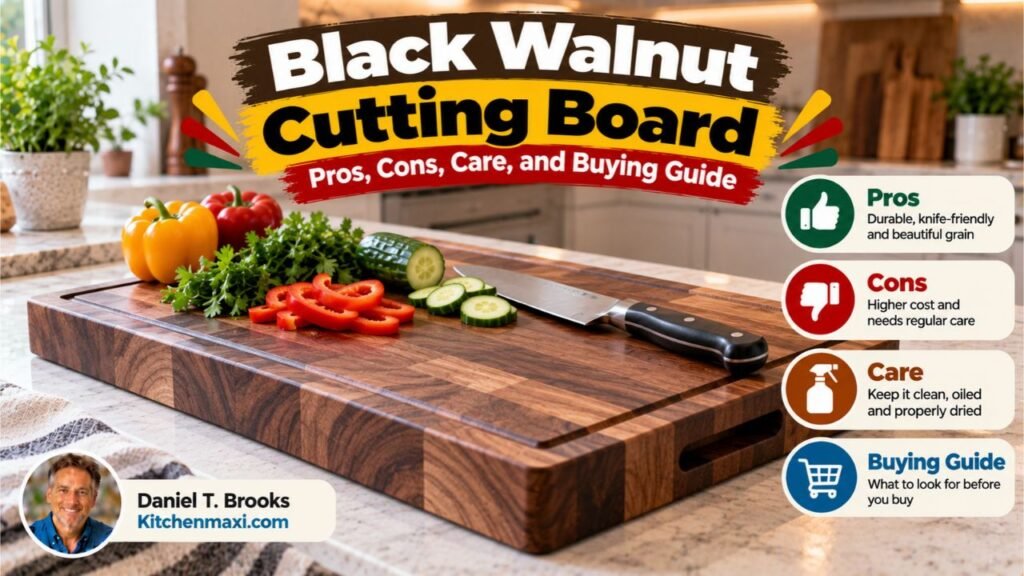
Below are the properties, advantages, drawbacks, food-safety considerations, grain styles, comparisons with maple and cherry, cleaning methods, oiling, stain removal, warping prevention, buying factors, and signs that a walnut board needs repair or replacement.
Is Black Walnut Good for Cutting Boards?
Yes. Black walnut has a strong combination of moderate hardness, tight grain, attractive color, and a relatively forgiving feel under a knife.
Black Walnut Has Moderate Hardness
American black walnut is commonly rated around 1,010 lbf Janka hardness.
For comparison:
- Hard maple: about 1,450 lbf
- Black walnut: about 1,010 lbf
- Black cherry: about 950 lbf
This puts walnut in a useful middle range.
It is much harder than soft construction lumber, yet noticeably softer than hard maple.
The lower hardness means a knife can leave visible marks sooner, but the wood also gives slightly under the cutting edge instead of feeling extremely hard.
Black Walnut Has a Tight Grain
Black walnut is a fine- to tight-grained hardwood.
That matters because a food-prep surface should not have large open pores that readily collect moisture and food debris.
A properly sanded walnut board has a smooth surface that is straightforward to wash and condition.
The grain can still vary visibly from one piece of lumber to another. Dark streaks, lighter sapwood, and changes in grain direction are natural characteristics rather than signs of poor wood.
Walnut Is Gentle on Knife Edges
A cutting board should be firm enough to resist damage but not so hard or abrasive that it causes unnecessary edge wear.
Walnut sits on the softer side of the classic hardwood cutting-board group.
That makes it a good match for:
- Chef’s knives
- Santoku knives
- Paring knives
- Slicing knives
- High-carbon kitchen knives
Knife technique still matters. Dragging a sharp edge sideways across any cutting board can dull it faster than ordinary chopping.
Key Takeaway: Black walnut combines moderate hardness, tight grain, and a relatively soft cutting feel, making it a strong choice for regular kitchen knife work.
What Does a Black Walnut Cutting Board Look Like?
Appearance is one of walnut’s strongest selling points.
Black Walnut Heartwood
The heartwood is the darker inner portion of the tree.
Its color can include:
- Medium brown
- Dark chocolate
- Gray-brown
- Purple-brown undertones
- Dark natural streaks
Two walnut cutting boards can look very different even when made from the same species.
That variation is part of the appeal.
Walnut Sapwood
Sapwood is much lighter.
It can appear:
- Cream
- Pale tan
- Nearly white
Some board makers remove most sapwood for a more uniform dark appearance.
Others leave lighter areas to create natural contrast.
Sapwood is not automatically defective wood.
Oil Makes Walnut Look Darker
Dry unfinished walnut looks lighter and more muted.
Applying food-grade mineral oil deepens the brown color and makes the grain more visible.
A freshly oiled walnut board may look dramatically darker than it did when dry.
The surface gradually becomes lighter again as the oil leaves the upper wood fibers, which is one visual clue that another coat may be due.
Key Takeaway: Black walnut ranges from medium brown to dark chocolate, often with dramatic grain and lighter sapwood. Mineral oil deepens the color and highlights the grain.
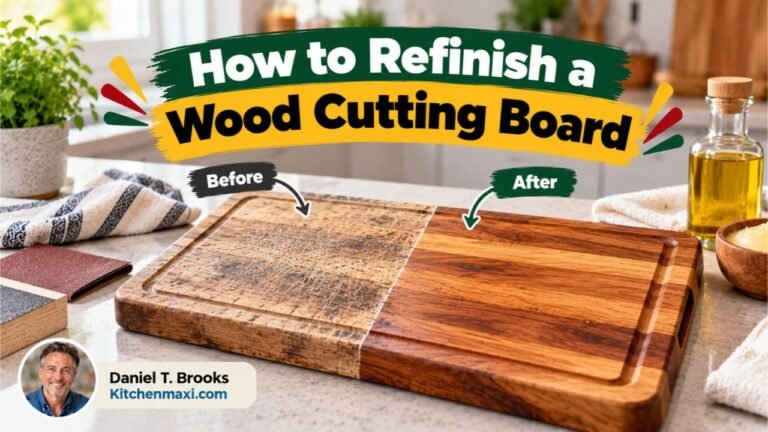
Black Walnut Cutting Board Pros and Cons
Walnut has real strengths, but it is not the perfect choice for every kitchen.
| Factor | Black Walnut Cutting Board |
| Knife friendliness | Very good |
| Hardness | Medium for a hardwood cutting board |
| Janka rating | About 1,010 lbf |
| Grain | Fine/tight |
| Color | Medium to dark chocolate brown |
| Stain visibility | Low to moderate |
| Knife-mark visibility | Often lower because of dark grain |
| Daily durability | Good |
| Heavy cleaver resistance | Lower than hard maple |
| Maintenance | Regular hand washing and oiling |
| Dishwasher safe | No |
| Typical price | Often higher than maple |
| Serving appearance | Excellent |
Main Advantages
Black walnut offers:
- A relatively forgiving cutting surface
- Dark natural color
- Distinctive grain
- Good everyday durability
- Good stain camouflage
- Comfortable knife feel
- Strong serving-board appearance
- Availability in edge-grain and end-grain construction
Main Drawbacks
The weaknesses include:
- More denting than hard maple
- Knife marks can develop sooner
- Regular oiling is needed
- Long soaking can cause swelling or warping
- Dishwasher use can ruin the board
- Walnut boards can cost more than common maple boards
- Dark color makes some dark food residue harder to see
A walnut board is best viewed as a working hardwood surface that will develop signs of use rather than a decorative piece that must remain flawless.
Is a Black Walnut Cutting Board Food Safe?
A properly made and properly maintained walnut cutting board is commonly used for food preparation.
There are still several details worth separating.
Walnut Wood and Food Contact
The wood used for cutting boards is dried, shaped, sanded, glued when necessary, and finished with a food-contact-appropriate product.
For a home board, look for:
- Sound hardwood
- Tight glue joints
- Smooth surface
- Food-contact-suitable adhesive
- Food-safe board finish
The FDA Food Code for retail and food-service settings specifically permits hard maple or equivalently hard, close-grained wood for cutting boards. Black walnut is not individually named in that wording, so restaurants and commercial kitchens should follow applicable local requirements rather than assuming every household board is acceptable in regulated food service.
What About Juglone in Black Walnut?
Black walnut trees contain juglone, a natural compound most often discussed because it affects certain plants growing near walnut trees.
Concentrations are associated more strongly with parts such as:
- Roots
- Bark
- Leaves
- Nut hulls
A finished cutting board made from dried walnut lumber is a very different exposure from handling fresh plant material or breathing walnut sawdust during woodworking.
For normal kitchen use, juglone is not generally treated as a reason to reject a finished walnut cutting board.
Is Walnut Wood Safe for Someone With a Tree-Nut Allergy?
Food allergy is caused by allergenic proteins in the nut, not simply by the fact that a kitchen item came from a walnut tree.
Allergy specialists have described contact with finished walnut wood as very low risk for most people with tree-nut allergy.
There is an extra detail: the finish on the board.
A board treated with walnut oil or another nut-derived oil introduces a separate question from the wood itself. Highly refined oils contain little protein, while less refined nut oils can contain more.
For a household dealing with a severe walnut allergy, choosing a maple board finished with food-grade mineral oil is a simple way to remove uncertainty. Personal allergy questions should be discussed with an allergist.
Can You Cut Raw Meat on Black Walnut?
Wood cutting boards can be used for raw meat if they are cleaned correctly.
For easier cross-contamination control, use a separate board for:
- Raw meat
- Raw poultry
- Raw seafood
Keep another board for:
- Fresh produce
- Bread
- Cooked foods
- Ready-to-eat ingredients
Wash the board thoroughly after raw-animal-food preparation before using it again.
Key Takeaway: Finished black walnut is widely used for kitchen boards. Severe tree-nut allergy households may prefer maple for simplicity, especially when the finish used on a walnut board is unknown.
End-Grain vs Edge-Grain Black Walnut Cutting Boards
Walnut boards can be built with the wood fibers facing the knife in different directions.
That construction affects price, knife feel, appearance, and maintenance.
End-Grain Black Walnut Cutting Board
An end-grain cutting board exposes the ends of the wood fibers on the cutting surface.
It often has a block or checkerboard appearance.
When a knife enters end grain, the fibers can separate slightly around the edge rather than being cut straight across.
Advantages include:
- Soft cutting feel
- Reduced visible knife scarring
- Thick butcher-block appearance
- Excellent surface for frequent chopping
Drawbacks include:
- Higher price
- More glue joints
- Greater thickness and weight
- More care needed to prevent uneven moisture movement
A good end-grain walnut board can be a long-term main prep surface.
Edge-Grain Black Walnut Cutting Board
An edge-grain board is usually made from long strips glued side by side.
The long grain runs along the face of the cutting surface.
Advantages include:
- Lower cost than end grain
- Lighter weight
- Fewer glue joints
- Good strength
- Easier handling and storage
The knife cuts across more of the surface fibers, so marks can become visible sooner than on end grain.
For most home kitchens, edge grain offers a strong balance of price and daily function.
Face-Grain Walnut Board
A face-grain board uses the broad face of the lumber as the cutting surface.
It often displays the most dramatic walnut grain.
These boards are attractive for:
- Serving
- Cheese
- Bread
- Light slicing
- Charcuterie
For heavy daily chopping, edge grain or end grain is usually the stronger construction choice.
Key Takeaway: End grain gives the softest cutting feel and hides marks well, edge grain balances cost and durability, and face grain is attractive for lighter prep and serving.
Black Walnut vs Maple Cutting Board
Black walnut and hard maple are both popular hardwood choices, but they feel different in use.
| Feature | Black Walnut | Hard Maple |
| Janka hardness | ~1,010 lbf | ~1,450 lbf |
| Color | Dark brown | Pale cream |
| Knife feel | Softer | Firmer |
| Dent resistance | Good | Higher |
| Stain visibility | Lower | Higher |
| Knife-mark visibility | Often lower | More visible on pale surface |
| Price | Often higher | Often lower |
| Heavy prep | Good | Excellent |
| Serving appearance | Dark and dramatic | Light and clean |
Walnut Is Softer
Walnut gives more under a knife.
That makes it appealing to cooks who place a high priority on knife feel.
The tradeoff is that a hard impact can dent it more readily.
Maple Handles Hard Use Better
Hard maple’s higher hardness gives it an advantage for heavy daily prep.
It generally resists denting longer.
A pale maple board may show beet, berry, turmeric, or other colored stains more visibly than dark walnut.
Which One Should You Choose?
Choose walnut if you value:
- Dark appearance
- Softer knife feel
- Serving presentation
- Less-visible stains
Choose hard maple if you value:
- Maximum surface hardness
- Heavy everyday chopping
- Classic butcher-block appearance
- Often lower material cost
Key Takeaway: Walnut favors knife feel and dark appearance, while hard maple favors greater dent resistance and heavy daily use.
Black Walnut vs Cherry Cutting Board
Walnut and cherry are closer in hardness than walnut and maple.
Black cherry is around 950 lbf Janka, compared with walnut at roughly 1,010 lbf.
Both feel relatively forgiving under a knife.
Walnut starts much darker.
Cherry commonly begins as a pinkish or warm reddish tan and develops a deeper reddish-brown color through light exposure and age.
Choose walnut if you want:
- Chocolate-brown color
- Dramatic contrast
- Slightly higher hardness
- A dark serving surface
Choose cherry if you want:
- Warm red-brown tones
- A board that changes color noticeably with age
- A similarly soft cutting feel
Neither is a poor choice for ordinary home food prep.
Black Walnut vs Teak Cutting Board
Teak and walnut are close in measured hardness, but their wood characteristics are different.
Teak contains natural oils and is known for handling moisture well.
It also contains mineral content, including silica, that can make it more abrasive to cutting tools than its Janka number alone suggests.
Walnut is generally preferred when knife friendliness is the main concern.
Teak can make sense when the priority is:
- Humid conditions
- Moisture resistance
- Lower sensitivity to occasional water exposure
Walnut is stronger when the priority is:
- Knife feel
- Dark domestic hardwood
- Serving appearance
- Traditional butcher-block construction
Both still need proper cleaning and drying.
Best Uses for a Black Walnut Cutting Board
Walnut works well for most routine kitchen cutting.
Good uses include:
- Chopping onions
- Slicing vegetables
- Cutting fruit
- Mincing herbs
- Slicing cooked meat
- Cutting sandwiches
- Bread slicing
- Cheese preparation
- Charcuterie
- General meal prep
A large walnut board is also useful for assembling ingredients during cooking because its dark surface gives good contrast with many pale vegetables and foods.
Tasks That Cause More Wear
Walnut is not the first surface I would choose for repeated heavy bone chopping.
Avoid using it as the impact surface for:
- Heavy cleavers on bone
- Meat tenderizing with hard impacts
- Breaking hard shells
- Repeated pounding
Those tasks can create deep dents that are difficult to sand out.
How to Clean a Black Walnut Cutting Board
Routine cleaning should be simple.
Wash It After Use
Use:
- Warm water
- Mild dish soap
- Soft sponge or dishcloth
Clean the entire cutting surface.
If the board was heavily soiled, clean the opposite face too so moisture exposure stays more balanced.
Do not leave food residue sitting on the board for hours after meal prep.
Do Not Soak Walnut
Avoid leaving a walnut board submerged in a sink.
Wood absorbs moisture.
Extended soaking can cause:
- Swelling
- Warping
- Raised grain
- Split seams
- Glue-joint problems
Wash it, rinse it, and remove it from the water.
Dry It Upright
Wipe off excess moisture with a clean towel.
Then let the board finish drying with air reaching both broad faces.
A vertical rack or standing the board securely on an edge works well.
Do not put a wet board flat on a countertop for hours with one face unable to dry.
Do Not Put It in the Dishwasher
A black walnut cutting board is not dishwasher-safe.
Dishwashers expose wood to prolonged water, detergent, and drying heat.
That combination can lead to:
- Warping
- Cracking
- Joint failure
- Severe drying
- Raised fibers
Hand washing should be the normal method.
Key Takeaway: Hand wash walnut promptly, never soak it, and dry it with airflow around both faces. Keep it out of the dishwasher.
How to Oil a Black Walnut Cutting Board
Oiling replaces some of the moisture resistance lost as wood dries through washing and normal use.
Use Food-Grade Mineral Oil
A simple choice is food-grade mineral oil.
It is:
- Clear
- Odorless
- Stable
- Non-drying
- Resistant to rancidity
Do not use ordinary vegetable oils such as olive, corn, or canola oil as the main board conditioner. Food oils can oxidize and develop unpleasant odors.
How to Apply the Oil
Start with a clean, completely dry board.
Then:
- Apply mineral oil across the surface.
- Spread it over the entire face.
- Treat the edges and end grain.
- Turn the board over and oil the other side.
- Allow time for the wood to absorb the oil.
- Wipe away remaining surface oil with a clean cloth.
A very dry new board may absorb several coats.
Once the board stops drinking in oil quickly, wipe it thoroughly rather than leaving a wet layer sitting on top.
How Often Should Walnut Be Oiled?
There is no single schedule that fits every board.
Oil it when the wood begins to look or feel dry.
Common signs include:
- Lighter color
- Chalky-looking areas
- Water soaking in rapidly
- Dry or rough texture
A heavily used board may need conditioning more often than a serving board used twice a month.
Use the condition of the wood rather than an automatic calendar.
Mineral Oil and Beeswax Board Cream
A board cream made with mineral oil and beeswax can be added after oiling.
Wax creates a more water-resistant surface feel and slows moisture exchange.
It does not make the board waterproof.
Key Takeaway: Use food-grade mineral oil when the walnut looks dry, coat all faces and edges, wipe away excess, and add a board wax if you want extra surface protection.
How to Remove Stains and Odors From Black Walnut
Walnut’s dark color hides many stains, but the board can still absorb food odors or develop marks.
Wash Fresh Stains First
Do not start with sanding.
Wash the board with warm soapy water and dry it.
Many fresh food marks disappear during normal cleaning.
Use Salt for Light Odors
Coarse salt can provide mild surface scrubbing.
Spread salt over the dampened area and rub gently with a soft sponge.
Rinse and dry afterward.
Lemon Needs Moderation
Lemon is often used with salt for wood-board odors.
Acidic juice can alter wood color, so use it sparingly and test a small area if appearance matters.
Do not leave acidic mixtures soaking on walnut for a long time.
Sand Deep Knife Marks When Necessary
A badly scarred board can often be refinished.
Use progressively fine sandpaper and sand evenly with the grain on edge- or face-grain boards.
End-grain refinishing takes more work because the surface structure is different.
After sanding:
- Remove all sanding dust.
- Clean the surface appropriately.
- Let it dry fully.
- Reapply food-grade mineral oil.
- Add board wax if desired.
If the board contains deep cracks or separated glue joints, sanding alone will not repair the structural problem.
Key Takeaway: Start stain and odor removal with normal washing, use gentle surface treatment next, and reserve sanding for actual scars or persistent surface damage.
How to Prevent a Walnut Cutting Board From Warping
Warping occurs when different parts of a board gain or lose moisture at different rates.
The easiest prevention strategy is balanced moisture exposure.
Do not:
- Leave one face sitting in water
- Store the board wet and flat
- Dry it next to strong heat
- Put it in a dishwasher
- Leave it beside a hot stove
- Oil only one face repeatedly
Instead:
- Wash promptly
- Dry both faces
- Store vertically when practical
- Oil both faces and edges
- Keep it away from extreme heat
Thicker boards generally resist movement better than very thin boards, though any wood can move if moisture exposure becomes uneven.
Does Black Walnut Scratch Easily?
Walnut will show knife marks over time.
That is normal.
Its 1,010 lbf hardness makes it softer than hard maple, so aggressive cutting can mark it sooner.
The dark grain often makes shallow marks less obvious from normal viewing distance.
End-grain walnut also tends to hide cutting lines better than long-grain construction because the knife moves between exposed fibers.
A scratched walnut board is not automatically damaged.
Surface marks become a concern when they turn into:
- Deep grooves
- Splits
- Food-trapping cracks
- Loose splinters
Light knife marks are simply part of using a natural wood cutting surface.
Does Black Walnut Stain Easily?
Dark walnut is good at visually hiding many food stains.
That does not mean the wood is stain-proof.
Foods that can leave visible marks include:
- Beets
- Turmeric
- Berries
- Tomato sauce
- Strongly colored spices
- Dark sauces
A properly oiled surface absorbs spills more slowly than very dry wood.
Clean strongly colored foods soon after cutting rather than leaving juice sitting on the surface.
The dark grain usually makes leftover color far less obvious than it would be on hard maple.
How Long Does a Black Walnut Cutting Board Last?
A quality hardwood board can last for many years.
Lifespan is influenced by:
- Board thickness
- Construction quality
- Glue quality
- Moisture exposure
- Knife use
- Cleaning habits
- Oiling
- Storage
- Ability to refinish the surface
A thick end-grain or edge-grain board can often be sanded and refinished several times during its life.
Poor moisture habits can ruin an expensive board much faster than ordinary knife wear.
When Should a Walnut Cutting Board Be Replaced?
Many worn walnut boards can be restored instead of discarded.
Replacement makes more sense when the board has damage that cannot be cleaned or repaired reliably.
Watch for:
- Deep structural cracks
- Separated glue joints
- Severe permanent warping
- Loose wood pieces
- Rot or decay
- Persistent mold inside cracks
- Surface damage too deep to refinish reasonably
Normal knife marks, color changes, and dry-looking wood are usually maintenance issues rather than replacement reasons.
How to Choose a Black Walnut Cutting Board
Good boards differ in more than color.
Choose the Construction
For heavy chopping, look at:
- End grain
- Thick edge grain
For lighter kitchen prep and serving:
- Edge grain
- Face grain
End grain usually costs the most.
Choose the Right Size
Common useful sizes include roughly:
- 12 × 18 inches for general prep
- 15 × 20 inches for larger meal preparation
- Larger boards for roasts and batch cooking
The ideal board should fit the counter while leaving space for bowls and ingredients.
Check sink size too. A beautiful oversized board becomes annoying if it cannot be washed comfortably.
Consider Thickness
A thicker board generally feels more stable.
Boards around 1½ to 2 inches thick are common for substantial edge-grain and end-grain designs.
Thinner boards are easier to lift but may feel less planted during heavy chopping.
Look at Glue Joints
Multi-piece boards should have:
- Tight seams
- No visible gaps
- No loose strips
- Flat surfaces
Poor glue joints can become entry points for moisture.
Check the Finish
A board sold for cutting should use a food-contact-appropriate finish.
Common choices include:
- Food-grade mineral oil
- Mineral oil and beeswax
- Board creams made for food-contact wood
A hard decorative furniture finish is not the normal choice for a working knife surface.
Decide on a Juice Groove
A juice groove catches liquid near the board edge.
It is useful for:
- Roast meat
- Watermelon
- Tomatoes
- Juicy fruit
For vegetable chopping, a completely flat surface gives more usable cutting area.
Handles and Feet
Side handles make a thick walnut board easier to lift.
Rubber feet can improve airflow beneath the board and reduce movement, but they also make one side the permanent cutting face.
A board without feet can be flipped, giving access to two usable surfaces.
Key Takeaway: Choose construction first, then size, thickness, finish, and features. A board that fits your sink, counter, and normal prep routine is more useful than an oversized showpiece.
Who Should Buy a Black Walnut Cutting Board?
Walnut is a strong fit for someone who wants:
- A dark hardwood prep surface
- Good knife feel
- Everyday chopping ability
- A board suitable for serving
- A surface that hides many stains
- Natural grain that looks good on display
It works especially well for a kitchen where the cutting board stays visible on the counter.
A substantial walnut board can function as both a daily prep tool and a serving board for bread, cheese, fruit, and appetizers.
Who May Prefer Another Wood?
Hard maple may be better if the board will receive constant heavy chopping and dent resistance matters more than color.
Cherry may suit someone who wants a warmer reddish appearance and similarly gentle knife feel.
Teak may appeal to a cook more concerned with moisture exposure than keeping the cutting surface as gentle as possible on knives.
Plastic may make more sense for someone who wants:
- Dishwasher cleaning
- Very low maintenance
- Lightweight boards
- Simple separation of raw proteins and produce
A walnut board is best for someone willing to hand wash and condition natural wood.
Is a Black Walnut Cutting Board Worth It?
For the right kitchen, yes.
Black walnut offers a combination that is hard to duplicate: dark natural color, moderate hardness, tight grain, comfortable knife feel, and attractive serving presentation.
You pay for those traits.
Walnut lumber is generally a premium domestic hardwood, so a well-built walnut board can cost more than a comparable maple board.
The extra cost makes the most sense if you appreciate the appearance and plan to keep the board for years.
If maximum dent resistance at a lower price matters more than dark color, hard maple is often the more practical choice.
If appearance, knife feel, and versatility between chopping and serving matter most, walnut makes a strong case.
Conclusion
A black walnut cutting board is a strong kitchen choice for everyday chopping, slicing, food prep, and serving. Its roughly 1,010-lbf hardness gives it enough resistance for normal use while keeping the cutting surface softer than hard maple.
The main compromises are straightforward: walnut can dent and scar sooner than maple, it cannot go in a dishwasher, and it needs occasional conditioning with food-grade mineral oil. In return, you get a dark board that feels good under a knife and hides many stains and light surface marks.
For frequent chopping, choose a well-built end-grain or thick edge-grain board. Check the glue joints, size, thickness, finish, and available counter and sink space before buying.
Hand wash it, dry it with airflow around both faces, keep it away from long soaking and high heat, and oil it when the surface begins looking dry. A quality walnut board maintained this way can remain useful for many years and can often be sanded and refinished rather than replaced.
FAQs About Black Walnut Cutting Boards
Is Black Walnut Too Soft for a Cutting Board?
No.
At roughly 1,010 lbf on the Janka scale, black walnut is softer than hard maple but still firm enough for normal home food preparation. Its moderate hardness is one reason it feels relatively gentle under kitchen knives.
Is Black Walnut Better Than Maple for a Cutting Board?
Neither wood is best in every situation.
Walnut is softer, darker, and often gentler on knife edges. Hard maple is harder and resists dents better during heavy use. Choose walnut for dark appearance and cutting feel, or maple for maximum surface durability.
Can You Cut Meat on a Black Walnut Cutting Board?
Yes, provided the board is properly cleaned afterward.
For easier cross-contamination control, use separate boards for raw meat, poultry, and seafood and for foods such as produce, bread, and ready-to-eat ingredients.
Is Black Walnut Safe for People With Nut Allergies?
The allergy-causing proteins are associated with the walnut nut rather than ordinary finished walnut lumber, so a finished walnut board is generally viewed as very low risk.
The finish matters too. A board treated with walnut oil creates a separate exposure question. Anyone with a severe walnut allergy can choose maple and food-grade mineral oil or ask an allergist for individual advice.
How Often Should I Oil a Black Walnut Cutting Board?
Oil it when the wood starts looking dry, pale, or rough or when water begins soaking into the surface rapidly.
Usage and washing frequency change how fast that happens, so the condition of the board is a better indicator than a fixed calendar schedule.
What Oil Is Best for a Black Walnut Cutting Board?
Food-grade mineral oil is a simple choice because it is colorless, odorless, stable, and does not turn rancid like many cooking oils.
A mineral-oil-and-beeswax board cream can be applied afterward if you want an extra moisture-resistant surface layer.
Can a Black Walnut Cutting Board Go in the Dishwasher?
No.
Dishwasher water, detergent, long wash cycles, and drying heat can cause wood to swell, crack, warp, and separate at glue joints. Wash walnut cutting boards by hand and dry them with airflow around the surface.
Does Black Walnut Dull Knives?
All cutting surfaces cause some edge wear, but walnut is considered relatively gentle on knives.
Its moderate hardness is lower than hard maple, and it does not have the high mineral content associated with some more abrasive woods.
Does Black Walnut Stain?
It can stain, but the dark brown color hides many marks better than pale woods.
Keep the board well conditioned and clean strongly colored foods such as beets, turmeric, berries, and tomato sauce soon after use.
Is End-Grain Black Walnut Better Than Edge Grain?
End grain usually feels softer under the knife and hides cutting marks better.
Edge grain costs less, weighs less, and still works very well for daily food prep. A well-made edge-grain walnut board is often the better value for a home kitchen.
Why Is My Walnut Cutting Board Getting Lighter?
Walnut commonly looks lighter when the surface becomes dry.
Washing gradually removes oil from the upper wood fibers. After the board is completely dry, apply food-grade mineral oil. The rich brown color usually becomes deeper again.
Can You Refinish a Black Walnut Cutting Board?
Yes, if the board is structurally sound.
Knife scars, rough areas, and many surface stains can be sanded away. After sanding, remove all dust, let the board dry as needed, then recondition it with food-grade mineral oil and optional board wax.