Why Offset Chef’s Knives Are Every Cook’s Secret Weapon Today
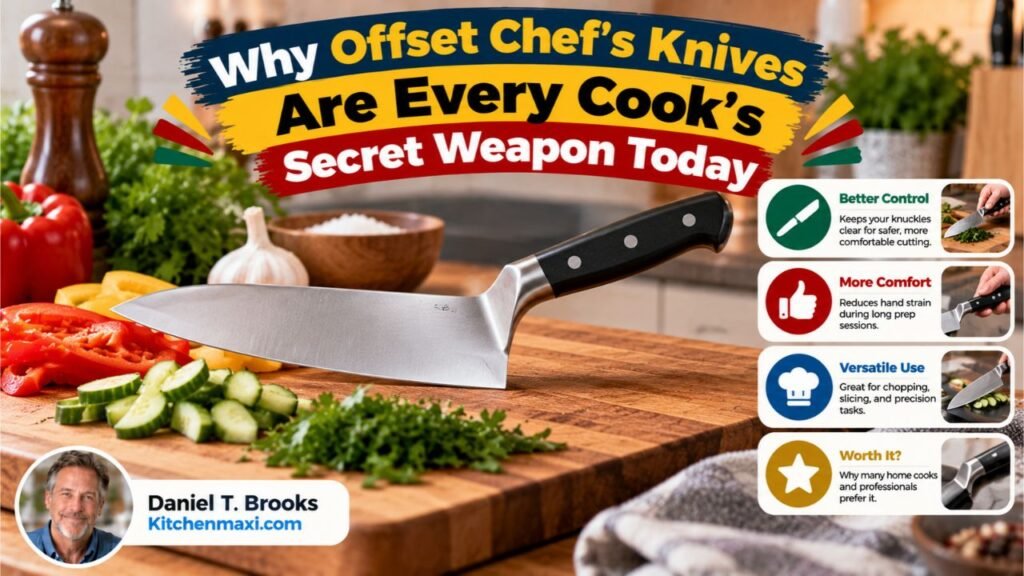
An offset chef’s knife places the handle higher than the cutting edge, creating extra room between your knuckles and the cutting board. That simple change can make chopping more comfortable, give the blade better board contact, and reduce the awkward wrist position that some cooks experience with low-handled knives.
At first glance, an offset knife can look unusual. Instead of the handle lining up directly behind the blade, the blade drops below the handle. This creates a stepped profile that keeps the gripping hand farther away from the cutting board.
That extra space becomes noticeable during repetitive prep. With a conventional low-profile knife, large hands can strike the board before the blade completes a cut. An offset design lets the cutting edge reach the board while the fingers remain higher.
The design is especially common on offset bread knives, sandwich knives, slicers, and vegetable knives, though chef-style and nakiri-style offset blades are also available. Not every offset knife is technically a traditional chef’s knife, so blade shape still matters when choosing one for general food prep.
Why offset chef’s knives are every cook’s secret weapon comes down to a practical combination of knuckle clearance, cutting-board access, hand position, slicing control, and comfort. For certain cooks and tasks, that geometry solves problems that sharpening, grip changes, or buying a taller conventional blade may not completely fix.
Offset geometry does have tradeoffs. The unusual blade position can require an adjustment period, some models are more specialized than all-purpose chef’s knives, and sharpening may feel different if the heel or handle position interferes with a sharpening system.
The sections below explain how offset knives work, where the design performs best, what foods suit it, how it compares with conventional chef’s knives, possible drawbacks, grip and cutting technique, and how to choose one that fits your hand and cooking style.
What Is an Offset Chef’s Knife?
An offset chef’s knife places the handle higher than the cutting edge rather than keeping the handle and blade close to the same horizontal line.
The Blade Sits Lower Than the Handle
The most recognizable feature is the step between the handle and cutting edge.
Depending on the knife, the offset may be modest or quite pronounced.
This creates a gap under the handle when the cutting edge rests against the board.
That space is called knuckle clearance.
A conventional chef’s knife gets clearance mainly from blade height. An offset knife creates additional clearance through the relationship between the handle and blade.
Offset Does Not Describe One Blade Shape
“Offset” describes handle and blade geometry, not one exact cutting edge.
Offset knives may have:
- Chef-style curved blades
- Flat vegetable blades
- Serrated bread blades
- Scalloped slicer blades
- Pointed tips
- Rounded tips
This is why an offset bread knife and an offset vegetable knife can feel very different even though both keep the handle above the cutting edge.
Offset Knives Are Not the Same as Offset Spatulas
The terms sound similar because both tools create hand clearance.
An offset spatula is thin, flexible, and usually blunt, while an offset kitchen knife has a sharpened cutting edge.
The shared idea is simply moving the hand away from the work surface.
Key Takeaway: “Offset” refers to the raised-handle geometry. Blade profile, edge type, length, and intended cutting task can still differ greatly between models.
Why Knuckle Clearance Matters So Much
Knuckle clearance sounds like a small ergonomic detail until you use a knife that does not provide enough of it.
Your Fingers Need Room Above the Cutting Board
When holding a chef’s knife, the fingers wrapped around the handle extend below it.
If the handle sits close to the cutting board, those fingers may hit the board before the edge completes its stroke.
This can cause you to:
- Raise the wrist
- Angle the knife
- Avoid using the heel
- Shorten the cutting stroke
- Grip the handle differently
An offset knife raises the hand without requiring the blade itself to become extremely tall.
Large Hands Benefit Most
Cooks with large hands or thick fingers often notice clearance problems sooner.
A knife can feel comfortable in the hand while lifted off the counter, then feel cramped once actual chopping begins.
Offset geometry gives those fingers more room.
Extra Clearance Can Improve Full-Blade Contact
A knife works best when the part of the edge intended to contact the board can actually reach it.
If your knuckles hit first, the heel may stay slightly above the board.
That can leave thin onion skins, herbs, celery fibers, or vegetable pieces partially connected.
More clearance lets the cutting edge finish the stroke.
Key Takeaway: Extra hand clearance lets the blade reach the board without forcing the cook to raise the wrist or change the cutting path simply to protect the knuckles.
Why Offset Chef’s Knives Feel Different During Chopping
The handle position changes more than finger space.
The Wrist Can Stay in a More Natural Position
With a low-handled knife, some cooks lift or bend the wrist to avoid contact between their fingers and the board.
An offset handle reduces that need.
A more neutral wrist position can feel more comfortable during long vegetable-prep sessions.
The exact result still depends on:
- Hand size
- Counter height
- Cutting-board thickness
- Knife length
- Grip style
- Blade profile
An offset design cannot correct a workstation that is far too high or low, but it can improve the relationship between the hand and cutting surface.
The Heel Becomes Easier to Use
The heel of the blade is the rear section closest to the handle.
It is useful for:
- Chopping onions
- Cutting carrots
- Celery prep
- Firm vegetables
- Repetitive push cuts
Poor clearance can make cooks avoid this section.
Offset geometry can restore access to more of the edge.
The Knife Can Feel More Purposeful on a Flat Board
A raised handle naturally makes sense when most of the work occurs against a board.
That is one reason offset geometry has long appeared on sandwich, bread, and commercial prep knives.
You can cut fully through food without your hand reaching the work surface first.
Key Takeaway: The raised handle can improve wrist position and make the heel easier to use, especially during repetitive board-based cutting.
Offset Chef’s Knives Give Better Board Clearance for Tall Foods
The extra space is also useful when cutting food with height.
Sandwiches
Offset slicers are common in sandwich prep for a reason.
A thick sandwich can require a long downward slice.
With the hand raised, you can cut through the full height of the sandwich and continue until the edge reaches the board.
This is easier than stopping because your knuckles or handle contact the work surface.
Bread
Large loaves often have tall rounded tops and wide bases.
A serrated offset knife keeps the hand above the board while the serrations travel completely through the crust and crumb.
This geometry is especially useful on:
- Boules
- Sandwich loaves
- Artisan bread
- Baguette sandwiches
- Bagels
Large Vegetables
An offset straight-edge knife can also work well on:
- Cabbage
- Eggplant
- Squash sections
- Large onions
- Zucchini
- Melons, when the knife is suitable for the size and rind
The raised handle gives the hand more space as the blade moves downward.
Key Takeaway: Offset geometry is particularly useful when the food is tall enough that a conventional handle approaches the board before the cutting edge finishes the stroke.
Offset Chef’s Knives Can Make Vegetable Prep More Comfortable
Vegetable work often involves hundreds of repeated board contacts.
Onions
An offset blade can make the final downward cuts through an onion feel less cramped.
The heel reaches the board without the gripping hand sitting close to the cutting surface.
Carrots
Firm carrots often use controlled push cuts.
A flat or moderately curved offset blade lets the cook direct force downward while maintaining hand clearance.
Peppers
Large pepper panels can be stacked and sliced without requiring the handle to sit almost level with the board.
Herbs
For herb chopping, edge profile matters more than the offset alone.
A curved offset chef-style blade can support a rocking motion, while a flatter offset vegetable blade is better suited to push cutting.
Choose the edge shape around the cutting motion you actually use.
Key Takeaway: The offset helps during repetitive vegetable prep, but blade profile still determines if the knife feels better for rocking, push cutting, or straight chopping.
Why Offset Knives Can Be Easier on Your Knuckles
The most obvious benefit is avoiding repeated hand contact with the board.
No More Knuckle Bumping
A conventional knife with limited clearance can cause the lower fingers to brush or bump the cutting board.
This is distracting and uncomfortable.
An offset handle creates physical separation between your hand and the surface.
Less Need to Alter Your Grip
Some cooks solve poor clearance by moving their fingers farther back on the handle.
That can reduce control.
Others raise the wrist or use only the front half of the blade.
A properly fitted offset knife lets you keep a controlled grip while still getting the clearance needed.
Better Clearance Can Improve Confidence
A knife that repeatedly hits your fingers against the board can make chopping feel awkward.
Removing that interference lets you concentrate on:
- Food position
- Edge path
- Guiding hand
- Cut size
- Rhythm
That does not make an offset knife inherently safer than every conventional knife. Safe technique and a sharp edge still matter.
Key Takeaway: The offset protects working space around the knuckles, reducing the need to compromise grip or cutting motion simply to keep fingers off the board.
Are Offset Chef’s Knives More Comfortable for Long Prep Sessions?
They can be, especially for cooks who experience board contact with normal knives.
Hand Position Matters During Repetition
One slightly awkward cut may not matter.
Hundreds of cuts during meal prep can expose a poor fit between hand, knife, board, and counter.
A raised handle can reduce repeated contact and may reduce the amount of wrist elevation needed.
Handle Shape Still Matters
Offset geometry cannot rescue a badly shaped handle.
Check:
- Handle thickness
- Handle length
- Surface texture
- Finger grooves
- Bolster shape
- Weight
- Balance
A handle that is too small, slippery, or heavily contoured in the wrong places may still become uncomfortable.
Knife Weight Changes Fatigue
Some offset knives are lightweight stamped tools designed for food-service work.
Others use thick forged blades and heavy handles.
Neither is automatically better.
A lighter knife can feel fast during high-volume slicing, while a heavier knife can use more blade weight during chopping.
Key Takeaway: Offset geometry can reduce one source of discomfort, but handle shape, knife balance, weight, counter height, and grip still determine how the knife feels during long prep sessions.
Offset Chef’s Knife vs Regular Chef’s Knife
A standard chef’s knife remains one of the most versatile kitchen tools, so the offset design should be viewed as an alternative geometry rather than an automatic replacement.
| Feature | Offset Chef’s Knife | Regular Chef’s Knife |
| Knuckle clearance | Usually higher | Depends on blade height |
| Handle position | Raised above edge | More directly aligned |
| Board contact | Easy with low blade | Good on properly sized tall blades |
| Familiarity | Requires adjustment | Familiar to most cooks |
| Product selection | More limited | Very large |
| Rock chopping | Model-dependent | Common strength |
| Push cutting | Good with flatter profiles | Model-dependent |
| Bread/sandwich slicing | Excellent with serrated version | Requires separate bread knife |
| Sharpening access | Can vary by design | Usually straightforward |
| Large-hand comfort | Often very good | Depends on blade height |
A Regular Chef’s Knife Can Already Have Good Clearance
A tall 8- or 10-inch chef’s knife may give plenty of room beneath the handle.
In that case, offset geometry may add little.
Blade height should always be considered alongside handle position.
Offset Geometry Helps Narrower Blades
The design becomes especially useful on knives that would otherwise place the handle too close to the board.
This explains its popularity on:
- Sandwich knives
- Bread knives
- Slicers
- Utility knives
The offset gives a relatively narrow blade the hand clearance of a much taller knife.
Conventional Chef’s Knives Offer More Choices
If you want a specific steel, handle material, grind, blade length, weight, or Japanese profile, standard chef’s knives offer far more choices.
Offset chef-style knives occupy a smaller niche.
Key Takeaway: Offset knives win on clearance, while conventional chef’s knives win on selection and familiarity. A tall traditional chef’s knife may already provide all the hand room you need.
Offset Chef’s Knife vs Nakiri
A nakiri has a wide rectangular vegetable blade with a relatively flat cutting edge.
Many nakiri knives already provide good knuckle clearance because the blade is tall.
Standard Nakiri
A normal nakiri gives:
- Tall blade
- Flat profile
- Good food transfer
- Strong push-cut performance
Its wide blade acts as the clearance solution.
Offset Nakiri
An offset nakiri raises the hand even farther.
This can be useful for:
- Very large hands
- Thick cutting boards
- Bulk vegetable prep
- Cuts made at unusual angles
The tradeoff is a more unusual feel and smaller product selection.
If a normal tall nakiri already gives plenty of clearance, the offset may not add much.
Offset Chef’s Knife vs Offset Bread Knife
These two tools share handle geometry but solve different cutting jobs.
Offset Chef’s Knife
A straight-edged chef-style model works for:
- Vegetables
- Herbs
- Meat
- General chopping
- Push cuts
- Slicing
Offset Bread Knife
A serrated offset knife works for:
- Bread
- Sandwiches
- Tomatoes
- Cakes
- Soft foods with tough outer surfaces
The serrations saw through crust or skin with less downward compression.
If you only want to experience the offset concept, an offset bread or sandwich knife is one of the easiest places to start because the design has a clear advantage on tall food.
What Foods Are Offset Chef’s Knives Good For?
A chef-style offset blade can handle many normal prep tasks.
Good candidates include:
- Onion
- Carrot
- Celery
- Bell pepper
- Cucumber
- Zucchini
- Potato
- Cabbage
- Herbs
- Boneless meat
- Cooked meat
- Fruit
- Sandwiches, with the right edge
- Bread, with a serrated offset model
The knife should still match the food.
Do not use a thin offset chef’s knife for:
- Bones
- Frozen food
- Hard shells
- Prying joints apart
- Tasks requiring a cleaver
The raised handle changes ergonomics, not blade strength.
Do Offset Chef’s Knives Have Any Disadvantages?
Yes. The shape is useful, but not everyone will prefer it.
The Geometry Feels Unfamiliar at First
Your hand sits higher relative to the cutting edge.
That can change your sense of where the edge is positioned.
Start slowly until the relationship between hand, edge, and cutting board feels natural.
Balance Can Feel Different
Raising or angling the handle can shift the way the knife feels in a pinch grip.
Some models feel handle-heavy.
Others place the balance point close to the blade.
There is no substitute for handling the knife when possible.
Some Offset Knives Are Specialized
Many offset models are bread knives, sandwich slicers, or utility knives rather than full all-purpose chef’s knives.
Read the blade description rather than buying based only on the offset handle.
Sharpening May Need More Attention
A large offset, bolster, or unusual heel can interfere with certain guided sharpening systems.
For a straight-edge model, check that the complete cutting edge can reach the sharpening abrasive.
Serrated offset blades require a sharpening method suited to serrations.
Storage Can Be Awkward
A stepped handle may not fit every:
- Knife block
- Drawer organizer
- Magnetic sheath
- Blade guard
Measure before assuming it fits your current storage setup.
Key Takeaway: The main compromises are unfamiliar geometry, possible balance differences, fewer model choices, and potential sharpening or storage complications.
How to Hold an Offset Chef’s Knife
The safest grip depends partly on the blade and handle design.
Try a Pinch Grip on Chef-Style Models
For a conventional chef-style offset knife, place the thumb and index finger near the blade just in front of the handle, with the remaining fingers around the handle.
A pinch grip can provide strong control over blade direction.
Do not force this grip if the knife’s unusual bolster or handle transition makes it uncomfortable.
Use a Full Handle Grip When the Design Calls for It
Some commercial offset slicers are designed around holding the handle rather than pinching the blade.
Follow the geometry of the tool.
The goal is a secure grip without:
- Excessive squeezing
- Wrist twisting
- Fingers hanging below the handle unnecessarily
Keep the Guiding Hand in a Claw Position
The raised knife handle does not change the job of the other hand.
Curl the fingertips inward and guide the food with the knuckles rather than leaving fingertips extended toward the blade.
Offset clearance protects the gripping hand from the board, not the guiding hand from poor knife technique.
Key Takeaway: Use a secure pinch or handle grip suited to the knife, and keep the guiding hand curled in a claw position just as you would with a conventional chef’s knife.
How to Choose an Offset Chef’s Knife
The offset alone should not decide the purchase.
Check Knuckle Clearance
Place the knife on a cutting board in a normal cutting position.
Grip it naturally.
There should be comfortable space between your lower fingers and the board.
More clearance is not automatically better. An extremely high handle can feel disconnected from the edge.
Match Blade Profile to Your Cutting Style
Choose a curved edge if you use a rocking chop.
Choose a flatter edge for:
- Push cutting
- Straight chopping
- Vegetable prep
For bread and sandwiches, choose a serrated or scalloped offset slicer instead of a straight-edge chef’s knife.
Pick the Right Blade Length
Common kitchen blade lengths run from roughly 6 to 10 inches for chef-style and utility work, with longer slicers also available.
Short blades feel nimble.
Long blades provide more cutting length for:
- Large produce
- Bread
- Sandwiches
- Large meat portions
The blade should fit your cutting board.
Check Handle Grip
A kitchen handle should remain secure when hands are slightly wet.
Look for:
- Comfortable thickness
- No sharp seams
- Sufficient length
- Secure texture
- A shape that fits your grip
Commercial knives often use textured synthetic handles because they are easy to wash and provide secure grip.
Check Heel Design
The heel should let the edge reach the board.
Avoid a design where a thick guard or bolster protrudes below the sharpened edge and prevents complete cutting-board contact.
Think About Sharpening Before Buying
Straight edges are simpler to sharpen at home.
Serrated offset knives stay useful for a long time but need a rod, tapered abrasive, or professional service suited to the serrations when sharpening is finally required.
Key Takeaway: Look beyond the raised handle. Blade profile, heel geometry, balance, handle texture, blade length, and sharpening access determine if the knife works well in daily use.
Who Benefits Most From an Offset Chef’s Knife?
An offset design is especially worth trying if:
- Your knuckles hit the cutting board with normal knives.
- You have large hands.
- You use narrow utility or slicing blades often.
- You prepare many sandwiches.
- You slice large bread loaves.
- You perform long vegetable-prep sessions.
- You prefer push cutting.
- Your current knife forces you to raise your wrist for clearance.
It may be unnecessary if a tall conventional chef’s knife already gives your hand plenty of space.
A cook who uses a 50-millimeter or taller chef’s knife comfortably may gain less from an offset than someone using a narrow slicing knife.
Are Offset Chef’s Knives Safer?
They can reduce one specific nuisance: the gripping hand striking the cutting board.
That does not make them injury-proof.
Knife safety still depends on:
- Sharp edge
- Stable cutting board
- Secure grip
- Controlled stroke
- Proper guiding-hand position
- Correct knife for the food
- Safe storage
A dull offset knife can still slip.
A sharp conventional chef’s knife with good technique can be extremely safe.
The raised handle should be viewed as an ergonomic feature, not a substitute for knife skills.
Are Offset Chef’s Knives Worth Buying?
They are worth considering when ordinary knife geometry is causing a specific problem.
If your fingers repeatedly hit the board, an offset handle directly addresses that issue.
The design also makes strong sense for bread knives and sandwich slicers, where narrow blades need to travel all the way down to the cutting surface.
For general chef-knife work, the choice is less automatic.
A tall conventional chef’s knife or nakiri may provide enough clearance while giving you more brands, steels, handle styles, and blade profiles to choose from.
An offset chef-style blade becomes most appealing when you want the cutting characteristics of a narrower knife without placing your fingers close to the board.
Conclusion
Why offset chef’s knives are every cook’s secret weapon comes down to the extra working space created beneath the handle. By placing the hand above the cutting edge, the design gives your knuckles more clearance and lets the blade reach the cutting board without forcing an awkward wrist position.
That advantage can be noticeable during repetitive onion, carrot, celery, herb, bread, and sandwich prep. Large-handed cooks and anyone who regularly bumps their fingers against the board have the strongest reason to try the design.
Offset geometry is not automatically superior to a traditional chef’s knife. A tall standard blade can already offer excellent clearance, and conventional knives provide far more choices in steel, balance, blade profile, and handle design.
Choose an offset model because its geometry fixes a real cutting problem. When the blade profile, handle, balance, and edge also suit your cooking style, that extra knuckle space can make a surprisingly large difference during daily prep.
FAQs About Offset Chef’s Knives
What Is the Point of an Offset Knife?
An offset knife positions the handle above the cutting edge so the hand stays farther from the cutting board.
This creates extra knuckle clearance and lets the blade travel fully through food without the handle or fingers reaching the work surface first.
Why Do Some Chef’s Knives Have Offset Handles?
Offset handles give cooks additional finger clearance without requiring an extremely tall blade.
The design can be useful for large hands, narrow blades, repetitive chopping, bread slicing, sandwich work, and other cutting tasks performed directly against a board.
Are Offset Knives Better for Large Hands?
They often are.
Large fingers take up more space below the handle, so a low-profile conventional knife may cause knuckle contact with the cutting board. Raising the handle creates more room without making the entire blade taller.
Are Offset Chef’s Knives Good for Vegetables?
Yes, if the blade profile suits vegetable work.
A flatter offset blade works well for push cutting onions, carrots, peppers, celery, and similar produce. A curved chef-style edge works better for cooks who prefer a rocking motion.
Is an Offset Knife the Same as a Bread Knife?
No.
Many bread knives use offset handles, but offset describes the position of the handle relative to the blade. An offset knife can have a straight, serrated, scalloped, chef-style, or vegetable-style edge.
Is an Offset Chef’s Knife Safer Than a Regular Chef’s Knife?
It can keep the gripping hand from bumping the cutting board, but overall safety still depends on technique.
A sharp edge, stable board, secure grip, claw position with the guiding hand, and correct knife choice matter more than handle geometry alone.
Are Offset Knives Harder to Sharpen?
Some can be.
A raised handle or unusual heel may interfere with certain guided sharpening systems. Straight-edge offset knives can usually be sharpened normally if the entire bevel is accessible. Serrated models require a sharpening method made for serrations.
Should I Buy an Offset Chef’s Knife or a Nakiri?
Choose an offset chef-style knife if you want extra hand clearance with a more general-purpose blade profile.
Choose a nakiri if vegetable prep is the main job and you prefer a tall, flat blade for push cuts. A standard nakiri already offers generous knuckle space, so an offset version is most useful for cooks wanting even more clearance.