

Geedel Vegetable Chopper Review: 5 Models, Pros, and Cons
Geedel’s manual choppers are worth considering for repeated vegetable prep, provided you choose the cutting style your recipes need. The 4-in-1 grid model suits diced vegetables, while the pull-cord and hand-crank versions suit chopped mixtures. Their main trade-offs are hand effort, limited working capacity, and cleaning around sharp blades.
A useful Geedel vegetable chopper must separate those designs. Buying a bowl chopper when you want neat cucumber cubes can leave you with uneven pieces and extra work, even if the product operates correctly.
Matching the mechanism to your meals gives you more control over texture. Salsa, soup vegetables, taco toppings, and finely chopped seasonings do not all call for the same blade or cutting motion.
Advance preparation also brings storage into the picture. The U.S. Food and Drug Administration recommends keeping perishable fresh produce at 40°F or below. A chopper’s collection bowl does not replace proper refrigerated storage after preparation.
I would pay more attention to the actual cutting attachment than the number of functions printed on the box. A small, suitable chopper can earn its cabinet space; extra accessories offer little benefit if they cannot produce the cut you need.

The five reviews below explain the strongest use for each model, current price context, and the compromises worth accepting. Preparation steps, ingredient tips, cleaning guidance, and troubleshooting follow so you can judge both the purchase and the work involved afterward.
Geedel Vegetable Chopper Review at a Glance
My first recommendation for diced vegetables is the Geedel 4-in-1 Vegetable Chopper. For chopped garlic, onion, and small sauce mixtures, I would start with the less expensive Mini Pull model. Choose the hand-crank processor if its larger bowl and mixing attachments match your cooking.
| Geedel model | Strongest use | Advertised container size | Direct-store price |
| 4-in-1 Vegetable Chopper | Repeated dicing and grating | 1.2 liters, about 5 U.S. cups | $25.00 |
| 3-Cup Hand Food Chopper | Chopped mixtures and mixing | 3 cups | $20.19 |
| Mini Pull Food Chopper | Small seasoning batches | 500 mL; marketed as 2 cups | $15.00 |
| 2.5-Cup Pull Food Chopper | Slightly larger pull-chopper batches | 600 mL; marketed as 2.5 cups | $29.00 |
| Slap Food Chopper | Small toppings and garnish jobs | Small cutting chamber | $20.00 |
Prices reflect Geedel’s U.S. direct-store listings checked on October 20, 2026, before any applicable checkout charges. They are not Amazon price quotes and may change. Container figures describe the advertised size, not a promise that the machine can process that much hard produce at once.
These are five distinct, established products, including two different pull-chopper sizes. I compared manufacturer information and retail feedback without claiming hands-on testing. The recommendations reflect suitability for specific tasks, not a verified ranking of Geedel’s U.S. sales. Color choices do not count as separate models.
Five Geedel Choppers Reviewed
1. Geedel 4-in-1 Vegetable Chopper: Best for Diced Vegetables
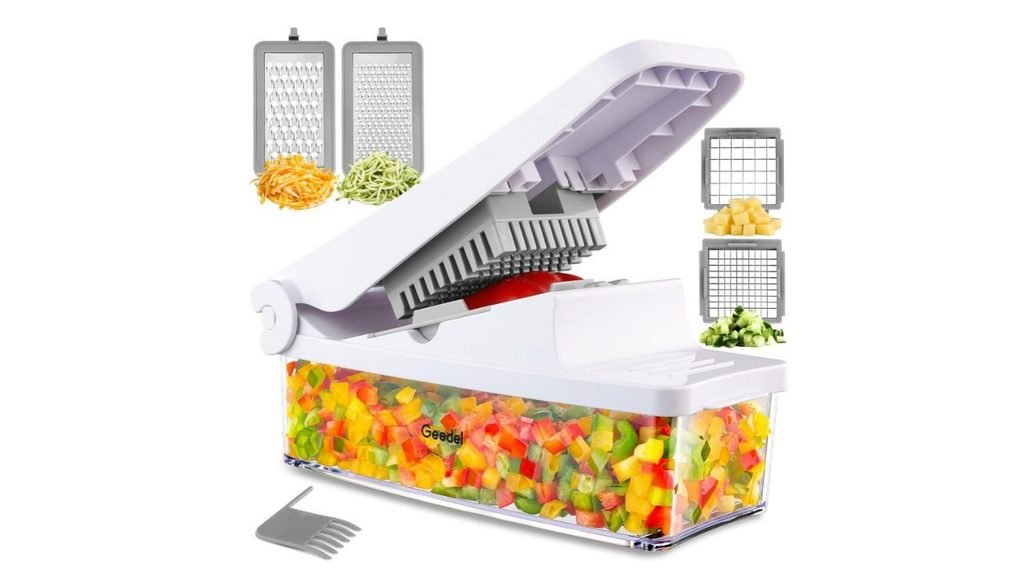
This is the closest match for someone who wants an onion dicer with a catch container. Its hinged lid pushes food through an interchangeable insert. Geedel describes two dicing options plus coarse and fine shredding attachments; check the pictured set before ordering because a four-piece package does not automatically include a mandoline or spiralizer.
The 1.2-liter container catches the cut food below the grid. The U.S. retail listing checked during this review showed 4.5 out of 5 stars from 1,575 ratings, a useful sign of an established customer base. Ratings are a changing snapshot and may combine variants.
The strongest reason to choose this model is repeatability. For a bowl of cucumber, onion, and pepper, a fixed grid gives you a consistent cut across successive pieces. You still need to trim the vegetables and prepare sections that fit the opening.
There is a geometric detail worth getting right: the grid controls two dimensions of a piece, while the thickness you load affects the third. A thick section may produce long pieces. Preparing thinner slabs first is the sensible route to shorter dice.
The trade-off is that pressure goes through the lid, grid, and plastic frame. I would avoid treating it like a heavy potato press. If the lid meets strong resistance, reduce the food size instead of pressing harder. Cleaning the small openings also adds time after chopping.
My verdict: This is my leading choice for repeated diced-vegetable jobs. Its appeal is weaker for one garlic clove, tiny herb portions, or anyone who finds firm downward pressure uncomfortable. Buy it for the cuts you repeat across a meal, rather than the promise of eliminating all knife work.
2. Geedel 3-Cup Hand Food Chopper: Best for Chopped Mixtures
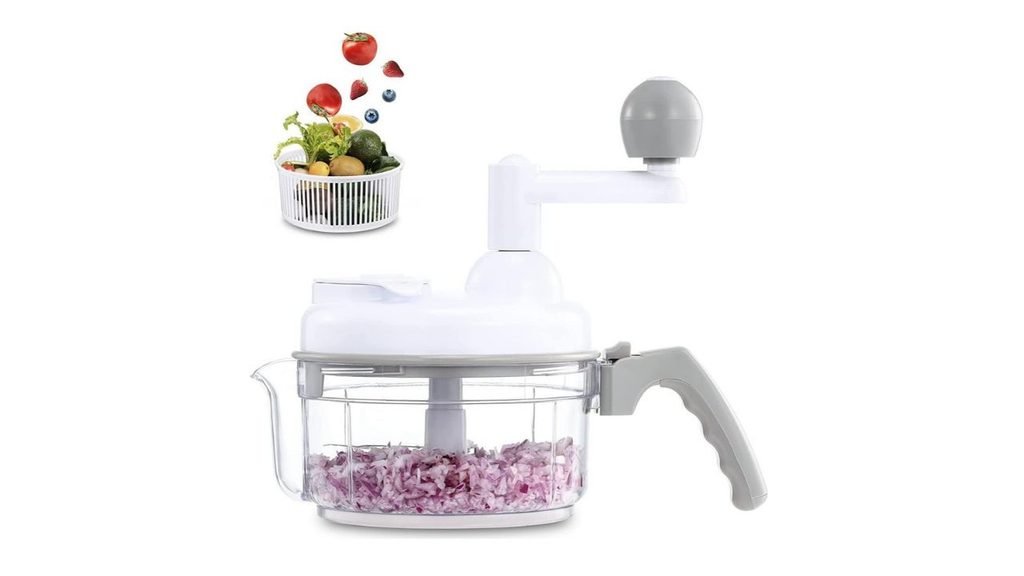
The Hand Food Chopper uses a crank to rotate blades inside a bowl. Geedel advertises a 3-cup capacity, and the retail package reviewed lists a chopping blade, whisking paddle, spinner basket, container, and handle. That makes it a broader preparation tool than the hinged dicer, although the supplied bundle should be checked before purchase.
Its U.S. listing showed 4.3 out of 5 stars from 2,228 ratings. That feedback history supports including it among established Geedel options, without proving how long a particular unit will last.
I would choose this model for chopped salad ingredients, onion mixtures, or recipes that need several ingredients reduced to a rough mince. The crank offers a different hand motion from pulling a cord, which may suit your preference during repeated batches.
The mixing attachments add a second reason to consider it. If you will use the paddle, it may avoid bringing out another bowl and whisk. If you only dice potatoes, those accessories do not make the crank model a better purchase than the grid version.
Leave room for ingredients to move. Packing the bowl tightly works against a rotating blade because food cannot circulate freely. A large bowl also does not guarantee good handling of a tiny quantity; a small ingredient can sit beyond the blade’s useful path.
The main ownership concern is its lid care: Geedel specifically directs owners to wipe the lid rather than rinse it. That deserves attention before buying a tool you expect to wash completely under the faucet.
My verdict: Pick it for mixed chopping and occasional mixing. I would pass on it if uniform cubes are the goal or if caring for a separate crank lid feels like unnecessary work.
3. Geedel Mini Pull Food Chopper: Best Budget Choice for Small Batches
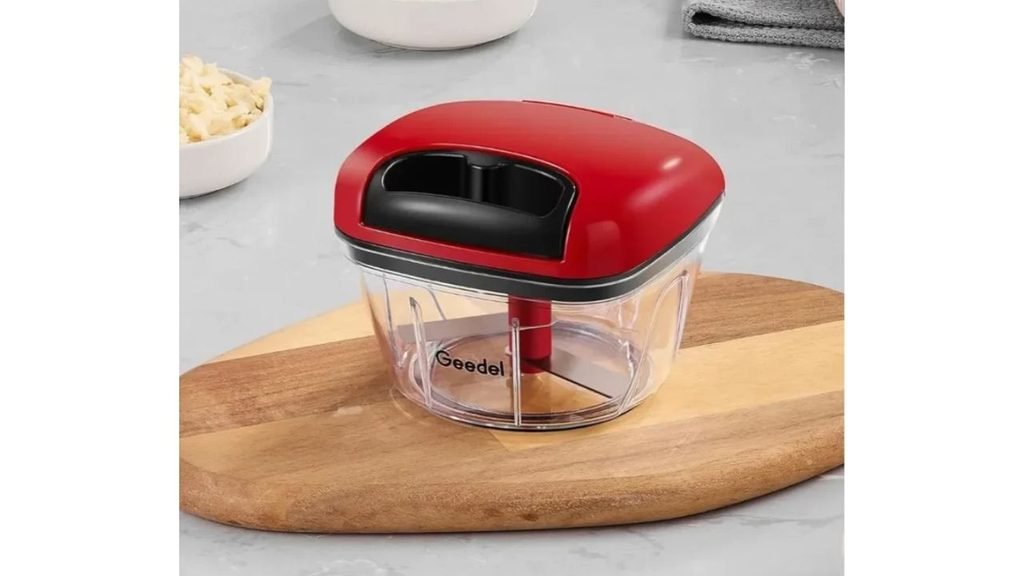
The Mini Pull model is the compact option for garlic, onion, herbs, and small topping mixtures. It is advertised as 500 mL, with Geedel also calling it a 2-cup model. Its three stainless-steel blades sit at different heights, and a pull handle turns the blade assembly inside the bowl.
The retail listing reviewed showed 4.4 out of 5 stars from more than 2,600 ratings. At the $15 direct-store price shown during research, it was the least expensive of these five options.
Its clearest use is a modest amount of chopping that does not require identical pieces. Think onion for a sandwich filling or a small garlic-and-herb mixture, rather than vegetables for a large roasting pan. You can inspect the contents between short groups of pulls and stop at the texture you want.
I like the purchase logic here: someone new to manual choppers can spend less and find out if the pulling motion fits their routine. There is little reason to pay for a larger mechanism if most of your recipes start with only a small amount of seasoning.
Its limits follow directly from that small size. Larger ingredients need preliminary cutting, repeated batches add handling, and a pull cord still demands a comfortable grip. It also cannot turn irregular chopping into precise cubes simply by changing the number of pulls.
For tiny jobs, compare it honestly with the tools already on your counter. If the knife and board are already out, assembling another device for one clove may add more washing than it saves in cutting.
My verdict: This is my budget pick for small chopped mixtures. Choose a different format if batch size, uniform dice, or the pulling motion is your main concern.
4. Geedel 2.5-Cup Pull Food Chopper: Best for a Larger Pull Bowl
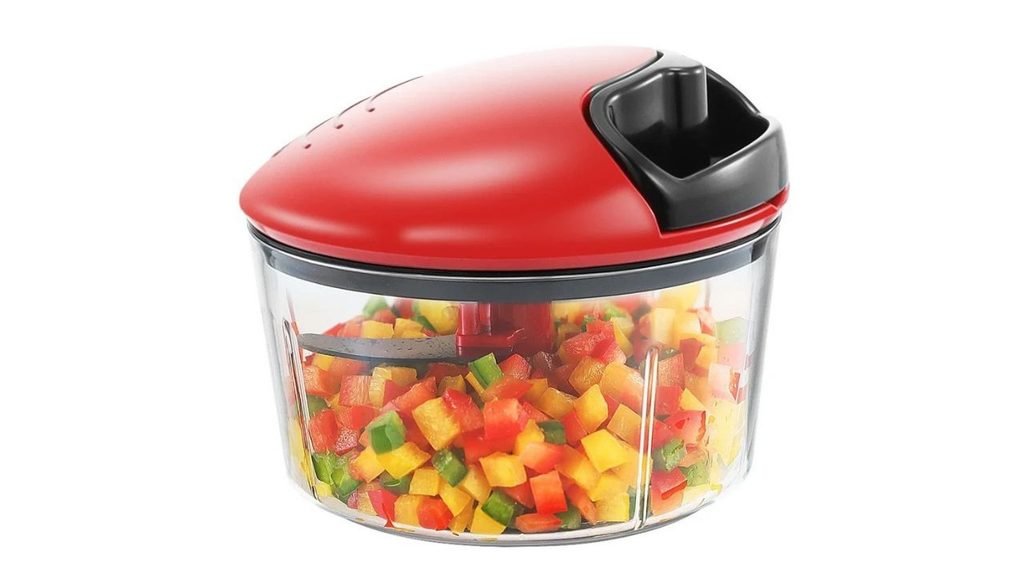
This Geedel 2.5-Cup Pull Food Chopper separately listed pull chopper has an advertised 600 mL, or 2.5-cup, capacity. It offers the same basic approach as the Mini Pull: a cord drives blades inside a closed bowl, with additional pulls reducing the pieces further. Its U.S. retail listing showed 4.5 out of 5 stars from 1,048 ratings.
The extra room is the main reason to consider it. If the smaller pull bowl is nearly sufficient for your usual onion or topping mixture, this version may be a more comfortable fit. That does not make it a substitute for a large food processor.
The comparison needs perspective. The advertised difference between 500 and 600 mL is only 100 mL, about 0.4 U.S. cup. That is a modest increase in container volume, and usable chopping capacity still depends on how loosely the food sits around the blades.
Price weakens its case at the direct-store figures checked. The 2.5-cup model was $29, compared with $15 for the Mini Pull and $20.19 for the hand-crank model. I would pay that difference only if I preferred the pull mechanism and expected to use the extra space regularly.
Before choosing it, picture your most common batch. If you already split vegetables into several portions, a small increase may not remove a complete batch. If you only need a little more room, it could be useful. This is a practical sizing decision, not a reason to assume the larger model cuts better.
My verdict: A reasonable alternative for someone committed to a pull chopper. Compare the delivered price closely; the smaller version has the stronger budget argument, while the crank model offers a different set of uses.
5. Geedel Slap Food Chopper: Best for Small Toppings
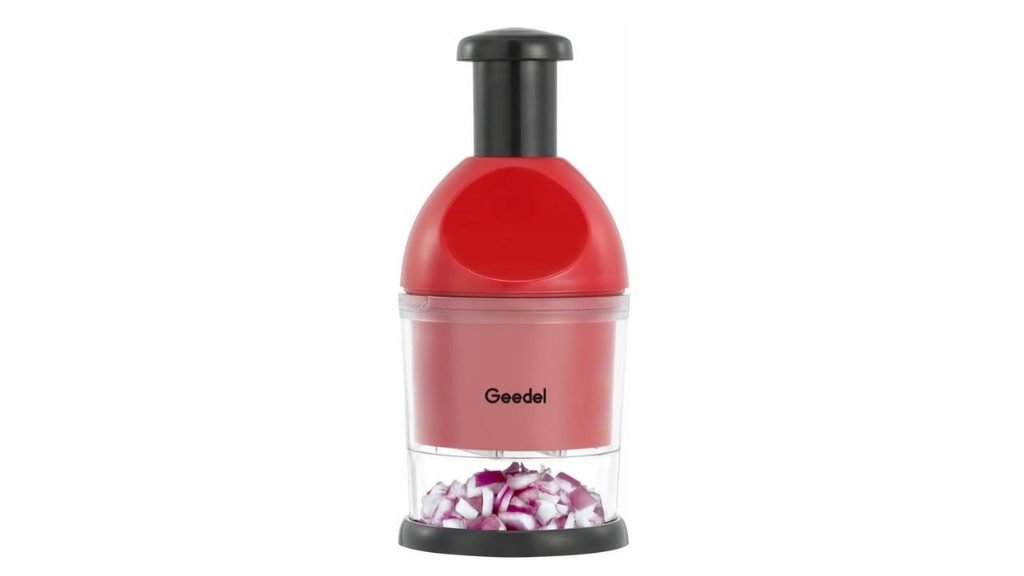
The Slap Food Chopper uses a press-down plunger instead of a hinged grid or cord. Its lower cup and base detach, and the holder opens to expose areas that need cleaning. Geedel markets it for small jobs involving ingredients such as onion, garlic, nuts, and cilantro.
It had the largest rating history among the five retail listings checked: more than 8,300 ratings, with an average of 3.8 out of 5 stars. That makes it a visible, established option, but the lower average is a reason to examine recent feedback rather than equate popularity with a stronger recommendation.
Its best role is keeping a small topping job contained. If you prefer pressing a handle to pulling a cord, it provides that choice without a large bowl or a collection of interchangeable grids.
I would judge it against the amount you actually chop. A few pieces for a topping fit the concept. Preparing several vegetables for dinner means loading, pressing, emptying, and repeating, so the small chamber can become a drawback.
The plunger motion also deserves a realistic assessment. The product name does not mean you should strike it violently. Controlled pressing gives you a chance to notice resistance or misalignment before forcing the mechanism.
Opening the holder is useful for reaching trapped food, but access and effortless cleaning are different things. Inspect the blade area after washing rather than assuming a quick rinse removes every onion fragment.
My verdict: Choose it because you prefer its motion and expect to prepare small portions. I would buy the grid model for diced meal preparation or a pull model for repeated chopped mixtures before choosing this one as an all-purpose kitchen tool.
Key Takeaway: Choose the grid for dice, a bowl chopper for chopped mixtures, and the plunger for small topping jobs.
Choosing the Model That Fits Your Cooking
Start With the Finished Cut
Dicing produces relatively regular pieces. Mincing reduces ingredients to small pieces without promising identical shapes. Shredding produces narrow fragments with a grating attachment. These are different outcomes, even when product titles use “chopper” for all of them.
Write down the cut you need most often before choosing a Geedel model. For cucumber cubes, start with the grid. For a fine onion mixture, consider a rotating-blade bowl. For shredded carrot, confirm that the actual package includes the suitable grating insert.
A photo of the attachments is more useful than a long product title. Do not assume that a cutting function shown on another Geedel product is included with yours.
Compare Working Space and Hand Motion
A container’s stated volume does not tell you how much hard produce you should load. The blade, center shaft, and room needed for food movement all affect practical use. Start with a loose batch and follow the supplied fill guidance.
Consider the motion as carefully as the bowl. A grid requires downward pressure; a pull model requires gripping and drawing the cord; a crank needs repeated turning. None is automatically comfortable for every hand or wrist.
For occasional cooking, compact storage may matter more than a little extra capacity. For repeated preparation, the number of times you must reload can matter more than the footprint.
Compare the Whole Preparation Job
I would assess time savings from the first trimmed vegetable to the last washed part. A short demonstration often shows only the cutting motion, which leaves out assembly, pre-cutting, clearing food, and cleanup.
The grid model has a stronger argument when several vegetables need the same cut. A small bowl chopper has a stronger argument when you want a chopped mixture and can use the batch immediately.
Treat price the same way. An inexpensive tool you use often may be a better purchase than a larger set that is awkward to wash or store. Accessories should justify their space with a task you already cook.
Key Takeaway: Match the finished cut, batch size, hand motion, and cleanup routine before comparing accessory counts.
Ingredients, Preparation, and Likely Results
Geedel lists common produce such as onions, potatoes, carrots, peppers, cucumbers, and zucchini for its grid chopper. The practical recommendations below follow the cutting mechanisms; they are not a claim that every ingredient was tested in each model.
| Ingredient or job | Practical approach | Main limitation |
| Onion | Grid for distinct pieces; bowl for a finer mixture | Peel and cut to fit first |
| Bell pepper | Remove stem and seeds; flatten sections for the grid | Folded, thick pieces can load unevenly |
| Cucumber or zucchini | Prepare slabs for short dice | Thick sections may produce long pieces |
| Raw potato or carrot | Use manageable, pre-cut sections | Dense produce needs more hand force |
| Firm tomato | Use gentle handling and stop early | Very ripe flesh may crush |
| Garlic and herbs | Start with a small bowl batch | Tiny quantities may escape the blade path |
| Shredded vegetables | Fit the specified grating attachment | Chopping blades do not make uniform shreds |
Keep mixed textures separate until you understand how they behave. A carrot needs more cutting than a ripe tomato; processing them together can leave tomato pulp surrounding large carrot pieces. Chopping the firmer ingredient first and combining afterward gives you more control.
Dry washed herbs before chopping if you want loose fragments rather than a wet clump. Remove tough stems, pits, shells, and other unwanted parts beforehand. Do not use a clogged blade as a reason to force unprepared food through the machine.
Tip: Match the cut to the recipe. Rough onion for a cooked sauce does not need the same appearance as raw cucumber in a chopped salad.
How to Use a Geedel Chopper

Start with the instruction sheet for your exact product. Check that the bowl, blade, lid, and attachments belong together and that nothing is cracked or bent. Keep a knife, cutting board, and the supplied cleaning tool nearby.
Wash produce before cutting. FDA advises using running water rather than soap or detergent, including for produce that will be peeled. Clean hands and a clean preparation surface belong at the start of the job.
Using the Hinged Grid Dicer
- Fit the cutting insert. With the lid open, seat the chosen insert in its intended position and engage the retaining mechanism. Keep fingers on the frame, away from the cutting edges.
- Prepare the ingredient. Remove unwanted skin, seeds, and ends. Cut a section that sits within the grid rather than across its frame.
- Choose the starting thickness. Use thinner slabs when you want shorter dice. Do not expect the grid to control the length of an oversized chunk.
- Press in a controlled motion. Place the prepared food on the grid, clear your fingers, and operate the lid as directed. Stop if resistance is unusually high.
- Empty and inspect. Clear the collection bowl before food crowds the underside of the blade. Remove trapped pieces with the proper tool while the mechanism is stationary.
Use grating inserts only in their instructed position and with the specified food holder. Do not assume the hinged pressing motion applies to every attachment.
Using the Pull-Cord and Hand-Crank Models
Seat the blade assembly correctly before adding food. Distribute prepared pieces loosely around it, fit the lid, and hold the bowl steady. Keep the operating handle and the supporting hand clear of each other.
Start with a few controlled pulls or turns, then stop and inspect the contents. Repeat only until the pieces suit the recipe. I would use appearance as the stopping point instead of treating a printed pull count as a guaranteed setting.
If ingredients collect outside the cutting path, stop completely before opening the bowl. Use a suitable utensil to redistribute them, keeping clear of the edges. If movement becomes difficult, reduce the load or cut large pieces smaller.
Avoid yanking a cord against its end stop. For crank models, never force a jammed handle. Follow the supplied instructions for changing from the chopping blade to a mixing accessory.
Using the Plunger Chopper
Load a small amount of prepared food within the chamber and assemble the base or cutting-board setup described in the instructions. Keep the unit upright and press the plunger steadily.
Inspect after a short series of presses. More pressing may reduce the pieces further, but repeated operation will not correct a chamber packed too tightly or food caught outside the blade path.
If the plunger sticks, stop before opening or cleaning the unit. Do not put your fingers underneath while testing its movement. Detach parts only after the mechanism has come to rest.
Key Takeaway: Fit the parts correctly, prepare manageable pieces, and stop to inspect instead of overcoming resistance with force.
Cleaning and Dishwasher Care
Check the Rules for Each Part
Geedel’s dishwasher guidance needs a careful reading. Its grid and plunger listings describe dishwasher compatibility, and the grid listing recommends the top rack. The direct-store care instructions also warn against Heat Dry and high-temperature drying, which may deform plastic parts.
The hand-crank model has a more specific restriction: wash the bowl and blades as directed, but wipe the lid with a damp cloth. Its page also contains a broad dishwasher statement, so I would follow the explicit lid instruction.
For pull-cord housings, check the supplied sheet before immersion. My cautious preference is to wipe the housing unless the exact model’s instructions clearly permit washing it. Do not transfer one chopper’s lid instructions to another mechanism.
Remove Food and Store the Blades Dry
Disassemble the washable parts and remove trapped food promptly. Use the supplied comb or brush for grid openings and the pusher’s recesses. Keep your fingertips away from the edges, even when the attachment looks small or harmless.
Wash approved parts with dish detergent and water, rinse, and inspect them before drying. A dishwasher cycle does not remove the need to check for food lodged in narrow spaces. Avoid leaving exposed blades hidden in a sink full of dishes.
Let parts dry before putting them together for storage. Store cutting inserts in their intended holder or protected location so reaching into a cabinet does not expose your hand to an edge.
If a lid traps water, develops an odor, or cannot be cleaned according to its instructions, contact support. Do not pry apart a sealed drive housing without manufacturer directions.
Key Takeaway: Check care instructions part by part, clear trapped food, and avoid high-temperature drying.
Common Problems and What to Check First
These checks address loading and assembly before assuming a part has failed. Stop operation before inspecting the cutting area.
| Problem | First checks | Sensible response |
| Grid lid needs heavy pressure | Oversized food, crowded grid, incorrect insert seating | Reduce the piece size and recheck assembly |
| Lid will not close properly | Food above the rim, misplaced shaft or attachment | Empty enough food and refit the parts |
| Pull cord or crank resists movement | Large pieces blocking the blade | Stop, open as instructed, and reduce the load |
| Mixture becomes watery | Soft produce cut too long | Stop earlier and process firm ingredients separately |
| Large pieces remain | Uneven starting pieces or restricted circulation | Redistribute with a utensil after stopping |
| Food remains in the pusher | Residue lodged between projections | Use the supplied cleaning tool |
| Cuts worsen despite correct loading | Dirty, bent, damaged, or worn cutting parts | Clean and inspect; seek the correct replacement |
The most useful distinction is between a poor result and a damaged mechanism. Uneven food may call for a smaller batch. A cracked lid, loose blade, frayed cord, or slipping drive calls for stopping use and contacting the seller.
I would not try to restore a bent grid by pushing it straight with bare fingers. A part that no longer seats securely should not be trusted simply because the chopper can still be assembled around it.
Replacement Parts, Manuals, and Warranty
Keep the order details, packaging label, and instruction sheet. Geedel product names can be long, and similar-looking listings may describe different mechanisms or bundles. Those records identify the version you received.
Geedel’s replacement catalog lists a hand-chopper handle, a hand-chopper slide cover, and parts labeled for the PS-331 vegetable chopper. Availability of these items does not mean every blade, bowl, or cord is sold separately. Confirm the exact part and its compatibility before ordering.
Send support a clear photo of the whole product and the failed part. Do not fit a blade because its outer dimensions merely look close; the holder, shaft, and lid must match the original assembly.
The brand advertises a one-year product warranty. Its direct-store return policy also describes a 45-day process requiring prior authorization and original packaging, with return-shipping costs assigned to the buyer. Check the policy attached to your seller and order rather than assuming a “free trial” means free return shipping.
Conclusion
The main finding of this Geedel vegetable chopper review is that each mechanism serves a different preparation job. The 4-in-1 grid model is my first choice for repeated dicing, the Mini Pull is the budget option for small chopped mixtures, and the hand-crank model suits broader bowl preparation.
The larger pull chopper deserves a price comparison before purchase, while the plunger model makes the most sense for small topping jobs and a preference for downward pressing. None removes the need to trim ingredients, control the load, or clean sharp parts carefully.
Choose around a meal you cook regularly. Identify the cut you want, check the supplied attachments and care sheet, and compare the full delivered price. A chopper earns its place when it improves that repeated task without adding more assembly and washing than you want.
FAQs About Geedel Vegetable Choppers
Is the Geedel vegetable chopper electric?
The five models reviewed here are manual. You supply the motion through a hinged lid, pull cord, crank, or plunger. They do not need charging or an electrical outlet. Choose among them by the cut they produce and the motion you find comfortable; manual operation still requires physical effort.
Does a Geedel chopper prevent onion tears?
Do not count on completely tear-free preparation. A closed bowl contains the chopped onion during operation, but you still need to peel, trim, load, and empty it. Geedel promotes reduced onion-preparation hassle, yet that is not a guarantee that every user avoids irritation. I would choose the model for its cutting result rather than a no-tears promise.
Can a Geedel chopper replace a food processor?
It can take over some small chopping jobs if the batch and texture suit its mechanism. A grid dicer does not puree, and a manual bowl chopper does not offer motor-driven processing. If your recipes regularly require large batches, sustained blending, or other attachments, keep those tasks in mind before replacing an appliance with one manual chopper.
Where can I find the correct Geedel instruction manual?
Start with the sheet supplied in the box. If it is missing, contact the seller or Geedel support with your order number and a photo of the product. Request instructions for that exact version, including lid care and assembly. Do not assume a generic online “Geedel manual” covers every grid, crank, pull, and plunger model.
Is a Geedel chopper a good choice for weak hands?
It may suit some users, but no mechanism is automatically the easiest for everyone. Consider grip, pulling reach, downward pressure, and repeated turning separately. I would favor a purchase with a clear return policy so you can assess comfort within the seller’s terms. Stop if operation causes pain or requires enough force to make the tool unstable.





One Comment