Are Wood Fiber Cutting Boards Safe? Materials and Risks
Yes, properly manufactured wood fiber cutting boards are generally safe for everyday food preparation. These boards combine compressed wood-based fibers with binding resin to create a dense, moisture-resistant cutting surface. Their safety depends on the resin formulation, food-contact suitability, manufacturing quality, and cleaning practices. Boards with verified food-contact certification offer stronger reassurance than products making unsupported safety claims.
The biggest concern is what holds the wood fibers together. Unlike solid hardwood boards, composite cutting surfaces contain manufactured binding materials. Poorly documented adhesives, damaged surfaces, or unsuitable finishes can raise questions about chemical exposure and food contamination.
Choosing a well-made composite board provides the convenience of a thin, durable cutting surface without the routine oiling associated with traditional wood. Many models are also dishwasher-safe, making cleanup after meat and vegetable preparation relatively simple.
In the United States, NSF/ANSI 51 establishes food-equipment material requirements. NSF’s certified-product listings include specific phenolic wood-fiber composite materials approved for food contact under stated conditions. This confirms that some resin-bonded fiber materials meet recognized food-safety standards, but it does not certify every board marketed as wood fiber.
During my research into are wood fiber cutting boards safe, one distinction stood out: the presence of synthetic resin does not automatically mean a cutting board releases harmful chemicals. The resin formulation, curing process, intended food contact, and applicable testing are more meaningful than the word “resin” alone.
Another point deserves attention. Wood fiber, paper composite, and pressed wood are not always interchangeable product descriptions. A cutting board manufactured from food-safe paper composite is different from ordinary furniture-grade fiberboard, which should never be assumed suitable for food preparation.
Understanding the ingredients, formaldehyde concerns, certification labels, microplastic questions, cleaning requirements, and signs of damage will make it easier to identify a safe composite cutting board and use it correctly.
What Are Wood Fiber Cutting Boards Made Of?

A wood fiber cutting board is an engineered food preparation surface made from wood-based cellulose fibers bonded together under pressure, usually with resin.
These materials are often described as wood composite, paper composite, or compressed wood fiber.
Wood Fibers and Paper-Based Materials
The main structural ingredient is cellulose, a natural material found in wood and other plants.
Manufacturers may use wood pulp, engineered paper, recycled paper, or layers of specially prepared fiber sheets.
The fibers provide the basic structure of the board.
Unlike solid wood, where natural grain runs through the material, composite boards contain processed fibers arranged and compressed during manufacturing.
This creates a dense surface with relatively consistent thickness.
Some manufacturers use Forest Stewardship Council (FSC)-certified paper or wood fibers.
FSC certification concerns responsible forest sourcing and related chain-of-custody requirements. It does not independently establish that a finished cutting board is safe for direct food contact.
Food-Safe Resin and Binding Materials
Resin holds the fibers together and contributes to moisture resistance and structural strength.
Many established paper-composite cutting boards use thermosetting resin, which hardens through a chemical curing process during manufacturing.
Phenolic resin is one example.
The fibers and resin are combined, then subjected to heat and pressure to create a dense, stable sheet.
A properly cured resin system can be suitable for food-contact applications when its formulation meets applicable requirements.
The key distinction is that resin is not automatically harmful simply because it is synthetic.
Its safety must be evaluated according to its composition, manufacturing process, and intended use.
Wood Fiber Composite Is Not Ordinary MDF
Wood fiber cutting boards should not be confused with medium-density fiberboard (MDF) or particleboard used in furniture and construction.
Furniture-grade boards may contain adhesives, additives, and finishes that are not intended for direct food contact.
Their construction may also be unsuitable for repeated wet cleaning.
A board made for furniture should not be repurposed as a cutting surface without clear manufacturer documentation establishing food-contact suitability.
A properly manufactured kitchen composite board is engineered for food preparation, cleaning, and knife contact.
Key Takeaway: Wood fiber cutting boards combine cellulose fibers with binding resin. Food-safe construction and verified material specifications distinguish kitchen composites from ordinary engineered furniture boards.
Are Wood Fiber Cutting Boards Safe for Food Contact?
Yes, wood fiber cutting boards can be safe for food contact when their materials and manufacturing processes meet applicable food-safety requirements.
The strongest evidence comes from recognized certification and clear manufacturer documentation.
What Does NSF Certification Mean?
NSF is an independent organization that develops standards and evaluates products used in food-related environments.
NSF/ANSI 51: Food Equipment Materials establishes requirements for materials and finishes used in commercial food equipment, including cutting-board materials.
Certification evaluates relevant food-contact characteristics, such as material suitability and sanitation requirements.
For example, NSF lists certain Richlite phenolic wood-fiber sheet materials for food-contact applications.
Some listed Richlite materials are rated for all food-contact types with specified maximum use temperatures.
These certifications apply to particular materials and conditions, not to every wood fiber cutting board on the market.
Look for a genuine certification mark and verify that the specific product or material appears in the certifier’s official listings.
Does FDA Compliance Mean a Cutting Board Is Safe?
The U.S. Food and Drug Administration regulates substances used in food-contact applications.
These can include materials used in food preparation surfaces, processing equipment, and cookware.
A manufacturer may state that its board complies with applicable FDA food-contact requirements.
That claim should relate to the materials, permitted uses, and conditions of contact.
The FDA does not generally issue individual product approvals for every household cutting board sold in the United States.
For this reason, phrases such as “FDA approved cutting board” deserve closer inspection.
I would give greater weight to specific material compliance documentation or independently verifiable certification than to a broad marketing statement.
Does Food-Safe Mean Antibacterial?
No. A food-safe cutting board is not automatically antibacterial or self-sanitizing.
Many wood fiber composites have dense, low-porosity surfaces that resist moisture absorption.
That makes them relatively easy to clean compared with materials that absorb more water.
Still, bacteria can remain on the surface after contact with raw chicken, seafood, or contaminated ingredients.
A board’s food-contact certification does not remove the need for washing and sanitizing.
Key Takeaway: Certified wood fiber composite materials can be suitable for food preparation. Verify certification and material claims, and never treat food-safe or low-porosity construction as a substitute for cleaning.
Do Wood Fiber Cutting Boards Contain Harmful Chemicals?
The presence of chemical ingredients in a composite board does not establish that the finished product creates harmful exposure.
Potential chemical migration depends on the ingredients, curing process, temperature, food-contact conditions, and product quality.
Formaldehyde in Wood Fiber Cutting Boards
Formaldehyde is one of the most common concerns surrounding engineered wood materials.
Some composite products contain resins manufactured using formaldehyde as a starting chemical.
For example, phenol-formaldehyde resin is made through a reaction involving phenol and formaldehyde.
During proper manufacturing, these ingredients react to form a hardened polymer network.
The chemical composition of the finished material differs from the original ingredients used to manufacture the resin.
That distinction matters.
A product containing cured phenolic resin should not automatically be assumed to release unsafe amounts of formaldehyde during normal food preparation.
Likewise, it would be inaccurate to claim that all wood fiber cutting boards are completely formaldehyde-free.
The better question is if the finished material meets applicable food-contact and exposure requirements under its intended conditions.
Some manufacturers advertise “no added urea-formaldehyde.” That statement does not necessarily mean the product contains no formaldehyde-derived resin chemistry.
For consumers concerned about formaldehyde, verified product documentation is more useful than an unsupported chemical-free claim.
Are Wood Fiber Cutting Boards BPA-Free?
Some manufacturers market their boards as BPA-free.
Bisphenol A (BPA) is associated with certain plastic and resin systems, but it is not a required ingredient in every composite material.
Phenolic wood-fiber boards do not automatically contain BPA simply because they use synthetic resin.
At the same time, the words “wood fiber” do not independently establish that a product contains no BPA.
If avoiding BPA is a priority, check the manufacturer’s material declaration or relevant testing information.
A BPA-free claim also does not address every other possible chemical used in a product.
Do Wood Fiber Cutting Boards Contain PFAS?
PFAS are a group of synthetic chemicals used in certain industrial and consumer applications.
They are not a necessary ingredient in every wood fiber cutting board.
Some composite manufacturers state that their products contain no intentionally added PFAS.
Those statements are product-specific.
A natural-looking surface does not prove the absence of PFAS, and resin construction alone does not prove their presence.
For products with limited material information, request written confirmation from the manufacturer if PFAS content is a concern.
Do Wood Fiber Boards Release Microplastics?
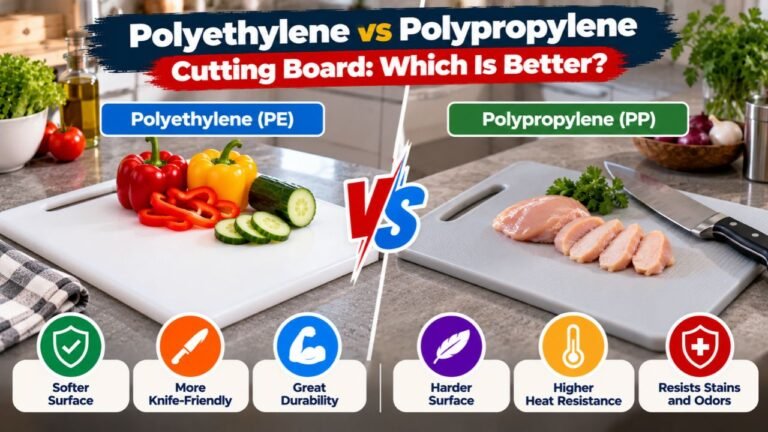
Wood fiber composite boards are different from ordinary polyethylene and polypropylene plastic cutting boards.
Their surfaces contain cellulose fibers combined with resin.
Some manufacturers report testing that found no detectable microplastic release from particular composite products under specified conditions.
Those results should not be extended automatically to every wood fiber board.
Repeated knife contact can wear composite cutting surfaces and may release small particles.
The composition and amount of material released depend on the board’s construction and how it is used.
Because many composites contain synthetic polymers as binding materials, I would avoid describing every wood fiber board as completely free of plastic-derived particles without suitable evidence.
Similarly, research measuring microplastic release from conventional plastic cutting boards cannot directly establish the release rate from every paper-resin composite.
Key Takeaway: Chemical safety depends on the finished material and its intended food-contact conditions. Formaldehyde-derived resins, BPA claims, PFAS claims, and particle release require product-specific evidence rather than assumptions.
Are Wood Fiber Cutting Boards Hygienic for Raw Meat and Vegetables?
A properly manufactured and maintained wood fiber cutting board can be used for meat, vegetables, fruit, and other food preparation tasks.
Its hygiene depends on cleaning, surface condition, and separation of raw and ready-to-eat foods.
Are Wood Fiber Cutting Boards Nonporous?
Many compressed wood fiber boards have very low porosity because the fibers are bonded and consolidated with resin.
This helps reduce water absorption and makes the surface easier to wash.
Low porosity does not mean the board cannot develop knife marks or hold food residue.
Repeated chopping can gradually create surface cuts.
Deep grooves may become difficult to clean thoroughly.
The U.S. Department of Agriculture advises replacing cutting boards when they become excessively worn or develop hard-to-clean grooves.
This principle applies to composite boards as well.
Can You Cut Raw Chicken on a Wood Fiber Board?
Yes, a food-safe composite board can be used for raw chicken when the manufacturer permits that food-contact use.
A dense composite surface can be cleaned after exposure to poultry juices.
Still, raw poultry may contain harmful microorganisms, including Salmonella and Campylobacter.
The USDA recommends separate cutting surfaces for raw meat, poultry, and seafood and for foods that will be eaten without further cooking.
For example, use one designated surface for raw chicken and another for salad vegetables.
If only one board is available, wash and sanitize it thoroughly before switching food categories.
A dishwasher-safe composite board can be convenient for raw meat preparation when machine washing is permitted by the manufacturer.
Do Wood Fiber Boards Harbor Bacteria?
Any cutting board can retain bacteria when contaminated and inadequately cleaned.
Wood fiber composites may resist moisture absorption better than many traditional wooden boards, but they do not automatically kill microorganisms.
Knife scars, damaged edges, and deteriorating surfaces can retain food residue.
Some composite products are marketed as antimicrobial.
Such claims should be supported by testing that applies to the finished product and the stated organisms.
Do not rely on antimicrobial advertising to replace routine cleaning.
Key Takeaway: Wood fiber cutting boards can be hygienic for raw and ready-to-eat foods. Separate food categories, wash after use, and replace boards with damage that prevents thorough cleaning.
How to Clean a Wood Fiber Cutting Board Safely
Most wood fiber composite boards need relatively little routine maintenance.
Cleaning methods vary because not every composite board uses the same resin or construction.
Everyday Cleaning Steps
For routine washing, use mild dish soap, warm water, and a soft sponge.
- Remove food scraps and loose residue from the cutting surface.
- Wash both sides with warm, soapy water.
- Clean around the edges, hanging holes, grooves, and rubber feet.
- Rinse thoroughly with clean water.
- Dry with a clean towel or allow the board to air-dry fully.
- Store it upright or flat in a dry location.
Avoid using unnecessarily abrasive cleaning tools that may damage the surface.
If a new board has a manufacturing odor, follow the manufacturer’s washing instructions before use.
An odor may fade after several washings, but persistent strong chemical smells, peeling, or visible surface deterioration justify contacting the manufacturer.
Sanitizing After Raw Meat Preparation
Cleaning removes food residue, while sanitizing reduces microorganisms remaining on a surface.
The USDA recommends a sanitizing solution containing 1 tablespoon of unscented liquid chlorine bleach per gallon of water for suitable cutting boards.
Wash the cutting surface first.
If the board manufacturer permits this sanitizing method, apply the solution, allow it to remain for several minutes, rinse thoroughly with clean water, and dry.
A commercial sanitizer labeled for food-contact surfaces may also be used according to its directions.
Do not mix bleach with ammonia, vinegar, or other cleaning chemicals.
For resin-based composites, follow the manufacturer’s instructions for sanitizer compatibility.
Are Wood Fiber Cutting Boards Dishwasher-Safe?
Many established wood fiber composite cutting boards are dishwasher-safe.
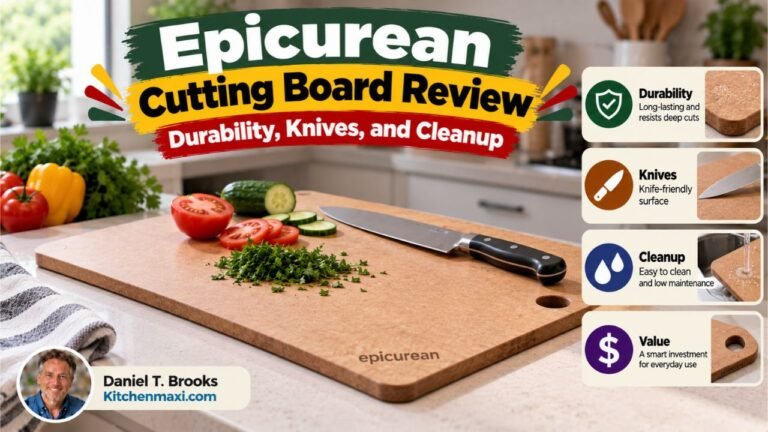
Epicurean, for example, identifies its paper-composite cutting surfaces as dishwasher-safe.
This is a useful distinction from many traditional wooden and bamboo boards, which can crack or warp after repeated dishwasher exposure.
Still, dishwasher compatibility is not universal.
Some composite boards may contain adhesives, coatings, backing materials, or other parts with different temperature limitations.
Check the manufacturer’s label before machine washing.
Even dishwasher-safe composite boards should be dried properly afterward. Prolonged exposure to trapped moisture can affect some wood-based materials.
Key Takeaway: Most quality wood fiber boards need simple washing and drying, with no routine oiling. Use a dishwasher or chemical sanitizer only when the manufacturer confirms compatibility.
Are Wood Fiber Cutting Boards Safe for Kitchen Knives?
Wood fiber composite cutting boards are generally suitable for ordinary kitchen knives, but their cutting feel differs from solid hardwood.
A dense composite surface can be relatively firm and may produce more noise during chopping.
Do Wood Fiber Boards Dull Knives?
Wood fiber cutting boards can gradually wear knife edges, just like other cutting surfaces.
Their effect depends on the surface hardness, blade steel, sharpening angle, and cutting technique.
Some composite boards feel harder than traditional end-grain hardwood.
Independent cutting-board comparisons have reported that certain paper-composite boards feel rigid and noisy during chopping.
This does not establish that every wood fiber composite causes excessive knife wear.
Compared with glass, ceramic, marble, or metal cutting surfaces, many wood fiber composites provide a more suitable surface for repeated knife contact.
For expensive Japanese-style knives with thin edges, a quality end-grain hardwood or suitable rubber cutting board may offer a more forgiving feel.
Are Wood Fiber Boards Good for Heavy Chopping?
A sturdy wood fiber composite board can handle ordinary chopping, slicing, and dicing.
Its suitability for heavy chopping depends on thickness, stability, and manufacturer instructions.
Thin composite boards may be lightweight and convenient but can move on polished countertops.
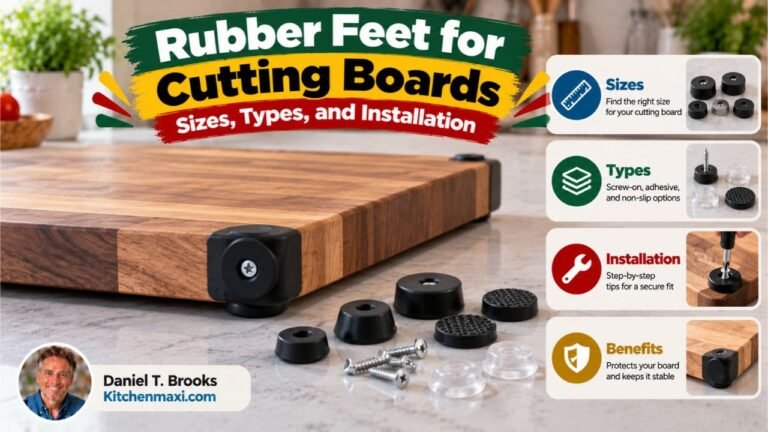
Some models include rubber feet to improve grip.
For forceful chopping, choose a board that remains stable and provides enough support for the knife.
Avoid using thin composite boards for splitting hard bones or other tasks involving repeated heavy impacts unless the manufacturer expressly permits that use.
Do Wood Fiber Cutting Boards Get Scratched?
Yes. Knife marks can develop on composite cutting surfaces.
These marks are not automatically evidence of poor quality.
A cutting board must allow some knife contact during normal use, so minor surface scoring is expected.
The concern begins when scratches become deep, rough, or difficult to clean.
Do not sand or refinish a resin-based composite board unless the manufacturer provides instructions permitting that procedure.
Removing surface material without suitable guidance may change the board’s finish or expose damaged areas.
Key Takeaway: Wood fiber composites are suitable for many kitchen knives, although some feel harder than solid wood. Minor knife marks are normal; deep damage and unstable construction are not.
Wood Fiber vs Wood, Bamboo, and Plastic Cutting Boards
Each cutting-board material presents different advantages and limitations.
The following comparison focuses on factors that affect food safety, cleaning, and everyday use.
| Feature | Wood Fiber Composite | Solid Hardwood | Bamboo | Plastic |
| Construction | Wood or paper fibers bonded with resin | Natural solid wood | Laminated bamboo strips | Synthetic polymer |
| Food safety | Safe when made for food contact | Safe with proper care | Safe with proper care | Safe when made for food contact |
| Porosity | Usually low | Varies by species and finish | Relatively low | Nonporous |
| Dishwasher use | Many models permit it | Generally hand-washing recommended | Generally hand-washing recommended | Many models permit it |
| Knife friendliness | Moderate to good; varies | Often very good | Moderate | Varies by formulation |
| Routine oiling | Usually unnecessary | Often recommended | Often recommended | Unnecessary |
| Moisture resistance | Generally good | Requires drying | Requires drying | Generally strong |
| Common damage | Deep scoring, edge damage, warping | Cracking, warping, knife grooves | Joint separation, cracking | Knife grooves, warping |
| Weight | Often lightweight | Often heavier | Moderate | Usually lightweight |
| Best use | Low-maintenance daily preparation | Frequent knife work | General household preparation | Convenient cleaning and raw-food preparation |
Wood fiber composites are appealing for people who want a wood-like appearance without regular oiling.
Solid hardwood may be more appealing for extensive chopping with premium knives.
Bamboo offers a natural-looking cutting surface, while plastic remains convenient for households that prioritize dishwasher cleaning.
No material is automatically safer under every condition.
Surface quality, proper cleaning, and product-specific food-contact suitability remain central to kitchen hygiene.
How to Choose a Safe Wood Fiber Cutting Board
A safe purchasing decision begins with the material description rather than the board’s appearance.
Some inexpensive composite boards provide little information about their ingredients or testing.
What to Check Before Buying
I recommend checking these details before purchasing a wood fiber cutting board:
- Food-contact suitability: The manufacturer should clearly identify the product as intended for direct food preparation.
- Resin information: Look for a meaningful description of the binding material and any applicable material-compliance statements.
- Independent certification: Verify genuine NSF certification or other relevant food-contact testing where claimed.
- Cleaning instructions: Confirm dishwasher and sanitizer compatibility.
- Heat limitations: Check the product’s permitted temperature range instead of assuming that all composites tolerate hot cookware.
- Surface construction: Look for smooth edges, a flat surface, and no visible separating layers.
- Manufacturer transparency: Prefer companies that publish material details and provide product-care information.
A product description that says only “natural wood fiber” without explaining the resin or food-contact suitability offers limited reassurance.
NSF certification is a strong supporting indicator when verified, but a board without NSF certification is not automatically unsafe.
Other legitimate food-contact compliance routes may apply.
Warning Signs of a Poor-Quality Board
Inspect the board before its first use.
Avoid using a composite cutting board that has loose fibers, peeling layers, rough damaged edges, or a surface that appears to crumble.
A new board should feel solid and stable.
Minor color variations are normal for some composite materials.
A mild manufacturing odor may also occur with certain products, but a persistent strong odor after the recommended washing procedure deserves attention.
Do not assume that smell alone proves toxic chemical exposure. It is a reason to seek product information before continued use.
When Should You Replace a Wood Fiber Cutting Board?
Wood fiber boards do not have one universal replacement schedule.
Their service life depends on construction, cutting frequency, cleaning practices, and physical wear.
Replace a board when it develops deep grooves that cannot be cleaned thoroughly, separating layers, loose surface fragments, sharp damaged edges, or permanent distortion that makes it unstable.
A board that rocks during cutting may increase the risk of knife accidents.
Minor surface marks and gradual changes in color do not necessarily require replacement.
Key Takeaway: Choose composite boards with clear food-contact documentation, suitable cleaning instructions, and sound construction. Stop using a board when damaged surfaces prevent proper cleaning or stable cutting.
Common Mistakes That Can Make Wood Fiber Cutting Boards Unsafe
Even a well-manufactured board can become unsuitable for food preparation through incorrect use.
Assuming all resin is toxic: A properly formulated and cured food-contact resin is not automatically unsafe. Certification and intended-use information provide stronger evidence than the word “resin.”
Treating every pressed wood product as food-safe: Ordinary MDF, decorative fiberboard, and construction panels should not be substituted for kitchen cutting surfaces.
Ignoring deep knife grooves: Heavily damaged surfaces may retain food residue and become difficult to sanitize.
Using the board beyond its heat rating: Some composites tolerate relatively high temperatures, but others may discolor or suffer damage. A heat-resistant cutting board is not automatically suitable as cookware.
Assuming dishwasher-safe applies to every brand: Composite construction varies. Follow the specific product’s care instructions.
Trusting antibacterial claims without evidence: Low moisture absorption does not mean bacteria disappear without cleaning.
Using the same unwashed board for raw chicken and salad ingredients: Cross-contamination remains possible on composite surfaces.
Continuing to use a delaminating board: Separating layers can create difficult-to-clean spaces and indicate structural deterioration.
Avoiding these mistakes does more for everyday food safety than choosing a cutting board based on a single marketing claim.
Conclusion
For households concerned about are wood fiber cutting boards safe, the evidence supports a reassuring but qualified answer: properly manufactured, food-contact-suitable composite boards are generally safe for everyday cutting. Their resin content does not automatically make them toxic, and independently certified materials offer stronger evidence of food-contact suitability.
The main precautions involve verifying the manufacturer’s material claims, following cleaning instructions, avoiding excessive heat, and checking for surface damage. A durable, low-porosity composite board can be a practical alternative to traditional wood, bamboo, or plastic when it is properly maintained.
My recommendation is to choose a wood fiber cutting board from a manufacturer that identifies its materials and provides clear food-contact and care documentation. Prioritize verified safety information over labels such as natural, chemical-free, or antibacterial, and replace the board if its surface becomes damaged or difficult to clean.
FAQs About Wood Fiber Cutting Board Safety
Are Wood Fiber Cutting Boards Non-Toxic?
Properly manufactured wood fiber cutting boards can be suitable for food contact without presenting an identified chemical hazard under their intended conditions of use.
Their safety depends on the resin formulation, manufacturing process, and applicable compliance requirements.
A natural appearance does not prove that a board contains no synthetic chemicals.
Look for reliable food-contact documentation, such as relevant NSF certification or material-compliance information, rather than relying exclusively on a non-toxic marketing label.
Do Wood Fiber Cutting Boards Contain Formaldehyde?
Some wood fiber composite boards use phenolic resins manufactured from chemicals that include formaldehyde.
During production, these chemicals react and cure into a hardened polymer structure.
That does not establish that the finished cutting board releases harmful amounts during normal use.
Actual exposure depends on the finished formulation and conditions of contact.
Not every composite uses the same resin, so manufacturer documentation and relevant testing are necessary for assessing a specific product.
Are Epicurean Wood Fiber Cutting Boards Safe?
Epicurean manufactures paper-composite cutting boards intended for food preparation.
Its materials use layers of paper combined with thermosetting resin and compressed into a solid cutting surface.
The manufacturer identifies relevant products as NSF certified and dishwasher-safe.
Specific Epicurean cutting-board models also appear in NSF’s official food-equipment listings.
Check the certification and care instructions for the particular model, because product features and approved uses may vary.
Can You Put a Wood Fiber Cutting Board in the Dishwasher?
Many wood fiber composite cutting boards are dishwasher-safe, including several established paper-composite products.
Their resin-bonded construction generally provides stronger resistance to washing than ordinary laminated wood.
Still, dishwasher compatibility varies by formulation and design.
Some boards may contain parts or finishes that require hand-washing.
Always follow the manufacturer’s cleaning instructions, and allow the board to dry fully before storing it.
Do Wood Fiber Cutting Boards Shed Microplastics?
Wood fiber composites do not have the same construction as ordinary polyethylene or polypropylene cutting boards.
They typically combine cellulose fibers with synthetic resin.
Some manufacturers report testing showing no detectable microplastic release under specific test conditions.
That does not prove all composite boards release no particles during cutting.
Surface wear may produce material fragments, and their composition varies by product.
Replace boards with extensive scoring, crumbling, or peeling, and avoid claims of zero particle release unless supported by suitable testing.
Are Wood Fiber Cutting Boards Better Than Plastic?
Wood fiber boards may offer a firmer surface, wood-like appearance, and good moisture resistance without routine oiling.
Many are also dishwasher-safe.
Plastic boards are often less expensive and come in a greater variety of thicknesses, sizes, and colors.
Both materials can develop knife grooves and need replacement when damaged.
For households seeking low-maintenance cutting surfaces with a natural appearance, a quality wood fiber composite can be appealing.
Can Wood Fiber Cutting Boards Be Used for Raw Meat?
Yes, wood fiber cutting boards manufactured for food contact can be used for raw meat when the product’s intended-use instructions permit it.
Clean the board thoroughly after handling raw meat, poultry, or seafood.
Sanitize it using a manufacturer-approved method, then rinse and dry as directed.
A separate board for raw animal products reduces the chance of contamination reaching bread, fruit, vegetables, and other ready-to-eat foods.
Are Wood Fiber Cutting Boards Safe for Hot Food?
Many wood fiber composite boards tolerate warm foods and ordinary kitchen temperatures.
Some specific products are rated for higher heat exposure, including limited contact with hot cookware.
Those limits are not universal.
A product’s heat rating must be verified before using it as a trivet or placing hot cookware on its surface.
Excessive temperature exposure may damage resin systems, discolor the material, or affect structural stability.
Use the board within its stated temperature limits rather than assuming that all wood fiber composites are heatproof.