Can a Food Chopper Be Used as a Blender? Uses, Limits, Tips
A food chopper can handle some blender-like jobs in small batches, especially chopping soft ingredients, making chunky sauces, mixing dips, and creating coarse purees. It usually cannot match a blender for smoothies, large amounts of liquid, very smooth purees, ice crushing, or recipes that need a strong vortex around fast-moving blades.
The main limitation comes from the appliance design. A food chopper usually has a short, wide bowl and a chopping blade near the bottom, while a blender uses a taller jar and blade system built to pull liquid and ingredients back toward the blades.
That difference affects texture. A chopper can break ingredients into small pieces very quickly, but it may leave a sauce slightly coarse or create uneven results when too much liquid is added.
For can a food chopper be used as a blender, the practical answer is yes for selected small-batch recipes, but not as a full replacement. Soft foods, dips, salsa, pesto, cooked vegetables, and small sauces are much better candidates than frozen fruit, ice, or large smoothies.
The amount of liquid matters too. Many food chopper bowls are not built for high liquid levels, and some lids are not sealed like blender lids. Filling the bowl too high can cause leaking around the lid or center shaft.
Knowing which blender jobs match the chopper’s blade, bowl, and capacity lets you use the appliance without turning a quick kitchen task into a leak, motor stall, or badly processed mixture.
Can a Food Chopper Be Used as a Blender for Small Batches?
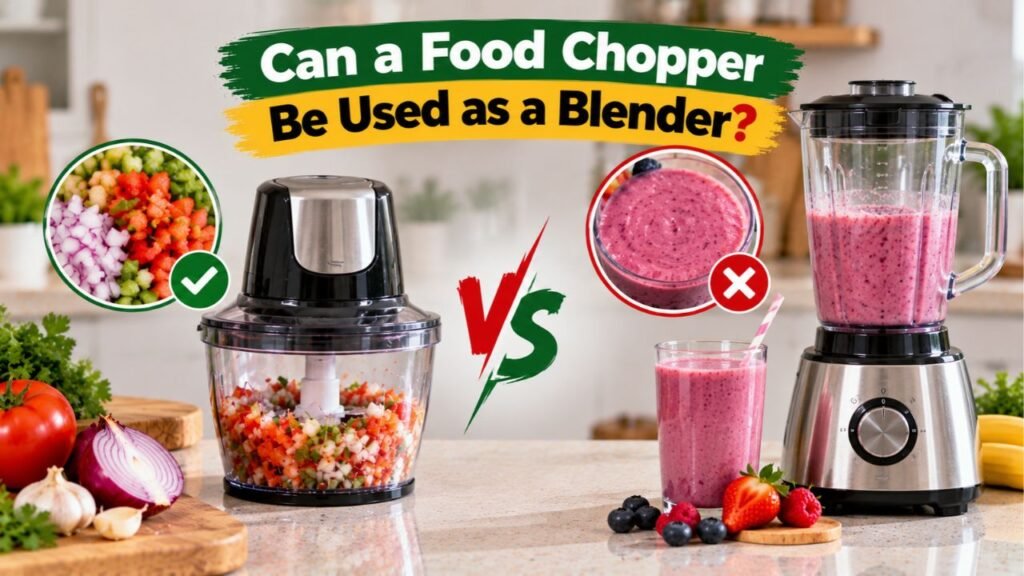
Yes, a food chopper can perform several blender-like tasks when the batch is small and the ingredients are not too hard.
Good candidates include:
- Salsa
- Pesto
- Chopped tomato sauce
- Hummus
- Soft vegetable puree
- Garlic sauce
- Herb sauce
- Salad dressing in small amounts
- Soft fruit mixtures
- Breadcrumb mixtures
A chopper is strongest when the recipe needs food to be broken down rather than completely liquefied.
For example, a tomato salsa only needs the onion, pepper, tomato, and herbs reduced to the desired size. A blender can do that job, but a food chopper often gives better control over a chunky texture.
A smooth fruit drink is different. The ingredients need to circulate continuously through liquid until the mixture becomes uniform. A blender jar and blade arrangement are much better suited to that movement.
How a Food Chopper Differs From a Blender

The two appliances use rotating blades, but they are built around different food-preparation jobs.
| Feature | Food Chopper | Blender |
| Main job | Chopping, mincing, small mixing | Blending, liquefying, pureeing |
| Bowl shape | Short and wide | Tall and narrow |
| Best batch size | Small | Small to large |
| Liquids | Limited | Well suited |
| Chunky foods | Very good | Good |
| Smooth purees | Fair to good | Very good |
| Smoothies | Limited | Very good |
| Ice crushing | Model-dependent, often poor | Common on capable models |
| Chopping control | Excellent with pulses | Easy to overprocess |
| Large liquid recipes | Poor choice | Better choice |
A chopper blade repeatedly cuts food as it falls into the bottom of the bowl.
A blender also cuts food, but the jar is shaped to create circulation. Liquid moves ingredients downward toward the blade and then back upward through the mixture.
That circulation is a major reason blenders produce smoother results.
How Food Chopper Blades Affect Blender-Like Results
The blade system determines what texture you can realistically achieve.
Food choppers usually use a compact S-shaped or multi-level chopping blade.
That design works well for:
- Onion
- Garlic
- Herbs
- Nuts
- Cooked vegetables
- Soft fruit
- Small meat pieces on approved models
The blade makes repeated cuts rather than relying on a strong liquid vortex.
This means a chopper may produce a good puree from soft cooked carrots but struggle to make a completely smooth drink from frozen berries, yogurt, and ice.
Blade height matters too. If a small amount of liquid sits below or around the blade without enough solid food to circulate it, the mixture may simply spin instead of blending evenly.
What a Food Chopper Can Blend Successfully
A food chopper works best with thick mixtures, soft foods, and recipes where a slightly textured finish is acceptable.
Salsa
Salsa is one of the best blender-style jobs for a food chopper.
Add firmer ingredients first, such as:
- Onion
- Garlic
- Pepper
Pulse briefly.
Then add softer ingredients such as tomato and herbs.
This reduces the chance of turning the tomato into watery foam before the onion is chopped.
Pesto
A mini food chopper can work very well for pesto.
Common ingredients such as:
- Basil
- Garlic
- Nuts
- Cheese
- Oil
fit naturally into a small chopping bowl.
Add oil gradually rather than filling the bowl with liquid at the beginning.
Hummus
Small batches of hummus are possible in many food choppers.
Cooked chickpeas are soft enough for the blade to break down, but the final texture may be slightly less smooth than hummus made in a strong blender or full-size food processor.
Stopping to scrape the sides can improve the result.
Soft Vegetable Purees
Cooked vegetables such as:
- Carrots
- Sweet potatoes
- Squash
- Peas
can be processed into a puree.
Cut them into small pieces before adding them.
A small amount of cooking liquid, broth, or other recipe liquid can be added gradually if the mixture is too thick.
Sauces and Dips
A chopper works well for thicker sauces such as:
- Herb sauce
- Garlic sauce
- Avocado dip
- Bean dip
- Roasted pepper sauce
Thin sauces may exceed the bowl’s liquid limit more easily.
Key Takeaway: Food choppers are best at blender-like jobs involving small, thick, soft mixtures rather than large quantities of free-flowing liquid.
What a Food Chopper Cannot Blend Well
Some blender jobs are a poor fit for a food chopper.
Smoothies
A typical smoothie contains:
- Liquid
- Fruit
- Frozen ingredients
- Yogurt
- Ice
A blender is built to keep those ingredients moving.
A small chopper may leave:
- Frozen chunks
- Uneven fruit pieces
- Thick material stuck above the blade
It can also leak if the bowl contains too much liquid.
Large Soups
A mini or standard food chopper is not a practical choice for blending a full pot of soup.
The bowl is too small, and hot liquid may not be approved for the plastic bowl or lid.
A countertop blender or immersion blender is a better match.
Large Amounts of Liquid
Many chopper lids are designed to contain chopped food rather than large amounts of thin liquid.
Running a nearly full bowl of:
- Milk
- Juice
- Broth
- Thin sauce
can lead to leaking.
Hard Frozen Ingredients
Rock-hard frozen fruit can put heavy load on a small chopper motor.
Thaw frozen fruit slightly unless the manufacturer says the appliance is made for frozen ingredients.
Ice
Do not assume a food chopper can crush ice.
Ice can:
- Damage the blade
- Crack the bowl
- Stall the motor
- Damage the drive coupling
Use ice only if the manufacturer specifically permits it.
Can You Make Smoothies in a Food Chopper?
A food chopper can sometimes make a very small soft-fruit drink, but it is not the best appliance for a normal smoothie.
A workable chopper mixture might contain:
- Ripe banana
- Soft berries
- Yogurt
- Small amount of milk
The result may still be thicker and less uniform than a blender smoothie.
Frozen fruit changes the situation. Small chopper motors may struggle with hard frozen pieces, and the bowl may not create enough circulation to pull every piece into the blade.
If you want to try a soft-fruit mixture, use a small batch and add liquid gradually.
Stop if the blade stalls or the motor slows sharply.
Can a Food Chopper Make Puree Like a Blender?
Yes, especially with soft cooked foods.
Puree quality depends on:
- Ingredient softness
- Batch size
- Blade design
- Moisture level
- Processing time
Cooked carrots or peas can become quite smooth because they break down easily.
Raw fibrous vegetables are harder to turn into a fine puree.
A blender usually produces a smoother final texture because the liquid keeps ingredients moving through the blades.
For baby-food-style purees, use only a chopper that is approved for the ingredients being processed, and follow safe food preparation and storage practices.
Can a Food Chopper Make Sauce Like a Blender?
Yes, many sauces work well.
Thick sauces are the best match.
Examples include:
- Pesto
- Chimichurri
- Garlic sauce
- Roasted pepper sauce
- Tomato salsa
- Avocado sauce
Start with solid ingredients and pulse them before adding much liquid.
This gives the blade time to reduce larger pieces first.
Then add oil, juice, water, or another liquid in small amounts until the texture reaches the desired consistency.
If the recipe is mostly liquid from the beginning, a blender is usually easier to control.
Can a Food Chopper Make Soup Like a Blender?
Only in very small quantities, and only if the appliance permits the temperature involved.
Hot liquids can be risky in small plastic chopping bowls.
Heat may:
- Damage the bowl
- Affect seals
- Create pressure under the lid
- Cause splashing
Allow cooked vegetables and liquid to cool before processing unless the manufacturer clearly states that hot foods are permitted.
For normal soup preparation, an immersion blender is often the simplest appliance because the soup stays in the cooking pot.
Can a Food Chopper Crush Ice Like a Blender?
Usually not unless the appliance instructions specifically say it can.
A blender designed for ice normally has:
- Stronger motor
- Heavier blade assembly
- Jar built for impact
- Drive system suited to hard ingredients
A normal food chopper may have a thin plastic bowl and a smaller motor.
Even if the blade manages to break one ice cube, repeated ice crushing can damage the appliance.
Do not use the ability to spin the blade as proof that the machine is rated for ice.
How to Use a Food Chopper Like a Blender
For suitable recipes, a few changes in technique produce better results.
- Cut larger ingredients into small pieces before adding them.
- Put firmer ingredients into the bowl first.
- Keep the batch below the maximum fill line.
- Add only a small amount of liquid at first.
- Lock the lid fully.
- Pulse several times rather than running the motor continuously.
- Stop and inspect the texture.
- Scrape ingredients down from the sides with the motor off and power disconnected when required.
- Add more liquid gradually if the recipe needs a thinner texture.
- Stop once the food reaches the desired consistency.
Pulsing is especially useful because a food chopper can move from coarse pieces to paste very quickly.
Long motor runs are more likely to overprocess food near the blade while leaving pieces higher in the bowl less processed.
How Much Liquid Can You Put in a Food Chopper?
Use the appliance’s marked liquid limit if one is provided.
Do not assume the bowl’s total capacity is also its safe liquid capacity.
A bowl that holds several cups of chopped vegetables may safely handle much less thin liquid.
Liquids can move rapidly around:
- Lid seam
- Center shaft
- Blade hub
during operation.
If there is no liquid-capacity marking, check the appliance manual before attempting sauce, dressing, or puree recipes with substantial liquid.
For thicker mixtures, adding liquid one tablespoon or small splash at a time gives much better control.
How to Prevent a Food Chopper From Leaking While Blending
Leaks usually come from too much liquid, an overfilled bowl, or an incorrectly seated lid.
Stay Below the Fill Limit
Leave open space at the top of the bowl.
Use Less Liquid
Start with less than you think you need.
More can be added later.
Lock the Lid Correctly
Some choppers will not run if the lid is misaligned, but others may still leak even if the motor starts.
Check the Blade Shaft and Seal
Food particles around the center shaft can interfere with proper seating.
Clean the bowl and blade assembly thoroughly after use.
Avoid Very Thin Mixtures
A thin liquid moves much more aggressively than chopped vegetables or thick dip.
A blender jar is usually safer for liquid-heavy recipes.
Key Takeaway: Keep the bowl below its fill line, limit thin liquids, and make sure the lid and blade assembly are seated correctly before trying blender-like recipes.
Food Chopper vs Blender for Smooth Texture
A blender wins when smoothness is the main goal.
The tall jar keeps food circulating through the blade zone repeatedly.
This is useful for:
- Smoothies
- Milkshakes
- Soups
- Pureed sauces
- Frozen drinks
- Thin dressings
A food chopper gives more control over coarse and medium textures.
That makes it better for:
- Chopped onion
- Salsa
- Garlic
- Nuts
- Herbs
- Chunky dips
If the recipe should still show small pieces of the original ingredients, the chopper may actually be the better tool.
Food Chopper vs Blender for Small Kitchen Jobs
A food chopper can be faster for small tasks because setup and cleanup are simple.
Chopping one onion in a full-size blender can be awkward. The blades may throw pieces against the walls while the bottom becomes too finely processed.
The short bowl of a chopper keeps a small batch closer to the blade.
It also gives better pulse control.
For a cup of salsa, small pesto batch, or chopped garlic, the chopper often makes more sense.
For several cups of smoothie or soup, the blender is the better fit.
Food Chopper vs Blender for Liquids
Blenders are much better suited to liquid-heavy recipes.
Their jars are made to contain movement from rapidly circulating liquid.
Food choppers are usually intended for food pieces and thick mixtures.
A chopper can still mix small amounts of:
- Oil
- Lemon juice
- Vinegar
- Water
- Broth
into a recipe.
The issue appears when liquid becomes the main ingredient instead of a supporting ingredient.
If most of the recipe is liquid, switch to a blender.
Food Chopper vs Blender for Frozen Fruit
A blender is usually better.
Frozen fruit is hard and places considerable load on the blade and motor.
A blender designed for frozen drinks can repeatedly pull the fruit into the blade.
A chopper may simply throw frozen pieces toward the bowl wall.
If the manufacturer permits frozen fruit in your chopper, cut large pieces smaller and let them soften slightly before processing.
Never force the blade through a jam.
Food Chopper vs Blender for Nuts
A food chopper is often better for chopped nuts.
Short pulses give good control over:
- Coarse nuts
- Medium chop
- Fine pieces
A blender may push nuts away from the blades unless the batch is large enough.
If the goal is nut butter, the answer changes. Nut butter needs long processing, enough motor strength, and a bowl shape that keeps the mixture moving as oils are released.
A small food chopper may overheat before the nuts become smooth.
Food Chopper vs Blender for Baby Food
A food chopper can work for small soft-food batches, but a blender may produce a smoother texture.
Cooked ingredients such as:
- Carrots
- Peas
- Squash
- Soft fruit
are easier for a chopper to process.
Add liquid gradually.
The correct texture should match the person’s age and feeding needs, and food should be prepared, stored, and served safely.
For very smooth purees, a blender generally gives a finer result.
Common Mistakes When Using a Food Chopper as a Blender
Using the wrong technique can make the chopper seem less capable than it really is.
Adding Too Much Liquid
This is the most common mistake.
A food chopper is not a blender jar.
Overfilling the Bowl
Ingredients need open space to move.
Running the Motor Continuously
Continuous operation can turn bottom ingredients into paste while larger pieces remain near the top.
Adding Hard Frozen Food
A small motor may stall.
Using Ice Without Approval
This can damage the bowl, blade, or drive system.
Processing Hot Liquid
Heat and pressure can create a burn or spill risk.
Expecting Blender-Smooth Results
A chopper can make a good puree without reaching the silky texture of a high-speed blender.
Key Takeaway: A food chopper works best as a limited blender substitute when the batch is small, thick, soft, and processed with short pulses.
When a Blender Is Better Than a Food Chopper
Use a blender when the recipe needs strong liquid circulation or a very smooth texture.
A blender is the better choice for:
- Large smoothies
- Milkshakes
- Frozen drinks
- Ice crushing
- Large soup batches
- Thin sauces
- Large purees
- Liquid-heavy dressings
It is also better when the recipe contains several cups of ingredients.
A chopper becomes less practical once you need to process multiple batches just to finish one recipe.
When a Food Chopper Is Better Than a Blender
Choose the chopper when the goal is controlled cutting rather than full liquefying.
It works especially well for:
- Onion
- Garlic
- Herbs
- Nuts
- Salsa
- Pesto
- Breadcrumbs
- Small dips
- Small cooked-vegetable purees
A chopper is also easier to clean for a small batch.
You do not need to wash a large blender jar just to mince a few garlic cloves or make half a cup of sauce.
Conclusion
For can a food chopper be used as a blender, yes, but only for the types of recipes that suit a small chopping bowl and blade. Soft foods, thick dips, pesto, salsa, cooked vegetables, and small sauces are good candidates.
The main limits are liquid capacity, blade design, motor strength, and bowl shape. A food chopper does not create the same strong circulation as a blender, so smoothies, ice, frozen drinks, large soups, and very smooth purees are better left to a blender.
Use small batches, cut ingredients down first, add liquid gradually, and rely on short pulses. Stop if the motor stalls, the lid starts leaking, or the recipe requires more liquid than the chopper is designed to contain.
A food chopper can cover several small blender jobs, but treating it as a full blender replacement will usually lead to uneven texture or unnecessary strain on the appliance.
FAQs About Using a Food Chopper as a Blender
Can I make a smoothie in a food chopper?
You can make a small soft-fruit mixture in some food choppers, but the result may be thicker and less smooth than a blender smoothie. Avoid hard frozen fruit or ice unless the manufacturer approves them.
Can a food chopper puree vegetables?
Yes. Soft cooked vegetables such as carrots, peas, squash, and sweet potatoes can be pureed in small batches. Add liquid gradually if a thinner texture is needed.
Can I put liquid in a food chopper?
Small amounts of liquid are usually fine for sauces, dips, and purees, but follow the appliance’s fill markings. Thin liquids can leak if the bowl is filled too high.
Can a food chopper make salsa?
Yes. Salsa is one of the best uses for a food chopper because short pulses let you control the texture without turning the ingredients into a thin puree.
Can a food chopper crush ice?
Only if the manufacturer specifically says the model is suitable for ice. Ice can damage a small chopper’s blade, bowl, motor, or drive coupling.
Can a food chopper make soup?
It can process a small amount of cooled cooked vegetables and liquid, but it is not ideal for a full batch of soup. An immersion or countertop blender is better for larger quantities.
Is a food chopper the same as a blender?
No. A food chopper is built mainly for chopping, mincing, and small thick mixtures. A blender is built to circulate liquids and produce smoother purees, drinks, and sauces.
Which is better for everyday kitchen use, a food chopper or blender?
A food chopper is better for onions, garlic, herbs, nuts, salsa, and small prep jobs. A blender is better for smoothies, soups, frozen drinks, and recipes where liquid makes up a large part of the mixture.