Hinoki vs Maple Cutting Board: Which Is Better for Knives?
Hard maple is the better everyday cutting board for most home kitchens because it resists deep knife marks and handles repeated chopping. Hinoki, a softer Japanese cypress, is an excellent alternative for delicate slicing with sharp Japanese knives. Both are knife-friendly materials, but maple offers greater surface durability while hinoki provides a softer cutting feel.
Choosing between these two woods matters because knife performance and board durability do not always improve together. A softer cutting surface may be gentler during slicing but develop grooves faster, while a harder surface can withstand repeated chopping with less visible damage.
Selecting a board that matches your cutting technique means fewer damaged surfaces, more predictable knife control, and less time spent on unnecessary maintenance.
The U.S. Food and Drug Administration’s 2026 Food Code, Section 4-101.17, identifies hard maple and equivalently hard, close-grained woods as suitable cutting-board materials in its model food-service standards. This recommendation reflects maple’s durability and surface characteristics. The code addresses regulated food establishments and is not a general prohibition against hinoki boards in home kitchens.
What stood out to me during the hinoki vs maple cutting board research was the large difference in wood hardness. Hard maple has a Janka hardness rating of approximately 1,450 pounds-force, while a commonly published figure for Japanese hinoki is around 510 pounds-force. These figures explain much of the difference in how the materials resist dents.
A detail many buyers overlook is how the two boards should be prepared and maintained. Hinoki manufacturers often recommend lightly wetting the cutting surface before use, while maple typically relies on periodic food-grade mineral oil conditioning.
The comparisons below explain knife-edge protection, durability, moisture behavior, food safety, cleaning, board construction, weight, and cost. You’ll also see which material makes more sense for Japanese knives, Western chef’s knives, and everyday home cooking.
Hinoki vs Maple Cutting Board: Quick Comparison
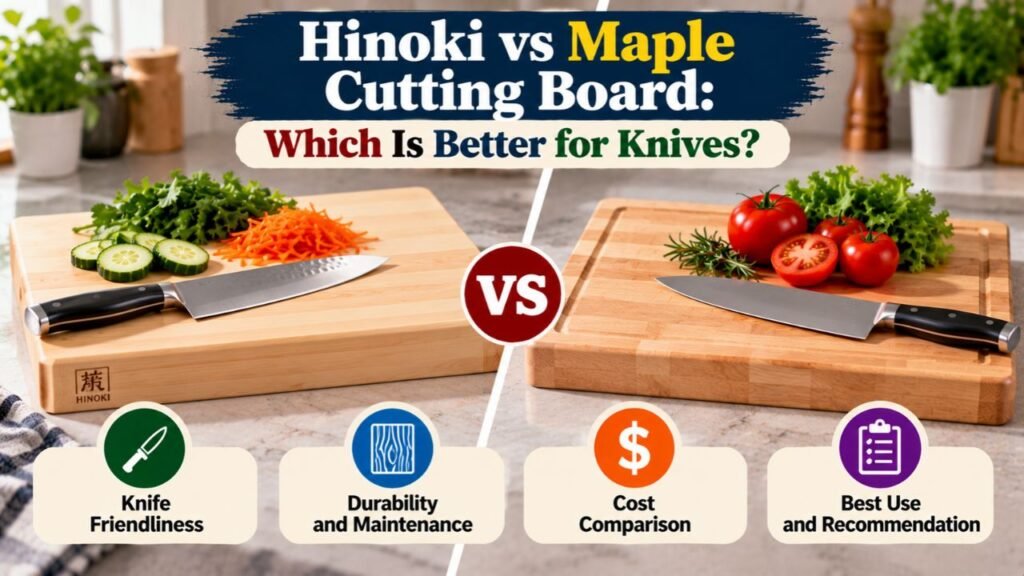
Hinoki and maple have different strengths because they come from different types of trees and have very different wood densities.
Hinoki is a relatively soft coniferous wood, while hard maple is a dense hardwood with strong resistance to surface indentation.
| Feature | Hinoki Cutting Board | Maple Cutting Board |
| Wood type | Japanese cypress, softwood | Hard maple, hardwood |
| Scientific name | Chamaecyparis obtusa | Acer saccharum |
| Janka hardness | About 510 lbf | About 1,450 lbf |
| Knife friendliness | Excellent for delicate edges | Very good for everyday knives |
| Dent resistance | Low to moderate | High |
| Deep knife marks | Develop more readily | Generally less frequent |
| Cutting feel | Soft and forgiving | Firm and stable |
| Weight | Generally lighter | Generally heavier |
| Moisture behavior | Natural extractives provide some resistance | Requires moisture management |
| Surface maintenance | Gentle care; oiling varies by manufacturer | Periodic mineral oil conditioning |
| Appearance | Pale cream or pinkish wood | Creamy white to light golden |
| Common construction | Often long-grain panels | Edge-grain and end-grain boards |
| Best use | Fish, vegetables, delicate slicing | Everyday chopping and mixed preparation |
| Availability in the U.S. | More specialized | Widely available |
Hardness figures are representative material measurements. Hinoki values vary among references, and finished cutting-board behavior also changes with wood quality and grain orientation.
The largest practical difference is how the boards handle repeated knife contact.
Hinoki gives way more easily under the blade. Maple provides a firmer cutting surface that develops dents and deep chopping marks more slowly.
For someone preparing several meals daily, maple is usually the more practical choice. For someone performing gentle, controlled slicing with a thin Japanese knife, hinoki has a distinct appeal.
What Are Hinoki and Maple Cutting Boards Made From?
The two materials differ in tree species, fiber structure, density, and traditional applications.
Understanding these characteristics explains why the cutting surfaces feel different despite both being natural wood.
What Is a Hinoki Cutting Board?
A hinoki cutting board is made from Japanese cypress, a coniferous tree scientifically identified as Chamaecyparis obtusa.
Hinoki is widely associated with Japanese woodworking and traditional kitchen tools.
Its wood is generally light in color, with pale cream, yellowish, or subtle pink tones. It also has a naturally pleasant woody fragrance produced by compounds within the material.
Hinoki has a relatively straight grain and a softer structure than many traditional North American cutting-board hardwoods.
Its flexibility under a knife is one reason manufacturers of Japanese kitchen knives recommend hinoki surfaces for delicate blades.
Hinoki cutting boards are commonly made from long-grain wood panels. Some are single-piece boards, while others use joined sections.
Many are thinner and lighter than traditional butcher blocks, making them convenient to move, wash, and store.
The main limitation is softness. Repeated hard chopping can produce noticeable knife marks, dents, and surface wear.
What Is a Maple Cutting Board?
A maple cutting board is a wooden food-preparation surface commonly manufactured from hard maple, also called sugar maple or rock maple.
Hard maple is identified botanically as Acer saccharum and grows naturally in northeastern North America.
Its pale color and fine, relatively uniform grain make it a familiar choice for kitchen cutting boards and butcher blocks.
Hard maple has a Janka hardness rating of approximately 1,450 lbf, making it much more resistant to indentation than hinoki.
Maple cutting boards are commonly produced in two constructions.
Edge-grain maple boards have long wooden strips arranged side by side, creating a durable surface with continuous grain lines.
End-grain maple boards expose the ends of wood fibers in a block pattern. This construction can provide a more forgiving chopping surface, although it often costs more and absorbs more conditioning oil.
One distinction matters when shopping: hard maple and soft maple are not the same material.
Soft maple refers to other maple species that generally have lower hardness ratings. A product labeled only “maple” may not identify the exact species.
How Their Natural Wood Structure Changes Performance
Hinoki fibers yield relatively easily when a knife contacts the surface.
This creates a gentle cutting feel, but the wood can develop pronounced marks under repeated heavy chopping.
Hard maple offers greater resistance to compression and surface damage.
Its fine grain also creates a smooth preparation surface that is suitable for regular cutting and cleaning.
Neither wood behaves like glass, ceramic, or metal, which provide almost no cushioning beneath a knife edge.
Key Takeaway: Hinoki is a soft Japanese cypress suited to gentle slicing, while hard maple is a dense North American hardwood that better withstands everyday chopping.
Which Cutting Board Is Better for Knife Sharpness?
Hinoki is generally more forgiving under delicate knife edges, but hard maple is also considered knife-friendly.
The difference becomes most relevant when comparing light slicing with repeated, forceful chopping.
Why Hinoki Is Popular for Japanese Knives
Japanese kitchen knives frequently use thin cutting edges for precise slicing.
Some specialized knives, including yanagiba knives used for slicing fish, are designed for long, controlled movements rather than forceful chopping.
A softer cutting surface reduces the resistance encountered when the blade reaches the board.
Hinoki can absorb some of that contact because its wood fibers compress more readily than hard maple.
Shun, a Japanese knife manufacturer, recommends hinoki cutting boards for helping preserve the fine edges of its knives.
The manufacturer also favors smooth slicing motions rather than heavy chopping with delicate Japanese blades.
Hinoki is appealing for tasks such as:
- Slicing sashimi and fish fillets
- Cutting soft vegetables
- Preparing delicate herbs
- Making thin, controlled cuts
- Using thin-edged Japanese kitchen knives
This does not mean a hinoki board prevents all knife damage.
Poor cutting technique, blade twisting, and contact with bones or frozen ingredients can still damage delicate knife edges.
Is Maple Still Good for Sharp Kitchen Knives?
Yes. Hard maple is a very good cutting-board material for most kitchen knives.
Although it is considerably harder than hinoki, it still provides a natural wood surface that offers some give under a blade.
Maple is suitable for Western chef’s knives, santoku knives, utility knives, and many Japanese-style knives.
The main advantage is versatility.
A maple board can handle frequent onion chopping, vegetable dicing, herb preparation, and ordinary slicing without developing deep surface damage as quickly as soft hinoki.
For a home kitchen that uses several different knives, I favor maple because it combines knife friendliness with stronger resistance to wear.
Does Softer Wood Always Keep Knives Sharper?
Not necessarily.
Wood hardness influences the cutting experience, but it does not directly measure how quickly a knife loses sharpness.
Blade steel, edge angle, cutting pressure, grain orientation, and sharpening quality also affect knife wear.
America’s Test Kitchen conducted a cutting-board comparison using a robot that made 5,000 cutting strikes on each board. Knife sharpness was checked at intervals, and the tested knives were still capable of cutting paper after the procedure.
The softer boards experienced more pronounced surface damage during the testing.
That finding is useful because it shows that differences in board wear can be much more visible than differences in knife sharpness during a particular test.
Hinoki’s softness makes it a sensible choice for delicate cutting. Still, it would be misleading to promise a specific increase in knife-edge lifespan without controlled testing of the exact boards and knives.
Key Takeaway: Hinoki provides a softer surface for precise Japanese knife work. Maple remains a strong knife-friendly option while offering greater resistance to repeated chopping damage.
Hinoki vs Maple Cutting Board Durability: Which Lasts Longer?
Hard maple generally has the advantage in surface durability.
Its higher hardness makes it more resistant to dents, heavy knife marks, and repeated chopping.
Hinoki trades some of that durability for a softer cutting feel.
Resistance to Scratches and Knife Grooves
Hinoki develops visible cutting marks relatively easily.
Light slicing may leave only shallow lines, but repeated chopping with substantial pressure can create deeper grooves.
These marks are not automatically a sign that the board is unsafe. A cutting surface can show ordinary wear and remain usable.
The problem develops when grooves become deep enough to trap food debris or prevent thorough cleaning.
Maple resists indentation more strongly, which generally slows the development of pronounced knife marks.
A hard maple board can still become scratched or grooved with repeated use, especially under aggressive cutting.
For frequent vegetable preparation and mixed kitchen work, maple provides a more durable surface.
Resistance to Water, Warping, and Cracking
Both materials can warp or crack when exposed to unsuitable moisture conditions.
Hinoki contains natural extractives associated with resistance to decay and moisture-related deterioration.
Still, those properties do not make the board waterproof.
Leaving hinoki submerged in water or drying it near a strong heat source may cause distortion or cracking.
Maple also absorbs and releases moisture as environmental conditions change.
If one side remains wet while the other dries, the board may cup or develop uneven movement.
Well-made maple boards can remain stable for years when washed and dried correctly.
The important distinction is that moisture resistance and surface hardness are different properties.
Hinoki may offer some natural resistance to moisture-related deterioration while remaining much softer under a knife.
Can Hinoki and Maple Boards Be Resurfaced?
Both woods may be resurfaced when shallow knife marks develop, provided the board has enough remaining thickness and sound construction.
Hinoki is relatively easy to cut and shape, so some traditional boards can be restored with careful planing.
Thin hinoki boards require more caution because removing too much material may weaken the board or change its shape.
Maple boards can often be sanded smooth when minor surface damage accumulates.
Thick maple butcher blocks provide more material for future refinishing.
A board with separating glue joints, severe cracking, or deep contamination is not necessarily suitable for simple resurfacing.
I would consider the board’s thickness and construction before assuming it can be restored.
Key Takeaway: Maple usually lasts longer under heavy chopping because it resists dents and deep grooves. Hinoki can remain useful for years with gentle cutting and proper maintenance.
Which Is Better for Food Safety: Hinoki or Maple?
Both hinoki and maple can be suitable for home food preparation when the boards are manufactured for food contact and properly maintained.
Neither material should be treated as self-sanitizing.
Natural Antibacterial Properties of Hinoki
Hinoki contains natural aromatic compounds, and some research has examined antimicrobial activity associated with cypress extracts.
These findings do not establish that a finished hinoki cutting board automatically kills harmful bacteria during ordinary kitchen use.
The concentration of natural compounds varies, and laboratory results involving extracts cannot be directly applied to every wooden cutting surface.
Maple does not rely on aromatic oils for its suitability as a cutting-board material.
Its relatively close-grained structure provides a smooth surface that can be cleaned after food preparation.
For both woods, cleanliness and surface condition matter more than broad marketing claims about antibacterial properties.
What U.S. Food Safety Guidance Says About Maple
The FDA’s 2026 Food Code identifies hard maple or equivalently hard, close-grained wood as an acceptable material for cutting boards in regulated food-service settings.
This provides a clear reason maple is widely associated with commercial butcher blocks and food-preparation equipment.
Hinoki is much softer and should not automatically be assumed to meet the same model-code material provision.
For a commercial kitchen, the applicable state or local food code and equipment requirements should be checked before using hinoki.
For ordinary home cooking, a properly manufactured hinoki cutting board can still be used with suitable cleaning and handling practices.
Can Raw Meat and Fish Be Cut on Both Boards?
Yes, wood cutting boards may be used for raw animal foods at home when they are cleaned and sanitized correctly.
The USDA recommends using separate cutting boards for raw meat, poultry, and seafood and for ready-to-eat foods such as bread and fresh produce.
This reduces the risk of cross-contamination.
A hinoki board used for slicing raw fish should not immediately be used to prepare vegetables without appropriate cleaning.
The same rule applies to maple.
After handling raw animal foods, wash the board thoroughly and sanitize as appropriate using a product approved for food-contact surfaces.
The USDA describes a sanitizing solution of 1 tablespoon of unscented liquid chlorine bleach per gallon of water. Follow product-label directions and the board manufacturer’s material-care restrictions.
Never mix bleach with other cleaning chemicals.
Key Takeaway: Both woods require cleaning and food-safety precautions. Maple is specifically identified in the FDA’s model food-service standards, while hinoki requires attention to its softer surface and manufacturer instructions.
How to Clean and Maintain Hinoki vs Maple Cutting Boards
Hinoki and maple share basic wood-care requirements, but their preparation and conditioning methods can differ.
Proper drying matters for both materials.
How to Prepare a Hinoki Board Before Cutting
Many hinoki manufacturers recommend lightly wetting the board before each use.
This helps reduce immediate absorption of food juices and may limit stains and odors.
The preparation is simple:
- Rinse or lightly dampen the cutting surface with clean water.
- Wet the opposite side as directed by the manufacturer.
- Wipe away excess moisture with a clean cloth.
- Place the board on a stable surface before cutting.
- Wash the board after food preparation and dry it thoroughly.
The purpose is to leave the surface lightly damp, not saturated.
Avoid soaking the board in water.
This preparation method differs from the usual routine for a conditioned maple cutting board.
How to Wash Hinoki and Maple After Use
Both boards should be washed with hot, soapy water after food preparation.
Use a soft sponge or suitable cleaning brush to remove food residue.
For hinoki, avoid aggressive scrubbing that could tear or roughen the relatively soft wood fibers.
Maple generally tolerates normal cleaning pressure better, but harsh abrasives may still damage its surface.
Rinse both sides thoroughly.
Dry the board with a clean towel, then leave it in a position that permits airflow around the wood.
Never store a wet board flat against a countertop for an extended period.
Most traditional hinoki and maple boards are not dishwasher-safe. Some specially manufactured wood boards are rated for dishwasher use, so the specific product instructions take priority.
Should Hinoki and Maple Be Oiled?
Maple cutting boards generally benefit from periodic conditioning with food-grade mineral oil.
The oil penetrates the wood and helps reduce excessive drying and moisture absorption.
Apply a thin layer to a clean, fully dry maple board, including the edges and underside.
Allow the oil to absorb according to the conditioning product’s instructions, then remove the excess.
Hinoki requires a more product-specific approach.
Some hinoki manufacturers recommend minimal additional conditioning, relying primarily on careful wetting, cleaning, and drying.
Others sell dedicated hinoki oil or recommend occasional food-grade mineral oil applications.
Shun, for example, offers a food-safe hinoki conditioning oil for its cutting boards.
This difference in manufacturer recommendations means there is no universal rule that every hinoki board must remain unoiled.
My preference is to follow the instructions supplied with the exact hinoki board rather than apply a maple maintenance routine automatically.
How to Dry and Store Both Boards
After washing, remove surface moisture with a clean towel.
Allow the board to finish drying in a well-ventilated area where air can reach both sides.
Store hinoki away from direct sunlight, heating vents, and hot appliances.
Rapid drying in strong heat may cause cracking or warping.
Maple should also be kept away from standing water and excessive heat.
Avoid stacking damp boards together.
If a board develops a persistent musty odor, visible mold, severe distortion, or structural separation, inspect it carefully before further use.
Key Takeaway: Lightly dampen hinoki before cutting when the maker recommends it. Condition maple periodically with food-grade mineral oil, and dry both materials thoroughly after washing.
End-Grain Maple vs Hinoki: Does Board Construction Change the Comparison?
Yes. Comparing a traditional hinoki board with an end-grain maple butcher block produces a different result from comparing two ordinary long-grain boards.
End-grain maple exposes the ends of the wood fibers on the cutting surface.
During chopping, the blade contacts those fiber ends rather than cutting directly across the long grain.
This can create a more forgiving surface than a comparable edge-grain maple board.
End-grain construction also tends to conceal some shallow cutting marks.
Hinoki generally achieves its soft cutting feel through the natural characteristics of the wood itself, rather than through end-grain construction.
A thick end-grain maple butcher block may offer an excellent balance between knife friendliness and resistance to surface damage.
The trade-offs are greater weight, higher cost, and potentially greater oil absorption through exposed wood-fiber ends.
For frequent heavy chopping, I would favor a quality end-grain maple board.
For delicate slicing with thin Japanese knife edges, hinoki remains an attractive alternative.
Hinoki vs Maple Cutting Board: Weight, Cost, and Appearance
Beyond knife performance, the size, weight, appearance, and purchase price of a cutting board affect daily convenience.
Weight and Ease of Handling
Hinoki is generally lighter than hard maple.
The lower density of Japanese cypress makes it appealing for cooks who regularly move their cutting boards between the countertop, sink, and storage area.
For a concrete example, Shun lists its medium hinoki cutting board at 15.75 × 10.75 × 0.5 inches, with a weight of approximately 21 ounces.
Maple is naturally denser, and many maple cutting boards are manufactured in thicker formats.
A large maple butcher block can be substantially heavier than a thin hinoki board of similar surface area.
That extra weight provides stability but makes lifting and washing less convenient.
Board dimensions, thickness, and construction must be considered before comparing the weight of individual products.
Purchase Price and Availability
Maple cutting boards are widely available in the United States.
Domestic hardwood supply and established cutting-board manufacturing make maple available across many price categories.
Basic edge-grain maple boards may be reasonably priced, while large end-grain butcher blocks often cost considerably more.
Hinoki boards are more specialized in the U.S. market.
Many are imported from Japan, and purchase prices may reflect timber grade, manufacturing quality, size, and transportation costs.
A small hinoki board may cost less than a premium maple butcher block, so neither species is automatically the cheaper option.
Comparing similarly sized boards gives a more meaningful picture of cost.
Appearance, Grain, and Natural Fragrance
Hinoki usually has a pale cream or subtle pinkish color with relatively straight, understated grain.
It also has a natural woody aroma that some people find pleasant.
That fragrance may fade with use, and people sensitive to strong wood scents may prefer a less aromatic surface.
Hard maple generally has creamy white, pale yellow, or light golden coloring.
Its grain is fine and uniform, although figured maple can contain more decorative patterns.
Maple has little characteristic odor, making it a practical choice for people who prefer a neutral-smelling preparation surface.
Hinoki is appealing for its traditional Japanese appearance, while maple works well in kitchens that favor a classic butcher-block look.
Key Takeaway: Hinoki is generally lighter and more specialized, while maple is more widely available in the United States. Size, thickness, and construction influence price and handling as much as wood species.
Which Should You Choose for Your Cooking Style?
The most useful recommendation comes from matching the board to your cutting habits rather than choosing solely by hardness.
Choose Hinoki for Delicate Japanese Knife Work
Hinoki makes sense for controlled slicing with thin-edged Japanese knives.
It is suitable for preparing fish, soft vegetables, herbs, and ingredients that require careful, smooth cutting movements.
Its lightweight construction may also appeal to people who dislike handling a heavy butcher block.
Hinoki is less suitable for repeated forceful chopping or tasks that involve striking the board with substantial pressure.
For a cook who prioritizes a soft cutting feel over resistance to cosmetic marks, hinoki is a strong option.
Choose Maple for Everyday Kitchen Preparation
Maple is the better all-purpose recommendation for most American home kitchens.
It provides a stable, durable surface for vegetable chopping, fruit preparation, meat slicing, and routine meal preparation.
Hard maple withstands repeated knife contact better than hinoki and is available in a variety of sizes and grain constructions.
An edge-grain maple board offers a practical balance of cost, durability, and maintenance.
An end-grain maple butcher block is worth considering for someone who performs extensive chopping and wants a thicker work surface.
Consider Both Boards for Different Tasks
There is also a practical reason to own both.
A hinoki board can serve as a lighter surface for delicate slicing, while a larger maple board handles regular chopping and more demanding preparation.
Using different boards for different foods may also support a safer kitchen workflow, provided each board is cleaned properly.
This arrangement is not necessary for every household.
For someone purchasing only one wooden cutting board, I would begin with hard maple because it covers more everyday cooking tasks.
Key Takeaway: Hinoki is best suited to delicate slicing, maple is better for mixed daily preparation, and using both is reasonable for cooks who want separate surfaces for different cutting techniques.
Common Mistakes to Avoid With Hinoki and Maple Boards
Some cutting-board problems come from using a suitable material in an unsuitable way.
The most common mistake with hinoki is treating its soft surface like a heavy butcher block.
Repeated hard chopping can create deep grooves and uneven areas. Smooth slicing motions are more appropriate for preserving the surface.
Another mistake is assuming that a natural fragrance means a hinoki board does not need cleaning.
Natural wood compounds are not a substitute for washing and sanitizing after food contact.
With maple, a common problem is neglecting moisture control.
Leaving water under a thick maple board can contribute to uneven swelling and warping. Periodic conditioning also matters when the surface becomes dry.
Avoid using either board as a hot-pan trivet. Excessive heat can discolor wood, damage finishes, or stress glue joints.
Finally, inspect the cutting surface instead of judging replacement needs by age alone.
A board with shallow cosmetic cuts may remain usable, while one with deep, hard-to-clean grooves, serious cracking, or separating joints may need replacement.
Safety Tip: If a thin hinoki board moves across the countertop during slicing, use a clean non-slip cutting-board mat. Keep the board level and stable before using a sharp knife.
Conclusion
The hinoki vs maple cutting board comparison reveals two materials suited to different cutting habits. Hinoki is softer, lighter, and appealing for delicate knife work, while hard maple offers stronger resistance to dents and repeated chopping damage.
Hinoki works well for precise slicing with Japanese kitchen knives, but its softer surface requires gentle handling and careful drying. Maple is more versatile for everyday food preparation and is available in durable edge-grain and end-grain constructions. Both require routine cleaning, suitable storage, and attention to surface damage.
For most home cooks, I recommend a quality hard maple cutting board as the main kitchen work surface. Hinoki is worth choosing when a softer cutting feel, lightweight design, and traditional Japanese preparation style matter more than maximum dent resistance.
FAQs About Hinoki and Maple Cutting Boards
Is hinoki better than maple for Japanese knives?
Hinoki is generally more forgiving under delicate Japanese knife edges because it is much softer than hard maple.
This makes it appealing for slicing fish, vegetables, and other ingredients with smooth, controlled movements.
Maple is also knife-friendly and may be more practical for a cook who uses Japanese knives for varied daily preparation.
An end-grain maple board is another strong option for knife care without sacrificing as much resistance to surface wear.
Does hinoki dull knives less than maple?
Hinoki’s softer surface is generally expected to produce less resistance during knife contact.
Still, wood hardness alone does not establish an exact difference in knife-edge wear.
Blade geometry, cutting pressure, wood grain orientation, and cutting technique also matter.
Both hinoki and hard maple are considered suitable wooden cutting surfaces for sharp kitchen knives. The difference is most relevant to delicate cutting techniques.
Is maple harder than hinoki wood?
Yes. Hard maple is considerably harder than hinoki.
Hard maple has a commonly reported Janka hardness rating of approximately 1,450 lbf, while a representative published figure for hinoki is about 510 lbf.
This means maple resists indentation much more strongly.
Hinoki’s softness provides a forgiving cutting surface but also makes it more prone to visible knife marks and dents.
Can you use a hinoki cutting board for meat?
Yes. A hinoki board manufactured for food preparation may be used for raw meat or fish when properly cleaned and maintained.
Use separate cutting surfaces for raw animal foods and ready-to-eat ingredients to reduce cross-contamination.
After raw meat preparation, wash the board thoroughly and sanitize according to suitable food-contact guidance and manufacturer instructions.
Replace the board if deep grooves or structural damage prevent thorough cleaning.
Should you oil a hinoki cutting board like maple?
Not automatically.
Maple cutting boards commonly require periodic conditioning with food-grade mineral oil.
Hinoki care varies among manufacturers. Some focus on lightly wetting the board before use and drying it carefully afterward, while others recommend specialized hinoki oil or occasional mineral oil.
Follow the instructions for the exact board instead of assuming that every wooden cutting surface needs the same conditioning routine.
Do hinoki cutting boards warp more easily than maple?
Both hinoki and maple can warp when exposed to uneven moisture or unsuitable drying conditions.
Thin hinoki boards may show noticeable movement if one side becomes wetter than the other.
Thick maple boards are also vulnerable to uneven moisture absorption, even though their weight and construction differ.
Washing both sides, removing excess water, and drying with adequate airflow reduces the likelihood of distortion.
Is an end-grain maple board better than hinoki?
An end-grain maple board is generally better for frequent chopping and long-term surface durability.
Its construction provides a relatively forgiving cutting surface while retaining maple’s strong resistance to indentation.
Hinoki remains appealing for light, controlled slicing with delicate Japanese knives.
End-grain maple boards are often heavier, thicker, and more expensive, so hinoki may be preferable when lightweight handling and a soft cutting feel are the main priorities.