Glass vs Plastic Cutting Boards: Which Is Better?
Plastic cutting boards are generally better than glass cutting boards for everyday food preparation. Plastic provides a more forgiving surface for kitchen knives, offers better cutting control, and will not shatter if dropped. Glass boards resist stains, odors, and deep knife grooves, but their extremely hard surfaces can dull knife edges quickly.
The difference matters most when you chop vegetables, slice meat, or prepare several ingredients every day. Repeated contact with glass can wear down a sharp blade, while a poorly maintained plastic board may develop deep cuts that trap food residue and make cleaning difficult.
Choosing the appropriate surface means fewer knife-sharpening sessions, steadier chopping, and simpler food preparation. It also means recognizing when a scratched plastic board should be replaced rather than continuing to use it.
According to the U.S. Department of Agriculture’s cutting-board guidance, updated August 27, 2024, glass and plastic are both nonporous materials. The USDA recommends washing cutting boards after use and replacing excessively worn boards that develop hard-to-clean grooves.
What stood out to me during the research on glass vs plastic cutting boards was that a surface can be easy to sanitize yet still be poorly suited to knife work. Glass is a good example because its resistance to scratches comes with a trade-off in blade protection.
Another detail worth checking is product construction. Tempered glass is stronger than ordinary glass but can still chip or break. Plastic does not shatter like glass, though repeated knife contact can gradually wear away its surface.
A closer comparison of knife sharpness, food safety, microplastic concerns, cleaning, durability, and kitchen tasks makes the decision much clearer. These differences will show where plastic performs better and why glass can still have a place in the kitchen.
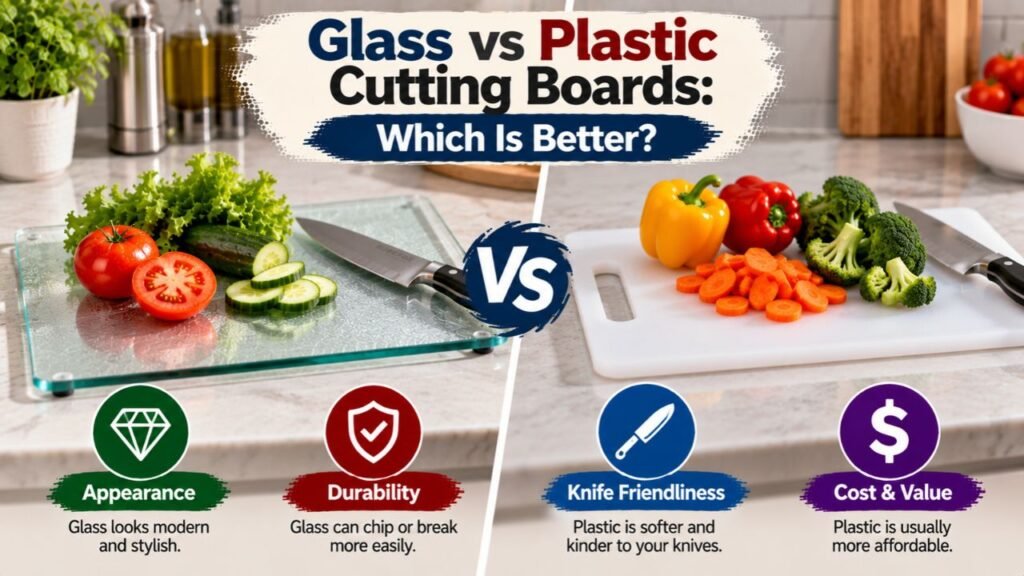
Glass vs Plastic Cutting Boards: Quick Comparison
Glass and plastic boards both provide nonporous food-preparation surfaces, but their physical properties create different experiences during cutting.
| Feature | Glass Cutting Board | Plastic Cutting Board |
| Main material | Usually tempered glass | Usually polyethylene or polypropylene |
| Surface hardness | Extremely hard | Softer and more forgiving |
| Knife friendliness | Poor | Generally good |
| Cutting noise | Loud, sharp contact | Quieter |
| Food safety | Safe when intact and properly cleaned | Safe when properly cleaned and maintained |
| Water absorption | Nonporous | Nonporous |
| Stain resistance | Excellent | Varies by plastic and food |
| Odor resistance | Excellent | May retain some odors |
| Scratch resistance | High | Develops knife marks |
| Breakage risk | Can chip or shatter | Does not shatter like glass |
| Dishwasher cleaning | Often suitable | Often suitable |
| Weight | Often relatively heavy | Usually lightweight |
| Microplastic shedding | No plastic cutting surface | Can release particles during cutting |
| Best use | Serving and light food handling | Everyday chopping and slicing |
The biggest difference is how each surface interacts with a knife.
Plastic has some give beneath the blade. Glass is rigid, so repeated chopping places greater stress on the knife’s thin cutting edge.
Glass has advantages in stain resistance and surface cleaning, but plastic offers a more practical balance for routine cooking.
What Are Glass and Plastic Cutting Boards Made Of?
Understanding the construction of each material explains why one works better for cutting while the other works well for serving.
Glass Cutting Board Materials and Construction
A glass cutting board is a flat, nonporous food-contact surface usually made from tempered glass.
Tempering is a heat-treatment process that strengthens glass and changes how it breaks. Tempered glass generally offers greater resistance to mechanical stress than ordinary annealed glass.
Many glass cutting boards have a smooth or slightly textured surface. Some include decorative patterns, printed designs, or rubber feet underneath.
The surface is resistant to moisture and does not absorb food juices.
Still, tempered glass is not unbreakable. A strong impact, damaged edge, or accidental drop can cause chipping or breakage.
Glass also has almost no flexibility under normal chopping pressure. That characteristic explains why it is harder on kitchen knives.
Plastic Cutting Board Materials and Construction
Plastic cutting boards are commonly manufactured from polyethylene (PE) or polypropylene (PP).
These materials are used in food-contact products because suitable grades can provide durable, washable surfaces.
Two common options are:
- High-density polyethylene (HDPE): A firm plastic commonly used for cutting boards in home and commercial kitchens.
- Polypropylene (PP): A durable plastic used for cutting boards, food containers, and other kitchen products.
Both materials can be suitable for food preparation when manufactured and sold for that purpose.
Plastic boards range from thick, rigid slabs to thin, flexible cutting mats.
Their surfaces are softer than glass, so the knife can make shallow impressions rather than striking an almost completely rigid material.
That softness protects the knife better, but it also means plastic boards gradually develop scratches.
Key Takeaway: Glass offers a hard, nonporous surface, while plastic provides a softer cutting surface. Plastic construction is generally more suitable for repeated knife work.
Which Cutting Board Is Better for Knife Sharpness?
Plastic is the clear winner for preserving kitchen knife edges.
The difference comes from surface hardness, impact, and the way a knife contacts the board during chopping.
How Glass Cutting Boards Affect Knife Edges
Glass is extremely hard compared with the thin cutting edge of a kitchen knife.
Every time a knife contacts the glass, its edge experiences a sudden impact against an unforgiving surface.
Repeated contact can cause microscopic edge deformation, rolling, or chipping, depending on the blade’s hardness and geometry.
This gradually reduces sharpness.
A knife that previously sliced tomatoes cleanly may begin crushing the skin or require additional pressure after repeated use on hard surfaces.
The problem becomes more noticeable with repeated chopping motions.
Glass is a poor match for:
- Fine-edged chef’s knives
- Japanese kitchen knives with thin edges
- Santoku knives used for frequent chopping
- Delicate slicing knives
An occasional cut on glass does not guarantee permanent knife damage. Regular chopping on glass is the greater concern.
How Plastic Cutting Boards Affect Knife Edges
Plastic provides a more forgiving surface.
When the knife makes contact, the plastic can deform slightly, reducing the harshness of the impact.
That does not mean plastic prevents all blade wear. Every cutting surface contributes to gradual edge deterioration.
Still, suitable plastic boards generally preserve knife sharpness better than glass.
This is a major reason plastic cutting boards remain common in professional food preparation.
A sharp knife also requires less force to cut through many foods, making controlled slicing easier.
Cutting Comfort, Noise, and Grip
Glass and plastic also feel different during food preparation.
Chopping on glass creates a sharp tapping sound. The rigid surface provides little cushioning, and the knife may feel as though it is striking a hard countertop.
Plastic produces a softer sound and generally feels more comfortable during repeated chopping.
Glass surfaces can also become slippery when wet. Food may shift during cutting, and boards without non-slip feet can slide across smooth countertops.
Plastic boards can slip too, but textured surfaces and rubber grips are common design features.
I would prioritize a stable, knife-friendly plastic board for everyday vegetable preparation rather than choosing glass for its appearance.
Key Takeaway: Plastic is considerably better for protecting knife edges, reducing chopping noise, and providing a comfortable surface for frequent cutting.
Are Glass or Plastic Cutting Boards Safer for Food Preparation?
Both materials can be safe for food preparation.
The greater food-safety concerns involve cleaning, cross-contamination, physical damage, and the condition of the cutting surface.
Bacteria and Cross-Contamination
Glass and plastic are considered nonporous materials, meaning their solid surfaces do not absorb water and food juices like porous wood.
That makes both materials relatively straightforward to wash.
Still, nonporous does not mean antibacterial.
Bacteria can survive on either surface if food residue remains or the board is not cleaned after handling raw animal products.
The U.S. Food and Drug Administration recommends using separate cutting boards for raw meat, poultry, and seafood and for fresh produce.
This reduces cross-contamination, which occurs when microorganisms transfer from one food or surface to another.
For example, cutting salad vegetables on an unwashed board previously used for raw chicken can transfer harmful bacteria to food that will be eaten without further cooking.
A glass board does not eliminate that risk simply because its surface looks clean.
Glass Chipping and Breakage Risks
Glass has one physical safety concern that plastic largely avoids: breakage.
Tempered glass is designed to resist ordinary stresses better than untreated glass, but it can still chip or shatter.
A damaged glass cutting board may introduce fragments into food.
This is a serious reason to stop using the board immediately if chips, cracks, or missing edge pieces appear.
Never continue preparing food on damaged glass.
If a glass board breaks near exposed ingredients, discard food that may contain fragments. Small pieces may be difficult to identify or remove completely.
The board’s hard, sometimes slippery surface also deserves attention during knife use.
Plastic Surface Wear and Hygiene
Plastic does not normally shatter when dropped, but knife marks accumulate over time.
Small surface cuts are expected during ordinary use. Deep grooves are more concerning because they can retain food particles and become difficult to clean.
The USDA recommends replacing plastic boards that become excessively worn or develop hard-to-clean grooves.
A board with deep scratches, rough sections, or cracks should not remain in service simply because it can still be washed.
Regular inspection is just as important as routine cleaning.
Key Takeaway: Both materials are suitable for food contact when properly maintained. Glass carries a chipping and breakage risk, while plastic requires attention to worn cutting grooves.
Do Plastic Cutting Boards Release Microplastics?
Yes. Research has shown that plastic cutting boards can release small plastic particles during chopping.
Microplastics are tiny pieces of plastic, commonly described as particles smaller than 5 millimeters.
Knife contact can gradually remove small amounts of material from a plastic cutting surface. Some particles may remain on the board, while others can transfer to food.
A 2023 study published in Environmental Science & Technology, involving researchers from North Dakota State University, examined particle release from polyethylene and polypropylene cutting boards.
The researchers found that chopping could produce microplastic particles. The amount varied with the material and cutting conditions.
The study also produced estimates of possible annual particle exposure, but those were based on experimental findings and assumptions rather than direct measurement of every person’s kitchen habits.
More recent research has continued to examine particles released from worn plastic food-preparation surfaces.
Does This Mean Plastic Cutting Boards Are Unsafe?
The evidence does not support a simple conclusion that ordinary plastic cutting boards are unsafe.
The FDA states that current scientific evidence does not demonstrate that the levels of microplastics or nanoplastics detected in foods pose a risk to human health. The agency also acknowledges research gaps regarding exposure and possible health effects.
Research showing that particles are released is not the same as proving a specific health outcome from using a cutting board.
Still, limiting unnecessary plastic wear is a reasonable precaution.
Replace boards with badly damaged surfaces, avoid scraping them with sharp metal tools, and choose products manufactured for food contact.
Does Glass Avoid Microplastic Shedding?
A plain glass cutting surface does not shed plastic through normal knife contact because its cutting surface is not plastic.
That is an advantage for someone seeking to reduce contact with plastic materials.
Glass introduces a different problem: hard knife contact and the possibility of glass fragments if the board is damaged.
For someone concerned about plastic particle release, a suitable wooden or rubber cutting board may offer a better balance than switching directly to glass.
A nonplastic material is not automatically a better cutting surface. Knife wear, stability, cleaning, and physical safety still matter.
Which Board Is Easier to Clean and Sanitize?
Glass and plastic are both relatively easy to clean compared with materials that absorb moisture.
Glass generally resists staining and odor retention better. Plastic provides convenient cleaning but requires closer attention to grooves and surface wear.
Cleaning a Glass Cutting Board
Glass has a smooth, nonporous surface that is easy to wash after ordinary food preparation.
Follow these steps:
- Remove loose food scraps from the board.
- Wash the surface with hot water and dish soap.
- Clean the edges and any attached feet or supports.
- Rinse thoroughly with clean water.
- Dry the board with a clean towel or allow it to air-dry.
Many tempered glass cutting boards are dishwasher-safe.
Check the manufacturer instructions before placing a board in the dishwasher, since decorative finishes, attached supports, or other components may affect compatibility.
Avoid sudden temperature changes beyond the board’s stated limits. Tempered glass is heat-resistant to a degree, but it should not automatically be treated as safe for every hot pan or heated appliance.
Cleaning a Plastic Cutting Board
Plastic requires a similar routine.
Remove food particles, wash with hot, soapy water, and rinse thoroughly.
Pay attention to knife grooves, juice channels, and corners where residue can collect.
Many polyethylene and polypropylene boards are dishwasher-safe, but not every plastic board tolerates the same temperatures.
Thin cutting mats may warp in a dishwasher, and attached components may have separate care requirements.
Follow the care label rather than assuming that all plastic boards can handle the same dishwasher cycle.
Sanitizing After Raw Meat Preparation
Washing removes visible residue. Sanitizing reduces microorganisms that may remain after cleaning.
The USDA provides a sanitizing method for wooden and plastic cutting boards using 1 tablespoon of unscented liquid chlorine bleach in 1 gallon of water.
The instructions involve covering the clean board with the prepared solution, allowing it to stand for several minutes, rinsing with clear water, and drying.
Follow the product label and appropriate safety precautions when handling bleach. Never combine it with ammonia, vinegar, or other cleaners.
For glass, follow the manufacturer instructions and the directions for a sanitizer approved for the food-contact surface.
Using separate boards for raw meat and ready-to-eat ingredients remains a sensible precaution.
Key Takeaway: Both materials are easy to wash, but glass has an advantage in stain and odor resistance. Plastic needs closer inspection as knife grooves develop.
Durability and Lifespan: Glass vs Plastic
Glass resists surface scratches better, while plastic is more resistant to impact and accidental dropping.
These differences affect how long each board remains suitable for kitchen use.
Glass Cutting Board Durability
An intact glass board can maintain a smooth appearance through many cleaning cycles.
It does not develop deep knife grooves as readily as plastic.
Glass also resists ordinary food stains from ingredients such as turmeric, tomatoes, and berries.
Its main weakness is brittleness.
A dropped board may chip, crack, or shatter. Even a small damaged edge can make the board unsuitable for food preparation.
The potential for sudden breakage is worth considering in kitchens with crowded countertops or frequent movement between the sink and storage area.
Plastic Cutting Board Durability
Plastic cutting boards are generally more forgiving when dropped.
Many are lightweight and resilient enough to withstand ordinary handling without breaking.
Repeated knife contact remains the primary source of wear.
Over time, plastic may develop:
- Shallow and deep cutting grooves
- Rough surface patches
- Discoloration from food
- Warping from excessive heat
- Cracks or damaged edges
These problems do not all require immediate replacement. Cosmetic staining and minor knife marks are different from damage that prevents thorough cleaning.
Deep, overlapping grooves and serious warping are stronger signs that the board should be replaced.
Long-Term Cost and Replacement
Plastic cutting boards are widely available at modest prices, although thicker professional-style models can cost more.
Glass board prices vary according to size, thickness, decoration, and construction.
An inexpensive plastic board may need replacement after substantial knife wear. A glass board may remain smooth longer but can become unusable after one damaging fall.
There is also the cost of maintaining kitchen knives.
Regular cutting on glass may increase the frequency of sharpening, which adds time and can involve service costs.
I would consider that ongoing knife maintenance before treating glass as a longer-lasting bargain.
Key Takeaway: Glass resists scratches and stains, but plastic is more forgiving of drops. Plastic surface wear and glass breakage are the main replacement concerns.
Glass vs Plastic Cutting Boards for Different Kitchen Tasks
The preferred material changes with the activity, although plastic has the advantage for most tasks involving a knife.
Chopping Vegetables and Fruits
Winner: Plastic
Plastic is better suited to repeated chopping of onions, carrots, peppers, herbs, and similar ingredients.
Its softer surface is more forgiving when a chef’s knife makes repeated contact.
Plastic boards with suitable non-slip grips also provide a stable working area.
Glass may look attractive while handling fruit, but its hardness is a disadvantage for everyday chopping.
Cutting Raw Meat, Chicken, and Seafood
Winner: Plastic
A food-safe, dishwasher-compatible plastic board is a practical option for raw animal products.
It provides a nonporous surface without the hard knife contact of glass.
Choose a size large enough to handle the food without allowing juices to spill onto the countertop.
A perimeter juice groove can be useful for wet foods, provided it is easy to wash.
Use a separate board for fresh produce and bread.
Slicing Bread and Sandwiches
Winner: Plastic
Plastic offers a more forgiving surface for cutting bread, sandwiches, and baked foods.
It also reduces the harsh impact of a knife contacting glass after passing through a loaf.
For bread service without much cutting, a glass board may still be suitable as a presentation surface.
Serving Cheese, Fruit, and Appetizers
Winner: Glass for presentation
Glass can be attractive for displaying cheese, crackers, prepared fruit, and other ready-to-eat foods.
It resists staining and is straightforward to wipe clean after serving.
Decorative glass boards may also fit modern kitchen designs.
If substantial slicing is required, prepare the ingredients on a plastic or suitable wooden board before transferring them to the glass surface.
Handling Sticky or Strong-Smelling Foods
Winner: Glass for surface cleanup
Glass generally resists absorbing strong food odors.
Ingredients such as garlic, onions, and strongly colored foods may leave more noticeable traces on some plastic boards.
For chopping these ingredients, I would still favor plastic because knife comfort matters more during cutting.
For holding prepared ingredients afterward, glass has a cleaning advantage.
Key Takeaway: Plastic wins for most tasks that involve cutting. Glass is more attractive for serving prepared foods and resisting stubborn stains or odors.
How to Choose a Good Plastic Cutting Board Instead of Glass
If you are replacing a glass board with plastic, look beyond the material name.
A well-made plastic board should provide enough room for cutting, remain stable on the counter, and withstand cleaning without unnecessary warping.
Choose Food-Safe Plastic
Look for a board made from material intended for food contact.
Polyethylene and polypropylene are common choices.
Food-contact suitability depends on the product’s full construction and intended conditions of use, not just its material abbreviation.
Avoid using unidentified industrial plastic sheets or decorative plastic panels as substitutes for a kitchen cutting board.
Choose a Practical Size and Thickness
For many home kitchens, a cutting board around 12 by 18 inches provides useful space for chopping vegetables, trimming meat, and preparing several ingredients.
A smaller board may be sufficient for quick fruit preparation.
Thicker plastic boards can feel more stable and resist flexing better than thin cutting mats, though actual performance varies by design.
Measure your available countertop, sink, and storage space before purchasing.
Look for Non-Slip Features
A cutting board should stay in place during normal knife movements.
Rubber feet, textured undersides, or a suitable non-slip mat can reduce sliding.
A clean, damp towel beneath a flat board may also improve grip, provided it is positioned securely and does not create rocking.
Avoid working on a board that shifts every time the knife contacts it.
Key Takeaway: Choose food-contact-safe plastic with adequate working space, a secure base, and cleaning instructions that match your kitchen routine.
When Does a Glass Cutting Board Still Make Sense?
Glass is not necessarily a useless kitchen accessory.
It can serve practical purposes when repeated knife cutting is not involved.
A decorative glass board can hold prepared cheese, crackers, fruit, or other snacks. It may also serve as an easy-to-clean surface for setting down cool utensils or arranging already-cut ingredients.
Some products are marketed for protecting countertops from food stains and light messes.
A glass board should not automatically be used as a trivet or heat-resistant counter protector. Only place hot cookware on it if the manufacturer explicitly approves that use and temperature range.
If you already own a glass cutting board, there is no need to discard an undamaged product simply because plastic is better for chopping.
Reserve it for suitable serving and food-handling tasks, and use a more forgiving material for knife work.
Common Mistakes When Comparing Glass and Plastic Boards
A common mistake is assuming that a scratch-resistant surface must be better for cutting.
Glass resists visible knife marks, but the knife absorbs much of the impact instead. Plastic develops scratches partly because its surface is more forgiving.
Another mistake is treating all plastic cutting boards as identical.
Thin flexible mats, rigid HDPE boards, and textured polypropylene boards can differ in stability, durability, and cleaning requirements.
It is also unwise to assume that a smooth-looking board is free of contamination. Both glass and plastic need proper washing after contact with raw meat, poultry, or seafood.
Finally, avoid keeping a badly damaged board just because it has not broken completely. Deeply grooved plastic and chipped glass present different problems, and both can justify replacement.
Conclusion
The glass vs plastic cutting boards comparison strongly favors plastic for daily food preparation. Plastic provides a gentler cutting surface, creates less noise, and avoids the shattering risk associated with glass. Glass has advantages in stain resistance and cleaning but is poorly suited to frequent chopping.
Both materials are nonporous and can be cleaned thoroughly. Plastic boards gradually develop knife grooves and may shed small particles during use, while glass boards can damage knife edges and introduce fragments if chipped or broken.
My recommendation is to choose a stable, food-safe plastic cutting board for everyday slicing, chopping, and raw meat preparation. Keep glass for serving or other suitable low-impact uses. Replace worn plastic boards promptly, and never continue using a damaged glass board.
FAQs About Glass and Plastic Cutting Boards
Are glass cutting boards better than plastic?
Glass cutting boards are better at resisting stains, odors, and visible scratches, but plastic boards are generally better for regular cutting.
Plastic provides a more forgiving surface for kitchen knives and does not shatter when dropped. Glass can damage knife edges through repeated contact and may become hazardous if chipped or broken.
For everyday chopping, plastic is the more practical material.
Do glass cutting boards dull knives faster than plastic?
Yes. Glass cutting boards generally dull knives faster than plastic boards because glass is extremely hard and does not cushion blade impact.
Repeated chopping against glass can deform or chip fine knife edges.
Plastic allows some surface deformation during cutting, reducing the harshness of contact. Wood and suitable rubber boards are other options worth considering for knife care.
Are plastic cutting boards more sanitary than glass?
Neither material is automatically more sanitary.
Glass and plastic are both nonporous, making them relatively easy to wash. Glass resists deep knife grooves, while plastic can become harder to clean as scratches accumulate.
Proper washing and separation of raw animal foods from ready-to-eat ingredients matter more than the material alone.
Can glass cutting boards break while cutting?
Yes. Glass cutting boards can chip or break from impacts, damaged edges, or excessive stress.
Tempered glass is stronger than ordinary glass but is not unbreakable.
If a board develops a crack or chipped edge, stop using it for food preparation. Discard any exposed food that may contain glass fragments.
Are plastic cutting boards safe despite microplastic concerns?
Food-contact-safe plastic boards remain a common option for preparing food.
Research has shown that chopping can release small plastic particles, but the health implications of exposure from cutting boards are not fully established.
The FDA states that current scientific evidence does not demonstrate a human health risk from the levels of microplastics detected in foods.
Replacing heavily worn boards is a sensible precaution.
Which cutting board is better for raw chicken?
A dishwasher-safe plastic cutting board is generally more practical for preparing raw chicken.
It provides a nonporous surface while remaining more forgiving on knives than glass.
Wash it thoroughly after use, sanitize when appropriate, and keep it separate from boards used for vegetables, fruit, bread, and other ready-to-eat ingredients.
Can glass and plastic cutting boards go in the dishwasher?
Many glass and plastic cutting boards are dishwasher-safe, but the manufacturer’s instructions should be checked first.
Tempered glass boards may include decorative finishes or attached components that affect dishwasher suitability.
Plastic boards can also vary in heat resistance. Thin models may warp during hot cycles.
Only use the dishwasher when the product is approved for that cleaning method.
How often should a plastic cutting board be replaced?
There is no universal replacement schedule for plastic cutting boards.
The board’s condition matters more than its age.
Replace it when deep knife grooves, cracks, severe warping, or damaged surfaces make thorough cleaning difficult. Minor cosmetic scratches do not always require replacement.
Inspect the board regularly, paying attention to heavily used cutting areas.
Is a glass cutting board good for serving cheese?
Yes. An intact, food-safe glass board can be a good surface for serving cheese, crackers, fruit, and other prepared foods.
It resists stains and odors and is easy to clean after serving.
For slicing hard cheese or repeatedly cutting ingredients, use a plastic, wooden, or suitable rubber cutting board first. Transfer the prepared food to the glass board for presentation.