Pastry Board vs Cutting Board: Uses and Key Differences
A pastry board provides a smooth, roomy surface for rolling, kneading, and shaping dough, while a cutting board is designed to withstand repeated knife contact. A clean wooden cutting board can handle occasional pastry work, but a marble pastry board is a poor choice for chopping because its hard surface can wear or chip knife edges.
Using the wrong surface can make kitchen work frustrating. Dough may stick inside knife grooves, a small board may leave insufficient room for rolling pie crust, and cutting directly on marble can damage an expensive chef’s knife.
Choosing a suitable board gives you more control over dough thickness, cleaner ingredient preparation, and a surface that suits the tools being used. It also reduces the need to replace boards damaged by activities they were not designed to handle.
Food safety deserves attention, too. The U.S. Food and Drug Administration has reported 168 known illnesses and 20 hospitalizations associated with several outbreaks involving raw flour or flour-containing products since 2009. Flour is a raw ingredient, so pastry surfaces require proper cleaning even when no raw meat has touched them.
The main pastry board vs cutting board distinction is purpose rather than appearance. Both may be rectangular, wooden, and suitable for food contact, but their dimensions, working surfaces, and special features often reflect different kitchen tasks.
What stood out to me while reviewing manufacturer specifications was that some wooden pastry boards are intentionally reversible. One side provides an uninterrupted dough-working surface, while the opposite side accommodates other food preparation. This means buying two separate boards is not always necessary.
The differences in design, materials, surface texture, knife safety, cleaning, and sizing will show when an ordinary cutting board is sufficient and when a dedicated pastry board offers a practical advantage.
Pastry Board vs Cutting Board: Quick Comparison
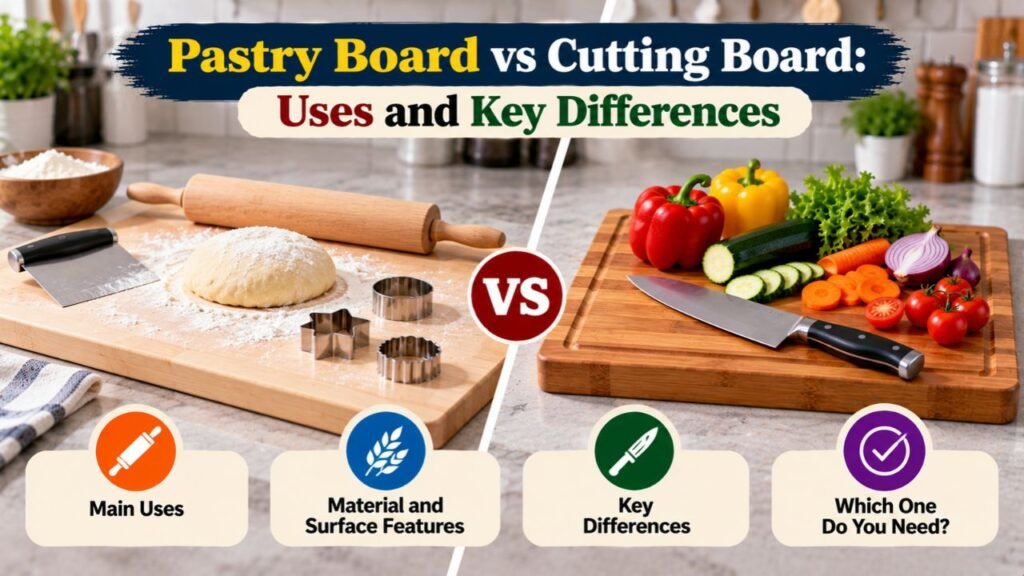
The main difference is that a pastry board is built around dough preparation, while a cutting board is designed around knife work.
Both products may have overlapping uses, but their design priorities are different.
| Feature | Pastry Board | Cutting Board |
| Primary purpose | Rolling, kneading, and shaping dough | Slicing, chopping, and dicing food |
| Common materials | Wood, marble, and other suitable smooth surfaces | Wood, plastic, bamboo, and rubber |
| Surface texture | Smooth and usually uninterrupted | Knife-friendly; develops cutting marks |
| Typical shape | Broad rectangular working surface | Rectangular, round, or specialty shapes |
| Size priority | Room for spreading dough | Room for ingredients and knife movement |
| Special features | Counter-edge lip, measurement markings, rolling-pin rest | Juice grooves, handles, nonslip feet |
| Knife friendliness | Depends heavily on material | Designed for repeated knife contact |
| Dough preparation | Main function | Possible with a suitable clean surface |
| Raw meat preparation | Not the intended primary use | Common use with proper cleaning |
| Cleaning | Depends on wood or stone material | Depends on wood, plastic, or other material |
| Storage | May be large and heavy | Many compact and lightweight options |
| Best for | Baking, bread, pastries, pasta | Everyday cooking and food preparation |
Best for baking: A pastry board with enough working room and a smooth surface.
Best for everyday chopping: A suitable wood or plastic cutting board.
Best for doing both: A smooth, properly maintained wooden board with enough usable space and construction intended for both tasks.
What Is the Purpose of Each Board?
Both products create a separate food-preparation area on the kitchen counter.
Their differences become clearer when looking at what happens on the surface during use.
What Is a Pastry Board?
A pastry board is a flat working surface designed for preparing dough.
It provides space to roll pastry evenly, knead bread dough, shape cookies, and prepare homemade pasta.
A typical pastry board has a relatively smooth surface without the deep cuts that develop on boards used for repeated chopping.
Some models include measurement guides, circular markings for pie crusts, and a raised wooden strip underneath that rests against the counter’s edge.
That strip, often called a counter-edge cleat, keeps the board from sliding away while dough is being rolled or kneaded.
Common pastry-board tasks include preparing pie crust, rolling cookie dough, shaping pizza dough, kneading bread, and making fresh pasta.
Not every pastry board has special markings or a counter lip. Some are simply large, smooth pieces of food-contact wood or stone.
What Is a Cutting Board?
A cutting board is a kitchen surface designed to protect countertops and support knife work.
Its primary purpose is to provide a stable area for cutting vegetables, fruit, meat, bread, and other ingredients.
Wooden cutting boards offer a surface with some give under a knife. Plastic and purpose-made rubber boards also provide suitable surfaces for regular chopping.
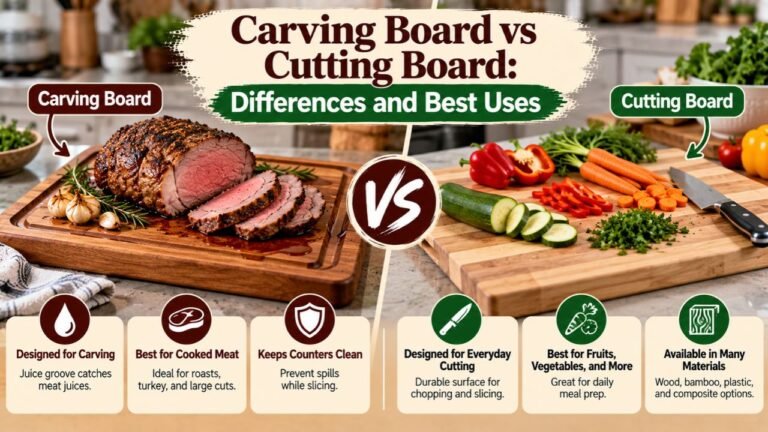
Many cutting boards include juice grooves, carrying handles, or nonslip feet.
The surface is expected to experience repeated blade contact.
A properly made board should remain stable during cutting and tolerate normal knife marks without immediately developing damage that prevents cleaning.
Unlike a dedicated pastry board, a cutting board does not need to provide a large uninterrupted area for rolling wide sheets of dough.
Key Takeaway: A pastry board is designed around rolling and kneading, while a cutting board is designed around slicing and chopping. Their materials and dimensions determine how easily they can share those jobs.
Main Differences Between Pastry Boards and Cutting Boards
The differences extend beyond their intended uses.
Surface condition, working area, stability, and special features influence how comfortable each board feels.
Surface Smoothness and Texture
Pastry work generally benefits from a flat surface that allows dough to move under a rolling pin.
Deep grooves can catch sticky dough or collect flour and residue.
A smooth board also makes it easier to turn the dough while maintaining an even shape.
Cutting boards start with relatively smooth surfaces, but knife marks develop naturally with use.
Small, shallow marks are normal.
Deep gouges become a problem when dough catches inside them or food residue becomes difficult to remove.
This is one reason a heavily used cutting board may perform poorly as a pastry surface.
Working Space and Board Dimensions
Pastry boards are often larger than ordinary household cutting boards.
Rolling pie dough into a wide circle requires enough room for the rolling pin and space around the edges.
Kneading bread also involves repeated pushing, folding, and turning.
A small board can force the dough toward the counter or require frequent repositioning.
Cutting boards are often sized for the amount of food being chopped.
A compact board may be adequate for an apple or onion but too small for rolling a full pie crust.
A large cutting board can overcome this limitation if its surface is flat and clean.
Grooves, Lips, and Measurement Markings
Cutting boards may include a juice groove, which collects some liquid released from meat, fruit, or vegetables.
This feature is useful for certain cutting tasks but inconvenient for rolling pastry.
Dough can extend into the groove, and flour may accumulate along its edges.
Pastry boards may instead include:
- Circular guides for pie crusts
- Inch or centimeter measurement markings
- A counter-edge cleat
- A rolling-pin rest
- A reversible flat surface
These features are optional rather than universal.
For instance, a wooden pastry board with engraved diameter circles may provide convenient visual guidance when rolling dough for a pie plate.
A board without those markings can still work just as well when paired with a ruler or other measuring tool.
Stability During Use
A cutting board needs to resist sliding while a knife is moving.
Some models accomplish this with rubber feet or nonslip edges.
Pastry boards must resist the repeated forward pressure of rolling and kneading.
A counter-edge cleat can provide a useful mechanical stop against that movement.
Without a cleat, a flat nonslip mat beneath the board may improve stability.
A heavy marble board may also resist movement because of its weight, but weight alone does not guarantee that it will stay in place on a slick countertop.
Key Takeaway: Pastry boards prioritize smoothness, rolling space, and resistance to kneading pressure. Cutting boards prioritize knife contact, ingredient handling, and stable chopping.
Which Materials Work Best for Each Board?
Material selection affects cutting comfort, dough handling, temperature behavior, maintenance, and long-term durability.
Some materials work well for both uses. Others are better reserved for one task.
Wooden Pastry Boards and Wooden Cutting Boards
Wood is one of the most versatile materials for a board intended to handle both dough and knife work.
Common hardwood choices include:
- Hard maple
- Beech
- Walnut
- Cherry
- Birch
These woods differ in hardness, grain characteristics, and appearance.
For pastry work, a smooth wooden surface provides a stable area for kneading and rolling.
A little surface friction can be useful when stretching and folding bread or pasta dough.
For cutting, a suitable hardwood offers more cushioning than stone or glass.
Hard maple is a practical choice for a dual-purpose wooden board because it is durable and commonly used for cutting surfaces.
Wood still requires maintenance.
It should be washed by hand, dried promptly, and periodically conditioned with a finish intended for food-contact cutting boards.
A food-grade mineral oil treatment is common for boards designed for knife use.
I would favor a smooth hardwood board for someone seeking one substantial surface for both bread preparation and everyday chopping.
Marble Pastry Boards
Marble is popular for pastry preparation because it provides a smooth, rigid surface with high thermal mass.
It can draw heat from warmer dough during contact and may help slow the softening of butter in pastry.
This is useful when preparing pie crust, puff pastry, and other doughs containing solid fat.
There is an important limitation.
Marble does not generate cold.
At room temperature, it eventually reaches the surrounding temperature. Chilling the slab before use can provide a colder starting surface, provided the manufacturer permits that treatment.
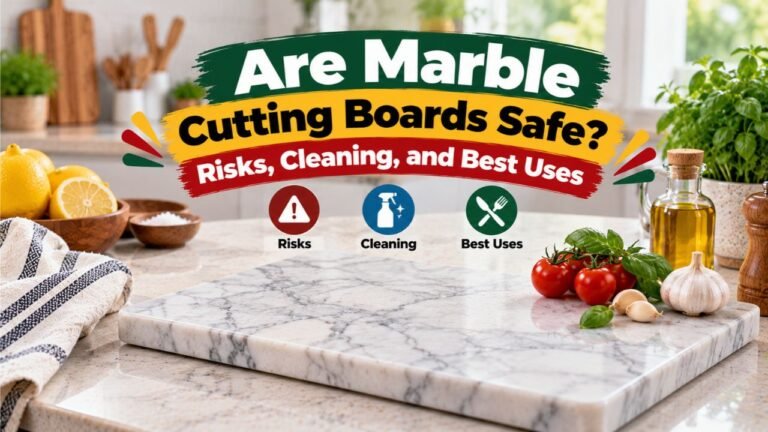
Marble is also hard on knife edges.
Cutting directly on marble can dull or damage blades and may scratch the stone.
Natural marble is also vulnerable to acidic substances such as lemon juice and vinegar, which can etch its surface.
For these reasons, a marble pastry board should not replace a regular cutting board.
Plastic Cutting Boards
Food-contact plastic cutting boards are useful for slicing and chopping.
High-density polyethylene and polypropylene are common materials.
Plastic resists water absorption and is often easy to clean.
Many products are dishwasher-safe when approved by the manufacturer.
A large, smooth plastic board can also serve as an occasional surface for dough preparation.
Still, deep knife marks and juice grooves can make it less convenient for rolling pastry.
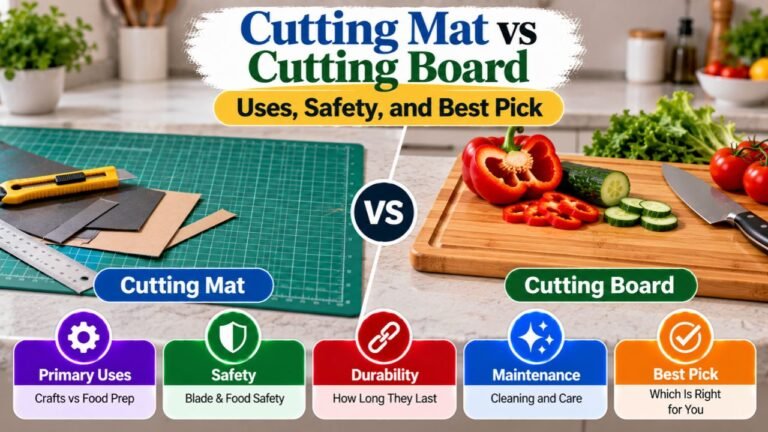
Thin, flexible cutting mats may also move under the pressure of kneading.
A substantial plastic board with a flat surface is better suited to occasional baking than a worn, lightweight sheet.
Silicone Pastry Mats
A silicone pastry mat is an alternative to a rigid pastry board.
It rests on a countertop or another suitable flat surface and creates a flexible area for rolling dough.
Many silicone pastry mats have printed measurement circles and rulers.
Some provide a surface that releases certain doughs with less added flour.
A major advantage is storage.
A silicone mat can often be rolled up when not in use.
Its main limitation is sharp knife contact.
Cutting directly on silicone can puncture or slice the mat, making it unsuitable for further food use when damaged.
A silicone pastry mat should not be treated as a cutting-board replacement.
Key Takeaway: Hardwood is the most versatile choice for combining cutting and pastry work. Marble is useful for temperature-sensitive dough but poor for knives, while plastic cutting boards and silicone pastry mats serve different primary tasks.
Can You Use a Cutting Board as a Pastry Board?
Yes. A suitable cutting board can serve as a pastry board when it is clean, smooth, stable, and large enough for the dough.
A separate pastry board is not necessary for every home baker.
When a Cutting Board Works for Dough
A flat wooden cutting board is suitable for many basic pastry tasks.
Examples include:
- Rolling a single pie crust
- Kneading a small bread dough
- Shaping dinner rolls
- Rolling sugar cookie dough
- Preparing a small batch of fresh pasta
The main requirements are a clean surface and enough room to move the dough.
A board used mainly for vegetables and bread may be a practical option.
A board with deep knife grooves, cracks, or persistent odors is a poor candidate for pastry preparation.
How to Prepare a Cutting Board for Pastry
Follow these steps before rolling or kneading dough.
- Wash the board. Use hot, soapy water to remove food residue, oils, and particles from previous preparation.
- Dry it completely. Remove surface moisture and allow the board to dry before adding flour.
- Inspect the surface. Check for deep knife marks, raised wood fibers, cracks, or separated glue joints.
- Choose the flattest working area. If the board has a juice groove on one face, use a suitable flat reverse side if the manufacturer permits it.
- Stabilize the board. Place it on a clean nonslip mat if it moves when pressure is applied.
- Dust lightly with flour. Add only enough flour to control sticking, following the dough recipe’s directions.
- Roll or knead the dough. Keep it away from the edges and avoid dragging sharp tools across the surface.
A bench scraper is useful for lifting and dividing dough on suitable wooden boards.
It also removes sticky dough residue without requiring aggressive scraping with a sharp kitchen knife.
When a Cutting Board Is Not a Good Substitute
A cutting board may be unsuitable when it has insufficient working space, deep grooves, a pronounced juice channel, or an unstable base.
A board that frequently holds raw meat also deserves additional attention.
Even after proper cleaning, using a dedicated pastry surface may be more convenient than repeatedly switching between raw meat preparation and dough work.
For large bread batches, wide pastry sheets, or frequent pie baking, a dedicated board generally provides a more comfortable working area.
Key Takeaway: A clean, smooth wooden cutting board can handle occasional pastry tasks. Deep grooves, limited space, and poor stability are stronger reasons to use a dedicated pastry board.
Can You Use a Pastry Board as a Cutting Board?
Some pastry boards can be used for cutting, but material and manufacturer instructions determine suitability.
A flat shape alone does not mean a board is intended for knife contact.
Cutting on a Wooden Pastry Board
A wooden pastry board made from suitable hardwood may tolerate ordinary cutting.
Certain models are deliberately designed for both baking and food preparation.
For example, some reversible maple pastry boards have a smooth pastry face and a second flat face intended for everyday preparation.
That arrangement is useful for keeping the dough-working surface free from heavy knife marks.
For a board intended for both jobs, I recommend reserving one face for pastry when the construction allows it.
Repeated heavy chopping on the pastry face may eventually create grooves that catch sticky dough.
If the product is intended only for rolling and shaping, follow that limitation instead of assuming all wooden pastry boards are chopping boards.
Cutting on Marble or Silicone Pastry Surfaces
Marble pastry boards should not be used for regular chopping.
Stone is much harder than the surface normally preferred for kitchen knife work.
Repeated cutting can increase knife-edge wear and potentially damage thin or delicate blades.
Silicone mats present the opposite problem.
They are soft enough for knives to cut through the material.
That can leave permanent damage or loose fragments.
When dividing dough on these surfaces, use a suitable dough tool following the product instructions, or transfer the dough to a proper cutting surface before using a sharp blade.
Key Takeaway: Some wooden pastry boards can double as cutting boards, especially reversible models. Marble and silicone pastry surfaces should not be used as ordinary chopping boards.
Pastry Board vs Cutting Board Sizes: How Much Space Do You Need?
Size is one of the most practical differences between the two tools.
A board that works comfortably for slicing vegetables may feel restrictive during dough preparation.
Choosing a Pastry Board Size
A pastry board should provide room for the finished dough shape and the movements needed to create it.
For example, common pastry-board products include sizes such as 20 × 15 inches and 24 × 18 inches.
These are product examples rather than universal standards.
A 20 × 15-inch surface may work for many home baking tasks.
A 24 × 18-inch board provides extra room for rolling wider pie crusts, shaping bread, and working with homemade pasta.
Some large pastry boards are even wider.
Measure your countertop before choosing one.
The usable surface should fit comfortably without interfering with the sink, stove, backsplash, or other kitchen equipment.
Also consider storage. A large wooden or marble board can be inconvenient in a kitchen with limited cabinet space.
Choosing a Cutting Board Size
Cutting-board dimensions should reflect the amount of food being prepared and the length of the knife.
Common household options include boards around 12 × 18 inches, although smaller and larger models are widely available.
A medium board may be sufficient for ordinary vegetable preparation.
Larger boards provide more room to separate chopped ingredients from food waiting to be cut.
For pastry use, pay attention to the flat area rather than overall dimensions.
A cutting board with wide handles or deep juice grooves may offer less usable rolling space than its outside measurements suggest.
Thickness and Stability
Thickness influences weight, storage, and resistance to flexing.
A thicker wooden board may feel more stable during kneading, but thickness alone does not guarantee freedom from warping.
Moisture content, grain direction, and construction quality also matter.
Marble boards can be heavy even when relatively thin.
Before buying a substantial pastry slab, confirm that its weight and dimensions suit your countertop and storage arrangement.
Tip: Measure the widest dough shape you expect to prepare, then allow additional space around it for turning and rolling. Choosing a board solely because it looks large enough in a product photograph can lead to an undersized working area.
Key Takeaway: Pastry boards generally benefit from a larger uninterrupted working area. Cutting boards can be smaller, provided they allow comfortable knife movement and ingredient handling.
Food Safety and Cleaning Differences
A clean pastry board is just as important as a clean cutting board.
The main contamination concerns differ because the foods and tools used on the surfaces are different.
Raw Flour and Dough Safety
Many people associate foodborne bacteria with raw meat or eggs, but flour is also a raw agricultural product.
According to the U.S. Centers for Disease Control and Prevention, raw flour can contain harmful bacteria, including certain strains of E. coli and Salmonella.
Grinding and ordinary flour processing do not reliably eliminate those organisms.
That is why raw cookie dough and uncooked pastry dough should not be tasted unless specifically manufactured for safe consumption without baking.
Flour can also spread across countertops, utensils, and nearby food.
After handling raw dough, wash the board and surrounding equipment with soap and water.
Do not assume that a dry, flour-covered surface is sanitary simply because it contains no visible meat residue.
Cleaning Wooden Pastry and Cutting Boards
Both wooden board types require similar basic care.
- Remove loose flour, crumbs, and dough residue.
- Wash the surface with warm or hot soapy water.
- Clean edges, grooves, and other areas where residue collects.
- Rinse with clean water.
- Wipe dry with a clean towel.
- Allow both sides to air-dry completely before storage.
Avoid leaving wooden boards submerged in water.
Prolonged soaking can encourage swelling, warping, and glue-joint separation.
Most laminated wooden boards should not go in the dishwasher.
Periodically apply a suitable food-grade mineral oil or cutting-board conditioner when the surface appears dry.
Oil helps condition the wood but does not replace washing or make the surface waterproof.
Cleaning Marble Pastry Boards
Marble needs a different cleaning approach.
Remove loose dough or flour with a suitable soft scraper or cloth.
Wash using water and a mild, pH-neutral cleaning product approved for marble.
Avoid acidic cleaners, including vinegar and lemon juice.
The Natural Stone Institute explains that acidic solutions can damage calcium-carbonate-based stones such as marble.
Abrasive cleaners may also scratch the polished surface.
Rinse and dry according to the manufacturer’s instructions.
Do not place a marble pastry board in the dishwasher unless the manufacturer specifically permits it.
Preventing Cross-Contamination
The USDA recommends separating boards used for raw meat, poultry, and seafood from those used for fresh produce and ready-to-eat foods.
The same separation principle is useful when preparing pastry.
A board used for raw chicken should not immediately be used for rolling dough or preparing ready-to-eat food.
Wash and sanitize cutting surfaces as appropriate after handling raw animal products.
Inspect wooden and plastic boards for deep grooves that cannot be cleaned properly.
If a board has developed extensive damage, replacement may be safer than continued use.
Key Takeaway: Pastry boards require careful washing because raw flour and eggs can carry harmful microorganisms. Wood, marble, and plastic require different maintenance methods, and surfaces should be cleaned between food-preparation tasks.
Which Board Is Better for Different Kitchen Tasks?
The best board becomes easier to identify when the main cooking activity is clear.
For Pie Crusts and Butter-Based Pastry
A smooth pastry board is generally the better choice.
Marble may be useful for dough containing cold butter, especially if the stone has been chilled before use.
Wood is also suitable when the dough is properly chilled and lightly floured.
For pie crust, the board should provide enough room to roll the dough into the required circle without reaching the edges.
If the kitchen is warm, keeping the dough and butter cold matters more than expecting the board itself to solve temperature problems.
For Bread Dough and Homemade Pasta
A large wooden pastry board is an appealing option.
Wood provides a stable area for pushing, folding, and shaping bread dough.
Its surface offers some grip, which may help during kneading.
Homemade pasta often needs considerable working room for rolling and dividing dough.
A counter-edge cleat can reduce movement during these tasks.
A large smooth wooden cutting board may also work when it provides similar space and stability.
For Vegetables, Meat, and Everyday Chopping
A cutting board is the clear choice.
Wood, plastic, and purpose-made cutting-board rubber provide surfaces suitable for repeated knife contact.
A cutting board with a juice groove may be useful when slicing foods that release liquid.
For raw poultry or meat, a separate dishwasher-safe plastic board is a practical option.
A dedicated pastry board is unnecessary for most ordinary chopping tasks.
For Small Kitchens and Occasional Baking
A large reversible wooden cutting board may be the most practical purchase.
It can support everyday slicing and occasional rolling without occupying storage space for two substantial boards.
A silicone pastry mat is another option when a clean, flat countertop is available.
It provides rolling space and can often be stored in a drawer.
I would choose this arrangement over a heavy marble slab for someone who bakes only occasionally and has limited countertop space.
Key Takeaway: Dedicated pastry boards are most useful for frequent baking and large dough projects. Cutting boards remain preferable for regular knife work, while reversible wood boards can serve both activities in smaller kitchens.
Common Mistakes When Using Pastry and Cutting Boards
Several avoidable mistakes reduce the usefulness of both boards.
Using a scratched chopping surface for delicate dough: Deep cuts can trap flour and cause sticky pastry to catch. Choose a smooth, clean working surface.
Chopping directly on marble: A polished stone surface may look suitable for food preparation, but it is not a knife-friendly chopping surface.
Buying a board with too little rolling room: A board should accommodate the dough’s final shape and the rolling pin’s movement.
Ignoring stability: A board that slides during kneading or chopping is harder to control. Use a suitable nonslip base or a properly fitted counter-edge cleat.
Using too much flour to compensate for sticking: Excess flour can change dough consistency. Chill dough when the recipe calls for it, and add flour gradually.
Storing wooden boards while damp: Moisture trapped beneath the board may contribute to swelling, distortion, and damage.
Treating pastry flour as harmless: Raw flour can contain bacteria. Clean tools and surfaces after handling dough, even when the preparation involves no meat.
Assuming every reversible board is dual-purpose: Confirm the manufacturer’s intended uses, finish, and care instructions before using either face for knife work.
Conclusion
The central distinction in pastry board vs cutting board is the task each surface is built to perform. Pastry boards provide room and smoothness for dough preparation, while cutting boards support repeated slicing and chopping. Some wooden boards can handle both tasks, but stone and silicone pastry surfaces have clear limitations around sharp knives.
Material, size, surface condition, and stability matter more than the product name alone. A large, flat hardwood board may be suitable for baking and everyday food preparation, while a marble slab is better reserved for pastry tasks that benefit from a cool working surface.
My recommendation is to start with a high-quality wooden or plastic cutting board if everyday cooking is your main activity. Choose a dedicated pastry board when you regularly prepare pies, bread, or homemade pasta and need extra rolling space. If you want one board for both jobs, look for a properly constructed, food-safe reversible wooden model.
FAQs About Pastry Boards and Cutting Boards
Is a pastry board the same as a cutting board?
No. A pastry board is primarily intended for rolling, kneading, and shaping dough, while a cutting board is intended for knife work.
A pastry board often provides a larger, smoother working area and may include measurement markings or a counter-edge cleat.
Cutting boards are usually designed to tolerate repeated chopping.
Some wooden products serve both purposes, but marble and silicone pastry surfaces should not be treated as ordinary cutting boards.
Can I roll pastry dough on a wooden cutting board?
Yes. A clean wooden cutting board can work well for rolling pastry dough.
The surface should be smooth, stable, and large enough for the intended pastry shape.
Avoid boards with deep grooves, rough areas, or persistent food residue.
Lightly flour the surface as directed by the recipe and use a rolling pin to spread the dough.
For frequent baking, a dedicated pastry board may offer more room and greater convenience.
Can you cut vegetables on a wooden pastry board?
A wooden pastry board can be used for cutting vegetables if the manufacturer confirms that its construction and finish are suitable for knife work.
Repeated chopping may create grooves that interfere with future dough preparation.
A reversible board with separate surfaces for pastry and other food preparation offers a practical compromise.
Do not use marble pastry boards for regular chopping, because hard stone can wear or damage knife edges.
Why do pastry boards have a lip?
Some wooden pastry boards include a counter-edge cleat or lip that braces against the edge of the countertop.
This helps prevent the board from sliding forward during kneading and rolling.
The feature is useful when applying repeated pressure to bread dough or a rolling pin.
Not every pastry board has a lip, and its position varies by design. Check that the cleat fits your countertop before purchasing.
Is marble or wood better for a pastry board?
Wood is generally more versatile, while marble may offer advantages for temperature-sensitive pastry.
A wooden board provides a stable surface for kneading bread, rolling pasta, and shaping dough.
Marble can absorb heat from warmer dough and may slow the softening of butter, especially when the stone is chilled beforehand.
Wood is more suitable for a dual-purpose cutting and pastry board. Marble should be reserved for dough work and other manufacturer-approved uses.
What size pastry board is best for home baking?
A pastry board around 20 × 15 inches can accommodate many ordinary home baking tasks.
A larger 24 × 18-inch board provides additional room for wide pie crusts, bread dough, and homemade pasta.
These are examples of available sizes, not mandatory standards.
Choose a board that accommodates the largest dough shape you normally prepare while leaving enough space for rolling and turning.
Also check countertop dimensions and storage space.
Do I need a pastry board if I already have a cutting board?
Not necessarily.
A large, smooth wooden cutting board can handle many pastry tasks, including rolling cookies, preparing pie crust, and kneading small batches of dough.
A separate pastry board becomes more useful when you bake frequently, require a larger surface, or want features such as measurement guides and a counter-edge cleat.
For occasional baking, a clean cutting board or suitable silicone pastry mat may be sufficient.
Is a pastry board better than a silicone pastry mat?
A rigid pastry board is usually more stable for firm kneading and heavy rolling.
Wooden boards can provide useful surface friction, while marble boards can help with temperature-sensitive dough.
A silicone pastry mat offers easier storage and may reduce sticking for certain doughs.
It is a practical option for small kitchens, but sharp blades can permanently damage it.
For frequent bread kneading, I would favor a substantial wooden board. For occasional pastry rolling with limited storage space, a silicone pastry mat is a sensible alternative.