Cutting board 101 – Everything you need to know about cutting board
A kitchen cutting board is a flat, stable surface used for chopping vegetables, slicing meat, preparing ingredients, and protecting countertops from knife damage. For most home kitchens, a sturdy wooden board paired with a dishwasher-safe plastic board offers a practical combination of comfortable cutting, easy cleaning, and safer food preparation.
Choosing the wrong cutting surface can lead to dull knives, unstable chopping, difficult cleanup, and premature board damage. Poor cleaning habits also create opportunities for bacteria from raw meat or poultry to reach foods that are ready to eat.
A suitable board makes daily food preparation more comfortable. It gives ingredients enough room, keeps the knife steady, and suits the cleaning routine you are willing to follow.
Food safety deserves attention. According to information published by the Centers for Disease Control and Prevention in November 2025, an estimated 48 million people in the United States experience foodborne illness annually. That figure covers foodborne illness from many causes, not cutting boards alone, but it reinforces the need to prevent cross-contamination during meal preparation.
A cutting board should be selected according to its material, size, surface texture, maintenance requirements, and intended use. Wood, plastic, bamboo, rubber, and composite boards each offer a different balance of durability, knife protection, cleaning convenience, and appearance.
One detail stood out during my research: even the best board material becomes a poor kitchen choice if its cleaning requirements do not match your routine. A thick hardwood board may last for years with proper care, while a dishwasher-safe plastic model may suit someone who prefers quick cleanup.
The following overview covers the main board types, popular wood species, material comparisons, food safety, cleaning methods, oiling, maintenance, sizes, brands, and buying considerations. Each topic provides a clear starting point for choosing, using, and maintaining kitchen cutting surfaces.
What Is a Cutting Board?

A cutting board is a portable kitchen surface that provides a designated place for cutting, chopping, slicing, dicing, mincing, and preparing food.
It creates a protective barrier between a kitchen knife and the countertop. A good board also gives the knife a consistent surface, making ingredient preparation more controlled.
Cutting boards appear in home kitchens, restaurants, bakeries, butcher shops, and commercial food preparation areas.
What Is the Purpose of a Cutting Board?
The primary purpose is to provide a stable, food-contact surface for kitchen knives.
Without a suitable board, knife blades may damage countertops or strike materials that are too hard for comfortable cutting.
A board also creates a designated preparation area. Ingredients can be organized, chopped, and transferred to cooking equipment without spreading food scraps across the entire counter.
Separate cutting surfaces are useful for preventing raw animal products from contacting ready-to-eat foods.
Cutting Board vs. Chopping Board
The terms cutting board and chopping board generally describe the same kitchen tool.
In American English, cutting board is the more common expression. Chopping board is also widely understood and appears frequently in international product descriptions.
Some manufacturers use chopping board for thicker models intended for repeated chopping. That difference is a product description rather than a fixed industry classification.
What Makes a Good Cutting Board?
A suitable cutting surface should offer several practical qualities:
- Stability: It should remain steady while food is being cut.
- Knife compatibility: The material should not cause excessive blade wear.
- Cleanability: Food residue should be easy to remove.
- Durability: The surface should resist premature cracking or damage.
- Usable space: Ingredients should fit without crowding.
- Food-contact suitability: Materials and finishes should be intended for food preparation.
A beautiful board that slides across the countertop or cannot be cleaned properly is not a good everyday option.
Key Takeaway: A cutting board protects the counter, supports controlled knife work, and provides a designated surface for preparing food safely.
Types of Cutting Boards
Cutting boards are available in several materials, each with distinct characteristics.
The most familiar options are wood, plastic, and bamboo. Rubber, composite, flexible, glass, stone, and metal boards serve other purposes or appeal to different preferences.
Understanding the types of cutting boards is the first step toward selecting a suitable kitchen setup.
Wooden Cutting Boards
Wooden cutting boards are popular for their appearance, durability, and comfortable cutting feel.
Common hardwood choices include maple, walnut, cherry, teak, acacia, and beech.
Wood has a degree of natural resilience, allowing many kitchen knives to contact the surface without the harsh impact associated with glass or stone.
Wooden boards are available in lightweight rectangular designs, thick butcher blocks, and decorative serving styles.
Their main disadvantage is maintenance. Most wooden boards require hand washing, thorough drying, and occasional treatment with food-grade oil.
A properly maintained hardwood board can remain useful for many years.
Plastic Cutting Boards
Plastic cutting boards are commonly made from polyethylene (PE) or polypropylene (PP).
They are usually lightweight, affordable, and easy to clean. Many models are dishwasher-safe, making them practical for busy households.
Plastic is a common choice for preparing raw meat, poultry, and seafood because compatible boards can be washed and sanitized without the maintenance required by most wooden products.
The main drawback is surface wear.
Knife cuts create scratches and grooves. Once those marks become deep enough to trap residue and resist thorough cleaning, replacement becomes necessary.
Bamboo Cutting Boards
Bamboo cutting boards are made from processed and bonded bamboo strips.
Although bamboo resembles hardwood, it is botanically a grass.
Bamboo boards are often lightweight, firm, and resistant to moisture absorption. Their appearance also makes them popular for serving cheese, fruit, and snacks.
Bamboo can be harder on some knife edges than commonly used hardwoods. The actual cutting feel varies with construction and manufacturing methods.
Most conventional bamboo boards should be washed by hand. Certain specially manufactured models are dishwasher-safe, so care instructions matter.
Rubber Cutting Boards
Rubber cutting boards are made from natural or synthetic rubber compounds designed for food-contact applications.
Many offer a slightly softer cutting surface than rigid plastic, which can feel comfortable during repeated slicing and chopping.
Professional cooks sometimes choose rubber boards because they provide grip and a surface suited to frequent knife work.
Some rubber products can be resurfaced when shallow knife marks develop, but this depends on the material and manufacturer.
Rubber boards may cost more than basic plastic models. Their weight and washing requirements also vary.
Composite Cutting Boards
Composite cutting boards combine materials such as paper fibers, wood fibers, and food-contact-safe resins.
These boards are often thinner than traditional butcher blocks while retaining a firm cutting surface.
Certain paper-composite products are dishwasher-safe and do not require routine oiling.
Their smooth appearance appeals to people who want some of the visual character of wood without the same maintenance routine.
Not every composite board has identical cleaning or heat-resistance properties. Always check the specific model.
Flexible Cutting Mats
Flexible cutting mats are thin sheets commonly made from plastic or similar food-contact materials.
Their main advantage is portability.
After chopping vegetables or herbs, the mat can be bent slightly to direct ingredients into a pot or bowl.
They are useful for small kitchens, quick preparation jobs, and situations where multiple separate cutting surfaces are needed.
Their thin construction makes them less stable for forceful chopping. A flexible mat works best on a flat, secure countertop.
Glass, Marble, and Stone Cutting Boards
Glass, marble, and stone boards have smooth, hard surfaces that resist moisture absorption.
These materials can be attractive for serving food or protecting a counter during certain kitchen tasks.
Their weakness is knife compatibility.
A hard surface offers little cushioning when a steel blade strikes it. Repeated cutting can dull or damage knife edges more quickly than wood, suitable plastic, or rubber.
Glass can also become slippery during food preparation, and breakage remains a concern.
I would choose these materials primarily for presentation or serving rather than routine chopping.
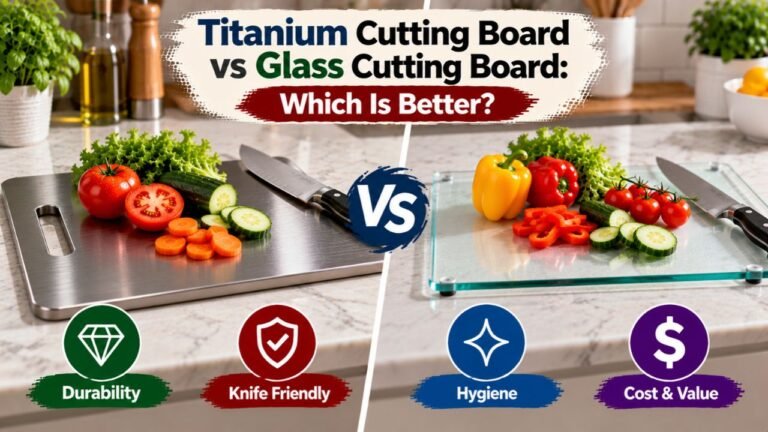
Metal and Titanium Cutting Boards
Metal cutting boards, including stainless steel and products marketed as titanium, are sometimes promoted for easy cleaning and resistance to surface damage.
Metal does not absorb water like unfinished wood, but its hardness creates a less forgiving cutting surface.
Repeated knife contact may increase edge wear, and the board can feel noisy during chopping.
The exact properties vary by metal and product design. A metallic appearance alone does not establish the board’s composition.
For daily knife work, wood, suitable plastic, and rubber are generally more practical options.
Key Takeaway: Wood, plastic, bamboo, rubber, and composite boards are the main practical options. Glass, stone, and metal are usually less suitable for frequent knife cutting.
What Is the Best Material for a Cutting Board?
The best material for a cutting board depends on how it will be used and maintained.
No single material performs equally well for every kitchen task.
Wood offers comfortable cutting and a traditional appearance. Plastic provides convenient washing. Rubber appeals to cooks who prioritize knife feel, while some composite boards offer low-maintenance alternatives.
The following comparison summarizes the main differences.
| Material | Main Strength | Main Limitation | Common Use |
| Hardwood | Durable and comfortable for knives | Requires care and oiling | Everyday chopping |
| Plastic | Easy cleaning and low initial cost | Develops knife grooves | Raw meat and daily prep |
| Bamboo | Firm, lightweight surface | Can be hard on knife edges | Vegetables and serving |
| Rubber | Comfortable knife contact | Higher cost for some models | Frequent slicing |
| Composite | Low maintenance | Product properties vary | General kitchen prep |
| Flexible plastic | Lightweight and portable | Limited stability | Quick cutting jobs |
| Glass | Nonporous and easy to wipe | Hard on knives | Serving and display |
| Marble or stone | Decorative and moisture-resistant | Heavy and very hard | Food presentation |
| Metal | Nonabsorbent surface | Increased knife-edge wear | Limited specialized uses |
Best Material for Everyday Cooking
For general home cooking, I favor hardwood or a suitable knife-friendly composite as the main preparation surface.
A medium-to-large wooden board offers enough room for chopping onions, preparing vegetables, slicing fruit, and handling repeated knife movements.
It also stays in place more easily when the board has sufficient weight.
A plastic board remains a useful companion for tasks requiring frequent sanitizing.
Best Material for Easy Cleaning
Plastic is often the simplest option for households that prioritize washing convenience.
A dishwasher-safe plastic board can be cleaned with regular kitchen dishes, subject to its product instructions.
Some paper-composite and specialized synthetic boards provide similar convenience.
Wooden boards can be cleaned thoroughly, but their moisture sensitivity makes the drying routine more demanding.
Best Material for Knife Protection
Wood and certain rubber materials are generally favored for preserving a comfortable knife edge.
End-grain hardwood boards are popular because their fiber orientation provides a resilient cutting surface.
Rubber boards offer another approach, with varying degrees of softness.
Avoid assuming that the softest possible board is automatically the best. Excessively soft surfaces can develop deep cuts or interfere with smooth blade movement.
Key Takeaway: Hardwood is a strong general-purpose choice, plastic suits easy cleanup, and suitable rubber boards appeal to frequent knife users.
Best Wood for Cutting Boards
The best wood for cutting boards is generally a durable, close-grained hardwood with a suitable food-safe finish.
Wood selection influences knife feel, moisture absorption, appearance, weight, and maintenance.
The U.S. Food and Drug Administration’s Food Code identifies hard maple or equivalently hard, close-grained wood as suitable for cutting boards in covered food-service applications.
That guidance highlights why wood structure matters more than appearance alone.
Maple Cutting Boards
Maple is one of the most established cutting board woods.
Hard maple, often called sugar maple, has a dense, close-grained structure that provides durability without being as unforgiving as stone or glass.
Its light color gives kitchen boards a traditional appearance.
Maple works well for both edge-grain and end-grain construction.
The pale surface can show certain food stains more clearly than dark woods, but regular cleaning and maintenance preserve its usability.
Walnut Cutting Boards
Walnut is valued for its rich brown color and attractive grain patterns.
American black walnut is generally softer than hard maple, giving it a slightly different cutting feel.
It is frequently used in premium kitchen boards, including decorative end-grain designs.
Walnut’s dark appearance can make ordinary staining less noticeable.
The color and finish may change gradually with exposure to light, washing, and use.
Cherry Cutting Boards
Cherry is another close-grained hardwood used for cutting surfaces.
It has a warm reddish-brown appearance and a somewhat softer surface than hard maple.
Cherry boards are attractive for food preparation and serving.
Like walnut, cherry requires routine hand washing and occasional conditioning.
The wood naturally changes color over time, so a new board may not look identical after years of use.
Teak Cutting Boards
Teak is known for its natural oils and moisture resistance.
These qualities help make teak a popular material for kitchen boards and carving surfaces.
Teak may contain silica, a naturally occurring mineral that can contribute to knife-edge wear. The degree of wear depends on the wood and the knife.
Teak boards still require cleaning, drying, and maintenance despite their natural oil content.
They are often selected for their balance of appearance and resistance to moisture.
Acacia Cutting Boards
Acacia cutting boards are widely available in different colors, grain patterns, and constructions.
The name acacia covers numerous species, meaning one acacia board may differ substantially from another in hardness and density.
Many have striking light-and-dark patterns that work well for serving food.
A well-made acacia board can be a practical kitchen option.
Check the finish, glued joints, and manufacturing quality rather than choosing solely by appearance.
Beech and Other Hardwood Boards
Beech offers a relatively uniform grain and is used in cutting boards, kitchen utensils, and food preparation equipment.
Some boards also use birch, olive wood, or other hardwood species.
Each material has its own combination of hardness, moisture behavior, and grain structure.
A board made from an unfamiliar wood should have clear manufacturer information confirming suitability for direct food contact.
Woods That Are Less Suitable for Cutting Boards
Not every type of wood belongs in the kitchen.
Softwoods such as pine may dent or scar more easily under repeated knife contact. Some aromatic woods can also transfer unwanted smells or flavors.
Very open-grained woods require careful consideration because pronounced pores can complicate cleaning.
Avoid reclaimed wood with unknown chemical treatments, old paint, or uncertain finishes.
My recommendation: For a first premium wooden board, hard maple is a sensible starting point. Walnut and cherry are appealing alternatives when appearance or a slightly different cutting feel matters.
Key Takeaway: Hard maple, walnut, cherry, teak, acacia, and beech are common choices, but close grain, suitable construction, and a food-safe finish matter most.
End-Grain vs. Edge-Grain vs. Face-Grain Cutting Boards
Wood species is only part of a board’s design.
The direction in which wooden pieces are arranged changes the cutting surface, appearance, construction cost, and durability.
Three common terms describe these arrangements.
End-Grain Cutting Boards
An end-grain cutting board exposes the ends of the wood fibers on the working surface.
These boards often display a checkerboard or block pattern.
During cutting, the knife contacts the ends of the wood fibers rather than moving across their length.
That structure can offer a comfortable cutting feel and reduce the visibility of some shallow knife marks.
End-grain construction usually involves more individual pieces and glued joints, which can increase manufacturing cost.
Many models are also thick and heavy.
Edge-Grain Cutting Boards
An edge-grain cutting board is made by joining long wooden strips with their narrower edges facing upward.
The resulting surface displays lines running along the length of the board.
Edge-grain boards often provide a useful balance of cost, stability, and durability.
They are widely available in maple, walnut, cherry, and teak.
For a household seeking a sturdy wooden board without the added price or weight of a large end-grain block, edge-grain construction is often a sensible option.
Face-Grain Cutting Boards
Face-grain boards expose the broad faces of wooden boards or planks.
This construction highlights natural grain patterns and can create striking decorative surfaces.
Face-grain products are common as serving boards and lighter preparation boards.
They may show knife scratches more prominently than some edge-grain or end-grain designs.
Construction quality and thickness still determine how well a board performs.
Key Takeaway: End-grain boards emphasize knife comfort, edge-grain boards balance everyday durability and cost, and face-grain boards often emphasize natural appearance.
How Cutting Boards Affect Kitchen Knives
The cutting surface influences how quickly a knife edge wears and how comfortable chopping feels.
A kitchen knife works best against a surface that supports cutting without creating excessive resistance or impact.
Hardness and Knife-Edge Wear
When a knife strikes a surface harder than necessary, its fine cutting edge experiences greater stress.
Glass, ceramic, marble, and many metal surfaces provide very little cushioning.
Wood and selected rubber materials are more forgiving.
Plastic falls somewhere between these options, with performance varying by formulation and surface design.
The goal is a board that supports the blade while remaining durable enough for repeated use.
Surface Texture and Cutting Control
Surface texture affects how ingredients behave during slicing.
A board that is too slippery can allow vegetables to move unexpectedly. A very soft or deeply scarred surface may interrupt smooth knife movement.
Textured plastic, properly finished hardwood, and certain rubber boards can provide a secure working surface.
Board stability also matters. Even an excellent cutting material becomes awkward when the entire board moves.
Does an End-Grain Board Keep Knives Sharper?
End-grain wood is commonly favored for its comfortable contact with knife edges.
Its exposed fiber ends can yield slightly as the blade reaches the surface.
That does not mean an end-grain board prevents dulling or eliminates the need for sharpening.
Knife steel, cutting technique, pressure, sharpening habits, and board condition all influence edge life.
Key Takeaway: Choose a surface with some resilience, avoid hard decorative materials for routine cutting, and keep the board stable during use.
Standard Cutting Board Sizes and Thicknesses
Cutting board dimensions influence usable preparation space, weight, storage, and cleaning convenience.
There is no single required household size.
Most consumers benefit from selecting a board according to countertop dimensions and the amount of food usually prepared.
Small, Medium, and Large Cutting Boards
Common cutting board dimensions include the following examples.
| Size Category | Example Dimensions | Typical Use |
| Small | 8 × 10 inches | Fruit, garlic, garnishes |
| Medium | 12 × 18 inches | Everyday vegetables and meal prep |
| Large | 15 × 20 inches | Larger batches and mixed ingredients |
| Extra-large | 18 × 24 inches | Large roasts or extensive preparation |
| Oversized | 24 × 36 inches | Specialized or commercial prep |
These are representative dimensions, not universal sizing standards.
A 12 × 18-inch board is a practical reference point for many home kitchens, while a larger board offers more room for chopped ingredients.
How Thick Should a Cutting Board Be?
Thickness affects board weight, rigidity, and appearance.
Thin plastic boards are easy to lift and store. Thick wooden boards provide substantial weight and may remain steadier during repeated chopping.
Many household hardwood boards are around 3/4 to 1 1/2 inches thick, while substantial butcher blocks and end-grain models may be thicker.
These are common product ranges rather than requirements.
A very heavy board can become inconvenient if it must be washed and moved after every meal.
Choosing the Right Size for Your Counter
Measure the usable countertop area before selecting a large board.
Allow room for the knife hand, ingredient containers, and finished food.
Also consider the sink. A board that barely fits inside the sink may be difficult to wash without splashing water.
Storage dimensions matter just as much as cutting space.
Key Takeaway: A medium or large board suits most routine kitchen preparation, but the best size must fit the countertop, sink, and storage area.
Cutting Board Shapes, Designs, and Features
Cutting boards differ in more than material and size.
Handles, grooves, feet, corners, and surface design can affect how convenient the board feels during daily cooking.
Rectangular, Round, and Oval Cutting Boards
Rectangular boards are the most common choice for general chopping.
Their shape offers a generous working area and fits naturally along the edge of a counter.
Round boards are attractive for serving bread, pizza, or cheese. They may provide less usable cutting space than a rectangular board with a similar overall footprint.
Oval boards are often chosen for carving and presentation.
For daily ingredient preparation, I prefer a rectangular shape because it gives chopped food room to collect on one side.
Juice Grooves and Carving Channels
A juice groove is a recessed channel around part or all of the cutting surface.
It collects some liquid released during food preparation.
Juice grooves are useful for carving cooked turkey, roast beef, and other foods that release juices.
The drawback is reduced flat cutting space. Grooves can also collect food residue and require careful washing.
A smooth, grooveless surface is often more convenient for chopping vegetables.
Handles, Finger Grips, and Non-Slip Feet
Handles and finger grips make heavier boards easier to lift.
Non-slip feet improve stability on smooth countertops.
Some models have removable rubber grips or textured corners.
A board with permanent feet may only be usable on one side, while a reversible board usually offers two cutting surfaces.
Neither design is automatically superior.
Reversible and Dual-Sided Boards
Reversible boards allow both broad faces to serve as cutting surfaces.
This may reduce wear concentrated in one area.
Some dual-sided plastic boards feature a grooved side for meat and a flat side for produce.
Using different sides can support an organized preparation routine, but turning the board over does not replace proper washing and sanitizing.
Contamination can also transfer through hands, juices, and utensils.
Key Takeaway: Choose design features for actual kitchen tasks. A flat rectangular board handles daily chopping, while juice grooves and grips suit specific needs.
How Many Cutting Boards Does a Kitchen Need?
For most households, two cutting boards are a practical starting point.
The main reason is food safety.
The USDA and FDA recommend using separate surfaces for raw meat, poultry, and seafood and for ready-to-eat foods such as bread and produce.
The Basic Two-Board Setup
A simple arrangement includes:
- One main board: Used for vegetables, fruits, bread, herbs, and other ready-to-eat ingredients.
- One separate board: Reserved for raw meat, poultry, and seafood.
A wooden main board and a dishwasher-safe plastic board form a common combination.
The arrangement reduces opportunities for raw animal juices to reach food that will not receive further cooking.
Both boards must still be cleaned after use.
When Additional Boards Make Sense
Households that prepare large meals may benefit from more cutting surfaces.
A small board is convenient for quick jobs such as slicing a lemon or chopping a few cloves of garlic.
A dedicated carving board can contain juices from cooked roasts.
Separate equipment may also help households managing food allergies, although dedicated boards must remain clearly identified and thoroughly cleaned.
Color-Coded Cutting Boards
Commercial kitchens frequently use color coding to separate different food categories.
The meaning of individual colors can vary by system.
For example, one household might designate red for raw animal products and green for produce.
Color coding is useful only when everyone follows the same system.
It does not replace cleaning between uses or the prevention of cross-contact.
Key Takeaway: Start with two clearly separated boards. Add specialty boards only when your cooking routine creates a genuine need.
Cutting Boards for Different Kitchen Tasks
Some cutting boards are better suited to specific ingredients and preparation styles.
Choosing by task can simplify cleaning and reduce unnecessary wear.
Cutting Boards for Vegetables and Fruits
Vegetable preparation benefits from a spacious, stable surface.
A large hardwood board works well for chopping onions, slicing carrots, dicing potatoes, and preparing salad ingredients.
Plastic and composite boards are also suitable.
For juicy fruit such as watermelon, a larger board with a juice groove may reduce liquid running onto the counter.
The board should have enough room to keep uncut produce away from chopped pieces.
Cutting Boards for Raw Meat and Poultry
Raw meat preparation requires careful separation from ready-to-eat foods.
A nonporous, dishwasher-safe plastic board is convenient because it can be washed and sanitized after contact with raw juices.
Wooden boards can also be used for raw meat when maintained, cleaned, and sanitized correctly.
The USDA permits both wood and nonporous cutting surfaces for this purpose.
My preference is a separate plastic board because it simplifies the cleaning routine in a typical home kitchen.
Cutting Boards for Fish and Seafood
Fish preparation may involve moisture, strong odors, and repeated trimming.
A nonporous cutting surface is often convenient for cleaning.
The board should be large enough to hold the fish without hanging awkwardly over the sides.
A smooth board also makes it simpler to remove scales and food residue.
Seafood preparation deserves the same separation from ready-to-eat foods as raw meat and poultry.
Cutting Boards for Bread
Bread cutting boards often feature large flat surfaces or removable crumb trays.
A standard wooden board works well for slicing loaves.
Serrated bread knives can leave visible marks, especially when the knife is pressed hard into the surface.
For frequent bread slicing, a dedicated board may keep crumbs away from other preparation areas.
Decorative wooden bread boards can also be used for serving.
Cutting Boards for Cheese and Charcuterie
Cheese boards emphasize presentation as well as food-contact suitability.
Wood, bamboo, marble, and stone appear frequently in serving products.
A wooden cheese board can support both slicing and presentation.
Marble is attractive for serving chilled cheese, but repeated cutting directly against the stone is harder on knife edges.
When serving ready-to-eat food, always start with a freshly cleaned board.
Cutting Boards for Carving Cooked Meat
A carving board is designed to support slicing cooked meat.
Larger models often include a juice channel and enough space for a roast, chicken, or turkey.
Some have raised grips or textured areas that help keep food steady.
Avoid moving cooked meat onto an unwashed surface previously used for raw poultry or meat.
Key Takeaway: Match the board to the ingredients. Large stable boards suit vegetables, washable nonporous boards suit raw animal foods, and grooved boards suit carving.
Cutting Board Food Safety and Cross-Contamination
A cutting board can become contaminated when food residue, raw juices, or unclean utensils contact its surface.
The greatest concern is transferring harmful microorganisms to food that will not be cooked afterward.
Food safety depends on cleaning practices, board condition, and ingredient separation.
What Is Cross-Contamination?
Cross-contamination occurs when harmful germs move from one food, object, or surface to another.
For example, cutting raw chicken and then slicing tomatoes for a salad on the same unwashed board can transfer bacteria from the chicken to the tomatoes.
The Centers for Disease Control and Prevention recommends separate cutting surfaces for raw meat, poultry, and seafood and for ready-to-eat foods.
Hands, knives, countertop surfaces, and nearby utensils can also spread contamination.
Are Wooden Cutting Boards Safe?
Wooden cutting boards can be safe for food preparation when made from suitable materials and maintained correctly.
Wood is porous, but porosity alone does not mean every wooden board is unsafe.
The USDA allows wooden cutting surfaces for raw meat and poultry.
Cleaning and board condition are the deciding factors.
Cracks, heavy knife damage, trapped residue, and prolonged moisture create problems regardless of the material.
Are Plastic Cutting Boards More Hygienic?
Plastic is nonporous and generally easier to wash and sanitize.
That makes it convenient for high-cleaning-demand kitchen tasks.
Still, plastic surfaces develop scratches under repeated knife contact.
Deep grooves can hold residue and become difficult to clean.
Neither plastic nor wood should be considered automatically sanitary without proper washing.
Do Plastic Cutting Boards Release Microplastics?
Plastic cutting boards can release small particles during chopping.
A 2023 study published in Environmental Science & Technology examined particles released from polyethylene and polypropylene boards during cutting.
The researchers found that particle release varied with board material and chopping conditions.
These findings raise questions about plastic wear and food exposure, but they do not establish that ordinary plastic cutting board use causes a specific human disease.
Replacing badly worn plastic boards and using appropriate cutting techniques are sensible precautions.
Food-Safe Materials and Certifications
A cutting board should be intended for direct food contact.
For wooden products, pay attention to finishes, adhesives, and any manufacturer statements about food-contact suitability.
Commercial food equipment may carry certifications associated with organizations such as NSF.
Certification applies to specific products or materials under stated standards, not automatically to every product from a brand.
An antimicrobial marketing claim is not a substitute for washing and sanitizing.
Key Takeaway: Food safety depends on clean surfaces, separation of raw and ready-to-eat ingredients, suitable materials, and timely replacement of damaged boards.
How to Clean a Cutting Board
The basic method for how to clean a cutting board is straightforward: remove food residue, wash with dish soap and water, rinse thoroughly, and dry.
Cleaning should take place after each use and whenever food preparation shifts between categories that could spread contamination.
The method changes slightly with the board’s material.
How to Clean a Wooden Cutting Board
Most wooden boards should be cleaned by hand.
Remove visible scraps, wash with mild dish soap and warm water, and rinse.
Dry the board promptly with a clean towel or paper towel.
Allow the remaining moisture to evaporate before placing it in a closed cabinet or stacking it against another damp surface.
Do not leave a wooden board submerged in a sink.
Repeated soaking can contribute to swelling, cracking, or damaged glued joints.
How to Clean a Plastic Cutting Board
Plastic boards can be washed with warm or hot soapy water.
Scrub the entire cutting surface, paying attention to knife grooves, corners, and juice channels.
Rinse thoroughly.
Many rigid plastic boards are dishwasher-safe, but the manufacturer’s instructions should confirm this.
High dishwasher temperatures may warp thin or unsuitable plastic products.
How to Clean Bamboo and Composite Boards
Most conventional bamboo boards follow a similar routine to wooden boards.
Use soap and water, rinse, and dry promptly.
Certain composite boards can be placed in the dishwasher and may not require conditioning.
Because composite materials vary, the manufacturer’s cleaning directions take priority.
A board that looks wooden may be made from a paper-resin material with different washing requirements.
Cleaning Rubber and Flexible Boards
Rubber boards should be washed according to their material-specific instructions.
Some tolerate commercial washing equipment, while others need hand cleaning.
Flexible cutting mats are often easy to wash because their thin surfaces can be reached from both sides.
Make sure they are fully dry before stacking.
For all materials, remove food residue before any separate sanitizing step.
Key Takeaway: Wash boards after use, pay attention to knife marks and grooves, and follow material-specific drying and dishwasher instructions.
How to Sanitize a Cutting Board
Sanitizing means reducing microorganisms on a cleaned surface to a safer level.
It is different from ordinary washing, which removes visible dirt, grease, and food residue.
Sanitizing is especially useful after contact with raw meat, poultry, or seafood.
Cleaning vs. Sanitizing
Cleaning should come first.
Soap and water remove food scraps and other material that can interfere with sanitizing products.
The USDA recommends washing cutting boards with hot, soapy water after use.
After thorough cleaning, a suitable food-contact sanitizer can be applied when needed.
A dirty board should not simply be sprayed with sanitizer and considered clean.
Using a Food-Safe Sanitizing Solution
The USDA provides an example using 1 tablespoon of unscented liquid chlorine bleach mixed with 1 gallon of water.
Its guidance calls for covering the cleaned cutting surface with the solution, allowing it to remain for several minutes, rinsing with clear water, and drying.
Use a product suitable for this application, prepare the dilution carefully, and follow any relevant label restrictions.
Never mix chlorine bleach with vinegar, ammonia, or other cleaning chemicals.
Commercial food-contact sanitizers may have different dilution, contact-time, and rinsing instructions.
Can Vinegar or Lemon Sanitize a Cutting Board?
Vinegar and lemon are often used in household cleaning.
They can be useful for addressing certain odors or surface residue.
They are not interchangeable with a properly labeled food-contact sanitizer or the USDA’s recommended sanitizing procedure.
Lemon juice and salt should not be relied upon to make a board safe after raw poultry preparation.
Key Takeaway: Clean first, then sanitize when appropriate using a product and procedure intended for food-contact surfaces.
Cutting Board Oil: Types, Uses, and Maintenance
Cutting board oil is a conditioning product applied to compatible wooden or bamboo surfaces.
Its purpose is to reduce moisture-related stress, improve water resistance, and maintain the appearance of the material.
Oiling does not make a dirty board sanitary.
It is a maintenance step performed on a clean, dry surface.
Food-Grade Mineral Oil
Food-grade mineral oil is a common choice for wooden cutting boards.
It is stable, has little odor, and does not turn rancid in the same way many cooking oils can.
When applied according to instructions, it penetrates the wood and helps limit moisture movement.
Look for a product clearly identified as suitable for food-contact cutting boards.
Do not assume industrial lubricating oil or unrelated mineral-oil products are appropriate.
Beeswax and Cutting Board Cream
Some board conditioners combine mineral oil with beeswax.
The oil penetrates the wood, while the wax contributes a surface barrier that helps repel moisture.
These products are often sold as butcher block cream or board butter.
They may be used alongside ordinary board oil when recommended by the manufacturer.
A wax treatment is not a replacement for regular cleaning.
Can You Use Olive Oil or Vegetable Oil?
Common cooking oils such as olive oil, canola oil, and vegetable oil are generally poor choices for routine board conditioning.
Some can oxidize, develop unpleasant smells, or leave sticky residues.
Specialized plant-based board treatments may be formulated differently.
Use products specifically intended for cutting board maintenance rather than assuming every edible oil will perform well.
How Often Should You Oil a Cutting Board?
There is no universal oiling schedule for every wooden board.
Frequency depends on the wood, existing finish, washing habits, room humidity, and manufacturer guidance.
John Boos recommends oiling many of its wooden cutting boards at least monthly, adjusted according to use and condition.
A dry, pale, or rough-looking surface may indicate that a compatible oil treatment is needed.
Key Takeaway: Food-grade mineral oil and compatible beeswax conditioners are common maintenance choices. Oil only clean, dry boards and follow the maker’s care schedule.
How to Care for a Cutting Board
Good cutting board care focuses on preventing excess moisture, maintaining the working surface, and storing the board correctly.
Most boards require simple routine attention rather than extensive maintenance.
Drying the Board After Washing
Drying is one of the most frequently overlooked steps.
Wood and bamboo can absorb water, causing uneven expansion or contraction.
After washing, remove surface moisture with a clean towel.
Stand the board on an edge or place it where air can circulate around the surfaces, provided it is stable.
Do not store a damp wooden board flat against a countertop that traps moisture underneath.
Plastic boards also benefit from complete drying before stacking.
Storing Cutting Boards Properly
Cutting boards can be stored upright in a rack, cabinet organizer, or designated countertop position.
Wooden boards need a dry environment with reasonable airflow.
Avoid prolonged exposure to standing water, intense direct heat, or moisture trapped against another surface.
Heavy boards should rest securely so they cannot fall.
Separate storage areas may help keep raw-meat preparation boards distinct from boards reserved for ready-to-eat food.
Maintaining Different Board Materials
Wood and conventional bamboo benefit from suitable conditioning.
Plastic boards generally do not need oil.
Rubber boards may have manufacturer-specific resurfacing or care instructions.
Composite boards often require little routine maintenance beyond cleaning and inspection.
Applying oil to a nonporous plastic board does not provide the same benefit as treating wood.
Protecting Boards From Heat and Moisture
A cutting board is not automatically a heat-resistant trivet.
Placing a hot pan directly on a board may damage plastic, weaken adhesives, stain finishes, or create uneven stress in wood.
Extended soaking is another common cause of damage to laminated wooden boards.
For board longevity, avoid using the surface for tasks outside its intended purpose.
Key Takeaway: Prompt drying, sensible storage, and material-specific maintenance prevent many common board problems.
Common Cutting Board Problems and Their Causes
Cutting boards gradually show evidence of use.
Minor knife scratches and changes in surface color are normal.
Deep damage, cracks, persistent odors, or unstable surfaces deserve closer attention.
Cutting Board Warping
Warping occurs when a board bends or twists away from its original flat shape.
For wood, uneven moisture exposure is a common contributing factor.
A wet underside and dry upper surface may cause different parts of the board to expand or contract at different rates.
Thin plastic boards may warp after exposure to unsuitable heat.
A board that rocks or shifts during cutting should not continue to be used in that condition.
Cracks and Splitting
Cracks may appear when wooden boards dry unevenly, experience large moisture changes, or suffer structural stress.
Small surface checks are different from deep cracks extending through the board.
A deep crack may trap food residue and compromise structural integrity.
Glue-line separation is another warning sign in boards made from joined pieces.
A damaged board should be assessed before repair or replacement.
Deep Knife Grooves
All working cutting surfaces develop some knife marks.
Shallow scratches are expected.
Deep grooves create cleaning problems because food particles can remain inside narrow cuts.
Plastic boards with extensive, hard-to-clean grooves should be replaced.
Some thick wooden boards can be professionally or carefully resurfaced, provided enough material remains and the board is otherwise sound.
Cutting Board Stains
Foods such as beets, berries, turmeric, and certain sauces can stain cutting surfaces.
Some discoloration is cosmetic.
Persistent dark patches inside cracks or damp areas may indicate a more serious problem.
The source of the stain matters more than appearance alone.
Persistent Odors and Sticky Surfaces
Onion, garlic, fish, and other ingredients may leave noticeable smells.
Proper washing and complete drying often reduce them.
A sticky wooden board may have excess conditioner, residue from an unsuitable oil, or accumulated kitchen grease.
Clean the surface and inspect its condition before adding more oil.
Key Takeaway: Minor marks are normal, but warping, deep cracks, hard-to-clean grooves, and persistent contamination may make a board unsuitable for continued use.
How to Remove Cutting Board Stains and Odors
Stains and odors are common after repeated food preparation.
The first step is always ordinary washing.
Extra treatment may be useful when residue remains on an otherwise clean, sound surface.
Removing Food Stains
Mild stains may fade through normal washing and use.
For compatible wooden boards, some manufacturers recommend gently working salt over the affected area or using other approved cleaning methods.
Avoid aggressive scraping that removes unnecessary material.
Plastic stains can also remain after thorough cleaning without automatically making the board unsafe.
If the surface cannot be cleaned or appears damaged, replacement may be more sensible than repeated scrubbing.
Removing Onion and Garlic Odors
Strong-smelling ingredients can leave odor compounds on a cutting surface.
Wash with dish soap and water first.
For wooden boards, some manufacturers suggest lemon and salt as an odor-treatment option.
Afterward, rinse and dry according to the board’s instructions.
This treatment is intended for odor removal, not as a substitute for food-contact sanitizing.
What About Mold on a Cutting Board?
Mold may appear when moisture remains trapped on or inside a board.
Visible mold in deep cracks, persistent dark spots, or extensive growth raises concerns about cleanability.
Do not assume a surface wipe removes contamination from damaged material.
A badly affected, cracked, or persistently moldy wooden board is better replaced.
Key Takeaway: Start with proper washing. Treat mild cosmetic stains separately, and replace boards with persistent contamination or damage that prevents thorough cleaning.
Can You Put a Cutting Board in the Dishwasher?
Dishwasher compatibility depends on the board’s construction and manufacturer guidance.
Many plastic cutting boards are designed for dishwasher cleaning.
Some composite and specialized synthetic boards are also dishwasher-safe.
Most conventional wooden and bamboo cutting boards are better washed by hand.
Plastic Cutting Boards in the Dishwasher
Rigid plastic boards may tolerate dishwasher temperatures and detergent.
Check the care label before washing.
Very thin plastic boards can deform under heat.
A dishwasher-safe label is more useful than assuming the material alone guarantees compatibility.
Wooden Cutting Boards in the Dishwasher
The USDA notes that certain solid-wood boards can be cleaned in a dishwasher, while laminated boards may split or crack.
That general food-safety guidance does not mean every wooden board should be machine washed.
Many wooden board manufacturers specifically prohibit dishwasher use.
For typical glued hardwood boards, hand washing is the safer maintenance choice.
Bamboo, Rubber, and Composite Boards
Conventional bamboo boards are usually hand-wash products.
Some specially manufactured bamboo boards are dishwasher-safe.
Rubber and composite products vary considerably.
Follow the model’s documented temperature limits, placement instructions, and approved cleaning methods.
Key Takeaway: Check the manufacturer’s label. Many plastic and composite boards are dishwasher-safe, while conventional wood and bamboo usually require hand washing.
When Should You Replace a Cutting Board?
Cutting boards do not have a fixed expiration date.
Replacement depends primarily on their physical condition and ability to be cleaned.
The USDA recommends discarding cutting boards that become excessively worn or develop hard-to-clean grooves.
Signs a Board Needs Replacement
Common warning signs include:
- Deep grooves that retain food residue
- Cracks extending into the material
- Separation between glued wooden pieces
- Excessive warping that causes instability
- Persistent contamination that cannot be removed
- Loose pieces or damaged surfaces
Cosmetic scratches alone do not always require replacement.
The concern is damage that interferes with safe use.
How Long Do Wooden Cutting Boards Last?
A well-made hardwood board may remain useful for many years.
Its lifespan depends on wood quality, construction, cleaning, moisture exposure, and maintenance.
Thick boards may permit limited resurfacing when shallow damage develops.
A cracked or structurally weakened board may not be worth repairing.
How Long Do Plastic Cutting Boards Last?
Plastic board lifespan varies with use and material quality.
A board used daily for heavy chopping may develop deep wear sooner than one reserved for occasional preparation.
Plastic boards are generally replaced rather than resurfaced.
There is no reliable universal schedule such as replacing every plastic board after a fixed number of months.
Key Takeaway: Replace a board when it becomes unsafe, unstable, or difficult to clean—not simply because it has reached a certain age.
Cutting Board vs. Butcher Block vs. Serving Board
Several kitchen products resemble cutting boards but serve different purposes.
Understanding the terminology prevents confusion when shopping.
Cutting Board vs. Butcher Block
A cutting board is a general food preparation surface.
A butcher block usually refers to a thicker, more substantial wood cutting surface traditionally associated with meat preparation.
Modern butcher blocks may be portable boards, heavy chopping blocks, or built-in work surfaces.
Not every wooden board labeled butcher block is intended for heavy cleaver use.
Thickness, construction, and manufacturer instructions determine suitability.
Cutting Board vs. Charcuterie Board
A charcuterie board is mainly a serving surface for foods such as cured meats, cheese, fruit, nuts, and accompaniments.
Some wooden charcuterie boards can also be used for light cutting.
Others are designed mainly for display.
Decorative finishes, engraving, and irregular shapes may reduce their practicality for routine chopping.
Cutting Board vs. Butcher Block Countertop
A butcher block countertop is a fixed kitchen work surface made from joined wooden pieces.
Some are designed and finished for direct food preparation.
Others have protective coatings intended for countertop use rather than direct knife contact.
Do not assume every butcher block countertop is suitable for chopping.
Verify its finish and manufacturer guidance before cutting directly on it.
Key Takeaway: Cutting boards are general prep tools, butcher blocks are often thicker cutting surfaces, and serving boards prioritize presentation.
Best Cutting Board Brands to Know
Several established manufacturers offer cutting boards in different materials and designs.
The best cutting board brand is not necessarily the most expensive or best-known name.
Product quality, dimensions, warranty terms, maintenance requirements, and intended use are more useful comparison points.
The following brands represent different categories rather than a hands-on-tested ranking.
John Boos & Co.
John Boos is known for hardwood cutting boards, butcher blocks, and commercial food preparation equipment.
Its Boos Blocks lineup includes wooden boards in materials such as maple and walnut.
The brand also sells conditioning products, including Mystery Oil and Board Cream.
John Boos is worth considering for shoppers who want a traditional hardwood preparation surface.
Wooden products require regular care, and different models vary in size, thickness, and construction.
OXO
OXO offers practical plastic cutting boards for home kitchens.
Its Good Grips boards commonly feature non-slip edges or feet, convenient handles, and reversible designs.
Some models include juice grooves.
Dishwasher-safe construction is a major attraction.
OXO is a reasonable brand to examine when ease of handling and cleanup matters more than a traditional wood appearance.
Epicurean
Epicurean is known for cutting boards made from paper-composite material.
Many of its boards combine a relatively thin profile with a firm cutting surface.
The brand offers dishwasher-safe products that do not need the same routine oiling as natural hardwood boards.
Epicurean appeals to cooks interested in a wood-like appearance with simpler care.
The exact features vary across product lines.
TeakHaus
TeakHaus focuses on teak cutting boards in several shapes, sizes, and grain constructions.
Its product range includes edge-grain and end-grain designs.
Teak’s natural appearance and moisture resistance are major selling points.
These boards still require hand washing and periodic conditioning.
TeakHaus is worth comparing with maple and walnut brands when wood appearance and moisture behavior are priorities.
Totally Bamboo
Totally Bamboo offers bamboo cutting boards, serving boards, carving surfaces, and decorative designs.
Its range includes compact boards and larger preparation surfaces.
Bamboo boards are commonly chosen for their firm surfaces and attractive striped appearance.
The brand also offers different constructions, so washing requirements should be checked for each model.
Hasegawa
Hasegawa makes specialized cutting boards used in professional-style food preparation.
Some models combine a lightweight internal core with synthetic cutting surfaces designed to be gentle on knife edges.
The company offers boards with different surface characteristics for various kitchen tasks.
These products may appeal to cooks who frequently use delicate, sharp kitchen knives.
They are generally more specialized than ordinary household plastic boards.
How to Compare Cutting Board Brands
Before choosing a brand, review the actual model rather than relying on reputation alone.
Compare the usable dimensions, weight, surface material, stability, care instructions, and replacement or warranty policies.
Also check how easily the board can be washed in your kitchen.
A smaller board from a premium manufacturer may be less useful than a properly sized board from a simpler product line.
Key Takeaway: John Boos, OXO, Epicurean, TeakHaus, Totally Bamboo, and Hasegawa cover several different board categories. Compare individual products before making a final choice.
How to Choose the Right Cutting Board for Your Kitchen
Buying a cutting board becomes simpler after identifying the tasks it must handle.
A board used mainly for vegetables has different priorities from one used for large roasts or frequent raw-poultry preparation.
Start with the intended use, then consider material, size, washing requirements, and storage.
For a Small Kitchen
A compact or medium board is often more practical than an oversized butcher block.
Look for a stable surface that fits comfortably in the sink.
Lightweight plastic and thin composite boards can be convenient in apartments and kitchens with limited cabinet space.
A small secondary board is useful for quick jobs.
For Frequent Home Cooking
A larger wooden board provides room for multiple ingredients.
Maple, walnut, and other suitable hardwoods are common choices.
Pairing the main board with a dishwasher-safe plastic board creates a useful division between everyday chopping and raw-animal-food preparation.
I would prioritize usable cutting space over decorative handles or complex shapes.
For Low-Maintenance Households
Dishwasher-safe plastic or compatible composite boards are logical choices.
They do not require routine wood conditioning.
Look for secure grips, a flat cutting area, and clear care instructions.
Avoid buying a wooden board solely for appearance if regular drying and oiling would become inconvenient.
For People Who Use Expensive Knives
The cutting surface deserves more attention when knives have thin or delicate edges.
Suitable hardwood and specialized rubber boards may provide a more comfortable surface than glass or metal.
Board stability and cutting technique also matter.
Choose a material that supports the type of knife and cutting style used most often.
For Families and Shared Kitchens
A clearly organized set of boards is useful when several people prepare food.
Separate boards for raw animal products and ready-to-eat foods reduce confusion.
Color coding or distinctive materials can make the system easier to follow.
The boards should remain simple to clean and store.
Key Takeaway: Choose a board according to cooking habits, washing preferences, available space, and knife compatibility—not appearance alone.
Cutting Board Prices, Quality, and Long-Term Value
Cutting boards are sold across a broad range of price levels.
A basic plastic board may cost much less than a thick handmade end-grain butcher block.
Higher prices can reflect material costs, thickness, construction labor, finishing, brand positioning, or decorative design.
Budget Cutting Boards
Budget boards are often made from plastic or bamboo.
They are practical for basic food preparation and for households needing multiple separate surfaces.
Low price does not automatically mean poor quality.
Inspect the board for warping, sharp unfinished edges, poor stability, and unclear food-contact information.
Midrange Cutting Boards
Midrange products may include thicker plastic designs, hardwood boards, and selected composite materials.
This category often offers a balance between durability and reasonable cost.
Features such as secure grips, greater thickness, or improved construction can make daily use more comfortable.
Premium Cutting Boards
Premium products frequently include thick hardwood boards, elaborate end-grain construction, and specialized synthetic cutting surfaces.
Some are designed for professional kitchens or long-term countertop display.
A premium board is worthwhile only when its features match actual use.
A heavy butcher block that is difficult to wash may offer little practical advantage in a very small kitchen.
Cost vs. Useful Lifespan
The purchase price is only one part of the value.
A durable board that remains stable and easy to maintain can offer good value over time.
A cheap board replaced repeatedly may become less economical.
Still, expensive boards can also fail when poorly maintained.
Key Takeaway: Judge cutting board value by construction, usability, maintenance, and realistic lifespan rather than price alone.
Are Eco-Friendly and Sustainable Cutting Boards Better?
Environmental considerations influence cutting board purchases, but material names alone do not establish sustainability.
Manufacturing methods, raw material sourcing, transportation, durability, and disposal all matter.
A product marketed as natural is not automatically the lowest-impact option.
Wooden Cutting Boards
Wood is a renewable material when sourced from responsibly managed forests.
A durable hardwood board may provide many years of use when properly maintained.
Some brands offer information about forest certification and material sourcing.
Look for specific claims rather than vague environmental language.
Bamboo Cutting Boards
Bamboo grows relatively quickly and can be harvested repeatedly.
That makes it attractive as a renewable raw material.
Bamboo cutting boards still require processing, adhesives, energy, and transportation.
Their environmental impact varies with manufacturing practices and product lifespan.
Plastic and Composite Boards
Plastic boards may be lightweight, inexpensive, and long-lasting under certain conditions.
Their environmental limitations include petroleum-based materials, surface wear, and end-of-life waste.
Some products incorporate recycled material, but food-contact suitability must still be verified.
Composite boards contain more than one material, which can complicate recycling.
Durability and Waste Reduction
A sensible environmental approach is to buy a board that fits the kitchen and maintain it correctly.
Avoid replacing sound equipment merely for cosmetic reasons.
At the same time, do not continue using a board with damage that prevents safe cleaning.
Key Takeaway: Responsible sourcing, suitable construction, and a long usable life are more meaningful than broad claims that one material is always environmentally superior.
Common Cutting Board Mistakes to Avoid
Many cutting board problems come from ordinary habits rather than manufacturing defects.
Avoiding a few common mistakes can improve both food safety and board longevity.
Using One Unwashed Board for Every Ingredient
Preparing raw chicken and then chopping salad vegetables on the same unwashed surface creates a cross-contamination risk.
Use separate boards or complete the necessary cleaning and sanitizing before switching tasks.
Keeping raw and ready-to-eat preparation equipment distinct is often simpler.
Putting Wooden Boards in the Dishwasher
Most laminated hardwood boards are not intended for repeated dishwasher cleaning.
High heat, water exposure, and drying cycles can damage glued joints or contribute to cracking.
Follow the manufacturer’s washing instructions.
Leaving Boards Wet
Storing wet wooden boards against a flat surface can trap moisture.
Dry the board thoroughly and provide airflow.
Plastic and composite boards should also be dry before stacking or enclosed storage.
Using the Wrong Conditioning Oil
Applying olive oil or ordinary cooking oil can leave residue or unpleasant odors on wood.
Choose a food-contact-safe board conditioner suited to the material.
Avoid applying oil to boards that do not require it.
Continuing to Use Deeply Damaged Boards
A board covered with hard-to-clean grooves may no longer provide a suitable food preparation surface.
Deep cracks, loose joints, and unstable warping also deserve attention.
Replacement is sometimes safer and simpler than attempting repair.
Buying a Board That Is Too Small
A small board may seem convenient until chopped ingredients occupy the entire surface.
Crowding reduces available knife space and increases the chance of ingredients falling onto the counter.
Choose enough room for both active cutting and prepared food.
Key Takeaway: Separate raw foods, follow washing instructions, dry boards fully, use compatible conditioners, and replace boards that can no longer be cleaned safely.
Conclusion
A cutting board is a basic kitchen tool, but its material, construction, size, and condition influence daily food preparation. Hardwood, plastic, bamboo, rubber, and composite boards each offer advantages, and no single design is the best match for every kitchen.
For most households, a spacious hardwood board and a separate dishwasher-safe plastic board provide a practical starting combination. Understanding wood species, grain construction, cleaning requirements, food safety, conditioning oils, and signs of wear makes it easier to select and maintain both.
My recommendation is to prioritize a stable cutting surface, enough room for ingredients, and a cleaning routine you can follow consistently. A well-chosen board should make everyday preparation comfortable without creating unnecessary maintenance or food safety problems.
FAQs About Cutting Boards
What Is the Best Cutting Board for Everyday Use?
A stable hardwood cutting board is an excellent everyday option for chopping vegetables, slicing fruit, preparing herbs, and general cooking.
Maple, walnut, and cherry are common choices.
A dishwasher-safe plastic board is also practical, especially for households that prefer simpler cleanup.
For many kitchens, owning one main wooden board and one separate plastic board provides a flexible setup without requiring a large collection.
Is a Wood or Plastic Cutting Board Better?
Wood generally offers a comfortable cutting feel and can provide a long usable life with proper maintenance.
Plastic is lighter, often less expensive, and easier to clean in a dishwasher.
Both materials can be used safely when cleaned and maintained correctly.
Wood is a sensible primary board for everyday chopping, while plastic is convenient for preparing raw meat, poultry, and seafood.
What Is the Healthiest Cutting Board Material?
No single cutting board material guarantees safer food preparation.
The USDA recognizes both wood and suitable nonporous materials as cutting surface options.
Cleanability, physical condition, ingredient separation, and sanitizing practices are more important than marketing claims.
A clean, well-maintained wooden board can be suitable for food preparation, while a badly scratched plastic board may need replacement.
What Type of Wood Is Best for Cutting Boards?
Hard maple is a leading choice because of its close grain, durability, and established use in food preparation surfaces.
Walnut and cherry are also popular hardwood options.
Teak, acacia, and beech can be suitable when properly manufactured.
The wood should be intended for food contact and have a compatible finish. Avoid boards made from unknown treated or painted lumber.
How Often Should I Clean My Cutting Board?
Wash your cutting board after each use and whenever food preparation shifts between ingredients that could spread contamination.
Use dish soap and water, then rinse and dry the board.
After contact with raw meat, poultry, or seafood, follow appropriate cleaning and sanitizing guidance.
Do not leave food residue on a board until the next meal, even when the surface looks relatively clean.
How Often Should I Oil a Wooden Cutting Board?
Oiling frequency depends on the wood, finish, washing habits, and manufacturer recommendations.
Some brands recommend treatment approximately once a month.
Dryness, fading, or a rough surface may indicate the need for conditioning.
Use food-grade mineral oil or a compatible board conditioner on a clean, thoroughly dry board.
Plastic boards generally do not require oiling.
Can You Cut Raw Chicken on a Wooden Cutting Board?
Yes. The USDA allows wooden cutting surfaces to be used for raw meat and poultry when properly maintained and cleaned.
The board must be washed and appropriately sanitized after raw chicken preparation.
Avoid using the contaminated surface for salad vegetables or other ready-to-eat foods.
A dedicated plastic board may simplify cleaning, but wood is not automatically unsafe.
How Do I Know When My Cutting Board Needs Replacing?
Replace a cutting board when it becomes excessively worn, develops deep hard-to-clean grooves, cracks, loose joints, or warping that prevents stable use.
Persistent contamination or damage that cannot be cleaned is another reason to discard it.
Minor knife marks do not always mean replacement is necessary.
Inspect the board regularly and judge its condition by stability, surface integrity, and cleanability rather than age alone.