Carving Board vs Cutting Board: Differences and Best Uses
A carving board is a specialized cutting board designed mainly for slicing cooked meat, collecting juices, and keeping large roasts steady. A regular cutting board is made for everyday food preparation, including chopping vegetables, slicing fruit, and cutting meat. Both serve as cutting surfaces, but their design features make them better suited to different kitchen tasks.
Carving a juicy turkey on a small, flat board can leave meat drippings running across the countertop. A board that slides while cutting also makes it harder to control the knife. These problems become more noticeable when handling large roasts, brisket, or whole poultry.
Choosing the proper surface gives you more room to work, better control over ingredients, and less cleanup. A flat board is usually more convenient for daily chopping, while a grooved board keeps juices contained during meat carving.
Food safety matters just as much as the board’s shape. A 2025 U.S. study published in the journal Foods found that about 27% of surveyed grillers who used a cutting surface for raw poultry reported only rinsing, wiping, or reusing it without proper washing. The findings were based on self-reported practices and highlight the need for proper cleaning between tasks.
The carving board vs cutting board decision comes down to the food you prepare, how much liquid it releases, and the space available in your kitchen. What stood out to me during the research was that a juice groove can be useful for carving without automatically making a board better for everyday chopping.
Another detail shoppers sometimes overlook is usable cutting space. A large board with a wide juice channel may provide less flat working area than a slightly smaller board without one.
The differences in design, materials, sizes, cleaning requirements, and food safety explain which board works best for vegetables, raw ingredients, cooked meat, and holiday roasts. Understanding those differences will make it easier to choose one versatile board or decide if owning both makes more sense.
What Is a Carving Board and What Is a Cutting Board?
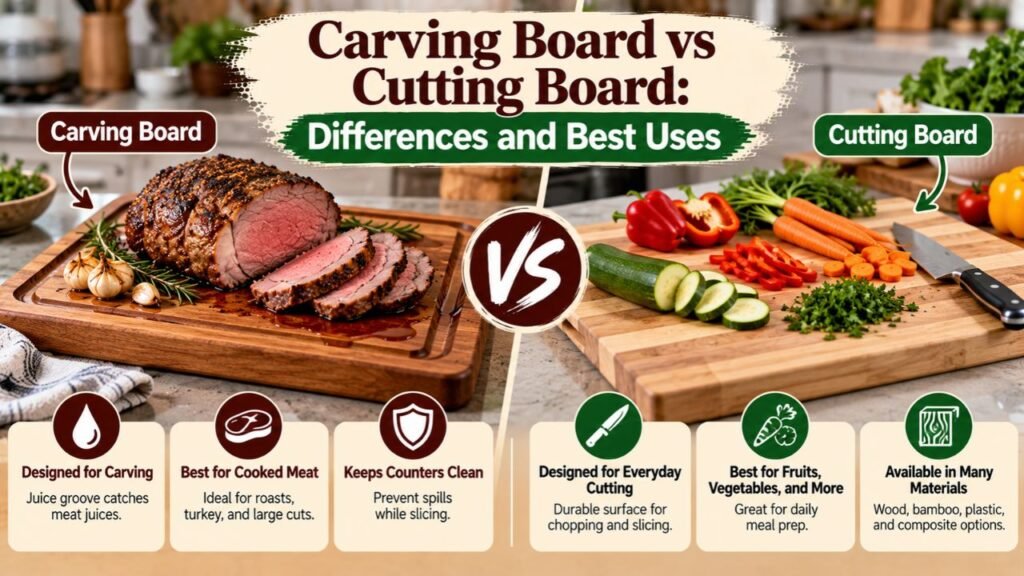
Although the names are sometimes used interchangeably, carving boards and standard cutting boards have different primary purposes.
What Is a Carving Board?
A carving board is a food preparation surface designed mainly for slicing cooked meat, such as turkey, roast beef, ham, pork loin, and brisket.
Most carving boards have a recessed channel around the perimeter called a juice groove. This channel collects meat drippings and keeps them from flowing onto the counter.
Some models also include a deeper collection well, recessed handles, or raised points that grip the meat during slicing.
Carving boards are often larger than basic kitchen cutting boards because carving requires room for the main cut of meat, the knife, and the slices being removed.
Wood is a common material, although plastic carving boards are also available. Some have a smooth reverse side for ordinary chopping.
What Is a Cutting Board?
A cutting board is a flat, durable surface used to chop, dice, mince, and slice ingredients during food preparation.
Its primary purpose is to provide a stable work area while protecting the countertop from knife damage.
Cutting boards come in different shapes, sizes, thicknesses, and materials, including hardwood, plastic, bamboo, and composite materials.
Common uses include chopping onions, slicing potatoes, mincing herbs, cutting fruit, preparing bread, and trimming raw meat.
Most general-purpose cutting boards have an uninterrupted flat surface. Some include juice grooves, handles, or nonslip edges, but those features are optional.
Key Takeaway: A carving board is a specialized type of cutting board. Its main advantage is handling cooked meat and liquid, while a standard cutting board focuses on everyday food preparation.
Carving Board vs Cutting Board: Side-by-Side Comparison
The following comparison highlights the design and practical differences between these two kitchen boards.
| Feature | Carving Board | Cutting Board |
| Main purpose | Carving cooked meat | Everyday food preparation |
| Common foods | Turkey, brisket, ham, roast beef | Vegetables, fruit, bread, herbs, meat |
| Surface design | Often includes a juice groove | Usually flat |
| Juice collection | Common feature | Optional |
| Typical size | Often medium to large | Small, medium, or large |
| Meat stability | May have grips or a recessed center | Usually relies on a flat surface |
| Materials | Wood, plastic, bamboo | Wood, plastic, bamboo, composite |
| Cleaning | Grooves and wells need attention | Flat surfaces are simpler to scrub |
| Serving use | Often suitable for serving sliced meat | Some models work as serving boards |
| Best application | Roasts and foods releasing liquid | Daily chopping and slicing |
These are general differences, not fixed design rules. A large cutting board may have a juice groove, while a carving board may have a simple flat surface.
The label matters less than the features and how they support the food being prepared.
Key Differences Between Carving Boards and Cutting Boards
Several design details explain why one board may perform better for a certain kitchen task.
1. Juice Grooves and Liquid Collection
The most recognizable difference is the juice groove.
A carving board often has a channel running around its outer edge. When you slice cooked meat, this groove collects drippings before they reach the counter.
Some boards also feature a collection reservoir or pour spout for transferring juices into a pan or gravy container.
A regular cutting board generally has a flat surface without a collection channel.
This difference matters most when carving:
- Whole turkey or roast chicken
- Prime rib or roast beef
- Brisket and other barbecue meats
- Ham and pork loin
- Large, juicy fruits
A juice groove has limited capacity. A shallow channel may overflow when carving a very juicy roast, so groove depth and overall capacity deserve attention.
2. Size and Usable Cutting Space
Carving boards are frequently larger because they need enough space for a whole roast and the slices being removed.
Standard cutting boards range from compact boards for small ingredients to oversized butcher blocks.
For example, a board around 18 × 12 inches can be a reasonable starting point for smaller roasts or chicken. A board around 20 × 14 inches or larger may be more practical for a midsize turkey. These are shopping guidelines, not universal size requirements.
The usable surface is just as important as the outside dimensions.
A perimeter groove reduces the flat area available for chopping. Small pieces of garlic, diced onions, or chopped herbs may collect near the channel.
A completely flat cutting board generally provides more uninterrupted working space.
3. Meat Stability and Cutting Control
A carving board must support large pieces of meat while a carving knife moves through them.
Some carving boards use a shallow recessed center or raised gripping points to keep meat from shifting.
Others depend on their weight, textured surface, or nonslip feet for stability.
A regular cutting board is normally flat, making it suitable for repeated chopping and knife movements.
Both types should remain firmly in place during use.
A lightweight board that slides across a smooth countertop can create problems regardless of its intended purpose.
Safety Tip: If a board slides, place a clean, damp kitchen towel or nonslip cutting-board mat underneath it. Confirm the board is stable before cutting.
4. Cleaning, Storage, and Serving
A smooth cutting board is generally simpler to wash because there are fewer recessed areas that collect food particles.
Carving boards require extra attention around grooves, wells, and meat-gripping features.
Large, thick wooden carving boards can also be heavier and harder to fit inside a kitchen sink.
Presentation is another difference. Many wooden carving boards have an attractive finish and enough space to arrange slices for serving.
A basic plastic cutting board may be more convenient for food preparation and cleanup, even though it may look less suitable on a dining table.
Key Takeaway: Juice management, usable surface area, meat stability, and cleaning convenience are the main practical differences. A carving board solves problems that become more noticeable when slicing large, juicy foods.
Carving Board vs Cutting Board Materials: Which Is Better?
The intended use determines the board’s design, while the material affects knife wear, cleaning, durability, and maintenance.
Wooden Boards
Hardwood is a popular material for both carving boards and everyday cutting boards.
Common choices include maple, walnut, cherry, and teak.
Wood provides a firm surface with some give under a knife edge. Quality hardwood boards can last for years when cleaned, dried, and maintained properly.
Wooden boards are made using different grain constructions.
Edge-grain boards expose the long sides of the wood fibers and offer a practical balance of cost and durability.
End-grain boards expose the ends of wood fibers and can be gentler on knife edges, although they are often thicker, heavier, and more expensive.
For occasional meat carving, I would not pay extra for end-grain construction solely because a board is labeled for carving. A stable edge-grain hardwood board with a useful juice groove can handle the job.
The main drawback of wood is maintenance. It needs proper drying, and many wooden boards benefit from occasional food-grade mineral oil.
Plastic Boards
Plastic cutting boards are generally lighter, less expensive, and easier to clean than large wooden boards.
Many dishwasher-safe plastic boards are suitable for preparing raw meat, poultry, and seafood.
Plastic carving boards can also include juice channels, nonslip edges, and textured areas to hold cooked meat.
Their main advantage is cleaning convenience.
Their main weakness is surface wear. Repeated cutting creates knife marks, and deep scratches can become difficult to clean.
A thin plastic board may also flex or move during heavy carving if it is not properly supported.
Bamboo, Composite, and Hard Surfaces
Bamboo boards are available in both flat and grooved designs.
Bamboo is relatively hard and resists moisture absorption, but its firmness may cause faster knife-edge wear than some hardwoods. Bamboo boards also need careful drying to prevent splitting or warping.
Composite boards made from bonded wood fibers or synthetic materials offer another option. Dishwasher compatibility and knife feel vary by product.
Glass, marble, and stone boards are less suitable for repeated chopping or carving with sharp kitchen knives.
Their hard surfaces can dull knife edges quickly, and some become slippery when wet.
For most home kitchens, hardwood or food-safe plastic is a more practical starting point.
Key Takeaway: Hardwood offers durability and a pleasant cutting surface, while plastic is convenient for cleaning. The material matters more for maintenance and knife wear than the label “carving” or “cutting.”
Can You Use One Board for Both Carving and Cutting?
Yes. A single board can handle carving and everyday food preparation if it provides enough room, remains stable, and can be cleaned properly.
Using a Cutting Board for Carving Meat
A regular cutting board can work for carving steak, chicken, pork, or other cooked meat.
The main requirements are adequate size and stability.
A large, sturdy hardwood cutting board may support a roast without any trouble.
The biggest limitation is liquid management.
Without a juice groove, drippings can move across the surface and spill over the edges.
One practical alternative is placing a stable cutting board inside a clean, rimmed baking sheet that is large enough to support it without wobbling. The tray catches runoff, but the board must remain flat and secure.
Avoid carving directly on a metal baking sheet because it can damage the knife edge.
Using a Carving Board for Everyday Chopping
A carving board can also be used for vegetables, fruits, bread, and other ingredients.
The center remains a normal cutting surface on most designs.
The inconvenience comes from the features around that surface.
Small food pieces may fall into the groove, and raised meat grips can interfere with normal chopping.
Flat carving boards without raised features are more convenient for frequent vegetable preparation.
A grooved board can be useful for cutting watermelon, tomatoes, pineapple, and other foods that release considerable liquid.
Using a Reversible Board for Both Tasks
A reversible cutting board is one of the most practical choices for a kitchen with limited storage.
Many reversible models have:
- One flat side for general chopping
- One grooved side for carving and juicy foods
This provides two different working surfaces without requiring two large boards.
Check the design before buying. Some boards have feet, permanent grips, or raised features that prevent the reverse side from sitting flat.
Also, turning a board over does not automatically make it safe for cooked or ready-to-eat food after handling raw meat. Juices can reach the edges, underside, or countertop.
Proper washing and separation are still necessary.
Key Takeaway: One reversible board can cover daily chopping and occasional carving, but separate, clean preparation surfaces remain the safer approach when handling raw and ready-to-eat foods.
Which Board Should You Choose for Your Kitchen?
The most useful choice comes from matching the board to the food prepared most often.
Choose a Regular Cutting Board for Daily Cooking
A traditional cutting board makes the most sense if your usual kitchen tasks involve vegetables, herbs, bread, fruit, and small portions of meat.
A broad, flat surface provides room for chopping and moving ingredients without working around a raised edge or groove.
It is also easier to scrape chopped food into a bowl or pan.
For daily meal preparation, I prefer the simpler flat design because it gives the knife more usable space.
Choose a board large enough for your typical ingredients and easy enough to clean after every meal.
Choose a Carving Board for Roasts and Barbecue
A dedicated carving board becomes more useful when you frequently prepare large cuts of cooked meat.
It makes sense for:
- Holiday turkey and whole roasted poultry
- Prime rib and roast beef
- Smoked brisket
- Large pork roasts or ham
- Barbecue meals that produce substantial drippings
Look for a generous flat center, a meaningful juice channel, and a stable base.
A collection well or pour spout may be useful if you regularly save juices for gravy or sauce.
Choose a board large enough to hold both the meat and the slices without crowding the cutting area.
Choose a Reversible Board for a Small Kitchen
A dual-sided board offers a useful compromise when counter and storage space are limited.
The flat side works for daily preparation, while the grooved side handles carving and juicy ingredients.
Before buying, check the total dimensions, weight, and cleaning requirements.
A large board that cannot fit comfortably in your sink may become inconvenient after every meal.
If you prepare raw meat often, a separate dishwasher-safe plastic board is still a sensible addition.
Key Takeaway: A flat cutting board is the better everyday starting point. Frequent roast preparation justifies a dedicated carving board, while a reversible model offers flexibility in smaller kitchens.
How to Choose the Right Size and Features
The best board is not necessarily the thickest, largest, or most expensive model.
Its dimensions and features should match the food and the available workspace.
Measure the Working Surface
Before purchasing a carving board, compare the width of the largest roast you normally prepare with the flat area inside the groove.
A board listed as 20 inches long may provide less usable length once its perimeter channel is included.
For a whole turkey or large brisket, check that there is room to position the meat, make knife movements, and transfer slices.
For everyday chopping, prioritize a comfortable flat area over extra thickness.
Also measure your sink and storage space.
Large boards can be inconvenient to wash, dry, and put away.
Evaluate the Juice Groove
A decorative-looking groove is not always deep enough for substantial meat drippings.
Look at its width, depth, continuity, and the presence of a collection well.
A groove that is too narrow may be difficult to scrub. A shallow channel may overflow before carving is complete.
Some designs include a corner spout that makes pouring collected liquid easier.
For occasional steak carving, a modest groove may be enough. Large, juicy roasts place greater demands on the collection area.
Check Weight, Grip, and Handling
A heavy wooden board often feels stable during carving, but weight creates additional work when washing and storing it.
Lighter boards are easier to move but may require nonslip feet or a mat.
Recessed handles are useful for carrying a board, especially when it is loaded with food.
Raised meat spikes may improve grip during carving, but they also limit the board’s usefulness for other tasks and need careful cleaning.
I recommend prioritizing a stable, easy-to-clean design over decorative features that do not support your usual cooking.
Key Takeaway: Compare usable dimensions, groove capacity, stability, and cleaning convenience before buying. A board should fit both the food and the kitchen where it will be used.
Food Safety and Cleaning: What Matters Most?
The difference between a carving board and a regular cutting board does not determine its food safety.
Proper cleaning, food separation, and surface condition matter more than the name or shape.
Keep Raw and Cooked Foods Separate
Raw poultry, meat, and seafood may carry harmful bacteria that can transfer to ready-to-eat food.
The U.S. Food and Drug Administration recommends using one cutting board for fresh produce and another for raw meat, poultry, and seafood.
This is especially relevant when carving cooked meat.
Do not place a cooked turkey or roast on a board that was used for raw meat unless the board has been thoroughly cleaned.
A dedicated carving board for cooked meat and a separate board for raw preparation can simplify this process.
Using separate knives or washing utensils thoroughly between raw and cooked foods is equally important.
Clean Both Board Types Properly
The USDA recommends washing cutting boards with hot, soapy water after each use, rinsing with clean water, and drying thoroughly.
For a wooden board, scrub the complete surface, including the juice groove and any recessed handles.
Avoid leaving wooden boards submerged in water. Follow the manufacturer’s care instructions, since prolonged moisture and dishwasher heat can damage many wood constructions.
Apply food-grade mineral oil when the wood becomes dry or according to the manufacturer’s schedule.
For a plastic board, wash thoroughly with dish soap and water. Use a dishwasher only if the manufacturer identifies the board as dishwasher-safe.
After contact with raw meat or poultry, follow appropriate food-contact surface sanitizing guidance.
Helpful Insight: A juice groove collects liquid, but it can also hold grease and food residue. Scrub the channel rather than washing only the center of the board.
Replace Boards That Are Difficult to Clean
Both wooden and plastic boards develop knife marks over time.
Ordinary shallow marks do not automatically mean a board needs replacement.
Deep scratches, extensive scoring, cracks, and separated joints are more concerning because they make cleaning difficult.
The USDA advises replacing boards that become excessively worn or develop grooves that cannot be cleaned thoroughly.
Also inspect permanent meat-gripping points and collection wells for trapped residue.
A damaged board should not remain in service simply because it is expensive or made from hardwood.
Key Takeaway: Keep raw ingredients separate from cooked foods, wash every cutting surface after use, and replace boards with damage that prevents thorough cleaning. A juice groove is a cleanup feature, not a food-safety substitute.
Common Mistakes When Comparing Carving and Cutting Boards
One common mistake is assuming every carving board must have a juice groove.
Many do, but carving boards can also rely on a spacious, stable surface. Similarly, some general-purpose cutting boards include perimeter channels.
Another mistake is choosing a board entirely by its outside dimensions. A large groove or recessed center may reduce the area available for normal chopping.
Buying the thickest wooden board can also create problems. Extra weight may improve stability, but an oversized board is inconvenient if it does not fit the sink or storage area.
Some shoppers overlook board maintenance. Wood requires careful drying and occasional conditioning, while plastic needs monitoring for deep knife damage.
Finally, a reversible board should not be treated as automatic protection from cross-contamination. Both sides, along with the edges, hands, knives, and surrounding work surfaces, must remain clean.
The most practical approach is to choose the surface and features that match your regular cooking rather than relying on the product name alone.
Conclusion
The carving board vs cutting board comparison is mainly about intended use and surface design. A carving board is better suited to slicing cooked meat and collecting drippings, while a regular cutting board provides an open working area for daily food preparation.
Juice grooves, usable dimensions, material, stability, and cleaning requirements are the features worth comparing. A reversible board can handle both tasks, although separate boards are useful for keeping raw ingredients away from cooked and ready-to-eat food.
For most kitchens, I recommend starting with a stable, generously sized cutting board. Add a dedicated carving board if roasts, barbecue, and whole poultry are regular parts of your cooking. Whichever design you choose, prioritize proper cleaning and a secure cutting surface.
FAQs About Carving and Cutting Boards
Is a carving board the same as a cutting board?
A carving board is a type of cutting board, but it is designed mainly for slicing cooked meat.
It often includes a juice groove, a larger working area, or features that stabilize roasts. A regular cutting board focuses on general chopping, slicing, and dicing.
The two can perform many of the same tasks, but carving boards offer features suited to juicy foods and large cuts of meat.
Can I use a regular cutting board to carve a turkey?
Yes. A regular cutting board can be used to carve a turkey if it is large, clean, and stable enough to support the bird.
A juice groove is useful but not mandatory.
Without one, meat juices may spill over the edges. Choose a board that provides room for the turkey and sliced portions, and make sure cooked turkey never touches a surface contaminated by raw poultry.
Is a juice groove necessary on a cutting board?
No. A juice groove is optional and is most useful for carving roasts, slicing cooked meat, and cutting juicy produce.
For routine chopping, a flat surface often works better because the complete area remains available for food preparation.
A groove also requires extra cleaning and reduces usable cutting space. It is worth having when collecting liquid is a frequent need.
Can a carving board be used for vegetables?
Yes. Most carving boards can be used for chopping and slicing vegetables if they have a flat working area.
A perimeter groove can collect liquid from tomatoes, cucumbers, and other moist ingredients.
For finely chopped herbs, garlic, and onions, a regular flat cutting board is often more convenient because small pieces are less likely to collect inside the channel.
Are wooden carving boards better than plastic boards?
Wooden carving boards are often heavier, durable, and comfortable to cut on. Many also look attractive when serving sliced meat.
Plastic boards are typically lighter, easier to clean, and often dishwasher-safe.
Neither material is automatically safer in every situation. Proper cleaning, separating raw and ready-to-eat foods, and replacing damaged boards matter more than selecting wood or plastic alone.
What size carving board is best for a turkey?
A carving board around 20 × 14 inches is a practical starting point for a midsize turkey, but larger birds may require more room.
Pay attention to the working area inside the groove rather than relying only on the advertised dimensions.
The board should hold the turkey securely and leave space for carving. It should also fit your countertop, sink, and storage area.
Can a carving board be used as a serving board?
Yes. Many wooden carving boards are suitable for presenting roast turkey, sliced beef, ham, cheese, and other foods.
The broad surface provides room to arrange portions, while a juice groove can collect meat drippings.
Before serving, make sure the board has been properly cleaned and has not been contaminated by raw ingredients. Also check that the board is stable and manageable to carry when loaded with food.