Are Silicone Cutting Boards Safe? Food Safety, Knives & Care
Food-grade silicone cutting boards are generally safe for everyday food preparation when the material is intended for repeated food contact, the surface is kept clean, and the board is replaced after deep cuts or other damage. The safest choice is a product from a reputable maker that identifies its food-contact standard and gives clear cleaning and temperature instructions.
The material itself is only part of the safety picture. Knife grooves, trapped food residue, poor cleaning, cross-contamination from raw meat, and using a damaged board can create problems even when the original silicone is suitable for food contact.
A good silicone board offers a flexible work surface that is easy to wash and does not need oiling like wood. It can also be useful for cooks who want to move away from conventional plastic cutting boards.
In the United States, silicone used in repeated food-contact articles can fall under federal food-contact rules. Current 21 CFR 177.2600 includes silicone polymers and silicone elastomers among materials that may be used in repeated-use rubber articles, subject to formulation and extractive limits. FDA also evaluates food-contact substances around their intended conditions of use and potential migration into food.
For anyone asking are silicone cutting boards safe, the short answer is yes when the board is made for food contact and remains in good condition. A vague “silicone” label alone is not enough to tell you how the finished product was formulated or tested.
The most practical checks are the food-contact claim, board construction, surface condition, cleaning method, and manufacturer instructions. Heat resistance, dishwasher use, odor retention, knife cuts, and raw-meat prep also need separate attention because each can change how the board should be used.
What Makes a Silicone Cutting Board Safe?
Food-Contact Silicone Matters
Silicone is a synthetic rubber-like material built from silicon-oxygen chemistry. Health Canada describes food-grade silicone as a material used in cookware and bakeware because it tolerates temperature changes and resists staining.
In U.S. food-contact rules, 21 CFR 177.2600 covers rubber articles intended for repeated use and specifically lists several silicone elastomer classes. The rule also places limits on substances that can be extracted from finished food-contact rubber articles and requires finished repeated-use articles to be thoroughly cleaned before first food contact.
A cutting board marked only “silicone” does not automatically prove that its full formulation meets a food-contact standard. Look for a clear statement that the finished product is intended for food contact and, where provided, compliance information tied to U.S. food-contact rules.
Surface Condition Matters
A smooth board is easier to wash than one covered with deep knife channels.
USDA advises replacing cutting boards once they become excessively worn or develop grooves that are difficult to clean. That advice applies to cutting-board safety broadly, regardless of material.
Silicone is soft enough to be cut by a sharp knife if the surface is thin or the chopping force is high. Fine cosmetic marks are not the same as a deep slice, but a groove that opens, traps food, or sheds pieces is a reason to replace the board.
Cleaning Matters as Much as Material
No cutting-board material stays sanitary without washing.
USDA recommends washing cutting boards with hot, soapy water after use and keeping a separate board for raw meat, poultry, or seafood when possible. The University of Minnesota also advises replacing boards with deep grooves or scratches that can trap harmful germs.
Key Takeaway: A safe silicone cutting board should be made for food contact, remain smooth enough to clean thoroughly, and be washed after each use.
Are Silicone Cutting Boards Safe for Food Contact?

Yes, if the finished board is made from material authorized or compliant for its intended food-contact use.
The phrase “food grade” is more useful when it is backed by clear food-contact information. FDA explains that food-contact substances must have an appropriate regulatory basis for their intended use, such as an applicable regulation, food-contact notification, or exemption.
For repeat-use rubber articles, the current federal rule includes silicone basic polymers and several silicone elastomers. It also sets extractive limits for repeated contact with aqueous and fatty foods.
For a consumer, the practical approach is simple:
- Buy from a maker that clearly identifies the board as intended for food contact.
- Prefer products that state a recognized food-contact compliance standard.
- Follow the board’s stated temperature and dishwasher limits.
- Wash the board before first use.
- Replace it if the surface starts breaking down.
I would not treat an unbranded product with no material or food-contact information as equivalent to a board with clear compliance documentation.
Silicone Cutting Boards vs Plastic and Wood for Safety
Each material has strengths and limits.
| Feature | Silicone | Plastic | Wood |
| Food-contact use | Safe when made for food contact | Safe when made for food contact | Common food-prep material |
| Water absorption | Very low | Very low | Can absorb moisture |
| Dishwasher use | Often possible if maker permits | Often possible | Product-specific; laminated wood may split |
| Knife grooves | Can occur | Can occur | Can occur |
| Oiling needed | No | No | Often recommended |
| Flexibility | Often flexible | Usually rigid or semi-flexible | Rigid |
| Main care issue | Cuts, odors, residue | Grooves, wear, particle shedding | Drying, cracking, grooves |
USDA says consumers may use wood or nonporous cutting surfaces and stresses cleaning, separation of raw foods, and replacement after excessive wear. It also notes that nonporous surfaces are easier to clean than wood.
Consumer Reports has suggested food-grade silicone as an alternative for people trying to reduce use of plastic kitchen tools and has noted that chopping on plastic boards can generate microplastic particles.
That does not make silicone automatically superior in every kitchen. Wood offers a stable work surface, while a thick plastic board may be easier to find in large rigid sizes. Silicone stands out most for flexibility, easy washing, and the lack of wood-style oil maintenance.
Are Silicone Cutting Boards Safe for Knives?
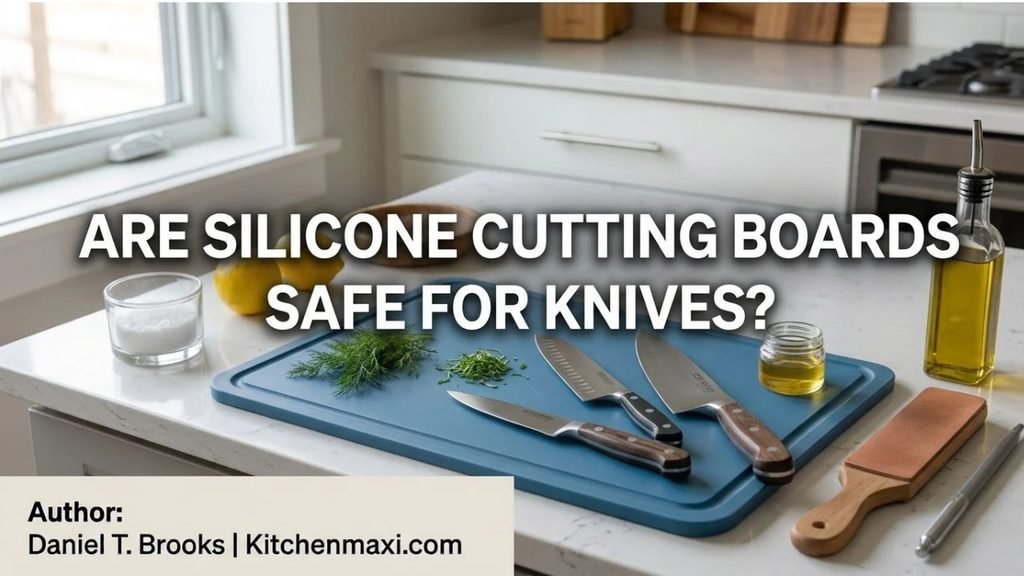
A silicone surface has more give than glass, stone, or ceramic, so it is generally a more sensible cutting surface for kitchen knives than those very hard materials.
The larger issue is protecting the board from the knife.
A thin silicone mat can be sliced if you chop hard with a cleaver, cut through bones, or repeatedly use the same small area. Some silicone cutting boards also have a rigid core, so the actual feel under the knife can vary by product.
For normal slicing and chopping:
- Keep the knife sharp so less downward force is needed.
- Avoid chopping bones on a thin silicone surface.
- Do not use the tip of a knife to stab or pry into the board.
- Rotate cutting areas so one spot does not take all the wear.
- Inspect the surface for cuts after heavy prep.
A few shallow marks do not automatically make the board unsafe. Deep cuts that hold residue or start separating are different.
Are Silicone Cutting Boards Safe for Raw Meat?
Yes, a food-contact silicone board can be used for raw meat if it is washed and sanitized correctly after use.
Cross-contamination is the bigger concern, not silicone itself.
USDA recommends using one board for fresh produce and bread and another for raw meat, poultry, and seafood when possible. After food preparation, wash the board with hot, soapy water, rinse it, and dry it.
The University of Minnesota gives similar advice: use separate cutting boards for raw animal foods and ready-to-eat foods, and replace boards that develop deep grooves or scratches.
For raw chicken, beef, pork, or seafood, I would reserve one board for those foods if storage space permits. Color-coding the board also reduces the chance of mixing it up with the board used for fruit, salad ingredients, or bread.
How to Choose a Safe Silicone Cutting Board
Look for Clear Food-Contact Information
A trustworthy listing should tell you more than “premium silicone.”
Look for wording that identifies the board as:
- Food-contact safe
- Made from food-grade silicone
- Compliant with an applicable U.S. food-contact rule or another recognized food-contact standard
- Intended for repeated food preparation
FDA explains that food-contact substances used in food-contact materials must have an appropriate regulatory basis for the intended use.
“BPA-free” by itself is not proof that a silicone board meets food-contact rules. It only addresses one chemical claim and says little about the rest of the formulation.
Check the Board Construction
Silicone cutting boards come in different forms:
- Thin flexible mats
- Thick silicone boards
- Silicone surfaces bonded to another core
- Boards with silicone borders or non-slip sections
If the board has a core, the heat and dishwasher limits may come from the complete construction rather than the silicone surface alone.
A thicker board also tends to stay flatter during chopping. Very thin mats are easy to bend and pour from, but they may move more under a knife unless the underside grips the counter well.
Avoid Vague Heat Claims
Silicone can tolerate substantial heat, but the exact limit belongs to the finished product.
Health Canada advises using silicone cookware and bakeware according to manufacturer instructions and gives 220°C/428°F as an upper limit for the silicone bakeware guidance on its consumer safety page. A cutting board may have a different rating, especially if it contains a rigid core, adhesive, printed layer, or non-silicone component.
Do not assume a silicone cutting board is also a trivet unless the manufacturer says it is suitable for that use.
Key Takeaway: Choose a board with clear food-contact information, stable construction, and product-specific cleaning and temperature limits rather than relying on a generic silicone claim.
How to Clean a Silicone Cutting Board Safely
Wash After Every Food-Prep Session
Wash the board with hot, soapy water after use, then rinse it thoroughly and let it dry.
USDA gives this cleaning method for cutting boards and recommends cleaning between different food-preparation tasks to reduce cross-contamination.
Pay extra attention to:
- Textured surfaces
- Juice grooves
- Raised borders
- Knife marks
- Handles
- Underside grips
Food residue can remain in these areas even when the center of the board looks clean.
Use the Dishwasher Only if the Board Allows It
Many all-silicone kitchen products tolerate dishwasher cleaning, but the finished cutting board may contain other materials.
Check the maker’s directions first.
A flexible silicone mat made entirely from food-contact silicone may have different care instructions from a silicone-topped board with a composite or metal core.
Remove Oil and Soap Residue
Silicone kitchen products can hold onto oily films and strong detergent odors. Consumer Reports notes that oil residue and strongly scented soaps can contribute to lingering tastes or smells on silicone utensils and other silicone kitchen items.
If a board develops a soapy smell, wash it again with an unscented dish detergent and rinse thoroughly. Greasy residue should be removed before the board is stored.
Key Takeaway: Wash silicone boards after each use, clean grooves and textured areas carefully, and use a dishwasher only when the finished product is labeled for it.
Can Silicone Cutting Boards Harbor Bacteria?
Any cutting board can become contaminated if food residue remains on the surface.
A smooth silicone surface does not absorb water like unfinished wood, which makes routine washing straightforward. Still, silicone should not be described as naturally sterile or antibacterial unless the specific product has a supported antimicrobial claim.
Knife damage changes the cleaning situation.
USDA and university food-safety guidance both recommend discarding cutting boards with deep, hard-to-clean grooves because those damaged areas can retain food and germs.
That is the practical hygiene rule to use with silicone: a clean, intact surface is acceptable; a badly cut surface that no longer cleans fully should be replaced.
Are Silicone Cutting Boards Safe With Heat?
Silicone material can tolerate more heat than many ordinary plastics, but a cutting board should not be treated like bakeware unless the maker gives that use.
Health Canada describes food-grade silicone bakeware as heat-tolerant and advises staying within manufacturer instructions. Its consumer guidance says not to use silicone bakeware above 220°C/428°F.
For a cutting board, the safer rule is to follow the product’s own maximum temperature.
Do not place a hot skillet, Dutch oven, baking sheet, or roasting pan on the board unless it is specifically rated for that job. A bonded core, adhesive, printed coating, or non-slip backing may fail before the silicone surface does.
Heat resistance and cutting-board safety are separate product claims.
Do Silicone Cutting Boards Release Chemicals Into Food?
Food-contact regulation exists partly to control migration from materials into food.
FDA explains that its food-contact review considers the amount of a substance that may migrate under the proposed conditions of use and toxicology information related to that exposure.
For repeated-use rubber articles, 21 CFR 177.2600 lists permitted material classes, including silicone elastomers, and sets extractive limits for contact with aqueous and fatty foods.
That does not mean every object marketed online as silicone has identical composition. Colorants, curing agents, fillers, surface coatings, and other components can differ.
This is why product traceability and a clear food-contact claim matter more than a vague statement that “silicone is safe.”
Do Silicone Cutting Boards Shed Microplastics?
Silicone is not a conventional plastic such as polyethylene or polypropylene, so the microplastic issue is not identical to that of plastic cutting boards.
Consumer Reports recommends food-grade silicone as one possible kitchen-tool material for people trying to reduce plastic exposure and notes that cutting on plastic boards can produce microplastic particles.
That does not mean a silicone board cannot be physically damaged. A knife can cut, gouge, or tear a soft silicone surface.
If you see loose fragments, peeling, exposed inner material, or cuts that continue opening, replace the board. There is little reason to keep using a food-prep surface that is visibly breaking apart.
When Should You Replace a Silicone Cutting Board?
Replace It After Deep Knife Damage
USDA’s general cutting-board rule is to discard boards that become excessively worn or develop hard-to-clean grooves.
For silicone, replacement is sensible when:
- Deep cuts stay open
- Food becomes lodged in grooves
- Pieces begin separating
- An inner core becomes visible
- A cut extends nearly through a thin mat
Do not glue or patch a damaged food-contact cutting surface unless the board manufacturer provides an approved repair method.
Replace It if the Material Starts Breaking Down
Stop using the board if the surface becomes permanently sticky, brittle, cracked, peeling, or otherwise degraded after normal cleaning.
A silicone item that has changed texture after heat exposure or chemical contact may no longer behave as intended.
Persistent Odor Calls for Inspection
Odor alone does not always mean the silicone is unsafe. Oil films and scented detergents can cling to silicone and cause lingering smells.
Clean the board thoroughly and let it dry.
If the odor remains alongside tackiness, visible damage, staining that will not wash away, or trapped residue, replacement is the simpler choice.
Key Takeaway: Replace a silicone board when cuts become hard to clean, material separates, an inner layer is exposed, or the surface shows physical breakdown.
Common Silicone Cutting Board Safety Mistakes
Assuming Every Silicone Product Is Food Grade
Silicone is a material family, not a guarantee that every finished article is suitable for direct food contact.
Check the intended use and compliance information.
Believing “FDA Approved” Is the Only Useful Label
FDA regulates food-contact substances through several routes, including regulations and food-contact notifications. A company may more accurately describe a material as compliant with an applicable food-contact regulation rather than claiming that the consumer cutting board itself received an individual FDA approval.
Using One Board for Raw Chicken and Salad Without Washing
Even a safe material can transfer pathogens from one food to another.
USDA recommends separate boards for raw meat and ready-to-eat foods when possible.
Keeping a Deeply Cut Board Too Long
A flexible board is not automatically safe forever.
Once grooves become difficult to scrub clean, the board has reached the same practical replacement point USDA gives for other cutting-board materials.
Using It as a Hot Pad Without Checking the Label
The silicone surface may tolerate heat while a core or bonded layer does not.
Use the board only within the temperature range stated for the complete product.
Key Takeaway: The biggest safety errors are buying an undocumented product, ignoring cross-contamination, keeping a deeply damaged board, and assuming every silicone board is heat-safe.
Conclusion
For are silicone cutting boards safe, food-contact silicone boards are generally a sound choice for normal chopping and food preparation when the material is intended for repeated food contact, the board is cleaned correctly, and damaged surfaces are replaced.
The strongest safety checks are straightforward: look for clear food-contact information, wash the board after each use, separate raw animal foods from ready-to-eat foods when possible, follow the stated heat and dishwasher limits, and inspect knife grooves before they become difficult to clean.
A silicone board should not be treated as maintenance-free. If it develops deep cuts, peeling, exposed inner material, persistent residue, or physical breakdown, replace it rather than trying to extend its service life.
FAQs About Silicone Cutting Board Safety
Are silicone cutting boards non-toxic?
Food-contact silicone made and used within applicable safety standards is intended for contact with food. U.S. regulations include silicone elastomers among materials that may be used in repeated-use rubber food-contact articles under stated conditions. The finished product still needs to meet the applicable formulation and use limits, so choose a board that clearly identifies its food-contact status.
Are silicone cutting boards safer than plastic?
They can be a useful alternative to conventional plastic. Consumer Reports has suggested food-grade silicone for people trying to reduce plastic kitchen products and notes that cutting on plastic boards can produce microplastic particles. Silicone boards still require routine washing and replacement after serious knife damage.
Are silicone cutting boards safe for raw chicken?
Yes, a food-contact silicone board can be used for raw chicken if it is cleaned and sanitized correctly. USDA recommends using a separate board for raw meat, poultry, and seafood when possible so bacteria are not transferred to produce or other ready-to-eat foods.
Can silicone cutting boards go in the dishwasher?
Many can, but check the manufacturer’s instructions. An all-silicone mat may tolerate dishwasher cleaning while a board with a rigid core, adhesive, printed layer, or special backing may have different care limits. Use the dishwasher only if the complete board is labeled dishwasher-safe.
Do silicone cutting boards damage knives?
Silicone has more give than glass, stone, or ceramic, so it avoids the very hard cutting surface those materials create. The exact knife feel varies with board thickness and construction. Heavy cleaver work can cut the silicone itself, so use another board for bones and other forceful chopping jobs.
Can bacteria grow in silicone cutting boards?
Bacteria can remain on any dirty food-contact surface. Smooth silicone is straightforward to wash, but deep knife grooves can hold residue. USDA advises replacing cutting boards once grooves become difficult to clean, regardless of the board material.
Are cheap silicone cutting boards safe?
Price alone does not prove safety, but a very cheap unbranded board with no food-contact information gives you less to verify. Look for the material description, manufacturer identity, intended food use, cleaning instructions, temperature limits, and any stated compliance with an applicable food-contact standard.
How long does a silicone cutting board last?
There is no fixed replacement interval. Keep using it while the surface remains intact and easy to clean. Replace it once deep knife cuts trap food, the silicone tears or peels, an inner layer becomes exposed, or the surface becomes damaged enough that thorough cleaning is no longer practical.