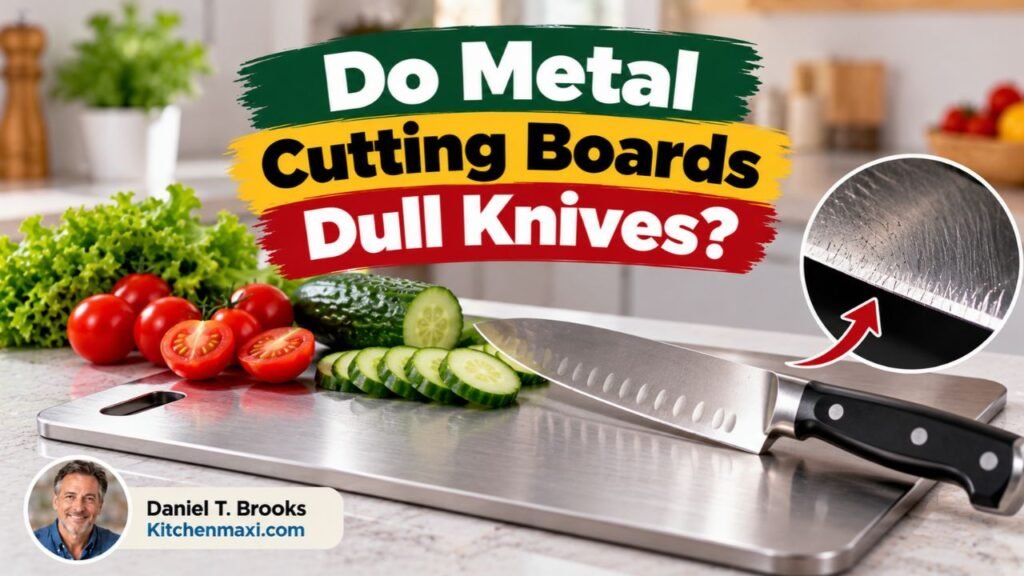
Do Metal Cutting Boards Dull Knives? Edge Wear and Better Options
Yes. Metal cutting boards usually dull kitchen knives faster than wood, plastic, or rubber boards because the cutting surface does not yield much when the blade hits it. Repeated metal-to-metal contact can roll, flatten, or micro-chip a fine knife edge, so sharpening or honing may be needed more often.
A stainless steel or titanium board may look durable and easy to clean, but durability for the board does not mean gentleness for the knife. The board can remain nearly unchanged while a thin sharpened edge takes repeated impact during chopping.
That difference matters most with chef’s knives, santoku knives, nakiri knives, and other blades used for repeated chopping or rocking cuts. A softer board absorbs part of each impact, while a rigid metal surface sends more force back into the cutting edge.
WÜSTHOF specifically advises against cutting on metal, glass, and stone because those hard surfaces can dull a knife quickly. Victorinox also lists metal among cutting-board materials it does not recommend because hard, slippery surfaces reduce knife control and wear the blade faster.
So, do metal cutting boards dull knives? Yes, and the effect is usually more noticeable than with wood or plastic. The amount of edge wear changes with the board material, surface finish, knife steel, edge angle, cutting technique, and how often the board is used.
Metal boards still have traits people like: they resist moisture, do not absorb food odors easily, and can be simple to wash. Those traits do not remove the knife-edge tradeoff.
The sections below explain why stainless steel and titanium affect sharpness, which metal is harder on knives, how quickly dulling can occur, and which cutting-board materials make more sense for daily chopping.
Why Metal Cutting Boards Dull Knife Edges
A kitchen knife does not stop cutting the instant it passes through the food. Its edge usually continues downward until it contacts the cutting board.
That final contact happens hundreds or thousands of times during normal meal preparation.
Metal Does Not Yield Much Under the Knife
Wood fibers, rubber, and many plastics deform slightly when a blade presses into them.
Metal behaves very differently.
The edge meets a hard, rigid surface and absorbs more of the impact itself. Over repeated cuts, that can alter the extremely thin strip of steel at the apex of the blade.
WÜSTHOF states that metal surfaces are too hard for the narrow knife edge and can bend it against the cutting surface, causing rapid dulling.
A Knife Can Be Harder Than the Board and Still Become Dull
A common argument is that knife steel is harder than stainless steel or titanium, so the board should not harm the blade.
Hardness alone does not settle the issue.
The knife edge is extremely thin. Even when the blade steel is harder than the board material, repeated impacts against an unyielding surface can deform the very tip of the edge.
Think of the difference between pressing the edge into wood and tapping it against another solid piece of metal. The softer support lets the blade settle into the surface slightly; the metal surface does not.
The Edge Can Roll, Flatten, or Micro-Chip
Dulling does not always mean large pieces of steel break away.
Several smaller changes can reduce cutting ability:
- The apex can roll slightly to one side
- The very tip can flatten
- Small chips can form
- The edge can wear from repeated friction
- Sideways scraping can bend the apex
A knife may still look fine to the naked eye while tomatoes, herbs, and onions become harder to slice cleanly.
Scraping Food Sideways Adds More Edge Wear
After chopping, many cooks use the sharp edge of the knife to scrape diced food across the board.
That habit is rough on an edge even on wood.
On metal, it creates direct sideways blade-to-metal contact.
Victorinox advises turning the knife over and using the spine to move food rather than dragging the cutting edge across the board.
Key Takeaway: Metal boards resist the blade instead of cushioning it, so repeated chopping and sideways scraping can roll, flatten, or chip the thin cutting edge faster than softer boards.
Stainless Steel Cutting Boards and Knife Dulling
Stainless steel boards have become more visible in home kitchens because they resist moisture and are easy to wipe clean.
For knife care, stainless steel is still a hard cutting surface.
Stainless Steel Dulls Knives Faster Than Wood
A knife manufacturer does not need to test every grade of stainless board separately to explain the basic issue.
WÜSTHOF’s cutting-board advice groups metal with glass and stone as surfaces that can quickly dull knife edges.
An independent controlled comparison by Prudent Reviews also measured greater sharpness loss on stainless steel than on the tested wood, plastic, bamboo, and rubber boards. In that test, stainless steel produced a 184-point increase on the BESS sharpness scale after the test sequence; higher BESS numbers mean a duller edge.
That result is one test rather than a universal prediction for every knife and steel board, but it matches the broader knife-maker advice to avoid metal surfaces.
Stainless Steel Does Not Automatically Chip Every Knife
Using a steel board once is unlikely to destroy a normal chef’s knife.
The issue is repeated use.
A sturdy Western-style chef’s knife with a thicker edge may show gradual loss of sharpness, while a very thin, hard blade can be more sensitive to rough contact.
Heavy chopping increases the stress compared with light slicing.
Polished Steel Can Feel Slippery
Another drawback is traction.
Victorinox describes metal cutting surfaces as hard and often slippery. A wet onion, tomato, or piece of meat can move more readily on a smooth metal surface than on a textured wood or polymer board.
A sliding ingredient can reduce knife control even before sharpness becomes an issue.
Key Takeaway: Stainless steel is durable and easy to wash, but it is much less forgiving to knife edges than wood, plastic, or rubber and may also provide less grip during cutting.
Do Titanium Cutting Boards Dull Knives Too?
Yes. A titanium cutting board can also dull a kitchen knife faster than a softer cutting surface.
Titanium being lighter or softer than some knife steels does not make it equivalent to wood.
Titanium Is Still a Rigid Metal Surface
The main issue remains lack of give.
When the knife finishes each cut, the fine edge contacts a solid metal board rather than sinking slightly into wood fibers or a polymer surface.
That repeated impact can reduce edge retention.
Independent Testing Found Heavy Edge Wear on Titanium
One independent comparison tested titanium, stainless steel, several woods, plastic, bamboo, composite, and rubber.
In that test, titanium caused the largest measured loss of sharpness. The reported average BESS change was 444 points for titanium, compared with 184 for stainless steel, 65 for polypropylene plastic, 41 for edge-grain maple, 15 for end-grain walnut, and 10 for rubber.
Those numbers should not be treated as fixed performance ratings for every board. Knife steel, board texture, cutting force, and testing method all change the result.
The useful finding is the direction of the comparison: both tested metals were far harder on the edge than the softer boards.
Claims About “Knife-Friendly Titanium” Need Context
Some titanium-board sellers claim textured surfaces reduce knife wear.
Surface finish may change how a blade contacts a board, so two titanium boards do not have to perform identically.
That still does not make titanium as forgiving as a board made from softer material. If keeping a sharp edge for as long as possible is the main goal, wood or rubber remains a safer direction.
Key Takeaway: Titanium can still wear knife edges quickly, and one controlled comparison found more sharpness loss on titanium than on stainless steel, wood, plastic, bamboo, or rubber.
How Fast Can a Metal Cutting Board Dull a Knife?

There is no universal number of cuts or days.
Knife dulling varies too much between kitchens.
Knife Steel Changes the Result
A soft German-style chef’s knife may roll its edge more readily.
A hard Japanese knife may resist rolling better but can have a thinner edge that is less tolerant of hard impact.
Neither type becomes immune to a metal board.
Edge Angle Matters
A narrow sharpening angle produces a thin, keen edge.
That can make slicing feel excellent, but there is less steel behind the apex to support it during impact.
A thicker edge is generally more resistant to rough board contact.
Chopping Technique Matters
Repeated vertical chopping produces more direct board impact than gentle slicing.
Rock-chopping also keeps part of the blade in regular contact with the surface.
Heavy force speeds the process further.
Frequency Matters
Using a metal board once for slicing a sandwich is very different from preparing three meals on it every day.
A cook who dices onions, minces herbs, chops vegetables, and portions meat on metal may notice edge loss much sooner.
Knife Sharpness Can Fade Before the Blade Looks Damaged
Early symptoms often include:
- Tomato skins becoming harder to start
- Onions crushing rather than slicing cleanly
- Herbs bruising more
- More downward pressure being needed
- Paper cutting becoming rough or snagged
The edge may only need honing if it has rolled. Once the apex has worn or chipped, sharpening removes metal to create a fresh edge.
Key Takeaway: There is no fixed dulling schedule; thin edges, forceful chopping, frequent use, and hard metal surfaces all shorten the time between sharpening sessions.
Metal Cutting Boards vs. Wood, Plastic, and Rubber
Knife friendliness is only one part of choosing a board, but it is a major difference between these materials.
| Board Material | Effect on Knife Edge | Moisture Resistance | Cleaning | Best Fit |
| Stainless steel | High edge wear | Excellent | Easy | Non-cutting prep or specialty use |
| Titanium | High edge wear | Excellent | Easy | Non-cutting prep or specialty use |
| Wood | Low edge wear | Moderate | Hand cleaning for many boards | Daily knife work |
| Plastic | Low to moderate edge wear | Excellent | Often dishwasher-safe | General prep and raw proteins |
| Rubber | Very low edge wear | Excellent | Varies by product | Frequent knife work |
| Glass/stone | High edge wear | Excellent | Easy | Serving rather than chopping |
Wood Is Gentle on Knife Edges
Wood remains one of the most common surfaces for serious knife work.
Its fibers offer slight give when the edge contacts the board.
Victorinox specifically describes wood as gentle on knife edges and recommends it over metal, stone, and glass.
Common board woods include maple, walnut, cherry, and beech.
Plastic Is Practical for Everyday Prep
Plastic boards are also easier on knife edges than metal.
Many are dishwasher-safe, light, and inexpensive enough to keep separate boards for different food categories.
USDA guidance permits plastic and other nonporous cutting surfaces and recommends washing boards with hot, soapy water after each use. It also advises using separate boards for raw meat and foods such as produce or bread to reduce cross-contamination.
Plastic boards should be replaced once deep grooves become difficult to clean.
Rubber Is Very Knife-Friendly
Professional-style rubber boards are made to provide a soft landing for the cutting edge.
The independent test cited earlier showed the tested rubber board causing the least measured sharpness loss among the materials compared.
Rubber boards can be heavier and cost more than basic plastic, but they suit cooks who put knife-edge retention first.
Key Takeaway: Wood, plastic, and rubber give a knife edge a softer landing than stainless steel or titanium, making them better choices for repetitive chopping and slicing.
Are Metal Cutting Boards More Hygienic?
Metal is nonporous and does not absorb moisture the way unfinished wood can, which makes surface cleaning straightforward.
That does not mean a metal board stays sanitary without washing.
Nonporous Does Not Mean Self-Cleaning
Food residue, raw-meat juices, grease, and bacteria can remain on any dirty surface.
A smooth metal board still needs cleaning after food preparation.
USDA recommends washing cutting boards after each use with hot, soapy water, rinsing, and drying them.
Separate Raw Meat From Ready-to-Eat Food
A stainless or titanium surface does not remove cross-contamination risk.
If raw chicken is cut on the board and a tomato is placed there afterward without proper cleaning, contamination can still transfer.
USDA recommends separate cutting surfaces for raw meat, poultry, or seafood and produce or bread when possible.
Confirm That the Board Is Made for Food Contact
Not every sheet of stainless steel or titanium sold online is automatically a kitchen cutting board.
A food-prep board should have:
- Food-contact-safe material
- Smooth finished edges
- No unknown coating
- No flaking surface treatment
- No deep seams that trap residue
Follow the board maker’s cleaning instructions.
Key Takeaway: Metal is nonporous and simple to wash, but it still requires normal food-safety cleaning and separation between raw proteins and ready-to-eat foods.
How to Reduce Knife Dulling if You Already Own a Metal Board
You do not have to throw away a metal board. It can be used in ways that limit knife-to-metal contact.
Use Metal for Jobs That Do Not Require Chopping
A metal board can work as a surface for:
- Arranging ingredients
- Rolling some doughs
- Serving food
- Handling food before transfer
- Resting packaged ingredients
- Plating
For knife work, place a smaller wood, plastic, or rubber board on top.
Use Light Slicing Instead of Heavy Chopping
If you occasionally cut on metal, use controlled slicing rather than driving the edge hard into the board.
Less impact means less stress at the apex.
Never Scrape With the Sharp Edge
Turn the knife over and use the spine to move chopped ingredients.
Victorinox specifically recommends this method to avoid blunting the edge by scraping it against the board.
Keep the Metal Board From Sliding
Use a board with non-slip feet or place a stable non-slip mat underneath.
A hard board that slides creates both a knife-control problem and an edge-wear problem.
Hone and Sharpen as Needed
Honing can realign a rolled edge on suitable knives.
Sharpening removes metal to form a new edge after the apex has worn.
Do not compensate for a dull knife by pressing harder. More force increases the chance of slipping.
Key Takeaway: If you keep a metal board, reserve it mainly for non-cutting prep, avoid scraping with the knife edge, stabilize the board, and do repetitive chopping on a softer surface.
Are Metal Cutting Boards Worth Using?
A metal board has real strengths, but most of those strengths do not require chopping directly on it.
Stainless steel and titanium resist water, stains, and odors better than many porous materials. They can also be thin and easy to store.
For daily knife work, those advantages come with a clear downside: faster edge wear.
WÜSTHOF directly recommends avoiding metal cutting surfaces, and Victorinox places metal in the same hard-surface group it advises against for knife care.
If keeping knives sharp is a priority, I would use wood, plastic, or rubber for cutting and keep metal for prep jobs where the knife does not repeatedly strike the surface.
Conclusion
For do metal cutting boards dull knives, the answer is yes. Stainless steel and titanium boards are hard, rigid surfaces that put more stress on a fine cutting edge than wood, plastic, or rubber.
The damage is usually gradual rather than dramatic. Repeated chopping can roll, flatten, wear, or micro-chip the apex, while scraping chopped food sideways with the sharp edge adds even more stress.
Metal boards do have advantages such as moisture resistance and simple cleaning, but those traits do not make them the best surface for chef’s knives. A wood, plastic, or rubber board is a better match for frequent chopping and slicing.
If you already have a metal board, use it for serving or non-cutting prep and place a knife-friendly board over it for regular food cutting. That keeps the durable metal surface useful without sacrificing knife sharpness.
FAQs About Metal Cutting Boards and Knife Dulling
Do Stainless Steel Cutting Boards Dull Knives?
Yes. Stainless steel is a rigid cutting surface, so repeated blade contact can dull the edge faster than wood, plastic, or rubber.
WÜSTHOF specifically advises against metal cutting boards because hard surfaces can bend and dull a narrow knife edge.
Do Titanium Cutting Boards Dull Knives?
Yes. Titanium does not provide the cushioning offered by softer cutting-board materials.
One independent edge-retention comparison recorded much more sharpness loss on the tested titanium board than on wood, plastic, bamboo, or rubber. Results vary with the specific knife and board.
Is Titanium Better Than Stainless Steel for Knives?
Not enough to make either material my first choice for daily chopping.
Board texture and alloy affect wear, but both remain rigid metal surfaces. A softer wood, plastic, or rubber board is usually better for retaining a sharp knife edge.
Can a Metal Cutting Board Chip a Knife?
It can contribute to micro-chipping, mainly with thin, hard edges or forceful chopping.
A tougher, thicker knife edge may roll or gradually lose sharpness instead. Knife geometry, steel, cutting force, and board texture all affect the type of wear.
What Cutting Board Keeps Knives Sharp the Longest?
Soft rubber and suitable wood boards are strong choices for edge retention.
In one independent comparison, rubber and end-grain walnut caused less measured sharpness loss than the tested stainless steel, titanium, plastic, bamboo, and composite boards.
Are Metal Cutting Boards Safe for Raw Meat?
A food-contact-safe metal board can be used for raw meat if it is cleaned correctly afterward.
USDA recommends washing cutting boards with hot, soapy water after each use and separating raw meat, poultry, and seafood from ready-to-eat foods to reduce cross-contamination.
Should I Stop Using My Metal Cutting Board?
You do not have to stop using it completely.
Reserve it for serving, arranging ingredients, or other prep work that involves little knife contact. For repeated chopping, mincing, and slicing, place a wood, plastic, or rubber board between the knife and the metal surface.