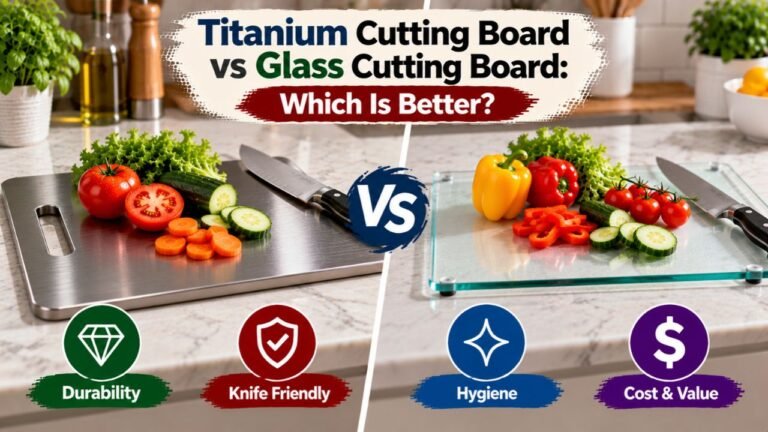
Titanium Cutting Board vs Plastic: Which One Is Better?
Plastic cutting boards are generally better for everyday chopping because they are affordable, lightweight, quieter, and gentler on kitchen knives. Titanium cutting boards offer a durable, nonporous surface that resists deep grooves, stains, and odors. They also avoid plastic particle shedding when made from solid titanium, but their rigid metal surface can dull knife edges faster.
The main concern with choosing between these materials is that each solves one problem while introducing another. Plastic gradually develops knife grooves and can release tiny particles during chopping, while titanium creates more direct contact between the knife edge and a rigid metal surface.
Choosing the suitable material means balancing food hygiene, knife sharpness, durability, and daily convenience. A board that feels comfortable during repeated chopping and is easy to sanitize can make food preparation simpler and reduce unnecessary knife maintenance.
The U.S. Department of Agriculture advises replacing plastic cutting boards once they develop excessively worn, hard-to-clean grooves. A 2023 study published in the American Chemical Society journal Environmental Science & Technology also estimated that polyethylene cutting boards could generate 14.5 million to 71.9 million microplastic particles per person annually under modeled chopping conditions. These figures are estimates, not direct measurements of every household’s exposure.
During my research, the biggest distinction in the titanium cutting board vs plastic debate was the difference between material durability and cutting performance. A cutting board can resist scratches and moisture while still being a poor surface for maintaining sharp knives.
Another detail deserves attention: some products advertised as titanium cutting boards contain stainless steel, surface coatings, or plastic components. The actual construction can change the board’s weight, cleaning requirements, and long-term value.
A comparison of material composition, knife wear, bacterial hygiene, microplastic exposure, cleaning, stability, price, and everyday food preparation shows where each board performs well and which compromises deserve the most attention.
Titanium Cutting Board vs Plastic: Quick Comparison
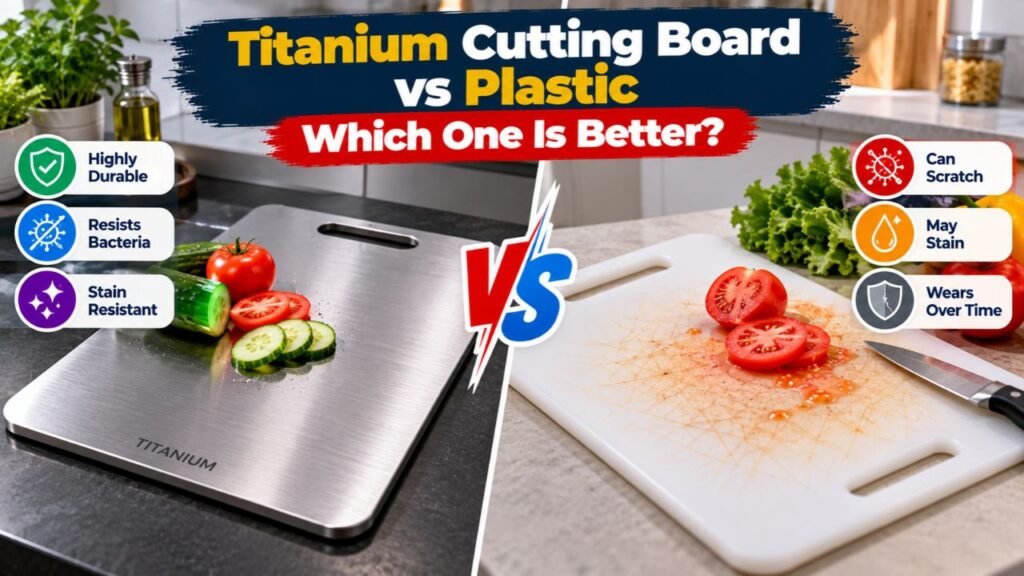
Titanium and plastic are both used to create washable food-preparation surfaces, but they behave differently under a sharp knife.
The following table highlights the main differences.
| Feature | Titanium Cutting Board | Plastic Cutting Board |
| Main material | Titanium metal, often Grade 1 or Grade 2 | Usually polyethylene or polypropylene |
| Surface hardness | Hard, rigid metal | Softer, slightly flexible polymer |
| Knife friendliness | Can dull knife edges faster | Generally gentler on knives |
| Microplastic shedding | None from a solid titanium surface | Possible during repeated cutting |
| Bacterial resistance | Nonporous, but not automatically germ-free | Nonporous initially; grooves can trap residue |
| Scratch resistance | Resists deep gouges but can develop surface scratches | Knife marks and grooves develop with use |
| Stain resistance | Usually excellent | Varies by plastic and food |
| Odor retention | Generally low | Odors may remain in damaged surfaces |
| Dishwasher compatibility | Many models, if manufacturer-approved | Many models, if manufacturer-approved |
| Cutting noise | Noticeably louder | Usually quieter |
| Countertop grip | Smooth metal may slip without a nonslip base | Depends on feet, texture, and weight |
| Weight | Depends on thickness; often sold as thin sheets | Usually lightweight |
| Maintenance | Washing and drying; no oiling | Washing, drying, and replacing when worn |
| Purchase price | Usually higher for genuine titanium | Usually lower |
| Best use | Low-maintenance, plastic-free prep surface for limited cutting | Everyday slicing, chopping, and raw-food preparation |
Overall winner for most home kitchens: Plastic. Titanium has advantages in moisture resistance and avoiding plastic shedding, but plastic provides a more forgiving cutting surface at a lower initial cost.
What Are Titanium and Plastic Cutting Boards Made Of?
Understanding the actual materials explains why these boards behave differently and why their product descriptions deserve attention.
Titanium Cutting Boards
A titanium cutting board is a food-preparation surface made from titanium metal.
Titanium is known for its corrosion resistance, strength relative to weight, and ability to form a protective oxide layer.
Commercially pure titanium is commonly divided into grades. Grade 1 and Grade 2 titanium are used in applications that require good corrosion resistance and formability.
A genuine titanium cutting board may use a thin sheet of commercially pure titanium rather than a thick metal block.
Titanium is less dense than stainless steel, so a thin titanium sheet can be relatively lightweight while remaining structurally strong.
Its nonporous surface does not absorb food juices the way porous materials can. It is also not affected by routine exposure to water in the same way as untreated wood.
Still, titanium is not indestructible.
Knife contact can produce visible scratches, and thin metal boards may bend or deform if subjected to excessive force.
Some products marketed as titanium use titanium coatings over another metal. Others combine metal with plastic or composite backing materials.
The word titanium in a product title does not establish that the entire board is solid titanium.
Plastic Cutting Boards
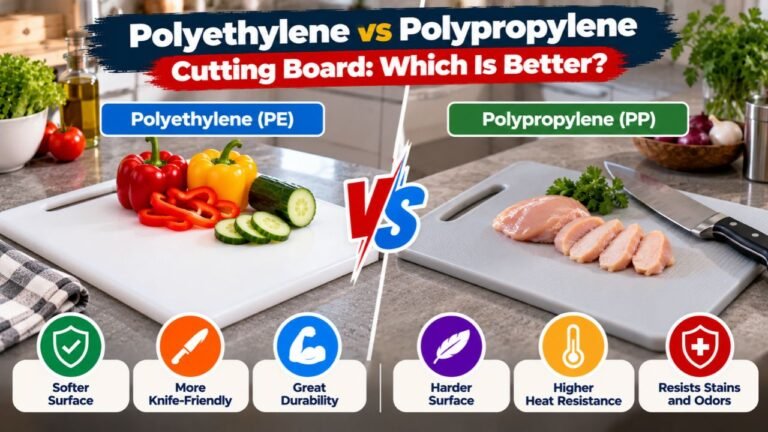
Plastic cutting boards are commonly manufactured from two food-contact polymers:
- High-density polyethylene (HDPE): A durable plastic with a slightly forgiving cutting surface.
- Polypropylene (PP): A lightweight polymer used in many molded kitchen products, including dishwasher-safe cutting boards.
Both materials can be manufactured into smooth, nonporous surfaces suitable for food preparation.
Plastic cutting boards range from thin, flexible mats to thick commercial-style boards.
Their main advantage is that the material can yield slightly beneath a knife edge.
This reduces the hard impact associated with chopping directly on metal.
Plastic can still become damaged. Every cut may leave a small mark, and repeated use can create deeper grooves.
The material also varies in quality. A thick, stable HDPE board behaves differently from a thin, flexible cutting mat.
Key Takeaway: Titanium offers a rigid, corrosion-resistant metal surface, while polyethylene and polypropylene provide softer cutting surfaces. Verify the actual material rather than relying on product advertising.
Which Cutting Board Is Better for Knife Sharpness?
Plastic is generally better than titanium for protecting kitchen knife edges.
This is one of the most meaningful differences for anyone using a chef’s knife regularly.
Why Titanium Can Dull Knives Faster
A knife edge is extremely thin, even when made from hardened steel.
When it strikes a rigid titanium surface, the impact is concentrated along that narrow edge.
Repeated contact can gradually deform, roll, or damage the cutting edge.
Titanium does not have to be harder than the knife steel to contribute to dulling.
The important issue is that metal provides much less cushioning than a softer cutting board.
Independent cutting-board comparisons have reported substantially greater knife-edge wear on titanium surfaces than on plastic or wood.
The amount of wear varies with the knife’s steel, blade geometry, cutting pressure, and surface finish.
For high-hardness Japanese kitchen knives with thin cutting edges, I would avoid making titanium the primary chopping surface.
Why Plastic Is More Knife-Friendly
Plastic has some flexibility under cutting pressure.
When the knife contacts the board, the surface can deform slightly rather than forcing the full impact back into the blade edge.
That property makes plastic suitable for repeated slicing, dicing, and chopping.
It does not prevent knife dulling completely.
A knife can still lose sharpness through normal cutting, poor technique, or contact with food particles and surface contamination.
Plastic simply provides a more forgiving contact surface than rigid metal.
The tradeoff is that the plastic board itself accumulates cutting marks.
Cutting Feel and Noise
Knife performance involves more than sharpness.
Titanium produces a harder sensation during chopping. Contact between the blade and metal can create a sharp clicking or scraping sound.
Plastic generally creates less noise and offers a softer feel.
This difference becomes more noticeable during long preparation sessions involving onions, carrots, potatoes, or other ingredients requiring repeated cuts.
A smooth metal surface can also provide less traction for wet ingredients.
Key Takeaway: Plastic offers better knife-edge protection and a more comfortable cutting feel. Titanium’s rigid surface can increase sharpening frequency, even though the board itself resists deep grooves.
Food Safety and Bacterial Hygiene
Both titanium and plastic can be hygienic cutting-board materials.
The main difference is how their surfaces change during use and how easily those surfaces can be cleaned.
Is Titanium More Hygienic Than Plastic?
Titanium has a nonporous surface that does not readily absorb moisture or food juices.
This makes it relatively straightforward to remove food residue, provided the surface remains smooth and accessible.
Titanium also resists many forms of corrosion under ordinary kitchen conditions.
These are useful material properties, but they do not mean titanium automatically kills bacteria.
A contaminated titanium board can still transfer harmful microorganisms to food.
Bacteria may remain on the surface until the board is properly cleaned and, when needed, sanitized.
Claims that every titanium cutting board is permanently antibacterial or germ-free should be treated cautiously unless supported by product-specific testing.
Can Plastic Cutting Boards Harbor Bacteria?
New, smooth plastic cutting boards are relatively easy to clean.
Problems become more likely when repeated knife cuts create deep grooves and rough surfaces.
Food residue and moisture may collect inside those damaged areas, making thorough washing more difficult.
The USDA advises discarding plastic and wooden cutting boards that become excessively worn or develop grooves that cannot be cleaned adequately.
This does not mean every scratch makes a plastic board unsafe.
Shallow marks are expected during normal use. The concern is extensive damage that prevents proper cleaning.
A smooth, well-maintained plastic board can remain a suitable surface for preparing food.
Cross-Contamination Matters More Than Material Alone
Cross-contamination happens when microorganisms from one food transfer to another.
Raw chicken, raw meat, and seafood can introduce harmful bacteria onto a cutting surface.
Those microorganisms can then transfer to salad ingredients, fruit, or other foods eaten without cooking.
The USDA recommends using separate cutting boards for raw animal products and fresh produce or ready-to-eat foods.
This recommendation applies to both titanium and plastic.
I would prioritize separate food-preparation surfaces over claims that an expensive metal board eliminates the need for careful sanitation.
Key Takeaway: Both materials can be hygienic when cleaned properly. Titanium resists deep grooves, while plastic requires closer inspection as knife marks accumulate. Neither material prevents cross-contamination by itself.
Titanium vs Plastic Cutting Boards: Microplastics and Health Concerns
Microplastic exposure is a major reason consumers consider replacing plastic cutting boards with titanium.
The concern is real enough to study, but it is important to distinguish particle release from demonstrated health effects.
Do Plastic Cutting Boards Release Microplastics?
Yes. Scientific research has demonstrated that chopping on plastic cutting boards can release microscopic plastic particles.
Microplastics are small plastic fragments, commonly described as being less than 5 millimeters in size.
A 2023 study published in Environmental Science & Technology examined particle generation from polyethylene and polypropylene cutting boards.
The researchers found that chopping could release microplastic particles, with differences influenced by material and chopping conditions.
Their modeled annual exposure estimates were based on experimental measurements and assumptions about cutting habits.
They should not be interpreted as proof that every individual consumes the estimated amount.
Material quality, knife sharpness, food type, cutting frequency, and surface wear can influence particle generation.
Are Microplastics From Cutting Boards Dangerous?
The possible health effects of microplastic exposure remain an active research question.
The U.S. Food and Drug Administration states that current scientific evidence does not demonstrate that levels of microplastics and nanoplastics detected in food pose a risk to human health.
That position does not establish that every level or form of microplastic exposure is harmless.
Researchers are still investigating differences in particle size, chemical composition, exposure levels, and biological effects.
Plastic cutting boards can release particles, but there is not enough evidence to calculate a reliable individual health risk from normal household cutting-board use.
Replacing severely worn boards is a sensible practice regardless of the unresolved health questions.
Does Titanium Eliminate Microplastic Exposure?
A solid titanium cutting surface does not generate plastic particles through the cutting of the metal itself.
That is a legitimate distinction from polyethylene and polypropylene.
Still, a titanium cutting board is not guaranteed to release zero particles of any kind.
Metal surfaces can develop scratches through repeated knife contact. Coatings, adhesive layers, silicone feet, and plastic components may also be present in some products.
Research specific to particle transfer from consumer titanium cutting boards remains limited.
Titanium also cannot eliminate microplastics from other food and environmental sources.
For someone seeking to reduce plastic contact during food preparation, a genuine solid titanium board addresses one possible source. It should not be treated as a scientifically proven way to improve overall health.
Key Takeaway: Plastic cutting boards can release microplastic particles during chopping. Solid titanium avoids that specific plastic-shedding mechanism, but the health implications of cutting-board microplastics are not yet fully established.
Cleaning and Dishwasher Safety: Titanium vs Plastic
Both materials have an advantage over cutting boards that require regular oiling or special moisture protection.
Routine cleaning remains necessary after every food-preparation session.
How to Clean a Titanium Cutting Board
For a standard solid titanium board, the cleaning process is straightforward.
- Remove food scraps and visible residue.
- Wash the surface with warm water and mild dish soap.
- Use a soft sponge or suitable cleaning cloth.
- Rinse thoroughly with clean water.
- Wipe dry and inspect the surface before storage.
Avoid harsh abrasive tools that can create unnecessary scratches.
Inspect the board’s edges, handles, and any attached rubber or silicone components.
Many solid titanium boards can tolerate dishwasher cleaning, but the manufacturer’s instructions should determine the method.
A board with glued components, coatings, or mixed materials may have different restrictions.
How to Clean a Plastic Cutting Board
Plastic boards need similar cleaning, with extra attention to knife marks.
Remove food residue and scrub the surface using dish soap and warm or hot water.
Focus on areas where scratches or textured sections may trap particles.
Rinse the board and let it dry completely.
Many HDPE and polypropylene boards are dishwasher-safe, but thin products may warp under high heat.
Check the manufacturer’s temperature and dishwasher instructions before using a heated drying cycle.
Sanitizing After Raw Meat Preparation
Sanitizing is useful when a cutting board has been exposed to raw meat, poultry, or seafood.
The USDA provides a household sanitizing method using 1 tablespoon of unscented liquid chlorine bleach mixed with 1 gallon of water.
Its guidance calls for applying the solution to the cleaned cutting surface, allowing it to remain for several minutes, rinsing, and drying.
Use this method only where the board manufacturer permits bleach.
For titanium boards with coatings or attached components, a food-contact sanitizer approved for those materials may be more suitable.
Follow the sanitizer’s label for concentration, contact time, and rinsing.
Do not use ordinary household disinfectants on food-contact surfaces unless their directions explicitly allow that application.
Key Takeaway: Both cutting boards are relatively easy to wash. Plastic may require extra scrubbing around knife grooves, while titanium needs attention to product-specific finishes and attachments.
Durability, Scratches, and Long-Term Maintenance
A durable cutting board should withstand repeated food preparation without becoming difficult to clean or unsafe to handle.
Titanium has an advantage in resistance to deep cuts, but its overall construction still matters.
How Titanium Cutting Boards Wear Over Time
Titanium does not develop deep knife grooves as readily as softer plastic.
It also resists moisture absorption and many common food stains.
These properties can make a solid titanium sheet a long-lasting kitchen surface.
Small surface scratches are still possible, including visible lines caused by hard knife steel.
Thin titanium sheets may also bend under substantial force or rough handling.
Inspect any exposed corners and edges for sharp burrs or damage.
Durability should be judged by the whole product rather than the metal alone.
A smooth solid sheet with rounded edges is preferable to a poorly finished board that can scratch a countertop or feel uncomfortable to handle.
How Plastic Cutting Boards Wear Over Time
Plastic cutting boards gradually develop knife marks as part of normal use.
With continued chopping, those marks can become wider or deeper.
Thin plastic boards may also warp after exposure to dishwasher heat or uneven mechanical stress.
Discoloration and retained odors can occur, especially when damaged surfaces hold food residue.
A plastic board should be replaced if it becomes difficult to clean, develops extensive grooves, or no longer rests securely on the counter.
A fixed replacement schedule is less useful than inspecting the actual condition of the board.
Which Material Lasts Longer?
Solid titanium generally has greater potential to resist deep surface wear and moisture-related damage.
Plastic will usually need replacement sooner under heavy knife use.
That does not establish a fixed lifespan for either product.
A thick commercial-quality plastic board may remain useful for years, while a thin, poorly constructed titanium board can develop other problems.
A titanium board’s longer potential service life also comes with the continuing cost of maintaining knife edges.
Key Takeaway: Titanium generally wins for resistance to deep grooves and moisture damage. Plastic wears faster, but its softer surface remains more suitable for regular knife contact.
Which Board Is More Comfortable for Everyday Food Preparation?
The best cutting surface should remain stable, give you control over the knife, and suit the ingredients you prepare most frequently.
Chopping Vegetables, Herbs, and Fruit
Plastic is generally preferable for repeated vegetable preparation.
Its forgiving surface works well for rocking cuts, straight chopping, and slicing.
Chopping a large batch of onions or carrots creates repeated knife-to-board contact. A softer surface reduces the harsh feeling associated with metal.
Plastic boards are also available with nonslip feet and juice grooves.
Titanium can be used to cut vegetables, but repeated chopping brings its knife-wear and noise disadvantages into focus.
Preparing Raw Meat and Seafood
Both materials can be used for raw meat and seafood when properly cleaned and sanitized.
Titanium’s smooth, nonporous surface is relatively easy to wash.
Plastic offers the advantage of lower cost, making it practical to maintain separate boards for raw chicken, red meat, and other foods.
A dishwasher-safe plastic board is often the more convenient choice for routine raw-meat preparation.
Wet ingredients can slide on smooth titanium, so a stable cutting setup is necessary.
Stability and Countertop Safety
A cutting board that moves under knife pressure creates an avoidable safety concern.
Thin titanium boards may have little grip against smooth countertops.
Lightweight plastic boards can also slide if they lack rubber feet or a textured base.
For either material, look for a nonslip design or use a clean, secure nonslip mat intended for kitchen use.
The board should sit flat without rocking.
Rounded edges and a comfortable grip are also useful when carrying the board to the sink.
Key Takeaway: Plastic is usually more comfortable for everyday chopping. Both materials need a secure base, but smooth metal surfaces deserve extra attention during wet-food preparation.
Price and Long-Term Value
Plastic cutting boards are generally less expensive than genuine solid titanium boards of comparable size.
They are widely available in different sizes, thicknesses, and designs.
A basic plastic board can be replaced when its surface becomes badly worn without a large purchase expense.
Titanium normally requires a higher initial investment because of the raw material and manufacturing costs.
The price difference becomes less straightforward when products contain stainless steel, titanium coatings, or mixed materials.
A low-priced product advertised as titanium may not contain a full solid titanium cutting surface.
Consider the Cost of Knife Maintenance
The purchase price is not the only cost that matters.
A metal board that dulls knives faster can increase sharpening frequency.
This matters more for someone using expensive knives or paying for professional sharpening.
Plastic boards gradually wear and eventually require replacement, but they generally place less stress on knife edges.
My preference is to accept periodic plastic board replacement rather than expose a good chef’s knife to unnecessary metal contact during every meal preparation.
Environmental Considerations
Titanium is durable and recyclable as a metal, although titanium extraction and production require substantial energy.
Plastic cutting boards use petroleum-derived polymers in many cases, and recycling options for finished boards vary by local recycling programs.
Their disposal and replacement create environmental considerations.
A long service life does not automatically establish that a titanium board has a smaller total environmental impact than plastic.
That comparison would require reliable lifecycle data covering manufacturing, transportation, product lifespan, and disposal.
What to Look for Before Buying Either Cutting Board
A product’s design can influence safety and convenience as much as its base material.
Check Titanium Purity and Product Claims
When purchasing titanium, inspect the actual material specification.
Look for an identified grade, a clear construction description, and reliable information about food-contact suitability.
Do not assume the phrases “100% titanium,” “medical grade,” or “antibacterial” establish independent verification.
Pure titanium has a density of approximately 4.5 grams per cubic centimeter, compared with roughly 7.9 to 8.0 grams per cubic centimeter for common stainless steels.
A very heavy metal board advertised as thin solid titanium may deserve closer inspection.
A magnet can offer another clue because titanium is not strongly magnetic. Some stainless steels are also nonmagnetic, so this test alone cannot confirm purity.
Independent material testing is more dependable than appearance, weight, or a simple magnet check.
Also inspect the finish, edge shape, and any coating claims.
Choose Suitable Plastic Materials and Thickness
For plastic, look for clear identification of food-contact polyethylene or polypropylene.
A smooth, solid construction is preferable to a board with loose layers or rough manufacturing defects.
Choose enough thickness to keep the board reasonably stable during cutting.
A board around 12 × 18 inches can provide a useful preparation area for many home kitchens, although the ideal dimensions depend on available counter and sink space.
Check dishwasher compatibility if machine cleaning is a priority.
A juice groove can be useful for carving, while a flat reversible surface often provides more room for vegetables.
Avoid Misleading Marketing Claims
Some manufacturers use labels such as “non-toxic,” “antibacterial,” “BPA-free,” or “knife-safe.”
These terms do not answer every question about the board.
For example, BPA-free plastic can still generate particles through mechanical wear.
Similarly, titanium can be corrosion-resistant and suitable for food contact while still accelerating knife dulling.
Look for clear product information about the material, finish, cleaning instructions, and relevant third-party testing.
Key Takeaway: Verify titanium composition, choose food-contact plastic from reputable manufacturers, and inspect stability and construction. Avoid treating broad marketing claims as proof of safety or performance.
Which Should You Choose: Titanium or Plastic?
Neither material wins every category.
The better option becomes clearer when the board’s intended purpose is considered.
Choose Plastic for Regular Home Cooking
A quality plastic cutting board is the stronger choice for most household kitchens.
It offers a practical balance of:
- Better knife-edge protection
- Lower purchase cost
- Quieter chopping
- Easy washing and sanitation
- Lightweight handling
- Broad availability of sizes and designs
Its main disadvantages are gradual surface damage and the possibility of microplastic shedding.
Inspecting the board regularly and replacing it when badly worn addresses the cleaning problems associated with deep grooves.
Choose Titanium for a Plastic-Free Cutting Surface
Titanium makes more sense for someone who specifically wants to avoid cutting directly on plastic and prioritizes a nonporous, moisture-resistant metal surface.
A genuine solid titanium board can be useful for certain limited preparation tasks and for people who place greater value on easy cleaning than knife-edge retention.
It is less appealing as the primary board for frequent chopping.
Anyone choosing titanium should be comfortable with increased knife maintenance and the possibility of louder, less forgiving knife contact.
Consider a Two-Board Kitchen Setup
Using more than one cutting board can solve several practical concerns.
For example, a large, knife-friendly board can handle everyday vegetables and bread, while a separate dishwasher-safe board can be reserved for raw animal products.
If avoiding plastic contact is a firm priority, a well-made wooden board is another option for the main cutting surface.
A titanium board can serve as an additional washable surface, though its knife-wear drawbacks still apply.
For most cooks choosing strictly between titanium and plastic, I would select a quality plastic board and replace it when the surface becomes excessively worn.
Key Takeaway: Plastic is the better all-around cutting surface for most cooks. Titanium suits a narrower preference for plastic-free, corrosion-resistant construction, with a clear compromise in knife friendliness.
Conclusion
In the titanium cutting board vs plastic comparison, plastic is generally the better choice for everyday kitchen use. Its softer surface is more forgiving to knives, and its lower cost makes it practical for regular food preparation. Titanium offers stronger resistance to deep grooves, moisture, and odors but can accelerate knife-edge wear.
The main tradeoff involves the cutting surface itself. Plastic gradually accumulates knife damage and may release microplastic particles, while titanium maintains a more rigid, nonporous surface that can be less comfortable for repeated chopping.
For most home kitchens, I recommend a good-quality, dishwasher-safe plastic cutting board with a secure nonslip base. Inspect its surface regularly, clean it after every use, and replace it when grooves become difficult to wash.
If avoiding plastic is your highest priority, genuine solid titanium is an option, but it should be selected with realistic expectations about knife maintenance. Choosing a board that stays stable, cleans thoroughly, and suits your cutting habits matters more than any single material claim.
FAQs About Titanium and Plastic Cutting Boards
Are Titanium Cutting Boards Safer Than Plastic?
Titanium cutting boards have some hygiene advantages because their nonporous metal surfaces resist deep grooves and moisture absorption.
Plastic boards are also suitable for food preparation when kept clean and replaced after excessive wear.
There is not enough evidence to establish that titanium cutting boards are universally safer for human health than properly maintained plastic boards. Cleaning, food separation, and product construction remain important for both materials.
Do Titanium Cutting Boards Dull Knives?
Yes. Titanium cutting boards can dull kitchen knives faster than softer plastic or wooden cutting surfaces.
The rigid metal provides little cushioning when the blade strikes it. Repeated contact can gradually deform or damage the cutting edge.
The amount of wear varies by knife steel, cutting technique, and board finish. For frequent chopping with expensive knives, plastic is generally the more suitable option.
Do Titanium Cutting Boards Shed Metal Particles?
Titanium boards can develop surface scratches during knife contact, but there is limited direct research measuring metal-particle transfer from consumer titanium cutting boards into food.
It would be inaccurate to claim that every titanium board releases harmful amounts of metal or that none can release any particles.
Product composition, coatings, and surface wear deserve attention. Select a verified food-contact product and replace it if the surface becomes damaged or develops sharp burrs.
Are Plastic Cutting Boards Safe Despite Microplastics?
Plastic cutting boards remain commonly used for household food preparation.
Research has shown that chopping can release microplastic particles, but the long-term health implications of exposure from cutting boards are not yet fully established.
The FDA states that current scientific evidence does not demonstrate that detected levels of microplastics in food pose a human health risk.
Regular cleaning and replacing badly worn plastic boards remain sensible precautions.
Can Titanium and Plastic Cutting Boards Go in the Dishwasher?
Many titanium and plastic cutting boards are dishwasher-safe, but compatibility depends on the specific product.
Solid titanium generally tolerates water and normal dishwasher conditions, while coatings, adhesives, or attached components may impose restrictions.
Many polyethylene and polypropylene boards are dishwasher-safe, although thin plastic can warp under excessive heat.
Always check the manufacturer’s cleaning instructions before placing either board in the dishwasher.
Which Is Better for Raw Chicken: Titanium or Plastic?
Both materials can be used for raw chicken when cleaned and sanitized correctly.
Plastic is often more practical because it is inexpensive, forgiving to knives, and widely available in dishwasher-safe designs.
Titanium resists deep grooves and is easy to wash, but it offers no substitute for sanitation.
Use a separate raw-poultry board and prevent raw chicken juices from contacting ready-to-eat foods.
How Often Should You Replace a Plastic Cutting Board?
There is no universal replacement interval for plastic cutting boards.
Replacement depends on cutting frequency, surface wear, cleaning conditions, and product quality.
Inspect the board for deep grooves, cracks, severe warping, and areas that remain difficult to clean.
The USDA recommends replacing boards that become excessively worn or develop hard-to-clean grooves. Light surface scratches alone do not always require immediate replacement.
Is a Titanium Cutting Board Worth the Extra Money?
For most home cooks, a titanium cutting board is not worth the extra cost as a primary chopping surface.
Its advantages include corrosion resistance, limited moisture absorption, and freedom from plastic shedding when the cutting surface is solid titanium.
The main disadvantages are faster knife dulling, louder cutting, and higher initial cost.
Titanium may still appeal to someone prioritizing a plastic-free metal surface, but a quality plastic board usually offers better everyday cutting comfort and value.