Titanium Cutting Board vs Glass: Which Is Better?
Titanium cutting boards are more resistant to breaking than glass cutting boards, but both materials can be hard on kitchen knives. Titanium may scratch or bend under heavy use, while glass can chip or shatter. Both have nonporous surfaces that are easy to clean. For everyday chopping, wood, food-grade plastic, or purpose-made rubber is generally a better choice.
Choosing between these two materials involves more than appearance or cleaning convenience. A cutting surface that is too hard can accelerate knife dulling, while an unstable board may make slicing less controlled. Glass also introduces the possibility of fragments contaminating food if it breaks.
Selecting an appropriate board can reduce unnecessary knife maintenance, prevent avoidable damage, and make food preparation more comfortable. Titanium has advantages for impact resistance, while glass is attractive for serving and certain non-cutting kitchen tasks.
Food hygiene also deserves attention. In 2022, the U.S. Department of Agriculture’s Food Safety and Inspection Service reported that only 32% of participants in a study cleaned and sanitized the surface used to prepare raw meat. This finding matters because even a completely nonporous cutting surface needs proper cleaning.
In the titanium cutting board vs glass comparison, what stood out to me was the difference between durability and knife friendliness. Titanium is less likely to break when dropped, but that does not make it gentle on sharp blades. Glass provides a smooth surface, yet its hardness and brittle structure make repeated chopping undesirable.
Another detail is that products advertised as titanium cutting boards are not always solid titanium. Some are stainless steel, titanium-coated metal, or double-sided products containing plastic. Their actual materials can change the cutting experience, price, and maintenance requirements.
Comparing material construction, knife wear, food safety, durability, cleaning, cutting comfort, and everyday kitchen tasks will clarify which board is worth considering and when a more traditional cutting surface makes sense.
Titanium Cutting Board vs Glass: Quick Comparison
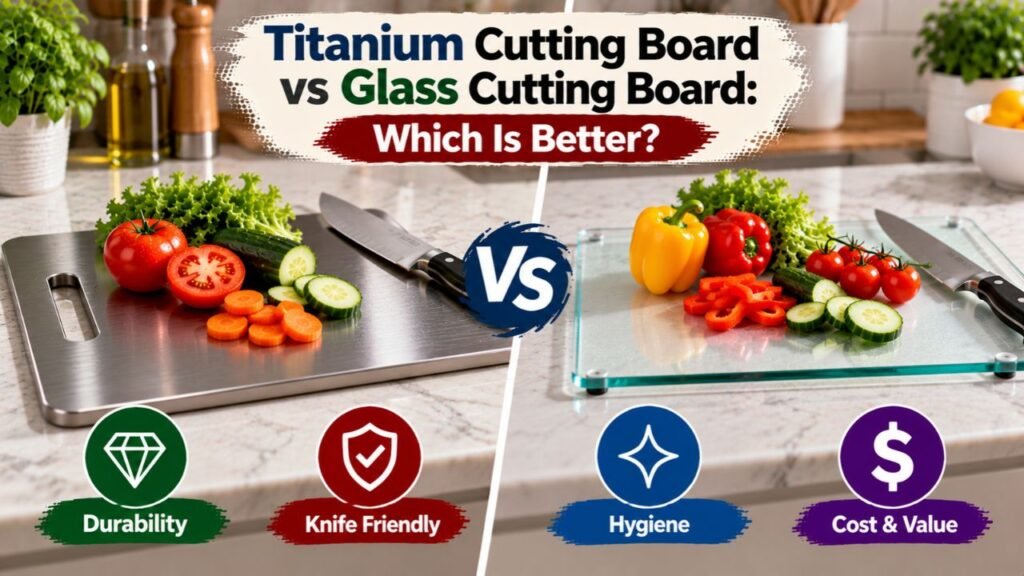
Titanium and glass cutting boards share several practical characteristics. Both resist moisture absorption and are relatively simple to clean, but they behave differently when subjected to impacts, scratches, and repeated knife contact.
| Feature | Titanium Cutting Board | Glass Cutting Board |
| Main material | Titanium metal, if genuine | Usually tempered glass |
| Surface porosity | Nonporous | Nonporous |
| Knife friendliness | Poor compared with wood or plastic | Very poor |
| Breakage resistance | High | Lower; glass can fracture |
| Scratch resistance | Can develop visible scratches | Resists many ordinary scratches |
| Stain resistance | Excellent | Excellent |
| Odor absorption | Very low | Very low |
| Bacterial resistance | Easy to clean, not self-sanitizing | Easy to clean, not self-sanitizing |
| Dishwasher compatibility | Often safe if manufacturer-approved | Often safe if manufacturer-approved |
| Surface feel | Firm, metallic | Extremely hard and rigid |
| Cutting noise | Metallic tapping or clanking | Sharp clicking or tapping |
| Weight | Depends on thickness and construction | Depends on thickness and construction |
| Maintenance | Washing, drying, and inspection | Washing, drying, and damage inspection |
| Oiling required | No | No |
| Damage concerns | Scratches, bends, rough edges | Chips, cracks, shattered fragments |
| Typical price | Often higher for verified solid titanium | Commonly more affordable |
| Best application | Light food preparation and non-cutting tasks | Serving, presentation, and non-cutting tasks |
Overall recommendation: Titanium is the better choice when resistance to breakage matters most. Glass is suitable for serving and presentation, but neither is my preferred material for regular chopping.
What Are Titanium and Glass Cutting Boards?
Although both materials are solid and nonporous, their construction and physical properties differ.
Understanding those differences is useful because marketing descriptions do not always explain what the cutting surface is actually made from.
What Is a Titanium Cutting Board?
A titanium cutting board is a food preparation surface made from titanium metal or a product marketed as having a titanium cutting surface.
Titanium is a metallic element known for its corrosion resistance, strength-to-weight ratio, and use in demanding industrial applications.
Commercially pure titanium has a density of approximately 4.51 grams per cubic centimeter, according to materials information published by the University of Cambridge.
Titanium forms a thin, stable oxide layer when exposed to air. This protective layer contributes to its corrosion resistance.
Genuine solid titanium boards do not absorb food liquids into the metal, and they do not require the oiling or waxing associated with wooden cutting boards.
Yet their firm surfaces provide little cushioning for knife edges.
A titanium board may also produce a metallic sound during chopping, especially if it consists of a thin metal sheet.
What Is a Glass Cutting Board?
A glass cutting board is a rigid food preparation surface manufactured from glass, commonly tempered glass.
Tempered glass is processed through controlled heating and cooling to improve its resistance to certain impacts and thermal stresses.
This treatment makes it stronger than comparable ordinary annealed glass in some situations.
It does not make glass unbreakable.
Glass cutting boards are usually smooth, flat, and nonporous. Many are clear or feature printed decorative designs.
Some have rubber feet that hold them slightly above the countertop.
Glass does not absorb food juices or odors into its surface and can often be washed in the dishwasher when the manufacturer approves.
Its main drawbacks are hardness, the potential for slipping, and the possibility of chipping or breaking.
Are All Titanium Cutting Boards Made From Pure Titanium?
No. A product advertised as a titanium cutting board is not necessarily made entirely from titanium.
Some boards are constructed from:
- Commercially pure titanium: The main cutting surface consists of solid titanium metal.
- Titanium-coated stainless steel: A thin titanium-containing coating covers another metal.
- Stainless steel marketed with titanium terminology: The product may contain little or no titanium.
- Double-sided boards: One face may be metal, while the other is plastic or another material.
These differences matter.
A thin coating can wear or become damaged through repeated knife contact. A plastic-backed board has different cleaning and surface-wear considerations from solid metal.
I recommend checking the full material description rather than relying on the word titanium in the product title.
Key Takeaway: Glass boards are commonly made from tempered glass, while titanium-labeled boards may contain several different materials. Verify the construction before comparing performance.
Which Cutting Board Is Better for Kitchen Knives?
Neither material is especially friendly to knife edges.
Both provide a hard surface that absorbs very little of the force generated during cutting.
How Titanium Cutting Boards Affect Knife Sharpness
Titanium is not automatically harder than a hardened kitchen knife blade.
Still, metal-to-metal contact can cause edge rolling, wear, and possible microchipping, even when the board metal is softer than the blade.
A kitchen knife has an extremely thin cutting edge.
When that edge repeatedly strikes a rigid titanium surface, much of the cutting force returns to the knife instead of being absorbed by the board.
Surface roughness can also contribute to abrasion.
Independent cutting board evaluations have reported noticeable knife dulling after repeated use on titanium surfaces.
The amount of wear varies with the titanium grade, surface texture, blade steel, edge geometry, and cutting pressure.
A smooth titanium board should not be assumed to preserve sharpness simply because the manufacturer describes the material as relatively soft.
How Glass Cutting Boards Affect Knife Sharpness
Glass has a hard, rigid surface that provides almost no cushioning during cutting.
Repeated knife contact can cause the fine edge of a blade to lose sharpness.
Glass boards are commonly discouraged for frequent chopping because they can accelerate knife wear and provide an uncomfortable cutting feel.
This is more noticeable during repetitive preparation tasks such as:
- Dicing onions
- Mincing garlic
- Chopping herbs
- Cutting carrots
- Preparing large quantities of vegetables
Glass may remain visibly smooth after repeated cutting, but that does not mean the knife edge is unaffected.
Tempered glass improves certain aspects of breakage resistance. It does not provide the cushioning available from wood, plastic, or cutting-board rubber.
Does Titanium Dull Knives Faster Than Glass?
There is not enough comparable independent testing to establish a universal winner between titanium and glass.
Both can damage knife edges faster than suitable wood or plastic boards.
Glass is extremely rigid, while titanium introduces repeated metal-to-metal contact and possible surface abrasion.
The effect depends on the exact board and knife.
Published product testing has shown substantial knife-edge wear from titanium boards, contradicting claims that titanium is automatically harmless to kitchen knives.
A smooth glass board may behave differently from a textured titanium sheet, but neither surface provides the controlled cushioning associated with conventional cutting boards.
My preference: Use wood, food-grade polyethylene, or purpose-made cutting-board rubber for frequent knife work. Reserve titanium and glass for tasks involving little direct blade contact.
Key Takeaway: Both materials can accelerate knife dulling. Claims that titanium always protects knife edges better than glass are not supported by enough consistent comparison data.
Is Titanium or Glass Better for Food Safety?
Both materials can be suitable for food contact when properly manufactured, maintained, and cleaned.
Their nonporous surfaces are convenient, but neither should be described as bacteria-free.
Nonporous Surfaces and Bacteria
A nonporous cutting surface does not readily absorb food liquids into its material.
Both solid titanium and intact glass have this property.
Juices from vegetables, meat, and seafood remain on the surface, where they can be washed away.
This is useful for cleaning, but it does not prevent bacteria from attaching to the board.
Food residue, moisture, and microorganisms may remain on any surface that is not washed properly.
Scratches, seams, handles, and rubber feet can also collect debris.
The USDA recognizes nonporous surfaces, including glass, as acceptable cutting board materials when properly cleaned.
Titanium’s corrosion resistance is useful for kitchen equipment, but the claim that an ordinary titanium board automatically destroys harmful bacteria is not established.
Which Is Safer for Raw Meat and Chicken?
Both titanium and glass can be used for raw meat preparation when they are suitable for food contact, stable, undamaged, and properly cleaned afterward.
Titanium has an advantage in resistance to breaking.
If a glass board develops a chip or crack, fragments may contaminate food and create an injury hazard.
Titanium is less likely to fracture in this way.
Still, both surfaces can become slippery when covered with meat juices.
For frequent raw poultry preparation, I prefer a separate, dishwasher-safe food-grade plastic board.
The USDA recommends using one cutting board for raw meat, poultry, and seafood and another for produce, bread, and foods that will not be cooked.
That separation reduces cross-contamination.
Are Titanium Cutting Boards Naturally Antibacterial?
Titanium is corrosion-resistant, but corrosion resistance is not the same as antibacterial activity.
Certain specially treated titanium dioxide surfaces have been studied for antimicrobial properties under specific conditions.
Those findings do not mean an ordinary titanium cutting board kills bacteria during normal food preparation.
An untreated titanium board can still carry foodborne microorganisms.
Likewise, glass is nonporous but does not automatically sanitize itself.
I would avoid paying extra for claims that a cutting board eliminates the need for washing or sanitizing unless the manufacturer provides credible, product-specific evidence.
Key Takeaway: Titanium and glass are easy-to-clean materials, but neither eliminates bacteria automatically. Safe food preparation still requires cleaning and preventing cross-contamination.
Durability: Does Titanium Last Longer Than Glass?
Titanium generally has the advantage for resistance to accidental breakage.
Glass resists many ordinary surface scratches, but its brittle structure creates a different kind of risk.
Titanium: Scratches, Bending, and Wear
Solid titanium is tough and corrosion-resistant.
It does not shatter like glass during ordinary kitchen handling.
A thin titanium board may bend or develop dents under concentrated pressure.
It can also develop surface scratches from knives and abrasive cleaning tools.
These scratches may be cosmetic when shallow, but deep scoring, raised burrs, or sharp damaged edges can make cleaning and handling more difficult.
Repeated cutting can change the finish of the metal.
Titanium is durable, but a claim that its surface is completely scratchproof is inaccurate.
Glass: Chips, Cracks, and Breakage
Glass is brittle.
A dropped board, sharp impact, or damaged edge can cause cracking or breakage.
Tempered glass is designed to handle certain stresses better than ordinary annealed glass, but it can still fracture.
When tempered glass breaks, it commonly forms numerous smaller fragments.
Those pieces can still cut skin or contaminate ingredients.
The U.S. Food and Drug Administration identifies glass fragments in food as a physical hazard because ingestion can cause injury.
Safety Tip: Never continue using a glass cutting board after discovering a chip, crack, or missing piece. Replace it and inspect nearby food and surfaces for fragments.
Which Material Resists Scratches Better?
Glass generally resists scratches from ordinary kitchen knives better than many metal surfaces.
Titanium can develop visible knife marks even when it remains structurally sound.
Still, scratch resistance and overall durability are different properties.
A glass board may retain a smooth appearance for a long time but break after one damaging impact.
Titanium may become visibly scratched while remaining usable for light food handling.
Key Takeaway: Titanium resists breakage much better, while glass often retains a smoother appearance. Neither material is completely damage-proof.
Cutting Comfort, Noise, and Stability
A cutting board should remain stable and provide reasonable control over both the knife and the ingredients.
Titanium and glass are relatively unforgiving surfaces, and their smooth finishes can affect handling.
How Titanium Feels During Chopping
Titanium boards usually provide a firm cutting sensation with little cushioning.
Thin sheets can create a metallic tapping or clanking sound.
Some may flex slightly, but that does not make them equivalent to a purpose-made rubber cutting board.
Repeated contact with a hard metal surface can feel less comfortable than chopping on wood or plastic.
Smooth titanium surfaces may also allow wet ingredients to slide.
A board with rubber feet or a nonslip backing can improve stability.
How Glass Feels During Chopping
Glass produces a sharp tapping sound whenever a knife makes contact.
It provides almost no give beneath the blade.
That rigid sensation can make repetitive chopping less pleasant.
Wet vegetables may slide across the glass, especially if the surface is highly polished.
Glass boards can also move on smooth countertops when they lack secure feet.
A slippery board combined with a hard cutting surface may reduce cutting control.
Which Board Is More Stable?
Neither material guarantees stability.
Board thickness, size, weight, feet, and countertop conditions determine how securely a board rests.
Some titanium boards are made from thin metal sheets that may slide or flex.
Glass boards may be heavier, but a smooth underside can still move during use.
A nonslip backing is useful on either material.
Place the board on a clean, level countertop and check that it does not rock before using a knife.
Key Takeaway: Both boards are firm and relatively noisy. Nonslip support improves stability, but softer cutting surfaces generally provide greater comfort during repeated chopping.
Titanium vs Glass Cutting Boards for Different Foods
The better material depends on the task.
Some kitchen activities require frequent knife contact, while others mainly need a clean surface for holding or presenting ingredients.
Cutting Raw Meat, Chicken, and Fish
Titanium is more practical than glass when breakage resistance is a priority.
A food-contact-suitable titanium surface can hold raw meat and other ingredients without absorbing their juices.
It can also be cleaned after preparation.
Still, frequent slicing places stress on knife edges, and raw juices may make the surface slippery.
Glass can be cleaned thoroughly but adds a breakage concern.
For regular meat cutting, food-grade plastic remains a more forgiving option.
Chopping Vegetables and Fruits
Neither titanium nor glass is ideal for extensive vegetable preparation.
Chopping onions, carrots, celery, and herbs involves repeated blade contact.
This can accelerate knife wear on both materials.
For occasional light slicing, titanium has a practical advantage because it is unlikely to shatter if accidentally dropped.
For daily vegetable chopping, I recommend using a wood or suitable plastic board instead.
Serving Cheese, Snacks, and Appetizers
Glass is attractive for serving food.
Clear and decorative glass boards can display cheese, fruit, crackers, and appetizers.
Titanium offers a modern metallic appearance and can also serve as a presentation surface.
Both are easy to wipe after serving.
Prepare ingredients on a knife-friendly board before transferring them to glass or titanium whenever possible.
Handling Dough and Other Ingredients
A smooth titanium board can be useful for organizing ingredients, assembling sandwiches, or handling dough.
Glass can also provide a smooth surface for certain pastry tasks when stable and approved for that use.
Neither requires mineral oil or wax.
Do not assume every glass board is heatproof or suitable for direct contact with hot cookware. Check the manufacturer’s temperature restrictions.
Titanium conducts heat differently from glass, and a thin sheet can transfer heat to the countertop beneath it.
Key Takeaway: Titanium has an advantage for light preparation and durability, while glass works well for serving. Neither is the best surface for extensive chopping.
How to Clean Titanium and Glass Cutting Boards
Both materials require regular washing.
A nonporous surface simplifies cleaning but does not remove the need for sanitizing after certain food preparation tasks.
Daily Washing and Sanitizing
Use the following routine for an undamaged, food-contact-suitable board:
- Remove loose food scraps and residue.
- Wash the board with hot, soapy water.
- Gently scrub the entire cutting face and edges.
- Clean handles, seams, feet, and backing materials.
- Rinse thoroughly with clean water.
- Sanitize when appropriate using a food-contact-safe product compatible with the board.
- Follow the sanitizer’s required contact time and rinsing instructions.
- Dry the board completely before storing it.
The USDA describes a sanitizing solution containing 1 tablespoon of unscented liquid chlorine bleach per gallon of water for cutting boards.
That general recommendation does not replace product-specific material restrictions.
Follow the manufacturer’s directions before exposing a titanium board, metallic coating, or attached components to chlorine-based products.
Some cleaning chemicals may damage metal finishes or attached materials.
Can Titanium and Glass Boards Go in the Dishwasher?
Many solid titanium and tempered glass boards are dishwasher-safe.
Still, the complete product matters.
A titanium board with a coating, bonded handle, or plastic backing may have different cleaning limits.
A glass board with adhesive decorations or rubber feet may also require hand-washing.
Follow the product label rather than assuming all titanium and glass boards tolerate every dishwasher setting.
Removing Stains, Water Spots, and Residue
Both materials resist most ordinary food stains.
Hard-water minerals may leave pale spots after washing.
Start with mild dish soap, warm water, and a soft cloth.
For stubborn mineral marks, use a cleaner approved for the board’s material.
Avoid abrasive pads that scratch titanium or damage decorative glass finishes.
Do not use harsh chemicals without confirming their compatibility.
Key Takeaway: Wash both boards after use and sanitize when needed. Dishwasher compatibility and cleaning-product restrictions depend on the complete board, not just its main material.
Pros and Cons of Titanium and Glass Cutting Boards
Both materials have strengths, but their limitations matter during regular kitchen preparation.
Titanium Cutting Board Advantages and Disadvantages
Advantages:
- Resistant to shattering and accidental breakage
- Nonporous surface
- Does not absorb food liquids
- Resistant to rust and corrosion when made from suitable titanium
- Simple to wash
- No oiling or waxing required
- Can be thin and easy to store
Disadvantages:
- Can dull or damage knife edges
- Metallic cutting noise
- Surface may scratch or develop burrs
- Thin boards can flex or slide
- Genuine solid titanium may cost more
- Some products advertised as titanium use other materials
- Smooth metal may provide limited grip for wet ingredients
Glass Cutting Board Advantages and Disadvantages
Advantages:
- Nonporous surface
- Resists food stains and odors
- Often easy to clean
- Resistant to many ordinary surface scratches
- Available in clear and decorative styles
- No oiling or waxing required
- Useful for serving and presentation
Disadvantages:
- Extremely hard on kitchen knives
- Can chip, crack, or shatter
- Glass fragments may contaminate food
- Smooth surface may be slippery
- Produces sharp cutting noise
- Can be heavy or awkward to handle
- Damaged boards generally require replacement
Key Takeaway: Titanium offers greater impact resistance, while glass provides serving appeal and scratch resistance. Both have drawbacks as everyday knife-cutting surfaces.
What to Check Before Buying Titanium or Glass
Product quality can vary widely even when two boards look similar in photographs.
Inspect the construction and intended use before buying.
Verify Titanium Grade and Construction
Look for a clear description of the metal.
Some manufacturers identify commercially pure Grade 1 or Grade 2 titanium.
A product’s declared titanium grade describes the metal, but it does not independently establish that the entire finished board is suitable for food contact.
Check the coating, backing material, adhesive, and product instructions.
A magnet test is not sufficient proof that a board is solid titanium. Some stainless steel grades are also weakly magnetic or nonmagnetic.
Reliable material specifications are more useful than claims such as surgical-grade or antibacterial without supporting details.
Inspect the Glass Type and Edges
Choose glass products specifically intended for kitchen food contact.
Tempered glass is common because it provides improved strength compared with ordinary glass under certain conditions.
Look for smooth, rounded edges and secure rubber feet.
Avoid boards with existing chips, cracks, or rough exposed glass.
For decorative products, confirm which side is intended to touch food.
Consider Size, Thickness, and Price
A board must fit your countertop and provide enough usable space for its intended tasks.
A surface around 12 × 18 inches is a practical reference size for many home kitchens, provided there is enough counter and sink space.
A smaller glass board may be enough for serving cheese or appetizers.
Titanium boards are often sold in thin constructions, so check for bending or flexing concerns.
Compare the price against the actual materials and build quality.
I would not pay a large premium for titanium solely because a seller promises permanently sharp knives or a surface that never needs sanitizing.
Key Takeaway: Verify titanium content, glass construction, edge quality, and nonslip support. Treat unsupported durability or hygiene claims with caution.
Common Mistakes When Choosing These Cutting Boards
Several assumptions can lead to an unsuitable purchase.
Assuming titanium is harmless to knives: Titanium can still accelerate blade wear, even if the metal is softer than hardened knife steel.
Assuming tempered glass cannot break: Tempering improves certain strength characteristics but does not eliminate the risk of fractures or chips.
Confusing nonporous with antibacterial: Neither material automatically prevents bacteria from remaining on an unwashed surface.
Ignoring the underside: Rubber feet, plastic backing, adhesive joints, and attached handles can affect cleaning and stability.
Buying based only on appearance: A polished board may look attractive but provide an uncomfortable chopping surface.
Overlooking material specifications: A titanium label may describe a coating or marketing feature rather than a solid titanium cutting face.
Using the same board for every ingredient: Raw meat juices can contaminate ready-to-eat foods if the board is not cleaned properly between tasks.
The simplest mistake to avoid is expecting either material to perform like a conventional wood or plastic cutting board.
Which Is Better Overall: Titanium or Glass?
Titanium is the better option for someone who specifically wants a durable, nonporous surface and values resistance to breakage.
It does not have the same brittle failure risk as glass, and a genuine solid titanium board can resist moisture and corrosion.
Glass is a reasonable choice for serving, displaying food, and certain preparation tasks that do not involve repeated knife contact.
Its smooth surface is attractive and simple to wash, but its breakage risk makes it less appealing for regular cutting.
For daily chopping, neither material offers the balance of comfort, knife friendliness, and usability found in a suitable wooden, plastic, or rubber cutting board.
A practical combination is to use a regular cutting board for slicing and chopping, then use titanium or glass as a secondary surface when its individual properties are useful.
Conclusion
In the titanium cutting board vs glass comparison, titanium is generally the better material for durability and resistance to breakage. Glass provides a smooth, nonporous surface and attractive serving options, but it can chip or shatter. Both materials are easy to clean, yet neither is a particularly forgiving cutting surface for kitchen knives.
Titanium can scratch, bend, and accelerate knife wear. Glass is highly rigid, hard on knife edges, and vulnerable to damaging impacts. Both require proper washing and sanitation, regardless of claims about their hygienic properties.
I recommend choosing titanium over glass if you specifically need a metal preparation surface that is unlikely to break when dropped. For regular chopping, I would use wood, food-grade plastic, or purpose-made cutting-board rubber instead.
The most practical purchase is a board that keeps your ingredients stable, protects your knives from unnecessary wear, and remains easy to clean after preparing food.
FAQs About Titanium and Glass Cutting Boards
Is a Titanium Cutting Board Better Than Glass?
Titanium is generally better than glass for resistance to breakage and accidental impacts. Both materials have nonporous surfaces that are easy to clean, but both can accelerate knife wear. Titanium may develop scratches or bends, while glass can crack or shatter. For daily chopping, a suitable wood, plastic, or rubber board is usually preferable to either material.
Does Titanium Dull Knives More Than Glass?
There is insufficient consistent side-by-side testing to establish that titanium always dulls knives faster or slower than glass. Both materials provide hard surfaces that can cause knife-edge wear. Titanium introduces repeated contact between metal surfaces, while glass offers very little cushioning. Independent product evaluations have found noticeable sharpness loss on titanium boards. Neither is recommended for preserving knife edges during frequent chopping.
Are Titanium Cutting Boards Safer Than Glass?
Titanium has an advantage in physical durability because it is less likely to break into fragments. Glass can chip or shatter, creating an injury and food-contamination risk. Both can be suitable for food contact when properly manufactured and cleaned. Neither material is automatically antibacterial, and both need secure placement to prevent slipping during food preparation.
Can Titanium and Glass Cutting Boards Harbor Bacteria?
Yes. Both materials are nonporous, but bacteria can remain on their surfaces when food residue is not properly removed. Scratches, attached components, and dirty edges may also collect debris. Wash the boards with hot, soapy water after use and sanitize when appropriate. Separate surfaces used for raw meat from those used for ready-to-eat ingredients to reduce cross-contamination.
Do Titanium Cutting Boards Release Metal Particles Into Food?
Titanium cutting boards can develop scratches through repeated knife contact, and mechanical wear can produce small particles. The amount depends on the metal, surface finish, knife, and cutting technique. There is not enough product-specific evidence to claim that all titanium boards release dangerous amounts of metal or that every board releases none. Choose products intended for direct food contact and replace surfaces with serious damage.
Can a Glass Cutting Board Shatter While Cutting?
Yes. Tempered glass is designed to resist certain stresses better than ordinary glass, but a hard impact, damaged edge, or existing defect can cause it to fracture. Forceful chopping increases the chance of a damaging strike. Stop using a glass board if it develops cracks or chips. Do not attempt to repair it with glue for continued food preparation.
Are Titanium Cutting Boards Completely Scratchproof?
No. Titanium resists corrosion and breaking, but ordinary knife contact and abrasive cleaning tools can scratch its surface. Thin boards may also bend or develop dents. Shallow scratches are often cosmetic, while deep scoring, rough burrs, or damaged coatings deserve closer inspection. A titanium board is not automatically maintenance-free simply because it is made from metal.
Are Titanium and Glass Cutting Boards Dishwasher-Safe?
Many solid titanium and tempered glass boards can be cleaned in a dishwasher, but compatibility depends on the complete product. Coatings, rubber feet, plastic backing, and decorative designs may have restrictions. Follow the manufacturer’s instructions. If dishwasher safety is unclear, wash the board with hot, soapy water, rinse thoroughly, and dry it before storage.
Which Cutting Board Is Better Than Titanium or Glass for Everyday Use?
Wood, food-grade plastic, and purpose-made rubber cutting boards are generally better choices for frequent chopping. Maple and walnut offer more forgiving surfaces for knife edges, while suitable plastic boards are convenient for raw meat preparation and often dishwasher-safe. Rubber cutting boards are also used for their cutting feel and grip. Titanium and glass are better reserved for situations where their nonporous surfaces, appearance, or resistance to breakage provide a practical advantage.