Acacia vs Oak Cutting Board: Which Wood Is Better?
Acacia is generally a more practical cutting board material than oak for everyday chopping, mainly because many acacia varieties have a less pronounced pore structure. Oak is also durable, but its grain requires closer attention during cleaning. White oak is a better cutting board candidate than red oak, although wood quality and construction can change the comparison.
Choosing the wrong hardwood can leave you with a board that develops deep knife marks, absorbs moisture unevenly, or becomes difficult to clean. A beautiful wood grain does not automatically mean the surface is suitable for frequent food preparation.
A well-made wooden cutting board should balance hardness, moisture resistance, knife friendliness, and simple maintenance. Understanding these differences makes it easier to choose a board that remains useful through regular chopping and washing.
For a measurable comparison, The Wood Database lists American white oak at 1,350 pounds-force and American red oak at 1,220 pounds-force on the Janka hardness scale. Acacia varies by species, with Australian blackwood rated at 1,160 pounds-force and mangium at 1,430. These figures show why hardness alone cannot identify the better cutting board.
The USDA also recommends separating cutting boards used for raw meat, poultry, and seafood from those used for produce and bread. This recommendation applies to both acacia and oak because neither hardwood eliminates the need for proper food handling.
What stood out to me while researching the acacia vs oak cutting board comparison was the importance of wood anatomy. Acacia is not one uniform wood, and red oak and white oak have meaningful differences in their pore structures.
The comparison below explains how both hardwoods perform with knives, moisture, food contact, cleaning, and long-term wear. It also identifies situations where oak remains a reasonable choice and the features worth checking before buying either board.
Acacia vs Oak Cutting Board: Quick Comparison
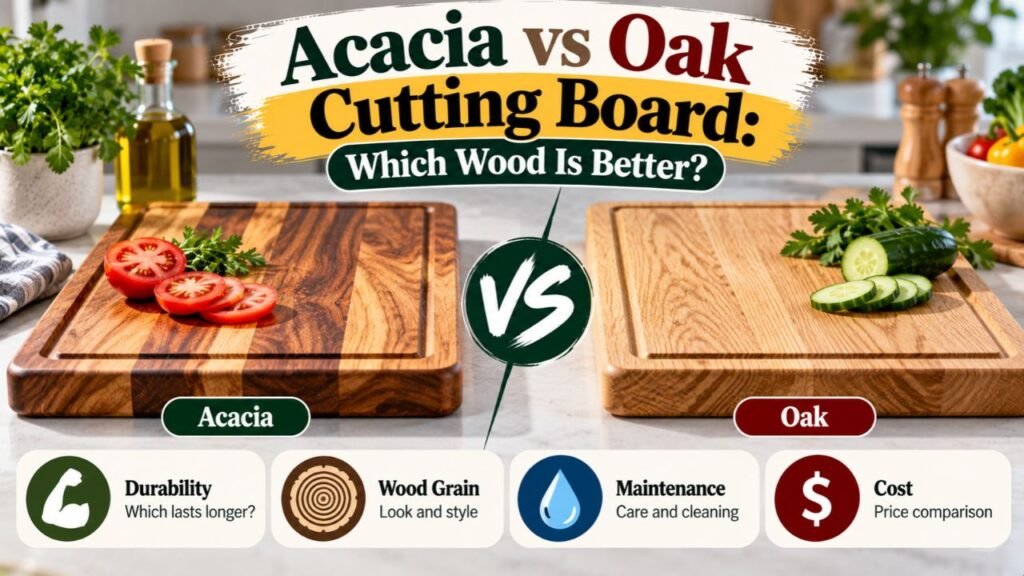
Acacia and oak are both hardwoods, but their grain patterns, moisture behavior, and cutting characteristics are different.
Acacia is often preferred for everyday chopping because many commercially available varieties provide a durable surface without oak’s strongly ring-porous appearance.
Oak offers a traditional hardwood look and dependable strength, but the difference between white oak and red oak is worth examining before using either for food preparation.
| Feature | Acacia Cutting Board | Oak Cutting Board |
| Wood type | Hardwood group with many species | Hardwood group containing red and white oak |
| Hardness | Varies considerably by species | Common American species have moderate to high hardness |
| Grain structure | Generally diffuse-porous | Ring-porous with pronounced growth rings |
| Water resistance | Varies by species and finish | White oak generally resists liquid penetration better than red oak |
| Knife friendliness | Depends on species, hardness, and construction | Reasonably firm, but surface texture matters |
| Food preparation | Suitable when made and maintained for food contact | White oak is generally preferable to red oak |
| Cleaning | Hand washing usually recommended | Hand washing usually recommended |
| Staining | Darker varieties may conceal some discoloration | Tannin reactions and visible grain can affect appearance |
| Appearance | Golden, reddish, and dark brown variations | Pale tan, golden brown, and reddish tones |
| Maintenance | Regular washing, drying, and occasional oiling | Regular washing, drying, and occasional oiling |
| Common advantage | Attractive appearance and versatile daily use | Traditional appearance and sturdy hardwood construction |
| Main limitation | Unspecified species can make quality difficult to judge | Prominent pores, especially in red oak |
For most kitchens, I would choose a well-made acacia cutting board over an otherwise similar red oak board.
White oak creates a closer comparison. Its pore structure provides better resistance to liquid movement than red oak, making properly constructed white oak boards reasonable alternatives.
The biggest mistake is judging every board only by its wood name. Surface quality, glue joints, finishing materials, and maintenance can matter just as much.
Understanding Acacia and Oak Wood for Cutting Boards
Before comparing performance, it helps to understand what these names describe.
Both materials are hardwoods, but their botanical differences influence how they behave when exposed to knives, water, and repeated cleaning.
What Is Acacia Wood?
Acacia is a group of hardwood species used for furniture, kitchen accessories, flooring, and cutting boards.
The wood is often recognized by its warm brown colors and contrasting grain patterns. Some varieties have straight grain, while others display waves or interlocking fibers.
Commercial acacia cutting boards may be made from different species, including plantation-grown varieties.
This matters because acacia hardness, density, and pore size are not identical across species.
For example, Australian blackwood (Acacia melanoxylon) has a different density and hardness from mangium (Acacia mangium).
Many acacia boards provide a firm cutting surface that resists ordinary knife marks. Very hard varieties may place more wear on knife edges than moderately hard hardwoods.
Acacia also has visible pores, so describing every acacia board as completely closed-grain or waterproof would be inaccurate.
What Is Oak Wood?
Oak is a hardwood from the Quercus genus, widely used in furniture, flooring, cabinetry, and traditional woodworking.
In the United States, two important commercial categories are red oak and white oak.
Both have a distinctive grain pattern created by large vessels concentrated in their growth rings.
This structure is called ring porosity.
Oak’s pronounced grain creates its familiar appearance, but it can produce an uneven texture on cutting surfaces if the board is poorly finished or inadequately maintained.
Oak is strong enough for chopping and slicing. The main concern is not a lack of hardness but the ease of cleaning its grain and keeping moisture out of damaged areas.
White Oak vs Red Oak for Cutting Boards
White oak and red oak should not be treated as identical materials.
Red oak has relatively open vessels that can allow liquid to move through the wood. These openings are a drawback for a cutting surface exposed to food juices and frequent washing.
White oak contains structures called tyloses, which block many of its larger vessels.
These natural obstructions are one reason white oak is traditionally used for barrels and other applications requiring resistance to liquid penetration.
White oak still has visible pores and requires normal cutting board care.
If oak is your preferred material, I would choose a properly finished white oak board rather than red oak for regular food preparation.
Key Takeaway: Acacia properties vary by species, while oak performance differs between red and white oak. White oak is the more practical oak option because many of its large vessels are naturally blocked.
Acacia vs Oak Cutting Board Hardness and Durability
Hardness determines how strongly a wood resists dents and indentation. It influences cutting board wear, although it cannot predict overall performance by itself.
A suitable board needs enough hardness to resist excessive damage without creating unnecessary wear on knife edges.
Janka Hardness Comparison
The Janka hardness test measures the force needed to press a standardized steel ball halfway into wood.
Higher numbers indicate greater resistance to indentation.
The following measurements illustrate how acacia and oak species overlap.
| Wood Species | Janka Hardness | Practical Meaning |
| Australian blackwood (Acacia melanoxylon) | 1,160 lbf | Moderately hard hardwood |
| Northern red oak (Quercus rubra) | 1,220 lbf | Durable, with open vessels |
| American white oak (Quercus alba) | 1,350 lbf | Durable, with many blocked vessels |
| Mangium (Acacia mangium) | 1,430 lbf | Harder than the listed oak species |
These are published species-level reference values, not guarantees for individual cutting boards.
Acacia includes species that are much harder than these examples, along with others that are softer.
A manufacturer using only the word “acacia” may not provide enough information to determine the board’s exact hardness.
Janka measurements also describe indentation resistance under controlled conditions. They do not directly measure how quickly a cutting board dulls a knife.
Resistance to Knife Scratches and Grooves
Both acacia and oak develop cutting marks over time.
A moderately hard board generally resists deep dents better than a very soft board. Still, repeated contact with sharp knife edges gradually changes the surface.
Acacia boards may conceal shallow marks within their contrasting grain patterns, although scratches can remain visible on polished surfaces.
Oak may develop a rougher feel when moisture raises exposed wood fibers.
Knife grooves become a food safety concern when they are deep enough to trap residue and prevent thorough cleaning.
A well-maintained board with shallow marks can remain suitable for food preparation.
Deep cuts, cracks, splinters, or separated glue joints require closer inspection and may justify replacing the board.
Which Wood Is Gentler on Knives?
Neither acacia nor oak has a universal advantage in knife friendliness.
Knife wear depends on wood density, hardness, mineral content, grain direction, and how forcefully the knife contacts the board.
Some dense acacia species are relatively hard and may wear a fine knife edge faster than softer cutting board woods.
Oak is moderately hard, but its uneven grain texture can affect cutting feel.
Both materials are generally more forgiving than glass, ceramic, or stone cutting surfaces.
For someone using expensive Japanese kitchen knives, I would examine the exact wood species and board construction rather than assuming acacia is always gentler.
Edge-Grain vs End-Grain Construction
Construction influences cutting performance independently of wood species.
An edge-grain cutting board places the long sides of wood strips on the cutting surface. These boards are common, relatively straightforward to manufacture, and often less expensive than end-grain designs.
An end-grain cutting board exposes the ends of the wood fibers.
A properly manufactured end-grain surface may allow knife edges to move between fibers during cutting, often producing a softer cutting feel.
Both acacia and oak can be used in these constructions, but the wood’s pore structure remains relevant.
Red oak’s open vessels deserve extra attention in end-grain construction because the exposed fiber ends can present visible pore openings.
Key Takeaway: Acacia is not automatically harder or gentler on knives than oak. Compare the actual species and construction, not just the hardwood name.
Water Resistance and Grain Porosity: Which Wood Performs Better?
Water exposure is one of the main challenges for wooden cutting boards.
Repeated washing, food juices, and prolonged dampness can cause swelling, raised grain, cracking, or warping.
Acacia Cutting Board Water Resistance
Many commercial acacia cutting boards have a relatively smooth texture that works well for ordinary kitchen preparation.
Some acacia species also possess natural compounds associated with decay resistance, although those properties vary widely.
Acacia should still be treated as a moisture-sensitive wooden material.
Water can enter exposed grain, knife marks, end-grain areas, and poorly maintained glue joints.
Leaving an acacia cutting board in standing water may cause swelling or distortion.
A suitable food-contact oil helps limit moisture absorption, but it does not make the board waterproof.
Oak Cutting Board Water Resistance
Oak behaves differently based on its species.
White oak typically offers greater resistance to liquid movement because many of its vessels contain tyloses.
Red oak lacks these extensive vessel blockages, allowing liquid to move more freely through its grain.
This distinction is more meaningful than the simple claim that all oak absorbs water easily.
Even white oak can absorb moisture through exposed surfaces, damaged finishes, and knife cuts.
Neither variety should be soaked or left damp after cleaning.
Stains, Odors, and Food Residue
Acacia’s darker grain patterns can make some minor discoloration less noticeable.
Lighter oak boards may display certain food stains more clearly, although the result also depends on the finish and the type of food.
Oak contains tannins, natural compounds that can react with iron and moisture.
Contact with iron particles or certain metal objects under damp conditions may produce dark gray or black marks.
This discoloration is usually a chemical reaction rather than proof of bacterial contamination.
Acacia species can contain tannins too, so staining is not exclusive to oak.
For either wood, prompt washing and drying reduce the chance of persistent food residue and moisture-related discoloration.
Key Takeaway: White oak generally handles liquid penetration better than red oak. Acacia can also perform well, but moisture resistance varies by species and neither material is waterproof.
Is Acacia or Oak Safer for Food Preparation?
Both acacia and oak can be used for food-contact cutting surfaces when the wood, construction, and finishing materials are suitable.
Food safety depends more on proper cleaning, surface condition, and preventing cross-contamination than on claims about natural antibacterial properties.
Does Acacia Prevent Bacterial Growth?
Acacia is sometimes advertised as naturally antibacterial.
Certain woods contain compounds that show antimicrobial activity under specific conditions, but that does not establish that an ordinary acacia cutting board disinfects itself.
No home cutting board should be treated as self-sanitizing.
The USDA recommends washing cutting boards with hot, soapy water after each use, followed by rinsing and drying.
The board must also be replaced if deep grooves or excessive wear make thorough cleaning difficult.
Is Oak’s Open Grain a Food Safety Problem?
Oak’s pronounced pores can make a cutting surface harder to clean when food residue enters the grain.
This concern is stronger with red oak because many of its larger vessels remain open.
Yet open grain alone does not prove that an oak cutting board is unsafe.
Research involving different wood species has shown that bacterial behavior on wood is more complicated than simply comparing visible pore sizes.
Moisture, surface finish, cleaning procedures, wood condition, and the microorganisms involved can all affect the outcome.
A properly maintained white oak board can be used for food preparation. A cracked or heavily scarred acacia board may be unsuitable despite its different grain structure.
Can You Cut Raw Meat on Acacia or Oak?
Yes. Properly maintained wooden cutting boards can be used for raw meat under USDA consumer guidance.
The more important precaution is avoiding cross-contamination.
Use a separate board for raw meat, poultry, and seafood whenever possible. Reserve another board for fresh produce, bread, and other ready-to-eat foods.
Plastic is often more convenient for raw animal products because many plastic boards are dishwasher-safe.
For frequent raw chicken or seafood preparation, I would use a separate plastic board and reserve acacia or white oak for vegetables and general food preparation.
Key Takeaway: Neither wood eliminates bacteria automatically. A clean, intact acacia or white oak board can be suitable for food preparation, while heavily damaged or poorly cleaned boards are a concern.
Acacia vs Oak Cutting Board Appearance and Kitchen Style
Appearance may not change food safety, but it influences how well a cutting board fits into a kitchen.
Acacia and oak offer noticeably different visual characteristics.
Acacia Color and Grain Patterns
Acacia cutting boards commonly display combinations of golden brown, reddish brown, and darker chocolate tones.
Some include contrasting stripes or curved grain patterns.
These variations create a distinctive appearance that works well for both preparation and food presentation.
Acacia is a reasonable choice for someone who wants a cutting board that also serves as a cheese or charcuterie board.
The main disadvantage is inconsistency in appearance between products. Two boards labeled acacia may have very different colors and grain patterns.
Oak Color and Grain Patterns
Oak generally offers a lighter, more traditional hardwood appearance.
White oak often has pale brown, beige, or slightly golden tones.
Red oak commonly shows warmer reddish or pinkish shades.
Both have noticeable grain lines, and quartersawn oak can display distinctive ray patterns.
Oak works well in kitchens featuring natural cabinets, rustic wood furniture, or classic wooden countertops.
A smooth white oak serving board may be attractive for bread, cheese, and occasional food preparation.
Which Wood Looks Better After Long-Term Use?
Both woods change appearance with cutting, washing, and exposure to light.
Acacia’s contrasting tones may conceal minor marks, but a dark polished surface can also make fresh scratches noticeable.
Oak’s lighter color may reveal stains, especially where food liquids enter exposed grain.
Oiling can deepen the color of either wood and make grain patterns more visible.
Appearance is largely personal preference, but surface smoothness should take priority over decorative grain for a board used every day.
Key Takeaway: Acacia offers richer color variation, while oak provides a classic light hardwood appearance. Choose by appearance only after confirming the board is suitable for repeated cutting and washing.
Cleaning and Maintaining Acacia and Oak Cutting Boards
Both woods need routine care to stay clean and resist moisture-related damage.
Neither material should be treated as maintenance-free simply because it is a hardwood.
How to Clean Acacia and Oak Cutting Boards
The basic cleaning process is similar for both types.
- Remove food scraps immediately after preparation.
- Wash the board with warm or hot water and mild dish soap.
- Scrub the cutting surface, edges, and any juice grooves.
- Rinse thoroughly with clean water.
- Dry the board with a clean towel or paper towels.
- Allow the remaining moisture to evaporate before storage.
Avoid soaking the board or leaving it flat against a wet countertop.
Do not place glued wooden cutting boards in the dishwasher unless the manufacturer specifically permits it.
The USDA notes that some solid-wood boards can be washed in a dishwasher, but laminated boards may split. Hand washing is the safer default for most commercially manufactured acacia and oak boards.
How Often Should You Oil Each Wood?
Acacia and oak both benefit from occasional conditioning.
Use food-grade mineral oil or a cutting board conditioner specifically intended for food-contact wood.
A simple approach is to apply oil whenever the board begins to look unusually dry or absorbs small drops of water more quickly than before.
For frequently used boards, checking the surface approximately once a month is a practical starting point.
Apply a thin layer to clean, dry wood, including the edges and reverse side, following the product instructions.
Allow the oil to absorb and wipe away excess residue.
Avoid ordinary cooking oils that can become rancid, and do not apply furniture polish or finishes that are unsuitable for direct food contact.
How to Prevent Warping and Cracking
Wood changes dimensions as it absorbs and releases moisture.
This movement occurs in both acacia and oak.
To reduce damage:
- Wash both sides rather than leaving one surface repeatedly wet.
- Dry the board promptly after cleaning.
- Store it where air can circulate.
- Avoid prolonged exposure to direct heat or sunlight.
- Do not leave it soaking in a sink.
- Follow the board manufacturer’s conditioning instructions.
A thick cutting board can still warp if moisture exposure is uneven.
Likewise, a glued board can develop gaps if its strips expand or contract differently.
Key Takeaway: Cleaning and conditioning requirements are similar for acacia and oak. Prompt drying, suitable oil, and proper storage matter more than following a rigid maintenance calendar.
Which Is Better for Different Kitchen Tasks?
Acacia and oak can both serve different kitchen purposes, but some situations favor one over the other.
Best for Everyday Vegetable Chopping
Acacia is my preferred option for regular vegetable preparation when the board has a smooth surface and suitable hardness.
A good acacia board handles common tasks such as slicing tomatoes, chopping onions, and preparing carrots.
White oak can also perform these jobs, though its pronounced grain may require closer attention as the surface wears.
I would place red oak below both options for frequently washed cutting surfaces.
Best for Bread, Cheese, and Serving
Both acacia and white oak work well for bread and cheese boards.
Acacia offers bold natural colors that suit charcuterie and serving presentations.
White oak provides a lighter appearance that can complement traditional table settings.
For a board used mainly for serving, cutting performance is less demanding than for a board used with knives throughout the day.
A red oak serving board may also be reasonable when it is clean, food-contact suitable, and not exposed to frequent wet preparation.
Best for Heavy Chopping
Neither acacia nor oak should be selected for heavy chopping based solely on species.
Board thickness, construction, stability, and surface condition are also relevant.
A thick end-grain acacia board may provide a suitable working surface, but a poorly glued version could fail before a well-made edge-grain board.
For repeated chopping, choose a board that sits firmly on the countertop and has no loose joints, splinters, or damaged areas.
A thin decorative oak board should not be mistaken for a heavy-duty butcher block.
Best for Low-Maintenance Cooking
A well-made acacia cutting board is often the more convenient of these two hardwood choices.
Still, both need hand washing and drying under typical manufacturer care instructions.
If minimal cleaning effort is your highest priority, a dishwasher-safe plastic or suitable composite cutting board may be more practical than either wood.
Key Takeaway: Acacia is a sensible everyday choice, white oak suits lighter preparation and serving, and heavy chopping requires attention to board construction rather than species alone.
Price, Quality, and What to Check Before Buying
Acacia cutting boards are widely sold in affordable and premium styles.
Oak cutting boards are also available at different price levels, with costs influenced by wood origin, manufacturing, size, and construction.
A low price does not automatically indicate poor performance, and a premium hardwood label does not guarantee a good cutting surface.
Compare Board Construction Before Price
Check that the board is flat and sits securely on a countertop.
The working surface should feel smooth, without raised fibers or splintered areas.
Examine the edges and any visible glue joints. Gaps between strips can collect moisture and may become larger with repeated washing.
A useful everyday size for many kitchens is approximately 12 × 18 inches, although smaller counters may favor a more compact board.
Thickness should provide enough stability for the board’s intended tasks without making it difficult to lift and clean.
Check the Species and Food-Contact Finish
For acacia, look for a manufacturer that identifies the wood species or provides clear material information.
This gives you a better basis for comparing hardness and quality.
For oak, check that the product identifies white oak or red oak rather than simply stating “oak.”
A well-made white oak cutting board deserves more consideration than an unidentified oak board.
Also confirm that the finish is intended for direct food contact and repeated cutting.
A decorative serving tray with a hard film coating is not automatically suitable for routine knife work, even if the underlying wood is oak or acacia.
Consider Long-Term Maintenance and Replacement
A cutting board’s lasting value depends partly on how easily it can be maintained.
Choose a product with clear cleaning instructions and a construction suited to repeated washing.
Look for evidence of careful sanding, suitable adhesives, and consistent finishing.
Avoid boards with cracks, loose pieces, peeling coatings, or a strong unexplained chemical odor.
Once a cutting board develops excessive wear or hard-to-clean grooves, replacement is generally more appropriate than continuing to use a damaged food-contact surface.
Key Takeaway: A clearly identified, well-constructed board with a food-contact finish is a better purchase than an attractive board with uncertain wood, glue, or coating details.
Conclusion
For most everyday food preparation, the acacia vs oak cutting board comparison favors a well-made acacia board over red oak. White oak is a more reasonable alternative because its natural vessel structure offers greater resistance to liquid penetration.
Hardness should not be the only deciding factor. Grain structure, surface quality, knife wear, board construction, and cleaning habits all influence the long-term result.
My recommendation is to choose acacia for regular vegetable chopping and general kitchen tasks, or consider white oak when its appearance and construction suit your preferences. Avoid choosing red oak solely because it is strong and readily available.
Whichever wood you select, prioritize a smooth cutting surface, suitable food-contact materials, careful washing, and prompt drying. Those habits are more meaningful than unsupported claims that one wood naturally prevents contamination.
FAQs About Acacia and Oak Cutting Boards
Is Acacia Better Than Oak for a Cutting Board?
Acacia is generally a more practical option than red oak for everyday chopping because many acacia varieties have a less pronounced pore structure.
White oak is a closer competitor because its large vessels are often blocked by tyloses.
The final comparison also depends on acacia species, board construction, finish, and maintenance. A well-made white oak board can be preferable to a poorly constructed acacia board.
Is Oak Wood Safe for Cutting Boards?
Yes, oak can be used for cutting boards when the material and finish are suitable for food contact and the board is properly maintained.
White oak is generally preferable to red oak because of differences in pore structure.
Red oak’s open vessels can make cleaning more challenging, but that does not mean every red oak food-contact surface is automatically unsafe.
Is Acacia Wood Too Hard for Kitchen Knives?
Some acacia species are hard enough to create greater knife wear than softer cutting board woods.
Others have hardness values comparable to familiar hardwoods used in kitchens.
The name acacia alone does not identify one hardness level. Knife steel, sharpening angle, cutting technique, and board construction also influence how quickly an edge becomes dull.
Does Acacia Absorb Less Water Than Oak?
Many acacia cutting boards handle ordinary kitchen moisture well, but acacia does not have one fixed absorption rate.
White oak has naturally blocked vessels that give it better resistance to liquid movement than red oak.
Surface finishing, exposure time, wood species, and existing knife damage all influence actual moisture absorption. Neither acacia nor oak is completely waterproof.
Is White Oak or Red Oak Better for a Cutting Board?
White oak is generally the better choice.
Its large vessels often contain tyloses, while red oak has more open pathways through its wood structure.
This makes white oak a more suitable candidate for a cutting board exposed to moisture and repeated cleaning. Both species still require thorough washing, drying, and regular inspection for damage.
Do Acacia Cutting Boards Need Oiling?
Yes, most unfinished or oil-finished acacia cutting boards benefit from periodic conditioning with food-grade mineral oil or a suitable board conditioner.
Oiling reduces rapid moisture absorption and helps maintain the wood’s appearance.
The frequency varies with washing, humidity, and manufacturer instructions. Apply conditioner when the surface looks dry rather than assuming every acacia board requires an identical schedule.
Can I Put an Acacia or Oak Cutting Board in the Dishwasher?
Hand washing is recommended for most acacia and oak cutting boards, especially those assembled from glued wood strips.
Dishwasher heat, water, and drying cycles can cause wood movement, cracking, or joint separation.
Some solid-wood boards may be dishwasher-safe according to their manufacturers. Always follow the specific product instructions rather than assuming that every hardwood board tolerates machine washing.
Which Cutting Board Lasts Longer, Acacia or Oak?
Neither wood has a guaranteed longer lifespan.
A well-made acacia board may remain suitable for many years when cleaned and maintained correctly. A properly constructed white oak board may also provide long service.
Actual durability depends on species, thickness, wood movement, adhesive quality, cutting intensity, and moisture exposure. Deep cracks, splinters, and grooves that cannot be cleaned thoroughly matter more than the board’s age alone.