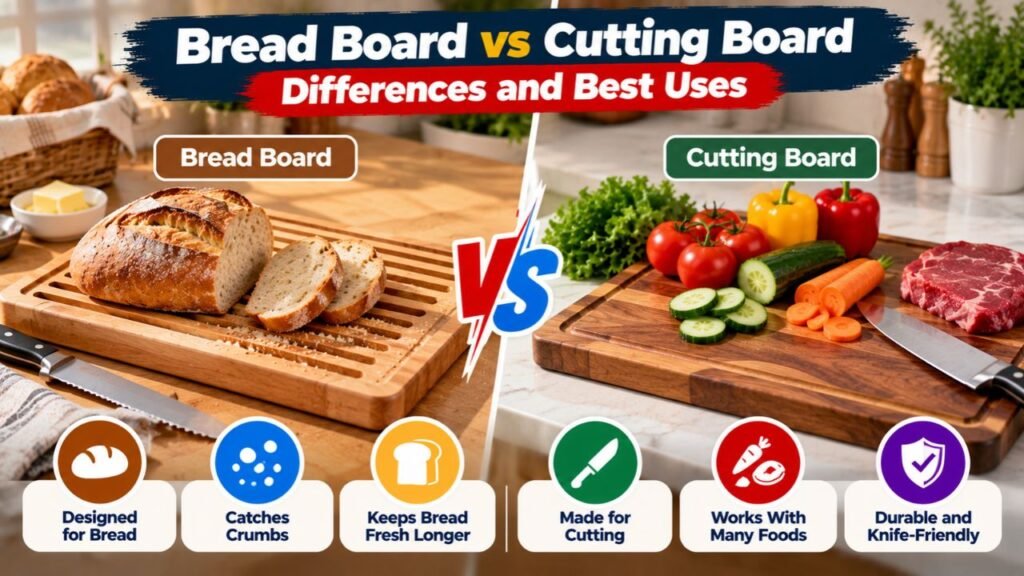
Bread Board vs Cutting Board: Differences and Best Uses
A bread board is designed mainly for slicing and serving bread, often featuring grooves, wooden slats, or a removable crumb tray. A regular cutting board is a multipurpose surface for chopping vegetables, slicing fruit, preparing meat, and cutting bread. Both work for slicing loaves, but a specialized bread board offers better crumb control, while a standard cutting board provides greater versatility.
The difference matters most when cutting crusty sourdough, baguettes, or homemade loaves. An ordinary flat board leaves crumbs scattered across the surface, while a poorly designed bread board may lack enough support for safe, even slicing.
Choosing a board that matches your usual food preparation gives you better knife control, less countertop cleanup, and a more convenient place to work. It also prevents unnecessary spending on a specialized board that may duplicate something already in your kitchen.
The U.S. Department of Agriculture recommends using two separate cutting boards when possible: one for ready-to-eat foods such as bread and fresh produce, and another for raw meat, poultry, and seafood. This separation reduces the risk of transferring harmful bacteria to foods that will not be cooked before eating.
What stood out to me while researching the bread board vs cutting board comparison was that not every bread board has a crumb-catching design. Some are ordinary flat wooden boards marketed for bread, while others have removable slatted surfaces that make them much less suitable for general chopping.
That distinction changes the buying decision. A flat wooden bread board can often serve as a regular cutting board, but a slatted bread board is better reserved for slicing bread and similar baked goods.
Comparing their construction, crumb management, slicing performance, materials, maintenance, food safety, and cost will clarify which type makes sense for your kitchen and when owning both is worthwhile.
Bread Board vs Cutting Board: Quick Comparison
Bread boards and cutting boards share the basic purpose of providing a suitable surface beneath a knife.
Their differences come mainly from design and intended use.
| Feature | Bread Board | Regular Cutting Board |
| Primary purpose | Slicing and serving bread | General food preparation |
| Common foods | Bread, baguettes, rolls, pastries | Vegetables, fruit, meat, bread |
| Surface design | Flat, grooved, or slatted | Usually flat and continuous |
| Crumb collection | Some include removable crumb trays | Usually no dedicated crumb catcher |
| Common materials | Wood, bamboo | Wood, plastic, bamboo, rubber, composites |
| Typical shape | Rectangular, elongated, or paddle-shaped | Usually rectangular or square |
| Knife type | Mainly serrated bread knives | Chef’s knives, utility knives, bread knives |
| Heavy chopping | Slatted designs are unsuitable | Designed for repeated cutting |
| Raw meat preparation | Best avoided on slatted designs | Suitable with proper cleaning |
| Cleaning | May require removing and cleaning a tray | Usually simpler, flat-surface washing |
| Serving appearance | Often decorative | Varies from basic to decorative |
| Versatility | Depends on construction | Generally higher |
| Best advantage | Managing bread crumbs | Handling many kitchen tasks |
The practical difference: A bread board is a specialized type of cutting or serving board. A general cutting board performs more tasks, while a dedicated crumb-catching bread board provides a cleaner surface for frequent bread slicing.
What Is a Bread Board?
A bread board is a kitchen board primarily intended for slicing, handling, or serving bread.
It is commonly made from hardwood or bamboo and may include grooves, open slats, handles, or a removable tray.
Not every bread board has the same construction. The term covers several different designs.
Slatted Bread Boards With Crumb Trays
A slatted bread board features narrow wooden strips separated by small openings.
When you slice crusty bread, loose crumbs fall through those openings into a space underneath.
Many models include a removable tray or bottom compartment that collects the crumbs.
After slicing, you can lift out the wooden insert, empty the crumbs, and clean the pieces separately.
This design is useful for sourdough, crusty French bread, and other loaves that produce substantial debris during slicing.
Its main limitation is the uneven cutting surface.
Small ingredients can fall between the slats, and narrow knife blades may catch against individual wooden strips.
For these reasons, slatted bread boards are not good replacements for ordinary vegetable chopping boards.
Flat Wooden Bread Boards
A flat bread board is a solid wooden surface used for cutting or serving bread.
It may resemble an ordinary cutting board, sometimes with a decorative handle or elongated shape.
Unlike slatted designs, it has no openings for crumbs to fall through.
Some flat bread boards include a shallow groove around the edge, but others have no special crumb-control features.
These boards are often suitable for slicing bread, preparing sandwiches, arranging cheese, or serving appetizers.
If the manufacturer confirms that the surface is suitable for knife use, a flat wooden bread board may function much like a conventional wooden cutting board.
Bread Boards With Slicing Guides
Some specialized bread boards include adjustable guides that help position the knife for repeated slices.
These designs may have parallel guide slots, side rails, or adjustable supports.
Their purpose is to produce more consistent slice thickness when cutting homemade bread.
A slicing guide is useful for preparing sandwich bread, toast, or evenly portioned loaves.
The tradeoff is that guides and additional components require more cleaning and storage space.
They also may not accommodate unusually wide or irregularly shaped artisan loaves.
Key Takeaway: Bread boards range from simple flat serving boards to specialized slicing systems. Slatted models offer the clearest functional difference from ordinary cutting boards.
What Is a Regular Cutting Board?
A cutting board is a flat, durable surface that protects countertops and supports food while it is being sliced, chopped, or trimmed.
It is designed to handle many different kitchen tasks rather than one specific food.
Multipurpose Food Preparation Surface
A standard cutting board can be used for preparing vegetables, fruit, herbs, meat, poultry, bread, and other ingredients.
Its continuous surface supports small pieces of food and provides a stable area for different cutting motions.
For example, chopping onions requires space for both the whole onion and the diced pieces.
A flat board lets the knife move across the surface without encountering gaps or raised strips.
This makes a regular cutting board more suitable than a slatted bread board for everyday meal preparation.
Different Materials and Construction Styles
Cutting boards are manufactured from hardwood, plastic, bamboo, rubber, and several composite materials.
Wooden boards commonly use edge-grain or end-grain construction.
Edge-grain boards expose the long sides of wood fibers, while end-grain boards expose their ends.
Both can be used for bread slicing, although their weight, price, and surface behavior differ.
Plastic boards are another common choice because many are lightweight and dishwasher-safe.
The surface material influences knife wear, maintenance requirements, and cleaning convenience.
Features Designed for General Kitchen Work
Some cutting boards include juice grooves to collect liquid from fruit or cooked meat.
Others feature rubber feet, handles, reversible surfaces, or textured edges for stability.
These details support general food preparation rather than bread slicing alone.
A juice groove can collect some bread crumbs, but it does not function like a removable crumb tray.
Key Takeaway: A regular cutting board provides a continuous cutting surface for many ingredients. Its versatility makes it the stronger choice when only one kitchen board is practical.
Main Differences Between Bread Boards and Cutting Boards
The most meaningful differences appear during actual food preparation.
A board that works well for a crusty loaf may perform poorly when chopping carrots or trimming raw chicken.
1. Crumb Collection
Crumb management is the clearest advantage of a specialized bread board.
Crusty bread naturally produces fragments when a serrated knife cuts through the outer crust.
On a normal flat cutting board, those crumbs remain around the loaf.
They can collect beneath bread slices, scatter onto the counter, or fall onto the floor when the board is moved.
A slatted bread board directs many of those crumbs into a separate compartment.
This reduces the amount of loose debris on the cutting surface.
It does not prevent every crumb from escaping, but it makes cleanup more convenient for frequent bread slicing.
2. Cutting Surface and Knife Movement
Regular cutting boards offer a continuous area beneath the entire knife blade.
This supports rocking, chopping, slicing, and mincing motions.
A slatted bread board has interruptions in the surface, making it better suited for controlled slicing through a loaf.
The slats must be stable enough to support the bread during each stroke.
A poorly built slatted design can feel uneven or allow the knife to catch unexpectedly.
Flat bread boards do not have this limitation and often feel almost identical to ordinary wooden cutting boards.
3. Size and Shape
Many bread boards are longer than they are wide.
This shape accommodates elongated loaves, baguettes, and bread arranged for serving.
A regular cutting board commonly provides more width, giving space to hold chopped ingredients beside the food being cut.
For example, a wide cutting board works well when preparing several vegetables for a recipe.
A narrow bread board may be comfortable for slicing one loaf but restrictive for collecting diced ingredients.
Dimensions vary by manufacturer, so shape alone does not determine the board’s function.
4. Food Preparation Versatility
A general cutting board can support almost every common kitchen cutting task when properly cleaned and used with appropriate food separation.
A bread board has narrower practical applications.
A flat wooden bread board may be versatile enough for fruit, vegetables, cheese, and sandwiches.
A slatted board is poorly suited for small chopped ingredients or foods that release substantial amounts of liquid.
This distinction is worth checking before purchasing a board described simply as a bread board.
5. Cleaning and Maintenance
A standard flat cutting board normally has fewer spaces where food particles can collect.
It can usually be washed as one piece.
A bread board with removable slats or a crumb drawer requires cleaning beneath the upper surface.
Crumbs can become trapped in corners, joints, and narrow gaps.
A bread board may keep the countertop cleaner while requiring slightly more attention during washing.
Key Takeaway: Bread boards have an advantage in crumb control, while regular cutting boards are more versatile and generally simpler to clean.
Can You Use a Regular Cutting Board for Bread?
Yes. A clean, flat cutting board works well for slicing nearly every type of bread.
A specialized bread board is not required for sourdough, sandwich loaves, baguettes, rolls, or homemade bread.
The main difference is that an ordinary board lacks built-in crumb collection.
For occasional bread slicing, this is rarely a serious disadvantage.
A large wooden cutting board can provide excellent support for a serrated bread knife.
Plastic cutting boards also work, provided they remain stable and offer enough space for the loaf.
How to Slice Bread on a Regular Cutting Board
Use this basic method for clean, controlled cuts.
- Choose a stable board. Place a clean cutting board on a level counter. Add a clean nonslip mat beneath it if necessary.
- Allow freshly baked bread to cool. Follow the recipe’s cooling instructions before slicing. Cutting hot bread can compress or tear the interior.
- Position the loaf securely. Keep enough room for the knife to travel without striking nearby objects.
- Use a serrated bread knife. An 8- to 10-inch bread knife is a practical choice for many household loaves.
- Cut with gentle sawing strokes. Let the serrated edge work through the crust instead of pressing straight downward.
- Clear away crumbs. Brush loose crumbs into a bowl or over the sink after slicing.
Tip: A bench scraper or soft brush can remove bread crumbs from a flat wooden board without repeatedly scraping the surface with a sharp knife.
A bread knife and a stable cutting surface matter more to slice quality than the presence of a dedicated crumb tray.
Can You Use a Bread Board as a Regular Cutting Board?
The answer depends on the bread board’s construction.
A flat board may work for several kitchen tasks, while a slatted design has clear limitations.
Using a Flat Bread Board for Vegetables and Fruit
A smooth wooden bread board can be suitable for slicing apples, tomatoes, cucumbers, and other produce.
The board should be intended for direct knife contact and finished with a food-contact-safe product.
Check that it provides enough space for ingredients and remains stable during cutting.
A decorative serving board is not automatically a good chopping board.
Some serving products use coatings intended for presentation rather than repeated knife cuts.
If the manufacturer identifies the board as serving-only, avoid using sharp knives directly on its surface.
Why Slatted Bread Boards Are Poor for Chopping
Slatted bread boards have openings that can trap small food pieces.
Diced onions, herbs, chopped garlic, and other ingredients may fall into the crumb compartment.
Juice from tomatoes or fruit can run between the slats.
Cleaning liquid and food residue from those spaces takes more work than washing a flat board.
A chef’s knife may also catch against the slats during a rocking motion.
For these reasons, I would reserve a slatted bread board for bread and use a continuous cutting surface for vegetable preparation.
Can You Prepare Raw Meat on a Bread Board?
A slatted wooden bread board is a poor choice for raw meat, poultry, or seafood.
Meat juices can enter the crumb tray and collect around joints and narrow openings.
These spaces complicate cleaning and sanitation.
A separate flat cutting board designed for raw animal products is more practical.
Flat wooden boards can be used for raw meat when suitable for that purpose and properly cleaned, but a dedicated raw-meat board is still a sensible way to reduce cross-contamination.
Key Takeaway: Flat bread boards may double as ordinary cutting boards. Slatted bread boards should remain specialized surfaces for bread and similar foods.
Which Board Works Best for Different Types of Bread?
The type of bread you prepare can influence how useful a dedicated bread board will be.
Crusty Sourdough and Artisan Loaves
Crusty sourdough often has a firm exterior that breaks into small fragments during slicing.
A bread board with a removable crumb tray is useful because crumbs fall away from the loaf.
Large round loaves also need enough board width to remain stable.
A narrow slatted board may not support a wide sourdough boule adequately.
For large artisan loaves, prioritize surface area and stability before crumb collection.
A solid wooden cutting board remains a good alternative.
Baguettes and French Bread
Baguettes are long and relatively narrow.
An elongated bread board offers room to position the loaf and cut several slices.
Slatted designs are useful because the firm crust can release a noticeable amount of crumbs.
A standard cutting board can perform the same task, although longer baguettes may extend beyond its ends.
For angled slices, leave enough width for the knife to move comfortably.
Soft Sandwich Bread and Brioche
Soft bread usually produces fewer hard crust fragments.
It is also more vulnerable to being compressed when excessive downward pressure is applied.
A flat cutting board works very well for soft sandwich bread, brioche, and similar loaves.
A sharp serrated knife and gentle slicing technique are more important than a crumb tray.
A specialized bread board offers limited extra value if you mainly slice soft bread.
Bread Rolls, Bagels, and Pastries
Bread rolls and bagels can be prepared on either type of board.
A flat, stable surface often gives better control when cutting smaller items.
For bagels, place the item securely on the board and use a suitable slicing technique that keeps fingers away from the knife path.
Do not hold a bagel in your palm while cutting it.
Pastries with flaky crusts can benefit from a crumb-catching board, although delicate baked goods should be handled without excessive pressure.
Key Takeaway: Slatted bread boards are most useful for crumb-heavy sourdough and baguettes. Ordinary flat cutting boards handle soft bread, rolls, and sandwiches very well.
Best Materials for Bread Boards and Cutting Boards
The material affects knife contact, surface wear, appearance, and maintenance.
A specialized shape alone does not guarantee good cutting performance.
Hardwood Bread Boards
Hardwood is a popular choice for bread boards because it offers a durable surface with some give under a knife.
Common species include:
- Maple: Fine-textured, durable, and suitable for regular cutting.
- Beech: Smooth and commonly used for bread boards with wooden slats.
- Walnut: Dark-colored hardwood suited to cutting and serving.
- Cherry: Fine-textured wood with a warm reddish appearance.
- Acacia: Often has varied grain patterns and attractive natural color.
Wooden boards may be finished with food-grade mineral oil or an appropriate cutting-board conditioner.
Their main disadvantage is maintenance.
Repeated soaking, uneven drying, or dishwasher exposure can damage many wooden boards.
Bamboo Bread Boards
Bamboo is widely used for bread boards, including slatted models with removable crumb trays.
It is relatively hard and can be manufactured into thin strips and panels.
Bamboo offers an attractive natural appearance and is widely available.
Some bamboo boards feel harder under the knife than moderately hard wooden boards.
Construction quality matters because glued strips can separate if the board is exposed to prolonged moisture.
Bamboo bread boards should generally be hand-washed and dried according to manufacturer instructions.
Plastic Cutting Boards
Plastic is common for general cutting boards rather than decorative bread-serving boards.
High-density polyethylene and polypropylene are commonly used materials.
Plastic boards are often lightweight, affordable, and easy to clean.
Many are dishwasher-safe.
Their main limitation is that repeated knife contact creates scratches and grooves.
For bread slicing, plastic remains a practical option, although it rarely offers the appearance or built-in crumb management of a dedicated wooden bread board.
Glass, Marble, and Metal Surfaces
Glass, marble, and metal may be used for serving bread.
They are less suitable for repeated cutting with a serrated knife.
Their hard surfaces can accelerate knife-edge wear and may produce unpleasant cutting noise.
A polished surface may also provide less friction against the loaf.
I would use stone or glass for presentation rather than making it a primary bread-cutting surface.
Key Takeaway: Hardwood and bamboo are common bread-board materials, while wood and plastic are practical for multipurpose cutting boards. Avoid extremely hard surfaces for repeated knife contact.
Bread Board Size, Thickness, and Design Features
A bread board needs enough space to support the loaf and allow the knife to move freely.
An undersized board can create more difficulty than a missing crumb tray.
Choosing the Right Board Dimensions
There is no single standardized bread-board size.
For many household loaves, a board approximately 14–18 inches long and 9–12 inches wide offers a practical working area.
Long baguettes may require more length, while wide round sourdough loaves need greater width.
A multipurpose cutting board around 12 × 18 inches can handle both bread and ordinary meal preparation.
These are useful shopping reference sizes, not mandatory dimensions.
Before buying, compare the usable cutting area with your usual loaf size rather than relying only on the board’s outside measurements.
Crumb Tray Design and Accessibility
A crumb-catching board should have a tray that can be removed without turning the entire board upside down.
Look for secure, removable slats and corners that can be reached during cleaning.
The tray should fit properly without rattling or shifting during slicing.
Some models have separate sliding drawers, while others use a lift-out slatted panel above a shallow base.
A removable top is useful because crumbs can collect beneath it.
Avoid designs with deep, inaccessible compartments that are difficult to wash and dry.
Stability and Thickness
A board must remain steady during the back-and-forth motion of a serrated knife.
Sufficient weight and a flat base improve stability.
Rubber feet or a suitable nonslip mat can prevent sliding.
A very thin board may be easy to store, but it should not bend or rock under normal cutting pressure.
The board’s overall design matters more than choosing the thickest model available.
Handles and Storage
Paddle-shaped bread boards often include a handle.
This is convenient for carrying sliced bread to the table or hanging the board for storage.
A large handle can also make the board longer without increasing usable cutting space.
For small kitchens, check the total length and storage clearance.
Boards with crumb-catching compartments are often bulkier than flat cutting boards of similar dimensions.
Key Takeaway: Match the board size to your usual loaf, look for stable construction, and choose a crumb tray that is easy to empty and clean.
How to Clean and Maintain Bread Boards and Cutting Boards
Cleaning requirements depend more on the material and construction than on the product name.
A flat wooden bread board and a wooden cutting board generally need similar care.
Slatted bread boards require extra attention around their removable parts.
Cleaning a Wooden Bread Board
Use this routine after slicing bread:
- Remove the loaf and remaining slices.
- Brush away loose crumbs.
- Remove the crumb-catching insert or tray if present.
- Wash with warm water and mild dish soap.
- Clean between slats and around corners using a soft brush or sponge.
- Rinse thoroughly without leaving the board submerged.
- Wipe away moisture with a clean towel.
- Allow all parts to dry completely before reassembly.
Some manufacturers advise wiping rather than fully washing certain wooden components. Follow the product’s care instructions.
Do not return a damp slatted insert to a closed crumb compartment.
Trapped moisture can contribute to odors, staining, or wood damage.
Oiling Wooden Boards
Unfinished or oil-finished wooden boards may require periodic conditioning.
Food-grade mineral oil is a common choice because it does not become rancid like many ordinary cooking oils.
Apply a thin layer to clean, completely dry wood.
Allow it to absorb according to the conditioner instructions, then remove excess oil.
A food-safe mineral oil and beeswax conditioner can provide additional surface water resistance.
A slatted bread board may require treating individual exposed wooden components.
Avoid applying so much oil that it accumulates inside the crumb tray.
Washing Plastic Cutting Boards
Most plastic cutting boards can be cleaned with warm water and dish soap.
Scrub around visible knife marks where residue may remain.
Many plastic models can also go in the dishwasher, but manufacturer instructions should be checked first.
Replace plastic boards that develop excessively worn, deep grooves that cannot be cleaned thoroughly.
Food Safety and Sanitizing
Bread is usually eaten without further cooking, so keeping its cutting surface separate from raw animal products is sensible.
The USDA recommends cleaning cutting boards after use with hot, soapy water, rinsing, and drying.
Its guidance also describes a sanitizing solution made from 1 tablespoon of unscented liquid chlorine bleach per gallon of water for appropriate wooden and plastic boards.
Follow the sanitizer instructions and the board manufacturer’s restrictions, especially for finishes, glued joints, and removable components.
Sanitizing does not replace proper washing.
Key Takeaway: Flat boards are generally simpler to wash. Bread boards with removable trays need careful crumb removal and complete drying before storage.
Bread Board vs Cutting Board: Which Should You Buy?
For most kitchens, a regular cutting board is the first purchase to make.
A specialized bread board becomes more useful as bread slicing becomes a frequent task.
Choose a Regular Cutting Board if You Want One Board
A multipurpose cutting board is a sensible choice for a small kitchen.
It handles bread alongside fruits, vegetables, and other food preparation.
A smooth hardwood board provides an attractive surface that can also be used for serving bread.
For raw meat, use a separate suitable board to reduce cross-contamination.
If counter space and storage are limited, I would start with a flat cutting board rather than a slatted bread board.
Choose a Bread Board if You Slice Bread Frequently
A dedicated bread board is worth considering if you regularly bake sourdough, buy crusty artisan loaves, or slice baguettes.
Crumb-catching slats and a removable tray make these tasks tidier.
They also provide a designated place for bread preparation.
The extra cleaning required for the tray is usually a reasonable tradeoff for someone who slices crumb-heavy bread often.
Choose a Flat Bread Board for Serving and Display
A flat paddle-style board is useful for serving bread with butter, cheese, or appetizers.
It provides a more decorative presentation than many basic plastic cutting boards.
A flat wooden model can also support bread slicing, provided the finish is suitable for knife contact.
This option makes sense for someone who values presentation but does not require a crumb-catching compartment.
Consider Owning Both for Different Tasks
A general cutting board and a dedicated bread board can complement each other.
The cutting board handles everyday preparation, while the bread board stays reserved for loaves and ready-to-eat baked goods.
This arrangement also simplifies food separation.
There is no need to purchase both immediately.
Start with the board that matches your most frequent task and add a specialized model only if loose crumbs or repeated bread slicing become a regular inconvenience.
Key Takeaway: Buy a regular cutting board for maximum versatility. Add a crumb-catching bread board if slicing crusty bread is a frequent part of your kitchen routine.
Common Mistakes When Choosing or Using a Bread Board
A few common mistakes can reduce convenience or create avoidable problems.
Assuming Every Bread Board Collects Crumbs
Some bread boards are simply flat serving paddles.
They may look attractive but provide no more crumb control than a standard wooden cutting board.
If crumb collection is the reason for buying one, inspect the actual design for slots, a removable grate, or a dedicated tray.
Choosing a Board Too Small for the Loaf
A narrow bread board may support a sandwich loaf but provide insufficient room for a large round sourdough.
When the loaf extends too far beyond the board, cutting becomes awkward.
Choose enough usable surface area to support the bread throughout the cut.
Using a Slatted Board for Heavy Chopping
Repeated chopping across wooden slats may damage the surface and make knife control less predictable.
Small pieces of food can also enter the crumb compartment.
Use a solid cutting board for vegetables, herbs, and other general preparation.
Ignoring the Bread Knife
An expensive bread board cannot compensate for an unsuitable knife.
A dull or poorly designed knife may crush soft bread or tear an artisan loaf.
Use a sharp serrated bread knife with enough blade length to cut comfortably through the loaf.
Avoid forcing the knife downward.
Putting a Wooden Bread Board in the Dishwasher
Many wooden bread boards contain glued joints and removable pieces that may react poorly to prolonged heat and moisture.
Dishwasher cleaning can cause swelling, splitting, or warping.
Unless the manufacturer expressly permits machine washing, hand-wash the board and dry it thoroughly.
Key Takeaway: Check the crumb-catching design, match the size to your bread, and use the board only for tasks its construction can support safely.
Conclusion
The bread board vs cutting board difference comes down to specialization and versatility. Bread boards are intended for slicing and serving bread, with some offering slats and crumb-catching trays. Regular cutting boards provide flat, continuous surfaces suitable for many food-preparation tasks, including slicing bread.
A dedicated bread board makes the most sense for crusty sourdough, baguettes, and frequent homemade bread slicing. A standard cutting board is more practical for vegetables, fruit, sandwiches, and general meal preparation. Material, stability, usable cutting area, and cleaning requirements also deserve attention.
For most home kitchens, I recommend beginning with a quality wooden or plastic cutting board and a suitable serrated bread knife. That combination handles ordinary bread slicing without requiring another specialized accessory.
If loose crumbs become a daily annoyance, a bread board with a removable crumb tray is a practical addition. Choose one that fits your usual loaves, stays secure on the countertop, and can be cleaned thoroughly after every use.
FAQs About Bread Boards and Cutting Boards
Is a Bread Board the Same as a Cutting Board?
A bread board is a specialized type of cutting or serving board intended mainly for bread. Some have flat surfaces resembling ordinary cutting boards, while others feature wooden slats and removable crumb trays.
A standard cutting board is designed for a broader selection of food-preparation tasks. Flat bread boards and wooden cutting boards can perform many of the same functions, but slatted bread boards have more limited uses.
Why Do Bread Boards Have Slats?
Bread boards have slats to let loose crumbs fall into a compartment beneath the cutting surface.
When a serrated knife slices crusty bread, fragments of the crust break away. The openings between slats direct many of those crumbs into a removable tray.
This keeps the upper surface cleaner and reduces countertop mess. Slatted construction is useful for bread but unsuitable for chopping small ingredients.
Can I Cut Bread on a Wooden Cutting Board?
Yes. Wooden cutting boards are suitable for slicing bread, including sourdough, baguettes, and soft sandwich loaves.
A flat hardwood surface provides steady support and is generally forgiving to serrated knife edges.
Use a sharp bread knife and gentle sawing strokes. For freshly baked loaves, allow the bread to cool according to the recipe before cutting.
A crumb-catching bread board is optional rather than necessary.
Is a Bread Board Better for Sourdough?
A bread board with a removable crumb tray can be more convenient for crusty sourdough because it collects crumbs produced during slicing.
Still, the board must be wide enough to support the loaf securely.
A large, flat wooden cutting board may be preferable for an unusually wide sourdough boule.
The most useful combination is a stable cutting surface and a sharp serrated bread knife.
Can You Use a Bread Board for Cutting Meat?
A flat bread board may be suitable for some food preparation if its material and finish are intended for knife contact, but using a separate board for raw meat is preferable.
Slatted bread boards should not be used for raw meat because juices can collect beneath the slats and inside the crumb compartment.
For raw meat, poultry, and seafood, choose a suitable cutting board that can be thoroughly washed and sanitized.
Can You Put a Bread Board in the Dishwasher?
Most wooden and bamboo bread boards should be hand-washed unless their manufacturer states that dishwasher cleaning is safe.
Heat and prolonged moisture can damage glued joints, wooden slats, and removable crumb trays.
Wash the pieces according to the care instructions and allow them to dry completely before reassembly.
Some nonwood bread boards may be dishwasher-safe, but material and construction determine compatibility.
What Is the Best Wood for a Bread Cutting Board?
Maple, beech, walnut, and cherry are all suitable choices for wooden bread boards.
Maple and beech offer smooth, durable cutting surfaces, while walnut and cherry provide distinctive natural colors.
Construction quality matters more than small differences in wood hardness for ordinary bread slicing.
A board should have a smooth, food-contact-safe surface, secure joints, and enough area to support the loaf without rocking.
Can You Use a Bread Board for Kneading Dough?
A flat, sturdy bread board can be used for kneading dough if its surface is suitable for that purpose.
Some traditional bread boards are specifically designed as dough-preparation surfaces rather than slicing boards.
A large, continuous surface gives enough room to stretch, fold, and work the dough.
Slatted bread boards with crumb-catching compartments are not suitable for kneading because dough can enter the openings and become difficult to remove.