How Often to Replace Cutting Board: 7 Signs to Watch
You should replace a cutting board when deep knife grooves, cracks, warping, or other damage make it difficult to clean or unsafe to use. There is no fixed replacement schedule for every board. Plastic boards often wear faster under frequent chopping, while well-maintained wooden boards can last many years. The condition of the cutting surface matters more than its age.
A cutting board can appear clean after washing while still having deep scratches that hold food particles and moisture. Those damaged areas may be difficult to scrub, increasing the risk of cross-contamination during food preparation.
Replacing a worn board at the right time reduces hygiene concerns and provides a steadier surface for chopping vegetables, preparing meat, and slicing other ingredients. It also prevents unnecessary spending on replacing boards that remain in good condition.
The U.S. Department of Agriculture’s cutting-board guidance, updated August 27, 2024, does not establish a fixed expiration date. Instead, the USDA recommends discarding plastic and wooden cutting boards once they become excessively worn or develop grooves that are difficult to clean.
What stood out to me during the research was how often replacement recommendations focus on the number of years a board has been used. Actual damage provides a more useful indication of when replacement is necessary.
The practical answer to how often to replace cutting board surfaces changes with the material, cutting frequency, cleaning habits, and amount of knife wear. A heavily used plastic board may need replacing much sooner than a properly maintained hardwood board.
One detail deserves attention: minor scratches do not automatically make a cutting board unsafe. Deep grooves that trap food and resist cleaning are a different matter.
Understanding normal replacement timelines, warning signs, material differences, and maintenance practices will make it easier to identify when a board should be discarded, restored, or kept in service.
How Often to Replace Cutting Board Surfaces
Most cutting boards should be replaced according to their physical condition rather than a fixed number of months or years.
Material, cutting frequency, cleaning methods, and storage conditions determine how quickly a board deteriorates.
A board used for chopping vegetables three times a day experiences more knife contact than one used occasionally for slicing bread.
The difference becomes even greater when boards are exposed to dishwashers, prolonged moisture, heavy cleaver work, or improper storage.
Cutting Board Replacement Timeline by Material
| Cutting Board Material | General Lifespan Expectation | Main Replacement Signs |
| Plastic | May need replacement after months to a few years of frequent use | Deep grooves, rough surface, warping |
| Hardwood | Can last many years or longer with proper care | Cracks, deep damage, splitting, persistent odors |
| Bamboo | Can last several years with suitable care | Splitting, splinters, separated joints |
| Rubber | Varies by material and construction | Deep wear, cracking, permanent deformation |
| Wood composite | Varies by manufacturer and product design | Cracks, peeling, damaged surface |
| Glass | No fixed replacement age | Chips, cracks, damaged edges |
| Stainless steel | No fixed replacement age | Corrosion, sharp burrs, severe deformation |
These are broad expectations, not guaranteed service lives or USDA replacement schedules.
A plastic board with deep, hard-to-clean grooves may require replacement after only a few months. A hardwood board that remains smooth, stable, and easy to clean may continue working for more than a decade.
For everyday home use, I recommend inspecting boards during routine washing and performing a more careful examination about once a month.
That monthly check is a practical habit rather than an official food-safety requirement.
The goal is to notice damage before it affects cleaning or safe knife handling.
Key Takeaway: Cutting boards do not have a universal expiration date. Replace them when damage prevents thorough cleaning or creates a physical safety concern.
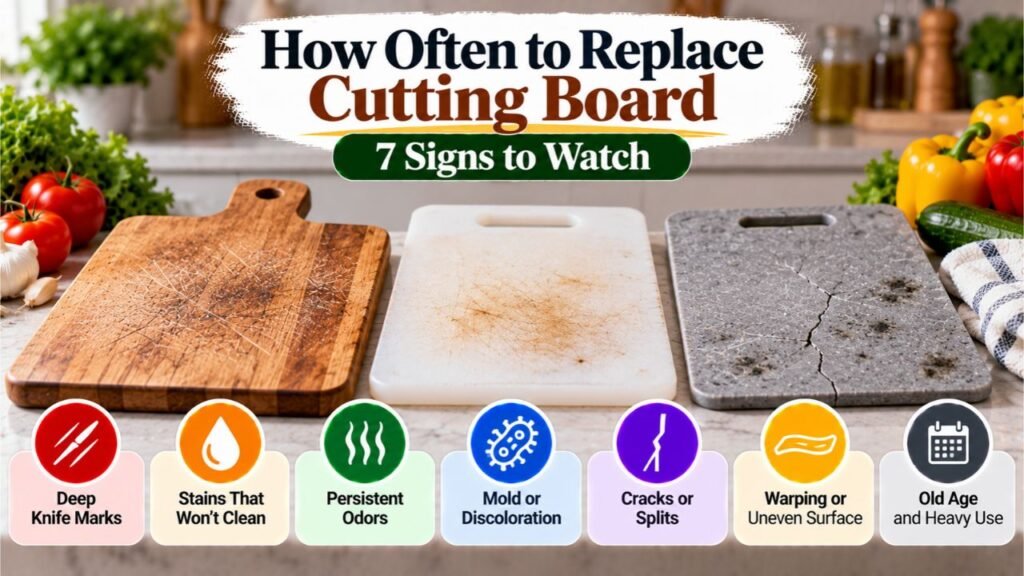
7 Signs It’s Time to Replace a Cutting Board
Visible wear is the most useful guide to cutting-board replacement.
Some damage affects hygiene, while other problems make a board unstable or create a risk of foreign material entering food.
1. Deep Knife Grooves That Are Difficult to Clean
Deep cutting grooves are among the clearest signs that a board needs replacing.
Repeated slicing and chopping gradually create marks on the surface.
Shallow scratches are normal, especially on plastic boards. They do not necessarily affect cleaning.
Deeper grooves are different.
Food particles, raw meat juices, and moisture can collect inside cuts that are difficult to reach with a sponge or brush.
The USDA specifically recommends replacing excessively worn boards with hard-to-clean grooves.
You can examine the surface under bright light and gently run a clean fingertip across it to locate rough areas.
If your fingernail repeatedly catches in deep cuts, inspect those areas for trapped residue.
The fingernail check is an informal warning sign, not an official USDA measurement or automatic replacement test.
The deciding issue is if the damaged surface can still be cleaned thoroughly.
2. Cracks, Splits, or Separating Wood Joints
Cracks and splits create spaces where food and moisture can become trapped.
These problems are common concerns with wooden and bamboo boards exposed to improper drying, prolonged soaking, or excessive heat.
A laminated wooden cutting board may also develop separation between glued pieces.
Look for:
- Cracks extending into the wood
- Open gaps between joined sections
- Splinters or loose fibers
- Damaged corners that expose internal layers
A small cosmetic surface mark is different from a structural crack.
If a board develops an opening that cannot be cleaned or creates splinters, replacement is the safer choice.
Adding mineral oil or wax does not repair a failed glue joint.
3. Warping That Makes the Board Unstable
A warped cutting board no longer rests evenly on a flat countertop.
It may rock, twist, or move during chopping.
That instability can reduce knife control, especially when applying pressure to firm ingredients.
Wooden boards can warp after uneven moisture exposure.
Plastic boards may also deform when exposed to dishwasher temperatures beyond their recommended limits.
To check stability, place the clean board on a dry, flat counter.
Press gently near each corner.
If it rocks or lifts noticeably, examine the board for permanent deformation.
A flat board that simply slides may only need a suitable non-slip mat or replacement rubber feet.
A permanently warped board that cannot provide a secure cutting surface should be replaced.
4. Persistent Odors or Sticky Residue
A cutting board should not retain strong unpleasant odors after proper washing and drying.
Some ingredients, such as garlic and onions, can leave temporary smells.
These odors do not automatically indicate bacterial contamination.
The concern increases when a board repeatedly smells sour, stale, or musty despite careful cleaning.
Sticky or greasy patches that remain after washing may indicate trapped residue or deteriorated cooking oil used for conditioning.
Start with a thorough wash using suitable dish soap.
Allow the surface to dry completely and inspect it again.
If objectionable residue or odors persist and cannot be removed, replacement may be necessary.
5. Mold-Like Growth or Unexplained Dark Patches
Dark discoloration on a wooden board can result from several causes, including food stains, moisture, wood extractives, or microbial growth.
A dark mark alone does not prove that mold is present.
More concerning signs include fuzzy growth, recurring dark patches inside cracks, or a persistent musty smell.
Moisture trapped in joints or damaged areas may create conditions that allow mold to develop.
A board with suspected growth deep inside cracks or separated joints should be discarded.
Do not assume that sanding the surface or applying mineral oil will resolve contamination inside damaged wood.
Ordinary food stains that wash clean and leave the board structurally sound are not automatically reasons to replace it.
6. Rough, Peeling, or Fraying Plastic
Plastic cutting boards can gradually develop rough surfaces after repeated knife use.
Some boards form raised ridges around deep knife marks.
Others develop small loose pieces or visible shavings.
A heavily worn plastic surface may be difficult to scrub and can release material during food preparation.
Research has shown that cutting on polyethylene and polypropylene boards can produce small plastic particles.
That finding does not establish that every scratched plastic board presents a proven health risk.
Still, loose fragments, peeling sections, and heavily damaged surfaces are sensible reasons to retire a plastic board.
I would replace a board that sheds visible pieces rather than continue chopping on it.
7. Chipped Glass or Damaged Metal Edges
Glass and metal boards develop different forms of damage.
A glass cutting board should be removed from food preparation immediately if it becomes chipped or cracked.
Small glass fragments may enter food, and damaged tempered glass can break unexpectedly.
Stainless steel boards do not crack like glass, but damaged edges, raised burrs, severe corrosion, or deformation can create hazards.
Inspect the corners, cutting surface, and underside.
An intact stainless steel board does not need replacing simply because it has minor cosmetic scratches.
Damage that creates sharp edges or interferes with cleaning is a stronger reason to stop using it.
Key Takeaway: Deep grooves, structural cracks, permanent warping, persistent residue, suspected mold, loose plastic, and damaged glass or metal are the main warning signs that justify replacement.
When Should You Replace a Plastic Cutting Board?
Plastic cutting boards should be replaced when knife wear makes their surfaces difficult to clean or when heat and physical damage affect stability.
Daily-use plastic boards deserve regular inspection because repeated chopping gradually cuts into the material.
How Long Do Plastic Cutting Boards Usually Last?
A frequently used plastic board may remain serviceable for several years, while another can develop serious wear much sooner.
The exact lifespan depends on the material, thickness, cutting habits, and cleaning conditions.
Some chefs recommend replacing heavily used plastic boards around once a year as a conservative practice.
That is an individual recommendation, not a federal expiration rule.
A useful approach is to examine a daily-use plastic board closely after its first year and continue checking its condition regularly.
Replace it sooner if deep knife marks or permanent warping appear.
Do not automatically discard a smooth, undamaged board only because it has reached a particular age.
When Plastic Scratches Become a Problem
Plastic naturally develops shallow cuts during use.
The problem begins when those cuts overlap, deepen, or create rough sections where residue remains after washing.
A board with numerous deep grooves may require replacement even if its original shape remains intact.
For a board used with raw chicken, fish, or meat, cleanability deserves close attention.
A heavily scored surface that no longer washes thoroughly should not remain in use for raw animal foods.
Can You Restore a Plastic Cutting Board?
Plastic boards generally are not good candidates for ordinary home resurfacing.
Sanding or scraping may leave an uneven surface, loosen additional plastic particles, or create new areas that are difficult to clean.
Some commercial plastic cutting surfaces are designed for professional resurfacing using suitable equipment.
Most inexpensive household plastic boards are better replaced once severe wear develops.
Key Takeaway: Replace plastic boards when deep grooves, permanent deformation, or loose material interfere with safe food preparation. A yearly inspection is useful, but age alone is not the deciding factor.
How Often Should You Replace a Wooden Cutting Board?
A quality wooden cutting board can last many years when properly cleaned, dried, and conditioned.
Some hardwood boards remain usable for more than a decade.
Unlike plastic, certain wooden boards can be restored through careful sanding and refinishing.
Signs a Wooden Board Needs Replacing
Examine the board for deep cracks, loose joints, splinters, and serious warping.
Also check for odors or residue that remain after washing.
A wooden board may develop ordinary knife marks without becoming unsafe.
If the surface remains smooth enough to clean and the board stays structurally sound, those marks do not necessarily require replacement.
A crack running deeply through the board is a different matter.
The opening may collect food and moisture, and washing may not reach the affected area.
If structural damage cannot be repaired appropriately, replace the board.
Can Sanding Extend a Wooden Board’s Life?
Yes. Some solid hardwood cutting boards can be resurfaced.
Light sanding removes shallow knife marks and rough fibers, allowing the surface to be refinished.
The board must have enough thickness to support the work, and the sanding process should maintain a flat cutting surface.
After sanding, remove dust, clean according to the maker’s instructions, dry fully, and apply an approved food-grade conditioner if appropriate.
A large butcher block or expensive end-grain board may justify professional resurfacing.
Sanding is not a dependable fix for deep structural cracks, separating joints, or suspected contamination trapped inside damaged wood.
Does Oiling Prevent Replacement?
Regular conditioning can reduce excessive surface drying, but it cannot prevent every kind of damage.
Food-grade mineral oil or an approved mineral oil and beeswax conditioner is commonly recommended for unfinished or oil-finished wooden boards.
Oiling does not disinfect wood or repair cracks.
The board still needs washing after use and complete drying before storage.
Key Takeaway: Wooden boards can last many years and may be resurfaced when damage is shallow. Replace boards with structural problems or contamination concerns that cannot be resolved.
When to Replace Bamboo, Rubber, and Composite Cutting Boards
Not all nonplastic boards age the same way.
Their construction and manufacturer recommendations determine how much surface wear they can tolerate.
Bamboo Cutting Boards
Bamboo boards are often made from laminated strips bonded together.
These boards may remain usable for years, but they can develop cracks, splinters, or separating joints after repeated moisture exposure.
Inspect the seams for openings.
A bamboo board should be replaced when the surface develops deep cracks, loose fibers, or structural separation that makes cleaning difficult.
Minor surface dryness may respond to manufacturer-approved conditioning.
Avoid prolonged soaking and dishwasher cleaning unless the product specifically permits it.
Rubber Cutting Boards
Rubber cutting boards provide a relatively resilient surface beneath kitchen knives.
High-quality products can tolerate substantial cutting activity, but they still develop wear.
Look for deep cuts, surface gouges, cracks, and permanent changes in shape.
Some professional rubber boards can be resurfaced according to manufacturer instructions.
Others should be replaced after significant damage.
Do not assume that every rubber board can be sanded, shaved, or exposed to dishwasher heat.
Composite Cutting Boards
Composite boards may contain wood fibers, paper fibers, resins, or other materials.
Their resistance to water, heat, and cutting varies by product.
Inspect for peeling, cracking, excessive grooves, and damaged edges.
Some composite boards tolerate dishwashers, while others have stricter temperature limits.
Follow the manufacturer’s care and replacement guidance.
Key Takeaway: Bamboo, rubber, and composite boards have different wear patterns. Replace them when surface or structural damage prevents proper cleaning, and use approved restoration methods only.
How to Check If Your Cutting Board Needs Replacing
A brief inspection can reveal most visible problems.
Use this five-step method when a board appears worn or has been in regular use for an extended period.
- Wash the board first. Remove food residue with hot, soapy water, rinse thoroughly, and allow the surface to dry.
- Examine the cutting surface. Look for deep knife grooves, rough patches, peeling material, and openings that hold food particles.
- Inspect the edges and joints. Check wooden boards for splitting, bamboo boards for separating strips, and glass boards for chips.
- Test stability. Place the board on a clean, flat countertop. Check for rocking, twisting, or permanent warping.
- Check for persistent residue or odors. A clean, fully dry board should not retain stubborn greasy patches, loose material, or unexplained musty odors.
Use the findings to decide what to do next.
| Board Condition | Recommended Action |
| Light scratches, stable surface | Continue using and cleaning |
| Dry-looking wooden surface | Condition if manufacturer recommends |
| Shallow wood knife marks | Consider suitable resurfacing |
| Deep grooves that cannot be cleaned | Replace or professionally resurface if appropriate |
| Open cracks or separating joints | Stop using; replace if not properly repairable |
| Plastic shedding visible pieces | Replace |
| Permanently warped board | Replace if cutting stability is affected |
| Chipped or cracked glass | Replace immediately |
| Persistent suspected mold in cracks | Replace |
Helpful Insight: A cutting board does not need to look new. It needs to remain stable, intact, and capable of being cleaned thoroughly.
The inspection process should focus on those conditions rather than appearance alone.
How to Make a Cutting Board Last Longer
Good maintenance can reduce unnecessary wear and delay replacement.
The most useful habits involve cleaning after use, proper drying, suitable conditioning, and avoiding damage from excessive heat or moisture.
Wash the Board After Each Use
The USDA recommends washing cutting boards with hot, soapy water after use.
Scrub the entire food-contact surface, including juice grooves and corners.
Rinse thoroughly with clean water and dry with clean paper towels or allow the board to air-dry.
Plastic boards that are approved for dishwasher cleaning can often be cleaned using the dishwasher.
Most laminated wooden and bamboo boards should be washed by hand because prolonged heat and moisture can damage their construction.
Sanitize After Handling Raw Animal Foods
Sanitizing reduces microorganisms that remain on a clean surface.
The USDA provides a method for wooden and plastic cutting boards using 1 tablespoon of unscented liquid chlorine bleach mixed with 1 gallon of water.
Apply the solution to the cleaned board, allow several minutes of contact, rinse thoroughly, and air-dry or pat dry with clean paper towels.
Follow the cleaning product’s directions and make sure the treatment is compatible with the cutting-board material.
Never mix chlorine bleach with ammonia, vinegar, or other cleaning products.
Sanitizing does not restore a cracked board or remove deep structural damage.
Keep Raw Meat and Produce Separate
The U.S. Food and Drug Administration recommends using separate cutting boards for raw meat, poultry, and seafood and for fresh produce.
This reduces cross-contamination, which occurs when harmful microorganisms move from raw animal foods to ingredients that may be eaten without cooking.
Color-coded boards can help maintain that separation.
For example, one board can be assigned to raw meat and another to bread, vegetables, and fruit.
If only one board is available, wash it thoroughly between different food-preparation tasks.
Dry Wooden Boards Properly
Moisture left against one side of a wooden board can contribute to uneven expansion and warping.
After washing, wipe away excess water.
Stand the board upright or place it on a rack where air can reach both sides.
Avoid placing a damp wooden board flat against a countertop for an extended period.
Do not store it in a closed cabinet until completely dry.
Condition Wood When Needed
Wooden boards may benefit from periodic applications of food-grade mineral oil or an approved board conditioner.
Conditioning reduces excessive drying and may help limit moisture absorption.
For regularly used boards, checking the surface about once a month is a sensible starting point.
Apply conditioner according to the manufacturer’s instructions.
Avoid olive oil, ordinary vegetable oil, and other cooking oils that can become rancid during storage.
Key Takeaway: Routine washing, complete drying, proper food separation, and manufacturer-approved conditioning preserve cutting-board condition and reduce avoidable replacement.
Does Using a Cutting Board for Raw Meat Change Replacement Frequency?
Using a board for raw meat does not create an automatic monthly or yearly replacement requirement.
The main concern is the board’s ability to be cleaned and sanitized after contact with raw meat juices.
Raw chicken, meat, and seafood may carry harmful microorganisms, including Salmonella and Campylobacter.
A deeply grooved board that cannot be washed thoroughly is a poor surface for raw animal food preparation.
A smooth, undamaged board can remain suitable when it is properly maintained.
For this purpose, I prefer a separate dishwasher-safe plastic board because routine cleanup is convenient.
Still, a plastic board used for raw meat should be replaced once knife wear makes cleaning difficult.
A clean, sound wooden board can also be used for raw meat when appropriate cleaning procedures are followed.
The important distinction is not the type of food alone, but the combination of surface condition, hygiene, and cross-contamination control.
Common Mistakes That Cause Premature Cutting Board Replacement
Leaving wooden boards submerged in water is a common cause of damage.
Extended soaking may contribute to swelling, warping, and splitting. Glued boards may develop weakened joints after repeated moisture exposure.
Dishwasher cleaning can also shorten the life of boards that are not rated for that method.
Another mistake is treating mineral oil as a repair product.
Conditioning helps maintain suitable wooden surfaces, but it cannot close deep cracks or restore severely damaged joints.
Using excessive force with heavy cleavers on thin cutting boards can also cause cracking or deformation.
A board designed for ordinary vegetable preparation may not tolerate repeated heavy chopping.
Finally, many people replace boards solely because of stains while ignoring deeper problems.
A harmless turmeric stain on an intact board may be cosmetic. A clean-looking board with an open crack can present a more serious cleaning problem.
Pay attention to structural integrity and cleanability rather than surface color alone.
Conclusion
Understanding how often to replace cutting board surfaces means paying attention to wear rather than relying on a fixed expiration date. Replace boards when deep grooves, cracks, structural damage, or persistent contamination concerns make thorough cleaning or stable cutting impractical.
Plastic boards often require closer attention because frequent knife contact creates grooves. Hardwood boards can remain useful for many years with suitable care, and some can be resurfaced. Bamboo, rubber, composite, and glass boards have their own replacement signs.
I recommend examining your cutting boards during normal cleaning and making a more careful inspection about once a month. If a board remains flat, intact, and straightforward to clean, age alone is not a reason to discard it.
When damage cannot be repaired safely, replacing the board is a sensible way to maintain a clean and stable food-preparation surface.
FAQs About Cutting Board Replacement
How often should you replace a plastic cutting board?
Replace a plastic cutting board when deep knife grooves, rough patches, warping, or cracks make it difficult to clean or use safely.
Some frequently used boards may show serious wear within a year, while others remain in good condition for several years.
The USDA does not specify a fixed replacement schedule.
Inspect the board regularly and discard it when excessive wear affects cleaning or stability.
How often should you replace a wooden cutting board?
A well-maintained wooden cutting board can last many years and sometimes more than a decade.
Replacement becomes necessary when deep cracks, splitting, damaged glue joints, or persistent hard-to-clean areas affect the surface.
Minor scratches may be addressed through careful sanding on suitable boards.
Regular washing, complete drying, and approved conditioning can extend a wooden board’s usable life.
Should I replace my cutting board every year?
Not necessarily.
There is no universal rule requiring every cutting board to be replaced annually.
A heavily used plastic board may need replacement within a year if deep grooves develop.
A wooden board in good condition may remain usable much longer.
Inspect the board for damage and replace it when wear prevents thorough cleaning or safe cutting.
Is it safe to use a cutting board with scratches?
Light scratches are normal on many cutting boards and do not automatically make them unsafe.
The concern is with deep grooves that collect food particles or cannot be cleaned properly.
A lightly scratched board that remains smooth enough to wash thoroughly may continue to be used.
Replace it when cuts become excessively deep, overlapping, or difficult to clean.
Can you sand a cutting board instead of replacing it?
Some solid wooden cutting boards can be restored by sanding away shallow knife marks and refinishing the surface.
The board must have adequate thickness and sound construction.
Sanding is not a dependable repair for deep cracks, severe warping, loose glue joints, or suspected contamination trapped inside damaged wood.
Most household plastic boards should be replaced rather than sanded after serious wear.
Do cutting boards expire if they are rarely used?
Cutting boards do not have a universal expiration date simply because time passes.
An unused board stored in suitable conditions may remain usable for many years.
Inspect it before use for cracks, warping, deterioration, damaged coatings, or contamination.
Materials such as wood can respond to changing humidity even during storage, so condition remains the best guide.
Should I replace a cutting board that smells bad?
Start by washing the board thoroughly with hot, soapy water and allowing it to dry completely.
Temporary odors from garlic, onions, or other ingredients may disappear after proper cleaning.
If a strong, unpleasant odor persists or returns repeatedly, inspect the surface for cracks, grooves, and trapped residue.
Replace the board if the odor cannot be removed and the surface cannot be cleaned satisfactorily.
When should you throw away a bamboo cutting board?
A bamboo cutting board should be discarded when it develops deep cracks, splinters, separating strips, or serious warping that affects cleaning or stability.
Bamboo boards are commonly made from laminated strips, so damaged joints deserve attention.
Minor knife marks and surface dryness do not automatically require replacement.
Hand-washing, complete drying, and manufacturer-approved conditioning can reduce premature deterioration.
Can an old cutting board make you sick?
An old cutting board can contribute to foodborne illness if harmful microorganisms remain on its surface and contaminate food.
Age alone does not make a board unsafe.
The main concerns are poor cleaning, cross-contamination, deep hard-to-clean grooves, cracks, and damaged surfaces.
A clean, intact older board may remain suitable for use, while a newer board with serious damage should be replaced promptly.