Birch vs Maple Cutting Boards: Which Wood Is Better?
Hard maple is generally the better choice for a durable, all-purpose wooden cutting board because it offers greater resistance to dents and knife marks. Yellow birch is a good alternative with a fine grain, solid cutting performance, and sometimes a lower price. Both woods are suitable for everyday food preparation when properly manufactured, cleaned, and maintained.
The difference becomes less straightforward when product labels simply say “birch” or “maple.” Not every birch species has the same hardness, and a soft maple board may actually be softer than a yellow birch board.
Selecting the proper wood can reduce deep cutting marks, improve chopping comfort, and help your board remain usable through years of regular preparation. The quality of the glue joints, grain orientation, and surface finish also affects how the board performs.
The U.S. Food and Drug Administration’s 2026 Food Code specifically recognizes hard maple or equivalently hard, close-grained wood for certain commercial cutting surfaces. The Wood Database also reports a Janka hardness of 1,450 pounds-force for hard maple, compared with 1,260 pounds-force for yellow birch.
What stood out to me during the research was how closely these two hardwoods compare in density and grain texture. The difference in indentation resistance is measurable, but it does not automatically mean maple will outlast every birch board.
For someone comparing birch vs maple cutting boards, the most useful distinction is between the exact wood species and the quality of the finished board. A well-constructed yellow birch board may perform better in daily use than an inexpensive maple board with poor joints or an unsuitable finish.
The differences in hardness, knife friendliness, moisture behavior, food safety, appearance, construction, and maintenance will help you choose the material that makes the most sense for your kitchen.
Birch vs Maple Cutting Boards: Quick Comparison
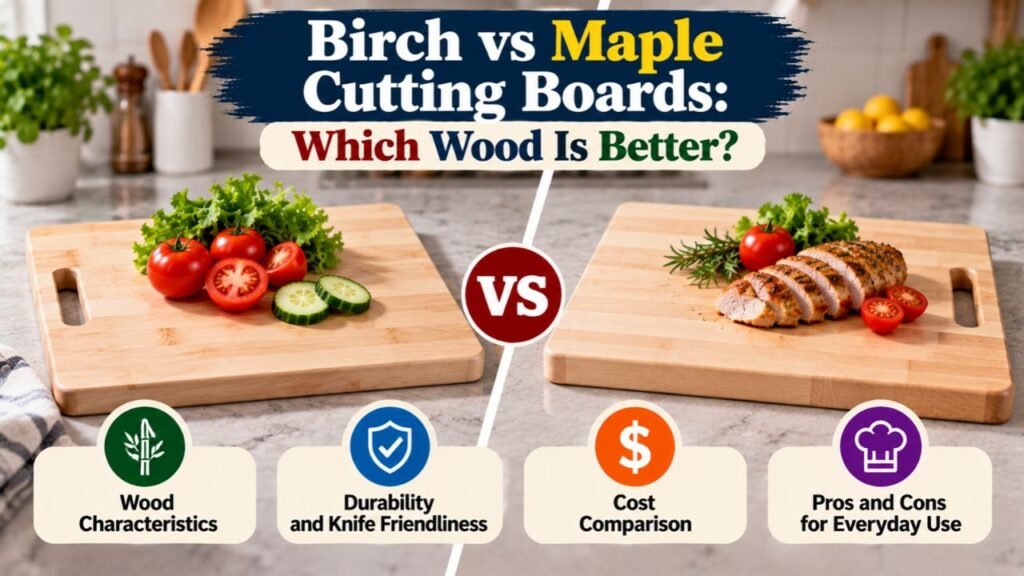
Birch and maple are both hardwoods with relatively fine, even grain structures. Both can be made into practical cutting boards, but hard maple generally has an advantage in resistance to surface indentation.
The comparison below focuses on yellow birch and hard maple, two North American species commonly used as reference points for these woods.
| Feature | Birch Cutting Board | Maple Cutting Board |
| Primary comparison species | Yellow birch (Betula alleghaniensis) | Hard maple (Acer saccharum) |
| Janka hardness | 1,260 lbf | 1,450 lbf |
| Average dried density | 43 lb/ft³ | 44 lb/ft³ |
| Grain texture | Fine, even, generally straight | Fine, even, generally straight |
| Knife friendliness | Good | Good |
| Dent resistance | Good | Slightly higher |
| Visible knife marks | May develop somewhat sooner | Generally better resistance |
| Water resistance | Requires protection from prolonged moisture | Requires protection from prolonged moisture |
| Food safety | Suitable when appropriately constructed and maintained | Established choice for cutting surfaces |
| Appearance | Pale cream to reddish brown | Creamy white to pale golden |
| Typical price position | Often affordable | Budget to premium |
| Maintenance | Hand-washing and periodic conditioning | Hand-washing and periodic conditioning |
| Best suited for | Everyday kitchen prep and budget-conscious buyers | Frequent chopping and long-term general use |
Overall winner: Hard maple, assuming similar board dimensions, construction quality, and price.
Yellow birch remains a strong alternative for ordinary home cooking. Its lower hardness does not make it unsuitable for repeated knife work.
What Are Birch and Maple Cutting Boards Made From?
Birch and maple come from different groups of trees, and both names cover multiple species.
This distinction matters because a product’s wood label may not identify its actual hardness or physical properties.
What Is a Birch Cutting Board?
A birch cutting board is a food-preparation board made from hardwood belonging to the Betula genus.
Birch trees are common across northern parts of North America, Europe, and Asia.
Several species are used for furniture, cabinetry, utensils, and other wood products.
Common examples include:
- Yellow birch (Betula alleghaniensis): A relatively hard North American species with a fine grain.
- Paper birch (Betula papyrifera): A lighter, softer species with a pale appearance.
- Sweet birch (Betula lenta): A dense species with a hardness rating close to hard maple.
- Silver birch (Betula pendula): A European species used in furniture and wood products.
The finished appearance typically ranges from creamy white to light reddish brown.
Birch generally has a fine, uniform grain, although individual boards may contain wavy or figured patterns.
For kitchen use, solid birch lumber or properly manufactured laminated solid-wood panels are preferable to assuming that ordinary birch plywood is suitable for direct food preparation.
What Is a Maple Cutting Board?
A maple cutting board is made from hardwood belonging to the Acer genus.
Maple has a long history of use in kitchen cutting surfaces, butcher blocks, and food-service equipment.
Two broad commercial categories are especially relevant.
Hard maple generally refers to sugar maple, also called rock maple. It has a dense structure and strong resistance to indentation.
Soft maple refers to several maple species, including red maple and silver maple.
The word “soft” is relative. Soft maple is still hardwood, but some species are considerably less resistant to dents than sugar maple.
Maple cutting boards usually have a pale cream or light golden appearance with subtle grain patterns.
Some boards feature darker mineral streaks, small color variations, or decorative grain figures.
For a primary kitchen cutting board, hard maple is the more established choice.
Key Takeaway: Birch and maple are broad wood categories. Verify the species before comparing hardness, since yellow birch, paper birch, hard maple, and soft maple do not provide identical cutting surfaces.
Which Wood Is Harder: Birch or Maple?
Hard maple is harder than yellow birch, but the comparison changes when different species are involved.
Janka Hardness Comparison
The Janka hardness test measures the force required to press a standardized steel ball halfway into wood.
Higher values indicate greater resistance to indentation under controlled test conditions.
The Wood Database reports these hardness ratings:
| Wood Species | Janka Hardness |
| Silver maple | 700 lbf |
| Paper birch | 910 lbf |
| Red maple | 950 lbf |
| Silver birch | 1,210 lbf |
| Yellow birch | 1,260 lbf |
| Hard maple | 1,450 lbf |
| Sweet birch | 1,470 lbf |
Hard maple has a Janka rating approximately 15% higher than yellow birch.
That suggests greater resistance to dents when the two species are subjected to similar conditions.
The difference is not enormous, and the ratings do not indicate a fixed difference in cutting-board lifespan.
Another interesting detail is that sweet birch has a listed hardness slightly above hard maple.
Therefore, saying that all maple is harder than all birch would be inaccurate.
Resistance to Knife Marks and Scratches
Every wooden cutting board eventually develops marks from knives.
Yellow birch’s somewhat softer surface may develop shallow impressions more readily than hard maple under similar cutting pressure.
Hard maple generally resists those impressions better.
That can be useful for cooks who regularly prepare:
- Firm vegetables such as carrots and squash
- Dense root vegetables
- Large quantities of chopped ingredients
- Foods requiring repeated downward cutting
A harder board will not remain scratch-free.
Knife sharpness, cutting technique, and grain construction still determine how visible those marks become.
A sharp blade used with controlled pressure may produce less surface damage than a dull blade pushed aggressively through food.
Does Harder Wood Always Last Longer?
No. Surface hardness is only one part of cutting-board durability.
A thick yellow birch board made from properly dried wood with secure glue joints may remain usable longer than a poorly constructed hard maple board.
Uneven moisture exposure, poor manufacturing, and incorrect cleaning can cause either material to warp or crack.
Janka ratings are useful for comparing indentation resistance, not predicting the exact number of years a cutting board will last.
I would choose hard maple for its slightly greater hardness when all other qualities are comparable. I would not reject a well-made birch board simply because its Janka rating is lower.
Key Takeaway: Hard maple generally resists dents better than yellow birch. Species identification and construction quality matter more than assuming every maple board is harder than every birch board.
Birch vs Maple: Which Is Better for Kitchen Knives?
Both yellow birch and hard maple are generally suitable for routine kitchen knife work.
Their cutting surfaces provide some cushioning compared with rigid materials such as glass, ceramic, or metal.
How Birch Affects Knife Edges
Birch provides a moderately hard surface that can yield slightly under knife pressure.
This makes it suitable for slicing vegetables, cutting fruit, and preparing herbs.
Yellow birch’s lower hardness does not automatically mean it will preserve knife edges longer than maple.
Knife-edge wear also depends on wood structure, cutting pressure, blade steel, and sharpening angle.
Still, birch is a reasonable choice for home cooks who want a traditional wooden cutting surface.
Very soft birch species may show more knife damage, even if they feel forgiving during cutting.
How Maple Affects Knife Edges
Hard maple has a reputation as a dependable cutting-board material because it combines hardness with a relatively fine grain.
Although it is harder than yellow birch, it is not so rigid that it behaves like a glass or stone surface.
Properly constructed hard maple boards can support repeated knife work without excessive surface deformation.
The cutting feel also depends on how the wood fibers are positioned.
An end-grain maple board may feel more forgiving than an edge-grain maple board.
A blade with a thin edge may still suffer damage if the user twists or strikes it with excessive pressure.
Which Is Better for Expensive Chef’s Knives?
Either properly made wood can work with high-quality kitchen knives.
For frequent use of a chef’s knife or santoku, I would pay close attention to board construction instead of choosing only by the Janka number.
An end-grain board made from a suitable hardwood may provide a softer cutting feel than a comparable edge-grain design.
Knife maintenance also matters.
Use controlled cuts, avoid twisting the knife into the wood, and do not scrape chopped ingredients sideways with the sharpened edge.
Key Takeaway: Both woods are suitable for kitchen knives. Hardness alone cannot establish which one preserves sharpness longer, and grain construction can influence cutting comfort as much as species choice.
Which Wood Is More Resistant to Water and Warping?
Neither birch nor maple is waterproof.
Both absorb and release moisture as kitchen conditions change.
The main risks include prolonged soaking, uneven drying, and repeated exposure to high heat.
How Birch Handles Moisture
Birch is not naturally resistant to prolonged dampness or decay.
The Wood Database describes birch as perishable when exposed to conditions that encourage deterioration.
In kitchen use, moisture can enter the board through exposed wood fibers, unfinished areas, and damaged surfaces.
When wood absorbs water, it swells. When it dries, it shrinks.
Repeated uneven movement can produce:
- Cupping or warping
- Surface cracks
- Raised grain
- Rough cutting areas
- Separation along poorly made glue joints
A birch board can remain stable with proper care.
The concern is leaving it wet for extended periods, not the brief water exposure associated with ordinary hand-washing.
Is Maple More Water-Resistant?
Hard maple is commonly recommended for cutting boards because of its fine grain, strength, and established use in food preparation.
Still, it absorbs moisture and can warp or split.
The wood is not naturally waterproof, and it does not become waterproof after mineral oil is applied.
Available wood-property measurements do not justify claiming that every hard maple board absorbs less water or warps less than every birch board.
Differences in grain orientation, drying quality, and board construction can outweigh species differences.
A flat, properly dried birch board may remain stable while an unevenly dried maple board develops distortion.
Does Wood Density Prevent Warping?
Not by itself.
The Wood Database lists average dried weights of:
- Yellow birch: 43 pounds per cubic foot
- Hard maple: 44 pounds per cubic foot
These densities are very close.
A maple board of the same dimensions is not automatically much heavier than a yellow birch board.
Wood movement also depends on the direction of the grain and moisture changes inside the material.
Dense wood can still warp.
Proper manufacturing and even drying remain important for both materials.
Key Takeaway: Both birch and maple need protection from standing water and uneven moisture. Hard maple is not guaranteed to resist warping better, and neither board should be soaked or stored while damp.
Are Birch and Maple Cutting Boards Safe for Food?
Both can be suitable for home food preparation when made from appropriate wood and food-contact materials.
The condition of the cutting surface and the cleaning routine matter more than assuming one species is naturally free from bacteria.
Grain Structure and Food Safety
Birch and maple are generally classified as diffuse-porous hardwoods.
Diffuse-porous means the wood vessels are distributed across the growth rings rather than concentrated in large bands.
Both materials have relatively fine, even textures.
This is useful for producing smooth cutting surfaces that can be maintained and refinished.
Neither wood is completely nonporous.
Liquids can enter exposed wood, especially through end grain, cracks, or damaged areas.
The FDA’s 2026 Food Code permits hard maple or equivalently hard, close-grained wood for specified commercial cutting applications.
That provision provides a clear basis for hard maple’s established suitability.
It does not automatically approve every birch species, every wood finish, or every manufactured board for commercial food-service use.
For home kitchens, a properly manufactured solid birch board can also be a reasonable cutting surface.
Bacterial Contamination and Cleaning
Neither birch nor maple should be described as self-sanitizing.
Bacteria may remain on dirty cutting surfaces, especially when food residue collects in cracks or damaged joints.
The USDA states that wood and nonporous cutting boards may both be used for raw meat and poultry in home kitchens.
It recommends separating boards used for raw meat, poultry, and seafood from boards used for fresh produce, bread, and other ready-to-eat foods.
For everyday cooking, I prefer keeping a separate dishwasher-safe plastic board for raw poultry and using a wooden board for vegetables, fruit, and bread.
That arrangement simplifies cleaning and reduces accidental cross-contamination.
Does Birch Have Food Safety Disadvantages?
Birch does not become unsafe merely because it is slightly softer than hard maple.
The more meaningful questions concern the board’s construction, finish, and condition.
Check that the product is intended for direct food contact.
Avoid boards with unidentified coatings, exposed unsuitable adhesives, loose wood fragments, or cracks that trap food.
The same precautions apply to maple.
People with a known sensitivity to a specific wood should also seek appropriate product and medical guidance before use.
Key Takeaway: Both woods can be used for food preparation. Hard maple has explicit recognition in the FDA Food Code, while safe use of either material depends on suitable construction, proper cleaning, and preventing cross-contamination.
Edge Grain vs End Grain: Does Construction Matter More Than Wood Type?
Grain orientation can have a major influence on the feel and durability of a wooden cutting board.
It is worth checking before comparing the price of birch and maple products.
Edge-Grain Birch and Maple Boards
An edge-grain cutting board is constructed with the long grain of the wood facing upward.
The surface usually shows long parallel grain lines.
Edge-grain boards are common because they are relatively straightforward to manufacture and are available in many thicknesses.
Advantages include a stable cutting surface, relatively simple maintenance, and often lower prices than comparable end-grain boards.
The main limitation is that repeated knife contact cuts across exposed long-grain fibers.
Over time, visible knife marks may accumulate.
An edge-grain hard maple board generally offers greater resistance to indentation than a similarly constructed yellow birch board.
End-Grain Birch and Maple Boards
An end-grain cutting board is made with the ends of the wood fibers facing upward.
This construction often creates a checkerboard or block pattern.
During cutting, the knife interacts with the ends of the fibers rather than cutting primarily across the long grain.
The structure can provide a more forgiving cutting feel and reduce the appearance of some surface marks.
Both birch and maple can be used in end-grain construction.
Hard maple is a popular choice for substantial butcher blocks and premium kitchen cutting boards.
End-grain boards usually require more material preparation and glue joints, which can increase manufacturing costs.
They also need careful moisture management because end grain absorbs water readily.
Key Takeaway: A well-made end-grain board may offer a more forgiving cutting experience than an edge-grain board of the same wood. Construction quality should be evaluated alongside hardness and price.
How to Clean and Maintain Birch and Maple Cutting Boards
Birch and maple require nearly identical maintenance.
Consistent hand-washing, thorough drying, and occasional conditioning are more useful than relying on supposed natural water resistance.
Daily Cleaning Routine
Use this process after preparing food on either board.
- Remove food residue. Scrape away loose ingredients with a suitable food-safe scraper.
- Wash with soap and water. Clean the surface using warm or hot soapy water and a sponge or soft brush.
- Clean the edges and underside. Pay attention to handles, juice grooves, and areas near glue joints.
- Rinse thoroughly. Remove soap residue with clean water without soaking the board.
- Dry immediately. Wipe away excess water with a clean towel.
- Allow complete air-drying. Stand the board upright or place it on a rack where air reaches both faces.
Most laminated wooden cutting boards should not go in the dishwasher.
The USDA warns that laminated boards can crack or split during dishwasher cleaning.
Although some solid wood boards may tolerate dishwasher washing, hand-washing is the safer routine for most manufactured birch and maple boards.
Oiling and Conditioning
Food-grade mineral oil is commonly used to condition wooden cutting boards.
A suitable beeswax-based cutting-board conditioner is another option.
Apply the finish only after the board is completely clean and dry.
Spread a thin, even layer across the cutting surface and exposed edges, allow it to absorb according to the product instructions, and wipe away any excess.
There is no universal oiling schedule for either species.
A monthly inspection is a practical starting point.
If the surface becomes dry, rough, or pale, conditioning may be needed sooner.
Avoid ordinary cooking oils such as olive oil or vegetable oil because they can become sticky or rancid over time.
Tip: Food-grade mineral oil slows rapid moisture absorption but does not create a waterproof barrier. Proper washing and drying still matter.
Preventing Cracks and Deep Surface Damage
Both materials should be kept away from extended exposure to water or direct heat.
Avoid placing a wet board flat against a countertop where its underside cannot dry.
Do not place wooden boards near hot burners or leave them in strong sunlight for long periods.
Inspect the surface and glue joints regularly.
Light knife marks are expected.
Deep cracks, loose joints, or grooves that cannot be cleaned properly may justify replacing the board.
The USDA recommends discarding cutting boards that become excessively worn or develop hard-to-clean grooves.
Key Takeaway: Birch and maple need the same basic care: hand-washing, immediate drying, periodic conditioning, and inspection for cracks or deep knife damage.
Appearance, Weight, and Price Differences
Birch and maple have similar natural color ranges, which can make them difficult to distinguish in product photographs.
Their visual differences become easier to recognize when comparing untreated wood samples.
Birch Cutting Board Appearance
Birch commonly has a light cream or pale brown surface.
Some sections feature reddish or warm golden tones.
The grain is generally fine and fairly uniform, although certain boards show gentle waves or decorative figures.
Birch can look slightly warmer than pale hard maple.
It fits kitchens with light wood cabinets, natural countertops, and simple decorative accents.
Its understated appearance also works well for serving bread, cheese, and other prepared foods.
Maple Cutting Board Appearance
Hard maple often has a creamy white to pale golden color.
Its grain is typically subtle, creating a clean and consistent look.
Some maple boards feature mineral streaks or darker heartwood sections.
The relatively light surface can make crumbs, staining, and food residue easier to notice.
Maple also changes appearance as it ages and is exposed to light.
A board treated with mineral oil may appear warmer and slightly darker than unfinished lumber.
I prefer hard maple for a clean, traditional cutting-board appearance. Birch is attractive when a somewhat warmer grain pattern is desired.
Which Wood Costs Less?
Birch cutting boards may cost less than comparable hard maple products, but that is not guaranteed.
The price depends on species, board size, thickness, production methods, and brand.
A simple edge-grain maple board may be less expensive than a thick, handcrafted birch end-grain board.
Likewise, premium maple butcher blocks can cost considerably more than basic birch boards.
Price comparisons are most useful when the products have similar dimensions and construction.
The density difference between yellow birch and hard maple is small, so board thickness and size generally matter more for weight.
Key Takeaway: Birch and maple both offer attractive light-colored surfaces. Birch may provide a lower-cost alternative, while hard maple has a well-established position in premium butcher blocks and everyday cutting boards.
Which Is Better for Different Kitchen Tasks?
The best choice changes slightly with cutting habits, board design, and budget.
For Everyday Vegetable Preparation
Both woods are suitable for cutting onions, carrots, potatoes, fruit, and herbs.
Hard maple offers an advantage in resistance to indentation.
That is useful when a board receives frequent knife contact throughout the day.
Yellow birch remains suitable for routine meal preparation and may offer comparable comfort when constructed in the same grain orientation.
For a home cook preparing a few meals daily, the difference may be less noticeable than the board’s thickness and stability.
For Heavy Chopping and Butcher Blocks
Hard maple is the stronger general recommendation for frequent chopping and substantial butcher-block construction.
Its hardness, fine grain, and established history in food preparation support that preference.
A thick maple end-grain board is an option for cooks who regularly handle large volumes of ingredients.
Birch can also be used for heavy cutting, but its species and construction deserve close attention.
Avoid assuming that every product labeled “birch butcher block” is made from yellow birch or another relatively hard species.
For Budget-Friendly Home Cooking
A properly made birch cutting board can provide good everyday value.
It may be a sensible option for someone who wants a wooden board without paying for a premium hard maple butcher block.
The wood should be properly dried, smooth, and intended for food contact.
A lower price becomes less attractive if the product has visible cracks, poor glue joints, or an unstable surface.
If the two boards have similar quality and nearly identical prices, I would choose hard maple for its slightly greater resistance to dents.
Key Takeaway: Hard maple is my preference for frequent chopping and long-term general use. Birch is a practical alternative for ordinary kitchen preparation when the product offers sound construction and good value.
What to Check Before Buying a Birch or Maple Cutting Board
A cutting board’s label should not be the only basis for choosing it.
Before purchasing, inspect the following details:
- Exact wood species: Look for hard maple, yellow birch, or another clearly identified species. Generic labels may hide meaningful hardness differences.
- Solid wood construction: Check that the board is intended for direct food preparation. Ordinary Baltic birch plywood should not automatically be treated as a substitute for a solid wood cutting board because adhesive, finish, and exposed-edge suitability require verification.
- Grain orientation: Edge-grain boards usually offer good value, while end-grain models may provide a more forgiving cutting feel.
- Board thickness: A thicker board can feel more substantial and resist flexing, but proper drying and construction are still necessary to prevent warping.
- Glue joints: Look for tight, clean connections without gaps, separation, or exposed adhesive.
- Food-contact finish: Confirm that the surface coating or conditioner is suitable for cutting-board use.
- Cutting area: Compare usable space rather than relying only on overall dimensions. Juice grooves and handles can reduce the main cutting surface.
- Stability: The board should sit flat without rocking. Nonslip feet or a suitable mat may improve grip on a smooth countertop.
One detail deserves extra attention: some products marketed as butcher blocks are intended primarily as countertops or serving surfaces.
Confirm that the product is designed for direct knife contact rather than decorative use alone.
Conclusion
In the birch vs maple cutting boards comparison, hard maple is generally the stronger overall choice because of its greater indentation resistance, fine grain, and established use in kitchen cutting surfaces. Yellow birch is also a good material and can provide similar everyday usefulness at an attractive price.
Species differences are important. Soft maple may be less resistant to dents than yellow birch, and some birch species are much harder than others. Grain orientation, board thickness, manufacturing quality, and moisture exposure also influence long-term durability.
I recommend hard maple for a primary wooden cutting board used frequently. For lighter everyday preparation or a limited budget, a well-made yellow birch board is a sensible alternative. Whichever material you select, proper washing, complete drying, and periodic conditioning will do more for its longevity than relying on hardness alone.
FAQs About Birch and Maple Cutting Boards
Is birch wood good for a cutting board?
Yes. Birch can be a good cutting-board material, especially when the board is made from a relatively hard species such as yellow birch.
Yellow birch has a Janka hardness of approximately 1,260 lbf and a fine, even grain suitable for ordinary kitchen cutting.
The board should be made with appropriate food-contact materials, sound joints, and a smooth surface. It also needs proper cleaning and drying because birch is not naturally resistant to prolonged moisture exposure.
Is maple better than birch for cutting boards?
Hard maple is generally preferable to yellow birch for resistance to dents and surface indentation.
It has a Janka hardness of 1,450 lbf compared with yellow birch’s 1,260 lbf.
Both materials are suitable for everyday kitchen use when properly constructed.
A well-made birch board can still be a better purchase than a poorly manufactured maple product. The wood species should be considered alongside thickness, grain orientation, finish, and overall construction quality.
Which is more knife-friendly, birch or maple?
Both yellow birch and hard maple provide suitable wooden cutting surfaces for kitchen knives.
Birch is somewhat softer, but that does not prove it will preserve sharpness longer.
Knife wear depends on blade geometry, cutting technique, wood structure, and grain orientation.
A properly made end-grain board may feel more forgiving than a similar edge-grain design. For normal slicing and chopping, either wood is a reasonable choice.
Does birch warp more easily than maple?
Birch and maple can both warp when exposed to uneven moisture or improper drying.
Wood movement varies by species, grain direction, drying quality, and board construction.
There is no dependable rule that every birch cutting board will warp sooner than every maple board.
Wash either material by hand, wipe away excess water, and allow airflow around both surfaces. Avoid soaking and storing a damp board flat against the countertop.
Are birch cutting boards food-safe?
Properly manufactured birch cutting boards can be suitable for home food preparation.
Choose a board made from an identified wood species with food-contact-safe adhesives and finishes.
Keep the surface clean and inspect it for cracks or deep cutting grooves.
The FDA Food Code specifically recognizes hard maple and equivalently hard, close-grained woods for certain commercial food-contact applications. That does not mean every birch product automatically meets commercial food-equipment requirements.
How often should I oil a birch or maple cutting board?
Inspect the cutting board approximately once a month and apply food-grade mineral oil when its surface becomes dry or rough.
The needed frequency depends on washing habits, humidity, finish, and use.
Apply oil to a completely dry board, spread it evenly, and wipe away any excess after the recommended absorption time.
Both materials benefit from conditioning, but neither requires a fixed universal oiling interval.
Is soft maple better than yellow birch?
Not necessarily.
The Wood Database lists yellow birch at 1,260 lbf on the Janka scale, while red maple is rated at 950 lbf and silver maple at 700 lbf.
That means yellow birch is harder than these two soft maple species.
Soft maple can still be used for certain kitchen products, but the name “maple” alone does not guarantee hard maple’s greater indentation resistance.
For an accurate comparison, verify the specific wood species.
Can I use Baltic birch plywood as a cutting board?
Ordinary Baltic birch plywood is not my recommendation for a primary cutting board.
Plywood contains multiple veneer layers joined with adhesive. Cutting exposes the surface to repeated knife contact and moisture, while the edges may expose glue lines and layered construction.
Do not assume that furniture-grade or cabinet-grade plywood has been manufactured for repeated food contact.
A solid birch cutting board made with suitable food-contact materials is a more dependable choice for regular chopping and slicing.