

Mueller Pro-Series 10-in-1 8 Blade Vegetable Chopper Reviews
Mueller’s eight-blade manual chopper is a sensible option for cooks who regularly dice vegetables and want slicing and grating attachments in the same kit. Its tradeoffs are the force needed for firm foods, trimming before chopping, and cleaning scraps from the cutting grid. It suits repeated prep better than occasional tiny portions.
Useful Mueller Pro-Series 10-in-1 8 blade vegetable chopper reviews must separate the current model from older versions. Otherwise, different containers, blade assortments, and release mechanisms can get mixed into the same buying advice.
For someone preparing several vegetables for a salad or a week of lunches, a grid chopper offers a practical benefit: repeatable cuts without making every cut individually. That benefit matters most when the chopping saved outweighs assembly and washing.
Mueller’s current U.S. specifications list a 7.5-cup container for the MC-780, along with ¼-inch and ½-inch dicing grids. These are manufacturer specifications, so buyers should match them to the model offered by their seller.
I would judge this chopper by the tasks it will handle every week. Eight attachments are useful only if their cuts fit the meals you actually cook.
The following assessment covers blade selection, food texture, cutting effort, cleanup, price, replacement parts, and differences between versions, so you can decide how well the Mueller fits your kitchen.
Mueller Pro-Series 10-in-1 8 Blade Vegetable Chopper Reviews: Verdict

My verdict: consider it for frequent diced vegetables and mixed prep tasks, with realistic expectations about force and cleanup. A cook making chopped salads, soup ingredients, and vegetable toppings has a clearer reason to buy it than someone slicing one tomato for a sandwich.
I base this assessment on Mueller’s current documentation and published product evaluations. Older hands-on reviews provide useful context, but they do not establish the lifespan or exact performance of every newer version.
The appeal is convenience across several cuts. You can prepare a batch using one insert, change to another attachment, and collect ingredients underneath.
The compromise is that each used attachment adds something to wash and store. A kitchen knife also remains part of the process because vegetables still need peeling, trimming, and sizing.
For someone who dislikes detailed cleaning or has difficulty pressing firmly with both hands, I would look more closely at a simpler knife setup or a suitable electric chopper.
Check the Exact Model Before Buying
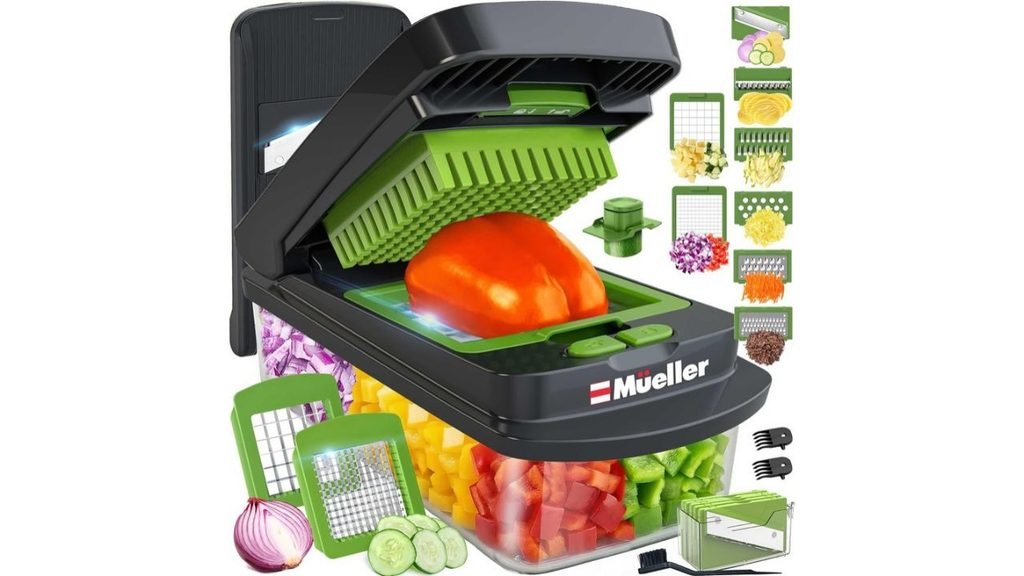
The current plastic-container version on Mueller’s U.S. site is the MC-780. The MSS-780 is a separate stainless-container option, listed at 8.5 cups.
Some older product evaluations describe different containers and blade assortments. A familiar product name or matching color is not enough to confirm that two listings contain identical equipment.
Before ordering, compare the model number, container material, photographs of the inserts, and included accessories. Keep a copy of the seller’s description and your order confirmation.
For storage planning, Mueller lists the current MC-780 at a maximum of 11 × 6 × 5 inches. Leave room for handling the attachments and opening the cover during use; the stored dimensions do not describe the entire working area.
What the Eight Blades Actually Do
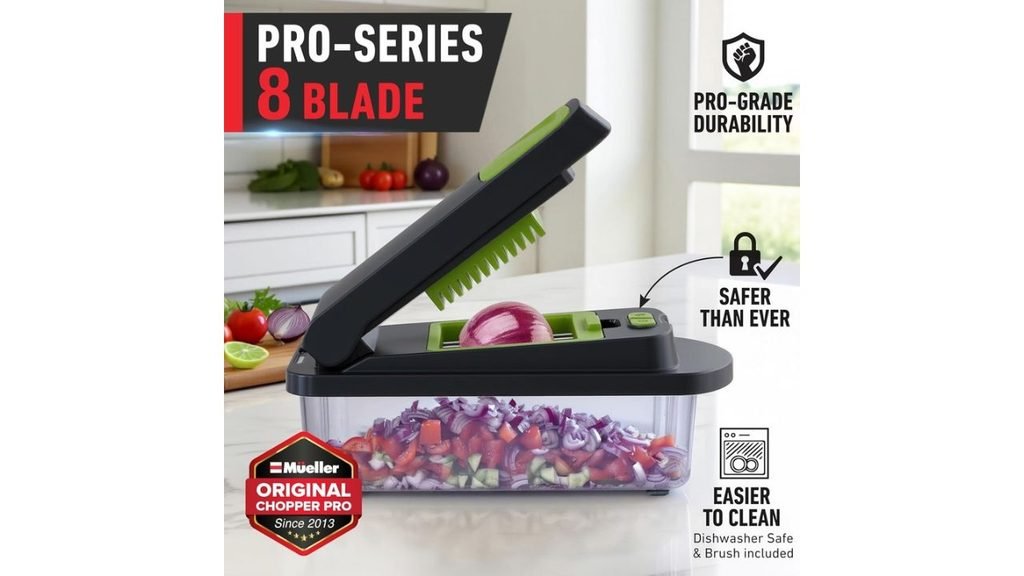
The current kit combines two dicing grids with six slicing and grating inserts. The following table reflects the current MC-780 assortment; older bundles may differ.
| Insert | Main purpose |
| Small dicer | Smaller diced pieces |
| Large dicer | Larger diced pieces |
| Straight slicer | Flat slices |
| Wavy blade | Ridged slices |
| Julienne blade | Narrow strips |
| Grater | Grated ingredients |
| Coarse grater | Coarser grated texture |
| Fine grater | Finer grated texture |
“10-in-1” does not mean ten separate blades. Compare the physical inserts shown in the selected bundle instead of assuming the name promises ten different cutting attachments.
A dicer forces food through a grid. A slicer cuts across a piece of food as it moves over an edge. A grater removes smaller pieces through cutting openings. Those motions suit different recipe results.
There is also a difference between even spacing and perfect cubes. The grid controls the spacing of cuts in two directions; the thickness of the food before pressing affects the remaining dimension.
For example, a thick slab pushed through a small grid produces longer pieces than a thinner slab. If a recipe calls for neat cubes, the preliminary knife cuts still matter.
Cutting Results With Common Vegetables
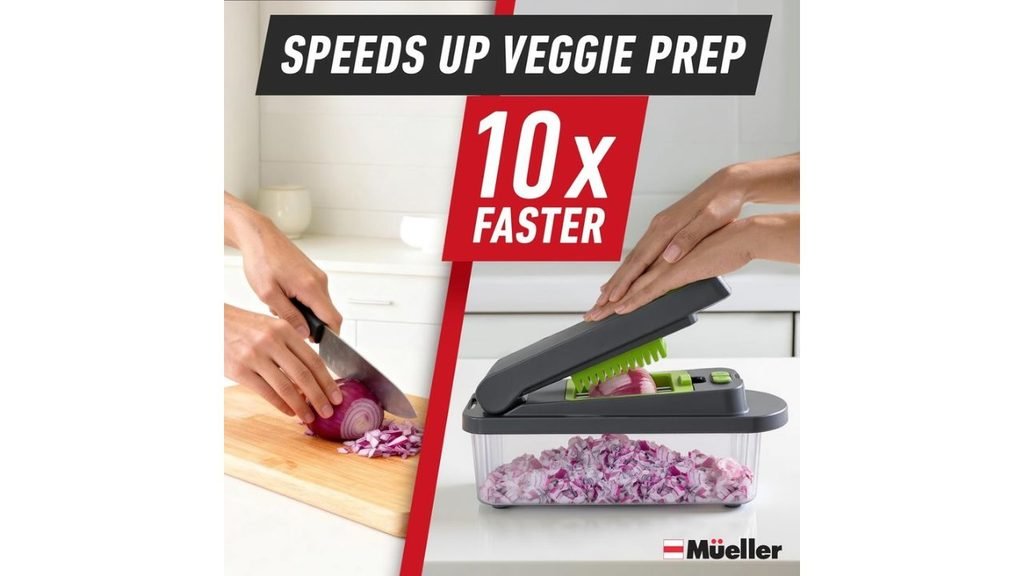
Onions, Bell Peppers, and Cucumbers
Repeated dicing is the clearest reason to consider this style of chopper. These ingredients often appear together in chopped salads, relishes, and toppings, making one prepared batch more practical than repeated setup for tiny portions.
Published testing of an earlier Pro-Series unit reported tidy onion pieces and relatively low pressure compared with other choppers in that test. Another evaluation found that halved onions still required considerable force. Those results describe different experiences, so “easy chopping” should not be treated as a promise for every user.
My practical preference is to begin with a modest portion that rests flat. A whole vegetable that barely fits offers little advantage if it makes the press difficult to control.
For peppers, remove the stem, seeds, and bulky inner sections first. For cucumber salads, choose a piece size that fits the other chopped ingredients and the texture you want.
Tomatoes and Other Soft Ingredients
Tomatoes deserve cautious expectations. One published Pro-Series evaluation reported clean tomato cuts, while another reported squashing and splatter during chopper testing. The available evidence does not support promising tidy results with every tomato.
My reading of that disagreement is that ripeness, thickness, and preparation deserve attention. A firm piece and a very soft, ripe piece do not resist pressure in the same way.
Try a small amount before committing a whole batch. If the flesh compresses while the skin remains caught, switch to a knife instead of repeatedly pressing the same piece.
For presentation slices or delicate fruit, a careful knife cut may be the better choice. The goal is the texture required by the dish, rather than using the chopper for every ingredient.
Potatoes, Carrots, and Dense Produce
Firm vegetables make preparation and hand strength more relevant to the buying decision. The question is how comfortably you can complete the repeated presses required for your usual portions.
Do not take a successful onion demonstration as proof that a thick carrot section will feel the same. Reduce dense ingredients to manageable portions and select a cut suited to the recipe.
For carrot slaw, grated texture may be more useful than cubes. For potatoes, think about the intended cooking method before choosing the grid or slicer.
Stop if the tool shifts, the frame visibly flexes, or the food will not pass through with controlled pressure. Reassess the portion and assembly instead of escalating the force.
Slicing and Grating Larger Batches
An earlier hands-on evaluation found the smaller slicing and grating surface less suited to those tasks than a dedicated mandoline. That is worth considering if your main purchase goal is frequent large batches of sliced vegetables.
For a salad needing some grated carrot and cucumber slices, having the attachments together may appeal. For a whole meal built around evenly sliced potatoes, I would compare the working surface and thickness options with a dedicated slicer.
Mueller’s current manual specifies 2 mm straight slices. Check that cut against your recipe instead of assuming the attachment has adjustable thickness.
Herbs, Tiny Quantities, and Precision Cuts
I would keep a knife available for a little chopped parsley, one garlic clove, or carefully sized garnish. Setting up a multi-part tool for a tiny amount can create more washing than the job justifies.
This is also a matter of control. A knife gives you a direct way to adjust each cut, remove a tough bit, and stop when the texture looks right.
Use the Mueller when repeated cuts are the tedious part of the recipe. Use another method when ingredient inspection or fine adjustment takes more attention than the cutting itself.
Key Takeaway: Match the attachment and portion to the food; repeated dicing is a stronger reason to buy than an expectation that every ingredient will cut equally well.
How to Use the Current Mueller Chopper
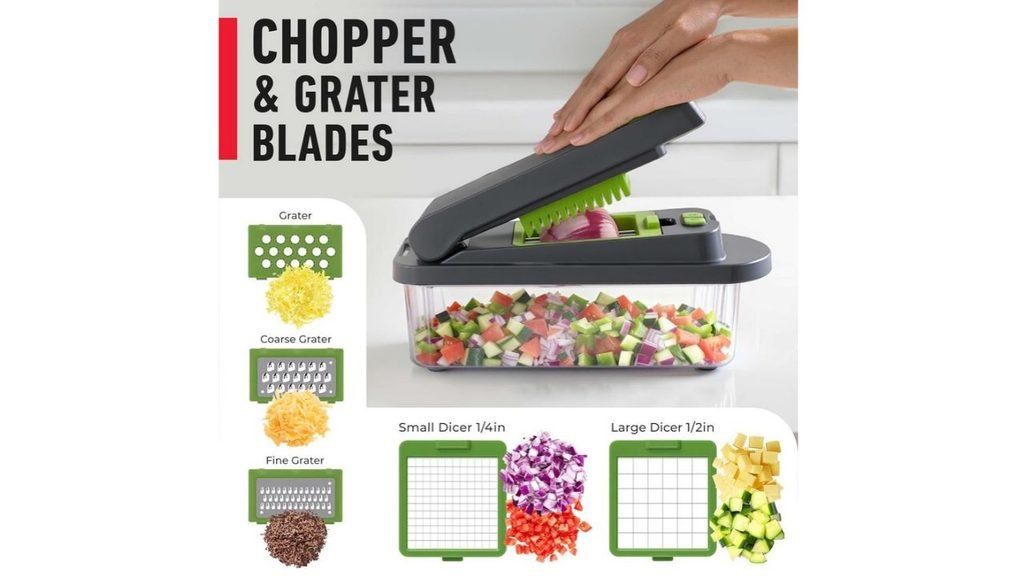
Begin with washed produce, a clear counter, a knife for preliminary trimming, and a bowl for finished ingredients. The FDA recommends rinsing fresh produce under running water and advises against washing it with soap or detergent.
For the current MC-780, Mueller’s instructions support this basic sequence:
- Secure the base to the container. Attach the cover and pusher correctly.
- Fit and secure a dicing grid. Hold its plastic frame.
- Size the food. Keep it within the grid, flat-side down.
- Press the cover with both hands. Keep fingers away from the blade.
- Stop for a jam. Clear scraps using the supplied cleaning tools.
For slicing or grating, use the food holder to move food across the insert. Follow your version’s assembly instructions.
For a batch of soup ingredients, prepare and collect each vegetable separately if the recipe adds them at different times. Combining everything in the catch tray too early creates another sorting job.
Keep the next ingredient ready before starting, and set the receiving bowl close enough that transferring food does not require carrying an assembled chopper around the kitchen.
Tip: Judge convenience across the whole recipe. Include trimming, switching inserts, transferring food, and washing when comparing the Mueller with your usual knife routine.
Cleanup, Dishwasher Limits, and Blade Storage
Hand Washing and Stuck Food
Cleaning the container is only part of the job. The grid and the underside of the cover are the places to inspect closely after chopping.
Published tests describe onion fragments and other scraps remaining in these areas, even after initial washing. That is a reason to budget for detailed cleanup instead of assuming a rinse will finish the task.
Mueller recommends prompt washing with warm, soapy water and its cleaning tools, followed by drying and protected storage.
I would wash the parts before food dries into the corners. Keep blades visible while cleaning, and avoid leaving them hidden beneath other utensils in a sink.
Dishwasher Temperature Matters
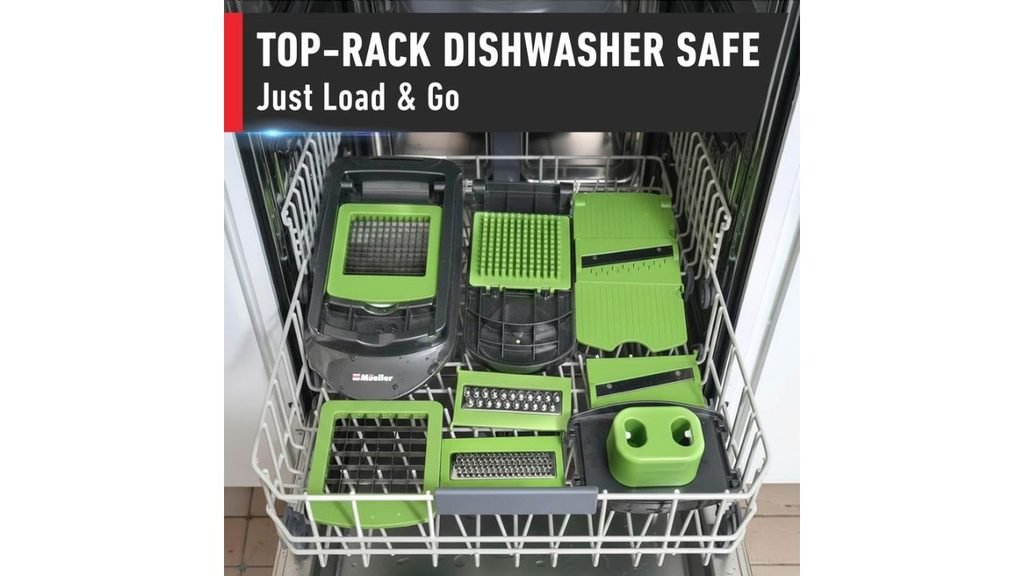
The current manual permits the top rack only, at temperatures below 150°F (65°C). Check that limit against your dishwasher’s programs.
Check your dishwasher instructions before selecting a hotter cycle. If you cannot confirm that the program stays within the chopper’s limit, hand washing is the straightforward option.
Inspect the cleaned parts before putting them away. Machine washing still needs to leave the grid and pusher free of trapped food.
Keeping the Attachments Together
Choose a storage location before buying. A tool with several small cutting inserts becomes inconvenient if the correct attachment or food holder disappears behind other equipment.
Keep protected blades, the holder, and cleaning tools together. Store them where children cannot reach them and where someone reaching into a drawer will not encounter an exposed cutting edge.
You can also reduce washing by taking out only the insert required for the job. Spare attachments do not need to cover the counter during routine onion prep.
Key Takeaway: Cleanup is a real ownership cost; plan for grid inspection, suitable washing temperatures, and protected storage.
Durability, Replacement Parts, and Warranty
A stainless-steel blade does not tell you how long the entire assembly will last. Hinges, the pusher, the blade frame, and the container also affect continued use.
I would pay attention to alignment before each session. If parts no longer seat correctly, forcing them together is a poor trade for a few minutes of chopping.
Do not attempt to straighten a damaged cutting grid and resume food prep. A replacement part confirmed for the model is a more sensible route than improvising a repair near sharp edges.
Mueller directs requests for chopper replacement parts within warranty to its support service. Have the model number, order information, and a clear photo of the affected part ready.
Ask for confirmation of compatibility before buying a replacement from another listing. Similar dimensions do not prove that an insert will seat correctly or line up with the pusher.
Do not assume a lifetime warranty. The current general warranty page does not establish that term for this manual chopper, so request the applicable coverage for your order.
Price and Value for Different Kitchens
Mueller’s U.S. storefront listed the current plastic-container model at $49.99 on October 20, 2026. Treat that as a dated direct-store price; check the selected seller’s current total and exact bundle before purchasing.
The strongest value case is regular use across more than one meal. For example, someone preparing vegetable toppings, diced soup ingredients, and grated salad additions has several jobs that could justify keeping the kit accessible.
The weaker case is buying it for a single occasional task already handled comfortably with existing tools. Extra attachments add little value when they remain in the cabinet.
If you already own a grater and mandoline, focus on the dicing function. Compare how much you would pay for that benefit alone instead of treating every duplicate attachment as money saved.
For limited hand strength, consider the amount of pressing and the grip needed for slicing. Fewer knife cuts can be appealing, but a manual press still requires physical effort.
I would favor a seller with clear model identification and a usable return policy. Trying the tool during that period on the vegetables you cook most often is more informative than judging it only by promotional demonstrations.
When Another Prep Tool Makes More Sense
| Main task | Tool worth considering | Reason |
| Repeated diced vegetables | Mueller grid chopper | Repeats the selected grid pattern |
| One small ingredient | Kitchen knife | Little assembly or cleanup |
| Adjustable slicing thickness | Suitable adjustable mandoline | More direct thickness control |
| Finely chopped mixtures or purées | Suitable electric processor | Rotating blades suit a different texture |
| Cuts requiring individual adjustment | Kitchen knife | Control over each piece |
These are comparisons of working methods. They do not establish that every product within a category performs equally well.
For the Mueller, the decision starts with diced food. Its slicing and grating attachments broaden its uses, but they should support a real routine rather than become the only reason to purchase.
A rotating-blade chopper also produces a different result from a grid. If neat pieces matter more than a finely chopped mixture, compare the finished texture each method produces before switching tools.
Conclusion
Mueller Pro-Series 10-in-1 8 blade vegetable chopper support a qualified buying recommendation: this style of tool makes the most sense for recurring vegetable prep when the saved knife work justifies pressing, assembly, and cleanup.
Match the seller’s model to its specifications, choose an attachment for the texture you want, and prepare portions that fit comfortably. Treat washing and protected storage as part of each use.
My recommendation is to buy it for a repeated cooking task you can name. If you regularly prepare several diced ingredients and accept the cleaning routine, the Mueller deserves consideration; if your portions are usually tiny, your existing tools may already serve you well.
FAQs About the Mueller Pro-Series Vegetable Chopper
Does the 10-in-1 Model Have Ten Blades?
No. The current version reviewed here contains eight cutting inserts. The product name should not be read as a count of ten blades or ten included accessories. Compare the photographed blade assortment on the exact listing, because older Pro-Series bundles do not necessarily match the current assortment.
Can It Replace a Kitchen Knife?
It can take over many repeated dicing tasks, but a knife remains useful for peeling, trimming, removing stems, and reducing vegetables before chopping. Keep one available for delicate ingredients and cuts that need individual adjustment. Think about how often you need repeated grid cuts when judging its place in your kitchen.
Is It a Good Choice for Weak or Painful Hands?
It may reduce repetitive knife movements, but pressing firm vegetables and gripping food during slicing can still be demanding. Published tests do not support a promise of low effort for every user. If force or grip is a concern, assess a suitable electric option and prioritize a return policy that permits checking comfort.
Can the Catch Container Store Food in the Refrigerator?
Check the exact bundle for a separate food-storage lid and the intended use stated by the manufacturer. A tray that catches chopped vegetables should not automatically be treated as airtight storage. Transfer ingredients to an appropriate covered food container if the supplied setup is intended only for collection during prep.
Was This Mueller Chopper Recalled?
The CPSC’s October 29, 2020 recall covered certain M-700 Onion Chopper Pro units with locking tabs pushed toward the blades. That notice identifies a different model from the current MC-780 discussed here. If an older unit matches the recall description, stop using it and follow the CPSC remedy instructions.






2 Comments