Beech vs Walnut Cutting Board: Which Wood Is Better?
Beech cutting boards are harder, usually more affordable, and better at resisting shallow dents and knife marks. Walnut cutting boards are softer, generally more dimensionally stable, and gentler on knife edges. Both are suitable for everyday food preparation, but walnut is the better all-around choice for knife comfort and appearance, while beech offers excellent value for a practical kitchen board.
Choosing between these hardwoods is not just about color or price. Their different hardness levels and responses to moisture affect how a board handles repeated chopping, washing, and drying. A poorly maintained board can develop deep grooves, warped surfaces, or separated glue joints.
The right material provides a comfortable cutting surface, protects knife edges from unnecessary wear, and stands up to normal kitchen preparation. Understanding the differences also prevents spending extra money on a premium wood when a less expensive alternative would work just as well.
According to the American Hardwood Information Center, American beech measures approximately 1,300 pounds-force (lbf) on the Janka hardness scale, compared with 1,010 lbf for American black walnut. These U.S. hardwood figures confirm that beech resists indentation more strongly, although hardness alone does not determine cutting board performance.
In a beech vs walnut cutting board comparison, what stood out to me was the trade-off between surface hardness and moisture movement. Beech handles physical indentation well, but walnut generally experiences less dimensional change as moisture levels vary. That distinction matters for boards that undergo repeated washing.
Another detail worth checking is the specific wood species. American beech and European beech have different hardness ratings, and the term walnut may refer to several species. A product described only as hardwood or natural walnut does not provide enough information to verify its properties.
Comparing hardness, knife friendliness, wood grain, moisture resistance, hygiene, appearance, construction, and upkeep will show which material fits your cooking habits and what to inspect before buying either board.
Beech vs Walnut Cutting Board: Quick Comparison
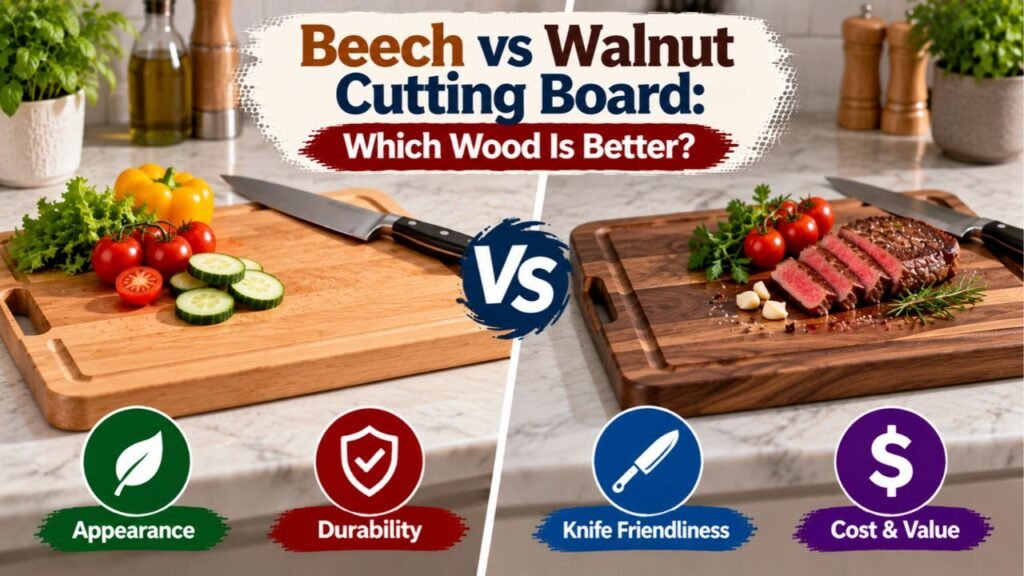
Beech and walnut are both hardwoods used in kitchen cutting boards, but they have different physical characteristics.
The comparison below uses American beech and American black walnut, two species relevant to the U.S. market.
| Feature | Beech Cutting Board | Walnut Cutting Board |
| Common wood species | American beech (Fagus grandifolia) | American black walnut (Juglans nigra) |
| Janka hardness | 1,300 lbf | 1,010 lbf |
| Surface hardness | Harder | Moderately hard |
| Knife friendliness | Good | Very good |
| Scratch resistance | Generally better | Shows physical scoring more readily |
| Dent resistance | Better | Lower |
| Moisture movement | Greater | Lower |
| Warping tendency | More sensitive to uneven moisture | Generally more stable |
| Grain structure | Fine, mostly diffuse-porous | Typically semi-ring-porous |
| Color | Pale cream to pinkish brown | Medium to dark chocolate brown |
| Visible stains | Usually more noticeable | Often less noticeable |
| Typical weight | Heavier at equal dimensions | Lighter at equal dimensions |
| Maintenance | Regular washing, drying, and oiling | Regular washing, drying, and oiling |
| Typical price | Usually lower | Usually higher |
| Best suited for | Budget-friendly daily chopping | Knife-friendly daily prep and attractive serving |
| Main disadvantage | Greater moisture movement | Higher cost and easier denting |
Overall recommendation: Walnut has a slight advantage for a premium everyday cutting board, while beech is a sensible choice for cooks who want a hard, functional surface without paying extra for dark hardwood.
What Are Beech and Walnut Cutting Boards?
Both materials come from deciduous hardwood trees. Their grain structure, density, and natural appearance influence the performance of a finished board.
What Is a Beech Cutting Board?
A beech cutting board is a food preparation board made from beech hardwood, generally American beech or European beech.
Beech has a pale cream color that may contain pink, tan, or light brown tones. Its grain is usually straight, with a fine to medium, uniform texture.
Two species commonly appear in woodworking:
- American beech (Fagus grandifolia): Approximately 1,300 lbf Janka hardness.
- European beech (Fagus sylvatica): Approximately 1,450 lbf Janka hardness.
European beech is harder than its American counterpart, so not every beech cutting board has exactly the same resistance to indentation.
Beech is used for butcher blocks, kitchen utensils, furniture, and other products that require a firm hardwood.
Its main advantages are hardness, an even grain, and a relatively accessible price. Its main limitation is a tendency to move as moisture conditions change.
What Is a Walnut Cutting Board?
A walnut cutting board is made from walnut hardwood, most commonly American black walnut in the United States.
American black walnut has a deep brown heartwood that may contain darker streaks, gray tones, or subtle purple coloring. The lighter sapwood can create contrast along the board’s edges or within individual strips.
At approximately 1,010 lbf Janka hardness, black walnut is softer than both American and European beech.
That moderate hardness makes walnut attractive for repeated slicing because the cutting surface has some give under a knife edge.
Walnut is also prized for its rich color and decorative grain. A finished board can function as both a regular cutting surface and an attractive serving board.
Its main disadvantages are a higher typical price and a greater tendency to develop dents under concentrated impact.
Key Takeaway: Beech is a harder, pale-colored hardwood, while walnut is softer, darker, and usually more expensive. Both are suitable for properly maintained wooden cutting boards.
Which Wood Is Better for Knife Sharpness?
Walnut generally has an advantage for knife friendliness because it is softer than beech.
Still, the wood’s Janka rating is only one part of how a cutting board interacts with a knife.
Beech Cutting Boards and Knife Wear
Beech provides a firm cutting surface that resists indentation during normal food preparation.
Its hardness supports repetitive chopping and slicing without allowing deep marks to form as readily as they might in a softer board.
American beech has a Janka hardness of approximately 1,300 lbf, while European beech reaches about 1,450 lbf.
That does not make beech excessively hard for kitchen knives. It is still more forgiving than glass, stone, ceramic, or metal cutting surfaces.
The main trade-off is that its relatively firm surface may provide less cushioning during repeated knife contact than black walnut.
A properly finished beech board remains a good option for ordinary chef’s knives, paring knives, and general kitchen slicing.
Walnut Cutting Boards and Knife Wear
Walnut’s lower hardness makes it appealing for protecting fine cutting edges.
When a knife contacts the board, the wood can yield slightly instead of presenting an extremely rigid surface.
This can reduce some of the stresses associated with repeated chopping.
Walnut is commonly selected for cutting boards used with high-quality kitchen knives, including thin Japanese-style blades.
That does not guarantee that a walnut board will extend sharpening intervals by a specific amount. Knife steel, edge geometry, cutting pressure, grain orientation, and the condition of the board also influence wear.
A smooth walnut board used with controlled cutting movements is generally a comfortable surface for daily preparation.
Does Harder Wood Always Dull Knives Faster?
No. Janka hardness measures resistance to indentation, not actual knife-edge wear.
The standard Janka test determines the force required to press a steel ball into the wood to a specified depth.
It does not measure how many cuts a kitchen knife can make before sharpening becomes necessary.
Factors such as abrasive mineral content, grain direction, surface contamination, and cutting technique also matter.
A carefully made beech board may offer a better cutting experience than a poorly finished walnut board with raised grain or damaged joints.
My preference is walnut for delicate slicing and repeated knife work, but I would not reject a good beech board based only on its higher hardness rating.
Key Takeaway: Walnut generally offers a softer cutting surface, while beech provides greater resistance to indentation. Both are knife-friendly compared with glass and metal.
Beech vs Walnut: Moisture Resistance and Warping
Moisture behavior is one of the most meaningful differences between these two hardwoods.
Both absorb and release moisture because wood is hygroscopic, meaning its moisture content changes in response to surrounding conditions.
Why Beech Is More Sensitive to Moisture
Beech undergoes relatively large dimensional changes as its moisture content changes.
The Wood Database reports the following total volumetric shrinkage values:
- American beech: 17.2%
- European beech: 17.9%
- American black walnut: 12.8%
These figures describe shrinkage from green wood to an oven-dry condition. They are not predictions of how much a finished kitchen board will shrink during a normal washing cycle.
Still, they provide useful evidence of the different movement characteristics of these species.
Beech can expand as it absorbs moisture and contract as it dries. If one face becomes wetter than the other, uneven movement may cause cupping or warping.
Repeated soaking, drying near strong heat, or leaving a wet board flat against the countertop increases that risk.
Why Walnut Is Generally More Dimensionally Stable
Black walnut typically experiences less dimensional movement than beech under comparable moisture changes.
The Wood Database lists a tangential-to-radial shrinkage ratio of approximately 1.4 for black walnut, compared with 2.2 for American beech.
This ratio describes the relationship between shrinkage in two different directions across the wood.
Lower and more balanced shrinkage can reduce the internal stresses that contribute to distortion.
Walnut’s relative stability is useful for larger cutting boards and boards assembled from multiple hardwood strips.
It does not make walnut waterproof.
A walnut board can still warp, crack, or experience glue-joint failure if repeatedly soaked or dried improperly.
Which Board Is Less Likely to Crack or Warp?
Walnut generally has the advantage when boards of comparable construction and quality receive similar care.
Beech can still perform well when the wood has been dried properly, the board is constructed carefully, and moisture exposure is controlled.
A thick, well-made beech board may remain flatter than a thin walnut board manufactured from poorly dried lumber.
Keep in Mind: Wood species is not the only cause of warping. Board thickness, grain orientation, glue quality, storage conditions, and uneven washing all affect stability.
Key Takeaway: Walnut generally handles moisture-related dimensional changes better than beech, but neither board should be soaked or left wet.
Which Cutting Board Is More Hygienic: Beech or Walnut?
Both beech and walnut can be used safely for food preparation when the boards are properly constructed, cleaned, and dried.
Neither wood species should be treated as self-sanitizing.
Beech and Walnut Grain Structure
Beech is generally classified as diffuse-porous, meaning the wood vessels are distributed relatively evenly through the growth rings.
This produces a uniform texture that is suitable for a smooth cutting surface.
American black walnut is generally described as semi-ring-porous, with some differences in vessel size across the growth rings.
Walnut has a somewhat different pore structure, but this does not automatically make it unsafe for cutting boards.
Both woods are widely used in household kitchen products.
Pore structure matters, but surface damage, cleaning habits, and drying conditions also affect hygiene.
A deep knife groove or separated joint can trap food debris in either material.
Are Both Woods Safe for Raw Meat?
Both may be used for raw meat preparation when they are food-contact suitable and properly cleaned afterward.
The USDA Food Safety and Inspection Service advises separating cutting boards used for raw meat, poultry, and seafood from those used for produce, bread, and other ready-to-eat foods.
This reduces the risk of cross-contamination.
The USDA also recommends washing cutting boards with hot, soapy water after use, rinsing them with clean water, and drying them thoroughly.
For sanitizing, the agency describes a solution of 1 tablespoon of unscented liquid chlorine bleach per gallon of water, followed by several minutes of contact, rinsing, and drying.
Follow the manufacturer’s instructions for the specific board and sanitizer.
I would prioritize a dedicated, easy-to-clean cutting board for raw poultry rather than assuming that either beech or walnut offers special protection against bacteria.
A board with deep, hard-to-clean grooves, persistent contamination, or separated joints should be replaced.
Key Takeaway: Both woods can be hygienic cutting surfaces. Proper cleaning, drying, and preventing cross-contamination matter more than small differences in pore structure.
Durability, Scratches, and Appearance: Which Wood Wins?
Beech and walnut age differently during ordinary cutting board use.
The differences are especially noticeable in knife marks, dents, stains, and the appearance of the finished surface.
Resistance to Knife Marks and Dents
Beech’s higher Janka hardness generally makes it more resistant to indentation.
That is useful during everyday tasks such as chopping vegetables and cutting firm ingredients.
Walnut can develop shallow marks more readily because its surface is softer.
The difference becomes more noticeable under concentrated pressure, such as cutting with a heavy knife or repeatedly striking the same area.
Still, the finished board’s grain orientation strongly influences how knife marks develop.
An end-grain walnut board may disguise some knife marks better than an edge-grain beech board despite the difference in wood hardness.
Avoid using either board as a surface for cutting through bones with force unless the board is specifically made for that work.
Stains and Visible Wear
Beech is pale, so strongly colored ingredients may leave noticeable marks.
Examples include:
- Beets
- Turmeric
- Berries
- Tomato-based ingredients
Walnut’s naturally dark color often makes discoloration less noticeable.
That does not mean walnut prevents staining. It simply provides a darker background that can conceal some marks.
The same principle applies to shallow knife scratches.
Light marks may blend into walnut’s grain pattern, while similar marks can be easier to see against pale beech.
For a cutting board that remains visible on the countertop, I prefer walnut’s darker appearance. Beech may be a better visual match for light cabinets and minimalist kitchens.
Weight and Handling
Beech is generally denser than American black walnut.
The Wood Database lists average dried weights of approximately:
| Wood | Average dried weight |
| American beech | 45 lb/cu ft |
| European beech | 44.3 lb/cu ft |
| American black walnut | 38 lb/cu ft |
At identical dimensions and moisture conditions, a beech board will generally be heavier.
Extra weight may reduce unwanted movement during cutting, although nonslip support remains important.
A lighter walnut board can be more convenient to carry to the sink or move around the countertop.
The difference in finished product weight also depends on thickness, handles, feet, and overall construction.
Key Takeaway: Beech resists dents better and is generally heavier. Walnut often conceals stains and light knife marks better because of its darker appearance.
End-Grain vs Edge-Grain Beech and Walnut Cutting Boards
Grain orientation can influence cutting board performance almost as much as the wood species.
Both beech and walnut are available in edge-grain and end-grain constructions.
Edge-Grain Beech vs Edge-Grain Walnut
An edge-grain cutting board exposes the long sides of wood fibers across the cutting surface.
It is commonly constructed by joining hardwood strips with food-contact-suitable adhesive.
Edge-grain boards are widely used because they can be relatively thin, easier to manufacture, and more affordable than thick end-grain butcher blocks.
Beech edge-grain boards offer a firm surface with good dent resistance. Walnut edge-grain boards feel somewhat softer and have a darker appearance.
Knife marks may remain visible because the blade cuts across exposed wood fibers.
For a straightforward kitchen board, both species work well in edge-grain construction.
The choice comes down to price, appearance, and your preference for a harder or softer cutting surface.
End-Grain Beech vs End-Grain Walnut
An end-grain cutting board exposes the ends of wood fibers on the working surface.
Many individual wood blocks are arranged with their grain facing upward, creating a checkerboard or patterned appearance.
During cutting, knife edges can move between wood fibers rather than repeatedly crossing their long sides.
That arrangement often makes end-grain boards feel gentler under a knife and may make shallow marks less noticeable.
End-grain beech provides a firm, wear-resistant chopping surface.
End-grain walnut offers a softer cutting feel and a distinctive dark pattern.
Both are suitable for everyday chopping when properly built.
End-grain boards often require more material, more joinery, and greater thickness, which can increase their price and weight.
Does Construction Matter More Than Wood Species?
In some situations, yes.
A carefully manufactured edge-grain beech board can be a better purchase than a poorly assembled end-grain walnut board.
The same applies in reverse.
Inspect the quality of the joints, wood preparation, flatness, and finishing rather than assuming every end-grain board is superior.
For most home cooks, a good edge-grain board is enough.
I would choose end grain when knife comfort, a substantial chopping surface, and appearance justify the added price and maintenance attention.
Key Takeaway: Edge-grain boards offer practical everyday value, while end-grain construction can improve cutting feel. Construction quality matters for both beech and walnut.
How to Maintain Beech and Walnut Cutting Boards
The basic cleaning routine is almost identical for both woods.
Beech deserves extra attention to moisture control because of its greater tendency to expand and contract.
Cleaning Beech and Walnut After Use
Wash both materials by hand after food preparation.
- Remove food scraps from the cutting surface.
- Wash the board with warm or hot water and mild dish soap.
- Gently scrub the cutting surface, edges, and juice groove.
- Rinse thoroughly with clean water.
- Dry both sides with a clean towel.
- Allow the board to air-dry with adequate circulation before storing it.
Avoid leaving either board submerged in the sink.
Most laminated wooden cutting boards should not be placed in a dishwasher because heat and repeated water exposure can damage the wood and glued joints.
Although some solid hardwood products may tolerate machine washing, follow the specific manufacturer’s instructions.
Tip: After washing, stand a suitable board on its edge or place it where both faces can dry evenly. Avoid leaving one side pressed against a wet countertop.
Oiling and Conditioning
Both beech and walnut benefit from periodic treatment with a cutting board oil or conditioner recommended by the manufacturer.
Food-grade mineral oil is a common option.
It enters exposed wood grain and helps slow moisture absorption. A food-contact-safe beeswax and mineral oil conditioner can provide a thin water-resistant surface layer.
John Boos recommends oiling its wooden cutting boards at least monthly, adjusting for use and household conditions.
That is a useful starting point for inspection rather than a fixed requirement for every beech or walnut board.
To condition either board:
- Clean the board and allow it to dry fully.
- Apply a thin, even coating of food-grade mineral oil.
- Cover the cutting face, underside, and edges.
- Allow the oil to absorb for the time specified by the manufacturer.
- Wipe away excess oil.
- Add a thin board-safe wax conditioner if desired, then buff.
Avoid ordinary cooking oils such as olive or vegetable oil for routine conditioning because they can oxidize and develop unpleasant odors over time.
Preventing Warping and Cracks
The same habits protect both species, but they are especially useful for beech.
Do not leave the board beside a hot stove, heating vent, or other strong heat source.
Avoid soaking it, and never leave a freshly washed board standing in pooled water.
Inspect the surface regularly for raised grain, loose joints, or developing cracks.
A slightly rough surface may sometimes be restored with careful sanding and reconditioning if the manufacturer permits it.
Severe splitting, mold that cannot be safely removed, or deep contaminated gaps may require replacement.
Do not assume that extra mineral oil will repair damaged glue joints or straighten a warped board.
Key Takeaway: Clean, dry, and condition both woods regularly. Beech needs careful moisture management, while walnut still requires routine protection despite its better dimensional stability.
Beech vs Walnut Cutting Board: Price and Overall Value
Beech is usually the more economical choice, while black walnut is commonly sold as a premium hardwood.
The actual difference varies with board size, thickness, grain orientation, manufacturing quality, and where the wood was sourced.
Is Beech a Better Budget Choice?
Beech offers strong practical value because it provides substantial hardness and a smooth cutting surface without the typical price premium associated with dark walnut.
A simple edge-grain beech board is often enough for vegetables, fruit, bread, and regular meal preparation.
Its light color may require more attention to visible stains, and careful drying is important.
Still, the material is well suited to a kitchen where practicality matters more than decorative grain.
A quality beech board is often a smarter purchase than a similarly priced walnut board with poor construction.
Is Walnut Worth Paying More For?
Walnut’s price premium usually reflects the value of the timber, its appearance, and manufacturing costs.
Its rich brown color makes it attractive for people who leave a board on display or use it for serving cheese and appetizers.
The lower hardness may also appeal to cooks who frequently use fine-edged knives.
Its generally better dimensional stability is another useful characteristic, although a walnut board still needs the same basic care as beech.
For someone who uses a wooden board daily and appreciates the dark appearance, the additional cost may be reasonable.
I would not pay substantially more for walnut solely because a seller claims it is antibacterial, maintenance-free, or completely resistant to warping.
Those claims do not reflect how ordinary wooden cutting boards behave.
Key Takeaway: Beech usually provides better value for a limited budget, while walnut may justify its higher price through appearance, knife comfort, and relative dimensional stability.
Which Cutting Board Should You Choose for Your Kitchen?
The most practical way to decide is to match each material’s strengths to the work you actually do.
| Kitchen requirement | Better choice | Reason |
| Everyday vegetable chopping | Either | Both provide suitable hardwood cutting surfaces |
| Frequent use of fine-edged knives | Walnut | Softer cutting surface |
| Budget-friendly wooden board | Beech | Usually costs less |
| Greater resistance to dents | Beech | Higher Janka hardness |
| Reduced moisture-related movement | Walnut | Better dimensional stability |
| Light-colored kitchen appearance | Beech | Pale, uniform wood |
| Decorative serving board | Walnut | Dark grain and rich color |
| Easier lifting at equal dimensions | Walnut | Generally lower density |
| Heavy, stable countertop board | Beech | Greater density may add weight |
| Less noticeable food staining | Walnut | Darker color conceals some marks |
For a home kitchen that involves regular meal preparation, both woods can deliver years of service when properly maintained. There is no need to reject beech simply because walnut is more expensive.
If your main concern is knife comfort, walnut has a reasonable advantage. If resistance to shallow dents and purchase cost matter more, beech is attractive.
The final decision should also reflect construction quality. A flat, smooth, well-joined board with adequate thickness and stable support is more useful than a premium species label on a poorly made product.
Common Buying Mistakes With Beech and Walnut Boards
Several details are easy to overlook when comparing two hardwood boards online.
Assuming all beech is identical: American beech and European beech have different published Janka ratings. Look for the species name when comparing specifications.
Treating all walnut as black walnut: Other walnut species may differ in appearance and hardness. Confirm the material rather than relying on a generic product description.
Comparing different constructions by wood species alone: A thick end-grain walnut board and a thin edge-grain beech board are not equivalent products. Board construction affects price, weight, and cutting feel.
Ignoring glue joints and finish quality: Select a board made for direct food contact, with smoothly finished edges and no visible gaps or loose joints.
Choosing a board that is too small: A cramped cutting surface makes chopping less comfortable. For general home preparation, a board around 12 × 18 inches is a useful size to consider if counter and storage space allow it.
Assuming oil makes wood waterproof: Conditioning reduces some moisture absorption but does not prevent damage from soaking or dishwasher exposure.
I would check the manufacturer, wood species, construction, thickness, and care instructions before focusing on decorative features.
Conclusion
In the beech vs walnut cutting board comparison, beech is the harder and usually more economical material, while walnut offers a softer cutting surface and generally better dimensional stability. Both are reasonable choices for kitchen use, and neither is automatically superior in every situation.
Beech makes sense for everyday chopping, resistance to shallow dents, and a limited budget. Walnut is attractive for frequent knife work, a dark natural finish, and use as both a cutting and serving board. Grain orientation, board thickness, and manufacturing quality can be just as meaningful as the wood species.
My recommendation is walnut if the price difference is acceptable and knife comfort matters most. For a dependable everyday board at a more accessible price, I would choose a well-made beech board without hesitation.
Whichever wood you select, clean it after use, dry it thoroughly, condition it when needed, and replace it if damage prevents safe cleaning.
FAQs About Beech and Walnut Cutting Boards
Is Beech or Walnut Better for Cutting Boards?
Walnut is generally better for knife comfort and dimensional stability, while beech offers greater hardness and often costs less. Both are suitable for everyday cutting boards when properly finished and maintained. Walnut is a good choice for someone who values a softer cutting feel and dark appearance. Beech is a practical alternative for cooks who want a firm hardwood board at a lower price.
Is Beech Wood Harder Than Walnut?
Yes. American beech measures approximately 1,300 lbf on the Janka hardness scale, compared with 1,010 lbf for American black walnut. European beech is harder still, at approximately 1,450 lbf. These values indicate that beech generally resists indentation better. Hardness does not directly measure knife friendliness, wood stability, or how long a finished cutting board will last.
Does a Walnut Cutting Board Dull Knives?
Walnut is generally considered knife-friendly because it is moderately hard and provides some cushioning during cutting. It is softer than beech and hard maple, making it attractive for frequent kitchen knife use. Knife edges still wear down through normal chopping, and the rate depends on blade steel, cutting technique, grain orientation, and surface condition. Walnut will not prevent the need for sharpening.
Does Beech Warp More Easily Than Walnut?
Beech generally experiences greater dimensional changes as its moisture content changes. Published shrinkage data show higher total volumetric shrinkage for American and European beech than for American black walnut. This makes beech more sensitive to certain moisture-related problems. A properly made and carefully maintained beech board can still remain flat for years. Neither wood should be soaked, exposed to excessive heat, or left wet.
Are Beech and Walnut Cutting Boards Safe for Food?
Both are commonly used for wooden cutting boards and can be suitable for direct food preparation when made and finished appropriately. The board must be cleaned after use and kept free of deep grooves, cracks, and contaminated joints. Use separate preparation surfaces for raw meat and ready-to-eat foods to reduce cross-contamination. Neither beech nor walnut should be treated as naturally self-sanitizing.
Can Someone With a Walnut Allergy Use a Walnut Cutting Board?
Walnut wood and edible walnut nuts are different materials, so a walnut cutting board does not automatically present the same exposure as eating walnuts. Still, severe allergies require individual caution, and some board finishes may contain nut-derived oils. If you have a serious tree-nut allergy, check the board’s materials and finish with the manufacturer and seek guidance from your allergist. Choosing beech can avoid uncertainty about walnut wood.
Which Cutting Board Lasts Longer, Beech or Walnut?
There is no fixed lifespan advantage that applies to every board. Walnut’s generally lower moisture movement can reduce some risks of warping, while beech’s higher hardness provides better resistance to indentation. Construction quality, washing habits, humidity, and maintenance strongly influence service life. A well-made board of either species can last many years, while a poorly maintained board can deteriorate much sooner.
How Often Should I Oil a Beech or Walnut Cutting Board?
Inspect either board about once a month as a starting point, then adjust according to use, washing frequency, and the manufacturer’s instructions. Apply food-grade mineral oil when the wood appears dry, pale, or unevenly conditioned. Treat the cutting face, underside, and edges, and wipe away excess oil. A thin, food-contact-safe wax conditioner is optional for additional surface water resistance. Avoid over-oiling or applying conditioner to a damp board.