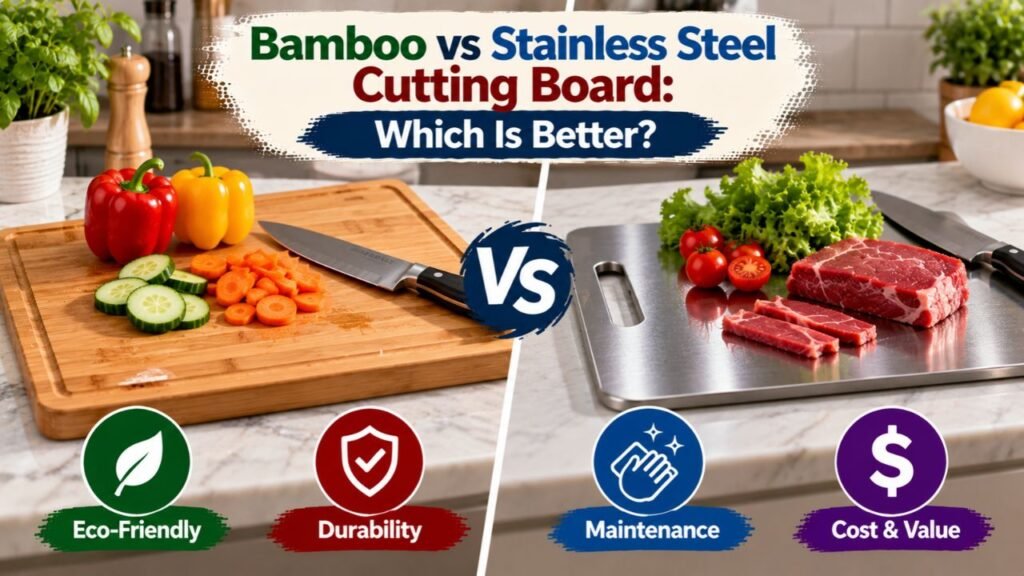
Bamboo vs Stainless Steel Cutting Board: Which Is Better?
Bamboo cutting boards are generally better for everyday chopping because they are quieter, more comfortable to use, and gentler on knife edges than stainless steel. Stainless steel cutting boards are easier to clean, resist moisture and odors, and require little maintenance. For frequent knife work, bamboo is usually the more practical choice, while stainless steel favors simple cleanup.
Choosing the wrong cutting surface can mean sharpening your kitchen knives more frequently, struggling with a slippery board, or dealing with cracks and moisture damage. These problems are easy to overlook when comparing two boards that both appear durable and food-safe.
The material beneath your knife determines how the blade responds to repeated contact. It also influences how quickly you can wash the board, how securely it stays on the counter, and how much maintenance it needs.
The U.S. Department of Agriculture’s Food Safety and Inspection Service states that bamboo absorbs very little moisture and is harder and less porous than hardwoods. Its cutting-board guidance, updated in August 2024, also recommends washing boards with hot, soapy water after use, regardless of claims about natural resistance to bacteria.
What stood out to me during the research was the difference between easy cleaning and comfortable cutting. Stainless steel has an advantage in moisture resistance, but that does not automatically make it the better surface for a sharp chef’s knife.
In a bamboo vs stainless steel cutting board comparison, knife-edge protection deserves just as much attention as hygiene. A board that cleans quickly may still be unpleasant for someone who chops vegetables several times a day.
The differences below cover materials, knife wear, bacterial contamination, cleaning, durability, comfort, cost, and practical food preparation. These details will clarify which surface makes more sense for your kitchen and when neither material is the strongest option.
Bamboo vs Stainless Steel Cutting Board: Quick Comparison
Both materials serve the same basic purpose, but their construction creates noticeable differences in daily use.
| Feature | Bamboo Cutting Board | Stainless Steel Cutting Board |
| Material | Compressed or laminated bamboo strips | Stainless steel alloy |
| Surface | Firm, fibrous, slightly forgiving | Rigid, smooth metal |
| Knife friendliness | Better than stainless steel | Harder on knife edges |
| Food safety | Safe with proper cleaning | Safe when made from suitable food-contact steel |
| Water absorption | Low, but not zero | Nonporous metal does not absorb water |
| Cleaning | Usually hand-washing | Generally easy to wash |
| Dishwasher | Usually not recommended | Often suitable if the manufacturer approves |
| Maintenance | Dry thoroughly; oil when recommended | Wash and dry; no oiling required |
| Stain resistance | Can develop stains | Generally resists food stains |
| Odor retention | Some odors may remain | Resists odor absorption |
| Cutting noise | Relatively quiet | Louder metal contact |
| Durability | Can crack, warp, or separate | Resists cracking but can scratch or dent |
| Appearance | Warm, natural finish | Smooth, industrial appearance |
| Best use | Daily vegetable and fruit preparation | Food handling where quick cleanup is a priority |
My preference: Bamboo is the stronger choice between these two for a primary cutting surface. Stainless steel is worth considering when nonporous construction and easy washing matter more than maintaining a sharp knife edge.
What Are Bamboo and Stainless Steel Cutting Boards Made Of?
The construction of each board explains much of its behavior during food preparation.
Bamboo Cutting Board Construction
A bamboo cutting board is a food-preparation surface made from processed bamboo, a fast-growing grass rather than a hardwood tree.
Most bamboo cutting boards are manufactured by cutting bamboo into strips, drying the material, and bonding the strips together with adhesive. The finished board is sanded smooth and may receive a food-safe oil or other finish.
Bamboo has a dense fiber structure and is generally harder than many common cutting-board hardwoods. This produces a firm working surface that resists some shallow knife marks.
Still, bamboo is not completely resistant to moisture. Water can affect the natural fibers and adhesive joints, especially when a board remains wet for extended periods.
A quality bamboo board should have:
- Smooth, firmly bonded bamboo strips
- Food-contact-safe adhesives and finishes
- No visible gaps, splinters, or cracks
- A flat surface that rests securely on the counter
The main attraction is a natural-looking board that handles everyday slicing and chopping without the harsh contact associated with metal.
Stainless Steel Cutting Board Construction
A stainless steel cutting board is a food-preparation surface made from a corrosion-resistant metal alloy containing iron, chromium, and sometimes nickel or other elements.
Unlike bamboo, stainless steel does not contain natural fibers or glued wood joints. A solid stainless surface does not absorb water or food juices into its material.
Some boards are made from a single sheet of stainless steel. Others combine metal with plastic, silicone, or other materials to create reversible surfaces or non-slip supports.
Manufacturers commonly advertise 304 stainless steel for kitchen equipment. Grade 316 also appears in food-processing applications and offers greater corrosion resistance in some conditions.
The grade alone does not certify the safety or quality of a finished cutting board. Surface finishing, manufacturing quality, and suitability for food contact also matter.
Stainless steel is used widely in commercial kitchen equipment because it is durable and straightforward to clean. That advantage does not necessarily extend to repeated knife contact.
Key Takeaway: Bamboo provides a dense, natural cutting surface, while stainless steel provides a rigid, nonporous surface. Their construction determines the trade-offs in knife care and cleaning.
Which Cutting Board Is Better for Your Knives?
Bamboo is generally better for knife-edge retention than stainless steel, although neither is as forgiving as some softer cutting-board materials.
How Bamboo Affects Knife Sharpness
Bamboo is relatively hard compared with several traditional cutting-board woods. Its fibers contain silica, a naturally occurring mineral that contributes to its abrasive properties.
Repeated cutting on bamboo can gradually wear down a knife edge. The amount of wear depends on the board’s construction, the knife’s steel, the blade geometry, and how forcefully the knife contacts the surface.
Even with these limitations, bamboo provides more give than a rigid metal board.
For ordinary slicing, dicing, and chopping, bamboo is generally a more comfortable surface for a chef’s knife than stainless steel.
Bamboo is not the most knife-friendly material available. Softer hardwoods, suitable rubber boards, and some food-safe plastics may provide gentler contact.
How Stainless Steel Affects Knife Sharpness
Stainless steel cutting boards are much less forgiving during repeated knife strikes.
A kitchen knife has a very thin cutting edge. When that edge repeatedly contacts a rigid steel surface, the force may cause microscopic bending, rolling, or other edge damage.
The board material does not have to be harder than the knife steel for this to happen. The lack of cushioning and repeated impact are enough to create additional wear.
Thin, finely sharpened blades may be more vulnerable than thicker, sturdier knives.
Common consequences of frequent chopping on stainless steel include:
- Faster loss of the knife’s fine cutting edge
- More frequent honing or sharpening
- A louder impact during chopping
- Less comfortable contact during repeated cutting
A few cuts on stainless steel will not automatically ruin a quality kitchen knife. The concern is repeated use over time.
Which Material Works Better With Japanese Knives?
I would avoid stainless steel cutting boards for regular use with thin Japanese kitchen knives.
Many Japanese-style knives have fine cutting edges and relatively hard blade steel. Such edges can provide excellent cutting precision but may be less tolerant of impact against an unforgiving surface.
Bamboo is the better of these two options, but a suitable hardwood or rubber cutting board is often preferable for delicate knife edges.
For expensive chef’s knives, preserving the edge can be more important than saving a little time during cleanup.
Key Takeaway: Bamboo wins for knife protection between these two materials. Stainless steel may be convenient to clean, but repeated metal contact creates unnecessary wear on sharp blades.
Bamboo vs Stainless Steel Cutting Board for Food Safety
Both materials can be safe for food preparation when manufactured for food contact, properly cleaned, and maintained.
The difference is that stainless steel is nonporous, while bamboo contains natural fibers and bonded joints.
Bacterial Growth and Surface Porosity
Stainless steel is nonporous, meaning the solid metal surface does not absorb liquids into a network of natural pores.
This property makes food residue easier to remove from a smooth, undamaged surface. It also reduces the possibility of liquids entering the board material.
Stainless steel is not automatically antibacterial. Harmful microorganisms can survive on contaminated metal surfaces, and bacteria may remain in food residue or poorly cleaned scratches.
Bamboo is less porous than many hardwoods and absorbs relatively little water, according to the USDA.
Still, bamboo is not sterile or self-cleaning. Food particles, moisture, and bacteria can remain on the surface if it is not washed properly.
Claims that bamboo naturally kills all harmful bacteria should not replace ordinary food-safety practices.
Which Is Better for Raw Meat and Chicken?
Stainless steel offers a cleaning advantage for raw meat, poultry, and seafood because its smooth, nonporous surface is straightforward to wash.
Raw animal foods may contain harmful microorganisms, including Salmonella and Campylobacter.
The U.S. Food and Drug Administration recommends using separate cutting boards for raw meat, poultry, and seafood and for fresh produce.
A stainless steel board can serve as a dedicated raw-meat preparation surface if it is food-contact-safe, stable, and properly cleaned after use.
Bamboo can also be used for raw meat when the board is in sound condition and thoroughly washed afterward. Its natural construction simply requires greater attention to drying and damage.
For someone who frequently prepares raw chicken, I would also consider a dishwasher-safe plastic board. It offers convenient cleaning without the same hard metal contact against the knife.
Is Stainless Steel Automatically More Hygienic?
No. Nonporous construction makes cleaning simpler, but it does not guarantee that the surface is free of bacteria.
A stainless steel board used for raw chicken can contaminate vegetables if it is reused without washing.
Similarly, a properly maintained bamboo board may be suitable for preparing fruits, vegetables, bread, and other foods.
The most important hygiene habits are washing, separating raw and ready-to-eat ingredients, and inspecting boards for damage.
Safety Tip: Never place cooked food onto an unwashed board that previously held raw meat or poultry, regardless of the board material.
Key Takeaway: Stainless steel has the advantage in surface cleanability, but neither material prevents cross-contamination without proper washing and separation of foods.
Which Cutting Board Is Easier to Clean and Maintain?
Stainless steel generally requires less routine maintenance than bamboo. Bamboo needs more careful drying and occasional conditioning.
How to Clean a Bamboo Cutting Board
Bamboo boards are usually best washed by hand.
A suitable cleaning routine is:
- Remove food scraps immediately after preparation.
- Wash the surface with hot water and mild dish soap.
- Use a soft sponge or brush to clean the surface and grooves.
- Rinse with clean water.
- Dry with a clean towel and allow remaining moisture to evaporate.
Do not leave bamboo submerged in water. Long soaking can cause swelling, splitting, warping, or failure of the adhesive joints.
Most manufacturers also recommend avoiding dishwashers because extended exposure to heat and water can damage bamboo construction.
Some bamboo boards benefit from occasional treatment with food-grade mineral oil or a manufacturer-approved board conditioner.
Conditioning frequency depends on the finish, use, and appearance of the board. A dry or rough surface may indicate that conditioning is due.
How to Clean a Stainless Steel Cutting Board
Stainless steel usually requires a simpler process.
- Remove food scraps and rinse away loose residue.
- Wash the surface with warm or hot, soapy water.
- Clean any grooves, corners, and attached supports.
- Rinse thoroughly.
- Dry with a clean towel or allow the board to air-dry.
Many stainless steel boards are dishwasher-safe, but the manufacturer’s directions should confirm this.
Some products contain silicone feet, adhesive-backed components, or plastic sections that affect dishwasher compatibility.
Stainless steel does not need mineral oil or wax. Drying helps prevent mineral water spots and keeps the surface ready for storage.
Avoid prolonged contact with concentrated chlorine bleach and harsh chloride-containing cleaners, which can damage stainless steel under some conditions.
Do not use steel wool or sharp metal scrapers that may leave scratches or contamination on the surface.
Sanitizing Bamboo and Stainless Steel Boards
Cleaning and sanitizing are different actions.
Cleaning removes food particles, grease, and other residue. Sanitizing reduces microorganisms remaining on a cleaned surface.
The USDA provides a sanitizing mixture for wooden and plastic cutting boards:
1 tablespoon of unscented liquid chlorine bleach mixed with 1 gallon of water.
The USDA recommends applying the solution to the cleaned board, letting it stand for several minutes, rinsing with clear water, and drying.
For bamboo, follow the board manufacturer’s guidance along with suitable food-contact sanitizing instructions.
For stainless steel, use a sanitizer specifically approved for stainless steel food-contact surfaces, following its concentration and contact-time directions. Do not assume that prolonged bleach exposure is safe for metal.
Key Takeaway: Stainless steel wins for low-maintenance cleaning. Bamboo requires hand-washing, thorough drying, and occasional surface care to protect its construction.
Durability and Lifespan: Which Material Lasts Longer?
Stainless steel generally has an advantage in resistance to moisture-related damage, but durability depends on the product’s construction and treatment.
Bamboo Durability and Common Damage
Bamboo is a strong material that can withstand regular food preparation.
A properly manufactured bamboo board may remain useful for years when it is washed promptly, dried completely, and stored correctly.
Its main weaknesses come from prolonged moisture exposure and physical damage.
Common problems include:
- Cracks between bamboo strips
- Warping caused by uneven moisture exposure
- Rough or raised fibers
- Splintering around damaged edges
- Separation of bonded joints
A board that develops deep cracks or loose sections may become difficult to clean safely.
Bamboo should be replaced when structural damage interferes with cleaning or creates splinters.
Stainless Steel Durability and Surface Wear
Stainless steel does not swell like bamboo and has no natural fibers to split.
It resists moisture, many household food stains, and ordinary kitchen cleaning conditions.
Still, stainless steel is not scratch-proof or rust-proof.
Repeated knife contact can create visible surface marks. Thin metal boards may bend or dent if subjected to excessive force.
Poor-quality steel, damaged finishes, or extended contact with certain chemicals can contribute to corrosion.
A stainless board should be replaced or repaired when it develops sharp burrs, serious corrosion, or damage that prevents safe cleaning.
Fine cosmetic marks alone do not always make the board unusable.
Which Board Offers Better Long-Term Value?
Long-term value involves more than the initial purchase price.
A bamboo board may cost less than a similarly sized stainless steel model, although prices vary with thickness, construction, brand, and finish.
Stainless steel may last longer structurally under wet kitchen conditions. Yet frequent use can increase knife-maintenance demands.
A lower purchase price is not much of an advantage if the board is uncomfortable for daily prep. Similarly, a longer-lasting metal board is not necessarily a better purchase when the user prefers a quieter, more forgiving cutting surface.
Key Takeaway: Stainless steel resists moisture-related damage better, while bamboo can provide years of practical use with proper maintenance. Consider knife wear alongside board longevity.
Cutting Comfort, Noise, and Countertop Stability
Daily comfort is easy to overlook when choosing a cutting board online.
A surface that feels awkward during repeated chopping may become frustrating even if it is easy to clean.
Cutting Feel and Noise
Bamboo provides a firm surface with some natural give beneath the knife.
It generally produces a softer chopping sound than stainless steel.
Stainless steel creates a noticeable metallic sound during repeated knife contact. Chopping herbs, onions, and firm vegetables may feel harsher because the metal surface does not cushion the blade.
For a household that prepares several meals a day, this difference can matter more than the appearance of the board.
I would give bamboo the advantage for comfortable, repeated food preparation.
Slipping and Movement
Both boards may slide on a smooth countertop if they lack a secure base.
Some stainless steel boards have polished surfaces and thin constructions that make movement more noticeable.
A board that shifts during cutting reduces control and increases the chance of the knife moving unexpectedly.
Look for non-slip feet or a suitable mat beneath the board.
Bamboo boards can also slide, especially lightweight models without rubber supports.
The board should remain stable during normal knife movements without requiring constant repositioning.
Weight and Storage
Weight varies by size, thickness, and construction.
A large bamboo board may be fairly heavy, while a thin stainless steel sheet can be relatively light. A thicker metal board may weigh considerably more.
Thin stainless steel models can be convenient for vertical storage, provided their edges are smooth and safe to handle.
Bamboo boards often have thicker profiles, making some models less convenient in narrow storage spaces.
Check the actual dimensions and weight rather than assuming one material is always lighter.
Key Takeaway: Bamboo generally offers quieter, more comfortable chopping. Stability depends on the specific board’s weight, feet, and countertop contact.
Environmental Impact and Material Sustainability
Bamboo and stainless steel have different environmental advantages, but neither is automatically the more sustainable choice.
Bamboo as a Renewable Material
Bamboo grows quickly compared with many timber species and can be harvested without replanting the entire root system under suitable growing conditions.
This makes it an appealing renewable raw material.
The finished board still requires processing, adhesives, manufacturing energy, packaging, and transportation.
A bamboo board that cracks prematurely and needs replacement may create more waste than one that remains in service for years.
Responsible sourcing and durable construction matter as much as the plant’s growth rate.
Stainless Steel and Recyclability
Stainless steel is recyclable, and recovered metal can be used in new products.
A board that stays in service for many years may reduce replacement frequency.
Producing stainless steel requires mining, processing, and energy-intensive manufacturing. These impacts cannot be judged from recyclability alone.
For both materials, buying a durable product and maintaining it properly is a sensible way to avoid unnecessary replacements.
Key Takeaway: Bamboo offers a rapidly renewable raw material, while stainless steel offers recyclability and resistance to moisture damage. Product lifespan and manufacturing quality influence the environmental picture.
Which Cutting Board Is Better for Different Kitchen Tasks?
The best choice changes with the food being prepared and the amount of cutting involved.
For Vegetables, Fruits, and Everyday Cooking
Winner: Bamboo
Bamboo is the stronger option for frequent chopping, slicing, and dicing.
It provides a practical working surface for onions, tomatoes, carrots, fruit, and other everyday ingredients.
Compared with stainless steel, it is generally more comfortable under a chef’s knife and produces less noise.
For someone preparing vegetables daily, these advantages are difficult to ignore.
For Raw Meat and Seafood Preparation
Winner: Stainless steel for ease of cleanup
Stainless steel is convenient when preparing raw chicken, fish, or meat because it has a nonporous surface.
Food juices can be washed away without absorbing into the metal.
The disadvantage remains knife contact. If significant cutting is involved, a suitable dishwasher-safe plastic board may offer a better balance between cleanup and knife care.
Use a separate board for produce and ready-to-eat foods.
For Bread, Cheese, and Serving
Winner: Bamboo
Bamboo offers a more traditional appearance for serving bread, cheese, fruits, and snacks.
It also avoids the metallic contact of stainless steel when slicing food.
Stainless steel can serve food if it is designed for food contact and has safe, finished edges. Bamboo is generally more appealing for presentation and quieter for slicing.
For Minimal Maintenance
Winner: Stainless steel
Stainless steel is preferable for someone who wants a board that does not require oiling or conditioning.
Its nonporous construction makes routine washing straightforward.
The trade-off is accepting a rigid cutting surface that is less suitable for preserving knife sharpness.
Key Takeaway: Bamboo is the better everyday cutting surface, while stainless steel is more attractive for tasks that prioritize quick cleanup and moisture resistance.
What to Check Before Buying Either Cutting Board
A good purchase involves checking the specifications of the actual product rather than relying on broad claims about bamboo or metal.
For bamboo boards, examine the construction, surface finish, thickness, and care directions. Look for information about food-contact-safe adhesives and coatings.
Boards with uneven joints, splinters, visible gaps, or an unknown finish deserve caution.
For stainless steel boards, check the stated alloy grade and the manufacturer’s information about food-contact suitability.
304 stainless steel is commonly used in food equipment, but the label alone does not prove that every part of the finished board is suitable for food contact.
Also examine the edge finishing, thickness, underside, and any attached rubber or plastic components.
A board made from metal on one side and plastic on the other should not be treated as a solid stainless steel board. The two surfaces may have different care instructions.
I recommend checking four practical details before purchasing: enough working space, a stable base, a surface suitable for the knives you own, and cleaning instructions that fit your routine.
For most American home kitchens, a board around 12 by 18 inches can provide comfortable working room if the sink and countertop are large enough. Smaller kitchens may benefit from a more compact board.
Avoid purchasing solely because a board is advertised as antibacterial, non-toxic, or maintenance-free. Those claims should be supported by specific materials, construction details, and appropriate product information.
Conclusion
The bamboo vs stainless steel cutting board comparison favors bamboo for most everyday cutting tasks. Bamboo offers a quieter surface with more give beneath the knife, making it better suited to repeated chopping and slicing. Stainless steel offers nonporous construction and straightforward cleaning but is harder on knife edges.
Bamboo needs hand-washing, thorough drying, and occasional conditioning. Stainless steel requires less surface maintenance, although it still needs washing and inspection for damage. Neither material eliminates the need to prevent cross-contamination.
My recommendation is to choose bamboo if you want one of these two materials for regular vegetable preparation and general cooking. Choose stainless steel if easy cleanup is your main priority and you are comfortable with its disadvantages for knife care. For a kitchen that handles raw meat frequently, a separate dishwasher-safe plastic board is also worth considering.
FAQs About Bamboo and Stainless Steel Cutting Boards
Is bamboo better than stainless steel for a cutting board?
Bamboo is generally better for everyday chopping because its surface is more forgiving on knives and less noisy than stainless steel.
Stainless steel has an advantage in cleaning and moisture resistance. It does not absorb food juices into the metal and needs no oiling. Bamboo is the more practical choice for frequent knife work, while stainless steel suits users who prioritize nonporous construction.
Are stainless steel cutting boards safe for knives?
Stainless steel cutting boards can accelerate knife-edge wear because the rigid metal surface does not cushion repeated cutting impacts.
The knife edge may gradually roll, deform, or lose sharpness faster than it would on bamboo, suitable plastic, or softer hardwood.
Occasional contact does not mean immediate blade damage. Frequent chopping on stainless steel is less desirable, especially with thin or finely sharpened knives.
Are bamboo cutting boards sanitary?
Bamboo cutting boards can be sanitary when properly washed, dried, and maintained.
Bamboo absorbs relatively little moisture compared with many hardwoods, but that does not make it sterile or eliminate bacterial contamination.
Wash bamboo with hot, soapy water after use. Inspect the surface for cracks and damaged joints, and separate raw animal foods from ingredients that will be eaten without cooking.
Can stainless steel cutting boards go in the dishwasher?
Many stainless steel cutting boards are dishwasher-safe, but product instructions should confirm this.
Some boards include plastic layers, silicone supports, or adhesive-backed components that may not tolerate dishwasher conditions.
Check the manufacturer’s care guidance before machine washing. Even dishwasher-safe metal boards should be inspected for corrosion, sharp edges, and damage.
Do bamboo cutting boards dull knives?
Yes. Bamboo can gradually dull kitchen knives because it is relatively hard and contains naturally occurring silica.
The amount of wear varies with the board’s construction and the knife’s edge.
Bamboo is generally less punishing than stainless steel, but softer hardwoods and some rubber or plastic cutting surfaces may be gentler on knife edges during frequent cutting.
Is stainless steel more hygienic than bamboo?
Stainless steel is generally easier to clean because its solid surface is nonporous and does not absorb food juices.
That does not mean it is always free of harmful microorganisms. Bacteria can remain on any dirty cutting board, including stainless steel.
Proper washing, sanitizing when appropriate, and keeping raw meat separate from ready-to-eat food matter more than the material alone.
Do stainless steel cutting boards rust or scratch?
Stainless steel cutting boards can develop scratches during normal knife use. Some may also develop corrosion if the material quality is poor or the surface is exposed to damaging chemicals.
Stainless steel is corrosion-resistant rather than completely immune to rust.
Wash the board after use, dry it properly, and avoid prolonged exposure to harsh chloride-containing cleaning products. Replace or repair boards with serious corrosion or sharp damaged areas.
Which cutting board lasts longer, bamboo or stainless steel?
Stainless steel generally has an advantage in structural durability because it does not absorb moisture, swell, or develop natural-fiber cracks.
Bamboo can also last for years with proper care, but prolonged moisture exposure may lead to warping, splitting, or separation of glued strips.
Neither has a guaranteed lifespan. Construction quality, cleaning habits, storage conditions, and physical damage determine how long the board remains suitable for food preparation.